Specs are compiled from manufacturer listings and verified buyer reviews and can change over time — please confirm the key details on the product page before buying.
If your stir-fry keeps coming out steamed instead of seared, the problem is almost never your technique — it is that a normal kitchen range cannot push enough heat into a carbon steel wok. A wok jet burner fixes that with a ring of small high-pressure jets that throw flame up the curved sides of the pan, which is exactly what restaurant kitchens do. Below you will find the six picks that actually deliver that heat, sorted by what each one is genuinely good at.
This guide is built by comparing the manufacturers’ published specifications and the patterns across verified customer reviews, so you get each pick’s real strengths and trade-offs instead of marketing spin.
You will see which burners run on propane and which need a natural gas line, how jet count changes the flame shape, and where a cheap unit cuts corners. Read on for the straight answer on the best wok jet burner for your setup.
Top Picks


How To Choose The Best Wok Jet Burner
The big number printed on the box is heat output in BTU, or British thermal units — a measure of how much energy the flame puts out. It sounds like the only thing that matters. It is not.
Jet count and jet hole size shape the flame
A jet burner head is a cast iron ring drilled with small brass-tipped holes, and each hole is one jet. More jets and larger gas holes give you a wider, taller flame that climbs the sloped sides of a wok instead of pooling in the center.
A 32-tip head with 0.9mm gas holes spreads the flame around the pan. A 23-tip head is a little more concentrated. Neither is better in the abstract; they suit different pan sizes and cooking styles.
Propane or natural gas — pick your fuel first
Propane burners run off a tank and go anywhere. Natural gas burners thread onto a fixed supply line and never run dry. These two are not swappable, and a jet burner built for one fuel will not run correctly on the other. Decide where the burner will live before you shop.
Regulator, hose and windscreen matter as much as the head
A 0-10 PSI adjustable regulator lets you turn a 120,000 BTU roar down to a gentle simmer instead of fighting a flame that only knows one speed. A pre-set 10 psi regulator is simpler to use but gives you less control. A steel braided hose outlasts a plain rubber one. And if you cook on an open patio, a windscreen keeps the flame from blowing out.
Side-by-Side Comparison
| Model | Best For | Heat Output | Jet Count | Weight | Amazon |
|---|---|---|---|---|---|
| COOKAMP SA1723★ Best Overall | All-round backyard wok work | 120,000 BTU | 23 | 17.4 lb | Amazon |
| TFCFL 32 Tips Natural GasMost Powerful | Fixed natural gas wok ranges | 176,000 BTU | 32 | 3.8 kg | Amazon |
| Sunrise Kitchen Supply 32 Tips | Commercial-style propane setups | 160,000 BTU | 32 | 8.5 lb | Amazon |
| DuraSteel JB-LP-S | Fitting an existing wok range | Up to 100,000 BTU | 23 | 5.18 lb | Amazon |
| COOKAMP JB-32LP | DIY burner builds | — | 32 | 4.93 kg | Amazon |
| Bayou Classic SS1 | Big boil pots and seafood boils | 106,000 BTU | 1 | 9 lb | Amazon |
Detailed Reviews
1. COOKAMP Jet Burner 23 Tips Outdoor Propane Gas Cooker SA1723
Our pick — 4.5+★ from 100+ verified ratings; the strongest balance of quality and price.
The one that brings a full wok to searing heat while still letting you turn the flame down.
Here is the case for this one in a single line: it pairs a 120,000 BTU head with a 0-10 PSI adjustable regulator and a steel braided hose, so you buy one box and get a complete, controllable propane system. That regulator is the part most buyers underestimate. It is what lets you go from a rolling boil to a gentle toss without the flame either dying or scorching the pan.
The head carries 23 brass tips in an alloy steel body and sits on a frame that is rugged enough to move in and out of a truck bed. It is also the heaviest pick here at 17.4 pounds, which is worth weighing against the DuraSteel at 5.18 pounds if you plan to carry it to a tailgate. The frame footprint is 15.7″L x 15.7″W x 12.8″H, so it wants a stable, level surface.
What wins people over is sheer performance — reviewers consistently describe it as doing exactly what a high-output propane cooker is meant to do. The honest catch is the flame itself: it is genuinely intense, and a few buyers find that intensity hard to tame at the very low end of the dial. Expect to spend a little time learning the regulator’s sweet range before your first delicate dish.
Where it earns its keep
- 120,000 BTU output with a 0-10 PSI adjustable regulator for real flame control.
- CSA Listed regulator plus a steel braided hose included in the box.
- 23 brass tips in a heavy duty alloy steel body built for repeat use.
- Handles grill, griddle, stir-fry, boil, steam and deep-fry duty.
The trade-offs to know
- 17.4 pounds makes it the least portable pick in this list.
- The flame runs very hot; the low end of the dial takes practice.
- Propane only, and rated for outdoor use only.
Go with it if: you want one complete, controllable propane setup for a backyard wok station and do not mind moving a 17.4 pound cooker.
Pause if: you need something you can sling into a backpack — the DuraSteel is far lighter.
2. TFCFL 32 Tips Natural Gas Jet Burner, 176,000 BTU
The top heat number in this roundup — but it will only run on a plumbed natural gas line.
Where this one leads is raw output, and it leads by a wide margin. It is rated at 176,000 BTU against the COOKAMP SA1723’s 120,000 BTU, a gap of 56,000 BTU that shows up most on a big stock pot. The 32-tip cast iron body distributes flame around a wok range, and the gas holes measure 0.9mm, which is the sizing that decides how tightly each jet is focused.
There is a fuel decision you cannot skip. This is a natural gas burner, not a propane one — it is built to thread onto a fixed gas supply and never run off a tank. If your kitchen or outdoor range is already plumbed, that is a benefit that quietly removes the tank-swap chore. If it is not, this is the wrong burner no matter how good the heat figure reads.
The review consensus is straightforward: it heats stock pots noticeably faster than the burner it replaces. Quality gets equal weight in the feedback, which matches the cast iron and brass build. It comes in at 3.8 kg, which is the benchmark that makes the COOKAMP JB-32LP’s 4.93 kg read as noticeably heavier in the hand.
On the performance front: owners describe it simply doing the job of a serious wok-range burner, with fast heat-up on large pots cited repeatedly.
On the fuel front: it is natural gas only — check your supply line before ordering.
Made for: anyone with a natural gas line who wants the highest heat figure in this group for wok range duty.
Wrong turn if: your only fuel source is a propane tank.
3. Sunrise Kitchen Supply Propane Gas Jet Burner, 32 Tips

A 32-tip propane head that pushes serious heat while running on a standard tank.
If you want the broad flame of a 32-tip head but you cook off a propane tank, this is the one to look at. It combines 160,000 BTU with a 3/4″ pipe inlet on a cast iron body fitted with copper tips. The knob control gives you a hand on the flame, and the round 32-tip layout spreads the burn across the pan rather than concentrating it.
It lands at 8.5 pounds, which is heavy enough to feel planted but light enough to lift off a bench. That puts it well under the COOKAMP SA1723’s 17.4 pounds and a little under the Bayou Classic SS1 at 9 pounds — a workable middle ground between a full cooker and a bare burner head.
Bear in mind this is a burner head at heart, so plan for a stand or a cut-out in a wok range to mount it. It is the highest-output propane unit in this group, and the build is the cast iron and copper combo a busy wok station expects. Everything about it is aimed at volume cooking, not a single quick dinner.
Heat for a crowd: 160,000 BTU on a 32-tip head is built for big pans and high-throughput cooking.
Sizing note: at 8.5 pounds it is stable, but it assumes you supply the stand.
Pick this if: you want the widest, hottest propane flame from a 32-tip head for volume wok and pot work.
Think twice if: you want a turnkey cooker with a frame — the COOKAMP SA1723 includes one.
4. DuraSteel Propane Gas Jet Burner JB-LP-S, 23 Brass Tips

A 5.18 pound wok burner head that slips into a van and fires up anywhere.
Portability is the whole pitch here. At 5.18 pounds, this is roughly a third of the COOKAMP SA1723’s 17.4 pounds — a real difference if you cook at campsites or pack it into a vehicle. It is built to run well at low pressure, so it behaves comfortably with an adjustable regulator rather than insisting on a full-blast flame.
Heat tops out at up to 100,000 BTU from 23 brass tips set in a cast iron body. That is the lowest ceiling in this group, which only matters if you are chasing the fastest possible boil. For everyday wok work and backyard stir-fry, it gets the pan hot with room to spare. The maker also positions it as a replacement head for an existing Chinese wok range.
One practical habit pays off with this design: start on the lowest setting and work up. That is the guidance the manufacturer gives, and it suits a burner with this much concentrated heat at the jets. Set it up on a solid surface and it delivers even heat across the cooking area.
The portable advantage
- 5.18 pounds — the lightest full burner head in this comparison.
- 23 brass tips in a cast iron body for repeat heat cycles.
- Works well at low pressure with an adjustable regulator.
- Double-duty as a replacement head for an existing wok range.
Set your expectations
- Up to 100,000 BTU is the lowest top-end output here.
- It is a burner head, so you supply the stand and regulator.
The right call for: anyone who values a light, easy-to-carry head over the biggest possible flame.
Better elsewhere if: you need the fastest boil and want a mounted cooker frame.
5. COOKAMP Outdoor Propane Burner JB-32LP with Regulator

A 32-nozzle cast iron head aimed squarely at people building their own burner rig.
The maker is upfront that this is a parts-style burner meant for DIY projects — you build around it rather than cook on it as-is. It carries 32 nozzles in a heavy duty cast iron body with a 3/4″ gas pipe inlet, and the head measures 9.84 inches across by 21 inches long. That is the sizing to compare against your existing parts before you order.
It runs on propane and includes a regulator, so you get the fuel side handled. On dimensions, its 9.45″L x 8.46″W x 2.7″H footprint is the most compact of the two COOKAMP units compared head to head — the SA1723 frame is the bulkier of the two in overall size. At 4.93 kg it is the heavier of the two COOKAMP heads, which is the opposite of what the compact footprint suggests.
The feedback trend here is simple: the burner works, but build quality draws mixed reports. Go in expecting a component for a custom build — a solid cast iron core and a 32-nozzle head — rather than a finished appliance, and it does its job. Measure twice against your build before committing.
For the builders: 32 nozzles and a 3/4″ inlet with a regulator included — a clean starting point for a custom wok rig.
The honest note: expectations on build quality vary, so treat it as a component, not a turnkey cooker.
Suits you if: you are assembling your own burner and want a 32-nozzle cast iron head to build around.
Not the fit if: you want a finished, ready-to-cook unit from the start.
6. Bayou Classic SS1 Stainless Propane Jet Cooker
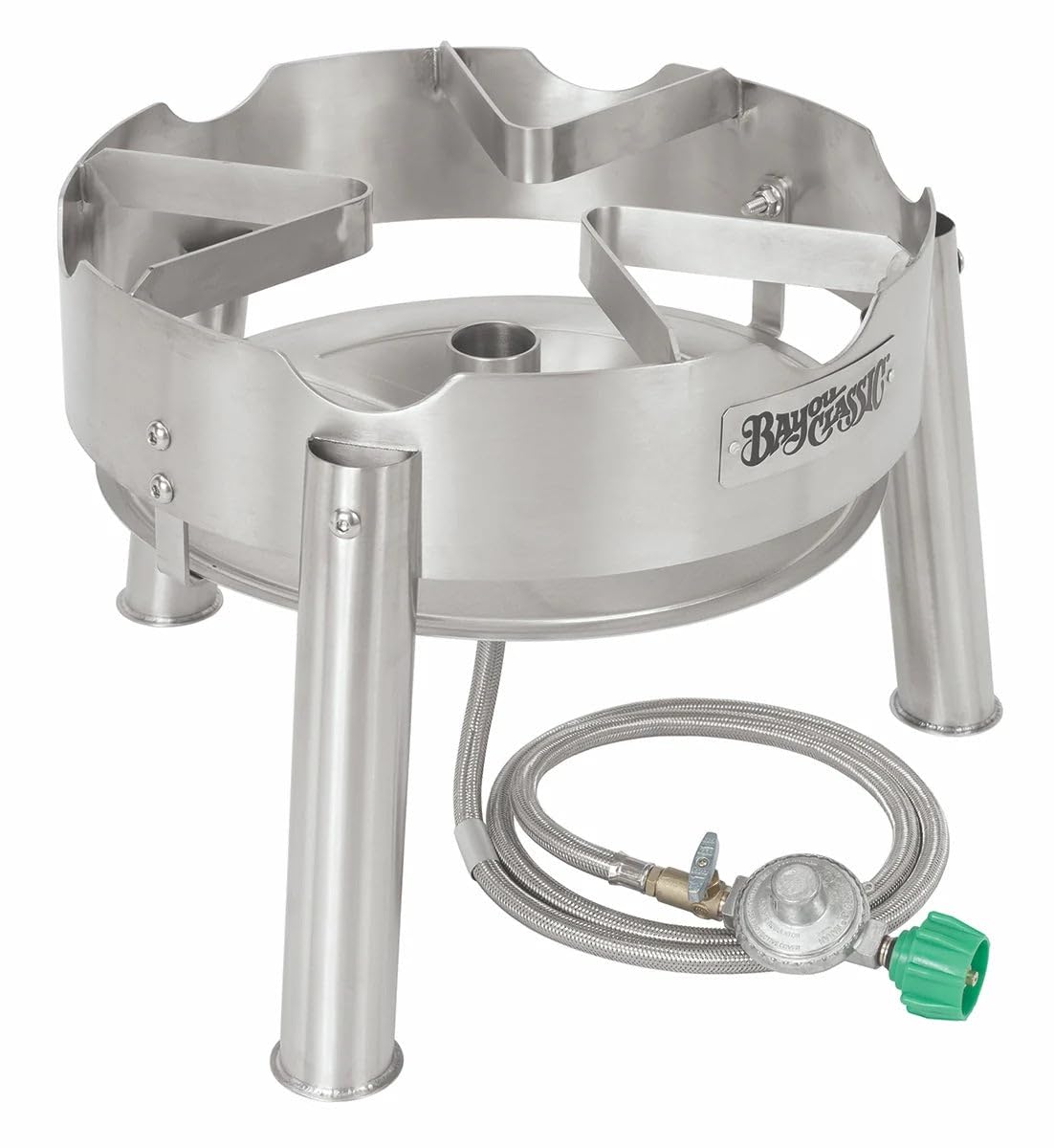
A stainless cooker built for oversized stock pots and full-blown seafood boils.
This is the one you reach for when the pan is measured in quarts, not servings. The 16 inch round cooking surface fits stockpots up to 82 qt, and the single jet burner delivers 106,000 BTU for fast boiling. That makes it the tool for a crawfish cooker, an oyster steamer, or a low country boil outdoors.
Against the COOKAMP SA1723 at 120,000 BTU, this Bayou Classic falls short on raw output — 106,000 BTU to 120,000 BTU — but it answers with a different strength: the 360° windscreen that keeps the flame steady in a breeze. That single-bolt leg attachment on a 12.5 inch tall stainless steel frame gives you a stable base for a heavy pot.
Ownership is where this one shows its age as a design. It includes a 10 psi pre-set regulator and a 60 inch stainless braided LPG hose, so the connection side is covered. But the feedback is not uniformly glowing, and a 4.0+ rating across a modest pool reflects a burner that some buyers love for boils and others find fussier than expected. It weighs 9 pounds and wants an outdoor setup.
For the boil pot: 106,000 BTU under a 16 inch surface that takes 82 qt pots is purpose-built for big seafood boils.
The catch: a single jet is one concentrated flame ring — great for a big pot, less suited to tossing a wok.
Cooks with it: the buyer planning crawfish boils and stockpot feasts who wants a windscreen and a stable frame.
Skip it for: everyday wok stir-fry — a multi-jet head spreads flame around the pan sides better.
Know the Specs
BTU (British thermal units)
BTU measures how much energy a burner puts out — the higher the number, the more heat the flame carries to your pan. A wok that hits a very hot surface fast gets a proper sear; a weak flame steams the food instead. Higher isn’t automatically better, though. A 176,000 BTU head demands the right fuel supply and a pan big enough to use all that heat.
Jet count and jet hole size
The tips are the small brass holes in the burner head, and each one is a jet. More jets spread the flame into a wider ring that curves up the sloped sides of a wok, which is where wok cooking gets its smoky character. Hole size — like the 0.9mm holes on the TFCFL — controls how tightly each jet focuses its flame. A 32-tip head and a 23-tip head behave differently, and neither is wrong.
Regulator and PSI
PSI is pounds per square inch, a measure of gas pressure feeding the burner. A 0-10 PSI adjustable regulator lets you lower that pressure for a gentle simmer or open it up for a roaring boil. A pre-set 10 psi regulator keeps it simple but removes that range of control.
Propane vs natural gas
Propane comes in a tank and goes anywhere; natural gas runs off a fixed supply line and never needs a refill. The two burn at different characteristics, and a burner is built for one or the other. Choose the fuel your cooking spot can actually supply.
Common Questions
Can a wok jet burner run on a standard propane tank?
Is a higher BTU number always better for wok cooking?
What does jet count change about the way the burner performs?
Why does a regulator matter so much on a jet burner?
Can I use a wok jet burner indoors?
Do these burners come with a stand or just the head?
What size wok fits a 32-tip jet burner?
How do I control the flame so it does not scorch the food?
Can a single-jet cooker like the Bayou Classic SS1 do wok stir-fry?
The Bottom Line
For most cooks the wok jet burner winner is the COOKAMP SA1723 — it is the crowd favourite at 4.5+ stars across 100+ buyers, and it pairs 120,000 BTU with a 0-10 PSI adjustable regulator and braided hose so you get control along with the heat. If your spot already has a natural gas line and you want the biggest output in this group, the TFCFL 32 Tips is the one to reach for. And if you have a plumbed gas line, confirm it is natural gas before ordering — a natural gas burner cannot run on a propane tank, so that one decision comes before every other.
How we choose
We do not accept paid placement. Every pick is matched to a real buyer and a real use-case; we do not hands-on test units.
Sources
Specifications: manufacturer listings and product documentation. Review insights: verified customer reviews, as of November 2026. Pricing: not shown on this page (it changes often); check the current price via the retailer link.
As an Amazon Associate, Tactical Gear Guy earns from qualifying purchases. This does not affect which products we feature.