Specs are compiled from manufacturer listings and verified buyer reviews and can change over time — please confirm the key details on the product page before buying.
You can avoid a failed inspection by matching the wire gauge (the wire’s thickness) to the circuit breaker first, then matching the length to the run. Get those two right and the rest — jacket color, coil size, how easily it strips — is comfort. Get them wrong and an inspector will hand the run back to you. This guide covers nine indoor NM-B cable options (NM-B is sheathed cable for dry indoor walls), what each is realistically good for, and where the honest limits sit.
This guide is built by comparing the manufacturers’ published specifications and the patterns across verified customer reviews, so you get each pick’s real strengths and trade-offs instead of marketing spin.
Below you’ll find how to read gauge against amperage, a side-by-side table of the nine cables, full reviews, and plain-English spec explanations. The short version: a 14-gauge cable feeds 15-amp circuits, a 12-gauge feeds 20-amp circuits, and choosing the right wires for house wiring starts with reading your breaker label before you order a coil.
Top Picks

How To Choose The Best Wires for House Wiring
Start with the breaker, not the coil. Every circuit in your panel has an amperage rating printed on it, and that number — not the price tag, not the color you like — decides which gauge you can legally run. Everything below follows from that one step.
Match the gauge to the circuit amperage
A 14 AWG cable carries a 15-amp circuit. That covers lighting, switches, ceiling fans and general-purpose outlets. A 12 AWG cable carries a 20-amp circuit, which is what kitchen receptacles, laundry runs and small appliances typically sit on. If you put 14-gauge wire on a 20-amp breaker, the wire becomes the weak link in a fault. Read the panel label first, then buy.
Work out how much cable the run actually needs
Measure the path, not the straight line. Cable routes up and over, through studs, along joists, down to the box, and you need extra slack at both ends for stripping and terminating. A 25 ft coil suits adding an outlet or moving a switch. A 50 ft coil covers a room-to-panel run. A 100 ft roll is for pulling multiple circuits or running the length of a house, and buying one long roll instead of splicing short ones is the simpler habit.
Understand what “NM-B” and the color codes tell you
NM-B means non-metallic sheathed cable built for dry indoor locations — inside wall cavities, attics, and the air voids of masonry block walls that are not wet or damp. The outer jacket color follows a convention: white marks 14 gauge, yellow marks 12 gauge, and orange marks 10 gauge. That color is a fast visual check during rough-in and inspection, so a wrapper that matches the code saves you time on site.
Check the listings before you pull it through a stud
A UL listing on the jacket is your proof the cable was made to a recognized standard, and many of these coils list the specific standards by number. Some also carry a printed UL file number you can look up. You also want the conductor material stated plainly — bare copper, not a copper-clad aluminum substitute. If the listing page won’t tell you which one you’re buying, that’s your cue to keep reading other listings.
Weigh jacket feel against stripping speed
Indoor NM-B is meant to be stiff — that rigidity is what lets it hold a bend through framing. The trade-off is stripping and cutting effort, and that’s where most of the practical complaints land. A proper cable ripper or a sharp lineman’s pliers makes short work of a jacket that feels stubborn with a utility knife. Budget a minute per termination and the stiffness stops mattering.
Side-by-Side Comparison
| Model | Best For | Gauge | Maximum Current | Length | Amazon |
|---|---|---|---|---|---|
| Southwire 63948421 10/3 NM-B★ Best Overall | Generator and heavy-draw hookups | 10 | 20 A | 25 ft | Amazon |
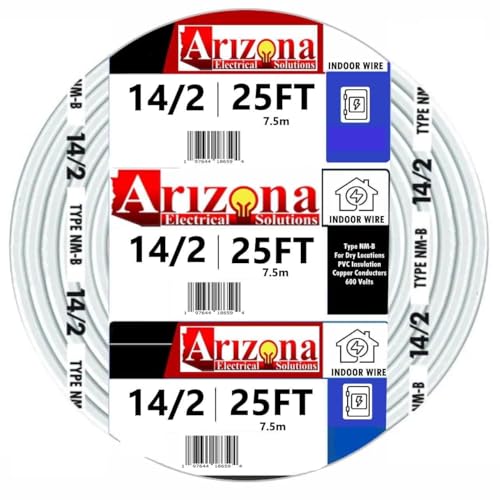
| Arizona Electrical 14/2 NM-B 25 ftBest for Small Jobs | Adding a single outlet or switch | 14 | 15 A | 25 ft | Amazon |
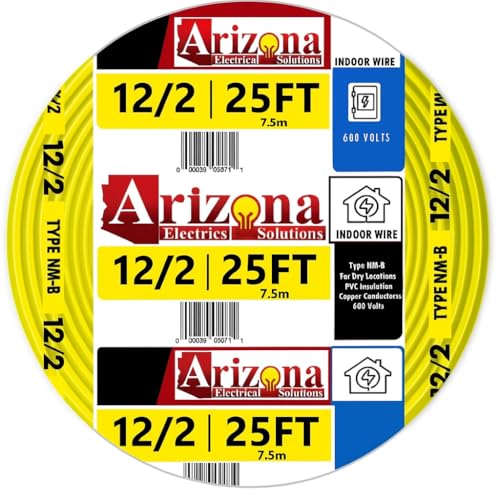
| Arizona Electrical 12/2 NM-B 25 ftBest 20A Short Coil | Kitchen and 20A branch circuits | 12 | 20 A | 25 ft | Amazon |
| Energeaster 12/2 NMB 25 ft | Short 20A runs in wall cavities | 12 | — | 25 ft | Amazon |
| Energeaster 14/2 NMB 50 ft | Whole-room lighting and outlet runs | 14 | — | 50 ft | Amazon |
| Arizona Electrical 14/2 NM-B 50 ft | Long 15A circuits on a budget | 14 | — | 50 ft | Amazon |
| Arizona Electrical 12/2 NM-B 50 ft | Full 20A circuit rough-ins | 12 | 20 A | 50 ft | Amazon |
| CIRENKO 14/2 NM-B 100 ft | Long lighting runs, UL listed | 14 | 15 A | 100 ft | Amazon |
| Arizona Electrical 14/2 NM-B 100 ft | Multi-circuit 15A pulls | 14 | — | 100 ft | Amazon |
Detailed Reviews
1. Southwire 63948421 25′ 10/3 with Ground Romex SIMpull NM-B
Our pick — 4.5+★ from 900+ verified ratings; the strongest balance of quality and price.
Ten-gauge, three conductors and a ground, on a coil light enough to carry up a ladder.
It carries three insulated conductors plus a ground — the fourth wire is what separates it from the two-conductor coils filling most of this list. That extra conductor is why it turns up on emergency generator hookups, where you need both hot legs plus a neutral plus a ground in a single pull. Twenty-five feet reaches from a panel to a nearby transfer point without waste.
What wins people over here is the jacket. The SIMpull coating is designed to slide through framing with less drag, and it strips back without fighting you — the two chores that eat the most time on a short pull. The wire is UL Listed type NM-B and it’s made in America, with the gauge and conductor count printed where an inspector can read them.
The honest catch is the price-to-length math. You get 25 feet here versus the 50 feet on the 12/2 coil further down, because the added conductor and the heavier 10 gauge both cost more to build. Set against the 14/2 coil on this list, though, this cable’s 20-amp maximum current sits above that cable’s 15-amp rating — the difference between a general-purpose circuit and one that can feed a heavier load. At 2 pounds the coil is easy to handle overhead. If your run is a plain 15-amp lighting circuit, this is more cable than the job asks for.
Where it pulls ahead
- Three conductors plus ground covers hookups that a two-conductor cable cannot
- SIMpull jacket slides through studs and strips cleanly, which trims install time
- UL Listed type NM-B and made in America
- 20 A maximum current handles heavier branch loads than 14-gauge cable
What to weigh first
- 25 ft is a short coil — a long panel run will need a second length
- 10 gauge is stiff and does not like tight radius bends
- Pricier per foot than the two-conductor coils here
Made for: generator hookups, sub-panel feeds and any run that needs a neutral and a ground alongside two hots.
Look elsewhere if: you’re wiring ordinary outlets and switches — a two-conductor 14 or 12 gauge coil does that job for less.
2. 25 Ft 14/2 NM-B Copper Wire
The short white coil that turns one dead outlet into a working one again.
Twenty-five feet of 14/2 is the classic repair length. It’s two 14 AWG solid copper conductors plus a bare ground, rated 600 volts, built for standard 15 amp residential branch circuits — lighting, wall outlets, switches, ceiling fans and small appliance runs. The white jacket matches the color convention for 14 gauge, so anyone walking the job can read the gauge without unrolling it. If you’re adding an outlet, moving a switch or extending a circuit, this is enough cable without committing to a full spool.
The reputation this one has earned is for conductor quality — solid copper that carries current cleanly and terminates predictably. Owners have used it for high-hat lighting runs and had it go in without complaint. The flat sheath pulls through studs and joists during rough-in and strips cleanly at the box, which is where a cheap cable usually shows itself.
Before you click, know two things. The wire diameter is listed at 1.63 millimeters, and the copper is solid rather than stranded — that’s correct for NM-B and wrong for anything that needs to flex repeatedly, so don’t plan on this for a moving connection. Also, a 15-amp cable belongs on a 15-amp breaker, and pairing it with a 20-amp breaker is a code problem, not a convenience. Match the panel label and this coil does exactly what it promises.
The short-run verdict: if your job is one box, one fixture, or one extension of an existing circuit, this coil ends the trip. It’s the cheapest way to finish a small repair properly.
The limit that matters: 25 feet runs out fast once you’re routing up a wall and across a ceiling — measure the path, not the room.
Reach for this if: you’re patching a single 15-amp circuit and want solid copper without buying a spool you’ll never finish.
Skip if: your run crosses more than one room or you’re feeding a 20-amp kitchen circuit — you need 12 gauge and more length.
3. 25 Feet 12/2 NM-B Copper
Yellow jacket, twenty amps, twenty-five feet — the kitchen-circuit coil.
Where the 14-gauge coils above cap out at 15 amps, this one is rated for 20 A on a 12 gauge conductor. That’s the gauge a kitchen receptacle, a laundry circuit or a small-appliance run usually wants, and the yellow jacket is the standard marker for it. Twenty-five feet of two-conductor-plus-ground cable handles a short pull from panel to box without dragging a full roll around.
Build quality is what carries this one. The conductors are solid copper built to ASTM B-3 and B-8 and Federal Specification A-A-59544, and the cable is made to National Electrical Code NFPA 70 with REACH and RoHS compliance listed. In practice that means the jacket and insulation behave the way a cable ripper expects — the sheath opens and the conductors strip cleanly, which is the difference between a ten-minute termination and a fight.
Here’s what to plan around. Twenty-five feet is a short coil, and 12 gauge is noticeably stiffer than 14 — the same stiffness that makes it hold a bend through framing also makes a tight radius a chore. If your run is long or crosses several studs at an angle, price the 50 ft version below instead of splicing two of these.
Why contractors keep a coil on the truck: solid copper conductors, a code-listed build, and a color that reads as 12 gauge from across the room. It’s a known quantity.
Where it strains: the coil length, not the cable. Twenty-five feet is a repair length — treat it as such and you won’t be disappointed.
Best fit: short 20-amp branch work — a kitchen receptacle, a dedicated appliance outlet, a switch leg off a heavier circuit.
Think twice if: you’re wiring a whole room’s worth of outlets in one pull, because you’ll want the longer 12/2 coil further down this list.
4. Energeaster Solid Indoor 12/2 W/G NMB Cable 25ft, Yellow

A yellow 12-gauge coil that wants to live inside a wall cavity, not on a workbench.
This cable is specified for the places you can’t see afterward — inside wall cavities, through attics, and in the air voids of masonry block or tile walls as long as those voids are not wet or damp. The voltage rating is 600 volts and it’s UL Listed, with two 12 gauge solid conductors in black and white running parallel and a 12 gauge bare ground wrapped in fire-retardant paper between them. The yellow jacket marks the gauge the way the code convention expects.
The thing everyone raves about is the construction itself — solid, consistent, and it cuts and bends the way NM-B should. What’s less consistent is the jacket when you go to open it. Some find it easy to work with; others find it extremely difficult to slice open, and that’s the one repeated gripe in the reviews. It’s a tool problem more often than a cable problem, but it’s real. Bring a proper cable ripper and score the sheath rather than sawing at it.
On durability, buyers report it holding up in long-term in-wall service without complaints — the only thing that matters for cable you’ll never see again. Twenty-five feet suits one branch from panel to box; plan on a longer roll if you’re feeding several outlets down a wall.
What holds up
- 600 volt rating and a UL listing on the jacket
- Solid 12 gauge copper conductors with a full-size bare ground
- Fire-retardant paper wrap between the conductors and the ground
- Yellow sheath matches the code color for 12 gauge
What to brace for
- The sheath can be stubborn to open — a cable ripper is close to mandatory
- 25 ft only, so a long panel pull needs a second coil
- Dry indoor locations only, per the NM-B rating
Suits you if: the cable disappears into a wall and never comes out — this is built for exactly that job.
Not your pick if: you’re stripping terminations by feel with a utility knife; the jacket will slow you down.
5. Energeaster Solid Indoor 14/2 W/G NMB Cable 50ft, White

Fifty feet of white 14-gauge — enough to finish a room instead of one outlet.
Fifty feet changes what a coil can do. This one covers a full run of lighting and receptacles in a room, or a long pull from the panel to a far wall, without a splice in the middle. It’s 14 gauge solid copper, two conductors in black and white running parallel, plus a 14 gauge bare ground wrapped in fire-retardant paper. The white jacket marks the gauge, the rating is 600 volts, and it’s UL Listed.
Owners consistently compare this to what the big box stores stock and come away satisfied — same construction, same in-wall behavior, without the trip. It’s approved for wall cavities and attic runs, and the air voids of masonry block or tile walls that aren’t wet or damp, which covers most of a normal residential rough-in.
There is one trade-off worth knowing before you buy. The jacket is difficult to cut and strip, and that shows up as the recurring complaint on this cable. It’s an annoyance, not a defect — the same stiffness that fights the knife is what lets it pull straight through a stud bay without sagging. Set your stripper properly and the problem shrinks to a minute or two per box.
What you get for the length: a 50 ft roll that turns a multi-outlet run into one continuous pull, at a value tier below the premium coils.
The honest friction: cutting and stripping demand patience — this is not a jacket that opens on the first pass.
Pick this when: the job spans a room rather than a single box, and 15 amps covers everything you’re feeding.
Otherwise look at: the 12/2 coils if any part of the circuit is a 20-amp kitchen or laundry run.
6. 50 Feet 14/2 NM-B Copper
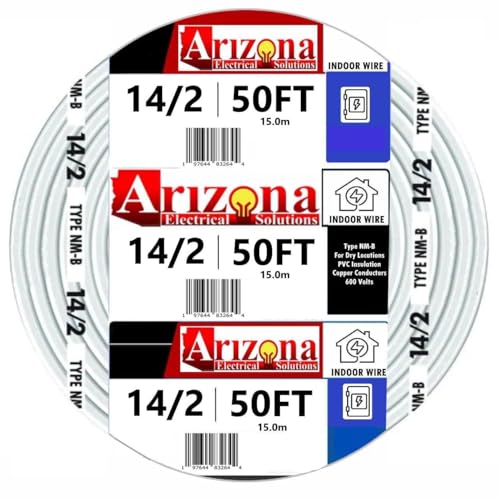
Built to the standard numbers, sold at the length that finishes a lighting circuit.
The first thing to notice here is the paperwork behind it. This cable is listed per UL Standard 719 and UL 83 (safety standards for electrical wire), the conductors are built to ASTM B-3 and B-8 and Federal Specification A-A-59544, and the whole build conforms to National Electrical Code NFPA 70 with REACH and RoHS compliance (rules on hazardous substances). That’s a lot of standards for a commodity coil, and it’s why this cable holds up next to name-brand cable on an inspection walkthrough. Fifty feet of 14/2 with ground covers a long lighting or receptacle run without a splice.
Where this coil earns its keep is long continuous pulls. Owners have used it for stretches that would have forced a junction box with a shorter roll, and it performs the same as the premium brands doing it. The conductors are solid copper and the jacket strips predictably, so termination time stays short even at the far end of a fifty-foot run.
Two practical notes. It’s 14 gauge, so keep it on a 15-amp breaker — this is not a substitute for 12 gauge on a kitchen circuit, no matter how convenient the length looks. And at fifty feet of solid cable, the coil has real weight to it; plan your pull order so you’re feeding from the roll rather than dragging it.
Where the value lands: standards-listed construction at a length that removes junctions. Standards-listed construction at a length that removes junctions is why it’s a sensible mid-list pick rather than a compromise.
Read before ordering: 14 gauge means 15 amps, period. If your panel says 20, buy the 12/2 coil above.
It’s the right coil if: your run is long, your circuit is 15 amps, and you’d rather pull once than splice twice.
Step up instead if: the circuit feeds a kitchen or laundry load — that calls for 12-gauge copper.
7. 12/2 NM-B Wire 50 FT
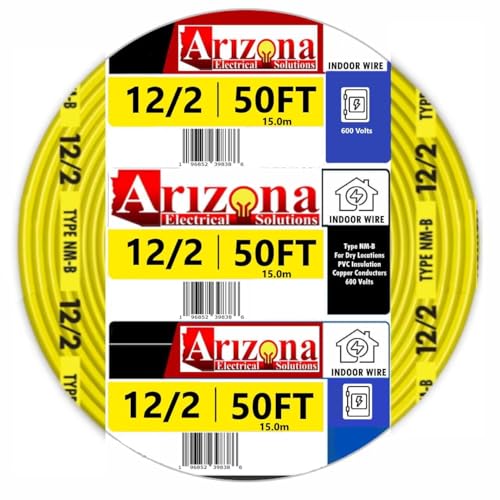
The 20-amp workhorse: fifty feet of yellow 12 gauge built for a full branch circuit.
Fifty feet at 12 gauge is the combination most serious household branch work actually needs. This roll gives you two 12 AWG solid bare copper conductors — one black hot, one white neutral — plus a bare copper ground, all inside a yellow nonmetallic PVC sheath rated 600 volts and 20 amps. That’s the spec for outlets, light switches, ceiling fixtures, smoke detectors, garbage disposals, dishwashers and kitchen, laundry or garage receptacles. One roll, one circuit, done.
Look closely at the insulation and you’ll find why this sits near the top. Ampacity is limited to 60 degree C conductor ratings per the code, which is standard NM-B practice. The build conforms to ASTM B-3 and B-8, Federal Specification A-A-59544, National Electrical Code NFPA 70 Article 334, and it’s REACH and RoHS compliant. It’s approved for dry indoor locations, exposed or concealed, including the air voids of masonry block walls that aren’t wet or damp.
Compare it honestly with the 25 ft 12/2 coil above and the difference is simple: you get double the length on the same gauge, which is the difference between one box and one room. The flat sheath staples flat against studs and strips cleanly with a cable ripper or lineman’s pliers, so the rough-in goes quickly once you’re in rhythm. Buyers on this listing have measured the roll at exactly fifty feet as advertised — a low bar until you’ve been shorted on a coil.
The spec that decides it: 90 degree C nylon-coated insulation over 12 gauge solid copper, on a 20-amp rated roll long enough to finish a real circuit.
Where it costs you: 12 gauge is stiff cable. Tight bends take effort, and you’ll want to plan the route before you start stapling.
Your coil if: you’re running a full 20-amp circuit through a kitchen, laundry room or garage and want one continuous pull.
Overkill for: a single lighting drop or a switch replacement — the 25 ft 14/2 coil handles those with less wrestling.
8. CIRENKO 14/2 NM-B Cable 100 FT
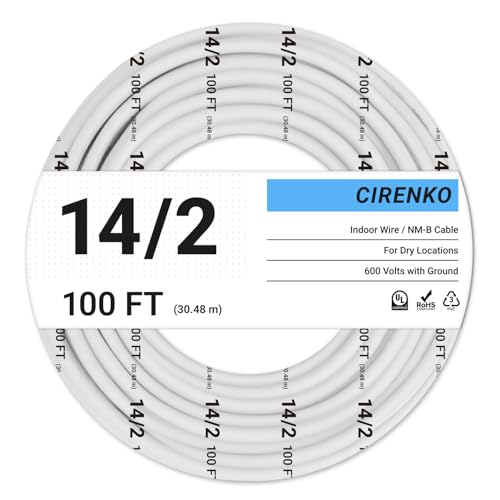
One hundred feet of verifiable UL-listed 14 gauge, for jobs that span a house.
What separates this roll from the other 14-gauge cable here is proof. It meets UL83 and UL719 standards and carries a UL E-file number you can actually look up — not just a printed word on a jacket. That’s a meaningful difference when an inspector asks, and it’s the reason this roll is worth considering for larger jobs where the paperwork gets checked. One hundred feet of solid bare copper, two insulated 14 AWG conductors plus a bare ground, in a white thermoplastic NM-B sheath rated 600 volts.
Copper-clad aluminum is cheaper to build and worse at carrying current; this cable states solid bare copper outright. The sheath has clear printed markings down its length for identification, and the insulation is built to strip cleanly, which keeps install time down on a long run of boxes.
The limit is the obvious one. At 15 amps maximum current this is a lighting-and-general-purpose roll, so it belongs on a 15-amp breaker and nowhere else. And it’s 14 gauge — the stiffness is there, and a hundred feet of it is a two-hand pull. Owners describe it as an inexpensive alternative to the mainstream brand that works like any electrical wire — exactly the review you want on a commodity roll.
Why it earns the length
- UL83 and UL719 compliance with a checkable E-file number
- Solid bare copper, explicitly no CCA
- 100 ft removes the need for junctions on a big pull
- Printed jacket markings make gauge identification instant
Plan around this
- 15 A maximum, so it’s locked to 15-amp circuits
- 100 ft of solid cable is heavy and awkward to feed alone
- Dry indoor locations only, as NM-B requires
Best for: a full-house 15-amp lighting or receptacle rough-in where you want one roll and a lookup-able listing.
Not the call if: you’re feeding 20-amp loads — that’s 12-gauge territory, and this roll won’t pass.
9. 100 Feet 14/2 NM-B Copper Building Wire
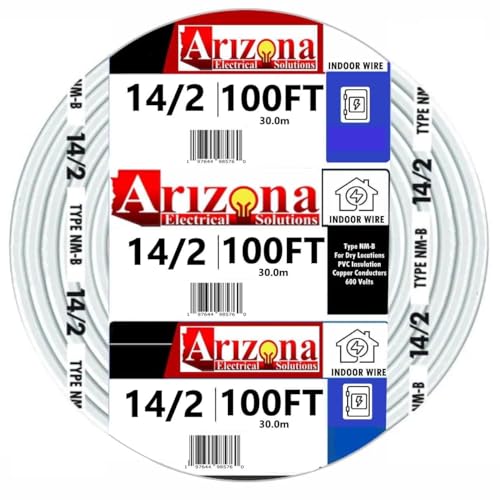
A full hundred-foot roll of white 14/2 for remodels that eat cable faster than expected.
Remodels always consume more cable than the plan says, and this roll is sized for that reality. You get a full 100 feet of Type NM-B cable — 14 AWG solid copper, two insulated conductors plus a bare copper ground, in a white PVC jacket rated 600 volts. It’s built for branch circuits feeding sockets, switches, light fixtures and other household loads in new construction, remodels and repairs, and the white jacket makes 14-gauge runs easy to spot during rough-in and inspection.
The temperature rating is worth knowing: it’s suitable where temperatures do not exceed 90 degrees C, with ampacity restricted to 60 degree C conductor ratings per the National Electrical Code, NFPA 70. The cable meets ASTM B-3 and B-8 and Federal Specification A-A-59544, and it’s REACH and RoHS compliant. Approved for exposed and concealed runs in dry environments, including the air gaps of masonry block or tile walls that are neither wet nor damp.
On value, this is one of the leaner ways to buy a hundred feet of 14 gauge, and that’s the main reason to consider it over the CIRENKO roll above. The trade-off is documentation — the CIRENKO listing names a UL E-file number you can verify, while this one leans on the cable’s code compliance and standards references. If your inspector wants a lookup, the CIRENKO roll is the one that gives it to you.
The straight read: a hundred feet of code-compliant 14/2 at the budget end of the premium tier, best for remodels that burn through cable in a hurry.
Pair it with: a sharp cable ripper — 14 gauge sheathing is stiff, and a hundred feet is a lot of terminations to open by hand.
Go with this if: you need volume of 14-gauge cable across a remodel and you’re comfortable checking code compliance yourself.
Choose the CIRENKO roll instead if: a verifiable UL file number matters to your inspection.
Know the Specs
Gauge and Ampacity
Gauge is the wire’s thickness, written as AWG — American Wire Gauge — and it runs backwards: a lower number means a thicker wire. A 12 gauge conductor is thicker than a 14 gauge one, so it carries more current. In NM-B house cable, 14 gauge is rated for 15 amps and 12 gauge for 20 amps. That rating is the ceiling, and the breaker protecting the circuit must not exceed it. Read the panel label before you order, because the breaker decides your gauge — not the other way round.
NM-B and Where It Can Go
NM-B means non-metallic sheathed cable for dry indoor locations. The conductors and a bare ground run inside an outer jacket, which is why it’s called sheathed cable. It’s approved inside wall cavities, through attic runs, and in the air voids of masonry block or tile walls that are not wet or damp. It is not for wet locations, and it is not for burial. That single dry-location limit matters more than any other spec on the listing.
Jacket Color Codes
The outer jacket color is a gauge marker, not decoration. White marks 14 gauge, yellow marks 12 gauge, and orange marks 10 gauge. On a rough-in, an inspector or a second set of hands can confirm gauge from across the room by color alone. It also keeps a remodeled circuit honest — if you grab the wrong coil from the truck, the color catches it before the boxes are closed up.
Voltage and Temperature Ratings
The 600-volt rating you see on nearly all of these coils is the cable’s insulation ceiling, well above the 120 volts a household branch circuit actually carries. The temperature figure is the other half of the spec. Cable rated for 90 degrees C insulation is still limited to 60 degree C conductor ampacity under the National Electrical Code — the higher temperature is about the insulation’s tolerance, not extra current capacity. That’s why a 12 gauge NM-B cable stays at 20 amps no matter how warm its insulation is rated.
Common Questions
What gauge wire do I need for a 20 amp circuit?
Can I use 14/2 wire on a 20 amp breaker?
What does NM-B mean on electrical cable?
Why are electrical cable jackets different colors?
How do I know what length of wire to buy for a room?
Is the outer jacket supposed to be this stiff?
What is the difference between CCA and solid copper wire?
Does UL Listed matter when buying house wire?
Can I run NM-B cable through a masonry or block wall?
Is 12/2 wire harder to work with than 14/2?
The Bottom Line
For most house wiring jobs, the pick that covers the widest range is the Southwire 63948421 10/3 SIMpull NM-B — three conductors plus a ground on a coated jacket that pulls and strips cleanly, and the only coil here with the fourth wire for generator and sub-panel hookups. If your work is ordinary 20-amp branch circuits, grab the Arizona Electrical 12/2 NM-B 50 FT, where the 90 degree C nylon-coated insulation and 20-amp rating line up with a kitchen or laundry run. And for a long 15-amp lighting pull across a whole room, the Arizona Electrical 14/2 NM-B 50 FT covers the run in one continuous pull, no junction box needed. Match the gauge to the breaker, confirm the length against the actual path, and any of these nine will close up behind the drywall and stay there.
How we choose
We do not accept paid placement. Every pick is matched to a real buyer and a real use-case; we do not hands-on test units.
Sources
Specifications: manufacturer listings and product documentation. Review insights: verified customer reviews, as of November 2026. Pricing: not shown on this page (it changes often); check the current price via the retailer link.
As an Amazon Associate, Tactical Gear Guy earns from qualifying purchases. This does not affect which products we feature.