Specs are compiled from manufacturer listings and verified buyer reviews and can change over time — please confirm the key details on the product page before buying.
You need a hotspot that holds a signal where you actually are, not one that shines in a city and drops on the road you drive. The short answer: the NETGEAR AC797 is the pick most buyers should start with, the TCL Linkzone is the one to grab if you need 5G speed and can live with a fussier setup, and the TravlFi JourneyGo is the travel specialist that finds the strongest local network for you. Everything below comes from published specs and verified customer experiences, so you can weigh real trade-offs instead of marketing lines.
This guide is built by comparing the manufacturers’ published specifications and the patterns across verified customer reviews, so you get each pick’s real strengths and trade-offs instead of marketing spin.
A hotspot only earns its place in your bag when the battery holds, the carrier accepts your SIM, and the device count covers your crew. Our picks for the best wireless Wi-Fi hotspot cover both SIM-based and SIM-free routes.
Top Picks

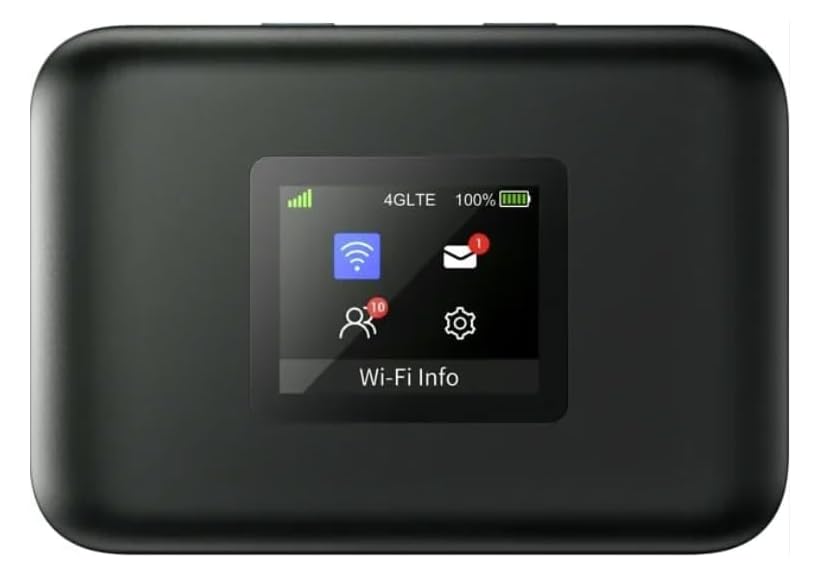

How To Choose The Best Wireless Wi-Fi Hotspot
The biggest mistake people make is buying on speed alone. A hotspot is really three things stapled together: a cellular radio, a Wi-Fi access point, and a battery. Whichever of those three is weakest is the one that will annoy you daily, so the right question is which one your own trips punish most.
Start With The Carrier, Not The Speed Number
A hotspot is only as good as the network it is allowed to join. Some units are open up for GSM carriers like AT&T and T-Mobile, while others lock you into one provider’s prepaid plan. Read that line before anything else, because a fast device on a carrier with no signal at your cabin is a paperweight. If you roam internationally, a SIM-free hotspot that switches carriers automatically removes a whole layer of hassle.
Match The Device Count To Your Crew
The device count is simply how many phones, laptops, or tablets can share the connection at once. Two people and a laptop are fine on a small unit; a family road trip with tablets and a smart TV needs more headroom. Pick a hotspot with a device limit above what you actually carry, because the last device to connect is the one that gets dropped.
Read Battery In Hours, Not Just mAh
Milliamp-hours (mAh) describe the size of the fuel tank, while the hours figure tells you how far that tank actually goes. A big battery paired with an efficient radio can outlast a smaller one with thirsty hardware. If you will be away from an outlet for a full workday, look for a stated hours figure you can plan around, and check whether the device can also top up your phone as a power bank.
Decide How You Want To Pay For Data
There are two routes. A SIM-based hotspot uses a data-only plan you buy from your carrier, which keeps things simple if you already have a line. A SIM-free hotspot uses cloud or eSIM technology with pay-as-you-go plans sold by the day, month, region, or gigabyte. The second route costs more per gigabyte but saves you from hunting down a local SIM the moment you land.
Side-by-Side Comparison
| Model | Best For | Max Download Speed | Battery | Max Devices | Amazon |
|---|---|---|---|---|---|
| NETGEAR AC797-100NAS★ Best Overall | Everyday SIM-based use | 400 Mbps | 2930 mAh, up to 11 hrs | 15 | Amazon |
| AT&T Turbo Hotspot 3Best Battery Life | All-day battery on prepaid | — | 3000 mAh, over 15 hrs | 16 | Amazon |
| TCL Linkzone 5G UW (MW513U)Top Performer | 5G speed with a touchscreen | 1000 Mbps | 4500 mAh, doubles as power bank | 32 | Amazon |
| Franklin A50 5G | Wi-Fi 6 and big battery | 960 Mbps LAN port bandwidth | 5000 mAh, removable | 20 | Amazon |
| GlocalMe UPP | Travel with data preloaded | 150 Mbps | 3000 mAh, over 13 hrs | 8 | Amazon |
| TravlFi JourneyGo | Remote areas, no SIM | 150 Mbps | 16 hrs | 10 | Amazon |
| NETGEAR Nighthawk M6 Pro | Fastest 5G and Ethernet | 8 Gbps | 5040 mAh | 32 | Amazon |
| SIMO Solis 5G | Rugged travel with lifetime data | — | Power bank feature | 16 | Amazon |
| GlocalMe Numen Air 5G | Fast global 5G without a SIM | 2.5 Gbps | — | 16 | Amazon |
Detailed Reviews
1. NETGEAR Mobile WiFi Hotspot AC797-100NAS
Our pick — 4.0+★ from 90+ verified ratings; the strongest balance of quality and price.
A 400 Mbps 4G LTE hotspot that runs up to 11 hours on a 2930 mAh battery and shares the connection with 15 devices.
For most people the right first hotspot is the one that simply works with the carrier they already pay. This NETGEAR delivers up to 400 Mbps download speed over 4G LTE, which is enough to stream video, take a video call, and keep a laptop synced without stutter. That 400 Mbps figure is a ceiling on the cellular side, so your real speed depends on the tower you are sitting under.
What makes it easy to live with is the shape of the thing: it creates its own secure wireless network anywhere, so a hotel room or a campsite turns into your own private Wi-Fi. It connects up to 15 devices at once — enough for two phones, a couple of laptops, and a tablet with room to spare. The rechargeable 2930 mAh battery powers up to 11 hours of use, which covers a full working day away from an outlet if you are not streaming constantly.
One thing to nail down before you buy: this unit is from AT&T and works only with GSM carriers like AT&T. If your plan runs on a CDMA-first network, this is the wrong device for you. What wins people over is plain reliability — day after day the thing just connects and holds, which is exactly what you want from a hotspot. A few find the battery life shorter than they hoped, so plan your charging around that 11-hour figure rather than stretching it.
Why owners keep it in the bag
- 400 Mbps download speed handles streaming and video calls
- Connects up to 15 devices on one private network
- 2930 mAh battery runs up to 11 hours
- Works with GSM carriers like AT&T
Where it will not suit you
- Locked to GSM carriers — no CDMA networks
- Battery run time, not speed, is the recurring gripe
- 4G LTE only, so no 5G where the tower offers it
Reach for this if: you want a dependable daily hotspot on a GSM carrier and do not need 5G speeds.
Look elsewhere if: you are on a CDMA network or routinely stream past the 11-hour battery mark.
2. AT&T Turbo Hotspot 3
A 3000 mAh hotspot rated for over 15 hours of use and up to 16 devices on dual-band Wi-Fi.
The Turbo Hotspot 3 is the answer for anyone who has watched a hotspot die at 4 p.m. on a long drive. Its 3000 mAh battery is rated for over 15 hours of usage on a single charge, which puts it ahead of the GlocalMe UPP’s 13-hour ceiling on paper. That kind of run time turns a hotspot from a novelty into something you can genuinely leave in the glovebox for a full day out.
It connects up to 16 Wi-Fi-enabled devices at once and uses dual-band Wi-Fi, which means the radio can work on more than one frequency at a time to reduce congestion from nearby networks. A 1.77-inch color LCD screen on the front shows the device information you need without reaching for your phone. The handy extra is the online WebUI Manager, a browser page where you can adjust settings, features, and security.
The catch is not a hardware flaw but a business one: this device requires you to purchase an AT&T prepaid plan, and it will not connect without one. If you are already on AT&T that is a formality, but if you are not, factor the plan into your thinking. Buyers here are largely happy with the core job — twenty-five of them single out how well it functions, making functionality the thing it gets praised for most, with value close behind.
The plain-numbers read: over 15 hours beats the GlocalMe UPP’s 13 hours, and 16 devices beats that same pick’s 8. For a family sharing one connection on a road trip, both margins matter.
The setup tax: an AT&T prepaid plan is mandatory, so this is best treated as an AT&T purchase rather than a free-agent device.
Built for: AT&T households or travelers who want the longest possible run time between charges.
Not the one if: you want to slip in a SIM from another carrier or avoid prepaid plans entirely.
3. TCL Linkzone 5G UW (MW513U)
A 1000 Mbps 5G hotspot that puts up to 32 devices on one connection and doubles as a 4500 mAh power bank.
If your work depends on a hotspot, the Linkzone’s 1000 Mbps download rating changes what you can do with one. Compare that with the GlocalMe UPP’s 150 Mbps and you are looking at a wide gap in stated throughput, which is the difference between a device that keeps up with cloud work and one that makes you wait. It is listed as Verizon and GSM open up, so you get 5G speeds on the move without being nailed to a single provider.
The device count is where it pulls away: up to 32 devices can share the connection at once. That is four times the GlocalMe UPP’s 8-device limit, so it converts a single connection into something an office or a hotel room full of people can use. A 4500 mAh battery also lets it double as a power bank to charge your phone or other devices while you are out and about. The easy-to-read touchscreen handles settings without an app.
Where this device draws its strength is reliability — the single most-discussed positive across its reviews, comfortably ahead of quality and signal. It also runs dual-band with 5 GHz support to help against interference. The honest note: early 5G coverage is patchy away from cities, and a device this capable makes that more obvious, not less. Where the signal is good it is excellent; where it is not, no hotspot will save you.
Speed-to-device math: 1000 Mbps across 32 connections gives every screen in the household a usable slice. The GlocalMe UPP offers 150 Mbps across 8 — a different class of device for a different job.
The 5G caveat: its best numbers only materialize under good 5G coverage.
Pick this one for: mobile office work, remote production, or any group that needs many devices on one fast pipe.
Think twice if: you spend most of your time well outside 5G coverage.
4. Franklin A50 5G

A removable 5000 mAh battery and Wi-Fi 6 in one AT&T prepaid package.
The Franklin A50 is the pick for someone who hates being chained to a charger. Its 5000 mAh battery is rated larger than the NETGEAR AC797’s 2930 mAh, and it is removable — so you can carry a spare and swap it rather than hunt for a wall outlet. The 2.4-inch display shows what you need at a glance, and the Qualcomm SDX62 chipset handles the 5G connection.
Wi-Fi 6 is the newer wireless standard that handles crowded rooms better than older Wi-Fi, and this device uses it alongside AT&T 5G and dual-band support for up to 20 devices. A built-in power bank feature lets it charge your external devices, so it earns its place in the bag even when nobody needs internet. Remote management adds an enhanced security option if you are handing the hotspot to a team.
There is real honesty in the balance here: reliability and quality carry it, and setup is straightforward, but signal strength and battery life both split opinion. If you are in a fringe reception area, temper expectations, because a few owners do not get the signal they were promised.
The spare-battery advantage: a removable 5000 mAh cell means your downtime is a swap, not a wait.
The reception reality: signal and battery are the two things owners are least united on, so buy with your local coverage in mind.
Best suited to: AT&T subscribers who want 5G, Wi-Fi 6, and a swappable battery for long days off-grid.
Less ideal for: anyone in a weak-signal area expecting the device to fix coverage that is not there.
5. GlocalMe UPP 4G Mobile Hotspot
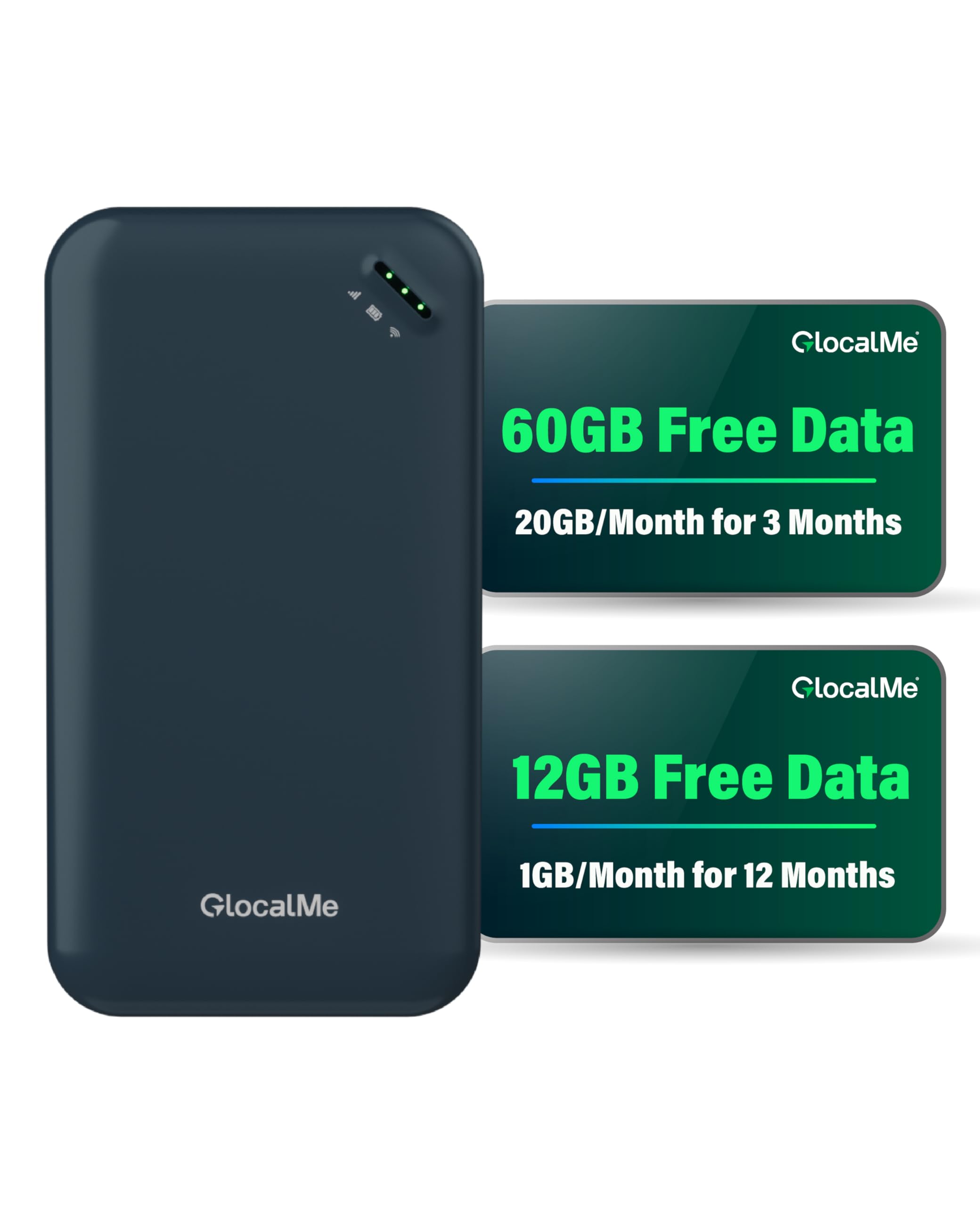
Ships with 72GB of preloaded data across US and global plans, so it works in 200+ countries without a SIM.
For a first-time international traveler, the worst part of a hotspot is the paperwork. This one skips it: it arrives preloaded with a total of 72GB of data, made up of 20GB of US data monthly for the first three months plus 1GB of global data monthly for twelve months. Download the GlocalMe app, register, and you are connected — no SIM card and no additional data purchase required.
Its coverage is the headline: support for 200+ countries and regions across Europe, Asia, Africa, and Oceania, with access to 390+ global carriers. The device automatically selects the strongest local carrier signal as you move. A 3000 mAh battery is rated for over 13 continuous hours, and it can share the connection with up to 8 devices at once.
Set your expectations on speed. The UPP is rated at 150 Mbps, well below the TCL Linkzone’s 1000 Mbps rating, so this is the pick for browsing, maps, and messaging rather than heavy uploads. If you already have a SIM you love, it supports one, and the slot is open up for any SIM. Portability is what people like most about it — it is genuinely slim and light for stuffing into a carry-on pocket.
Traveler wins
- 72GB of data preloaded across US and global plans
- Works in 200+ countries without a SIM card
- 3000 mAh battery for over 13 hours of use
- Accepts a physical SIM if you prefer your own carrier
Traveler trade-offs
- 150 Mbps rating is modest next to 5G rivals
- 8-device limit is tight for a large group
- Coverage quality still depends on the local carrier
The trip-ready pick: business and leisure travelers who want data waiting when the plane lands and no SIM to buy.
Go bigger if: your work needs high throughput or you are sharing with more than eight devices.
6. TravlFi JourneyGo Pocket Wifi
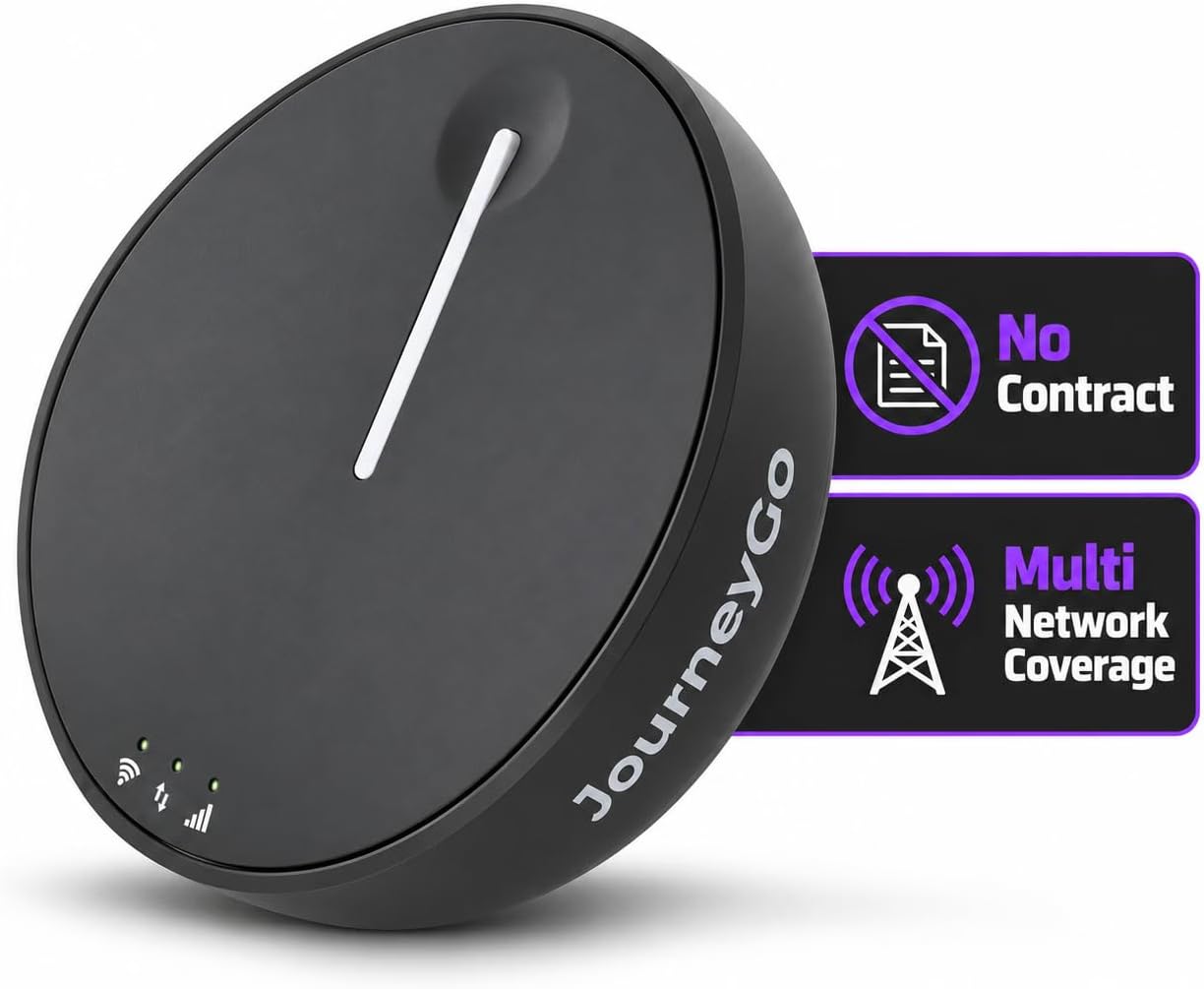
An eSIM hotspot that switches automatically to the strongest local network, with a 16-hour battery and 10-device support.
If the place you are going has more than one carrier but none of them reliably, this is the device built for exactly that problem. The JourneyGo uses eSIM technology and automatic network switching: it scans the available cellular networks and connects to the strongest local signal as you move. No SIM to install, no card to swap, no trip to a shop in a foreign city.
It is a 4G LTE device rated at up to 150 Mbps, connecting phones, laptops, tablets, and smart TVs, with a stated 16-hour battery and support for up to 10 devices. Plans are pay-as-you-go with no long-term commitment, from 2GB up to unlimited, which is the flexible model you want on a trip of unpredictable length.
Reliability is what earns its reputation here — far and away the thing owners talk about most, with setup mentioned next most often. It is used in hotel rooms, at remote work sites, and on road trips. The fair caveat is speed and connectivity: the signal you get is the signal that is there, and some users find it slow in weak coverage. It is also single-band on 2.4 GHz, so it is not the radio to choose for dense urban interference fights.
what separates it: it switches between networks automatically, all in one no-SIM package (no SIM card to buy or swap).
What to accept: 2.4 GHz only and a 150 Mbps ceiling, so heavy uploads will feel it.
Buy it for: RV trips, remote work sites, and travel where you cannot predict which carrier will work.
Skip the switch: if you need single-network simplicity and raw 5G speed.
7. NETGEAR Nighthawk M6 Pro (MR6500)

An 8 Gbps 5G mobile router with a 2.5G Ethernet port, tri-band Wi-Fi, and support for 32 devices.
The M6 Pro is not trying to be a neat little travel gadget — it is a mobile router. It is rated at 8 Gbps across 5G mmWave and Sub-6 bands, uses a Qualcomm SD X65 chipset, and runs AXE3600 Wi-Fi with a stated 2.9 Gbps over 5GHz/6GHz and 700 Mbps over 2.4GHz. That places it in a completely different league to the 150 Mbps GlocalMe UPP and even beyond the 1000 Mbps TCL Linkzone.
What it has that the others do not is a real Ethernet port — a 2.5G port that lets you wire a laptop or a small switch directly into the hotspot. It is tri-band and can serve up to 32 devices, and it includes guest Wi-Fi privacy separation to keep visitors off your main network. A 2.8-inch color touch LCD and a 5040 mAh battery round out the hardware.
Now the honest part. This is a nano-SIM device with no sim card or service included, so you must bring your own data-only plan, and compatibility is genuinely mixed — T-Mobile users often have an easier time than Verizon users. Speed is also mixed, excellent in good 5G coverage and uneven where it falls back. Buy it for the hardware ceiling, and verify your carrier first.
The connectivity flex: a 2.5G Ethernet port and tri-band Wi-Fi make it a small network hub, not just a hotspot.
The compatibility risk: bring-your-own-SIM plus carrier-dependent results is the price of all that speed.
Made for: power users who want laptop-grade wired networking out of a portable 5G device.
Not for: plug-and-play buyers who want the carrier to sort out itself.
8. SIMO Solis 5G WiFi Mobile Hotspot

An IP54-rated 5G hotspot covering 135+ countries, with 1GB of global data included every month.
The Solis is the one to look at if your hotspot lives in a backpack on a trail rather than a carry-on tray. It has an IP54 ruggedized design — a rating meaning it shrugs off dust and splashes, not submersion. The 2.4-inch LCD touch screen shows data usage, signal strength, Wi-Fi credentials, and settings, so you are not guessing at your remaining data.
Coverage is the selling point: you get 5G and 4G LTE (the fast and standard mobile data bands) across 135+ countries, with a virtual multi-carrier network that connects automatically to the strongest available signal. Your lifetime plan includes 1GB of global data every month, which covers maps and messages but not streaming. SignalScan is a manual tool that lets you switch to a stronger carrier signal if you notice a dip. It connects up to 16 devices, uses Wi-Fi 6 (the newer, faster Wi-Fi standard), and doubles as a power bank for your other gadgets.
The fair trade-off is reliability across regions: the unit works brilliantly where its partner networks are strong and less so where they are thin, and some find it on the pricier side for the data it includes. Great connectivity is what it does best, with fast speeds close behind. If your travel is spread across many countries, that consistency is worth real money.
What holds up
- IP54 dust and splash resistance for rough travel
- 5G and 4G LTE in 135+ countries
- 1GB of global data included every month
- Turns into a power bank when your phone is low
What to weigh
- Included monthly data is small for streaming
- Reliability varies depending on local partner networks
- Cost is on the high side for this feature set
Right for: frequent international travelers who want a tough, self-switching 5G hotspot and are happy adding data.
Reconsider if: you mostly stay domestic and want simple prepaid data.
9. GlocalMe Numen Air 5G Mobile Hotspot
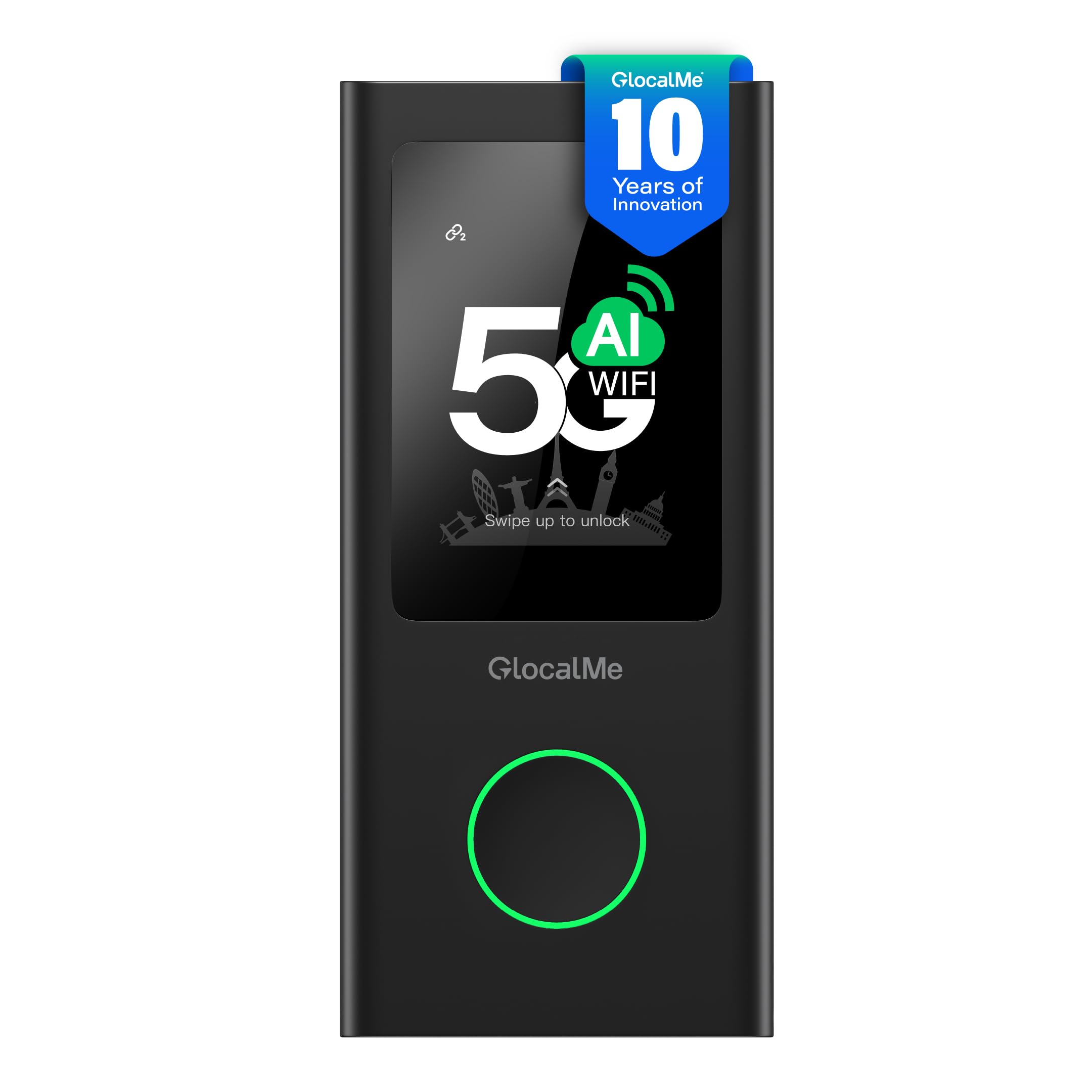
A CloudSIM 5G hotspot rated up to 2.5 Gbps that picks the best network across 200+ countries, no SIM required.
Here is the headline number: speeds up to 2.5 Gbps. That is well beyond the 150 Mbps the GlocalMe UPP is rated for and beyond the TCL Linkzone’s 1000 Mbps, making this the fastest SIM-free hotspot in the group. It works with more than 90 commercialized 5G countries and over 390 operator networks, and supports both 2.4GHz and 5GHz bands to manage interference in crowded places.
The clever part is CloudSIM technology — no physical SIM needed. It intelligently selects the network with the best signal, so you pay as you go with no contract and no roaming fee, choosing data packages across 200+ countries by the day, month, or gigabyte. If you prefer your own carrier, the SIM slot is open up for any SIM.
What keeps people happy is performance — the most-praised trait by a wide margin, ahead of speed and ease of use. A 2.4-inch LCD touch screen handles data monitoring and device management, up to 16 devices can share the connection, and it works as a power bank when your phone is running low. The honest note is the cost of entry and of the data plans themselves, which some find expensive — this is a premium device for someone who values speed over savings.
Performance first: 2.5 Gbps and global carrier switching is the combination that justifies the top-tier position.
The cost question: the pay-as-you-go data model is convenient but not the cheapest way to get online.
Weigh it for: international professionals and heavy streamers who want the highest stated speed without a SIM.
Pause if: your data budget is tight or your trips stay within one good carrier’s footprint.
Know the Specs
Download Speed (Mbps and Gbps)
Download speed measures how fast data arrives at the hotspot, in megabits per second (Mbps) or gigabits per second (Gbps). A 150 Mbps hotspot is fine for browsing and video calls; a 1000 Mbps device is aimed at heavy cloud work and multiple screens. Remember that this is a ceiling — the tower’s real-world speed is often lower. The 8 Gbps figure on the Nighthawk M6 Pro reflects its 5G mmWave hardware, not a promise at every location.
Battery mAh and Hours
Milliamp-hours (mAh) size the battery, while the hours rating tells you how long it runs in normal use. A 2930 mAh cell is rated up to 11 hours on the NETGEAR AC797, and a 3000 mAh cell runs over 15 hours on the AT&T Turbo Hotspot 3, because the radios differ in efficiency. Always plan around the hours figure and keep a charging cable handy.
Device Count
The device count is the number of phones, laptops, tablets, and smart TVs that can share the connection simultaneously. Entry travel hotspots handle around 8 devices, while the TCL Linkzone and Nighthawk M6 Pro allow up to 32. Buy headroom above the number your group actually carries.
SIM, eSIM, and CloudSIM
A standard SIM is a physical card from a carrier; an eSIM is a chip built in and activated by download; CloudSIM is a subscription service that connects to partner networks automatically without any card. SIM-free devices shine for international travel, while SIM-based hotspots like the Franklin A50 keep costs simple if you already have a carrier plan.
Common Questions
Will a mobile hotspot work with my current phone carrier?
How long does a hotspot battery actually last on a trip?
Do I need a SIM card to use a travel hotspot?
What does a 5G hotspot do that a 4G one cannot?
How many devices can connect to a hotspot at the same time?
Can a hotspot charge my phone too?
Is a SIM-free hotspot more expensive than a carrier one?
Does an incoming call interrupt the hotspot connection?
Can I use a hotspot while it is charging?
The Bottom Line
For most buyers, the best wireless wi-fi hotspot is the NETGEAR AC797-100NAS — 400 Mbps combined with a straightforward SIM-based setup beats everything else for simplicity. If you need 5G speed, the TCL Linkzone offers 1000 Mbps across 32 devices. For a rugged, self-switching travel companion, the SIMO Solis 5G earns its keep with its IP54 design and 1GB monthly data. Pick the one whose carrier and battery fit your habits, and you will have a hotspot you can actually trust on the road.
How we choose
We do not accept paid placement. Every pick is matched to a real buyer and a real use-case; we do not hands-on test units.
Sources
Specifications: manufacturer listings and product documentation. Review insights: verified customer reviews, as of November 2026. Pricing: not shown on this page (it changes often); check the current price via the retailer link.
As an Amazon Associate, Tactical Gear Guy earns from qualifying purchases. This does not affect which products we feature.