Specs are compiled from manufacturer listings and verified buyer reviews and can change over time — please confirm the key details on the product page before buying.
The right wireless weather station for home use puts your own backyard’s temperature, humidity, wind and rain on an indoor display — not a regional forecast that describes a town thirty minutes away. This guide covers nine stations that all beam outdoor readings from a wireless sensor to an indoor display, so you can see what is actually happening outside your door. One note up front: this list uses flexible, human-like matching for that wireless sensor-to-display requirement, so not every pick is the exact model you searched for. The nearest same-type station serves the same job, and I flag what each one actually measures.
This guide is built by comparing the manufacturers’ published specifications and the patterns across verified customer reviews, so you get each pick’s real strengths and trade-offs instead of marketing spin.
A station without wind and rain sensors will not tell you how hard it is gusting or how much fell overnight. The pick that balances accuracy, sensor coverage and a display you can read at a glance matters more than any single headline feature in a wireless weather station for home.
Top Picks

How To Choose The Best Wireless Weather Station for Home
You want numbers that describe your yard, not the airport weather report. That single goal decides everything else: which sensors you need, how far the outdoor unit can sit, and how much you want to see without reaching for a phone.
Sensor coverage decides what you actually know
A temperature-and-humidity sensor tells you it is humid but not whether a storm is blowing in. Add wind speed and direction plus a rain gauge and you can judge whether to open the patio umbrella or bring the laundry in. Stations with five or seven outdoor measurements (temperature, humidity, wind speed, wind direction, rainfall, and sometimes sunlight) give you the fuller picture. Simpler stations that track only temperature and humidity are the entry tier; they are honest and cheap, but they leave the wind and rain out.
Wireless range and transmission frequency
The outdoor sensor talks to the indoor display over a wireless radio link. That link has a distance limit, quoted in feet or metres, and a frequency such as 433 MHz or 915 MHz. A longer quoted range means you can mount the sensor further from the house without losing the signal. Keep in mind that walls, metal fencing and signal towers all cut that range in real life, so leave headroom between your actual distance and the quoted maximum.
Display readability and backlight
A station is only useful if you can read it from your chair. Look for a colour LCD (liquid-crystal display) with adjustable brightness levels. Run it on the included power adapter and the screen can stay lit; run it on batteries alone and many units dim or shut the screen off after a few seconds to save power. That trade-off matters if you want to glance at it in the middle of the night.
Side-by-Side Comparison
| Model | Best For | Wireless Link | Outdoor Sensors | Power | Amazon |
|---|---|---|---|---|---|
| AcuRite Notos (01604A2)★ Best Overall | Balanced all-round pick | Wireless | 3-in-1 (temp, humidity, wind) | Electric with battery backup | Amazon |
| Sainlogic High-Precision (SA9)Top Performer | Precision with data history | 5 GHz/2.4 GHz Wi-Fi | All-in-one (wind, rain, temp, humidity) | 3 AA batteries | Amazon |
| AcuRite Iris (01517RM)Widest Sensor Set | Widest sensor set | Wireless | 5-in-1 (adds rain) | Electric with battery backup | Amazon |
| Sainlogic AI Forecast (B0GXFBT2D6) | Max display and data | 5 GHz/2.4 GHz Wi-Fi | All-in-one with rain gauge | 3 AA batteries | Amazon |
| Ambient Weather WS-1965 | Smart-home integration | Wi-Fi (915 MHz sensor) | All-in-one (wind, rain, temp, humidity) | Not specified | Amazon |
| VEVOR YT60234 | Solar-powered, long range | 2.4 GHz Wi-Fi | 7-in-1 (adds light) | Solar + rechargeable | Amazon |
| VEVOR 7-in-1 App (B0FM3CVKNL) | App control without fees | 2.4 GHz Wi-Fi | 7-in-1 | Solar + rechargeable | Amazon |
| LFF with 3 Sensors | Multi-room monitoring | Wireless (330 ft) | 3 temp/humidity sensors | AC adapter or 2 AAA | Amazon |
| La Crosse S77925-INT | Simple colour forecast | 433 MHz | Temp and humidity | AC powered | Amazon |
Detailed Reviews
1. AcuRite Notos 01604A2 Weather Station
Our pick — 4.5+★ from 550+ verified ratings; the strongest balance of quality and price.
The do-it-all starter station that reads like a small backyard observatory.
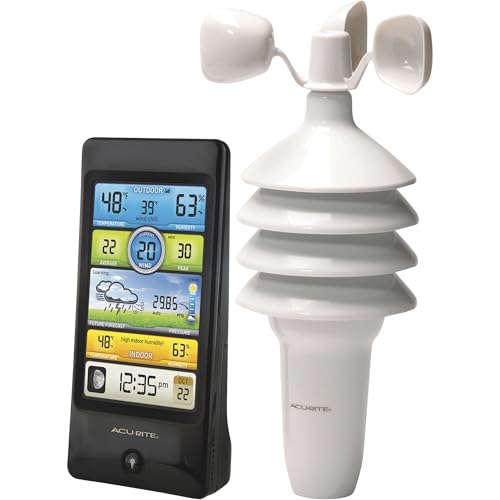
The three-in-one outdoor sensor tracks temperature, humidity and wind speed from one mounted unit, so you get the readings most people actually climb a ladder to check. It updates current wind speed, average wind speed and peak wind speed every 18 seconds — fast enough to see a real gust build and pass. An 18-second refresh means a gust shows up on the display while it is still blowing, not minutes after it passes.
The colour display is electric-powered with an optional battery backup, so a power cut does not blank your screen. The maker rates the sensor batteries for 2 years and quotes 17,500 hours of battery life, which is the sort of lifespan that means you set it up and mostly forget the sensor is up there. It also logs daily and all-time high and low records, so you can look back and say “the coldest night this year was…” without writing anything down.
What keeps this in the top spot is the way owners describe it: quality and functionality dominate the feedback, and the recurring word is solid. There is an honest caveat — the display divides people. Some find it easy to read, others find it washes out, and temperature and wind readings draw mixed notes about small offsets. For a backyard reference and trend view, that is a manageable trade-off, and it is why this is the pick most people should start with.
What earns it the crown
- Three outdoor measurements from one sensor: temperature, humidity and wind speed
- Wind updates every 18 seconds, tracking current, average and peak speed
- 2-year battery life on the sensor (17,500 hours quoted)
- Full colour display with adjustable dimmer and battery backup
- Daily plus all-time high and low records stored on the console
Where it asks patience
- Display readability is split — bright rooms can wash it out
- Accuracy notes put temperature slightly below actual for some owners
- Wind speed readings get mixed feedback
- No rainfall gauge — that step up costs more in other picks
Buy this if: you want temperature, humidity and wind in one wire, with records logged and a screen you can dim at night.
Step up instead: if rainfall totals matter to you, jump to the AcuRite Iris below, which adds a rain gauge to the five-in-one sensor.
2. Sainlogic 5G&2.4G WiFi Weather Station
A precision-tuned console with a notebook built in, for people who track trends.
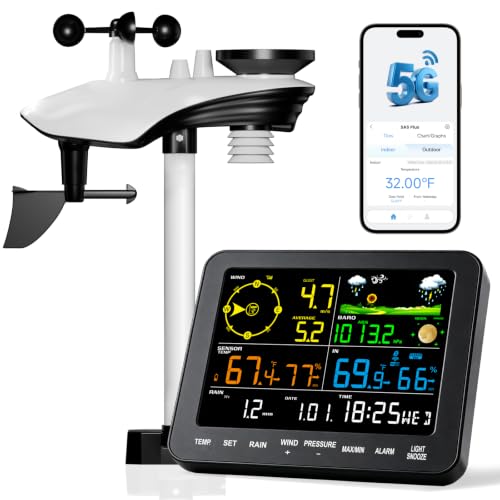
Here is the number that separates this station from the pack: temperature accuracy of ±0.2°C and humidity accuracy of ±1.8%RH, driven by an imported Swiss sensor chip. In plain terms, that is a tight tolerance (the ± figure is how far a reading can drift either side of true) — helpful in a greenhouse, a wine cellar or a nursery where a couple of degrees swings how you water or ventilate. The all-in-one outdoor unit covers temperature, humidity, barometric pressure, wind speed, wind direction and rainfall, so the sensor array does most of the measuring from one spot.
The Wi-Fi side is the reason to pay attention if you like records. It holds up to 2 years of local weather data with no subscription, and you can export it to Excel to chart temperature, humidity and extremes. It also links to the Inercom App, Weather Underground and Alexa, so remote checking and smart-home triggers are in reach. The wireless link is quoted at a 443 ft range in open areas, which gives you room to site the sensor at the back of a garden or on a farm outbuilding.
The most-repeated praise is simple build quality, with accuracy and setup close behind, and the sense from owners is that the numbers feel believable and the pairing is quick. The catch sits in the display: it draws mixed feelings, bright and legible for some and not quite what others wanted. Pair it with the fact that it runs on 3 AA batteries (not included) and you have the trade-off to weigh before you commit.
The precision payoff: the ±0.2°C and ±1.8%RH tolerances and the free 2-year Excel export make this the pick for gardeners, growers and anyone keeping a weather log rather than just a running number.
The honesty clause: display opinions are split, and the batteries are a separate buy, so budget the setup time and the AA pack before you mount it.
Right for record-keepers: choose this if you want tight tolerances, cloud sharing and a searchable history without a monthly fee.
Think twice if: a big, always-lit screen is your one priority — the Ambient Weather or the Sainlogic AI model both make the display a headline.
3. AcuRite Iris (01517RM) Weather Station with Vertical Display
Five outdoor measurements and a ticker that scrolls the day’s weather past you.
If you want the full picture, this is the station that adds rain to the wind. The five-in-one wireless sensor measures temperature, humidity, wind speed, wind direction and rainfall from one rooftop unit. Rainfall is tracked by day, month, year and all-time, so an overnight downpour is recorded rather than guessed at. That rainfall log is exactly the thing the AcuRite Notos above leaves out, and it is the main reason to climb to this tier.
A vertical colour display runs the show, with an adjustable dimmer and electric power plus an optional battery backup. A Weather Ticker streams real-time notes like the moon phase, indoor comfort level and “feels like” temperature across the screen. The maker also quotes 20,000 hours of battery life, which keeps the outdoor sensor going for a long stretch between changes. It is a heavier, more committed setup than the Notos, and the vertical format suits a wall or shelf where you glance up at it.
Owners settle into this one because the display reads easily from all angles and the data feels complete. Quality is the single most-praised trait by a wide margin, with functionality right behind it. The honest limit: accuracy draws mixed notes, some pointing to temperature readings off the mark, and value-for-money also splits. It is still a strong station; just do not expect lab-grade precision at every reading.
Where it wins: five outdoor measurements plus day, month, year and all-time rain tracking — a genuine weather record, not just a snapshot.
Where to be careful: mount the sensor with a clear, level spot so wind and rain readings stay honest, and accept that some owners see small temperature offsets.
Pick it for the rain gauge: this is your station if precipitation totals, comfort level and a scrolling data ticker are what you want on the wall.
Look elsewhere if: you only need outdoor temperature and humidity — a simpler two-value station does that job for less.
4. Sainlogic 5GHz/2.4GHz WiFi Weather Station
An 8.5-inch screen that turns your living room wall into a weather dashboard.
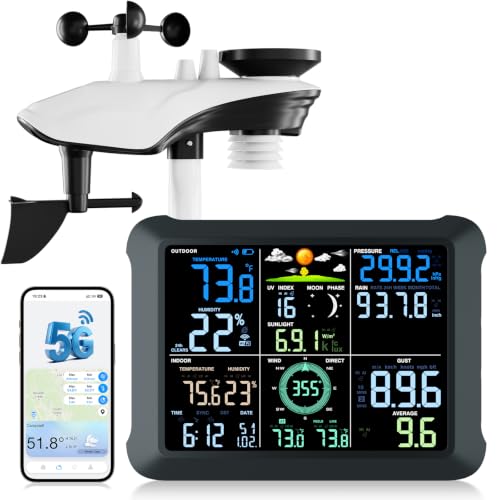
The largest display on this list sits at 8.5 inches, with wide-angle viewing so the numbers stay readable from across the room. At 8.5 inches, temperature, humidity, rainfall, wind speed, air pressure and moon phase each get their own labelled block instead of being crammed into one small window. Connect it over dual-band 5 GHz or 2.4 GHz Wi-Fi and the AI forecast engine pushes 24-hour and 7-day outlooks to your phone and email, with instant alerts when temperature, humidity or pressure shifts.
The rain side is unusually fussy in a good way. Rainfall is measured to ±1mm for totals under 15mm and ±7% for totals above 15mm, and a built-in bubble level helps you mount the gauge dead horizontal — a detail that matters, because a tilted rain gauge overcounts. The sensor itself uses a Swiss chip rated to ±0.2°C and ±1.8% RH. Transmission range reaches 135m / 443ft, which is generous for a large backyard or a property with outbuildings. Data logs every 5 minutes, and 2 years of history is exportable to Excel.
Setup is the thing owners talk about most, and they talk about it warmly — the station goes together and reads out without a fight. Connectivity to Wi-Fi is the wobbly part for some, and the included directions draw complaints for being thin. Accuracy of temperature also divides opinion. None of that sinks it; it just means you should have your router band and a little patience ready at install.
Reasons to reach for this one
- 8.5-inch wide-view LCD that stays legible across the room
- 24-hour and 7-day AI forecast with app and email alerts
- Rain gauge accurate to ±1mm under 15mm and ±7% above
- 443ft transmission range for big yards
- 2 years of history, exportable to Excel, refreshed every 5 minutes
Set your expectations here
- Wi-Fi setup can be finicky on first connect
- Directions are described as thinner than they should be
- Temperature accuracy splits opinion
- Runs on 3 AA batteries, which you supply
Reach for this if: you want the biggest, clearest dashboard screen plus app alerts and serious rain tracking.
Skip this one if: you would rather not deal with Wi-Fi setup — a purely wireless display station like the AcuRite Iris avoids the router entirely.
5. Ambient Weather WS-1965 Wi-Fi Weather Station

The station that feeds your smart home, not just your eyes.
An all-in-one sensor array measures temperature, humidity, barometric pressure, wind speed, wind direction and rainfall, and it pushes fresh readings to the console every 16 seconds. A 16-second refresh means a wind shift reaches the console almost as it happens rather than lagging behind. The colour LCD display is the second half of the kit, so you get a wall readout plus the data stream behind it.
Where this pulls ahead is integration. It works with IFTTT, Google Home and Alexa, so you can program your home around the weather — trigger a fan, a notification, a schedule — rather than only watching the numbers. It can also transmit to the Ambient Weather Network (AWN), a large personal weather station community where you can personalize a dashboard and share your local conditions. The indoor-to-outdoor radio link runs at 915 MHz (a frequency band that some find less crowded than the common 433 MHz).
Owners lean on this one for its stability and its precision — consistent readings that line up with official forecasts is the theme. Connectivity and reliability are where opinions part ways, with a share of users running into Wi-Fi trouble or a unit that stops responding. Display size also gets noted negatively, so go in expecting a compact console rather than a wall-sized one. For a smart-home tinkerer, the integration upside outweighs those notes; for a plug-and-watch buyer, it is worth knowing.
The smart-home angle: 16-second updates plus IFTTT, Alexa and Google Home support make this the automation-friendly pick in the lineup.
The fair warning: Wi-Fi pairing and long-term reliability draw mixed notes, and the display is on the small side.
For the connected home: choose this if you want weather data wired into automations and a personal-weather-network dashboard.
Pass if: you want a big screen and nothing to do with an app — the Sainlogic AI model gives you the larger display.
6. VEVOR YT60234 WiFi Weather Station

Seven measurements, solar top-up, and a waterproof sensor that shrugs off a downpour.
This is the pick that tracks the most from one sensor: wind speed, wind direction, temperature, humidity, rainfall and light, with wind chill, dew point, pressure, calendar and moon phase on the display. The outdoor unit carries an IPX6 waterproof rating (the IPX6 part is a water-jet resistance grade), so it is built to keep reading through heavy rainfall. A 4 x 3 in / 100 x 70 mm solar panel tops up the rechargeable Ni-MH batteries on sunny days, with the batteries taking over at night or in cloud — fewer swaps over the years.
Wi-Fi pulls the readings onto your phone, and it connects to Weather Underground and WeatherCloud so you can join the wider weather-watching community. The sensor reaches up to 150m, which gives you real freedom in where you plant it — a rooftop, a chimney, a farm or a big courtyard garden. The 7.5-inch screen has a 4-level dimming function spanning 100% to 60% to 30% to 0%, and time syncs automatically over the internet.
Owners like the setup and the value; it goes together without drama and covers a lot for the outlay. The recurring friction is Wi-Fi — some people link it to Weather Underground inside an hour, others wrestle with it for far longer. Treat the app connection as a bonus rather than the core, and keep the adapter plugged in (it has to stay connected for Wi-Fi and date sync). Used as a local display with solar-fed sensors, it does its job well.
Standout strengths
- 7-in-1 sensor adds light readings to wind, rain, temp and humidity
- IPX6 waterproof housing built for heavy rain
- Solar panel with rechargeable Ni-MH batteries to cut swaps
- 150m sensor range for rooftops, farms and big gardens
- 7.5-inch screen with 4-level dimming down to off
Trade-offs to know
- Wi-Fi setup is hit-or-miss for some owners
- Adapter must stay plugged in for Wi-Fi and date sync
- Extra outdoor features mean more to mount and align
Great fit for: properties where running power to the sensor is awkward — solar top-up and 150m range do the heavy lifting.
Not the simplest: if you dislike troubleshooting an app, the plug-and-watch stations higher up this list will feel easier.
7. VEVOR 7-in-1 Wi-Fi Weather Station
Real-time weather on the Smart Life app, with no weather-site signup required.
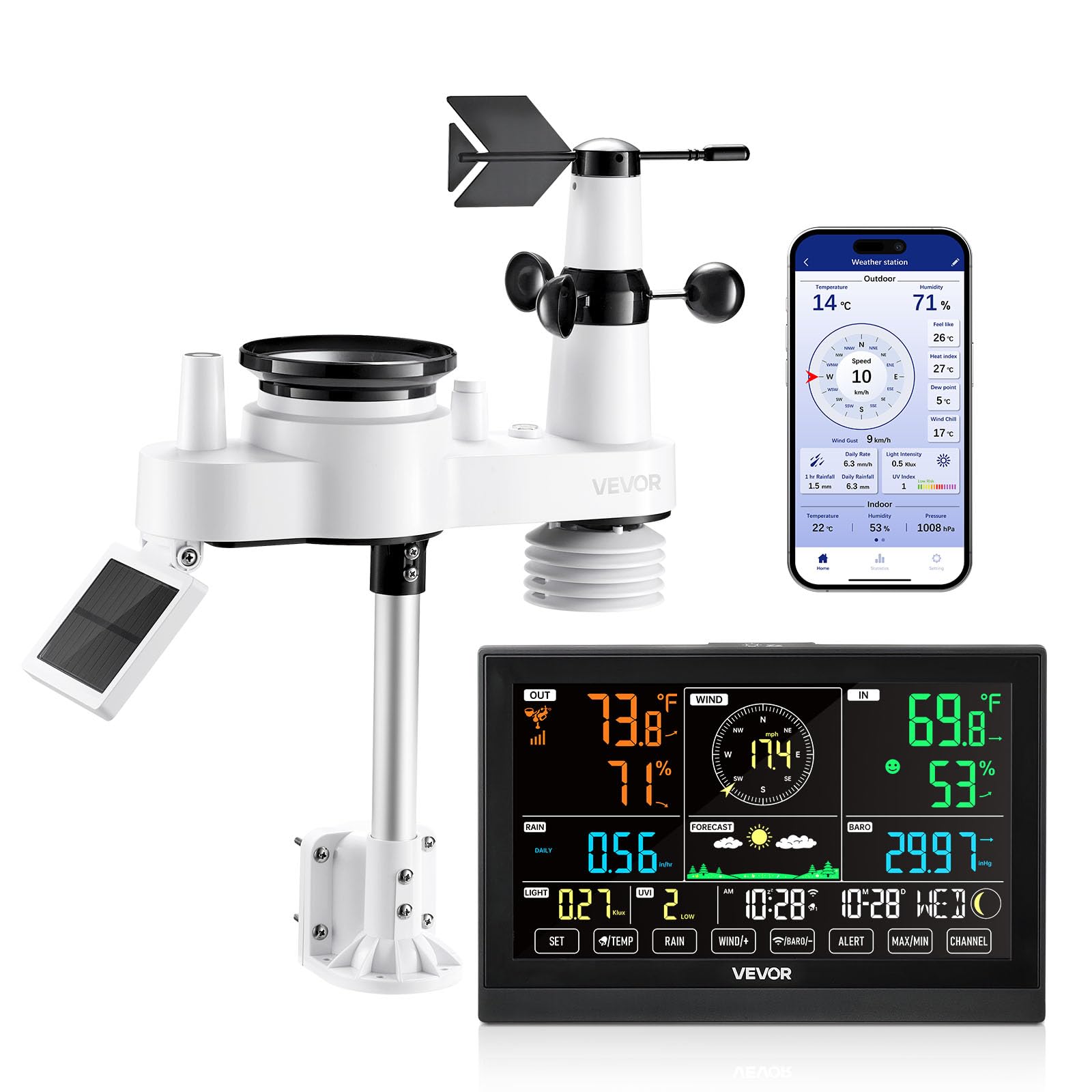
VEVOR’s second station on this list fixes the fiddliest part of the first: instead of tying into a weather website, it runs on the Smart Life app with no need to register, no ads and no paid plans. The seven-in-one outdoor sensor tracks temperature, humidity, rainfall, wind speed, direction and sunlight, and the whole set-up has been reworked to better resist water intrusion. It also accepts NiMH battery charging and uses an aluminium alloy rod and charging box for a sturdier mount.
The 7.5-inch screen has four brightness levels, so it fits a living room or bedroom without glare. The sensor transmits up to 492 ft (150 m), which handles a rooftop, garden or farm install. To actually get that 492 ft, keep the sensor away from metal fences, TVs, towers and power lines, which all eat the signal. Sync requires the adapter to stay plugged in, and the Wi-Fi is 2.4 GHz only — a 5 GHz network will not connect.
Build quality and setup are the glowing parts of the feedback, and the temperature readings come across as accurate. The app itself works well for some. But functionality and accuracy split down the middle: wind speed tends to read low, and the rain gauge draws complaints. Connectivity is another gamble, with frequent disconnections reported. If you want the app to be flawless, weigh that; if you want a solar-fed station with an easy, ad-free app, it has a lot to offer.
The sell: an ad-free Smart Life app plus solar charging and 492 ft range makes this the convenient app-first pick.
Read before buying: the rain gauge and wind accuracy are the weak points, and it needs a 2.4 GHz network — check that before you order.
Choose it for the app: pick this if you want phone-first weather control with no signups and no subscription.
Choose differently if: reliable rainfall and wind numbers are essential — the Sainlogic AI model measures rain more precisely.
8. LFF Weather Station

Three sensors in three places, so you can watch temperature across the whole house.
Most stations measure outdoors once. This one ships with three outdoor sensors, so you can drop them in three spots — a porch, a greenhouse, a garage — and see temperature and humidity from each on one display. Each sensor reaches 330 ft / 100 m in open air, but you must set them to channel 1, channel 2 and channel 3 to link them all. Set the three sensors to channel 1, 2 and 3 during setup, or the display will only see one of them. Also note the display measures at 7.48″D x 0.59″W x 5.12″H — a slim panel that sits on a shelf rather than taking over a wall.
The 7.5-inch colour touch screen shows a 6-to-12-hour forecast using six icons (sunny, slightly cloudy, cloudy, rainy, heavy rain, snow) and carries a self-calibrating atomic clock that syncs to the WWVB signal. You pick your time zone (AST, EST, CST, MST, PST, AKT or HST) and it corrects the time itself. Two alarms with snooze, comfort-level icons, barometric pressure and max/min records round it out. Run it on the included AC adapter and the screen stays on; switch to 2 AAA batteries and the display drops off after about 10 seconds to save power.
The display is the star for owners: bright, vivid colour and easy to read, with the indoor temperature read as accurate. The honest catch is that some find the main monitor reads about 6 degrees higher than the actual room temperature, so treat its indoor number as a rough gauge and lean on the sensors for precision. For multi-room watching, it does one job well: showing temperature and humidity in three places at once on a single 7.5-inch screen.
Its real trick: three sensors in one box turns this from a backyard station into a whole-home temperature map.
The catch: the console’s own indoor reading runs warm for some, so trust the sensors over the display when precision matters.
For spread-out homes: choose this if you want to compare a garage, a greenhouse and a porch from one screen.
Look elsewhere if: you need wind and rain data — this one tracks temperature and humidity only.
9. La Crosse Technology S77925-INT Weather Station

A tidy colour console that does the essentials with a gentle learning curve.
If you want indoor and outdoor temperature and humidity with a clear colour forecast, this is the simple one. The display runs 8.98 inches wide — noticeably broader than the LFF panel — while sitting only 1.14 inches deep, so it faces you squarely on a shelf. It shows current indoor and outdoor temperatures and humidity, a HI/LO custom alert for both, plus dew point and heat index views. A 24-hour barometric pressure graph rounds out the picture, and dynamic forecast icons with trend arrows read the outlook at a glance.
The sensor-to-display link runs at 433 MHz and reaches across a normal home. The atomic clock self-sets in 12- or 24-hour mode, handles the seven time zones and Daylight Savings automatically, and adds a crescendo alarm with a 10-minute snooze. Power comes from the included 5V cord for a constant, adjustable backlight; if you want battery backup you add 3 AA alkalines (not included), and on battery alone the backlight only lights up when you press it. Just give the forecast 7-10 days to calibrate the barometric sensor before you judge it.
What people appreciate is the easy setup and the colour display — it looks the part and goes together quickly. Where it divides: visibility at an angle draws mixed notes, accuracy has its doubters, and a few units have been known to fail after a day. That last point is rare, but worth knowing before you commit to leaving it running. As a straightforward everyday console for the basics, it earns its place.
Why it earns its spot
- Wide 8.98-inch colour display with forecast icons and trend arrows
- Indoor and outdoor temp and humidity plus HI/LO custom alerts
- Atomic clock self-sets across seven time zones and handles DST
- Dew point, heat index and a 24-hour pressure graph
The fine print
- Visibility at an angle is mixed
- Accuracy has some doubters; allow 7-10 days for forecast calibration
- A rare unit fails after a short time
- Battery backup needs 3 AA batteries you supply
Best for the basics: choose this if you want clear colour temp, humidity and forecast in a tidy console with an atomic clock.
Not for wind chasers: there is no wind or rain sensor here — step up to the AcuRite Iris for that coverage.
Know the Specs
Wireless transmission range and frequency
The outdoor sensor sends its readings to the indoor console over a wireless radio link. That link has a maximum quoted range in feet or metres — 330 ft, 443 ft, up to 150m — and a frequency band such as 433 MHz or 915 MHz. A larger range lets you mount the sensor further from the house without dropouts, but walls, metal fences and signal towers all cut the real-world distance, so leave margin between your install and the quoted limit.
Wi-Fi, apps and data history
A Wi-Fi station adds a phone app, cloud dashboards and alerts on top of the indoor screen. That extra layer means you can check readings remotely and, on models like the Sainlogic pair, store months or years of history and export it to Excel. The catch is that Wi-Fi setup is where many stations get fussy, so have your network band ready — several models here need a 2.4 GHz network and will not accept 5 GHz.
Sensor coverage: temp, humidity, wind, rain
Every station measures temperature and humidity. Wind speed and direction come from an anemometer and vane, and rainfall needs a tipping-bucket rain gauge. Each added measurement means more to mount and align — a station with seven values needs careful horizontal placement, and a bubble level helps. Decide which numbers you will actually use; a wind-and-rain station is overkill if you only care about overnight lows.
Power and backlight behaviour
Most consoles run from an included power adapter, with batteries as backup or a fallback. Run on the adapter and the backlight can stay on at a dimmable level; run on batteries alone and many units dim or shut the screen off to save power. Outdoor sensors typically run on AA or rechargeable Ni-MH batteries, some with a solar panel topping them up. Check whether the adapter must stay plugged in for Wi-Fi and time sync — on several models it must.
Common Questions
How far can the outdoor sensor sit from the indoor display?
Do these stations need Wi-Fi, or can they run without it?
Will a Wi-Fi station work on my 5 GHz network?
How long do the outdoor sensor batteries last?
Can I read the display in the dark?
Why does my station’s forecast take days to settle?
What does an IPX6 rating mean on an outdoor sensor?
Can I add more sensors or share data with a weather network?
Is a colour touch screen worth it over a simple LCD?
Do I have to mount the sensor on the roof?
The Bottom Line
For most homes, the strongest all-rounder in this wireless weather station for home lineup is the AcuRite Notos (01604A2) — it pairs temperature, humidity and wind speed updates every 18 seconds with a 2-year sensor battery and a full colour display you can dim at night. That mix of three outdoor measurements, 18-second wind updates and a dimmable colour display is why it takes the top spot, and it earns a 4.5+ star rating across 500+ ratings.
If you want precision and a searchable history, the Sainlogic 5G&2.4G WiFi Weather Station brings ±0.2°C temperature accuracy and a free 2-year Excel export. For the widest sensor coverage including a rain gauge, reach for the AcuRite Iris (01517RM), and for the largest dashboard screen with app alerts, the Sainlogic AI Forecast model delivers an 8.5-inch display and rain tracking to ±1mm under 15mm. Whichever you pick, the honest nudge is simple: match the station to the numbers you will actually read — wind and rain coverage only pays off if you look at them — and you will be checking your own backyard’s weather instead of guessing at the regional forecast.
How we choose
We do not accept paid placement. Every pick is matched to a real buyer and a real use-case; we do not hands-on test units.
Sources
Specifications: manufacturer listings and product documentation. Review insights: verified customer reviews, as of November 2026. Pricing: not shown on this page (it changes often); check the current price via the retailer link.
As an Amazon Associate, Tactical Gear Guy earns from qualifying purchases. This does not affect which products we feature.