Specs are compiled from manufacturer listings and verified buyer reviews and can change over time — please confirm the key details on the product page before buying.
You want a phone that lets you walk the warehouse floor, answer a call at the register, and still sound clear to the customer on the other end — without a cord tethering you to a desk. That means a wireless VoIP phone that talks to your SIP provider over either a DECT base station or your Wi-Fi network, and the choice between those two is the single decision that shapes everything else: coverage, battery, and how many calls the system can juggle at once.
This guide is built by comparing the manufacturers’ published specifications and the patterns across verified customer reviews, so you get each pick’s real strengths and trade-offs instead of marketing spin.
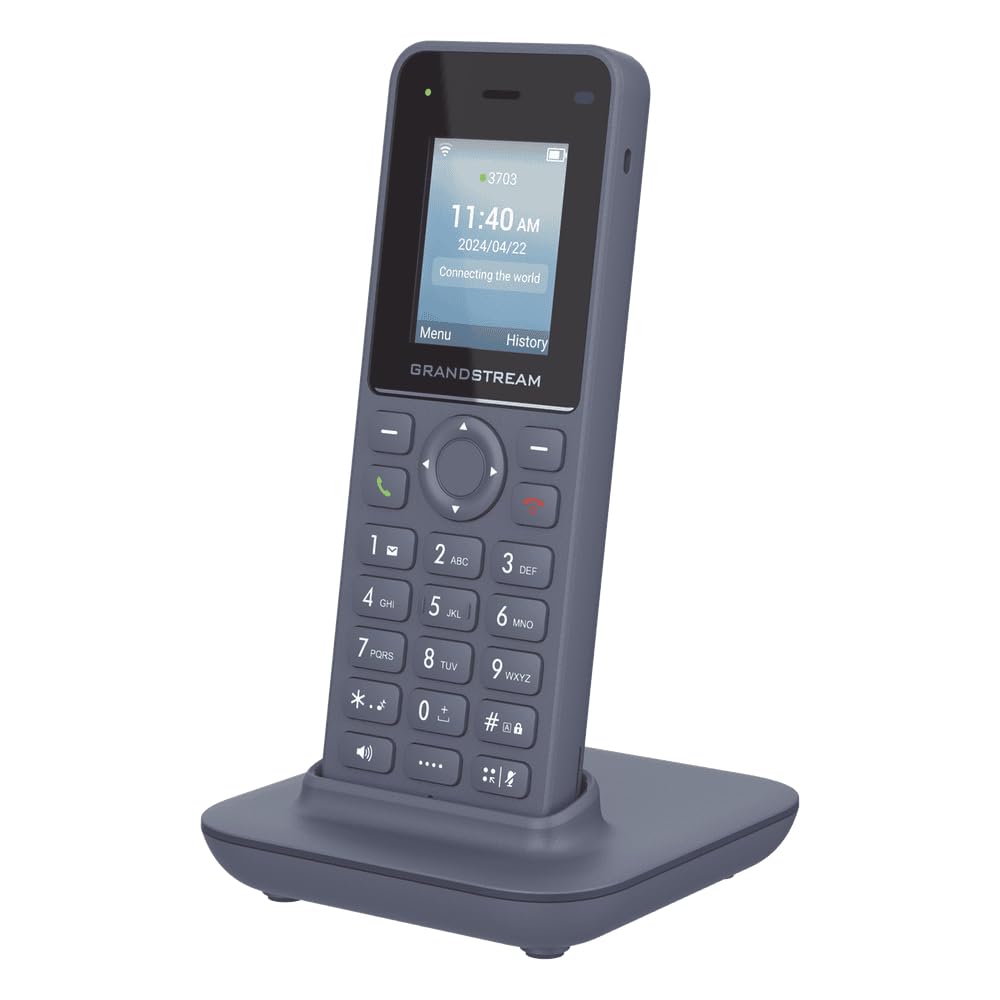
Below you’ll find nine real handsets sorted into the jobs they actually do, from a single roaming Wi-Fi phone to a multi-handset DECT base. Each entry covers talk time, SIP capacity, and the everyday snags that show up once the phone leaves the box so you can pick the right wireless voip phone on the first try.
Top Picks


How To Choose The Best Wireless VoIP Phone
The first fork in the road is how the handset reaches your phone system. A DECT phone links to a base station that plugs into your network, and that base then relays to the handset over a dedicated radio band. A Wi-Fi phone skips the base entirely and logs onto your existing wireless network like a laptop would. Neither is universally better — they fail in different buildings.
DECT base versus Wi-Fi handset
DECT gives you a self-contained radio link that doesn’t compete with staff laptops and guest devices on your Wi-Fi. It’s the safer bet in a dense office where the wireless network is already crowded. A Wi-Fi handset wins when you want one phone that roams across a campus with many access points and no base station to mount. The trade-off is that Wi-Fi calling quality rises and falls with your network’s roaming setup.
SIP accounts and lines decide your call ceiling
These two numbers are not the same thing. A SIP account is a registration with your provider; a line is a call path the handset can use. A phone with 10 SIP accounts and 10 lines can handle far more simultaneous conversation than one with 2 of each. Match the count to how many people share the device, not to how many people work in the building.
Talk time, standby, and the charger habit
Published talk time assumes ideal conditions, so treat it as a ceiling. Standby time matters more for a phone that lives in a cradle and only leaves it during a shift. A long standby figure means the handset isn’t dead when someone finally picks it up after a quiet morning.
Side-by-Side Comparison
| Model | Best For | Talk Time | SIP Accounts | Connection | Amazon |
|---|---|---|---|---|---|
| Yealink W73P | Busy front desk | Up to 35 hours | Up to 10 | DECT base station | Amazon |
| Grandstream WP826 | Everyday office calling | — | — | Wi-Fi | Amazon |
| Grandstream DP730 | Long-shift coverage | 40 hours | Up to 10 | DECT base station | Amazon |
| Grandstream WP820 | Pocketable portability | 7.5 hours | — | Wi-Fi | Amazon |
| Grandstream DP750 + DP720 | Multi-handset teams | — | Up to 10 per handset | DECT base station | Amazon |
| Yealink W76P | Security-minded offices | Up to 30 hours | Up to 10 | DECT base station | Amazon |
Detailed Reviews
1. Yealink W73P DECT Cordless IP Phone System
Ten SIP accounts and a DECT base that keeps a busy front desk running all day.
If your front desk fields several calls at once and needs a handset that can leave the desk without going quiet, this is the pick to beat. It supports up to 10 SIP accounts and up to 20 simultaneous calls, which means the phone isn’t the thing that caps how many conversations your team can hold. That headroom is the whole reason it takes the top slot.
The handset runs up to 35 hours of talk time and up to 400 hours of standby in ideal conditions, so a single overnight charge carries you through a long shift without a scramble for the cradle. The 1.8-inch 128 x 160 TFT color screen is small but legible, and the interface is laid out so a new employee can navigate it on day one. It also handles the Opus audio codec, which is the compression standard that keeps voice sounding natural over an IP network, and layers in a Flexible Noise Reduction system that dials down background hiss.
Buyers praise the build quality above all, and the base accepts both older and newer Yealink handsets — a real comfort if you’re expanding an existing setup rather than starting from scratch. The catch is scale: this is a single-handset bundle, and while the system supports up to 10 DECT cordless handsets, you’d add those separately. One more thing to plan for — DECT means the base needs a wired network connection and power, so you’re not fully wireless at the desk itself.
Where It Delivers
- Up to 10 SIP accounts and up to 20 simultaneous calls for a genuinely busy desk
- Up to 35-hour talk time and up to 400-hour standby in ideal conditions
- Opus codec plus Flexible Noise Reduction keeps voices clear in a noisy room
- Base accepts both older and newer handsets, so it fits an existing fleet
What To Plan Around
- Ships as a single handset — extra DECT handsets are a separate purchase
- Base station itself needs wired Ethernet and power at the desk
- The 1.8-inch screen is compact for anyone used to a large desk display
Go for it when: you run a reception or support desk that fields multiple calls and want a cordless handset that keeps up. Hold off when: you need several people on handsets from day one — budget for the additional DECT handsets up front.
2. Grandstream WP816 Compact Portable Wi-Fi Phone
Check Price on Amazon
A 4-inch color screen on a Wi-Fi handset that connects to nearly any VoIP service.
The screen is what you notice first. That 4-inch color LCD gives you a clear, readable interface for navigating menus and managing calls — genuinely useful when you’re working through a directory or juggling a transfer, and a real step up in legibility from the compact displays on smaller handsets. It’s a cordless Wi-Fi phone, so it moves with you around the office instead of tying you to a fixed desk station.
Where this one earns its reputation is connection. It’s a flexible device that cooperates with a wide spread of VoIP systems and Wi-Fi networks, and it carries a dual keypad layout for dialing. Buyers report it plays nicely with cloud phone services and PBX platforms, and the sound comes through clean and the chassis feels solid in the hand. For a mid-sized office that wants one reliable wireless extension without rebuilding its network, that compatibility story is the selling point.
The snag to expect is setup. Configuration feedback splits down the middle — some find it quick to bring online, others hit a steeper climb. If you’re comfortable with SIP settings and your provider’s portal, that’s a non-issue; if you’re not, budget time or bring in whoever manages your phone system. It’s rated for 6 hours of talk time and 120 hours of standby on a 1500mAh battery, with 2 SIP accounts and 2 lines — modest capacity, so confirm it fits your provider’s plan before you commit.
The Strong Hand
- Connects smoothly across a wide range of VoIP services and Wi-Fi networks
- Clear, sturdy build with sound quality that holds up on calls
- 4-inch color LCD makes menus and call management easy to read
- Dual keypad gives you flexible dialing options
The Fine Print
- Setup experience is split — straightforward for some, fiddly for others
- Only 2 SIP accounts and 2 lines, so capacity is modest
Best matched to: offices already fluent in SIP configuration that want a big-screen cordless extension. Think twice if: you want a plug-and-call phone with zero configuration legwork.
3. Grandstream DP730 DECT Cordless VoIP Telephone
Forty hours of talk time and a 400-meter outdoor range make this the endurance champ.
Nobody wants a handset that dies mid-shift. This one lists 40 hours of talk time and 500 hours of standby, figures that put it in a different class from the Wi-Fi portables here — versus the WP816’s 6-hour talk time and 120-hour standby. Plug it into a DP752 base and you get up to 400 meters of outdoor range or 50 meters indoors; with the DP750 base the outdoor figure is 300 meters. For a warehouse or a large retail floor, that reach is the reason to choose DECT over Wi-Fi.
The feature set is aimed at people who work on their feet. A dedicated push-to-talk button turns the handset into a walkie-talkie-style link for quick coordination, and built-in proximity and accelerometer sensors add gesture control and alert notifications. You get up to 10 SIP accounts and 10 lines per handset, 3-way conferencing, and a 2.4-inch 240 x 320 color LCD with three programmable soft keys you can assign to the functions you use most.
The trade-off is heft. At 454 grams this is a substantial handset — versus the 161-gram WP820 — so it’s built to survive a drop onto concrete rather than disappear in a pocket. It also relies on a compatible DECT base station, which is a separate piece of hardware if you don’t already own a DP750 or DP752.
What seals it: 40-hour talk time and up to 400-meter outdoor range (with the DP752) mean one charge and one radio link can cover a shift and a whole building.
What to check first: you need a compatible Grandstream DECT base to run it, and the 454 g body is noticeably heavier than a pocket Wi-Fi phone.
Built for: warehouse, retail, and multi-room sites where the handset leaves a charger for hours at a time. Not the one for: someone who wants a slim phone that disappears into a shirt pocket.
4. Grandstream WP820 Wireless Wi-Fi Phone

A 161-gram Wi-Fi handset built to ride in a pocket and roam between access points.
At 161 grams this is the light one of the group — versus the 454-gram DP730 — and you feel it the moment you clip it on. It joins dual-band Wi-Fi with advanced roaming support, so it stays connected as you cross from one access point to another. No base station, no wired desk line; just a phone that piggybacks on the network you already run.
The hardware reads like a proper mobile phone. You get a rechargeable 1500mAh battery rated for 7.5 hours of talk time and 150 hours of standby, a 3.5mm headset jack, and a Micro USB port for charging. Bluetooth syncs headsets and mobile devices, including contact and call transferring, so you can route audio to a wireless earpiece and keep your hands free. HD voice runs through the same dual-microphone design with echo cancellation and noise shielding found across this family.
Buyers single out the HD voice quality and the price for what you get. What’s less settled is connectivity and ease of use — some find it straightforward to set up and live with, others find it takes more patience than they expected. With solid Wi-Fi coverage and someone comfortable with SIP and roaming settings on hand, it pays off. If you want a handset that configures itself with zero legwork, this one asks more of you.
What It Gets Right
- 161 g handset you can carry all day without noticing it
- Dual-band Wi-Fi with roaming support for moving across the building
- Bluetooth connects a headset plus call transferring with mobile devices
- 3.5mm jack and Micro USB give you wired and charging options
Where It Asks More
- Setup and connectivity land mixed — going in with network knowledge helps
- 7.5-hour talk time is a daily-driver figure, not a full-shift guarantee
Suits you if: you roam a campus and want a light handset with headset support. Pass if: you need the longest possible runtime or the simplest out-of-the-box setup.
5. Grandstream WP825 IP Phone

One base, two handsets, and up to ten SIP accounts each for a small working team.
This is the bundle for a shop or office where more than one person needs a cordless handset. The DP750 base pairs with up to 5 of Grandstream’s DP720 DECT handsets, and this kit includes 2 of them — so two people can be on a call at once from the same system. The base supports up to 10 SIP accounts and 4 concurrent calls, with 3-way voice conferencing, full HD audio, and integrated PoE (Power over Ethernet, meaning the base can draw its power from the network cable instead of a wall adapter).
Each DP720 handset carries up to 10 SIP accounts of its own, full HD audio, a 3.5mm headset jack, a speakerphone, and multi-language support. That account flexibility is where it separates from the compact Wi-Fi phones here — the WP816, for instance, runs 2 SIP accounts, while this handset handles up to 10. It’s built to mobilize a VoIP network across a business, warehouse, retail floor, or home office, so the range is intended for real movement rather than a walk to the printer.
Reliability is the question mark. Feedback lands split — plenty of setups work exactly as intended, while others run into trouble getting off the ground. Pair it with a clean network and a base position that isn’t buried in a metal cabinet, and you’re giving it the best chance. It’s also the heaviest shipping kit of the group at 3 pounds, most of that box being base station and charger hardware.
The Reasons To Buy
- Two DP720 handsets included, base supports up to 5 total
- Up to 10 SIP accounts per handset with 4 concurrent calls at the base
- Integrated PoE simplifies power and network cabling
- Full HD audio plus headset jack and speakerphone on each handset
The Parts To Weigh
- Reliability feedback is mixed — network setup quality shapes the experience
- 3-pound kit with more hardware to mount and charge
Choose it for: a small team that wants two cordless handsets sharing one DECT base without buying separate pieces. Reconsider if: you want a single plug-and-play handset or you don’t have network support for the base.
6. Yealink W76P DECT Cordless IP Phone System

Encrypted calls and a ten-minute charge that buys two hours of talk time.
For a business that handles sensitive calls, the security layer is the reason to look here. It runs TLS and SRTP encryption — the standards that scramble call signaling and the audio itself as it travels over the network, so a call isn’t sitting open for anyone who knows where to look. That’s a meaningful step up from a standard DECT handset if your calls carry client or financial details.
The charging trick is the other standout. Ten minutes in the cradle buys 2 hours of talk time, which rescues the moment when someone grabs the phone and finds it half-dead. Full figures are up to 30 hours of talk time and up to 400 hours of standby in ideal conditions. The 2.4-inch 240 x 320 color screen is the larger, sharper display in this family, and the system supports up to 20 simultaneous calls, up to 10 DECT cordless handsets, and up to 10 VoIP accounts, with Opus codec support for natural-sounding voice and 3-way conferencing.
Weigh it against its sibling before you choose. The W73P lists up to 35 hours of talk time against this phone’s 30 hours, so if raw runtime is your priority the W73P edges ahead. What you trade for that is the encryption and the quick-charge feature, both of which live here. It’s also a single-handset bundle that fits a Yealink W56H handset, so expansion is straightforward if you want more handsets.
Why it earns a slot: TLS and SRTP encryption plus a 10-minute charge for 2 hours of talk time cover the two things a busy, security-conscious office worries about.
What to accept: 30 hours of talk time is slightly below the W73P’s 35, and you need wired power and Ethernet at the base.
Right for: offices where call privacy matters and staff forget to charge. Not needed if: you want the longest runtime above all else and encryption isn’t a factor.
Know the Specs
DECT versus Wi-Fi connection
A DECT phone pairs with a base station that plugs into your network, then talks to the handset over its own radio band — separate from your office Wi-Fi, so it doesn’t fight laptops for airtime. A Wi-Fi phone joins your wireless network directly and needs no base, which makes it simpler to deploy on a campus but more dependent on how well your access points hand off a moving device. DECT tends to win in dense offices and long-range sites; Wi-Fi wins when you want one phone that roams across many access points with no hardware to mount.
Talk time, standby, and batteries
Talk time is how long the handset runs on a call before it needs the charger, and standby is how long it lasts idle between calls. A bigger battery capacity in mAh (milliamp-hours) generally supports longer figures — the WP825’s 2000mAh sits above the 1500mAh units here. Published figures assume ideal conditions, so treat them as a ceiling and plan a charging spot near where the phone lives.
SIP accounts and lines
A SIP account is a registration with your phone provider; a line is a call path the device can use. More of both means the phone can handle more simultaneous conversations and more provider registrations. Check your provider’s plan and how many people share the handset before you decide how much capacity you need.
Range, ruggedness, and headset jacks
DECT range is quoted in meters and depends on which base you pair — the DP730 lists up to 400 meters outdoors with a DP752 base. Rugged ratings cover water, dust, and drop survival, quoted in meters for the drop. A 3.5mm headset jack or Bluetooth lets you move audio to an earpiece, which matters for anyone taking calls with busy hands.
Common Questions
Will a wireless VoIP phone work with my existing provider?
Do I need a base station for a cordless VoIP phone?
How much talk time should I expect between charges?
What is the difference between SIP accounts and lines?
Will a rugged VoIP phone survive a drop on concrete?
Can I connect a Bluetooth headset to these phones?
How far does a DECT handset reach from its base?
Is a conference station better than a handset for group calls?
Do these phones encrypt calls?
Can I add more handsets to a DECT base later?
The Bottom Line
The strongest all-around pick is the Yealink W73P — it carries the highest buyer rating in this group at 4.0+ stars and pairs up to 10 SIP accounts with up to 35 hours of talk time, so a busy desk stays reachable all shift. If range and runtime are what you lose sleep over, the Grandstream DP730 gives you 40 hours of talk time and up to 400 meters of outdoor reach with the right base. For a shop floor that never stands still, the Wi-Fi 6 Grandstream WP816 is the simplest way to put a phone in a pocket with no base station to mount — and if your crew works where phones get dropped, the rugged WP825 is the one that shrugs it off.
How we choose
We do not accept paid placement. Every pick is matched to a real buyer and a real use-case; we do not hands-on test units.
Sources
Specifications: manufacturer listings and product documentation. Review insights: verified customer reviews, as of November 2026. Pricing: not shown on this page (it changes often); check the current price via the retailer link.
As an Amazon Associate, Tactical Gear Guy earns from qualifying purchases. This does not affect which products we feature.