Specs are compiled from manufacturer listings and verified buyer reviews and can change over time — please confirm the key details on the product page before buying.
You want a landline that rings in every room, holds a call when you walk out to the garage, and stops the robocall before it wakes the house — without paying for a service contract. The six phones below do exactly that, and they split cleanly into three jobs: the two-handset systems that cover a whole house from one jack, the single-handset basics that keep it simple, and the call-blocking heavyweights for anyone whose number has been sold one time too many. Start with how many handsets you need and if you want a built-in answering machine, because those two choices decide most of the purchase.
This guide is built by comparing the manufacturers’ published specifications and the patterns across verified customer reviews, so you get each pick’s real strengths and trade-offs instead of marketing spin.
Below you’ll find the honest breakdown of each wireless telephone for home, including where each one falls short.
Top Picks


How To Choose The Best Wireless Telephones for Home
Most people buy the wrong cordless phone for one boring reason: they count handsets and ignore the answering machine. Twenty minutes later they realize nobody can leave a message and the old carrier voicemail is a hassle to check. Get these four decisions right and the rest is detail.
How many handsets does your house actually need
One handset means you walk to the base to answer, which is fine in a small apartment and annoying in a two-floor home. Two handsets let you park one in the kitchen and one by the bed, and both share the same phonebook and caller log. Check whether the model is expandable — that means the base unit can add more handsets later without a new phone line.
Answering machine or carrier voicemail
A built-in digital answering machine records messages straight onto the phone, so you can screen a call from across the room and never dial a voicemail menu. Capacity varies a lot between models, from short message windows up to 22 minutes. If your cell carrier already handles voicemail well, a phone with no answering system saves you one more thing to manage.
Range and interference
Look for DECT 6.0 (a cordless standard that runs on the 1.9 GHz band). It keeps the signal clear around Wi-Fi routers and microwaves, and it is harder to eavesdrop on than the older 2.4 GHz and 5.8 GHz systems. Some models publish an outdoor range figure; that number assumes a clear line of sight, so treat it as a best case.
Readability, hearing aids, and blocked calls
A backlit display and backlit keypad decide whether you can dial in a dim hallway. If anyone in the house wears a hearing aid, check for a stated compatibility rating. And if your number gets hammered by robocalls, a call-block list with real capacity is worth more than any other feature on the box.
Side-by-Side Comparison
| Model | Best For | Handsets | Answering Machine | Standout Spec | Amazon |
|---|---|---|---|---|---|
| Panasonic KX-TGC352B★ Best Overall | Whole-home coverage with call blocking | 2 | Digital | 1.6-inch amber backlit LCD | Amazon |
| VTech VG232Easiest To Live With | Seniors and low-vision users | 1 | 14 minutes | Up to 7 hours talk time | Amazon |
| Panasonic KX-TGC222S | Long call days and message capacity | 2 | 17 minutes | Up to 10 hours talk time | Amazon |
| AT&T BL108-2 | Stopping robocalls and cell dead zones | 2 | 22 minutes | 1,000-entry block directory | Amazon |
| VTech VG131-21 | Simple two-room coverage, no machine | 2 | None | 30-number call block memory | Amazon |
| VTech VG134 | Bluetooth headset calls at home | 1 | 14 minutes | Range up to 1,000 ft outdoor | Amazon |
Detailed Reviews
1. Panasonic KX-TGC352B Cordless Phone
Our pick — 4.0+★ from 12,500+ verified ratings; the strongest balance of quality and price.
Two handsets, a wide amber screen, and a block list that ends the nuisance calls.
What earns this the top spot is the combination of a wide, readable 1.6-inch amber backlit LCD on both the handset and the base, plus room for 30 blocked numbers. You walk past either unit and the caller’s name is right there in a warm amber glow that stays legible in a dark hallway. The two handsets charge from the two supplied covers, so one lives in the kitchen and one goes wherever you actually sit.
Silent mode is the underrated part. You can set a window of time when neither the handset nor the base will ring for outside calls — the answer to a 6 a.m. robocall. The phone runs on DECT 6.0 at 1.9 GHz, which keeps it clear of your Wi-Fi router, and it draws just 0.6 W on standby from its power-conserving Intelligent Eco Mode. Out in the yard, this thing holds: the owner consensus is that it keeps working well past the house walls.
It is a substantial footprint — 15.5 x 8 x 6 inches on the shelf, against 3.8 x 4.09 x 7.17 inches for the compact VTech VG131-21 below. So plan on a proper side table rather than a crowded nightstand. Setup itself is quick, and the menus are friendly enough that hearing-aid users get along with it easily, which is more than most landlines can claim. Four AAA NiMH batteries, one AC adaptor, and both handset covers come in the box.
What makes it the pick
- 1.6-inch amber backlit LCD on the handset and base — readable caller names in any light
- Block list holds 30 numbers, so repeat robocallers stay out
- Silent mode mutes a set window of hours on both handset and base
- Runs on 1.9 GHz DECT with 0.6 W standby draw
Where it gives ground
- Bulky base at 15.5 x 8 x 6 inches — needs real shelf space
- Caller ID needs a subscription from your phone provider before it lights up
Buy it if: you want two handsets, a wide readable screen, and a working call-block list in one package.
Plan around: that 15.5-inch base footprint before you clear a spot on the counter.
2. VTech Cordless Home Phone with Answering Machine — VG232
Big buttons, a high-contrast screen, and seven hours of talk time for the long call.
If someone in your house wears a hearing aid or simply refuses to squint at a tiny screen, start here. The VG232 has oversized buttons and a large high-contrast backlit display, and the handset itself is hearing-aid compatible with an M4/T4 rating. That rating is a real sticker number — it tells you the handset is designed to work with a telecoil-equipped hearing device instead of buzzing at it.
Battery is the quiet win here. It runs up to 7 hours of talk time and 5 days on standby, and the ENERGY STAR certified ECO mode trims transmitter power when you carry the handset near the base. Incoming info is generous too: it stores 50 caller IDs and 50 phonebook contacts, so the name, number, time, and date show up before you lift the handset. Add a 14-minute digital answering machine with a base counter and remote message checks and you have a phone built for a slower, easier daily rhythm.
The honest catch: the answering system will not announce who is calling, so you screen calls by number, not name. A share of buyers also find the volume side uneven — some love how loud it gets, some struggle to hear clearly. Compared with the Panasonic KX-TGC222S, this one gives fewer talk hours per charge (7 against the Panasonic’s 10) but wins on button size and hearing-aid tagging.
Straight-up read: this is the accessibility pick. Oversized keys, a bold display, and full-duplex audio so both sides can talk without the choppy cut-off. It does one job and it does it without asking much of you.
Worth grabbing if: a large-key phone for a parent or low-vision household is the whole reason you are shopping.
Look elsewhere if: name-announce on your voicemail matters to you, because this model skips it.
3. Panasonic KX-TGC222S Cordless Phone

Ten hours off the charger is the kind of number that ends battery anxiety.
You get up to 10 hours of talk time and up to 6 days of standby, so the handset sits in its cradle for days and picks up ready when you need it. A visual low-battery alert shows you the battery is low before the line goes dead. Two handsets and a digital answering machine that stores up to 17 minutes of messages complete the setup.
Call management is where it earns its keep. You can block up to 30 nuisance numbers and hold 50 contacts in the phonebook, and the quick-read message counter on the base tells you how many messages are waiting without a single button press. The 3-way conference capability means you can pull a third caller into the conversation, which is rarer on budget landlines than you would think. Standby, the phone sips power on its Intelligent Eco Mode.
Audio volume is the trade-off buyers point to most — plenty find it very clear, but a few want it louder across a large room. Caller ID also needs a service plan from your provider before it shows anything, and it will read out in English or Spanish if you set it that way. Against the AT&T BL108-2 it falls down on message capacity: 17 minutes here against AT&T’s 22 — though it beats the VTech VG232’s 14-minute machine.
The thing everyone raves about: build quality and the sheer number of useful features — call block, conference calling, and a 17-minute machine all running on the same two handsets. Long talk-time users get the runtime they came for.
The pick for: multi-hour callers and anyone tired of charging a cordless handset every day.
One honest note: if you take calls in a noisy room, get ready to ask for a bit more volume than the phone gives.
4. AT&T BL108-2 Cordless Phone
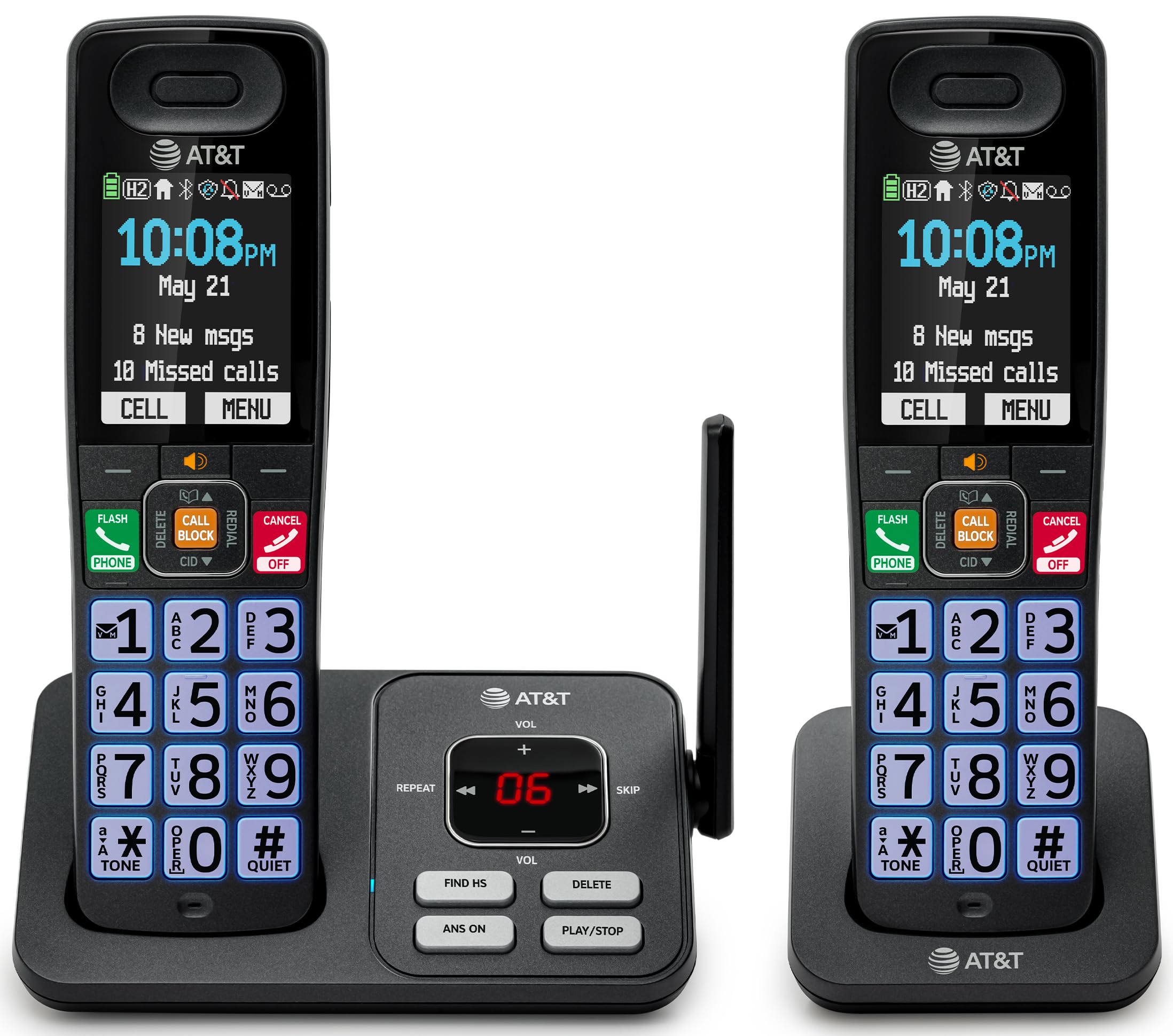
A thousand-number block list and a color screen make this the anti-spam specialist.
If your home number has been sold so many times that the phone is unusable, the BL108-2 is the response. Its smart call blocker filters robocalls on the very first ring with no setup, and the block directory holds up to 1,000 entries — versus the 30-number lists on the Panasonic KX-TGC352B and KX-TGC222S. One-touch blacklisting means the next unwanted caller is gone before you put the handset down. The phone also pairs with your smartphone over Bluetooth, routing mobile calls through the base, so dead zones at home stop mattering.
The screen is the biggest on the list — a 2.4-inch color LCD with high-contrast text, lit keys, and little icons for voicemail, battery, and missed calls. Caller ID announce speaks the caller’s name aloud from the handset, so you screen by ear without picking up. The digital answering machine stores up to 22 minutes of messages, the largest capacity here, and DECT 6.0 with an advanced antenna carries up to 1,000 ft through walls and floors.
One trade-off worth naming: the answering system was one of the features buyers flag most, and not everyone was happy with it. Message storage is generous, but set it up yourself and test the greetings rather than trusting it cold from the start. The base also lacks a second phone jack, which is fine for most single-line homes but rules out a two-line setup. Audio Assist boosts volume and cuts background noise mid-call to help the sound side.
Why this ends the spam
- 1,000-entry block directory, the deepest on this list by a wide margin
- Automatic robocall filtering on the first ring, no setup
- 2.4-inch color LCD with voicemail, battery, and missed-call icons
- Bluetooth pairing turns the handset into a home cell-phone extension
What to keep in mind
- Answering system experienced mixed owner feedback — verify greetings yourself
- Single-line operation only, so no dual-line households
Matches up with: households drowning in spam calls or fighting a cellular dead zone at home.
Skip it for: a home that runs two phone lines or needs name-announce on every voicemail.
5. VTech VG131-21 Cordless Phone, 2 Handsets, Black

Two handsets that share one phonebook, one jack, and one very small footprint.
The compactness wins here. At 3.8 x 4.09 x 7.17 inches, this base sits in a space the wide panasonic needs a side table for — which matters if your landline lives on a crowded kitchen counter. Two handsets charge from two AC adapters and share the same phonebook, caller ID log, and settings, so a name saved on one handset is already on the other. Both are hearing-aid compatible, and the handset stores a 30-call caller ID log with a last-5-number redial.
Quality and functionality are the two things this phone does better than anything else, and buyers respond to it. Both sides of a call can talk and listen at the same time thanks to the full-duplex speakerphone — meaning less of the awkward one-at-a-time cut-off you get on cheap speakerphones. A fully backlit white display and keypad keep dialing easy in low light, and the phone wall-mounts with no extra bracket.
Here is the part to get right before you buy: there is no answering machine on this model. That is a deliberate design for homes that already pay for cell carrier voicemail and just want two reliable handsets around the house. Sound quality gets mixed feedback on this one, and on a budget phone you should expect the audio to be workable rather than rich. It is also not expandable to extra handsets, so buy for today’s household, not a future one.
What you are paying for: two DECT 6.0 handsets, a shared phonebook, and full-duplex speakerphone at an entry-level tier — the cleanest route to whole-home coverage if you do not want a machine.
Choose this if: you have reliable carrier voicemail and just want handsets in two rooms.
Keep walking if: a built-in answering machine or later expansion are on your must-have list.
6. VTech VG134 DECT 6.0 Cordless Phone – White

Pair your headset and take the call without the phone ever leaving the cradle.
You can answer calls hands-free by pairing your Bluetooth headset or earbuds with the phone base, keeping the handset in its cradle and the conversation private — handy if you work from a home office or take calls while moving around the house. DECT 6.0 (a wireless standard for cordless phones) handles the link between handset and base, and VTech publishes a range up to 1,000 ft outdoor, which is the kind of reach that covers a back garden on a clear day.
Setup is one of its strong points: buyers consistently find it easy to hook up, and the look of the thing earns comments too. The answering machine records up to 14 minutes of messages and gives you a lighted counter on the base. The full-duplex speakerphone lets both sides talk and listen at the same time. The LED blue-white backlit display with a soft green illuminated keypad makes the whole thing readable in dim light, and it shows the caller’s name, number, time and date before you pick up.
The honest part: this handset is a single unit and heavier than most — 16 ounces against the Panasonic KX-TGC352B’s 8 ounces. Screen clarity gets mixed feedback, and the volume runs loud enough that some users dial it back. Those are small prices for the Bluetooth convenience, but if all you want is a plain two-handset home line, the VG131-21 or the Panasonic KX-TGC352B above will serve you with less handset weight.
The Bluetooth argument
- Pairs with a Bluetooth headset or earbuds for private hands-free calls
- DECT 6.0 range published up to 1,000 ft outdoor
- 14-minute digital answering machine with a lighted counter
- Blue-white backlit display and green lit keypad for dark rooms
The fine print
- 16 ounces in hand, the heaviest single handset here
- Screen clarity drew mixed feedback in owner reports
The right fit for: headset users, home-office talkers, and anyone who wants a long outdoor reach.
Worth noting: this is a single-handset system — no second handset or expansion in the box.
Know the Specs
DECT 6.0 — what that 1.9 GHz number buys you
DECT 6.0 is the cordless standard most modern home phones use, and it runs on the 1.9 GHz band. That band sits away from Wi-Fi’s 2.4 GHz and 5 GHz signals, so the call stays clear when the router is busy or the microwave is running. It is also harder to listen in on than the older 2.4 GHz and 5.8 GHz cordless generations, which is why every phone on this list runs on it.
Talk time vs. standby — which number matters
Talk time is how long the handset runs on a full charge while you are actually on a call; standby is how long it holds a charge sitting in its cradle. A phone rated at up to 10 hours of talk time or 5 days of standby will sit ready for days between uses in a normal home. Check both figures, because a long talk time with a short standby can still leave you hunting for the charger.
Answering machine capacity in minutes
Digital answering machines record messages straight onto the phone, and capacity is measured in minutes — from 14 minutes up to 22 minutes across this list. More minutes means more callers can leave a message before the machine is full, and it also gives you room for longer outgoing greetings. A phone with no answering system is a sensible match for a home that already relies on cell carrier voicemail.
Call block capacity — the number behind the feature
Call block is only as good as how many numbers it can hold. On this list the block lists range from 30 entries to a 1,000-entry directory, and the difference shows up fast in a home that gets hammered by robocalls. Some models also filter spam automatically on the first ring, which means you never hear the phone at all.
Hearing-aid compatibility and backlighting
If anyone wears a hearing aid, look for a stated compatibility rating on the handset — the VTech VG232 carries an M4/T4 rating, and the VG131-21 and VG232 both state hearing-aid compatibility. A backlit display and keypad decide whether you can read a caller’s name and dial in a dim room, so treat both as everyday features rather than extras.
Expandability and handset count
An expandable system lets the base unit add more handsets later without a second phone line or a new base. Two handsets is the usual balance for a house — one at the kitchen counter and one in the bedroom — and both share the same phonebook and caller log. Single-handset models keep things simple but cannot be grown into a multi-room setup.
Common Questions
Do I need a landline service for a cordless home phone to work?
Will a DECT 6.0 phone interfere with my Wi-Fi router?
What is the difference between a two-handset system and an expandable phone?
How much answering-machine capacity do I actually need?
Can I block robocalls on a cordless phone without a monthly subscription?
Why does my caller ID show a number but no name?
Are cordless phones with a hearing aid compatible handset worth getting for a parent?
How far from the base will the handset still work?
Can I take a call on both handsets at the same time or between them?
Do these phones need to recharge in a special way first time?
The Bottom Line
For most homes, the wireless telephones for home winner is the Panasonic KX-TGC352B because it pairs two handsets and a wide amber backlit display with a real 30-number call-block list, and it keeps working out in the yard. If accessibility is the reason you are shopping, grab the VTech VG232 with its oversized buttons and M4/T4 hearing-aid rating. And for spam calls or a cellular dead zone at home, the AT&T BL108-2 with its 1,000-entry block directory is the one to reach for. Pick by handset count and answering-machine need, and any of these six will keep the line live.
How we choose
We do not accept paid placement. Every pick is matched to a real buyer and a real use-case; we do not hands-on test units.
Sources
Specifications: manufacturer listings and product documentation. Review insights: verified customer reviews, as of November 2026. Pricing: not shown on this page (it changes often); check the current price via the retailer link.
As an Amazon Associate, Tactical Gear Guy earns from qualifying purchases. This does not affect which products we feature.