Specs are compiled from manufacturer listings and verified buyer reviews and can change over time — please confirm the key details on the product page before buying.
If dead zones in the garage and robocalls at dinner are the two things ruining your home phone, the fix is a cordless system built around long reach and a real call-blocker. That is the whole job here. Every pick below either reaches further across the house, blocks more junk numbers, or both — and one of them does it for less than you would guess. The short answer: the VTech CS6719-2 is the value stand-out, while the AT&T CL82557 is the one to buy if you want five handsets and a 1,000-entry call block list in a single box.
This guide is built by comparing the manufacturers’ published specifications and the patterns across verified customer reviews, so you get each pick’s real strengths and trade-offs instead of marketing spin.
Below, each pick is judged on stated DECT range, handset count, and block-list capacity. Read on to find the best wireless telephone system for your home, your call volume, and how far you need the signal to carry.
Top Picks


How To Choose The Best Wireless Telephone System
The mistake most buyers make is shopping for the prettiest handset instead of matching handset count and range to their house. A phone that drops out at the garage is useless if you take calls out there. Start with reach and handset count, then let the extras follow.
Range matters more than the spec sheet admits
DECT 6.0 is the wireless standard nearly every modern cordless phone in the US uses, and it operates on a dedicated band so your Wi-Fi router and microwave are not competing with your voice call. Range is where systems diverge — one of our picks is rated for up to 2,300 feet, while another stretches coverage to 1,000 feet. The longer numbers are line-of-sight figures, so treat walls and floors as a real deduction.
A bigger block list is a quieter evening
Call blocking works by keeping a list of known nuisance numbers and refusing to let them ring through. Entry capacity decides how many junk numbers you can hold over time. Panasonic’s KX-TGC352B holds 30 entries — a small, curated list. The AT&T systems here hold up to 1,000, which is enough that you will likely never fill one up.
Count the rooms before you count the handsets
Each handset needs its own charging stand and a power outlet nearby. A four or five handset system covers upstairs, downstairs, kitchen, garage, and office in one purchase. A two-handset kit is simpler to place and easier on counter space, but you give up the spread. Decide which rooms you genuinely take calls in, then buy one handset for each.
Side-by-Side Comparison
| Model | Best For | Handsets | Call Block Entries | Answering Machine | Amazon |
|---|---|---|---|---|---|
| VTech CS6719-2★ Best Overall | Budget-friendly everyday coverage | 2 | — | No | Amazon |
| Panasonic KX-TGC352BBest Display | Readable amber display | 2 | 30 | Digital | Amazon |
| AT&T DL72419 | Cell pairing on four handsets | 4 | 1,000 | Digital | Amazon |
| Panasonic KX-TGF852B | Corded base with call recording | 2 cordless + 1 corded | 1,000 | Digital | Amazon |
| AT&T BL102-5 | Full-house five handset spread | 5 | 1,000 | Digital | Amazon |
| VTech IS8128-51 | Longest stated range and cell pairing | 5 | 1,000 | Digital | Amazon |
Detailed Reviews
1. VTech CS6719-2 2-Handset Cordless Phone
Our pick — 4.0+★ from 31,500+ verified ratings; the strongest balance of quality and price.
Two handsets and real DECT 6.0 clarity, without paying for features you will never touch.
This is the pick for a couple or a small flat that just needs two reliable handsets and crisp voice. It uses DECT 6.0, the wireless standard that keeps your call separate from your Wi-Fi router, so the line stays clean even when someone is streaming in the next room. The full-duplex speakerphone lets both sides talk at once, which makes hands-free calls sound like a normal conversation instead of a walkie-talkie relay. And the keypad and screen light up, so you can dial in a dark hallway without turning on a lamp.
The storage is modest but sensible. Caller ID holds up to 50 entries, enough to scroll back through the last few callers without digging through a paper pad. Quiet mode silences the ringer when you need it to, and the handsets intercom each other plus support basic conference calling. What it does not have is an answering machine — so if you want messages captured when you are out, this is not the box. Compared with the Panasonic KX-TGC352B, it is the smaller, lighter unit at 1.5 pounds versus 1.4 pounds and a footprint of 5.6 x 7 x 3.7 inches against 15.5 x 8 x 6 inches — a much more compact base for a narrow shelf or kitchen counter.
What wins people over is just how little fuss the thing makes — set it up, put one handset by the bed and one in the kitchen, and it works. The recurring gripe is volume; the speaker can sound quiet in a noisy room, so if your house is loud, plan on using the speakerphone or stepping closer. The backlit display also draws a split opinion, with some finding it easy to read and others wanting more contrast.
What earns its keep
- DECT 6.0 sound that stays clear alongside your Wi-Fi router
- Full-duplex speakerphone for natural hands-free calls
- Backlit display and keypad for dialing in the dark
- Two handsets with intercom and basic conference calling
Where it stops short
- No answering machine to capture messages while you are out
- Speaker volume runs low in a noisy room
- Caller ID stops at 50 stored entries
The right call if: you want two solid handsets, easy setup, and crisp voice without paying for extras.
Think twice if: you need voicemail built into the base unit — this model has no answering machine.
2. Panasonic Cordless Phone 2 Handsets System (KX-TGC352B)
A 1.6-inch amber screen you can read from across the kitchen without your glasses.
If caller ID is the part you actually use, this Panasonic puts it front and center. The wide 1.6-inch amber backlit LCD lives on both the base and the handset, so you can glance at who is calling from a few feet away. That amber glow reads warmer and less glaring than a bright white screen in a dim room. It runs on a 1.9 GHz signal with an Intelligent Eco Mode that manages power consumption to protect handset battery life.
Two features do the quiet heavy lifting. Silent Mode lets you set a block of time — dinner, say — when the handset and base will not ring for outside calls. Call Block stores up to 30 numbers, and you register them by pulling the caller ID from an incoming call. Thirty is a small list compared with the 1,000-entry directories on the AT&T systems here, so this works best as a curated block list rather than a sweeping robocall shield.
The recurring honest note is sound. Voice clarity draws a split reaction, with some finding it clear and others wanting more volume in the earpiece. Battery life is the same story — fine for most, short for heavy talkers. If your main calls are quick check-ins, the readable screen and tidy two-handset setup make this a calm, easy pick.
The screen does the selling: that amber 1.6-inch display is the standout reason to pick this over the VTech — caller ID is genuinely glanceable from a distance. Ease of use follows close behind, since setup is quick and the keypad is straightforward.
The honest caveat: a 30-number block list is modest, and earpiece volume splits opinion. Treat it as a tidy two-handset phone for light calling, not a robocall fortress.
Reach for this if: reading the caller name without squinting matters more to you than a giant block list.
Look elsewhere if: you field dozens of unwanted calls a week and want a 1,000-entry blacklist.
3. AT&T DECT 6.0 Cordless Phone, 4-Handset (DL72419)
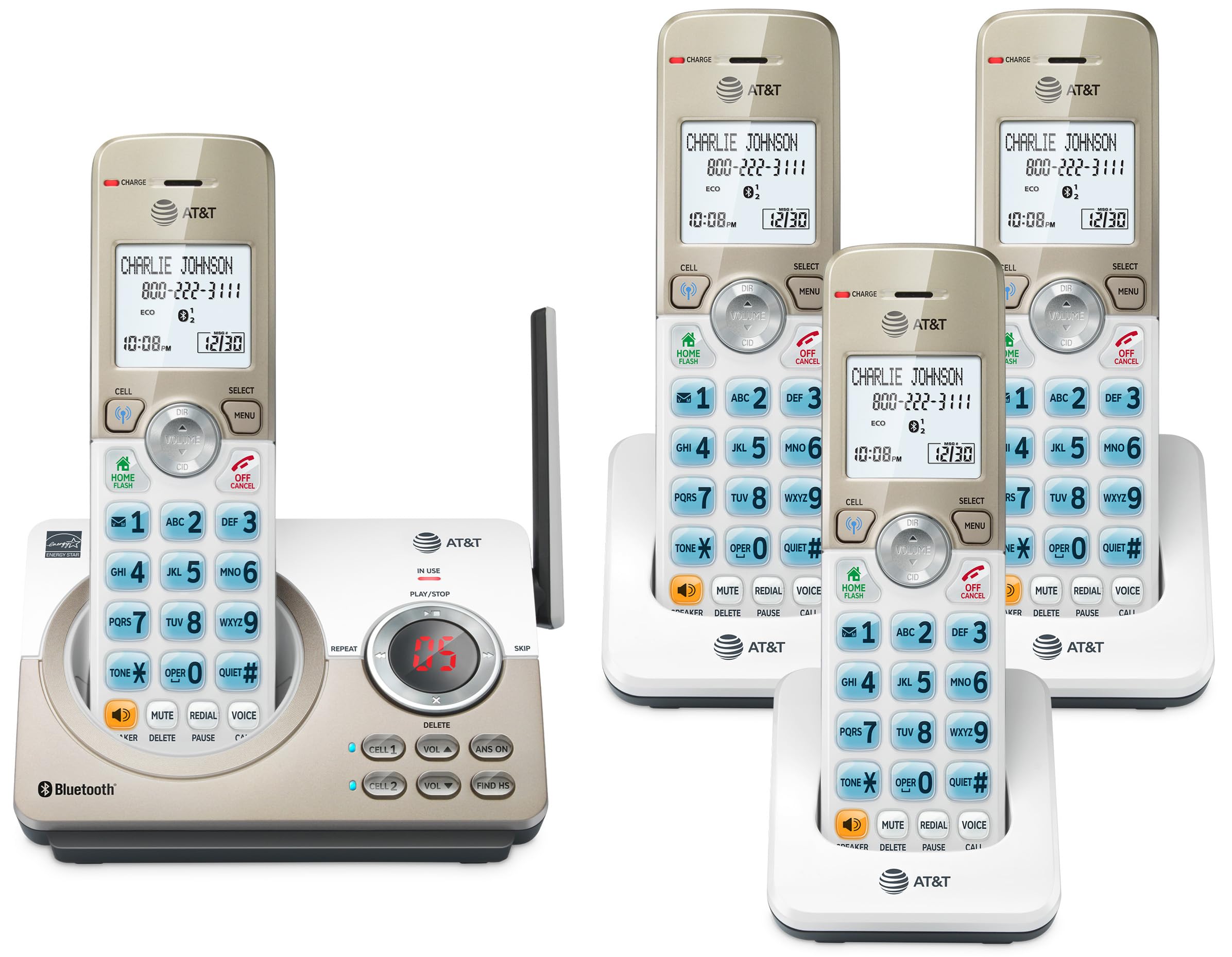
Four handsets, one phone jack, and a call blocker that catches robocalls on the very first ring.
The trick here is that it does two jobs at once. Bluetooth Connect to Cell pairs up to 2 smartphones — or 1 phone plus 1 headset — so mobile calls ring through any of the four handsets. You can even call up Siri or Google Assistant from any room. At the same time it handles your landline, cable, or VoIP service, including Ooma and Vonage, which makes it a good fit for anyone who kept a landline but lives mostly on a cell.
Robocall defense is the headline. The Smart Call Blocker blocks nuisance calls on the first ring with no setup, and the blacklist directory holds up to 1,000 entries. The digital answering machine records up to 22 minutes of messages with voice-guided setup and remote playback. All four handsets run off a single base and a single phone jack, and DECT 6.0 coverage is rated up to 1,000 feet. Each handset carries a 1.8-inch backlit display and a big lighted keypad.
The trade-off to know is sound. Volume and clarity draw a split reaction, with some finding it plenty loud and others struggling to hear during calls. The white finish is also less forgiving of fingerprints than a dark phone. If you want one system to merge your cell and your landline, though, the four-handset spread is a lot of coverage in a single buy.
A two-line lifestyle in one box: the Bluetooth pairing turns your four handsets into cell extensions, and the one-touch blacklist plus auto-blocking handles junk calls before they ring.
The honest read: clarity is the weak spot, so plan on the speakerphone when you need volume. Buy it for the pairing and the blocking — those are the strong suit.
Best matched to: a household that still has a landline but takes most calls on a cell.
The catch to weigh: if earpiece loudness is your biggest priority, the sound split here may nag at you.
4. Panasonic Cordless Phone, 2 Handsets Link2Cell (KX-TGF852B)

A corded handset anchors the base, so the phone still works when the power or the batteries do not.
This is the pick for someone who wants a desk phone that behaves like a desk phone. The base holds a corded handset — always live, always on — and adds two cordless handsets you can carry anywhere in the house or office. The system expands up to 6 handsets, so you can grow it room by room. The big tiltable 3.4-inch LCD on the base gives a clear read of who is calling, and one-touch dial buttons put frequent numbers a single press away.
Call handling is unusually deep for a home phone. Automated Call Block pre-blocks robocalls, Telemarketing Call Block lets you block announced callers, and the 1-touch Call Block button adds up to 1,000 more entries. There is also 2-way call recording with a dedicated Recording Start button — handy for confirming details from a business call. Full-duplex speakerphone and voice-command answering round out the hands-free side, and caller announcements come in English or Spanish.
The thing to know is that this is a bigger footprint than a basic cordless kit, and it weighs 1.4 pounds — a touch lighter than the VTech CS6719-2 at 1.5 pounds. Sound quality is the point of contention: some find it good, others find it weak and reach for the speakerphone to communicate clearly. If a corded safety net matters to you, though, no other pick here gives you that.
Why it stands out
- Corded base handset that stays usable when power is out
- 2-way call recording with a one-press start button
- Large tiltable 3.4-inch base display with one-touch dial
- Expandable up to 6 handsets
The trade-offs
- Bigger base takes more desk or counter space
- Earpiece sound quality splits opinion
- Two cordless handsets only in the box
Worth it for: homes and home offices that want a corded backup plus call recording.
Skip the upgrade if: you only need two light-use cordless handsets and value a small footprint.
5. AT&T DECT 6.0 5-Handset Cordless Phone (BL102-5)

Five handsets and a call-screening system that is built to keep junk calls away from your family.
The draw here is household-wide robocall defense. The Smart Call Blocker screens and blocks nuisance calls before they ring, even on the first attempt. A dedicated handset key blacklists numbers permanently, and the block directory holds up to 1,000 entries. The handset speaks the caller’s name out loud so you can decide whether to answer, and it handles five-party conference calling — useful for family check-ins across the house.
Coverage and comfort are solid. The extra-large 2-inch screen with high-contrast text keeps caller ID readable, the lighted keypad helps in the dark, and Audio Assist supports every-day clarity. A digital answering machine captures up to 22 minutes, and the system works with standard phone lines, VoIP services, and existing home phones. Five handsets plus a base, chargers, and batteries ship in the box.
Where it needs care is reliability. Call quality and battery life are the weaker spots — this is the highest-volume blocklisting system here but also the one most likely to give you a handset that will not hold a charge or a call that fades. Setup also splits opinion, with some finding it easy and some finding it fiddly. Give it a few days to settle in; most owners are happy once the block list is set.
The strong points
- 1,000-entry block directory with first-ring screening
- Caller ID announce for hands-free call screening
- Five-party conference calling for household-wide use
- Audio Assist to improve everyday clarity
What to watch for
- Call quality and battery life are the weaker areas
- Setup splits opinion — some find it fiddly
- Five handsets mean five outlets to find
The match for: a big household that wants a hard wall against unwanted calls.
The fair warning: budget a little patience in the first week for setup and a battery charge test.
6. VTech DECT 6.0 5-Handset Cordless Phone IS8128-51

Rated for 2,300 feet of DECT range — enough to carry a call to the back fence.
The reason to buy this one is reach. DECT 6.0 is rated for up to 2,300 feet here, the longest stated range in this list — walk out to the mailbox, the back fence, or a neighbor’s porch and keep talking. It stays clear of interference from your Wi-Fi router, which is the whole point of DECT 6.0. The catch is that range changes with home construction, so a brick house will not see the full 2,300.
It pairs with up to 2 cell phones — or 1 phone plus 1 Bluetooth headset — through the base, not the handsets. Leave your cell near the base, then answer cell or landline calls from any of the five handsets. The Smart Call Blocker screens robocalls before they ring, with a 1,000-entry block list. The digital answering machine records up to 22 minutes with remote access, and caller ID announce speaks who is calling so you can screen hands-free. The base screen is 3.5 inches, handset screens are 2 inches, and keypads light up.
The honest limit is reliability. Owner consensus here is genuinely split — some get a top-quality DECT system, others hit a unit that does not work or sounds poor. Battery life is the most consistent complaint, so plan on keeping handsets on their chargers. There is no wired headset jack either, so Bluetooth is your only headset route. Buy it for the reach, then test every handset early.
What you are paying for: the 2,300-foot range and Bluetooth cell pairing — the two things no other pick here does as well. The 1,000-entry block list is a strong bonus.
What to plan around: split reliability and a real battery-life gripe. Keep the handsets docked and check each one in the first week.
Made for: a bigger property or a long house where short-range phones drop out near the back door.
Weigh first: if you want plug-and-play certainty with no charging routine, this is the riskier bet.
Know the Specs
DECT 6.0 — the wireless standard
DECT 6.0 is the wireless band that cordless phones use in the US, and it is separate from the band your Wi-Fi runs on. That separation is why a DECT 6.0 handset can stay clear while a router or microwave is running nearby. The range figures manufacturers publish — 1,000 feet on the AT&T systems here, up to 2,300 feet on the VTech IS8128-51 — are best-case numbers. Walls, floors, and insulation can reduce them, so treat them as a ceiling rather than a promise.
Call block entries — the number that quiets your line
Call blocking keeps a list of numbers the system refuses to put through. Entry capacity is the number that matters: Panasonic’s KX-TGC352B holds 30, while the AT&T and VTech picks here hold up to 1,000. For most homes the larger list is the safer choice because it gives you room to add numbers as they come. A short list works fine if you only block a handful of repeat nuisances.
Common Questions
How far will a DECT 6.0 cordless phone actually reach in a house?
What is the difference between Smart Call Blocker and a manual block list?
Do these phones need a traditional landline to work?
Can I add more handsets to a system later?
How many minutes does the answering machine record?
What does full-duplex speakerphone mean on a cordless handset?
Will these systems interfere with my Wi-Fi router?
Is a corded base better than an all-cordless system?
Do I need to keep buying batteries for these handsets?
Can I answer my cell phone from a cordless handset in another room?
The Bottom Line
For most homes, the wireless telephone system that earns its place is the VTech CS6719-2, because two reliable DECT 6.0 handsets with a bright backlit keypad cover the basics without extra features to manage. If you want five handsets, a 2-inch screen, and a 1,000-entry block list in a single box, step up to the AT&T CL82557. And if your calls routinely reach the garage or the back fence, the VTech IS8128-51 and its 2,300-foot range is where to look — with one honest note: it is the riskiest pick here on consistency, so test every handset in the first week. Whichever you pick, decide handset count first, then blocking capacity, and let everything else fall in line.
How we choose
We do not accept paid placement. Every pick is matched to a real buyer and a real use-case; we do not hands-on test units.
Sources
Specifications: manufacturer listings and product documentation. Review insights: verified customer reviews, as of November 2026. Pricing: not shown on this page (it changes often); check the current price via the retailer link.
As an Amazon Associate, Tactical Gear Guy earns from qualifying purchases. This does not affect which products we feature.