Specs are compiled from manufacturer listings and verified buyer reviews and can change over time — please confirm the key details on the product page before buying.
The short answer: buy a system whose rear speakers get their signal wirelessly, then spend your money on channel count and subwoofer size rather than on brand badges. That is the core trade-off in this category. You want sound behind your head and above it without tearing up the room with cable runs. Everything below is sorted around that single goal.
This guide is built by comparing the manufacturers’ published specifications and the patterns across verified customer reviews, so you get each pick’s real strengths and trade-offs instead of marketing spin.
You want surround sound without running speaker wire to the back of the room. That is the job these picks do: wireless rear channels, no long cable from the front of the room to the couch. A couple of them differ from the exact model you searched for, because each pick is matched by function, and the nearest same-type system does the same job. My full breakdown of the best wireless surround sound speakers for TV is below, ranked by what actually changes how a movie night feels.
Top Picks

How To Choose The Best Wireless Surround Sound Speakers for TV
“Wireless” gets stretched hard in this category. On almost every system here, the rear speakers and the subwoofer still plug into a wall socket for power. What is missing is the long signal cable that used to run from the front of the room to the back, and that is the cable you are actually escaping. So check where your power outlets sit relative to your couch first.
Read the channel numbers before anything else
A format like 5.1.4 reads as speakers dot subwoofer dot height channels. A 5.1.4 system means five main channels, one subwoofer, and four height channels that fire sound at the ceiling so it lands on you from above. A 7.1.2 gives you more side and rear spread but fewer overhead channels. Both work. Choose based on if you want rain and helicopters overhead or a wider wall of sound around the sides.
Subwoofer driver size is the bass you feel
The subwoofer number in inches is the diameter of the bass driver. Bigger moves more air, which is why a 10-inch driver hits harder in a large room than a 6.5-inch one. If you live in an apartment with thin walls, a smaller driver with bass tuning can be the smarter call. If you want the floor to move during an explosion, size matters.
HDMI eARC is the connection that keeps life simple
HDMI eARC (Enhanced Audio Return Channel) sends the TV’s audio down one cable and lets your TV remote run the volume. Optical does audio too but carries less data. Bluetooth is for music from your phone, not for a lag-free movie feed. If your TV has an eARC port, use it and skip the rest.
Side-by-Side Comparison
| Model | Best For | Channels | Subwoofer Driver | Key Connection | Amazon |
|---|---|---|---|---|---|
| ULTIMEA Skywave X70★ Best Overall | Full overhead cinema | 7.1.4 | 10 inches | HDMI eARC | Amazon |
| LG S40TRSmall-Room Value | Small rooms on a budget | 4.1 | — | Bluetooth / Optical | Amazon |
| TCL S65K S SeriesAtmos On A Budget | Atmos on a mid budget | 5.1 | 6.5 inches | HDMI / Wi-Fi | Amazon |
| Amazon Fire TV Soundbar Plus | Fire TV households | 5.1 | — | Bluetooth | Amazon |
| ULTIMEA Skywave X50 | Big-room power | 5.1.4 | 8 inches | HDMI eARC | Amazon |
| Sony BRAVIA Theater System 6 | BRAVIA TV owners | 5.1 | Wired subwoofer | Bluetooth | Amazon |
| Polk Audio MagniFi Max AX SR | Music streaming too | 7.1.2 | 10 inches | HDMI eARC | Amazon |
| Samsung HW-Q990F | No-compromise buyers | 11.1.4 | Wireless subwoofer | Wi-Fi / Bluetooth | Amazon |
Detailed Reviews
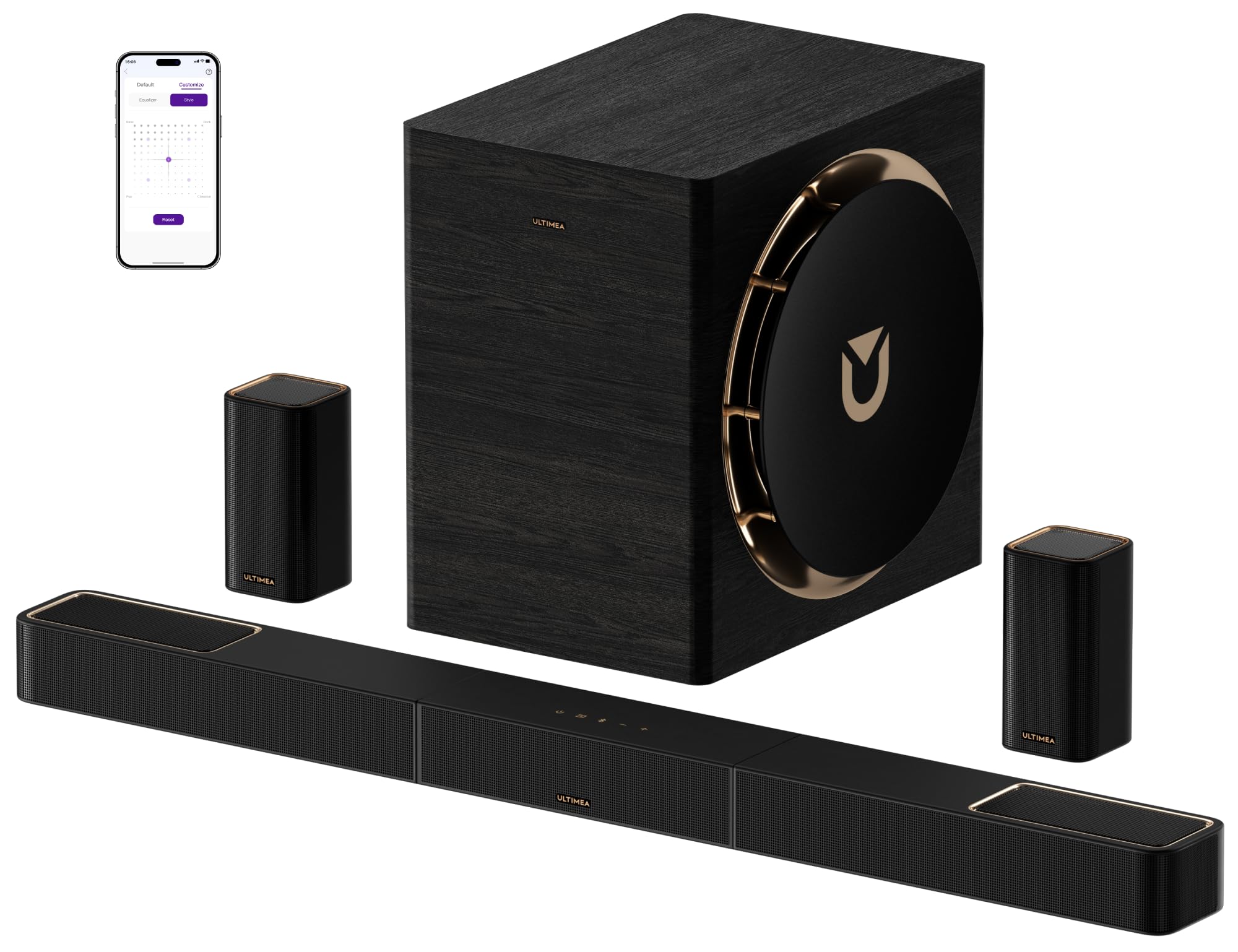
1. ULTIMEA Skywave X70 7.1.4ch Wireless Surround Sound System
Our pick — 4.5+★ from 200+ verified ratings; the strongest balance of quality and price.
Four height channels and a ten-inch sub make thunder roll across the ceiling
If you want a movie to sound like it is happening around you instead of in front of you, this is the pick. The Skywave X70 runs a 7.1.4 channel layout, which means seven main channels, one subwoofer and four height channels aimed upward so audio arrives from overhead. Rain lands above you. Helicopters cross the ceiling. That overhead layer is what separates a movie from a demo clip.
The bass hardware earns its keep. A 10-inch wireless subwoofer driver pushes down to 20Hz with 980W peak output, and this is where it pulls ahead of the TCL S65K — 10 inches against 6.5 inches is a visibly bigger cone moving more air. The rear speakers and the sub connect over dual 5GHz wireless transmission, so you get surround behind your couch without dragging a cable across the carpet. Setup is a genuine strength here; owners consistently say the instructions are easy to follow and the system sounds far bigger than its price suggests, with buyers reporting it outdoes setups costing considerably more.
The catch is adjustability. Tuning the system to taste draws the only mixed feedback in the reviews, so expect to spend some time in the app dialing in the 10-band EQ and the 121 sound presets before it feels right. The other thing to plan for: every rear speaker still needs its own power adaptor, so confirm you have outlets behind the couch before it arrives.
Where it wins
- 7.1.4 layout with four height channels for genuine overhead sound
- 10-inch wireless subwoofer reaching down to 20Hz at 980W peak
- Dual 5GHz wireless transmission to the rear speakers and sub
- 4K HDR pass-through and CEC so the TV remote handles power and volume
What to plan around
- EQ and preset tuning takes real fiddling to dial in
- Each rear speaker needs its own wall outlet
Reach for this if: you want overhead Atmos effects and deep bass from one boxed system without running speaker cable to the back wall.
Look elsewhere if: you would rather not spend an evening in an app tweaking EQ settings.
2. LG S40TR Soundbar
Four channels, two wireless rears, and a footprint that fits a small lounge
Not every room can host a seven-channel array, and this LG is built for the ones that cannot. It is a 4.1 setup: four channels, a wireless subwoofer, and a pair of rear speakers that connect wirelessly, so no receiver box sits behind your sofa. The system carries Dolby Digital and DTS Digital decoding, which covers the audio most streaming apps actually send out.
Where this one quietly earns its place is dialogue. Clear Voice Plus analyses the audio and pushes conversation forward through the centre speakers, and the pattern across owner feedback is that sports commentary and movie dialogue come through clearly. If your current TV makes you crank the volume during quiet scenes and dive for the remote during explosions, that single feature fixes the annoyance. The Smart Up-Mixer also widens two-channel audio across all the speakers, which helps older shows that were never mixed in surround.
Be honest about the ceiling. This is a 4.1 system with no height channels, so you will not get rain falling overhead the way the ULTIMEA X70 delivers it. Wireless connectivity also draws mixed feedback, with some owners sailing through pairing and others hitting snags, so keep the soundbar and rears in reasonable range of each other. The other name to know: if you own an LG TV, WOW Orchestra runs the TV speakers and the soundbar together and lets one remote handle both.
The honest read: a compact, easy-to-live-with surround upgrade that prioritises clear voices over overhead spectacle, and it suits a bedroom or small living room far better than a huge open-plan space.
Best fit: a smaller room where clear dialogue matters more than height effects.
Think twice if: you want overhead Atmos channels or you are pairing it with a non-LG TV and lose the Orchestra feature.
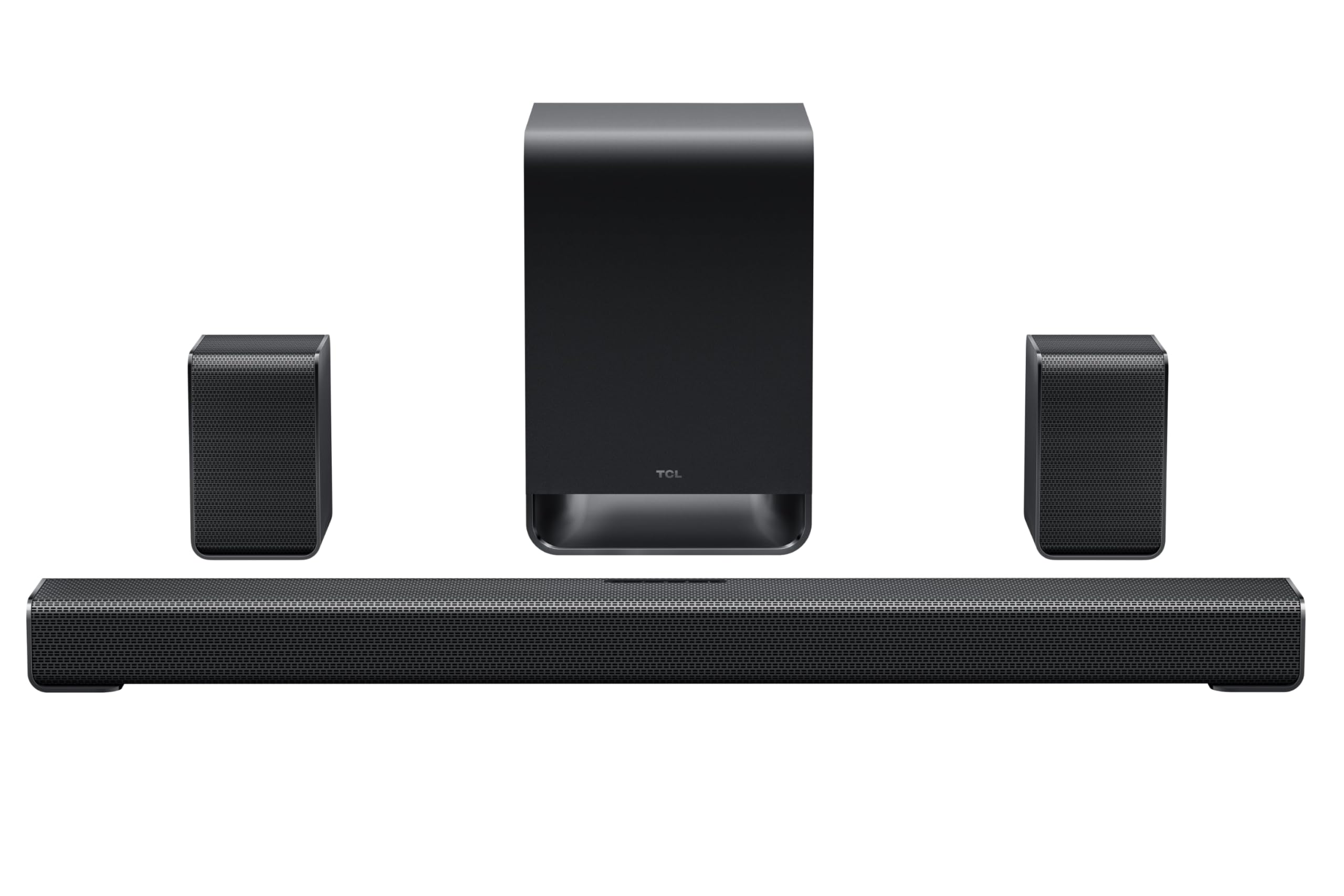
3. TCL S65K Soundbar
Dolby Atmos and DTS:X decoding at the entry point of the surround market
Here is the cheapest route to proper object-based surround. The S65K decodes both Dolby Atmos and DTS:X, the two formats that place a sound effect at a specific point in the room rather than just left or right. You get a 5.1 layout with wireless surround speakers and a wireless subwoofer, so the rear channels sit behind you without a cable run. Bass comes from a 6.5-inch driver with Bass Boost, which is the smallest sub in this lineup — enough to give action scenes weight, not enough to rattle the neighbours’ pictures.
What makes this one easy to live with is that it calibrates itself. AI Sonic Auto Room Calibration uses the system’s own mic to tune the sound to your space, which matters if your couch sits off-centre or your room has hard floors. Owners describe it as working right from the start and as a clear step up from built-in TV speakers, with buyers reporting it is an affordable upgrade over TV internal speakers. The built-in centre channel and tweeter keep dialogue anchored, and ChoruSound lets the TV’s own speakers join in for a wider stage.
One spec worth knowing before you buy: this system measures 3.54 inches deep and 33.46 inches wide, and the whole package weighs 27 pounds. That is a substantial bar, so measure your TV stand first. The subwoofer’s 6.5-inch driver also trails the ten-inch cones on the ULTIMEA and Polk picks, so deep bass heads should look upward in this list.
Why it earns the slot: it brings Atmos and DTS:X plus self-calibration into the entry tier, and the wireless rears mean no cable across the floor.
Measure first: at 33.46 inches wide it needs a TV stand with real width, and the 6.5-inch sub is the modest option here.
Worth grabbing: if you want Atmos decoding and wireless rears without stretching the budget.
Pass on it if: you want floor-shaking bass or have a narrow TV unit.
4. Amazon Fire TV Soundbar Plus

One remote for the whole living room, and dialogue that stops hiding
If your TV already runs Fire TV, this system slots in with almost no friction. It is a 5.1 package with a subwoofer and two surround speakers that connect to the soundbar after you plug them into power. It decodes Dolby Atmos and DTS:X, so you get height-style effects and multi-dimensional audio, and there is a dedicated centre dialogue channel that sharpens conversation.
The living-with-it part is where this pick shines. One remote controls both the TV and the soundbar, and you can shape the sound through the Fire TV audio settings on select models. Four modes — Movie, Music, Sports and Night — retune the system to whatever is on, and Night mode is the one apartment dwellers will use most. Bluetooth pairing with a phone is described as automatic, so playing a playlist from your handset is a two-tap job rather than a menu hunt.
The point of honesty: reliability is the mixed signal in the feedback, so treat this as the convenient pick rather than the most bulletproof one. It is also the option for Fire TV owners specifically. If you run a different smart platform, you lose the one-remote perk and the case gets much weaker.
What sells it: deep Fire TV integration, four content modes, and a centre channel built for dialogue.
The trade-off: reliability feedback is mixed, and the one-remote convenience only pays off inside the Fire TV ecosystem.
Made for you if: your TV runs Fire TV and you want surround with one remote.
Look past it if: you are on another smart platform or want the strongest reliability record here.
5. ULTIMEA Skywave X50 5.1.4ch Wireless Surround Sound System

760W of peak power and an eight-inch sub that shakes the room
Start with the number owners mention before anything else: the bass. An 8-inch subwoofer driver with Gravus bass tech reaching down to 28Hz gives this system genuine low-end authority, and 760W of peak power backs it up. Set against the X40’s 530W and 35Hz floor, the X50 is the option for a bigger room or a buyer who wants to feel the explosion, not just hear it.
It is a 5.1.4 layout, so four height channels handle overhead effects, and the app gives you full access to sound settings for tuning the system to your space. Connectivity is well covered — buyers report it pairs cleanly with TV providers, a PS5 and phones — and foley work like rain and thunder is called out specifically as sounding exceptional. The dual 5GHz transmission keeps the rear speakers and sub cable-free, and 4K HDR pass-through protects the picture going to your TV.
The real question is if you need this over the X40. In a large room, yes: the eight-inch driver and the extra two height channels do audible work. In a small lounge, you are paying for headroom you will rarely use, and the X40 will sound just as good at sane volumes.
The short version: a big-room monster with four height channels, an eight-inch sub and app-based tuning, built for buyers who want power on tap.
Where it stops: the extra output and driver size are wasted in a compact room.
Step up to this: when your room is large and you want the sub to carry real weight.
Stay with the X40 if: your space is modest and the extra headroom would go unused.
6. Sony BRAVIA Theater System 6

Three front-firing speakers and a centre channel tuned for clear speech
Sony’s take on the 5.1 formula leans on the front of the room. Three front-firing speakers, two rear speakers and an included subwoofer (which is wired) make up the array, and Dolby Atmos and DTS:X are both supported. A dedicated centre channel handles dialogue, and the setup is described as plug-in and play, which is the right first impression for a system aimed at people who do not want a hobby project.
The real reason to choose this one is owning a BRAVIA TV. Pair the two and you control the soundbar from the TV menu, plus you open up Voice Zoom 3, which lifts dialogue clarity specifically. The BRAVIA Connect app handles volume, sound profiles and advanced settings from your phone, and Bluetooth streaming brings music across from a handset. Multi Stereo plays the same audio across every speaker for a room-filling boost, which fills the room evenly for sports broadcasts and daytime TV.
Two things to weigh. First, the subwoofer is wired, so this is not the fully cable-free setup the ULTIMEA systems offer — you will run a cable to the sub. Second, rear speaker popping and cracking comes up in the feedback, and the HDMI cable connection draws mixed reviews. The 20Hz frequency response shows there is genuine low-end reach in the tuning, but that rear-speaker issue is the one to watch in your first week.
Standout feature: Voice Zoom 3 with a paired BRAVIA TV, plus one-menu control from the TV itself.
Worth knowing: the subwoofer is wired rather than wireless, and rear-speaker popping appears in the feedback.
Choose it when: you own a BRAVIA TV and want the dialogue features that pairing open up.
Reconsider if: a fully wireless sub matters, or you want the cleanest reliability record on this page.
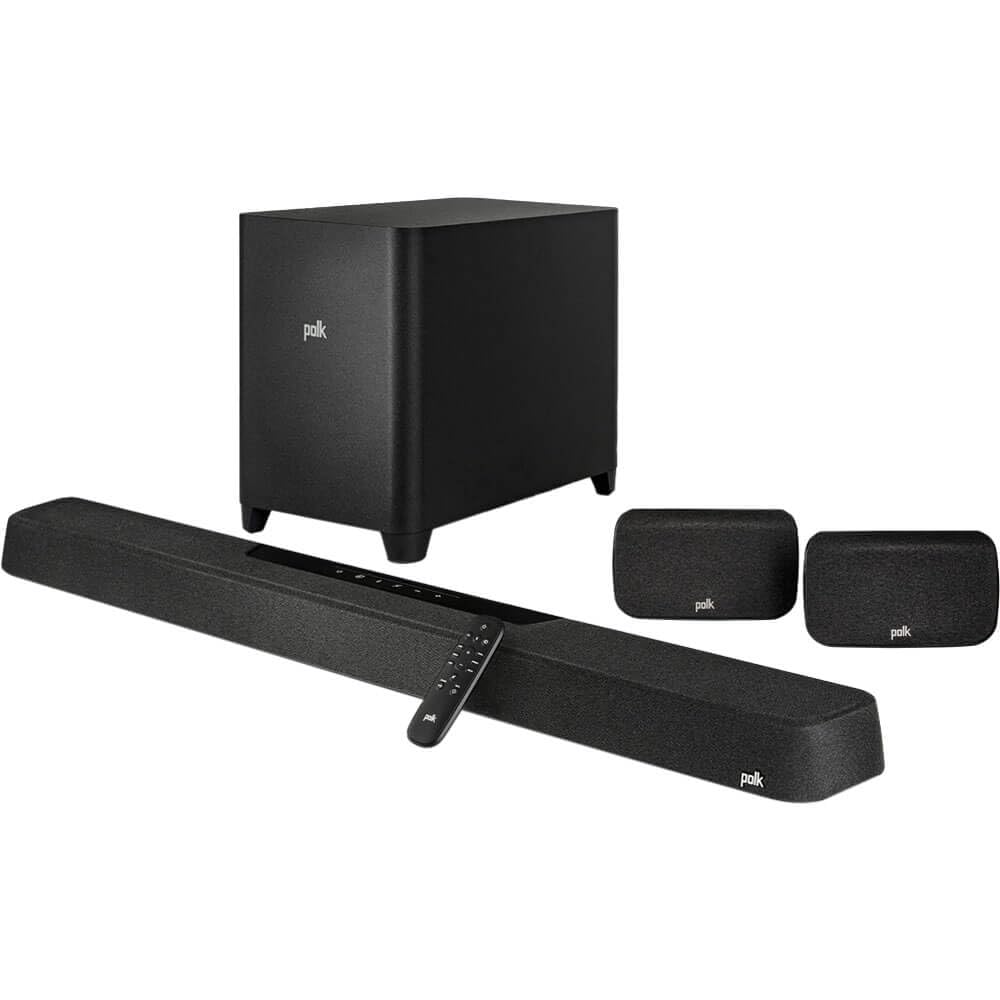
7. Polk Audio MagniFi Max AX SR
A 10-inch sub, SR2 surrounds, and every streaming standard in one bundle
Most systems here are cinema-first. This Polk bundle is cinema and music in equal measure. The 7.1.2 layout pairs a flagship MagniFi Max AX soundbar with a 10-inch wireless subwoofer and a pair of SR2 surround speakers, and two upfiring speakers handle the overhead Atmos and DTS:X effects. Polk’s SDA 3D technology spreads sound into the corners of the room, and owners describe the result as feeling like an auditorium.
Where it separates from the pack is connectivity. Wi-Fi, Bluetooth, Apple AirPlay 2, Chromecast, Spotify Connect and Alexa multi-room support all sit in the box, so the same system that plays a film also streams a playlist from your phone or pulls music from a computer. VoiceAdjust technology boosts vocal levels through the integrated centre channel without touching the rest of the soundtrack, which is the fix for mumbled dialogue. The 10-inch sub connects the moment you power it on and delivers deep bass at volume levels that surprise for its size.
The honest note is reliability, which is the one negative signal in the feedback alongside mixed connectivity and tuning responses. Nothing suggests it is common, but this is a feature-dense system and the more streaming protocols a box juggles, the more that can need a restart. Buy it for the music streaming and the 10-inch sub; do not buy it expecting a single-purpose appliance.
What it does well
- 7.1.2 with two upfiring speakers and SDA 3D spread
- 10-inch wireless subwoofer for deep bass
- AirPlay 2, Chromecast, Spotify Connect and Bluetooth built in
- VoiceAdjust lifts dialogue without touching the soundtrack
Keep in mind
- Reliability is the standout negative in the feedback
- Connectivity and sound tuning draw mixed responses
Pick this for: a living room that needs one system for both films and streaming music.
Skip if: you want the simplest possible box with the fewest moving software parts.
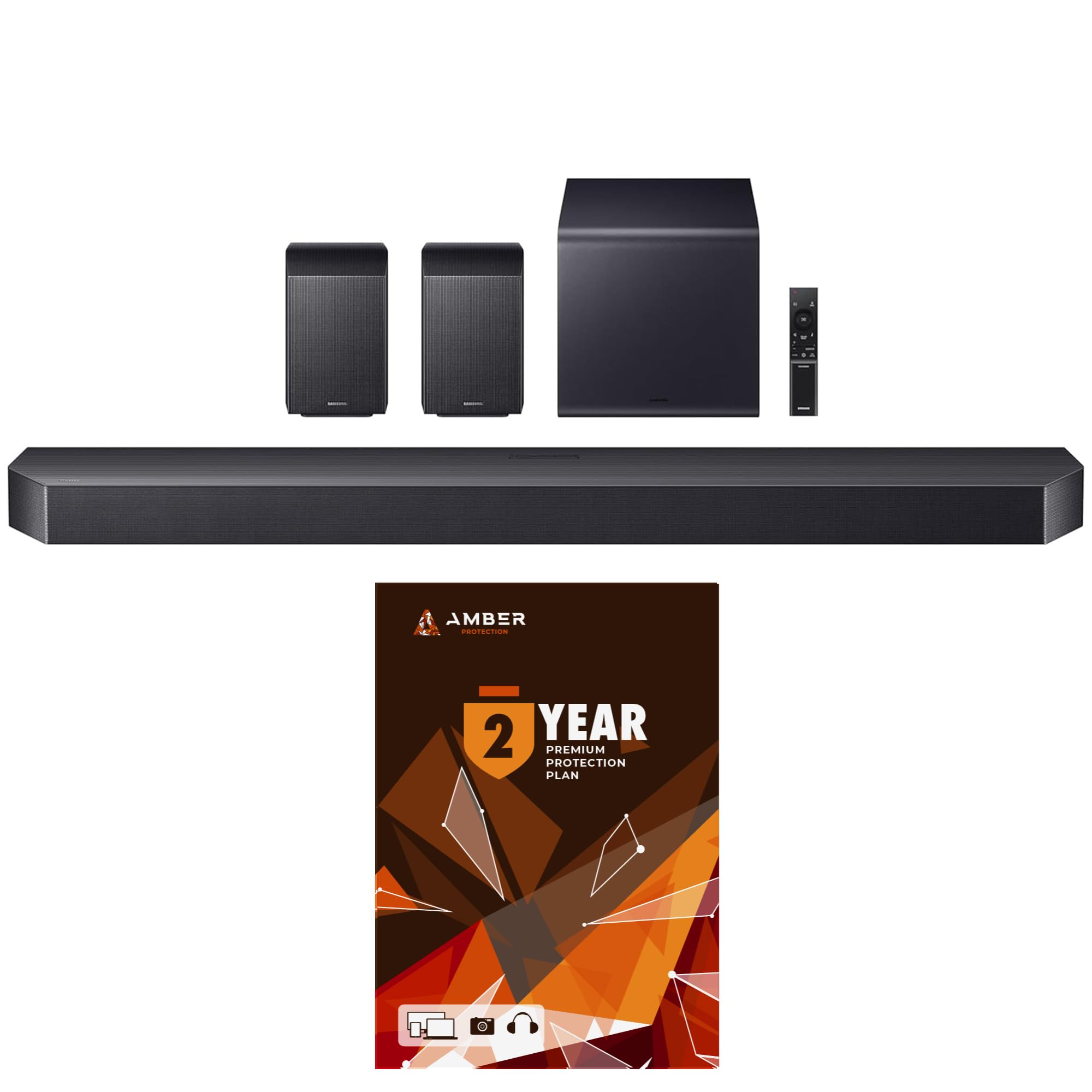
8. Samsung HW-Q990F Soundbar
Eleven channels, four height speakers, and no cable between bar and sub
This is the top of the ladder by channel count. An 11.1.4 layout spreads sound from every direction, and Dolby Atmos arrives wirelessly so the subwoofer and rear speaker connect without cables to the bar. SpaceFit Sound Pro Plus uses the soundbar’s own mic to calibrate the audio to your room, which is the feature that makes a complex system behave in a room that is not a perfect rectangle. Q-Symphony runs Samsung TV speakers alongside the soundbar for a fuller stage if you own a matching set.
The practical details are strong too. Active Voice Amplifier Pro lifts dialogue, Game Mode Pro tunes for gaming, and 4K Video Pass 120Hz with HDR10+ carries high-frame-rate HDR content through untouched. The bundle also includes a screen cleaner kit, a practical extra for anyone wiping down a large screen. Owners describe the volume ceiling as very high — it gets loud without strain.
You should know what you are buying into. This is the least-established pick here by a wide margin, with a fraction of the owner history of the systems above, so the long-term verdict is still being written. It also assumes a Samsung TV if you want Q-Symphony. Buy it for the 11.1.4 channel count and wireless Atmos, not for a long track record.
The flagship case: an 11.1.4 array with wireless Dolby Atmos and self-calibration for buyers who want the maximum channel count.
The caveat: the thinnest owner history on this list, so you are buying on spec and early feedback.
Go all in if: you want the highest channel count here and have a Samsung TV to pair it with.
Hold back if: you prefer a system with a long, proven feedback trail behind it.
Know the Specs
Channel Count: 5.1.4 vs 7.1.2 vs 11.1.4
The numbers separate main channels, subwoofers and height channels. A 5.1.4 gives you five main speakers, one sub and four overhead channels. A 7.1.2 gives you more side and rear spread but only two overhead channels. Neither is strictly better. It depends on if you want a wider wall of sound or more effects raining from above. Higher channel counts generally demand more setup care and a larger room to justify them.
Subwoofer Driver Size and Frequency Floor
The driver size in inches is the diameter of the bass cone. Larger cones move more air, which translates to deeper, more physical bass. The frequency floor, stated in Hz, is the lowest note the sub can produce — a lower number reaches deeper. A 10-inch driver paired with a 20Hz floor will move your chest in a way a 6.5-inch driver simply cannot, but smaller subs suit apartments where you cannot use the depth anyway.
Wireless Rear Speakers Still Need Power
Wireless means the signal travels through the air, not that the speakers are battery-powered. Each rear speaker plugs into a wall outlet for power and receives audio wirelessly from the soundbar. That removes the long cable run to the back of the room but leaves you needing outlets behind the couch. Dual 5GHz transmission reduces interference from Wi-Fi routers, which matters in a crowded apartment building.
HDMI eARC, Optical and Bluetooth
HDMI eARC carries full-quality audio on one cable and lets your TV remote control the soundbar’s volume. Optical handles audio too but supports less data. Bluetooth is best for streaming music from a phone and can introduce a slight delay with video. If your TV has an eARC port, use it and ignore the rest — it is the cleanest path and the one that keeps your coffee table remote count down to one.
Common Questions
Do wireless surround speakers still need a power outlet?
Is 5.1.4 better than 7.1.2 for movies?
Will these systems work with any TV brand?
How loud should I expect a soundbar with 760W peak power to get?
What does the subwoofer size in inches actually change?
Do I need Dolby Atmos to notice a difference?
Where should I place the wireless rear speakers?
Can I use these systems to stream music from my phone?
Will a soundbar with a wired subwoofer still count as wireless surround?
How long do these systems typically last?
The Bottom Line
For most rooms, the wireless surround sound speakers for tv answer is the ULTIMEA Skywave X70. Its 7.1.4 layout and 10-inch subwoofer deliver overhead effects and real bass from a single box, with wireless rears and no cable run. Want maximum channel count and a Samsung TV to pair with? The Samsung HW-Q990F takes that spot. And if your living room is small and dialogue clarity is the daily need, the LG S40TR gets you real surround for the least commitment. The X70 is the one worth moving on first: it has the most consistent positive owner feedback in this lineup.
How we choose
We do not accept paid placement. Every pick is matched to a real buyer and a real use-case; we do not hands-on test units.
Sources
Specifications: manufacturer listings and product documentation. Review insights: verified customer reviews, as of November 2026. Pricing: not shown on this page (it changes often); check the current price via the retailer link.
As an Amazon Associate, Tactical Gear Guy earns from qualifying purchases. This does not affect which products we feature.