Specs are compiled from manufacturer listings and verified buyer reviews and can change over time — please confirm the key details on the product page before buying.
You already own good speakers. What you do not own is a way to play music from your phone through them without dragging a cable across the room. A wireless speaker conversion kit fixes exactly that — it takes a wired stereo, amplifier, or powered speaker and makes it receive audio over the air. The short answer: most people should start with a Bluetooth receiver that has a 3.5mm or RCA output, because it plugs in and pairs in seconds. If you are running a live mixer or a subwoofer across the room, you want an XLR or 2.4GHz/5.8GHz kit instead, and the differences between those matter a lot.
This guide is built by comparing the manufacturers’ published specifications and the patterns across verified customer reviews, so you get each pick’s real strengths and trade-offs instead of marketing spin.
Below you will find nine kits sorted by what they actually do well, from a budget Bluetooth receiver that runs all day to a subwoofer adapter built for rooms where WiFi fights back. Each entry states the real connection type, the real range figure, and the honest catch — so you can pick the right wireless speaker conversion kit on the first try.
Top Picks
How To Choose The Best Wireless Speaker Conversion Kit
The first decision is not brand or budget. It is direction. A receiver takes wireless audio in and sends it out through a cable into your speakers. A transmitter takes audio from a TV or mixer and beams it out. Some kits are both. Buy the wrong direction and nothing works, no matter how much you spend.
Match the connector to the jack you already have
Look at the back of your stereo or speaker and find the input. A 3.5mm jack (the small headphone-style hole) takes a plain aux cable. RCA jacks (the red and white circles) take a stereo patch cable. XLR is the three-pin locking connector found on mixers and powered PA speakers. Almost every kit here ships with adapter cables, but confirm the kit covers your jack before you commit — a 3.5mm-only receiver will not plug straight into a mixer.
Know what latency does to your ears
Latency is the delay between the source and the sound leaving your speaker. For music streaming you will never notice it. For video, a big delay shows up as lips moving before you hear the words. Kits here quote figures like under 25ms latency, and lower is better for anything with a screen attached.
Battery or wall power
Some kits carry a rechargeable battery and run untethered. Others need a USB power adapter at all times. A battery unit is easier to move between rooms and cars; a wall-powered unit never needs charging but needs an outlet near the speaker. Neither is better — it depends on whether your speaker sits near a socket.
Do not assume Bluetooth
A handful of kits here are 2.4GHz or 5.8GHz radio sets, not Bluetooth at all. They pair only with their own matching transmitter, which sounds like a limitation until you learn they dodge the congestion that Bluetooth and WiFi share. For a subwoofer in a crowded living room, that trade can be worth it.
Side-by-Side Comparison
| Model | Best For | Connection | Battery | Rated Range | Amazon |
|---|---|---|---|---|---|
| SONRU LE523 Bluetooth 6.0 Receiver★ Best Overall | Everyday stereo streaming | Bluetooth 6.0 | 24 hours | — | Amazon |
| Upliftjoys Bluetooth 5.4 ReceiverEasiest Setup | Wall-powered permanent setup | Bluetooth 5.4 | Wall power | 30 meters | Amazon |
| Aokeo AK-M1 XLR ReceiverBest for Live Sound | Mixers and PA speakers | Bluetooth 5.1 / XLR | 8 hours | 100 feet | Amazon |
| Xvive P3 Wireless XLR | Stereo PA linking | Bluetooth 5.1 / XLR | 8 hours | 100 feet | Amazon |
| 1Mii 2.4GHz RCA TX/RX Set | TV to speakers, two rooms | 2.4GHz radio | Wall power | 262 feet open | Amazon |
| 1Mii B06Ultra Bluetooth 5.3 | Hi-Res stereo listening | Bluetooth 5.3 | Built-in | 100 feet open | Amazon |
| DYNASTY WSA-5TR-V2 Sub Kit | Wireless subwoofer placement | 5.2/5.8GHz dual band | Wall power | 100 feet line of sight | Amazon |
| BIC America WTR-Sys Kit | Powered sub and speaker runs | Wireless 4-channel | Wall power | 80 feet unobstructed | Amazon |
| SVS SoundPath Adapter | Subwoofer relocation | Wireless RCA | Wall power | — | Amazon |
Detailed Reviews
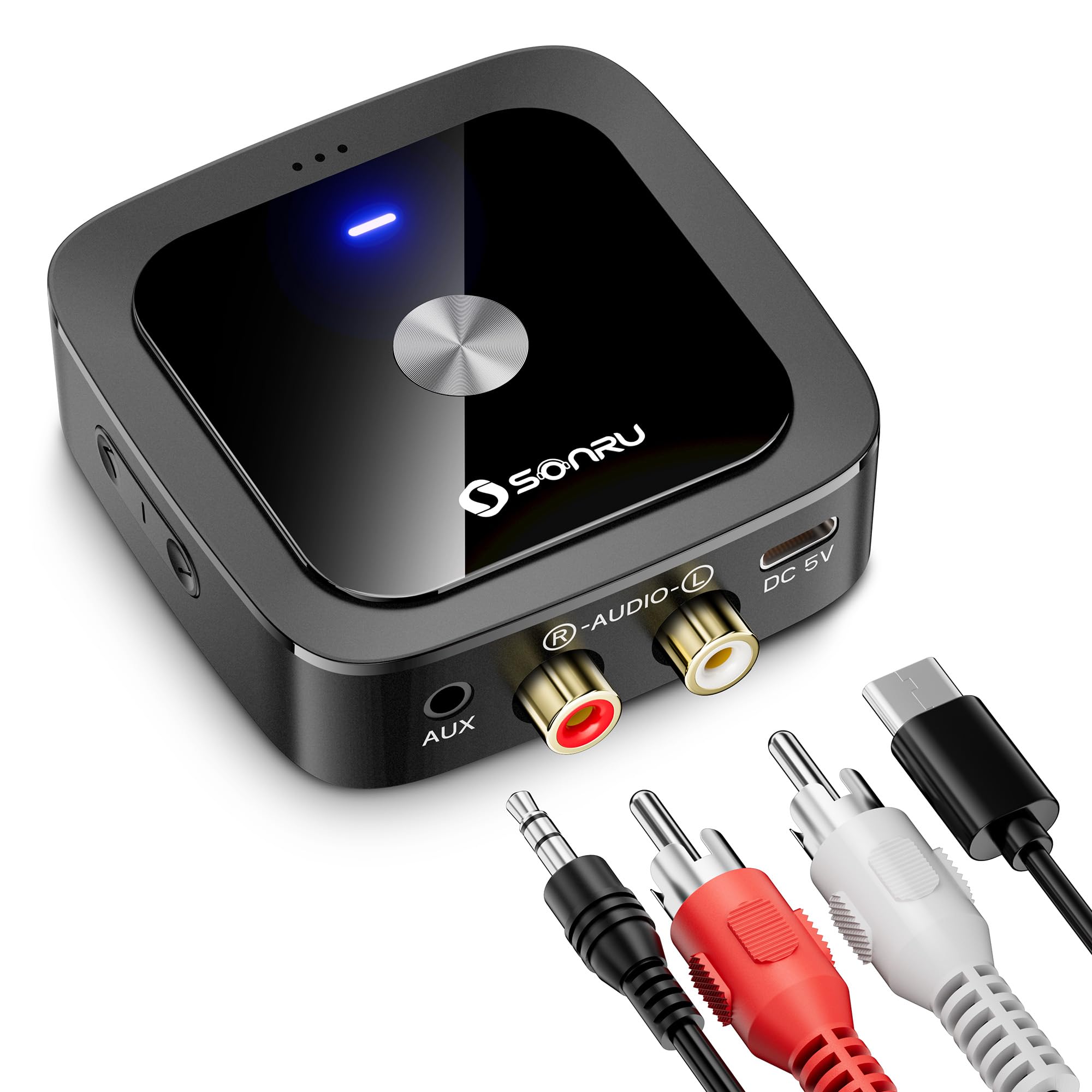
1. SONRU LE523 Bluetooth 6.0 Receiver
Our pick — 4.5+★ from 350+ verified ratings; the strongest balance of quality and price.
The one that runs a full day on a single charge and never asks for a wall socket.
Twenty-four hours of continuous playback from a two-hour charge is the headline here, and it is not a small thing. That is roughly three times the runtime of the AK-M1 XLR receiver further down this list, which tops out at 8 hours. For a garage speaker, a patio setup, or a car stereo you drive a few times a week, that gap is the difference between charging every night and charging every few weeks.
The Bluetooth version is the other quiet advantage. This unit runs Bluetooth 6.0, while the AK-M1 uses Bluetooth 5.1 — a newer generation of the same wireless standard, which generally means tighter connections and better power efficiency. It also accepts two paired devices at once, so a phone call pauses your music and hands it back automatically when the call ends, with no re-pairing. The kit speaks both 3.5mm aux and RCA, so it drops into a home stereo or a car head unit with the cable you already have.
One thing to get straight before you order: this is a receiver only. It takes Bluetooth in and pushes audio out through a cable. It cannot take a TV’s sound and beam it to a speaker — that job needs a transmitter, and the 1Mii 2.4GHz set below covers it. The other honest note is that the buttons take a few days to learn; the multi-function layout is compact, and the manual is thin.
What it gets right
- 24 hours of playback from a single 2-hour charge, so it travels without a charger
- Bluetooth 6.0 with support for multiple HD audio codecs
- Pairs two devices at once and resumes music after a call without re-pairing
- Both 3.5mm aux and RCA outputs cover home stereos and car head units
Where it stops short
- Receiver only — it cannot transmit audio from a TV or mixer
- The compact multi-function buttons take some getting used to
Made for: anyone turning a wired stereo, car head unit, or powered speaker into a Bluetooth target with the least fuss and the fewest charging days.
Not your unit: you need to send sound out of a television or mixer rather than receive it.
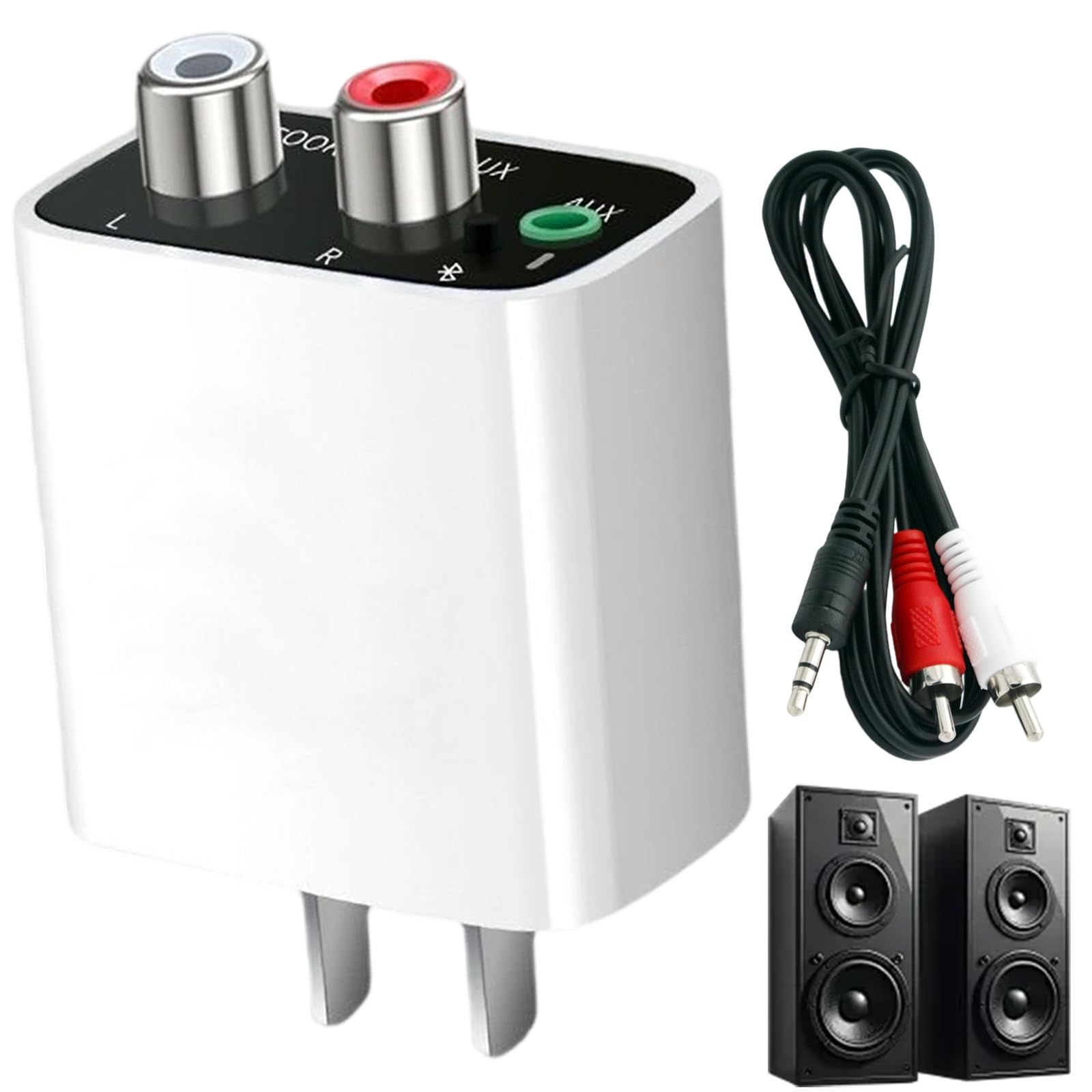
2. Upliftjoys Bluetooth 5.4 Receiver
No battery to charge, no pairing ritual — plug it in and your old speakers wake up.
This is the kit for the person who does not want to think about it. There is no internal battery, so it draws power from the wall and is always on and ready. You connect it to the RCA or 3.5mm input on your amplifier, pair your phone once, and it stays paired. The 30-meter coverage figure speaks to a space-saving white housing built to sit quietly behind a receiver rather than on top of one.
Bluetooth 5.4 is the current-generation wireless standard here, and it handles the basics well — stable transmission, stereo output across two channels, and compatibility that spans speakers, amplifiers, mixers, phones, tablets, and computers. For a permanent living-room conversion where the adapter never moves, wall power is a feature, not a compromise.
The trade-off to weigh: because it needs an outlet, this is not the kit for a patio speaker or a car stereo without a nearby socket. The other consideration is that the listing is thin on review history compared to the more established picks here — a newer arrival rather than a long track record. If you want a proven unit you can read a hundred opinions about first, the SONRU above has the deeper history.
Reach for this if: your speaker lives near a power strip and you want a set-and-leave conversion that never needs a charge.
Look elsewhere if: you plan to move the adapter between rooms or into a car — the wall requirement rules that out.
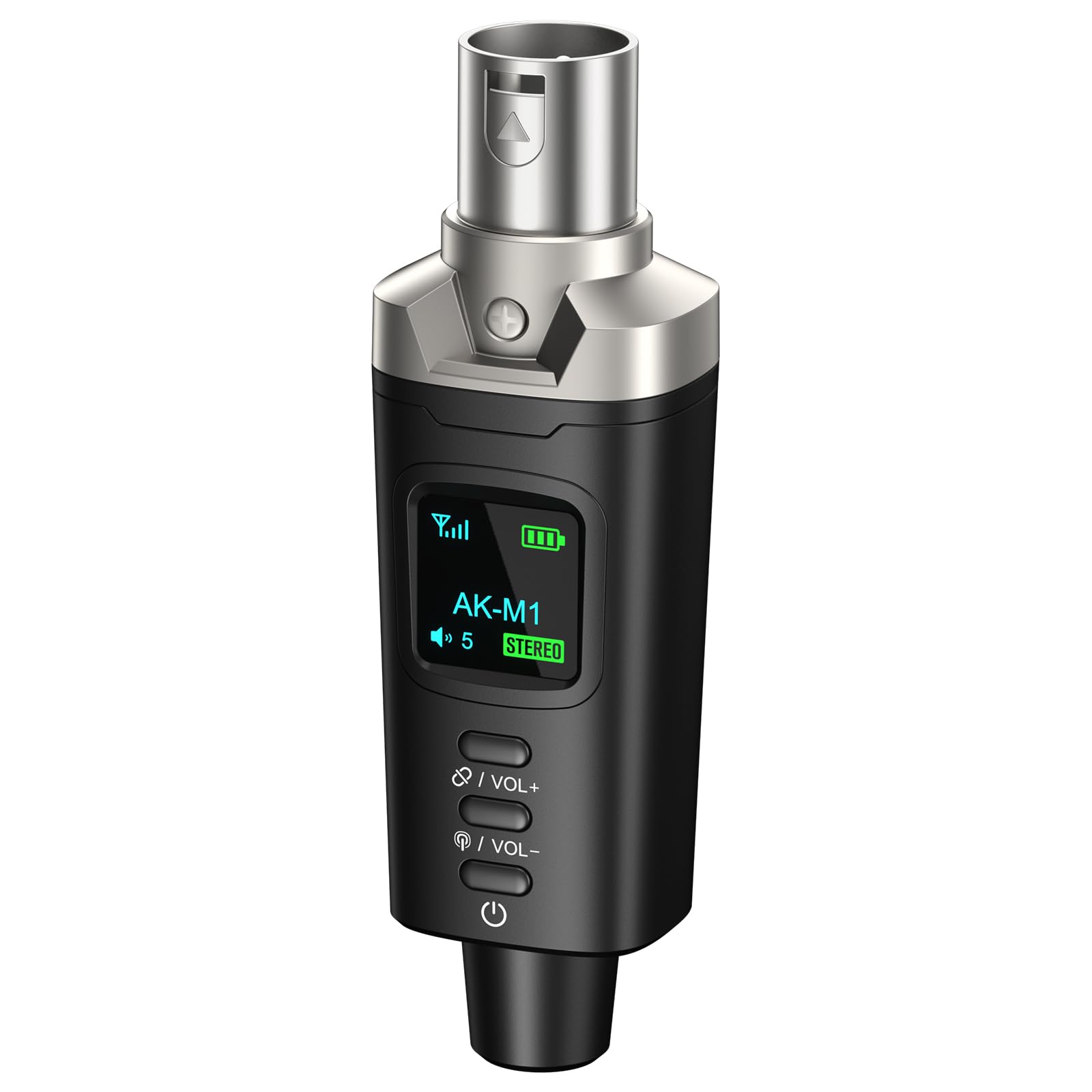
3. Aokeo AK-M1 XLR Bluetooth Receiver
The XLR plug that puts a wireless signal straight into a mixer or powered PA cabinet.
Most kits in this list end in a 3.5mm or RCA plug. This one ends in XLR — the three-pin locking connector you find on mixing desks and active PA speakers. That single detail is what makes it useful at a wedding, a church service, or a party, where the music source is a phone or tablet and the destination is a professional speaker cabinet. You plug the receiver into the XLR input, pair your device, and the cable run disappears.
The audio path is handled by a 16-bit/48kHz DAC (a digital-to-analog converter, which turns the wireless digital stream back into a signal your speakers understand). Aokeo’s pitch is that this resolution keeps the sound close to what a cable would deliver, and it is the same DAC figure the Xvive P3 quotes. Signal runs on Bluetooth 5.1 with A2DP and AVRCP, rated out to 100 feet. Runtime is 8 hours from a built-in rechargeable battery, topped up through USB Type-C in about two hours.
What makes or breaks this unit is whether your rig speaks XLR. If your speaker only has RCA or 3.5mm inputs, this is the wrong connector family entirely and you should stay with the SONRU or the 1Mii B06Ultra. It is also a mono receiver in its single-unit form; stereo playback requires the dual P3D variant, so check which one you are buying before the event, not at the venue.
Where it earns its place: the XLR connector, the 100-foot rated range, and a DAC that does not cut corners for the price. This is the pick for anyone whose speakers have professional inputs and whose gigs have a start time.
Best fit: DJs, venue operators, and anyone running a powered PA or mixer that accepts an XLR input.
Wrong tool: a home stereo with only RCA jacks — this receiver will not plug in without an adapter.
4. Xvive P3 Wireless XLR Bluetooth Receiver

Two of these link into one cable-free stereo pair across a stage.
Here is the feature that separates it from the Aokeo above: you can pair two P3 units together for true stereo playback, with one receiver feeding each powered speaker. That means a left and right cabinet on opposite sides of a room with no signal cable between them. The XLR plug locks into a mixer or active PA input, and setup is a matter of plugging in, pairing your phone or tablet, and playing.
The specs line up closely with the AK-M1 — Bluetooth 5.1, A2DP and AVRCP support, a 16-bit/48kHz DAC, and a rated 100 feet of range — but the P3 adds that stereo-link pairing and a touch-based control surface. For a dance floor, a wedding, or a broadcast setup where the speakers are physically apart, the two-unit option is the practical difference.
Battery is the honest weak point. It runs up to 8 hours and charges over USB Type-C in about two hours, which covers most events but leaves no margin for a full-day outdoor booking. Treat the runtime as a set-length commitment and keep a power bank in the bag. The stereo trick also only works if you buy the pieces to link — a single P3 is a single channel.
What owners rely on: the pairing and functionality side of this unit is what carries it. It holds a connection, it links two units cleanly, and it makes a wired PA feel like it never needed the wire. For an event rig where the speakers are set apart, that is the whole job.
Pick this: when your PA speakers sit on opposite sides of the room and you want a true stereo spread without running cable between them.
Think twice: if the event runs past 8 hours — plan for a top-up charge over USB Type-C.
5. 1Mii 2.4GHz RCA Wireless Audio Transmitter Receiver Set
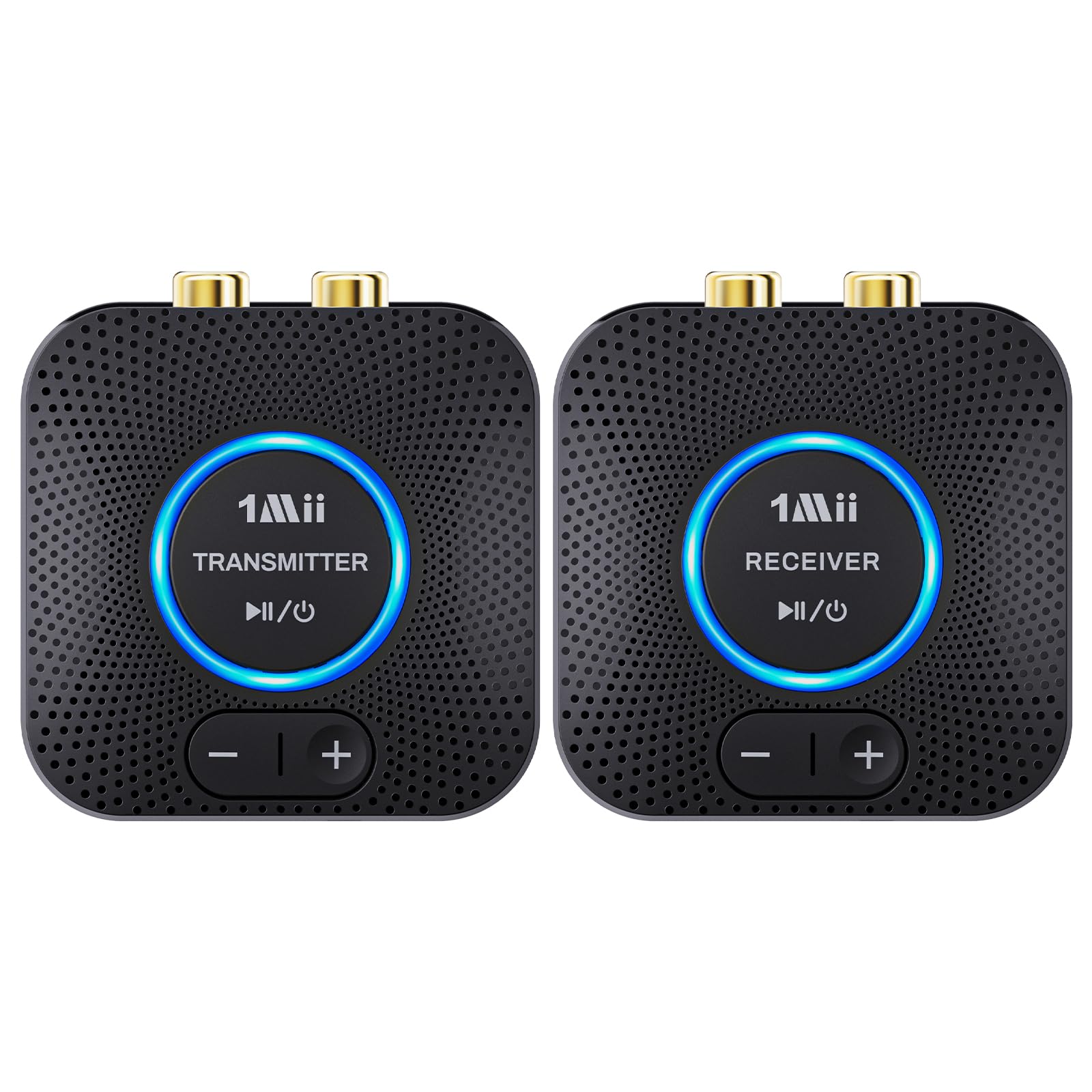
A matched transmitter and receiver pair that carries a TV’s audio into another room.
This set sends and receives, while everything else on this list only receives. You plug the transmitter into the audio output of a TV, PC, or CD player, and the receiver into a powered speaker, amp, or home theater. The two then find each other automatically and light up a blue ring when they are talking. That pairing of a source and a destination is what lets you send music into a separate room, which no Bluetooth receiver in this guide can do on its own.
The range figure is the standout: up to 262 feet with no obstacle in the way, and a minimum of 98 feet for indoor use, on 2.4GHz with anti-interference technology. Latency is quoted under 25ms, low enough that dialog stays glued to lips on a screen. Both the transmitter and receiver carry their own volume buttons, and a single press mutes.
One caution written right into the listing: this is not Bluetooth. The two units pair only with each other, so it will not take a phone call or join a headphone. It also is not suitable for a subwoofer, and it ships without a battery — both halves need their included power adapters plugged in. If you want a sub on the move, look at the DYNASTY or SVS kits below instead.
Strongest card: dual AUX and RCA outputs let one receiver feed two powered speakers at once, and the range covers a whole house.
Built for: pulling TV or PC audio across a large space to a powered speaker without cutting into walls.
Skip if: you want Bluetooth device pairing or a battery-powered unit — this kit is neither.
6. 1Mii B06Ultra Bluetooth 5.3 Receiver
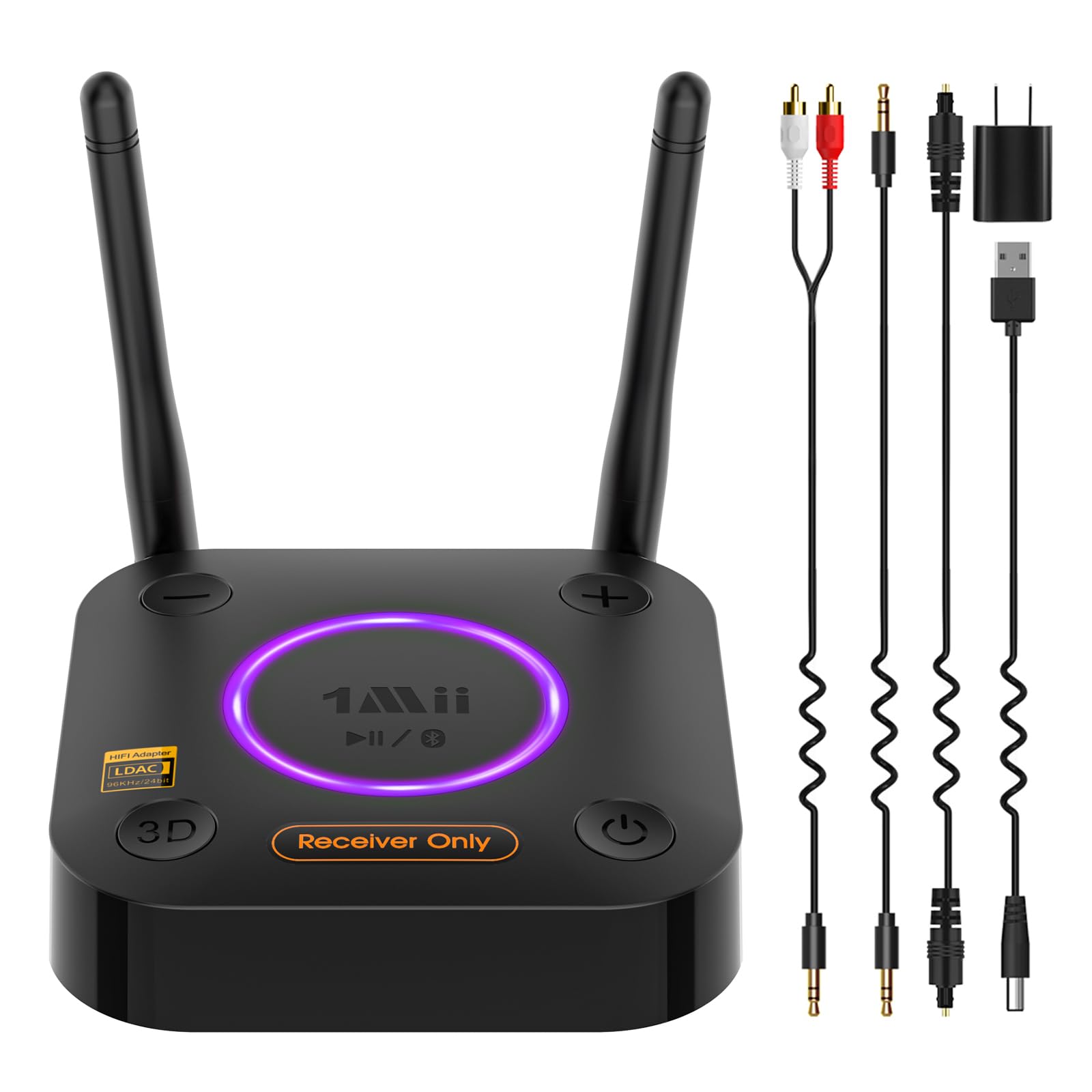
An audiophile chip inside a small black box — this is the kit that respects a good stereo.
If you already own a receiver or amplifier worth keeping, feeding it badly is the real risk. The B06Ultra is built around the ES9018K2M DAC chip (a digital-to-analog converter, the part that turns the incoming stream back into an analog signal). It supports LDAC at up to 24-bit/96kHz and a 990kbps bitrate, plus aptX HD, aptX Low Latency, AAC, and SBC. In plain terms, it moves a far larger slice of your music’s detail over the air than a standard connection can, so quiet passages keep their texture.
The physical side is just as thought through. Dual antennas with Class 1 Bluetooth 5.3 are rated for up to 100 feet in open space and 50 feet indoors, so you can walk to the kitchen with your phone and keep playing. It accepts Optical, Coaxial, RCA, or 3.5mm on the output side, which covers nearly every modern and vintage receiver in a home. There is also a dedicated 3D button that turns on a surround effect — a taste thing, not a requirement.
It is a receiver, so the same limitation as the SONRU applies: it cannot ship sound out of a TV. The 3D effect is the one feature to audition rather than assume; some listeners leave it off. The rest of the build serves one goal: making a wired hi-fi system wireless without making it sound wireless.
The detail that decides it: LDAC and a high-end DAC chip together put this above the SONRU on outright audio quality. If your speakers can reveal the difference, this is where the extra spend goes.
For the listener: someone with a receiver and speakers good enough that a cheap Bluetooth link would be a waste of them.
The catch: it needs a wall socket and a source device — no battery, no transmitting.
7. DYNASTY PROAUDIO WSA-5TR-V2 Wireless Subwoofer Kit

Built for the one job Bluetooth fights with your router over: a wireless sub.
A subwoofer is the hardest speaker to free from a cable, because low frequencies need the sub placed where it actually sounds right — often a corner far from the amplifier. This kit solves that with 5.2GHz and 5.8GHz dual-band wireless and an automatic total of 106 RF channels to hop a signal around interference from routers, phones, garage doors, and other 2.4GHz and 5GHz devices. That is the key difference from a Bluetooth kit: it does not share the crowded band your WiFi lives on.
You plug the transmitter into your existing stereo, home theater receiver, or audio source, then place the powered sub wherever it sounds best near a power outlet. The receiver handles the rest with no delay between audio and film. Rated range is 100 feet in line of sight or 50 feet through walls, ceilings, and floors, and the listing honestly notes that walls and floors reduce it. Buyers report no hiss and minimal delay from the plug-and-play pairing.
The fair limitation is interference in a very crowded wireless home — some setups hit it while others never do, and the listing admits the range shrinks with obstacles. It is also strictly a transmitter-and-receiver pair for one audio path, so it is not the kit for streaming from your phone. Wall power only, no battery.
Why it stands out
- 5.2/5.8GHz dual band with 106 RF channels dodges the band WiFi uses
- 100 feet line of sight or 50 feet through walls, ceilings, and floors
- Plug-and-play setup with no noticeable latency for film and TV
- Lets you move a powered sub to its best-sounding corner
Worth knowing
- Range and stability drop as walls and floors get in the way
- A crowded wireless home can still produce interference
- Needs wall power on both ends; no battery
Your match: a home theater owner with a wired sub they want to move across the room without cutting drywall.
Keep looking: if you need to stream music from a phone — this kit only talks to itself.
8. BIC America WTR-Sys Wireless Transmitter/Receiver Kit
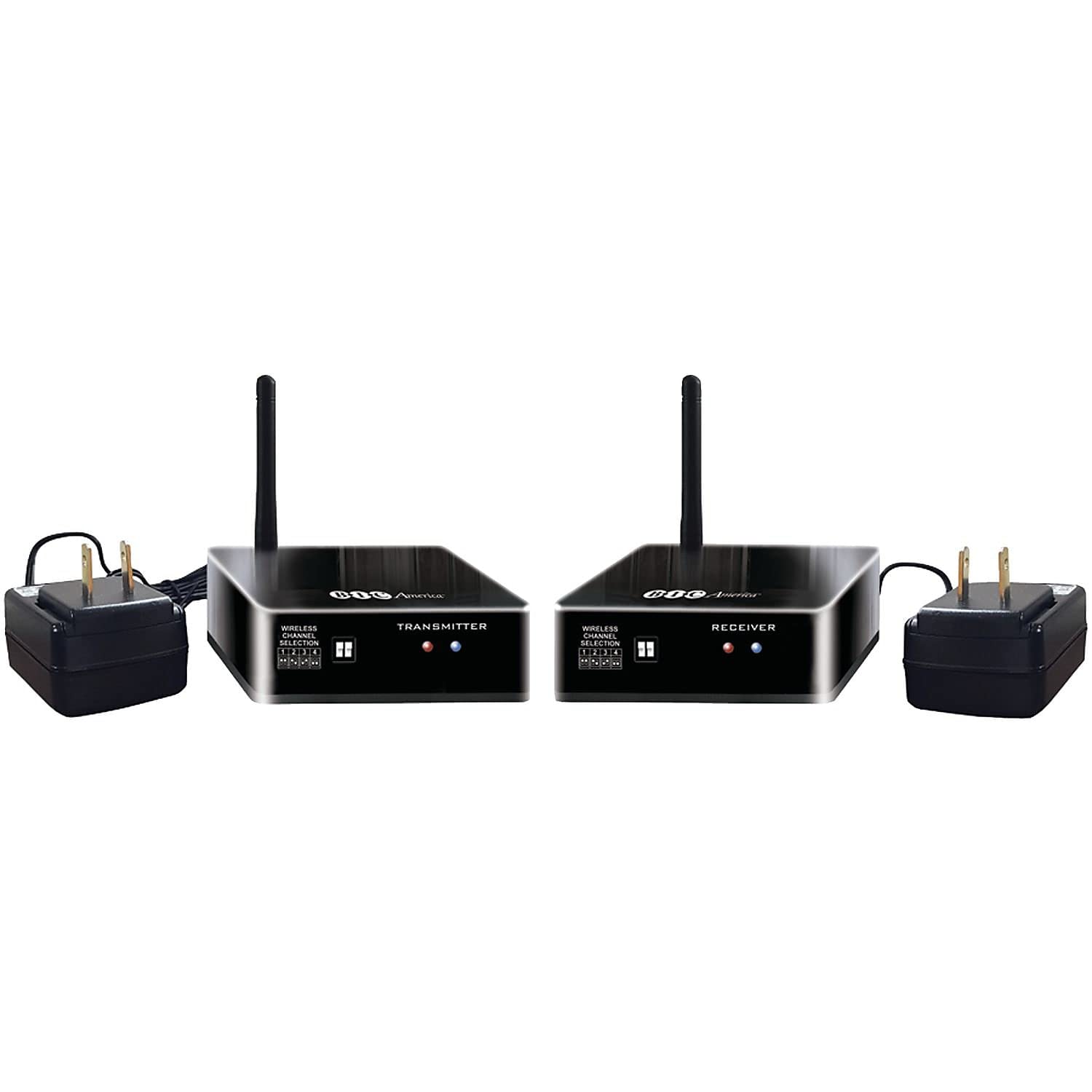
Four channels in the box, external antennas on top, and a cable kit for nearly any jack.
This is the most generously equipped set here. It is a 4-channel wireless transmitter and receiver system, and the box carries two external antennas, two USB AC power adapters, two USB cords, two RCA-to-RCA stereo patch cables, two RCA Y-adapter cables, and two 3.5mm stereo-to-RCA cables. If you have a powered subwoofer and a powered speaker to feed, the wiring is already in the bag. Range is rated at 80 feet unobstructed and up to 60 feet with obstacles.
It works with A/V receivers, Macs, PCs, mobile devices, and anything with a 3.5mm or RCA connector. For a powered speaker hookup, your A/V receiver needs variable pre-amp out RCA jacks — check that before you buy, because a fixed-level output will not give you volume control from the receiver. Velcro strips are included so the units can mount out of sight.
Where buyers split is sound. Some report clean audio and no WiFi interference; others hear audible noise or dropouts in some rooms. The honest read is that this kit rewards a clean power setup and a short, obstacle-free hop — it is not the most forgiving in a dense wireless home. If outright audio purity matters more than channel count, the 1Mii B06Ultra is the safer pick for the money.
What you are paying for: four channels and a complete cable kit in one box. That breadth is real, and for a sub-plus-speaker run it saves you a trip to the store.
Choose it when: you need to feed more than one powered device and want every adapter cable included from the start.
Pass if: your room is loud with wireless signals and you want the cleanest audio path possible.
9. SVS SoundPath Wireless Audio Adapter

The premium sub adapter that does one thing and does it without drama.
SVS builds subwoofers, and this adapter exists for one reason: to let a subwoofer live where it sounds best instead of where the cable reaches. It is a transmitter and receiver pair over RCA. In the box you get two 17-inch 3.5mm stereo male-to-stereo male RCA adapter cables, two 15-inch 3.5mm-to-mono male RCA adapter cables, and two USB 5V DC, 1A power adapters. That is everything to connect a receiver, an amplifier, or a speaker without buying another part.
The reason it sits at the top of this list on reputation is the consistency. Owners describe pairing that takes minutes, with no obvious change in sound when you cut the cable. That near-invisible behavior is exactly what you want from a sub adapter — you should forget it is there. The unit itself is compact and light, so it tucks behind a sub on the floor.
Two honest notes. It is a sub and powered-speaker adapter, not a music streamer — no Bluetooth pairing from your phone. And the physical setup is a small chore: with two power adapters and two RCA cables, you are committing to a semi-permanent install rather than something you move weekly. Cable tidiness around the sub is the recurring gripe, so plan the run before you place the sub.
The honest summary: the premium price buys polish and reliability, not extra features. You are paying for a sub adapter pair that works the first time and stays working.
Right for you: a subwoofer owner who wants the wireless hop to be invisible and never touch it again.
Not for you: anyone expecting phone-to-speaker Bluetooth streaming — this adapter only moves RCA audio between its own pair.
Know the Specs
Bluetooth version (5.1, 5.3, 5.4, 6.0)
The version number tells you how modern the wireless chip is. Higher numbers generally mean better power efficiency and more stable connections, but they do not automatically mean better sound. The real audio quality rides on the codec — LDAC, aptX HD, AAC, or SBC — and the DAC chip that turns the stream back into analog. That is why the 1Mii B06Ultra’s Bluetooth 5.3 with LDAC and the ES9018K2M DAC outresolves the Bluetooth 6.0 SONRU on paper for critical listening.
Latency (measured in milliseconds)
Latency is the gap between the source and the sound reaching your ears. For music, a small delay is invisible. For film and TV, a big gap shows up as out-of-sync dialog. One kit here quotes under 25ms, which is low enough for video. If a listing does not state a latency figure, assume it is fine for music and test it against a video before committing.
Range and obstacles
Rated range is almost always measured in open air with nothing in the way. The DYNASTY kit quotes 100 feet line of sight but only 50 feet through walls, floors, and ceilings; the BIC kit quotes 80 feet unobstructed and 60 feet obstructed. Expect real-world distance to shrink with every wall, and place the transmitter and receiver in the same room whenever you can.
Battery versus wall power
Battery kits run untethered — the SONRU delivers 24 hours, the Aokeo and Xvive deliver 8 each. Wall-powered kits never need charging but must sit near an outlet. If your speaker is fixed beside a power strip, wall power is simpler. If it moves, battery wins. Runtime figures assume continuous playback at normal volume; louder sessions can shorten them.
Common Questions
Does a wireless speaker conversion kit work with an old non-Bluetooth stereo?
What is the difference between a Bluetooth receiver and a transmitter?
Will a wireless subwoofer kit add lag to movie audio?
How far can a speaker adapter reach through walls?
Do I need an XLR kit or an RCA kit for my speakers?
Can a wireless subwoofer adapter connect two subwoofers?
Is LDAC worth it over standard Bluetooth audio?
Will these kits interfere with my WiFi router?
How long does the battery last on a portable speaker adapter?
Can I use one of these kits with a car stereo?
The Bottom Line
For most people, the wireless speaker conversion kit that hits the right balance is the SONRU LE523. It gives you 24 hours of untethered playback and Bluetooth 6.0 in a kit that drops into a home stereo or a car without a charger. The SVS SoundPath is the premium sub pick, rated 4.2 by owners who want their sub to just work. But if you want a proven all-rounder for the money, the SONRU is the safer first buy. If you are feeding a mixer or powered PA speaker, reach for the Aokeo AK-M1 with its XLR plug and 16-bit/48kHz DAC. And for a subwoofer that needs to sit across the room from the amplifier, the DYNASTY WSA-5TR-V2 and its dual-band 5.2/5.8GHz wireless is the one to reach for.
How we choose
We do not accept paid placement. Every pick is matched to a real buyer and a real use-case; we do not hands-on test units.
Sources
Specifications: manufacturer listings and product documentation. Review insights: verified customer reviews, as of November 2026. Pricing: not shown on this page (it changes often); check the current price via the retailer link.
As an Amazon Associate, Tactical Gear Guy earns from qualifying purchases. This does not affect which products we feature.