Specs are compiled from manufacturer listings and verified buyer reviews and can change over time — please confirm the key details on the product page before buying.
You want a board that turns a pair of passive speakers into a wireless system — and the one that gets it right without drama is the ZK-TB21, because it pairs a 2.1 channel layout (two speakers plus a subwoofer) with Bluetooth 5.0 and simple treble and bass knobs for a genuinely low-stress build. Most buyers in this DIY niche get stuck on one thing: whether the wattage on the label actually matches the speakers sitting on their bench. This guide sorts that out for you, one board at a time.
This guide is built by comparing the manufacturers’ published specifications and the patterns across verified customer reviews, so you get each pick’s real strengths and trade-offs instead of marketing spin.
A wireless amplifier module is the small board that sits between your phone and your passive speakers, and its power chips, channel count, and supply voltage decide how it sounds in your room. Below you get every pick’s real numbers plus the plain-English meaning behind them for wireless speaker components.
Top Picks

How To Choose The Best Wireless Speaker Components
The mistake almost every first-time builder makes is buying the board with the largest printed wattage. Those big numbers are peak ratings taken at the highest supply voltage the chip tolerates — and if you feed the board less, you get less. Pick the channel count and voltage window first, and the wattage question mostly answers itself.
Start with channel count, not wattage
A 2.0 board drives two speakers and stops there. A 2.1 board adds a dedicated subwoofer output, so you get the low end from a separate driver instead of asking your mains to fake it. If you already own a subwoofer, filtering your list down to 2.1 boards is the single fastest way to shop.
Match the board’s power to your speakers’ handling range
Look at what the board says it can drive, not just what it outputs. Some boards list a compatible speaker range and an impedance window, which tells you immediately whether your drivers qualify. A board paired with speakers that demand more than it can give will clip and sound harsh.
Watch the supply voltage window
Each board lists a minimum and maximum DC input. The wider and higher that ceiling, the more headroom you have before the amplifier runs out of puff. The power supply itself is usually sold separately, so factor that into your build plan before you commit to a board.
Decide how you want to feed it music
Every board here offers Bluetooth, but the input list varies: some add a 3.5mm AUX jack, some read USB flash drives, and a few include a USB sound card mode. Bluetooth 5.0 is the common baseline; one premium board steps up to Bluetooth 5.2 with AAC and SBC codec support.
Side-by-Side Comparison
| Model | Best For | Channels | Max Output | Supply Voltage | Amazon |
|---|---|---|---|---|---|
| ZK-TB21★ Best Overall | First 2.1 build | 2.1 (3) | 200W (50+50+100) | DC 12–24V | Amazon |
| ZK-1602TTop Performer | Pure stereo, no sub | 2.0 (2) | 320W | DC 15–36V | Amazon |
| ZK-HT21 (ARRAROWN)Longest Wireless Range | Long-range Bluetooth | 2.1 (3) | 540W | DC 15–36V | Amazon |
| Hosyond H019 | Car and truck audio | 2.1 (3) | 220W sub channel | DC 9–36V | Amazon |
| ZK-HT21 (AEXCVG) | Dial-button control | 2.1 (3) | 540W | DC 15–36V | Amazon |
| T220HS-W | Clean stereo with panel | 2.0 (2) | 440W | DC 12–36V | Amazon |
| AK45Pro | Karaoke and mic use | 2.0 stereo | 400W+400W peak | — | Amazon |
| S350HS | Big sub, small board | 2.1 (3) | 220W×2 + 350W | DC 12–38V | Amazon |
| S600X | Maximum headroom | 2.1 (3) | 1200W | DC 19–51V | Amazon |
Detailed Reviews
1. ZK-TB21 2.1CH Bluetooth Audio Amplifier Board
Our pick — 4.5+★ from 500+ verified ratings; the strongest balance of quality and price.
Three channels, a subwoofer output, and knobs you can turn without touching your phone.
The ZK-TB21 splits its 200 watts across three outputs: 50W left, 50W right, and a dedicated 100W subwoofer channel. That third channel is the whole reason to pick it, because it means your bass comes from a sub instead of being squeezed out of two small bookshelf drivers. Bluetooth 5.0 handles the wireless link, and a 3.5mm AUX input covers the wired case when you want it.
What wins people over is the build, which is the thing owners bring up more than anything else. A protective case wraps the board, and every interface is labelled on that plate, so you can wire the inputs and speaker terminals correctly without hunting for a manual. The treble and bass buttons sit on the module itself, so you tune the tone at the board rather than through a music app.
Two honest notes. The Bluetooth link is the mixed part — treat it as a short-range convenience rather than a room-spanning connection. And when you switch to AUX, you have to disconnect the Bluetooth pairing first, or the board stays latched to the wireless source. Supply voltage runs DC 12–24V, which is the narrowest window on this list, so plan your power supply before you commit.
What earns the top spot
- Dedicated 100W subwoofer channel adds real low end to a small build
- Every interface printed on the protective plate — no manual needed
- Treble and bass adjustable directly on the board
- Over-voltage, under-voltage, over-heat, and short-circuit protection built in
Where it asks more of you
- 12–24V supply window is tighter than the other 2.1 boards here
- Bluetooth is the mixed part of the picture — expect modest range
- AUX mode needs the Bluetooth pairing dropped first
Reach for this if: you are building a first 2.1 setup and want the tone controls sitting right on the board.
Plan around this: the 24V ceiling — buy a supply that matches it rather than a 36V brick.
2. ZK-1602T Bluetooth Audio Amplifier Board
A stereo-only board with the widest voltage headroom of anything here.
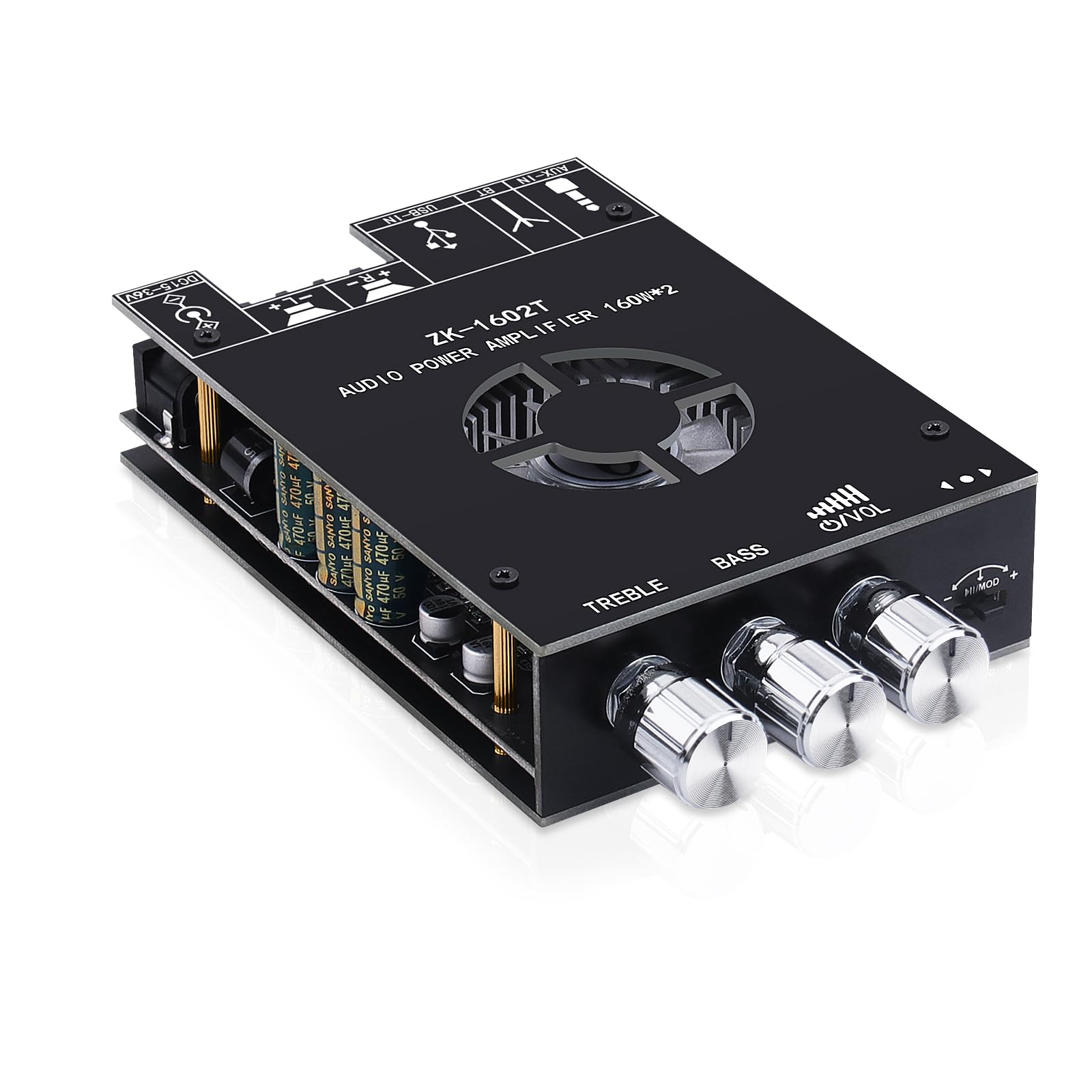
Two TDA7498E chips (high-performance class D amplifier chips) push this board to 320 watts across two channels, 160W per side. Ask for a subwoofer out and you will not find one — this is strictly a 2.0 design. In exchange it runs on DC 15–36V, the widest supply ceiling among the TDA7498E boards on this list, so it has more room to breathe before it runs out of power.
It is a hungry board by spec and works best with speakers in the 30–200W, 4–8Ω window the maker lists. A long-life ultra-silent fan with locked-rotor protection sits over the chips, and that matters in a small enclosure where heat builds up. Inputs cover Bluetooth 5.0, USB flash drive, USB sound card, and a 3.5mm AUX jack, with Bluetooth rated out to 10m (about 39ft) of unobstructed range.
Where the picture softens is sound. Owners are split on it — some find it clean and others do not — so this is a board to buy with modest expectations on tonality rather than a reference-grade ear. The upside is the silent fan and filtered output stage, and it drives larger drivers like 6×9 speakers without complaint.
The build argument: a filtered output stage plus the silent fan above the chips makes this the more forgiving board for a closed cabinet, and the 36V ceiling gives you room to grow.
What to weigh: no subwoofer channel and inconsistent reports on sound character mean it suits a straightforward stereo pair rather than a bass-heavy build.
Pick this for: a plain two-speaker build where you want voltage headroom and USB source options, not a subwoofer.
Leave it if: a subwoofer is part of your plan — there is no third channel to drive one.
3. ZK-HT21 2.1 Channel Bluetooth Amplifier Board
The one that keeps the wireless link alive across a whole room.
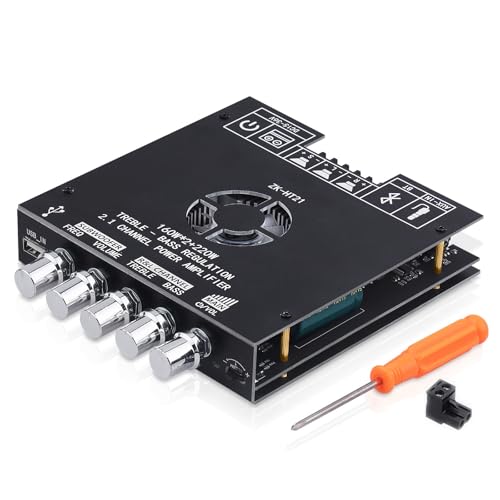
Bluetooth range is the number buyers ask about and rarely get a straight answer on. This ZK-HT21 lists 15m — roughly 49ft — of unobstructed range, which is the longest link of any board here and genuinely useful when your speakers sit across a room from the sofa. The board totals 540 watts: 160W per main channel plus a 220W subwoofer output, with a 2.1 channel layout and a fan over the amplifier chips.
Set against the ZK-1602T above, this board is the more capable of the two on paper — 540 watts against 320 watts, and three channels against two. It carries a 36V supply ceiling to the 1602T’s 36V, so the voltage headroom is a match, and the adapted supply is listed as DC 15–36V at 8A or above. That is a serious brick, so budget for the power supply before you commit.
What the board asks you to accept is a tone question. Owners split on the sound — some hear it clear, others catch a thin edge or a steady hiss — and one line of complaint is that the output does not hit the wattage printed on the box. Those are expectations to set, not disqualifiers: reliability and the way it performs day to day are what owners credit most, and the maker backs the board with a 2-year warranty.
Range and headroom: a 15m Bluetooth link plus 540W across three channels makes this the pick for a room where the source device lives far from the speakers.
The catch to price in: the 8A-or-above supply is not in the box, and the sound splits opinions, so audition it with speakers you already know.
Right choice for: a living-room build where your phone stays far from the amplifier.
Think twice if: you cannot source a power supply rated 8A or above at 15–36V.
4. ZK-HT21 TDA7498E Bluetooth Amplifier Board

Run it from a 12V line and drive door speakers with a sub in the trunk.
The supply floor is the decision-maker here. This board starts at 9V DC, with a 12V supply option called out specifically, and that makes it the natural fit for a vehicle electrical system. The 36V ceiling leaves plenty of upward room for a bench build as well. Channels run three deep, with 160W left, 160W right, and a 220W subwoofer maximum output.
Connection is quick and the pairing holds, which is what owners rely on. The dial button switches input modes and skips tracks without a separate remote, and the board handles 30–200W, 4–8Ω speakers — the maker notes it can drive 6×8 door speakers alongside a 10-inch subwoofer without strain. Protection covers anti-reverse polarity, undervoltage, overheating, overcurrent, and short circuit.
The honest caveat is longevity. Reports are mixed — plenty of boards run for months without a word of complaint, and a smaller group sees one quit early, sometimes within minutes. That spread argues for bench-testing the board before you bury it behind a door card. Where it does not wobble is power and value: 220W into the sub channel from a 9V floor.
Why the car builders like it
- 9V floor with 12V support suits vehicle wiring directly
- 220W subwoofer channel on top of two 160W main channels
- Dial button handles input switching and track skipping
- Five protection circuits including anti-reverse polarity
The tempered view
- Reliability is the mixed spot — bench-test before installing it out of reach
- Sound character draws split opinions rather than outright praise
Best matched to: a vehicle or bench build running from a 12V line with a sub in the mix.
Test it first: wire it up and run it before you mount it somewhere hard to reach.
5. ZK-HT21 Bluetooth Amplifier Board

One dial does volume, tracks, play, and input switching — no remote to lose.
Two original TDA7498E chips (amplifier chips that boost the audio signal) sit under the heatsink here, delivering 160W to the left channel, 160W to the right, and 220W to a subwoofer for a 540W total — enough to drive a full 2.1 setup without straining. The clever part is user-facing rather than spec-sheet: the rotary dial handles short press for play/pause, long press to switch between Bluetooth, AUX, and USB flash drive, and a twist left or right for previous or next track and volume. A screwdriver ships in the box.
As a build this one is quiet on paper about what it dislikes, because owners do not report much. Owners credit the sound quality first, and it powers a pair of Pioneer speakers without drama. What you get is Bluetooth 5.0 out to 10m (about 32ft) unobstructed, plus AUX, USB, and a dedicated subwoofer input; AUX mode again wants the Bluetooth pairing dropped first.
Compare it to the long-range ZK-HT21 listed above and the trade-off is clear: this board rates the wireless link out to 10m where that one lists 15m. Otherwise you get the same 540W, three channels, and 36V ceiling — the decision depends on if you want the extra five metres or a dial you never have to hunt for underneath a cushion.
The control win: a single rotary dial that covers volume, track skip, pause, and input source means your phone can stay in your pocket through a whole session.
Where it gives ground: 10m of Bluetooth range is the shorter link against its own namesake sibling, so a big open room may want the longer-range version.
Suits builders who: want hardware controls on the board rather than an app or a remote.
Consider the sibling instead if: your listening position sits further than 10m from the amplifier.
6. T220HS-W Power Amplifier Board 2.0 Channel
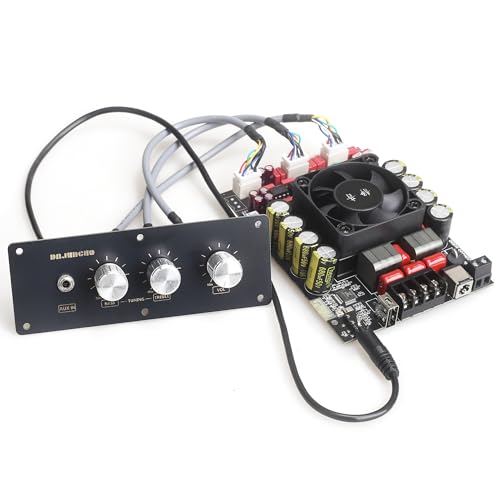
An imported TI chip, four swappable op-amps, and a panel that skips the drilling.
The chip is the story. A TI TPA3251D2 with PurePath technology drives 440 watts across two channels, 220W per side, and the maker targets low distortion and high-fidelity output rather than raw loudness. Four TI NE5532 op-amps (low-noise front-stage chips that shape the signal before it reaches the power stage) sit in gold-plated sockets, and they are compatible with JRC5532DD if you want to swap them later. That socketed design is unusual at this level and gives you a tuning path most boards do not offer.
Wireless is the newer standard here: Bluetooth 5.2 with AAC and SBC codec support, backed by a 3.5mm AUX input and a USB mode that decodes WAV, FLAC, APE, and MP3 files. Supply runs DC 12–36V. A DIY front panel comes in the box so you can mount the board in a speaker build without drilling your own cutouts.
Where it differs from the 2.1 boards on this list is what it does not do. There is no subwoofer channel — this is a two-channel design — so it is a pick for someone chasing clean stereo from a pair of good speakers rather than deep bass. Owners describe consistent operation and clear highs, and setup is straightforward; the trade is that you give up the third channel entirely.
Why it earns its keep: socketed op-amps and a pure digital amplifier inductor design mean this is the board on the list you can actually tune after the build is finished.
The honest limit: no subwoofer output at all, so a bass-heavy setup needs one of the 2.1 boards instead.
Go here when: clean stereo from two good speakers matters more to you than a bass channel.
Pass it over when: your design already has a subwoofer waiting for an amplifier.
7. AK45Pro Stereo Audio Amplifier, 400W 2Channel Bluetooth 5.0

A finished desktop box with two mic jacks — a party amp, not a bare board.
This one arrives as a complete unit with a case rather than a naked circuit board. Peak power is listed at 400W+400W with 50W×2 RMS rated power, and the chassis is compact enough for a bookshelf or desktop corner — the maker points it at small apartments, bedrooms, offices, basements, and garages. It handles old passive speakers without fuss and sets up in minutes.
Where it pulls ahead of the bare boards is the input list. Alongside Bluetooth there are RCA sockets, a USB port, an SD card slot, and two microphone jacks, plus separate knobs for mic volume, bass, treble, and master volume. That combination is why it lands in karaoke setups and games-room builds. A remote control ships in the box, though it takes AAA batteries you supply separately.
The Bluetooth range is the weak link in an otherwise strong package — reports trend toward a limited reach, so keep your source close. Bass and treble controls give you finer adjustment than a bare board’s fixed curve, and the sound comes through mellow and clear at moderate volumes. If you want two mic jacks and a finished chassis rather than a bare board, this is the one.
What makes it the party pick
- Two microphone jacks with dedicated mic volume knob
- USB, SD card, RCA, and Bluetooth inputs all in one chassis
- Compact footprint for a shelf or desktop
- Remote control included for couch-side control
What to keep in mind
- Bluetooth range is on the short side — keep the phone nearby
- Power output draws mixed views against the peak rating
- Remote needs AAA batteries not included
Built for: karaoke nights, garage setups, and anyone who wants a finished box rather than a board to wire.
Mind the reach: keep the source device within easy distance when streaming over Bluetooth.
8. S350HS TPA3251 Bluetooth Power Amplifier Board

A 350W subwoofer channel that will run a twelve-inch driver without flinching.
Three channels on a TPA3251 chip set, with 220W per main channel and 350W going to the sub — the highest subwoofer rating of the 2.1 boards here short of the flagship. Supply runs DC 12–38V, and the board weighs 327g, so it stays light enough to mount inside a speaker cabinet. Bluetooth, AUX, and USB flash drive cover the inputs for phones, TVs, and laptops.
Separate high and low frequency knobs are the feature you will actually use. Instead of a single volume control, you shape the sound in layers and bring the bass up on its own. Owners put this to work in serious rigs — one setup runs two sets of speakers and a 12-inch subwoofer off it — and it handles that load. Quality and power are what owners credit, and protection covers short circuit, over-current, over-heat, and anti-reverse.
The recurring gripe is crossover behaviour on the subwoofer channel: the low pass does not always keep vocals out completely, so a track with heavy low-mid content can leak voice through the sub. That is worth knowing before you buy if you are chasing a clean cutoff. A few units also draw reliability complaints, so bench-testing early is sensible.
The sub story: 350W into one driver is enough to move a twelve-inch sub properly, and the separate low-frequency knob lets you dial it in without touching your mains.
Where it asks patience: the subwoofer crossover does not fully shut out low vocals, so plan for some bleed-through on vocal-heavy tracks.
Choose it for: a 2.1 build where the subwoofer is a proper twelve-inch driver and you want tuning knobs for it.
Weigh the crossover: the subwoofer channel keeps some vocal content, so a strict cutoff is not on the menu.
9. S600X 2.1 Channel Amplifier Board

Two flagship chips, 1200 watts on the label, and a 51V ceiling to feed them.
Two TPA3255 chips run this board in a 2.1 configuration, with 300W to each main channel and 600W reserved for the subwoofer — 1200W of maximum output in total, the largest figure on this list. The supply window is the widest here too, at DC 19–51V, and that high ceiling is what lets the chips get near their rating. Just as important, the floor is 19V, so a modest power brick will leave most of that headroom on the table.
A gold-plated high-current shielded DC socket in 5.5 × 2.5mm takes the power connection and is built to avoid a spark when you plug in. Inputs run Bluetooth 5.2, AUX, USB flash drive, and USB sound card. Protection covers short circuit, over-current, over-heat, and anti-reverse, reporting faults to the processor rather than letting the board cook. At 496g it is the heaviest board here, which follows from the power it carries.
Buyers report it drives a low-impedance subwoofer load without complaint and keeps the highs crisp. It runs a subwoofer at a low impedance load without complaint, the highs come through crisp, and the value holds up against the power on offer. The trade is practical rather than sonic: to hear what this board can do you need a serious supply at the top of that 19–51V window, and that cost sits outside the board itself.
The headroom case: 1200W and a 51V ceiling make this the board for a large subwoofer and demanding mains, and the spark-free DC socket is a small but real reassurance on a high-current connection.
What it demands: a power supply near the top of the 19–51V range, which is a separate purchase and not an optional one.
The right build for it: a large-format system where you have already planned a high-voltage power supply.
Look down the list if: you are working from a low-voltage brick — a 19V floor will not wake this board up.
Know the Specs
Channel count: 2.0 versus 2.1
Channels are the separate outputs the board drives. A 2.0 board feeds two speakers and nothing else, which suits a straightforward stereo pair. A 2.1 board adds a third output dedicated to a subwoofer, so your low end comes from a purpose-built driver. If you are building around a subwoofer you already own, filter straight to the 2.1 boards; if a clean pair is all you need, a 2.0 design often costs less for the same power per channel.
Supply voltage and why the floor matters as much as the ceiling
Each board lists a DC input range — the voltage it needs and the most it will take. The ceiling caps how much output you can actually reach, because power scales with the voltage you feed in. The floor matters just as much: a board with a 19V minimum will under-deliver on a lower brick. Always match your power supply to the board’s stated window, and note that the supply is usually sold separately.
Bluetooth version and range
Bluetooth 5.0 is the baseline across most boards here, with 5.2 on the premium picks and AAC and SBC codec support on one of them. Range is listed in metres and is measured unobstructed — walls and furniture cut it down, so treat the rating as a best case. If your source device lives across the room, choose the longer-rated link.
The power chip: TDA7498E and TPA3255 compared
The TDA7498E is a class D power amplifier chip used across several boards here, valued for low distortion across the frequency band. The TPA3255 and TPA3251 are newer designs that support wider voltage inputs and higher output ceilings. Neither chip guarantees a sound you will like — the surrounding filter and op-amp design shapes it just as much — but the newer chips give you more room to add power later.
Common Questions
Can I connect a passive subwoofer to a 2.0 amplifier board?
What power supply do I need for a Bluetooth amplifier board?
Why does the Bluetooth keep cutting out when I plug in an AUX cable?
Will a 2.1 board drive 4-ohm speakers?
What is the difference between peak power and RMS power?
Can I use a Bluetooth amplifier board inside a wooden speaker cabinet?
How do I add treble and bass control to my build?
Is a bare amplifier board a good choice for someone new to DIY audio?
Why does my subwoofer output still play some vocals?
How much difference does the amplifier chip make to the sound?
The Bottom Line
For most builds the winner among these wireless speaker components is the ZK-TB21, because it gives you three channels, a dedicated 100W subwoofer output, and treble and bass knobs on a board with every interface labelled for you. It also carries 4.5+ stars across 500+ ratings, matching how often owners single out the labelled protective plate.
If clean stereo from a pair of good speakers is the goal rather than bass, the T220HS-W is the one to reach for, what with its TPA3251D2 chip, four socketed op-amps, and included front panel. And for a build with a genuine twelve-inch subwoofer behind it, the S350HS delivers 350W into that single driver with its own low-frequency knob to tune it.
How we choose
We do not accept paid placement. Every pick is matched to a real buyer and a real use-case; we do not hands-on test units.
Sources
Specifications: manufacturer listings and product documentation. Review insights: verified customer reviews, as of November 2026. Pricing: not shown on this page (it changes often); check the current price via the retailer link.
As an Amazon Associate, Tactical Gear Guy earns from qualifying purchases. This does not affect which products we feature.