Specs are compiled from manufacturer listings and verified buyer reviews and can change over time — please confirm the key details on the product page before buying.
You want a recorder that catches the conversation without you hovering over it, and the honest answer is this: the DJI Mic 2 is the safest all-round buy for most people. It gives you two clip-on transmitters, a receiver, a charging case, and a 32-bit float safety net, so a clipped shout does not wreck the file. The eight picks below split into two camps — wireless mic kits that feed a camera or phone, and pocket AI recorders that turn talk into typed notes. Settle that camp question first and the rest of the list sorts itself out.
This guide is built by comparing the manufacturers’ published specifications and the patterns across verified customer reviews, so you get each pick’s real strengths and trade-offs instead of marketing spin.
Some recorders here are built to clip a lav to a collar and send clean audio to a camera. Others sit on a desk and hand you a transcript. The trick is matching the tool to the job, and this breakdown of the wireless recording device field shows you exactly which one fits your day.
Top Picks


How To Choose The Best Wireless Recording Device
The first thing to settle is what happens to the audio after you capture it. If you are shooting video, you need a transmitter that talks to a receiver on your camera or phone. If you are sitting in meetings, you want a device that hands you text. Pick the wrong camp and a great recorder still fights you on every session.
Wireless mic kit or pocket AI recorder
A wireless mic kit means clip-on transmitters that send audio over the air to a receiver. These suit interviews, vlogs, and anything where the sound has to land on a video timeline. A pocket AI recorder instead captures and transcribes meetings, lectures, and interviews into text. If your end goal is a written summary rather than a video file, the AI side is the one to buy.
Why 32-bit float keeps showing up
32-bit float is a recording format with huge headroom, so a sudden laugh or a dropped mic does not clip the file beyond repair. On a standard 16-bit take, a spike that hits the ceiling is gone. That matters most when you cannot monitor levels live, like a two-person interview where both mics are clipped to shirts.
Range, and what it really means outdoors
Wireless range figures assume a clear line of sight. The DJI Mic 2 quotes a 250-meter range under FCC rules, and the COMICA VM40 quotes a 656-foot range. Walls, bodies, and Wi-Fi congestion cut into both, so treat those numbers as best-case and plan your shot distance around them.
Battery life versus recording time
Battery life and internal recording time are two different clocks. The SOULOG Sense runs 50 hours of battery and charges 8 hours of workday power from a 10-minute USB-C top-up. The COMICA VM40 records 40 hours internally but runs 10 hours in wireless mode. Read both numbers before you assume a device lasts a full shoot.
Side-by-Side Comparison
| Model | Best For | Recording Format | Battery / Use Time | Built-In Storage | Amazon |
|---|---|---|---|---|---|
| DJI Mic 2★ Best Overall | Two-person video shoots | 32-bit float internal | 18 hours with case | 14 hrs internal per TX | Amazon |
| COHANA 5000mAh 128GBLongest Runtime | Discreet long-run capture | WAV | 40 days | 128 GB | Amazon |
| Zoom F2-BTSet-And-Forget Audio | Lavalier with no gain fuss | 32-bit float WAV | 2 AAA batteries | Up to 512 GB SD | Amazon |
| SOULOG Sense | Unlimited transcription | Digital (8 GB) | 50 hours | 8 GB | Amazon |
| Comulytic Note Pro | Office meeting notes | MP3 / WAV | 45 hours | 16 GB | Amazon |
| Pocket AI Recorder | MagSafe on-the-go notes | RealAudio | 4 days | 64 GB | Amazon |
| Sennheiser Profile Wireless | Camera-first creators | 32-bit float feature recording | Charging bar powered | Internal backup per TX | Amazon |
| Insta360 Mic Pro | Multi-cam and branding | 32-bit float internal | 30 hours with case | Onboard per TX | Amazon |
| COMICA VM40 Combo | Shotgun plus wireless backup | 48kHz/32-bit float | 32 hrs wired / 10 hrs wireless | 32 GB | Amazon |
Detailed Reviews
1. DJI Mic 2 (2 TX + 1 RX + Charging Case)
Our pick — 4.5+★ from 5,000+ verified ratings; the strongest balance of quality and price.
Two clip-on transmitters and a charging case that together keep a shoot running all day.
If you film two people talking — an interview, a two-host segment, a sit-down review — this kit is the one that removes the most ways a take can fail. You get a receiver, two transmitters in Shadow Black, and a charging case in the box. The transmitters come pre-linked, so you clip them on and hit record instead of pairing devices on a cold morning.
The safety feature that matters is 32-bit float internal recording, which each transmitter can do on its own. That means each clip-on acts as a standalone recorder with up to 14 hours of internal recording, so the audio survives even if the wireless link drops. Owners consistently describe the sound as clear and the setup as easy, and the content-creation crowd — interviews, vlogs, filming — keeps landing on the same conclusion.
Battery headline is 18 hours of operation using the charging case, which covers a full wedding day or a long livestream without hunting for a socket. Range is quoted at 250 meters under FCC rules, and that is what gives you room to put the camera wide. One honest catch: the 18-hour figure is the case in play, so the individual transmitters run shorter on their own — plan a mid-day top-up if you are shooting solo for hours. For where this sits against the mic kit below, the Insta360 Mic Pro counters with 30 hours using its case, so the DJI leans on its lighter frame and pre-linked simplicity rather than a battery win.
What earns it the top slot
- Two transmitters plus a receiver and charging case in one box
- 32-bit float internal recording on each transmitter as a backup
- 250-meter FCC range lets you shoot wide
- USB-C and Lightning adapters cover phones and cameras
Think about this first
- The 18-hour figure depends on the charging case, not the transmitters alone
- It is a video-first kit, so it will not hand you a typed transcript
Who it fits: anyone filming two speakers who wants the audio backed up in two places at once.
Look past it if: your real goal is a written meeting summary rather than clean audio for a camera.
2. COHANA Voice Recorder 5000mAh 128GB
A thumb-sized recorder that hides on a metal shelf and keeps listening for weeks.
This is the tool for people who need to capture a room without announcing a recorder is in it. A 5000mAh battery supports continuous recording for up to 35 days, or roughly 1000 hours, and the standby figure runs to 460 days. The 128GB card inside holds up to 9500 hours of files. No other recorder on this list comes close to that runtime.
The dual magnetic suction design is what makes the discreet placement work — it clamps to any ferrous surface and frees your hands. Voice activation means it only records when sound crosses 45 decibels and stops when it falls below, so silent stretches never eat storage. One-touch power-on and save keeps the operation simple enough to do blind. What wins people over most is plain build quality, and easy operation is the runner-up in how it gets described.
The AI triple noise reduction uses DSP chips to model and cut background noise, and USB-C handles both charging and file transfer. The trade-off is that this is audio only — no transcription, no camera feed, no app summary. You get the file and you do the listening. Storage is a different story: the Zoom F2-BT below takes cards up to 512 GB against this recorder’s 128 GB, so if sheer capacity is the goal, the Zoom leads on that single number.
Where it quietly wins: the battery-to-size ratio. A device the size of your thumb that runs 1000 hours of capture is the whole pitch.
The realistic limit: no transcription and no live monitoring, so you find out what you caught only when you play it back.
Reach for this if: you need unattended audio over days and value a recorder nobody notices.
Not the one for: anyone who wants typed notes waiting when the meeting ends.
3. Zoom F2-BT Lavalier Recorder
Record a lav without ever touching a gain knob and still not blow the take.
Here is the reason this one exists in this list: 32-bit float recording at 44.1kHz or 48kHz means no gain adjustment, so a sudden laugh or a bump does not destroy the file. You clip it on, you record, you fix nothing later. For documentary work where you get one chance at a line, that is worth real money.
It runs on two standard AAA alkaline, lithium, or NiMH batteries, which you can buy anywhere in the world. It records straight to micro SD or SDHC cards up to 512 GB, and digital recording time runs up to 2000 hours. Bluetooth on this model connects to the F2 Control app for settings and remote transport control, so you can start and adjust without unclipping the talent. Sound quality and overall quality get the most praise from people who use it for vocals. It weighs 227 g.
The honest caveat lives in the build. Durability and build quality come up as concerns far more than anything else, and value-for-money and connectivity land mixed rather than glowing. So treat it as a recording brain that needs looking after, not a throw-in-a-bag tool. It also has no headphone jack, which means you cannot monitor on the unit itself. Against the DJI Mic 2, this records to 512 GB of card storage while the DJI puts its safety audio on internal memory, so if swappable, huge cards are your habit, the Zoom is the fit.
The reason to pick it: 32-bit float with no gain setting is a genuine insurance policy on one-take audio.
The catch worth knowing: build quality is the recurring flag, and there is no headphone jack for live monitoring.
Best matched to: solo documentarians who want lav audio without a sound bag.
Handle with care if: your kit gets thrown in a truck at the end of the day.
4. SOULOG Sense AI Voice Recorder

It rewinds thirty minutes of conversation you already thought was lost.
The feature nobody else on this list has is the 30-minute rewind. A client drops a requirement you did not expect, or a good idea floats past mid-meeting, and you can go back and save the past 30 minutes of audio. The only rule is that the device has to be powered on with Rewind enabled before that stretch happens. That rewind changes how you sit in a meeting — you stop scrambling for the record button.
Unlimited auto transcription is the other headline, turning meetings, lectures, and interviews into text, with AI-structured records that pull out decisions, action items, owners, and open questions. Battery runs 50+ hours on a full charge, and a 10-minute USB-C charge gets you an 8-hour workday. That 50-hour figure beats the DJI Mic 2’s 18 hours with case, which is why the SOULOG suits back-to-back meetings rather than a shoot. At 1.6 ounces and 8 GB of storage, it disappears into a pocket.
The dual-sided magnetic design attaches to a compatible phone on one side and holds a card holder on the other, so your phone, recorder, and cards travel as one stack. Recordings are secured with encryption and access controls, and the company states your data is never sold and never used to train models. The catch is storage: 8 GB is small next to the 16 GB and 64 GB AI recorders further down, so you will lean on the cloud and transcription rather than hoarding raw audio.
Built for: consultants and salespeople who need the last half hour back on demand.
Weigh this: 8 GB of local storage means you manage files rather than store years of audio.
5. Comulytic Note Pro AI Voice Recorder
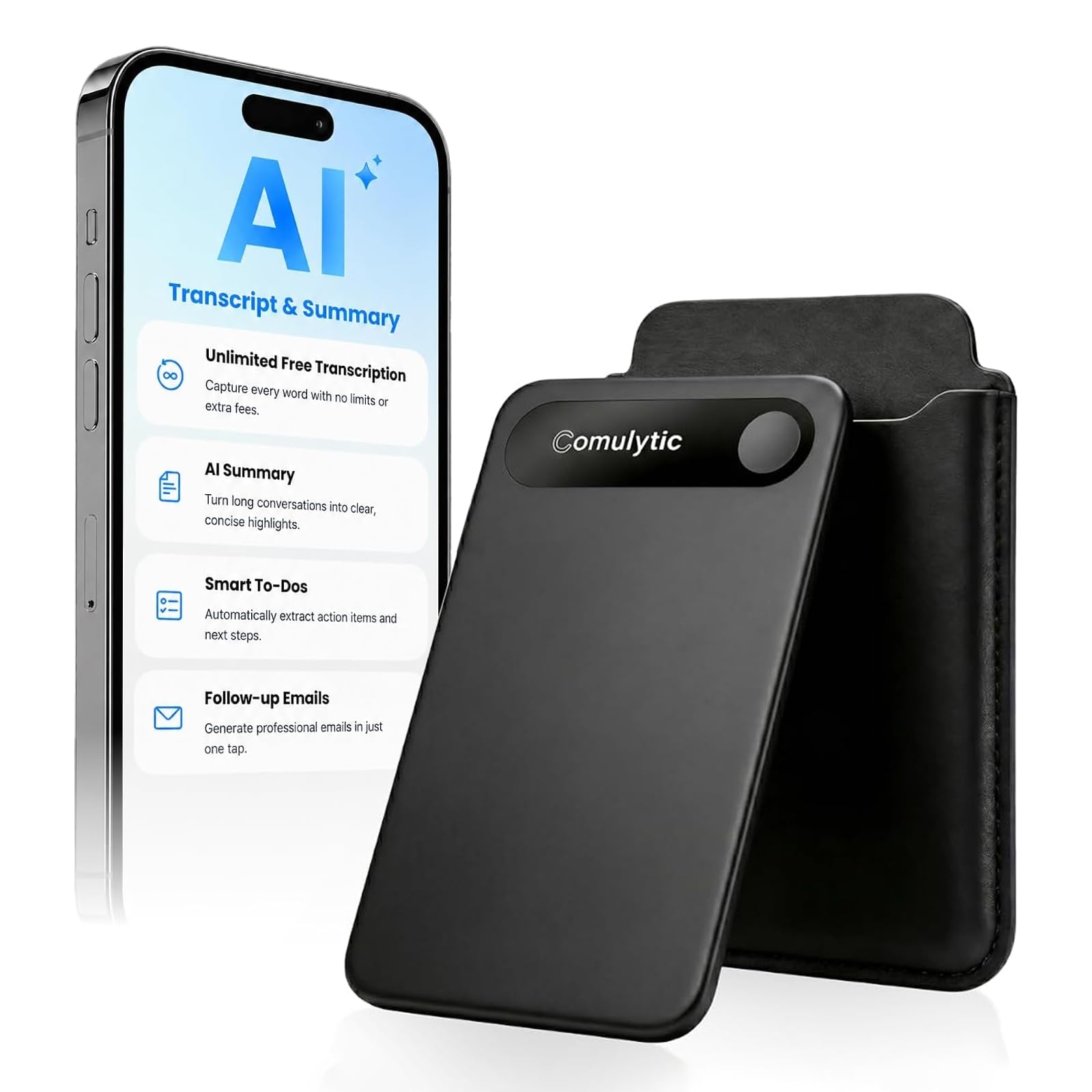
A three-millimeter slab that hears a crowded room and types the meeting for you.
Three millimeters thin, a 0.78-inch display under Corning Gorilla Glass, and an aluminum body — this is the AI recorder built to look like it belongs on a desk. A triple-mic array with AI noise reduction captures speech clearly within 5 meters even in a crowded room, and the AI auto-detects calls, meetings, video conferences, and interviews rather than making you choose a mode. Forty-five hours of continuous recording, 107 days of standby, and a 90-minute full charge keep it going through back-to-back days.
Transcription is quoted at 98% accuracy across 113 languages, and there is a real-time translator mode built in for bilingual meetings and travel. The vertical knowledge base covers insurance, real estate, auto sales, financial advising, law, headhunting, and consulting, so industry jargon has a better chance of landing right. The free Starter Plan includes unlimited transcription and basic AI summaries, with an optional Premium Plan adding advanced summaries and the Ask Comulytic assistant. Every file is encrypted with AES and the device is described as CCPA-compliant.
Device quality is the thing that keeps coming up in how owners talk about it, with usefulness close behind — this is a recorder owners describe as quietly becoming part of the workday. It weighs 27.6 g and holds 16 GB locally with a 45-hour battery. The magnetic attachment is the one area owners describe in mixed terms, so if you plan to stick it to a phone case daily, check that mount is right for your setup. It is also a meeting tool, not a camera mic — no wireless audio feed reaches a camera here.
Why it holds a mid-list spot
- Triple-mic array picks up speech within 5 meters
- 113 languages with a built-in real-time translator
- 45 hours recording and 107 days standby
- Free Starter Plan covers unlimited transcription
Where it may not suit you
- The magnetic attachment draws mixed feedback — verify your mount
- No wireless audio output to a camera
- Advanced summaries sit behind the optional Premium Plan
Pick it when: your day is meetings, calls, and client conversations you need summarized.
Skip the upgrade if: free unlimited transcription and basic summaries already cover your workflow.
6. Pocket AI Voice Recorder
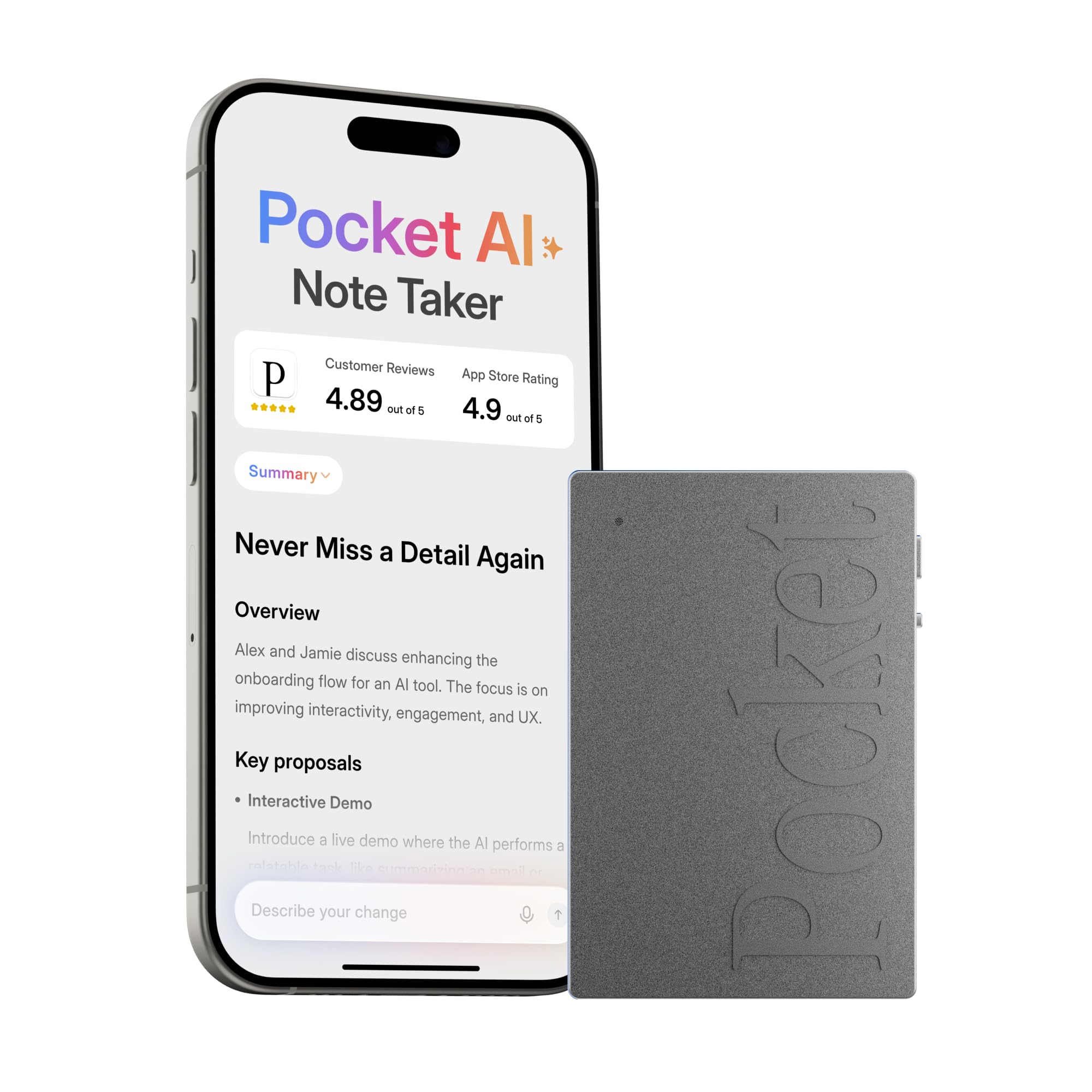
Snap it to your iPhone, tap once, and the meeting writes itself up later.
If your phone is your office, this is the recorder that rides along with it. MagSafe compatibility means it attaches to an iPhone or other MagSafe-compatible device, so it goes from pocket to phone mount in one click and records hands-free. One tap starts capture of meetings, phone calls, and in-person conversations — no typing, no fumbling with menus mid-sentence.
What it does after the recording is the real draw. It turns audio into clear summaries, key action items, and structured conversation maps, and the Ask Pocket feature lets you question your own recordings to pull out insights and next steps grounded in what was actually said. The 64 GB of storage is the largest among the AI recorders here, and the 4-day battery covers travel and long days without a charger. Owners lean on it for lectures and work tasks and describe the transcription accuracy as the standout.
Core features are included from the start, with advanced tools available through an optional subscription — so know which tools you actually need before you commit. Value for money is the aspect owners describe in mixed terms, which tracks with a premium device plus an optional paid tier. It is a productivity device first; there is no wireless transmitter feeding a camera, so video shooters should look at the Sennheiser or Insta360 above.
The real purchase logic: 64 GB local storage and a 4-day battery make it the set-and-forget option for people who record constantly.
Read the fine print: some advanced tools need the optional subscription, so map your workflow to the free core first.
Fits the phone-first worker: anyone who records calls and meetings straight from an iPhone.
Consider the alternative if: you want everything included with no optional paid tier on the horizon.
7. Sennheiser Profile Wireless 2-Channel System

A two-mic kit where the charging bar doubles as a handheld interview mic.
The clever piece here is the charging bar. It holds the receiver, the mics, and the mounts, and it converts into a handheld microphone for sit-down interviews. That saves you packing a separate handheld and keeps everything in one case. You get two clip-on mic/transmitters, two clip magnets, two windscreens, and a receiver built for camera, laptop, or phone.
This is a 2.4 GHz system — the same crowded wireless band your Wi-Fi and Bluetooth share — with internal recording on the transmitters as backup. Safety Channel Mode splits the audio to prevent clipping, and auto backup adds a second layer. A 32-bit float feature recording mode captures very high dynamic range and can recover clipped audio, though it requires Firmware 4.1.0 or above as a free download from Sennheiser. Sound quality and overall quality are what the creator crowd talks about most, and the metal enclosure and 400 g kit weight signal a build meant for daily handling.
The honest note is reliability: it draws mixed feedback, with plenty of people saying it works great and a share reporting issues. Treat it as a kit to test thoroughly on your own gear before a paid shoot. Against the COMICA VM40 below, the Sennheiser runs a 2.4 GHz clip-on system while the COMICA adds a shotgun form factor, so the choice is about your shot style rather than raw specs.
The standout: a charging bar that becomes a handheld interview mic is one less thing in the bag.
Test before you trust: reliability feedback is split, so run a full shoot on your own camera before relying on it.
Made for: freelance videographers who want clips and a handheld from one case.
Buy with a test day: prove the wireless link on your setup before the client is watching.
8. Insta360 Mic Pro (2 TX + 1 RX + Charging Case)

A customizable e-ink screen turns each transmitter into a moving brand badge.
Upload your logo, an image, or a graphic through the Insta360 app and the e-ink display on the transmitter shows it — the kind of detail that keeps a channel looking consistent in every shot. That is the feature you notice first. What sits underneath is a three-mic array that captures a broad sound field, so you do not have to aim the lav precisely to get consistent pickup from multiple angles. Three directional pickup modes let you tune the pattern to the room.
The 30-hour battery with the included case outlasts the DJI Mic 2’s 18 hours, and each transmitter records 32-bit float internally as a backup against clipped audio. AI noise cancelling runs on an embedded NPU chip, the kind of processor built for on-device audio processing, and it keeps the tone described as crisp and natural. Sound quality is the headline in how owners talk about it, with easy connectivity right behind.
One transmitter pairs with up to four receivers, so you can feed four cameras synced at once — useful when a multi-cam shoot would otherwise need a separate audio feed per angle. It also connects directly to Insta360 X5, Ace Pro 2, and GO Ultra cameras without a receiver, at 48kHz. The catch: size draws mixed reactions, with some finding it larger than most, and the magnetic attachment also lands mixed. Weigh that if you want a lav that disappears under a collar. It pairs with phones, computers, and cameras over USB-C, a Lightning adapter, or a 3.5 mm cable.
What buyers respond to
- Customizable e-ink display for branding each transmitter
- 30 hours with the charging case
- One transmitter feeds up to four receivers
- 32-bit float internal backup recording
Size and mount notes
- Larger than most lavs — check collar placement before a shoot
- The magnetic attachment gets mixed feedback
For multi-cam shooters: the four-receiver pairing is what sells it for a busy production day.
Weigh the frame: if you want a hidden lav, the size runs bigger than you may expect.
9. COMICA VM40 Combo Wireless Shotgun Microphone

A shotgun that records 40 hours internally while it runs wirelessly to your camera.
This is the pick for filmmakers who want a directional mic on the camera and a backup audio file running at the same time. The built-in 32GB storage holds up to 40 hours of internal recording, so you can use it as a standalone recorder or as insurance during a shoot. It works in both wired and wireless modes thanks to a patented integrated wireless RF module, and the range is quoted at 656 feet.
Recording runs at 48kHz/32-bit float, giving an expanded dynamic range that makes post-production easier. Safety, mono, and stereo output modes give you options: safety mode splits the sound into two tracks and adds a backup 6dB lower than the main recording. The CalMix noise reduction uses a one-key denoise, a low-cut filter that removes frequencies below 100Hz, and a high-frequency boost for crisper detail. Real-time monitoring gives instant feedback on what you are capturing.
Sound quality is the thing owners praise most, and value for money is second — this is a lot of kit for a shooter who wants one system. The battery runs up to 32 hours in wired mode but drops to 10 hours in wireless mode, which is the number to plan around on a long wireless day. The Comica Audio App handles remote monitoring, settings changes, and managing multiple devices by scene. It also accepts a 20Hz–20KHz frequency range with 25 dB audible noise and 130 dB sensitivity, and ships with shock mounts and a carry case.
For the solo filmmaker: a shotgun that backs itself up internally is one less cable to worry about.
Plan around 10 hours: wireless mode is where the battery drains, so carry a top-up for full shoot days.
Know the Specs
32-Bit Float Recording
A recording format with large headroom that can recover a take even when the input spikes hard. On a standard take, a sudden loud moment clips the file and the audio is gone. With 32-bit float, like the DJI Mic 2, the Zoom F2-BT, the Insta360 Mic Pro, and the COMICA VM40, you get a usable file even if you never touched the levels. It matters most when two mics are clipped to shirts and you cannot watch a meter.
Wireless Range
The distance a transmitter can reach its receiver, usually quoted in best-case line-of-sight. The DJI Mic 2 quotes 250 meters under FCC rules and the COMICA VM40 quotes 656 feet. Walls, bodies, and crowded Wi-Fi cut into both. Treat the quoted number as your ceiling and keep speakers between the transmitter and receiver unobstructed when it matters.
Battery Life Versus Recording Time
These are separate clocks. Battery life is how long the unit runs; recording time is how much audio fits. The COMICA VM40 records 40 hours internally but runs 10 hours in wireless mode. The SOULOG Sense runs 50 hours of battery and adds an 8-hour workday from a 10-minute charge. Read both before assuming a device lasts a full shoot.
Internal Storage
How much audio records on the device without a card. Internal storage on the AI recorders here ranges from 8 GB on the SOULOG Sense to 64 GB on the Pocket AI Recorder, with the COMICA VM40 fixed at 32GB. The Zoom F2-BT does it differently, recording to a micro SD card up to 512 GB. If you keep long raw files, swappable cards win; if you upload and clear, internal memory is plenty.
Common Questions
What does 32-bit float recording actually do for me?
Will a wireless mic kit work with my phone or only a camera?
How far can a wireless transmitter reach in real use?
Do I still need a receiver if I record internally on the transmitter?
Is AI transcription free or a subscription?
How long does a wireless recorder battery last on a full day?
Can I attach an AI recorder to my phone for hands-free recording?
Which is better for a band or event, a shotgun or a clip-on lav?
Do these recorders hold files if the wireless connection drops?
How much internal storage do I actually need for meetings?
The Bottom Line
For most people, the wireless recording device worth buying is the DJI Mic 2, because it covers two speakers, backs up every take with 32-bit float internal recording, and runs 18 hours with the case. If you want the last half hour of a conversation back on demand, take the SOULOG Sense and its 30-minute rewind. And for meetings you need typed up, the Comulytic Note Pro with its triple-mic array and 113 languages is the one that earns its desk space. Pick by the job in front of you: for video work, the DJI Mic 2 is the crowd favorite at 4.5+ stars across 5,000+ owners.
How we choose
We do not accept paid placement. Every pick is matched to a real buyer and a real use-case; we do not hands-on test units.
Sources
Specifications: manufacturer listings and product documentation. Review insights: verified customer reviews, as of November 2026. Pricing: not shown on this page (it changes often); check the current price via the retailer link.
As an Amazon Associate, Tactical Gear Guy earns from qualifying purchases. This does not affect which products we feature.