Specs are compiled from manufacturer listings and verified buyer reviews and can change over time — please confirm the key details on the product page before buying.
You want sound behind your head, but you do not want to pull cable through a finished living room. That is the real job of a wireless rear speaker kit: the two back speakers talk to your soundbar over a wireless link, so you can place them behind the couch without tearing up the wall. The catch nobody mentions upfront is that “wireless” rarely means zero wires — most rear speakers still need a power outlet each. This guide covers which kits genuinely skip the long cable run, which ones need a specific soundbar, and which ones are complete systems rather than add-ons. One honest note before you read: this list uses flexible, human-like matching for wireless rear and surround speaker setups, so not every pick is the exact model you typed into the search bar — the nearest same-type fit serves the same purpose, and every pick is flagged for what it actually is.
This guide is built by comparing the manufacturers’ published specifications and the patterns across verified customer reviews, so you get each pick’s real strengths and trade-offs instead of marketing spin.
Some picks here are the rear-speaker add-on itself, and some are full systems that already include the rear pair. Confirming whether a pick is a rear add-on or a full system before you order is the difference between a five-minute hookup and a return label. Here is how to pick the right wireless rear speaker kit for your room and your existing soundbar.
Top Picks

How To Choose The Best Wireless Rear Speaker Kit
The first thing to sort out is whether you are shopping for a pair of rear speakers that attach to a soundbar you already own, or a whole system that ships with the rear pair in the box. Those are two different purchases, and mixing them up is the most common reason people end up disappointed.
Add-on kit versus full system
An add-on kit like the Samsung SWA-9250S is two rear speakers plus the wireless link to your bar, and it only works with specific Samsung soundbars named in the listing. A full system such as the LG S40TR or the ULTIMEA Skywave X70 bundles the bar, the subwoofer and the rear speakers together, so nothing has to match. If your current bar is not on a kit’s compatibility list, a full system is the safer route.
The power outlet question
Wireless in this category usually means the audio signal travels without a cable, while each rear speaker still plugs into a wall outlet for power. Some systems add a wireless rear amp box that receives the signal and drives the rear pair. Plan your seating layout around having an outlet on the back wall before you commit to a placement.
Channel count and what the “.1” and “.2” mean
The first number is how many speakers carry the surround field, the “.1” is the subwoofer, and the second decimal is up-firing height channels that bounce sound off your ceiling. A 5.1.4 system can put rain overhead; a plain 4.1 system puts sound around you but not above. Match the channel count to how much you care about overhead effects.
Check the connection type before you buy
Rear kits link to the bar over Bluetooth or a dedicated wireless protocol, and the bar itself connects to your TV by HDMI eARC or optical. A kit that pairs over Bluetooth is not the same as one using a proprietary link, and the listing will say which. Confirm both links work with your TV and bar before ordering.
Side-by-Side Comparison
| Model | Best For | Channels | Rear Pair Included | Driver Size | Amazon |
|---|---|---|---|---|---|
| ULTIMEA Skywave X70★ Best Overall | Full-room immersion | 7.1.4 | Yes (2 surround speakers) | 10 inches | Amazon |
| Samsung SWA9250SSimple Add-On | Simple rear add-on | — | Yes (rear kit) | — | Amazon |
| Samsung 9250S (SWA-9250S/ZA)Built for 2025 Samsung Bars | 2025 Samsung bars | — | Yes (rear kit) | 6 inches | Amazon |
| LG S40TR | Small rooms, LG TVs | 4.1 | Yes (wireless rear) | — | Amazon |
| TCL S65K | Atmos on a budget | 5.1 | Yes (wireless surround) | 6.5 inches | Amazon |
| ULTIMEA Skywave X50 | Bass-first movie nights | 5.1.4 | Yes (2 surround speakers) | 8 inches | Amazon |
| Sony BRAVIA Theater System 6 | BRAVIA TV owners | 5.1 | Yes (wired sub, rear pair with amp box) | — | Amazon |
| Polk Audio MagniFi Max AX SR | Big rooms, music too | 7.1.2 | Yes (SR2 surround) | 10 inches | Amazon |
| LG S90TR | Wire-free Atmos | 7.1.3 | Yes (true wireless rear) | — | Amazon |
Detailed Reviews
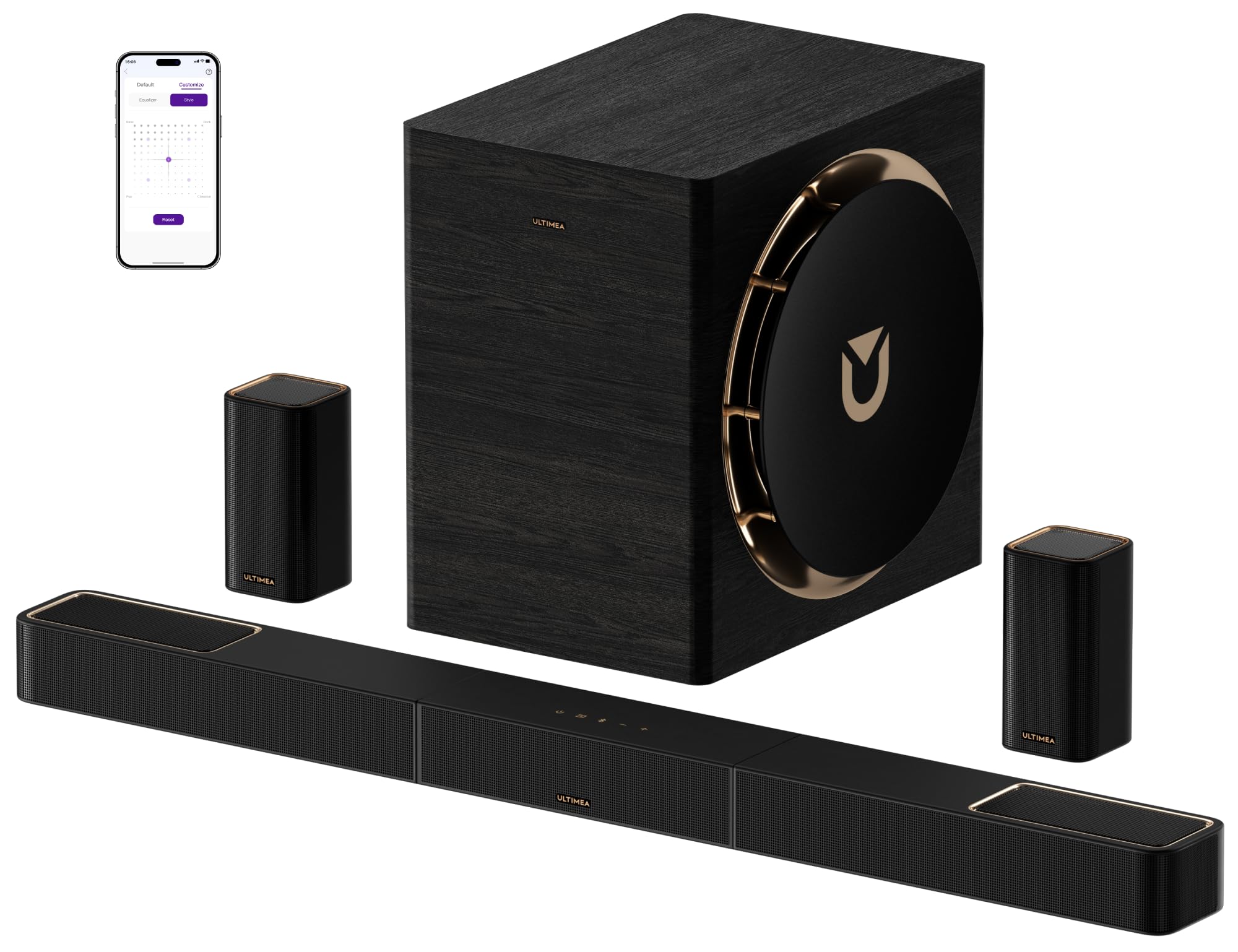
1. ULTIMEA Skywave X70 7.1.4ch Sound System
Our pick — 4.5+★ from 200+ verified ratings; the strongest balance of quality and price.
A 10-inch sub and four height channels, with the rear pair already in the box
The thing that makes the Skywave X70 the top pick here is not a single number but the combination: a 7.1.4 layout, a 10-inch wireless subwoofer, and a genuinely wireless link between the bar and the two surround speakers. The 7.1.4 means seven surround channels, one subwoofer, and four up-firing height channels — speakers that angle sound at your ceiling so rain and helicopters seem to come from above your head. The dual 5GHz wireless transmission is the reason the rear pair can sit behind the couch with no cable running back to the bar; it is a dedicated wireless link, not a Bluetooth handshake.
The subwoofer is the headline for anyone who watches action films. Its 10-inch driver reaches down to 20Hz, the deep rumble you feel in your chest more than hear, and ULTIMEA rates the peak output at 980W. Compared directly, that 10-inch driver is the largest in this group — the Samsung 9250S rear kit’s driver is listed at 6 inches. At 10 inches and 20Hz, the X70’s sub clears the size threshold where bass stops being background furniture and starts being an effect.
What wins people over, going by the long review record, is the sound itself — a large share of owners call out the audio first, with build quality a close second. Setup draws similar praise for picture-based instructions that walk you through the wiring without guesswork. The honest catch is adjustability: the app gives you a 10-band EQ and 121 sound presets, but some owners find that individual speaker levels cannot be changed, so fine-tuning the rear pair separately from the bar is limited. Budget a little time with the EQ to get it sitting right in your room.
true 7.1.4 wireless
- 7.1.4 channels with four height speakers, so overhead effects land where they should
- 10-inch wireless subwoofer reaching down to 20Hz at 980W peak output
- Dual 5GHz wireless link between bar and rear speakers, with no cable run to the back wall
- 4K HDR pass-through and CEC, so one remote can handle TV power and volume
pricey flagship
- Individual rear-speaker levels are not adjustable, so placement does more of the balancing work
- Every surround speaker still needs its own power adapter at the wall
- The subwoofer’s size takes up real floor space next to the couch
top surround pick: anyone building a serious movie room who wants the rear and height channels handled in one purchase.
budget too tight: you need to set each rear speaker at its own volume independently — that is the one control this system leaves out.
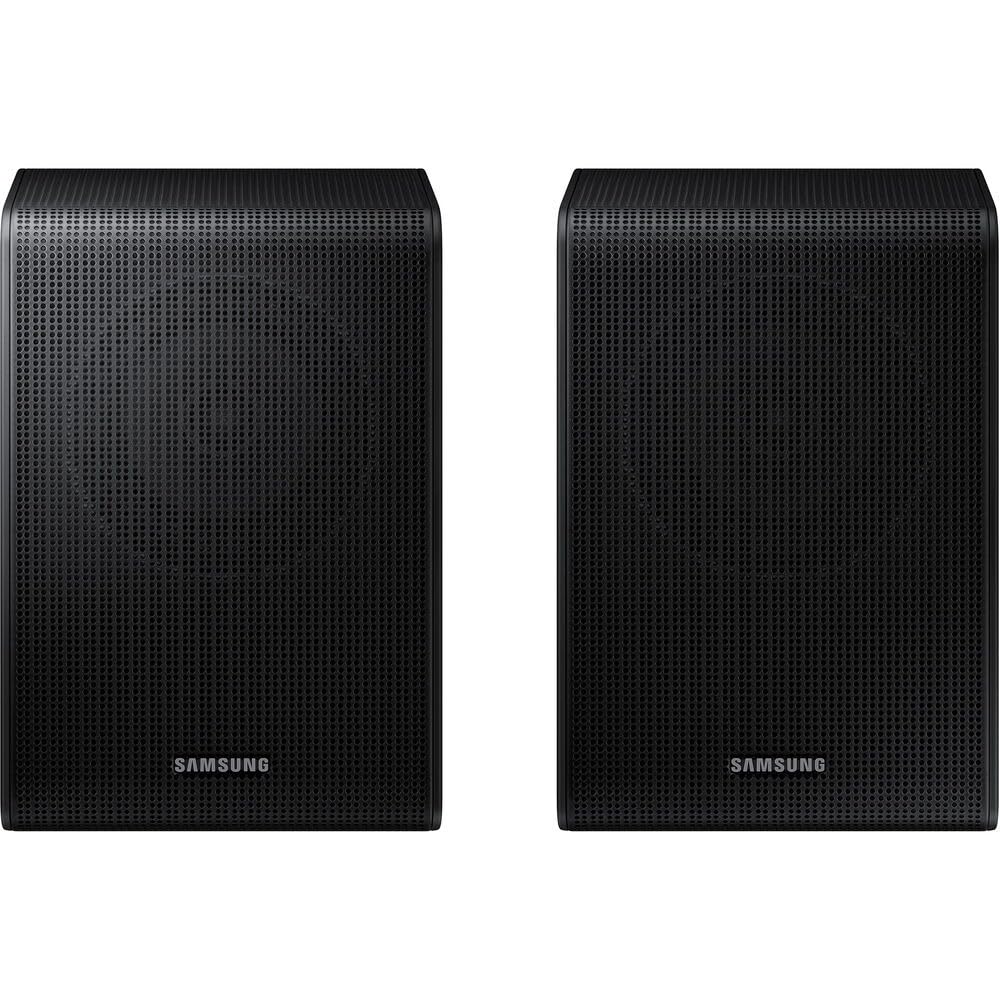
2. Samsung SWA9250S Wireless Rear Speaker Kit – Black
The lean two-speaker route for owners who just want sound behind them
If you already own a Samsung soundbar and only want the rear channels filled in, the SWA9250S is the shortest path. It is a dedicated rear kit — two speakers and their wireless link — rather than a full bar-and-sub bundle, so it slots into a setup you have already paid for. The enclosure is plastic and the speakers are listed as lightweight, which matters if you plan to wall-mount them or shift them around the room between movie nights.
The build quality is what owners talk about most, and the sound gets consistent praise alongside it. That is a good pairing for a kit whose job is to add the back half of a surround field without adding anything else to your shelf. It connects over RCA with Bluetooth protocol support, and the touch control on the speakers keeps the operation simple once they are paired.
Compatibility is the thing to check carefully. The review pages split on it: some owners pair the kit up in seconds, while others find it does not match up with their particular Samsung soundbar. Before you order, confirm your bar’s model is on the supported list for this kit — that single check is the difference between a five-minute install and a return. The one caveat worth repeating: this is a rear add-on only, so you still need the bar and sub from your existing system.
match your Samsung: a Samsung bar owner who wants rear channels added without buying a second soundbar.
other brand owner: if your bar’s model is not confirmed on the compatibility list, or if you need a full system rather than two extra speakers.
3. Samsung 9250S Wireless Rear Speaker Kit
The kit with an actual compatibility list, which is rarer than it should be
What sets this Samsung kit apart from the SWA9250S above is documentation. Samsung names the exact soundbars this one is built for: the HW-Q600F, HW-B750F, HW-B630F and HW-B550F. If your bar is on that list, you have removed the biggest unknown in rear-kit shopping. The rear speakers connect to your soundbar wirelessly, with no separate module needed and no cable routed to the back of the room.
The 6-inch dynamic drivers put this squarely in add-on territory rather than full-system territory — and that is where the comparison with the ULTIMEA Skywave X70 gets sharp. The X70’s subwoofer driver measures 10 inches against this kit’s 6-inch driver, and the deeper cone is what gives the X70 its rumble. The Samsung’s job is the rear channel, not the bass, and it hands low frequencies back to your existing sub. Owners describe these as loud and clear rear speakers, which is exactly the role.
Pairing gets the strongest reaction in the reviews — the speakers lock onto a Samsung bar immediately in most setups. Installation is quick and the value reads plainly to owners. The trade-offs are real but specific: some report the rear speakers are not truly wireless because they still cannot connect over Bluetooth, and the speaker wire is the recurring frustration — a few units arrived without the components needed to run them.
simple rear upgrade: a short, named compatibility list and near-instant pairing with those bars.
bar not included: the wireless link is Samsung-specific, so a non-listed bar will not work with it, and confirm the box contents include the speaker wire before install day.
easy add-on: buy it only if your Samsung bar model appears in the compatibility list — then pairing is a non-event.
want all-in-one: if you own a bar from another brand, or if you expect the rear speakers to be cable-free and Bluetooth-capable end to end.
4. LG S40TR 4.1 ch. Soundbar

Four channels, a wireless sub and rear speakers — the calm first step
Not every room needs seven channels. The LG S40TR is a 4.1 system — four surround channels plus the wireless subwoofer — with rear speakers that connect wirelessly to the bar with no special receiver. For a bedroom, a small den, or an apartment living room, that is the layout that fits without stacking speakers into corners. The wireless rear pair is the whole point here, and it delivers the back-of-the-room sound without a cable run.
The extras are aimed at LG TV owners specifically. WOW Orchestra runs the TV speakers and the soundbar together so both fill the room, and WOW Interface lets the TV remote handle volume, sound mode and connection status. Clear Voice Plus lifts dialogue through center-speaker analysis, which helps on shows where the music drowns out conversation. There is also a Smart Up-Mixer that spreads 2-channel audio across all the speakers so plain stereo content still fills the space.
Owners are clear about the sound being the strength, and setup draws steady praise for requiring no installation fuss. The honest catches show up in the fine print: 4.1 has no height channels, so you get sound around you, not overhead. Owners also flag that the rear speakers are not fully wireless in the cable sense, and some hit compatibility snags with newer LG TVs. It is still a well-regarded system overall, but check your TV’s model against LG’s pairing notes first.
small room fit: a smaller room and an LG TV, where four channels and a wireless sub cover the space without clutter.
large living room: if you want overhead Atmos effects or you need the rear speakers to be free of any wiring at all.
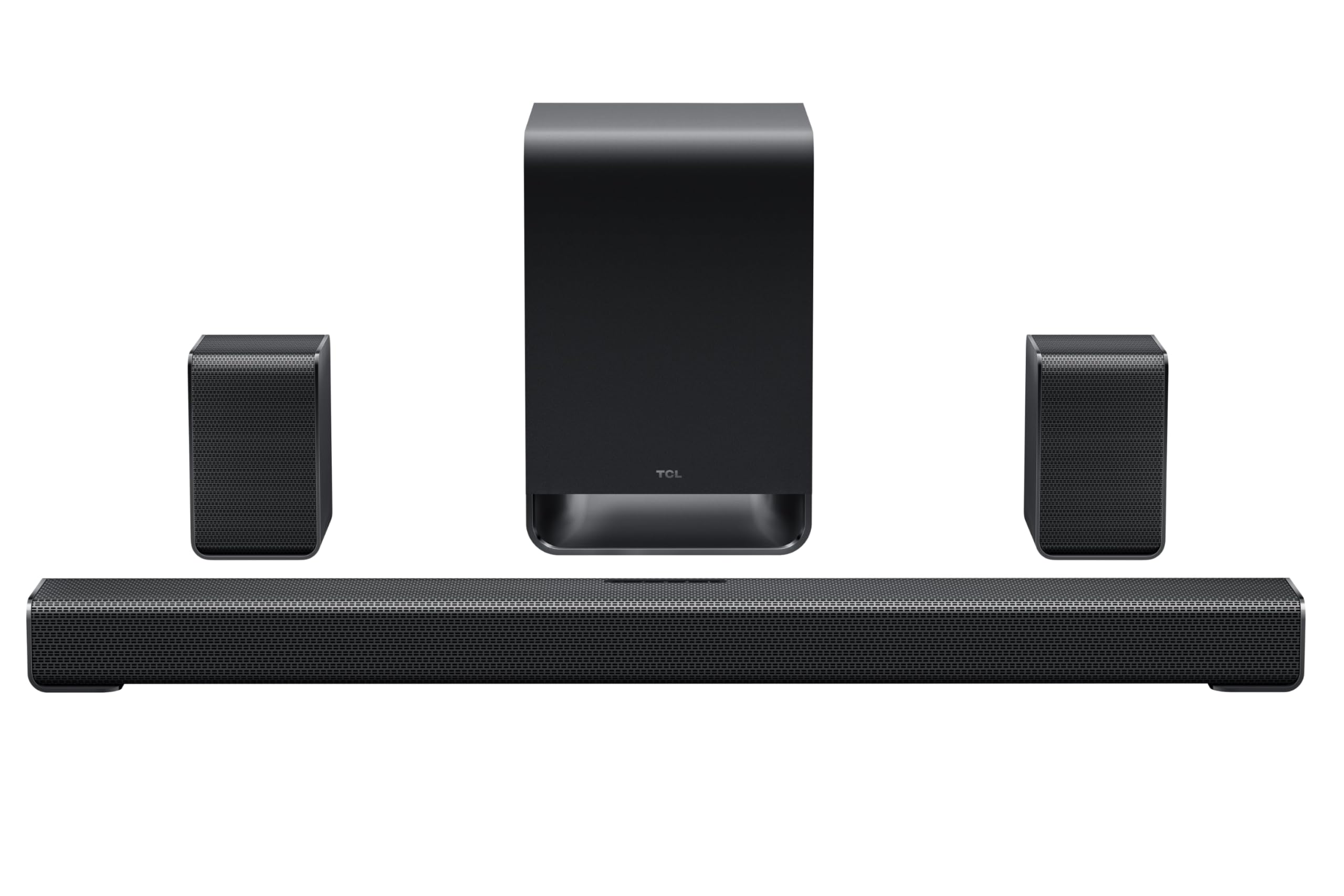
5. TCL S65K S Series 5.1 Channel Soundbar System
Dolby Atmos and DTS:X with the surrounds already accounted for
The TCL S65K makes its case with format support. It handles both Dolby Atmos and DTS:X, the two object-based surround formats, which means the height and rear cues in a modern movie mix have somewhere to go. A 5.1 layout — five surround channels plus the wireless sub — with the wireless surround speakers in the box is a lot of coverage to sit in one purchase. The subwoofer runs a 6.5-inch driver with Bass Boost, and the built-in center tweeter and center channel carry dialogue so voices stay out front.
Two features do quiet work here. AI Sonic Auto Room Calibration measures your space and adjusts the sound to fit it, which is useful when the couch is not centered. ChoruSound runs the TV speakers alongside the bar to widen the stage. Bluetooth streaming lets you push music from a phone or tablet straight to the system without a separate app chain. The listing gives the bar’s dimensions as 33.46 inches wide by 2.52 inches high, and the whole system at 27 pounds.
The bass is what people describe first, and setup gets close behind it — owners call the connection to their TV straightforward and the balance of sound to cost plainly good. Functionality lands too: it works right away without a fight. The one honest note is that this is a 5.1 system rather than a taller 7.1.4 layout, so while Atmos effects are present, the rear and height field is less crowded than a flagship. For a first surround system, that is an easy trade to accept.
atmos on budget: you want Atmos and DTS:X with wireless surrounds on an entry-level footing and a simple TV hookup.
need wireless: you are chasing a denser 7.1.4 height field and a bigger subwoofer driver than the 6.5-inch unit here.
6. ULTIMEA Skywave X50 5.1.4ch Sound System

760W of peak power and four height channels at a step below the flagship
If the Skywave X70 is the flagship, the X50 is the version that keeps the important parts and trims the rest. It still runs 5.1.4 — five surround channels, the sub, and four up-firing height channels — and it still uses the dual 5GHz wireless link for the rear pair. The peak power figure is 760W, which is the spec to note if loud, room-filling playback is your goal. The 8-inch wireless subwoofer with Gravus Ultra-Linear Bass reaches down to 28Hz, deep enough for movie rumble without the 10-inch footprint of the model above.
The shared internals are worth knowing: the GaN amplifier in both ULTIMEA units is rated at up to 98% efficiency, and the NEURACORE engine runs 24-bit/192kHz audio with under 0.5% distortion. 4K HDR pass-through keeps your video signal clean, and the ULTIMEA app handles EQ and updates. On driver size, the X50’s 8-inch sub sits between the X70’s 10-inch driver and the 6-inch driver of the Samsung 9250S rear kit — a middle position that matches its role.
Owners respond most to the bass, describing it as the kind that shakes the room, and setup — a fast, no-drama install — stays near the top of the feedback. Connectivity gets similar treatment: pairing with a TV provider box, a PS5, or a phone goes cleanly. Sound adjustment through the app is the recurring question mark; the EQ tuning works well for most, but a few find the per-setting control less flexible than they hoped. The system’s consistency across power and clarity is the takeaway.
four height channels
- 5.1.4 layout puts four height channels overhead alongside the rears
- 760W peak power with an 8-inch sub reaching down to 28Hz
- GaN amp rated at up to 98% efficiency and NEURACORE at 24-bit/192kHz
- Dual 5GHz wireless link, so the rear pair skips the cable run
subwoofer is small
- Sound adjustment through the app leaves a few owners wanting more control
- The rear speakers still draw power from wall adapters
- Fewer surround channels than the 7.1.4 X70 above
height effect fans: a movie-and-music room where chest-thumping bass and overhead effects matter more than the last speaker channel.
bass lovers: if you want the 10-inch sub and the extra surround channels for a little more money.
7. Sony BRAVIA Theater System 6 5.1ch Soundbar

Dialogue-first surround built to live under a Sony TV
A dedicated center channel is the reason to look at the BRAVIA Theater System 6. It runs a 5.1 layout — three front-firing speakers, two rear speakers, and the sub — with a center speaker focused on catching dialogue. The rear pair arrives with a wireless rear amp box, which is the piece that receives the signal and drives them. Note the subwoofer here is wired, a point worth knowing before you plan the cable path.
For BRAVIA TV owners, the pairing extras are the differentiator. Connecting to a compatible BRAVIA TV puts the soundbar controls in the TV menu and enables Voice Zoom 3, a dialogue-lift feature. The BRAVIA Connect app handles volume, sound profiles and advanced settings from a phone. Multi Stereo plays the same audio across all speakers for a room-filling boost, and Bluetooth streaming covers music from a phone. The system also supports Dolby Atmos and DTS:X for the object-based mixes.
Sound quality is what the reviews circle back to — owners describe the extra bass from the sub as movie-theater-like at home. Setup is often summed up as plug-and-play. The honest questions are on reliability and connectivity: a portion of buyers report the rear speakers popping and cracking, and some run into HDMI cable compatibility issues. If your TV is not a BRAVIA, the value proposition shifts, because the branded extras are where much of this system’s planning went.
Bravia TV pair: a Sony BRAVIA TV owner who wants films to sound like a theater and dialogue to stay clear.
mixed setup: if you own a non-BRAVIA TV and would not use the branded features, or if you need the subwoofer to be wireless.
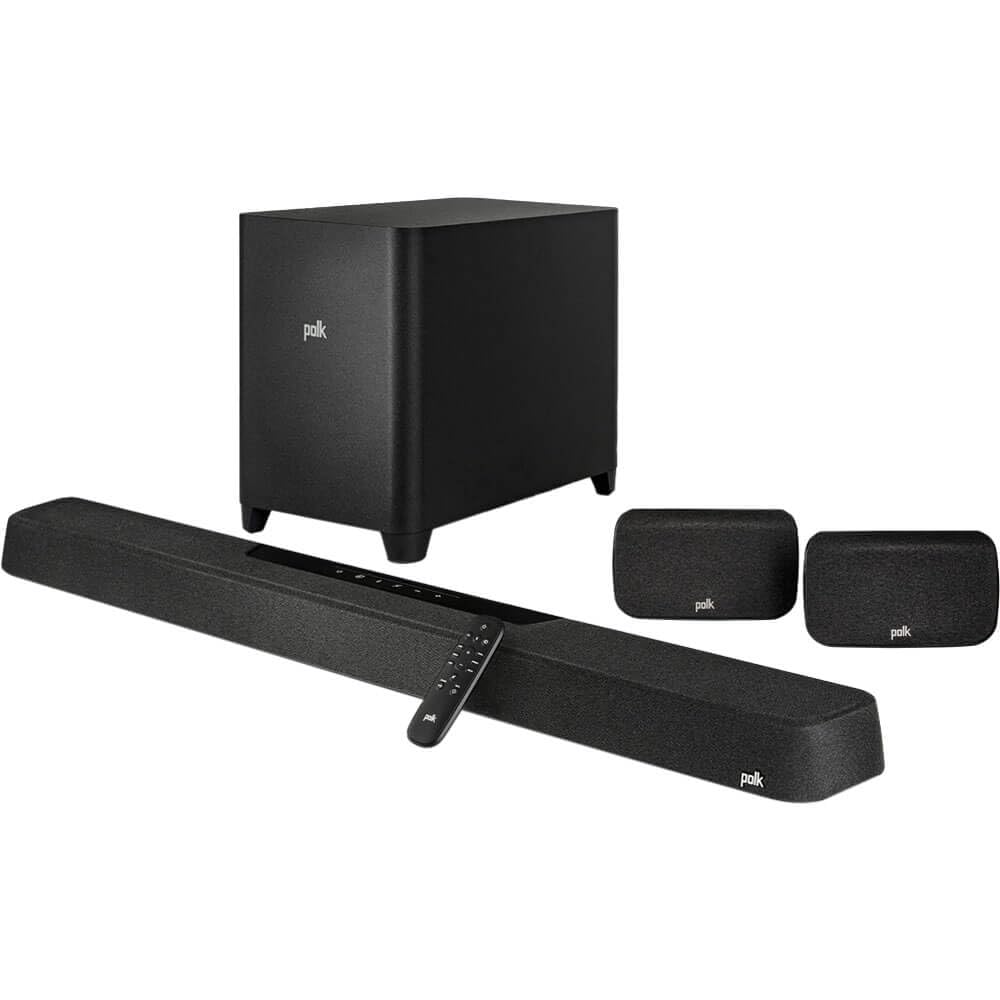
8. Polk Audio MagniFi Max AX SR 7.1.2 Soundbar
Seven channels, two upfiring speakers and Polk’s SR2 surrounds in one bundle
The MagniFi Max AX SR is a bundle in the fullest sense: Polk’s flagship soundbar, a 10-inch wireless subwoofer, and the SR2 surround speakers, all shipped together. It runs a 7.1.2 layout — seven surround channels, the sub, and two upfiring speakers that bounce height effects off the ceiling. The 10-inch sub matches the ULTIMEA X70’s driver size on paper, which tells you the bass ambitions here are the same tier.
Polk’s SDA 3D technology and certified Dolby Atmos and DTS:X support carry the surround work, and VoiceAdjust is the dialogue tool — it boosts vocal levels through the integrated center channel without dragging the rest of the soundtrack up with them. The connectivity list is broad: Wi-Fi, Bluetooth, Apple AirPlay 2, Chromecast, Spotify Connect and AlexaMRM, on top of HDMI eARC, optical in, three 4K HDMI inputs and a USB-A port for firmware updates. That last detail matters if you want your sources plugged into the bar rather than the TV.
Owners prize the sound and the build above all, and setup reads as easy across the board. The honest caveats live in the reliability and connectivity columns: automatic pairing and Bluetooth stability trip up some owners, and there are reports of a subwoofer or speaker failing after a stretch of use. Give the pairing a second attempt and the MagniFi Max AX SR holds its own for both music and movies.
big 10 inch sub: 7.1.2 channels, a 10-inch sub, and a streaming feature list that runs from AirPlay 2 to Chromecast.
bulky footprint: pairing and Bluetooth can need a second attempt, and long-term reliability is the question mark to weigh if you keep the system running for hours daily.
movie night pick: a large room that also has to serve as a music space, where the 10-inch sub and wide streaming support both get a workout.
tight space: if a truly set-and-forget connection is your priority, since the pairing experience is mixed.
9. LG S90TR 7.1.3 ch. Soundbar

The one that takes “wireless” all the way to no visible wires
WOWCAST is the reason this one stands out in the category. It is built-in wireless Dolby Atmos, which means the Atmos signal reaches the bar without a physical cable between the TV and the soundbar, and the rear speakers use wireless connectivity with no special receiver needed. The layout is 7.1.3 — seven surround channels, the sub, and three upfiring height channels, including an exclusive up-firing center speaker focused on dialogue clarity.
Gaming gets its own thought-through touches. VRR and ALLM with a passthrough refresh rate up to 120Hz keep the on-screen action smooth and the sound in sync, so a lag-free play experience is part of the design. Advanced Room Calibration uses a built-in microphone to measure your room’s dimensions and adjust the audio to fit. WOW Orchestra synchs the LG TV speakers with the bar, and WOW Interface puts both under one remote. Multi-platform support covers Google Assistant, Alexa, Chromecast and AirPlay 2 through the LG Soundbar.
Sound quality is the strong suit — owners call it wide and explosive, and setup is simple. Connectivity is the split verdict: pairing with LG TVs works smoothly for most, but some run into wireless performance issues. Value draws mixed feelings too, with some owners fully satisfied and others less so. If you are buying this, the wireless Atmos delivery and the gaming features are what you are paying for, and those are where the system delivers.
7.1.3 true wireless: wireless Dolby Atmos via WOWCAST plus true wireless rear speakers — the cleanest wire situation in this group.
premium price: wireless performance is the recurring question mark, so a steady Wi-Fi environment matters for getting the most out of it.
serious theater: visible cables bother you more than anything, and you want 7.1.3 Atmos delivered without running wire to the back wall.
casual listeners: your wireless environment is already crowded and connection stability is a worry.
Know the Specs
Wireless rear link versus true wireless
“Wireless rear speakers” usually means the audio signal travels to the rear pair without a cable, while each rear speaker still plugs into a power outlet. True wireless, as on the LG S90TR with WOWCAST, goes further and removes the cable between the TV and the bar as well. When a listing says wireless, check whether it means the signal, the power, or both.
Channel count (5.1, 7.1.2, 7.1.4)
The first number is the surround channels, the “.1” is the subwoofer, and the final number is the upfiring height channels. A 7.1.4 system like the ULTIMEA Skywave X70 puts sound overhead as well as around you. A 4.1 system like the LG S40TR keeps it around you only. A higher channel count only pays off if your room and your appetite for overhead effects can use the extra speakers.
Driver size and what it does
The audio driver is the cone that actually moves air. Subwoofer drivers in this group range from 6 inches on the Samsung 9250S rear kit to 10 inches on the ULTIMEA Skywave X70 and Polk MagniFi Max AX SR. A larger driver tends to produce deeper, more physical bass. The sub’s job is the low end, so its size matters more than the rear speakers’ size for rumble.
Compatibility lists and pairing
Rear add-on kits like the Samsung SWA-9250S pair with specific soundbar models, and Samsung publishes that list for the SWA-9250S/ZA version. Bluetooth protocol support does not mean a kit will pair with any Bluetooth bar. Confirm the exact model match before ordering — it is the single check that decides whether your rear speakers work on day one.
Common Questions
Will a Samsung rear speaker kit work with a non-Samsung soundbar?
Do wireless rear speakers still need a power cable?
What does “true wireless rear speakers” actually mean?
Is a 5.1 rear kit enough or do I need 7.1.4?
Will adding rear speakers improve dialogue clarity?
Can I mix a rear kit from one brand with a soundbar from another?
How long does a wireless rear speaker kit typically last?
Do I need HDMI eARC for a rear speaker kit to work?
Can I use rear speakers for music as well as movies?
Does a bigger subwoofer driver mean deeper bass?
The Bottom Line
For most people building a real surround room, the wireless rear speaker kit winner is the ULTIMEA Skywave X70 because it combines 7.1.4 channels, a 10-inch wireless sub and a genuinely cable-free rear link in one box. If rear channels on a bar you already own are all you need, the Samsung SWA-9250S/ZA gives you a published compatibility list so you know it will pair before you order. And for a room where you refuse to see a wire, the LG S90TR delivers wireless Atmos with true wireless rear speakers. Its 4.5+ rating is the highest in this group, which makes the ULTIMEA the safe first step if you are starting from scratch.
How we choose
We do not accept paid placement. Every pick is matched to a real buyer and a real use-case; we do not hands-on test units.
Sources
Specifications: manufacturer listings and product documentation. Review insights: verified customer reviews, as of November 2026. Pricing: not shown on this page (it changes often); check the current price via the retailer link.
As an Amazon Associate, Tactical Gear Guy earns from qualifying purchases. This does not affect which products we feature.