Specs are compiled from manufacturer listings and verified buyer reviews and can change over time — please confirm the key details on the product page before buying.
You want a landline that works in every room, holds a clear signal as you move through the house, and keeps robocalls from ringing at dinnertime. This list covers eight cordless phone systems, sorted by what each one is genuinely best at, so you can pick a base and handset count in minutes.
This guide is built by comparing the manufacturers’ published specifications and the patterns across verified customer reviews, so you get each pick’s real strengths and trade-offs instead of marketing spin.
Every system here pairs a base station with at least one cordless handset, so you get a wireless handset on a landline connection. Below is the full rundown on each wireless phone system, matched to your rooms and your tolerance for junk calls.
Top Picks


How To Choose The Best Wireless Phone System
A cordless phone is not a cell phone and not a VoIP app. It is a base unit that plugs into your landline jack or a paired cell phone, plus wireless handsets you carry around the house. The base does the dialing; the handset just talks to it over radio, so the key questions are how many handsets you need, how far those handsets reach, and how well the system filters calls.
Count your rooms before you count features
A handset only has a home where there is a charging cradle, and each cradle needs a power outlet. Two handsets suit a one-bedroom flat or a kitchen-and-bedroom setup. Three or four handsets make more sense when you want one in the kitchen, one at the desk, one by the bed, and one in the garage. Expanding later is possible on some models, but the number of handsets in the box is what you live with on day one.
Treat range as a rough guide, not a promise
Outdoor range figures are measured in open air with a clear line of sight. The moment a wall, a concrete floor, or a metal appliance sits between the handset and the base, that figure shrinks. If your home has thick walls or you like taking calls out to the garden, choose a system that lists its outdoor and indoor range separately so you know what you are actually getting.
Prioritize call blocking if robocalls are the reason you are shopping
Call-blocking storage is one of the few specs that genuinely changes your evenings. A small blocklist fills up in weeks; a larger one keeps working for years. The same logic applies to caller ID logs, which hold the numbers you might want to call back. Look at the block capacity and the log size side by side, and skip systems that leave you with a short memory.
Check the screen and keypad for the hands you actually have
Backlit keys, a bright display, and large text matter far more the older the user is or the darker the room is. A weak backlight makes a phone unreadable in a dark room, whatever the spec sheet says. If someone in the house wears glasses or has a hearing aid, pick a system with a large screen, backlit keys, and hearing-aid compatibility rather than the one with the most extras.
Side-by-Side Comparison
| Model | Best For | Handsets | Call Block | Answering Machine | Amazon |
|---|---|---|---|---|---|
| Panasonic KX-TGC352B★ Best Overall | Everyday home calls | 2 | 30 numbers | Digital | Amazon |
| VTech CS6919-2RBest for Night Calls | Nighttime and power-outage dialing | 2 | Screen only, 30-call log | No | Amazon |
| Motorola T603Best for Big Buttons | Large-button accessibility | 3 | 100 numbers | Digital | Amazon |
| VTech CS6529-4 | Four-room coverage with a recorder | 4 | Via Caller ID screening | 14 minutes | Amazon |
| Panasonic KX-TGF882B | Home office with cell pairing | 1 corded + 2 cordless | Auto block plus 1-touch, 1K extra | Digital | Amazon |
| AT&T BL102-4 | Aggressive robocall screening | 4 | 1,000 entries | 22 minutes | Amazon |
| Motorola O212 | Yard, dock, and wet-weather use | 2 | Via Caller ID screening, 50-call log | 25 minutes | Amazon |
Detailed Reviews
1. Panasonic KX-TGC352B Cordless Phone
Our pick — 4.0+★ from 12,500+ verified ratings; the strongest balance of quality and price.
An amber display you can read across the kitchen without squinting.
The 1.6 inch amber backlit LCD (a warm-tinted screen that stays legible in a dark hallway) sits on both the base unit and each handset. It fixes the most common landline frustration: leaning in to read who is calling before you pick up. The whole system runs on DECT 6.0, the standard that keeps a cordless handset clear of your Wi-Fi router, on a frequency of 1.9 GHz.
What wins people over is the plain build quality and the setup that takes minutes rather than an evening. Silent Mode is the feature worth knowing about: you pick a window of time and the handset and base stay quiet through it, so a 7 p.m. nap or a work call is not interrupted by a ringing phone. Intelligent Eco Mode then trims power draw while the handsets sit on their cradles, which is what keeps the batteries healthy over the long haul.
The catch is capacity. Call Block on this Panasonic stores 30 numbers, and the Motorola T603 stores 100, which matters if nuisance calls are the reason you are replacing your phone. The other thing to size honestly is the footprint: at 15.5 x 8 x 6 inches and 8 ounces, this is a wider package than the VTech CS6919-2R at 4.51 x 3.95 x 6.84 inches, so measure the shelf before you commit.
Where the Panasonic earns its keep
- Amber backlit 1.6 inch LCD on handset and base, readable in dim rooms
- Silent Mode schedules a quiet window for calls you do not want to hear
- Intelligent Eco Mode manages power for better battery performance over time
- Four AAA NiMH batteries, one AC adaptor, two handset covers all in the box
What to weigh before buying
- Call Block holds 30 numbers — the smallest blocklist on this list
- Base unit standby draw is 0.6 W, so it does sip power between calls
- Two handsets only, with expansion sold separately
Go for it if: you want a straightforward two-handset landline with a screen that reads from across the room and a quiet-hours setting built in.
Think twice if: robocalls are your main enemy — the 30-number blocklist fills up quickly compared with the Motorola T603’s 100.
2. VTech CS6919-2R Cordless Phone
A phone built for the 2 a.m. dial, when the lights are off and the power is out.
Power goes out, the lights go dead, and you still need to dial the utility company. That is the exact scenario this VTech is built around: a backlit keypad plus a large glowing LCD that stays readable in a dark room, so you are not fumbling for numbers by feel. Full-duplex speakerphone means both sides can talk at once the way they would in the same room, instead of taking turns at the end of each sentence.
One-touch Quiet Mode is the detail that gets used most: it silences the ringer on the handset and base for a set period or indefinitely. Naps, movie nights, and focused work calls all get their peace back without unplugging anything. Auto-ECO Mode then drops power use while the phone sits on standby, which is a small but sensible savings on a device that is plugged in permanently.
Where this one falls short is the record function. There is no answering machine at all — no recording, no messages waiting when you get home, so you either rely on a separate voicemail service or accept that a missed call is just a missed call. The caller ID log holds 30 entries and acts as your only screen, which is workable but lean. At 4.51 x 3.95 x 6.84 inches, though, it is the most compact base here, so it tucks onto a side table where wider systems will not fit.
Straight talk on the fit: ideal for a bedside or hallway handset where the priorities are a lit keypad, a natural speakerphone, and a ringer you can silence in one tap — not a message machine.
Honest limit: a 30-entry caller log and no recording mean you should pair it with your provider’s voicemail if you screen a lot of calls.
Reach for this if: you take calls after dark or during outages and want an illuminated keypad and a genuinely two-way speakerphone.
Look elsewhere if: an answering machine is a must-have — you will need the VTech CS6529-4 and its 14-minute recorder instead.
3. Motorola T603 Cordless Phone
Three handsets, big well-spaced buttons, and a blocklist that finally keeps up.
If the phone is going in a home where someone wears a hearing aid or struggles with small keys, the Motorola T603 leads with the right specs. The handsets are hearing-aid compatible (HAC, meaning they work cleanly with a hearing aid’s telecoil), and the keypad uses large, well-spaced buttons rather than a tight grid of tiny squares. Each of the three handsets carries its own speakerphone with adjustable volume, so you can take a call hands-free while cooking without moving the whole system into the kitchen.
The block capacity is where this one outclasses most of the list. Motorola lets you block up to 100 stored numbers, versus the 30-number limit on the Panasonic KX-TGC352B. It also handles anonymous, private, unavailable, and out-of-area callers, so the numbers that never show a name are exactly the ones it can still shut down. Internal calling and three-way conferencing between the handsets and an outside caller round out the office-style uses.
Be realistic about the feedback, though. Functionality is the most-discussed topic for this model and the verdict there is mixed, with some owners saying it runs fine and others reporting it does not work at all. Sound is the other honest note — some find the ringer quiet unless the handset is up against the ear. Neither issue is universal, but if a loud ringer is the whole reason for the purchase, try this one in person or buy where returns are simple. Three handsets, six rechargeable batteries, and three power adapters all come in the box, so a three-room setup works out of the gate.
The accessible pick: large buttons, bright backlit displays, and HAC compatibility make this the friendliest system on the list for older hands and assisted hearing.
The caveat to hear clearly: the ringer volume is not the loudest, and a mixed reliability record means this one is best bought where you can return it easily.
Suits: households where an older parent needs big keys, hearing-aid support, and a real 100-number blocklist on three separate handsets.
Does not suit: anyone who needs a ringer that carries through a whole house from a distant room.
4. VTech CS6529-4 Cordless Phone

Four handsets, one 14-minute recorder, and a base that lives in the garage too.
Coverage is the argument here. Four handsets versus the Panasonic KX-TGC352B’s two, so you can drop one in the kitchen, one by the bed, one in the home office, and one in the garage without buying add-ons. The DECT 6.0 radio is rated for up to 1,000 ft of outdoor range with the base plugged into a single standard phone jack — every handset charger then needs only a power outlet, which makes spreading them around the house easy.
The answering system is genuinely useful rather than decorative. It records up to 14 minutes of messages, lets you screen a call by listening as the caller speaks, plays messages from any handset or the base, and can be checked remotely from any touch-tone phone. Intercom and call transfer work between all four handsets, and a second handset can join a call already in progress for a three-way conversation. Caller ID and call waiting store up to 50 calls so unknown numbers are easy to skip, with caller ID service from your provider required.
Two things need saying plainly. The display is the recurring gripe — the font is small and the screen gets difficult to read from more than 6 inches away, which is a real problem if the person answering wears reading glasses. Sound quality splits opinion too, with some finding it good and others reporting very poor sound. The functionality, value, and ease of use all land positive, so this remains the safest four-handset bet on the list — just do not buy it for the screen.
Why it covers a house so well: four handsets on one base, up to 1,000 ft of outdoor range, and a 14-minute digital recorder you can check from any touch-tone phone.
The honest trade-off: a small, dim display and mixed sound reports mean this suits callers who mostly dial and listen rather than read tiny text.
Best match for: a larger home or small office that needs four handsets, intercom between them, and a real recording machine at the base.
Second-guess it if: the main user needs large, clear text on a bright screen to read caller names comfortably.
5. Panasonic KX-TGF882B Phone

The landline that borrows your cell signal so you can take mobile calls on a desk handset.
Link2Cell is the feature that separates this Panasonic from every other system on the list. You pair up to two smart phones to the base, then make and receive cell phone calls from either the corded handset or the cordless ones. That means your business line and your mobile number can both ring on the same desk, which is exactly the setup a home office with weak cell reception at the desk needs. The corded handset also means the base keeps working even if a cordless battery runs flat.
The call blocking here is the most layered on the list. Automated Call Block pre-blocks robocalls, telemarketing call block stops announced callers, and a one-touch button on the handset blocks 1K more numbers on top. The base also does 2-way call recording, so you can confirm what was said in an important conversation and avoid mistakes later. The large tiltable 3.4-inch LCD makes it easy to see who is calling, and a big red call block button makes rejecting a nuisance caller a single press. Taking Caller ID announces the caller in English or Spanish, and the full-duplex speakerphone lets you answer by voice command.
Weigh the build honestly. Build quality is the most-discussed point on this model and the verdict is mixed — some find it amazing, others describe it as very low quality. Reliability is similarly split, with some owners reporting months of solid use and others reporting a failure within weeks. This is a feature-rich system with a heavier, more elaborate base at 3.5 pounds and 6.8 x 8.3 x 3.8 inches, and it rewards anyone who wants the Link2Cell flexibility badly enough to accept that variability.
The reasons to pick the Panasonic base
- Pairs up to two smart phones so cell calls ring on your desk handsets
- 1-touch Call Block Button plus automated robocall pre-blocking and 1K extra numbers
- 2-way call recording for business calls and confirmations
- Large tiltable 3.4-inch LCD and full-duplex speakerphone
The honest reservations
- Build quality reads mixed, from excellent to very low depending on the unit
- Reliability reports range from months of use to failure within weeks
- A heavier 3.5 pound base that needs real desk space
Made for: a home office that wants one desk phone handling both the landline and a paired cell, with call recording for work conversations.
Not the safe pick if: you want the simplest, most predictable build — the mixed build and reliability notes here reward a buy with an easy return window.
6. AT&T BL102-4 Cordless Phone

A 1,000-number blacklist that ends the robocall problem for good.
Call blocking is the one thing this system does better than anything else here. The call block directory stores up to 1,000 name and number entries, and robocalls on your landline are blocked from ringing through even the first time. You can also permanently blacklist any number with one touch on a dedicated key on the handset. That is call blocking as a feature, not an afterthought, and it is why this AT&T is the pick for anyone whose phone currently rings all day with calls they never wanted.
The rest of the package is solid rather than flashy. Four handsets join the base, the digital answering machine records up to 22 minutes of incoming messages, outgoing announcements, and memos, and the voice guide walks you through setup. The 2-inch screen uses large high-contrast text so caller ID and call history are readable without hunting for glasses, and the extra-large lighted keypad helps in low light. A full-duplex handset speakerphone lets both ends talk at once, and a handset intercom keeps the room-to-room calls simple.
Two honest notes come up reliably. Sound quality splits opinion, and battery life is one of the weaker reported areas, so heavy talkers may find themselves thinking about charging more often. Setup splits too — many say it is easy, some find it too complicated. The 22-minute recorder is the strongest of the mid-range group and the 1,000-entry blocklist is the highest capacity on this list, so the trade-off is battery patience for genuinely aggressive call screening.
The blocking is the headline: a 1,000-entry blacklist plus automatic first-ring robocall rejection is the most thorough screening on the list.
What to accept: battery life and sound quality divide owners, so heavy daily talkers may want a second charger nearby.
Reach for it if: robocalls, telemarketers, and repeat nuisance numbers are the daily annoyance you want gone for good.
Look elsewhere if: you spend hours on the phone each day and battery life ranks above blocking capacity.
7. Motorola O212 Cordless Phone
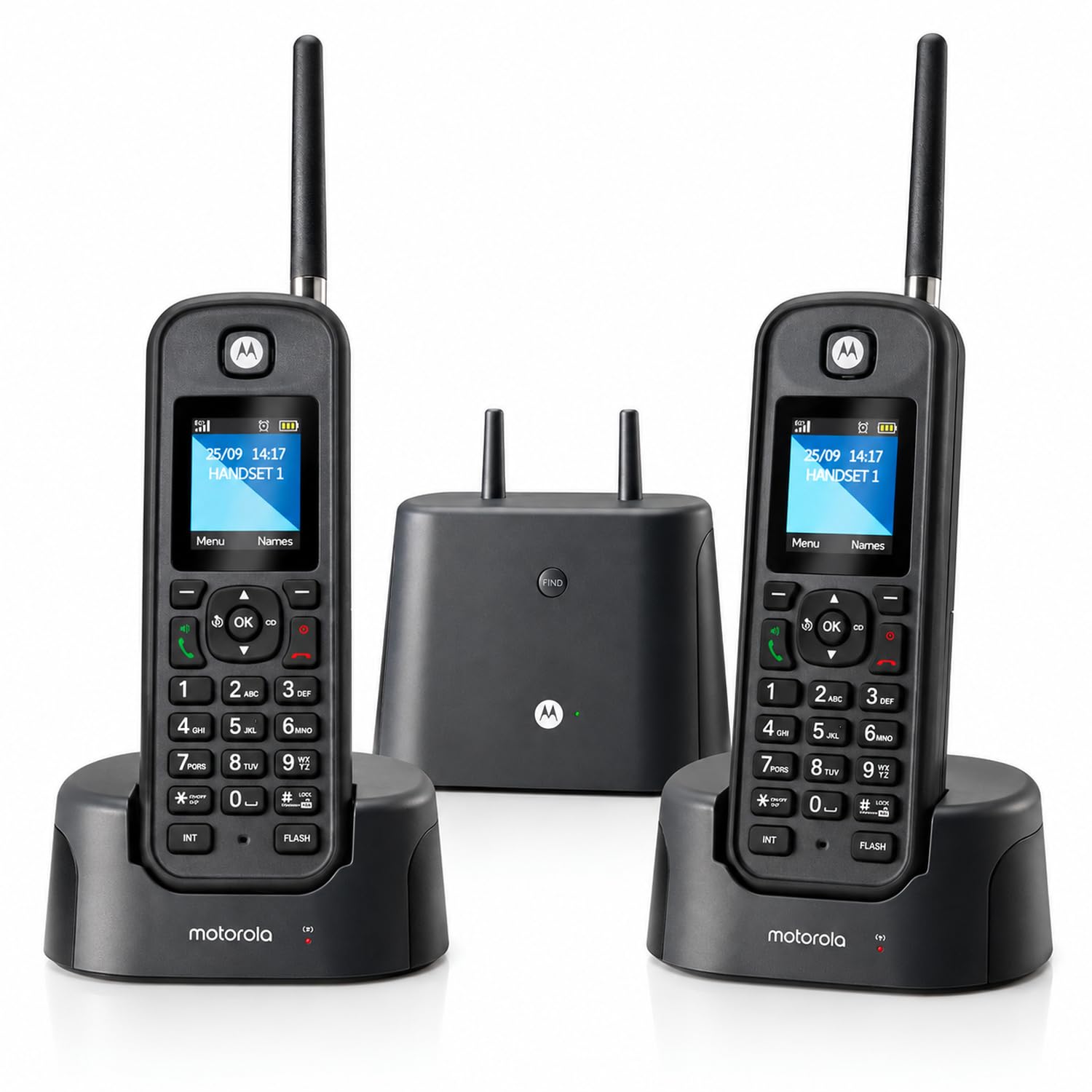
The only handset here you can drop in a bucket of water and keep talking.
The O212 earns its place on one spec that no other system on this list comes close to. Its handsets carry an IP67 rating, which means the handset can take dust and immersion in up to 1 m of water for up to 30 minutes. Keep the base and charging cradles indoors and dry, and the handset itself survives the deck, the dock, the workshop, and the unavoidable drop into a puddle. Pre-installed belt clips keep it on you while you move.
Range is the second headline. Motorola quotes up to 650 m (2,130 ft) of outdoor range with a clear line of sight and up to 50 m (164 ft) indoors, with the honest note that walls and buildings reduce that figure. Each fully charged handset delivers up to 12 hours of talk time or up to 250 hours of standby in ideal conditions, which is enough for a full day of yard work or a weekend at the cabin. The digital answering machine records up to 25 minutes of messages, and the 1.8-inch color display pairs with a backlit keypad and hands-free speakerphone for daily calls.
The contacts side is generous: 200 stored contacts, a phonebook you can copy between handsets, and 50 caller ID entries. The catch is that signal quality, range, durability, and sound quality all read mixed in owner feedback. Some owners find the reception impeccable and the range exactly as advertised; others report it does not reach as far outside the house as they hoped. Treat the range figures as clear-line-of-sight numbers, and let the IP67 rating be the real reason you buy.
The one reason it wins: IP67 handsets rated for 1 m of water for 30 minutes are the toughest on this list, with 650 m of outdoor range alongside.
Set expectations: range and sound reports split, so measure your own yard-to-base distance before you rely on the headline figure.
Built for: a big property, a dock, a workshop, or a farmhouse where the handset travels outdoors and gets wet.
Skip the rugged shell if: all your calls happen within a few rooms and you would rather put the budget toward a bigger blocklist.
Know the Specs
DECT 6.0 and what it does for your calls
DECT 6.0 is the digital radio standard most modern cordless phones use. It runs on the 1.9 GHz band, which sits away from Wi-Fi and microwave traffic, so calls stay cleaner when the house is busy. A system that lists DECT 6.0 is telling you the handset-to-base link uses a dedicated channel rather than the crowded 2.4 GHz band most routers share.
Handsets and expandability
The number of handsets in the box decides how many rooms you can cover without buying add-ons. An expandable system lets you register extra handsets to the same base later, which is useful if you add a room or want a handset in the garage. Check both numbers: how many come included, and how many the base can register.
Call block capacity
Call block storage is the size of your personal blacklist. A system that holds 30 numbers fills up fast if you get a lot of nuisance calls, while a larger directory keeps working for years. Some systems also block anonymous and out-of-area callers, which are exactly the calls that never show a name.
Answering machine and caller ID logs
Recording time is measured in minutes and decides how many messages the machine can hold before it fills. Caller ID logs are separate — they hold incoming call records rather than recorded messages. Both numbers matter at once: a long recorder plus a short caller log leaves you scrolling through old calls, while a short recorder with a big log misses messages.
Range and the real world
Range figures are quoted for open air with a clear line of sight. Walls, floors, and buildings cut that number, so an indoor range is always shorter than the outdoor figure. If you plan to take calls outside, check whether the maker publishes both numbers separately rather than one optimistic headline.
Batteries and talk time
Cordless handsets run on rechargeable NiMH batteries, rated in talk time and standby time. Talk time is how long you can keep a call going on one charge; standby time is how long the handset survives on the cradle between calls. ECO modes cut power draw while the handset sits idle, which is worth checking if the phone will spend most of its life on the charger.
Common Questions
Do I need a landline service to use a cordless phone system?
How many handsets can I register to one base?
What does DECT 6.0 mean and why does it matter?
How long should rechargeable handset batteries last?
Will a cordless phone interfere with my Wi-Fi?
Can I use a cordless phone during a power outage?
What is the difference between call block capacity and a caller ID log?
Is an answering machine different from voicemail?
Can I mount the base on a wall?
Are rugged cordless phones really waterproof?
The Bottom Line
For most homes, the wireless phone system winner is the Panasonic KX-TGC352B because the 1.6 inch amber backlit display on both handset and base solves the everyday problem of reading who is calling, and Silent Mode keeps a ringing phone out of the quiet hours. It is also the easiest of the group to live with, at 8 ounces and a simple two-handset setup that takes minutes to place. If robocalls are the reason you are shopping, grab the AT&T BL102-4 — its 1,000-entry blocklist and automatic first-ring rejection outclass every other system on this list. And for anyone who needs one handset to survive the yard, the dock, or a dropped call outdoors, the Motorola O212 with its IP67-rated handsets is the one to reach for.
How we choose
We do not accept paid placement. Every pick is matched to a real buyer and a real use-case; we do not hands-on test units.
Sources
Specifications: manufacturer listings and product documentation. Review insights: verified customer reviews, as of November 2026. Pricing: not shown on this page (it changes often); check the current price via the retailer link.
As an Amazon Associate, Tactical Gear Guy earns from qualifying purchases. This does not affect which products we feature.