Specs are compiled from manufacturer listings and verified buyer reviews and can change over time — please confirm the key details on the product page before buying.
You hit record, and five minutes later your footage has traffic noise, a hollow room echo, and a voice that fades every time you turn your head. A wireless mini mic fixes that by putting a tiny clip-on transmitter near your mouth and beaming the sound back to your phone over a short-range radio link. Which one suits you depends on three things: how many transmitters you need, how loud the background is, and whether your phone has USB-C or Lightning. Below you get seven real picks, sorted by what they are genuinely good at, with the plain-English version of every spec.
This guide is built by comparing the manufacturers’ published specifications and the patterns across verified customer reviews, so you get each pick’s real strengths and trade-offs instead of marketing spin.
On a busy street, the details that decide whether the audio survives are the windscreen, the noise-cancellation level, and the range — not the headline spec. Everything below is organized for exactly that — picking the right tool for the wireless mini mic job in front of you.
Top Picks

How To Choose The Best Wireless Mini Mic
Start with your phone’s charging port, because a mini mic’s receiver has to plug into something. USB-C receivers fit iPhone 15 and newer, most Android phones, and USB-C tablets or laptops. Older iPhones and iPads with a Lightning port need either a Lightning-specific version or an included adapter. Buy the wrong port version and the receiver will not plug in at all.
How many transmitters you need
A transmitter is the piece you clip to a shirt — it captures the voice. If you interview guests or co-host a podcast, you want a kit with two transmitters and one receiver, so each speaker gets their own mic and neither has to pass one back and forth. Solo shooters can buy a single-transmitter kit and save the extra weight in the bag.
Noise reduction is not one feature
You will see ENC, DSP, and basic noise cancellation listed separately, and they behave differently. A dedicated ENC chip with adjustable levels tends to be the most controllable, while a plain on/off button is simpler but blunter. Wind is the sneaky enemy: a foam or furry windscreen over the capsule does more for outdoor audio than any menu setting.
The battery math that actually matters
A spec that says 11.5 hours total is a combined figure across two transmitters and the receiver, not per device. What matters is whether your typical shoot ends before the case runs out of charge. Charging cases are what push total runtime past a single charge, and a receiver that can pass power through to your phone keeps a long livestream from dying mid-sentence.
Side-by-Side Comparison
| Model | Best For | Transmitters | Total Runtime | Max Range | Amazon |
|---|---|---|---|---|---|
| DJI Mic Mini★ Best Overall | Two-person shoots with serious range | 2 | 11.5 hours | 300 m | Amazon |
| Hollyland Lark M2Top Performer | Pro-level audio on long days | 2 | 30 hours | 1,000 ft | Amazon |
| MAONO Wave T5 | Clean voice in the loudest places | 2 | 30 hours | 300 m | Amazon |
| Insta360 Mic Air | Insta360 camera owners | 1 | — | — | Amazon |
| TXTUNE Mini Clip-On Mic | Budget two-mic interviews | 2 | 24 hours | 70 ft | Amazon |
| BOYA V30 | Marathon recording sessions | 2 | 36 hours | 328 ft | Amazon |
| ZealSound Mini Lavalier | Pocket-sized everyday recording | 2 | 33 hours | 328 ft | Amazon |
Detailed Reviews
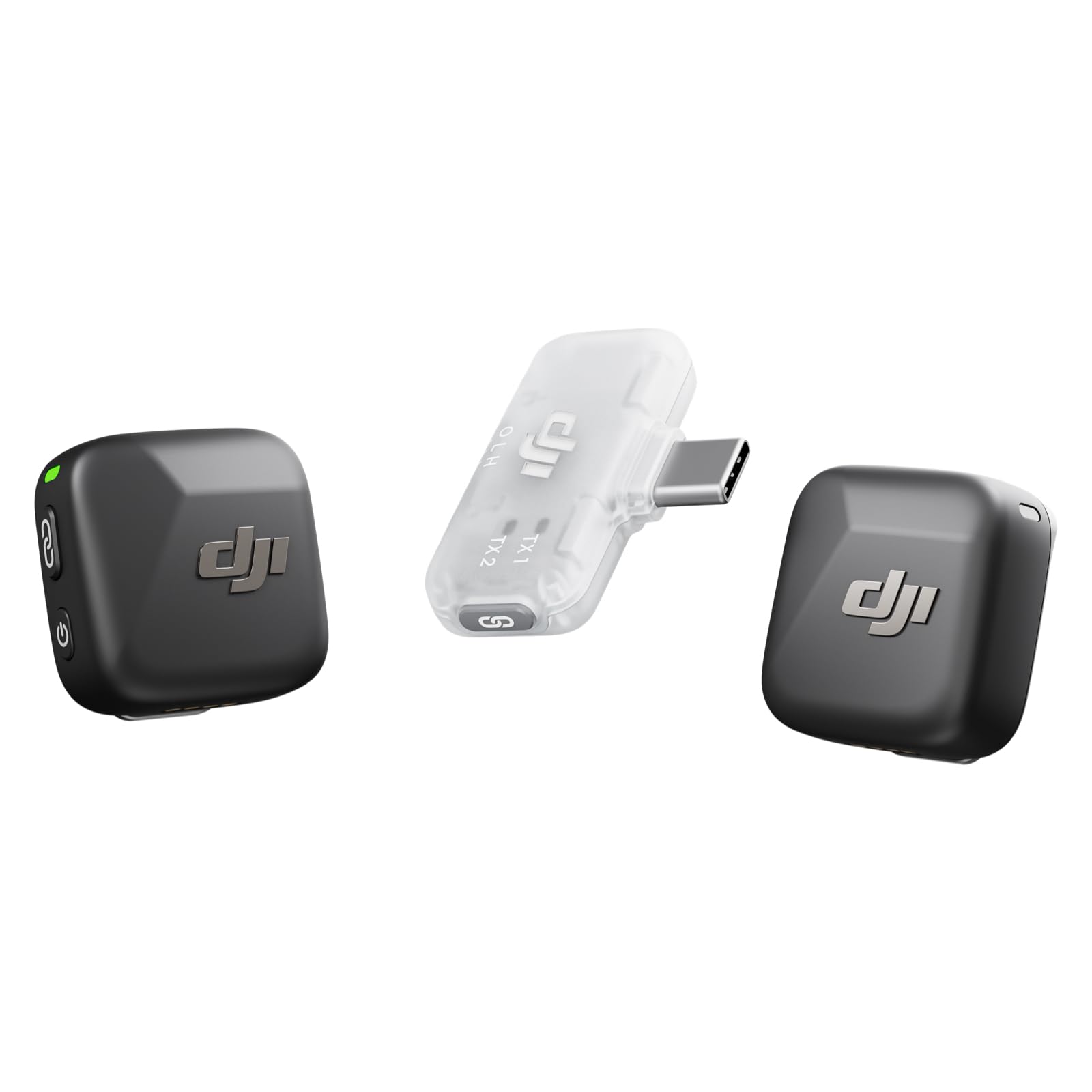
1. DJI Mic Mini (2 TX + 1 Mobile RX)
Our pick — 4.5+★ from 27,000+ verified ratings; the strongest balance of quality and price.
The pocket transmitter that keeps two voices clean from across a street.
What earns this the top spot is the distance it holds. The transmitter weighs 10 g, so it disappears on a collar, yet the system keeps a stable link out to 300 m (roughly three football fields of open line-of-sight). That is the kind of range that lets you set the phone on a tripod and walk off with a guest without the audio dropping.
Two transmitters and one mobile receiver means two people can be recorded at once through the USB-C plug, with no Bluetooth pairing and no app to open. The 11.5-hour stated operating time covers a full interview day, and it is backed by a charging dock for each transmitter plus a compact carrying pouch in the box. Sound stays clear at that distance too — 20 dB audible noise figures sit in studio territory rather than phone-mic mud.
The noise cancellation is the part worth understanding. There are two levels: Basic for quiet indoor rooms, Strong for busy street work — the second is what rescues outdoor dialogue. Automatic limiting then pulls the level down if someone laughs or shouts, so a sudden spike does not clip the recording. As owners put it, the voice isolation is the standout, and the combined runtime is generous enough that a full shoot day is not a worry.
Where the money goes
- 300 m transmission range keeps two people linked across large spaces
- Two transmitters ship in the box, so interviews need no extra purchase
- 10 g clip-on weight stays out of frame and off the mind
- Automatic limiting protects a take when volume suddenly spikes
What to plan around
- Receiver is USB-C only, so older Lightning iPhones need a different route
- The 11.5 hours is a combined figure, not per transmitter
Reach for this if: you shoot two-person interviews, street content, or anything where you want distance between the phone and the talent.
Look elsewhere if: you are on an older Lightning iPhone and do not want adapters in the chain.
2. Hollyland Lark M2
A 9 g button mic that carries pro-grade detail for a full shoot day.
If you record voiceover or podcast dialogue and want the capture to sound closer to a studio than a phone, this is the one to study. Each transmitter weighs just 9 g, and the system records at 48kHz/24-bit — that pairing of sample rate and bit depth is what keeps quiet breaths and consonant detail from smearing. A 70 dB signal-to-noise ratio keeps the noise floor low, and a 115 dB maximum sound pressure level means a loud room will not overload the capsule.
The range is the biggest headline here: 1,000 ft line-of-sight, versus the DJI Mic Mini’s 300 m. Battery tells a similar story. Ten hours continuous with ENC off, then a charging case that delivers two full recharges in under 1.5 h per cycle, stretching total use to 30 hours — against the DJI’s 11.5-hour combined figure, that is a big gap for multi-day work.
Controls live on the transmitter, which is where they should. One button toggles noise cancellation, and a double-press starts or stops your phone’s video recording, so you can run solo without walking back to the phone. The HollyAudio app handles firmware updates and noise-cancellation levels. What buyers notice is how clean the voice comes back — clear reproduction without the thinning that cheaper capsules introduce. The catch is narrow: the phone needs to support starting video with a single volume-button press for that remote trick to work.
Sound-first verdict: 48kHz/24-bit capture, a 70 dB signal-to-noise ratio, and 1,000 ft range put it in a different class of kit — this is the pick for anyone whose job is the audio, not the video.
Set it up once: transmitters are factory-paired, so the first unboxing is a plug-in-and-go moment rather than a pairing ritual.
The pro’s choice: podcasters, voiceover artists, and filmmakers who want detail preserved at 48kHz/24-bit and can use the 1,000 ft ceiling.
Overkill if: you shoot quick social clips where the phone’s built-in mic would do and you never record past one hour.
3. MAONO Wave T5

Fourteen noise-cancellation levels for anyone recording beside a busy road.
Most mini mics give you noise cancellation as a single switch. This one gives you three modes and 14 levels inside the Maono Link app, driven by a dedicated ENC chip — a processor focused on separating the human voice from everything else. Stand next to loud machinery or a café full of chatter and you can dial in how aggressively the background gets pushed down, rather than accepting one blunt setting.
The capture itself is serious for a clip-on: true 48kHz/24-bit recording, an 80 dB signal-to-noise ratio for a low noise floor, and a 120 dB maximum sound pressure level so a sudden shout does not distort. Four one-tap voice presets — Vocal Enhancer, Brightness, Warmth, and Magnetic Radio — handle tone shaping without touching an EQ. That is a real shortcut if you publish straight from the phone.
Range sits at 300 m in open air and still holds 100 m when the transmitter is tucked behind your back or in a pocket, thanks to frequency-hopping that jumps between channels to dodge interference. Each transmitter runs 9 hours, stretching to 30 hours total with the charging case. The receiver also passes Type-C power through to your phone, so a long livestream does not drain your battery mid-sentence.
Owners are clear-eyed about one thing: the audio and the value both land well, and the everyday usability is why it gets recommended. But the pairing step has to be done precisely — if the blue light is flashing slowly, the link failed, and both receiver and transmitter must be pushed into rapid flashing mode before they connect. Set that up correctly once and it behaves.
Why creators keep it: the tunable ENC and the four presets are the rare features that save post-production time rather than adding to it.
One setup habit: treat the first pairing as a deliberate two-step, and the rest of the kit runs plug-and-play.
Built for the loud world: outdoor reporters, market interviews, and anyone who films near constant background noise.
Worth weighing: if you want a totally hands-off mic with nothing to configure, the tuning options here are more than you need.
4. Insta360 Mic Air Transmitter

Seven point nine grams, no receiver, and it talks straight to your Insta360 camera.
This is the lightest thing on the list at 7.9 g, and it is aimed at a much narrower buyer than the rest. Instead of a phone receiver, it links wirelessly to Insta360 X6, X5, X4, X4 Air, Ace Pro 2, and GO Ultra cameras directly. If you already shoot on one of those, that saves the whole receiver step — clip it, pair it, and record.
Audio is captured at 48kHz sampling, with noise cancellation and an included windshield to keep wind out of the capture. A magnetic pendant, a clip magnet, and button magnet are all in the box, so you can wear it as a pendant, on a collar, or magnetically under a shirt. The transmitter itself controls video start and stop, noise cancellation, and mute, so the camera never needs to leave your hands.
The honest catch is in the fine print, and it matters. There is no receiver included, so this does not talk directly to a phone in the standard kit — mobile pairing requires the separate Mic Air (1 TX + 1 RX) bundle. Owners are largely happy with the audio quality and the wind handling, but the attachment options and the connection pathways generate more discussion than the sound itself, and the X4 is the one camera that only supports a direct Bluetooth connection with the transmitter. Know your camera model before you buy.
The Insta360 advantage
- 7.9 g — nothing else on this list is close
- No receiver required for supported Insta360 cameras
- Start, stop, and mute control right from the transmitter
- Magnet pendant, clip, and button magnet all included
The camera lock-in
- Useless with a phone unless you buy the separate receiver bundle
- X4 owners get Bluetooth only, not the full wireless link
Only if you shoot Insta360: this is a purpose-built accessory for X6, X5, X4, X4 Air, Ace Pro 2, and GO Ultra owners, and it earns its place there.
Pass on it if: your recording happens on a phone, because there is no receiver in this package.
5. TXTUNE Wireless Mini Clip-On Mic
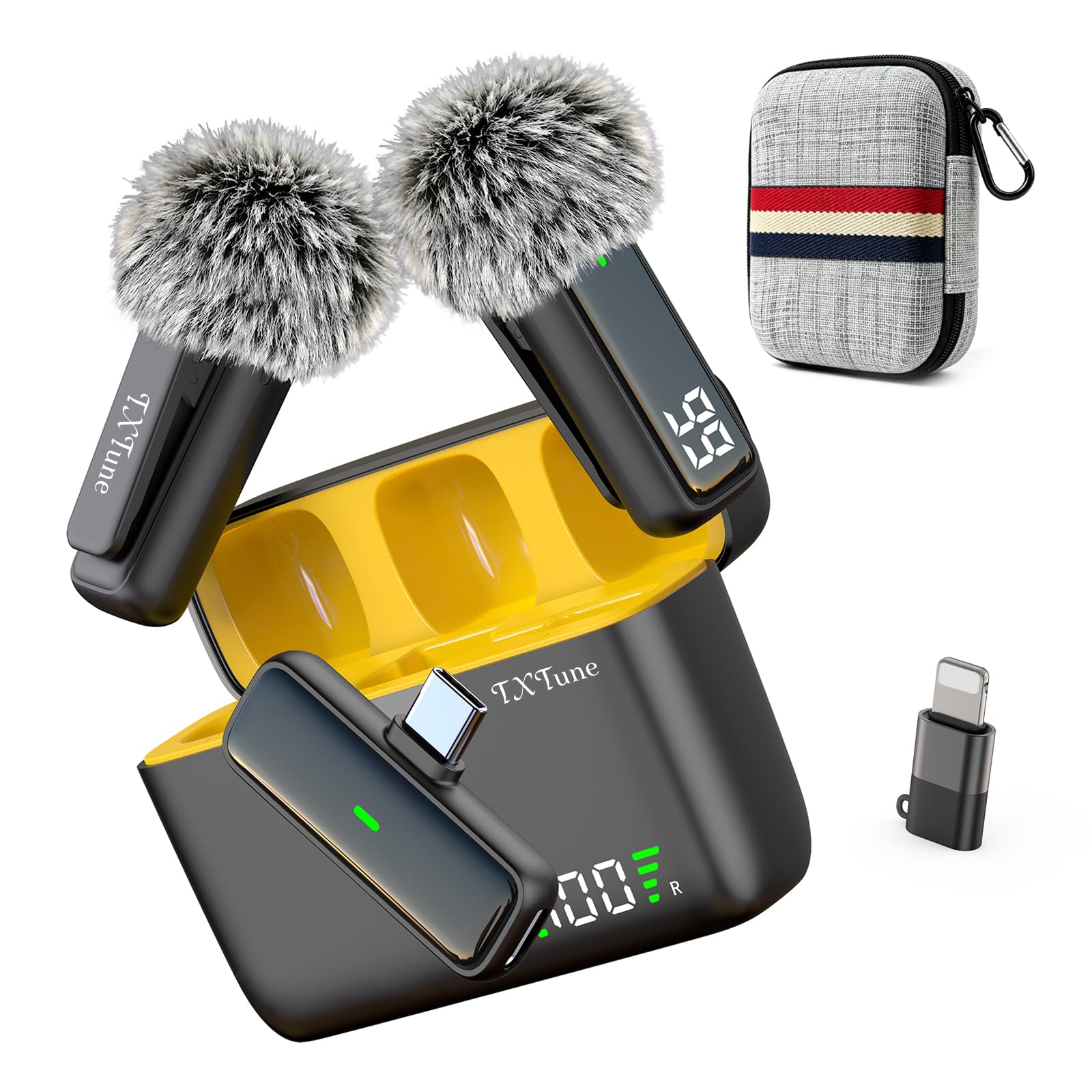
The two-mic starter kit that punches past its tier on sound clarity.
Two transmitters, one receiver, a charging case, and a Lightning adapter all ship together here, which is what makes it the sensible first kit for a two-person channel. Each transmitter weighs 9 g, so a guest barely registers it clipped to a collar. Setup is a plug-in and a button press, with no app and no Bluetooth pairing to fight.
The build centers on a DSP noise-reduction chip — a sound processor that filters background noise before it reaches your recording — paired with the included furry windshields for outdoor and street interviews. Each mic runs up to 6 hours per charge, and the charging case stretches total use to 24 hours. The receiver can also pass power to your phone while you record, which is the small detail that saves a long livestream.
Range is the number to go in with eyes open on: 70 ft stable transmission. That is fine for a stage, a couch interview, or a vlog with the phone on a nearby tripod, but it is not a set-it-across-the-field figure. Owners consistently rate the quality and sound well above the price tier, and the digital battery indicator on each mic is a detail people like being able to check at a glance. Connectivity and noise cancellation are the two areas that draw more mixed comments, so expect to test placement before a big shoot.
The wallet-friendly read: a two-mic kit with DSP filtering, furry windshields, and a 24-hour case covers most of what a beginner needs in one purchase.
Know the ceiling: 70 ft is the practical limit, so keep the phone near the subject rather than the far side of a venue.
Start here: new creators filming interviews, podcasts, or two-person vlogs who want both mics and the adapter in one box.
Not the distance champ: if you need to record from a distance or across a venue, look at the higher-range picks instead.
6. BOYA V30 Wireless Lavalier Microphone
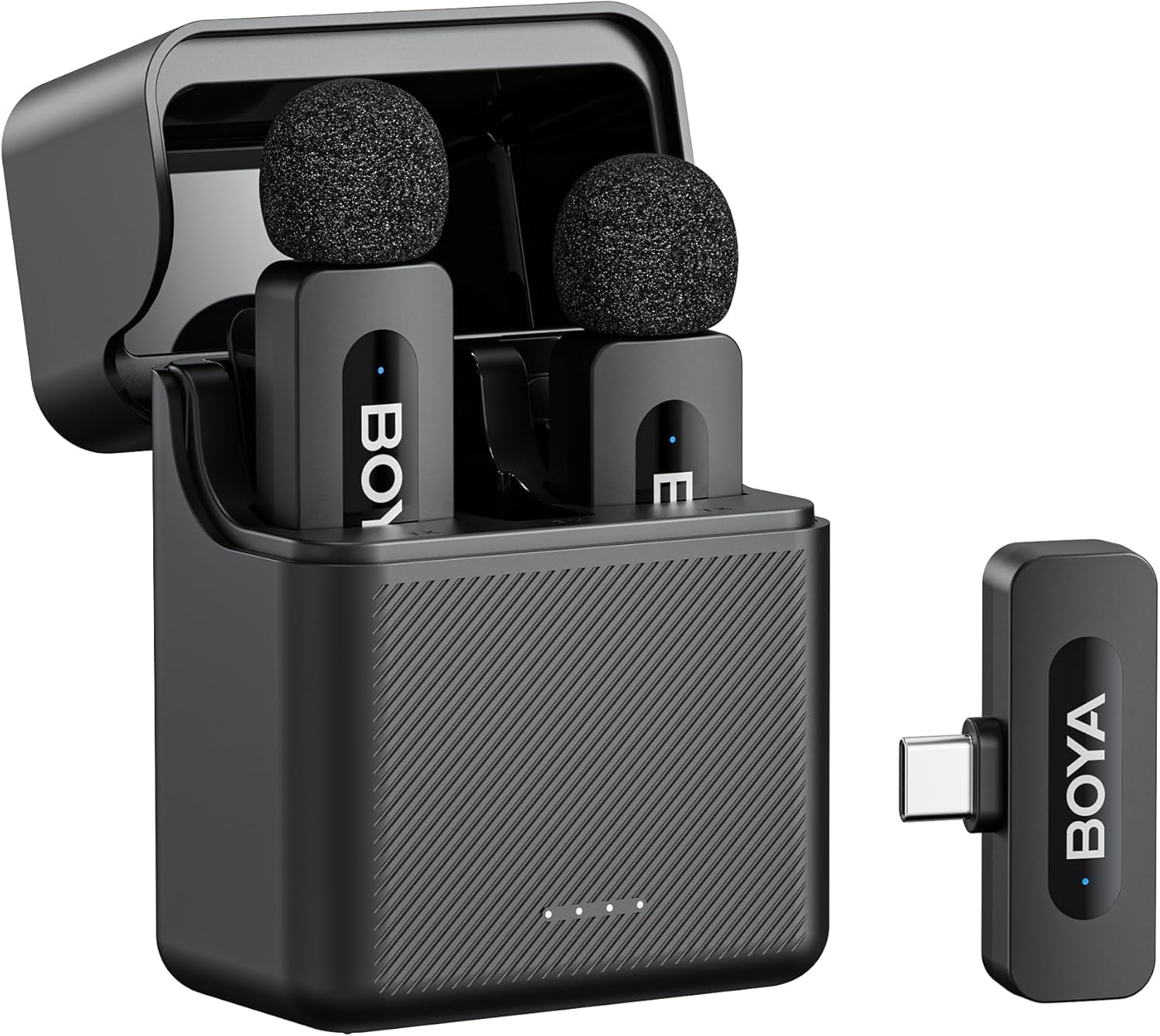
Thirty-six hours of runtime for shoots that outlast a single charge.
If your recording sessions run long, this is the pick with the stamina. Each transmitter carries a 95mAh rechargeable battery and delivers up to 9 hours on a charge; the included charging case pushes the mobile version to a 36-hour total. That is a big number against the 11.5-hour combined figure on the DJI Mic Mini — worth knowing if you film events or back-to-back interviews.
Each transmitter weighs 10.5 g, and the 360° rotatable clip means the mic can be angled wherever the fabric allows. The capture runs at 48kHz/16-bit with an 80 dB signal-to-noise ratio and a 120 dB maximum sound pressure level, so loud rooms do not crush the sound. One-click noise cancellation plus the dense foam windscreen is the defense against traffic and wind. Range tops out at 328 ft on 2.4GHz, which covers most tripod-and-talent setups.
The clever extra is playback without unplugging. You can review your recordings through the phone’s own speaker while the receiver stays connected, so you are not pulling the plug on every take. Buyers report clear audio and an easy plug-and-play experience, and the noise-cancelling side lands well for its tier. The one thing to understand is that the receiver occupies the USB-C port — the phone charging trick from other kits is not part of this package.
Where it holds up
- 36-hour total runtime via the charging case — the longest here
- Playback without unplugging the receiver
- 360° rotatable clip angles the capsule on any collar
- 48kHz/16-bit capture with an 80 dB signal-to-noise ratio
Where to be ready
- Receiver plugs into USB-C, so Lightning iPhones need another route
- 9 hours per charge means a recharge break on a very long day without the case
For the all-day crew: event videographers, back-to-back interviews, and anyone who runs out of juice before the shoot ends.
Consider the trade: the long battery comes with a chunkier case, so travelers with a minimal bag may prefer the smaller Pocket picks.
7. ZealSound Mini Wireless Lavalier Mic
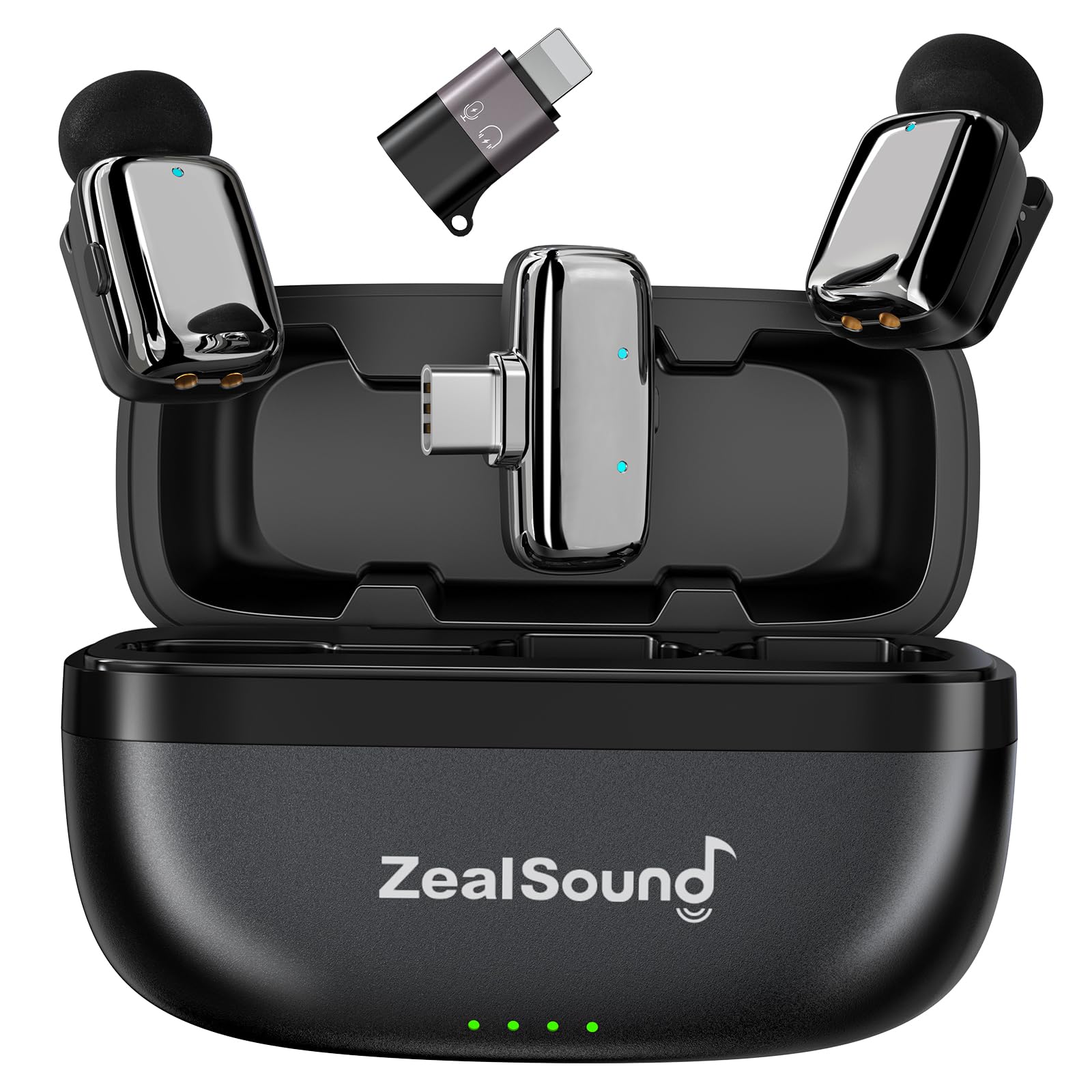
A coin-sized clip that hides in a pocket and covers both phone ports.
At 5 g and roughly the size of a coin, this is the smallest kit on the list by a wide margin, and it is the one to consider if portability is the whole point. Each transmitter captures at 48kHz/24-bit with a 360° omnidirectional pickup, so turning your head mid-sentence does not drop the level. There are three volume steps on the transmitter, which is enough to tame a soft speaker or a loud one without diving into a menu.
Both phone ports are covered from the start: the USB-C receiver plugs into modern phones, tablets, and USB-C laptops, and an included Lightning adapter handles older iPhones and iPads. You get two transmitters, which lets two people record on separate mics at once, plus two foam windscreens. Each transmitter runs 6 hours per charge, the case stretches total use to 33 hours, and a low mic comes back in about 40 minutes on a quick recharge. The 2.4GHz link reaches up to 328 ft in open line-of-sight.
The controls are unusually specific: double-tap the transmitter to mute, triple-tap for an echo effect, and the receiver has its own volume dial. The logo-free electroplated finish keeps it discreet on camera. On the honest side, the noise reduction is the split opinion in the feedback — some find the default mode genuinely helpful against wind and chatter, while others find it does not do enough for their space. It starts in Noise Reduction Mode by default, so flip it to Normal for a quieter room if the processed tone feels off.
Travel-first design: 5 g per transmitter, a charging case the size of a small box, and adapters for both USB-C and Lightning make this the easiest kit to keep on you.
Test the noise mode first: the cancellation is the one setting to trial before a paid shoot, since it splits opinion.
Best for the carry-on: vloggers, students, and teachers who want two clipped mics and port coverage without hauling a kit bag.
Check before you count on it: if you record in a genuinely noisy street and need heavy suppression, the more tunable picks above give you more control.
Know the Specs
Sample rate and bit depth
48kHz means the mic samples the sound 48,000 times a second, and 24-bit means each of those samples is stored with more detail than 16-bit. Together they make speech sound fuller and keep quiet syllables from vanishing, which is why 48kHz/24-bit is the figure voiceover artists look for first.
Signal-to-noise ratio
A signal-to-noise ratio of 70 dB or 80 dB is the gap between your voice and the hiss of the electronics. A bigger gap means less background hiss in the recording, so the voice sits cleanly on top even in a quiet room.
ENC and DSP noise reduction
ENC is a chip that separates the human voice from noise, and DSP is a processor that filters noise before it reaches the recording. A dedicated chip with adjustable levels gives you finer control than a simple on/off button. Outdoors, a foam or furry windscreen over the capsule does more against wind rumble than any noise-cancellation setting.
Transmission range and line-of-sight
Range figures are quoted for open line-of-sight, which means no walls, bodies, or vehicles between transmitter and receiver. A 300 m figure is not what you get through a brick wall. Pocketing the transmitter or turning your back is the usual real-world test of a wireless mini mic’s antenna work.
Common Questions
Will a wireless mini mic work with my iPhone 14 or older model?
Can two people record at the same time with one kit?
How far can a wireless mini mic actually transmit?
Do I need to pair a wireless mini mic with my phone before recording?
Will noise cancellation remove traffic from a street interview?
What does 48kHz/24-bit actually change about my recording?
Can I charge my phone while the receiver is plugged in?
How long does the battery actually last per shoot?
Do these mics need an app or special software?
Which mini mic is easiest to hide on camera?
The Bottom Line
For most people, the wireless mini mic that wins is the DJI Mic Mini, because it puts two transmitters in the box, holds a 300 m link, and stays discreet at 10 g — a combination that handles interviews, street work, and travel without extra purchases. If clean, detailed audio is the priority and you want 1,000 ft of range plus 30-hour battery, the Hollyland Lark M2 is the upgrade. And for recording beside loud traffic with fine control over the noise suppression, the MAONO Wave T5 is the one to reach for, with 14 levels to dial in exactly how much background gets left out.
How we choose
We do not accept paid placement. Every pick is matched to a real buyer and a real use-case; we do not hands-on test units.
Sources
Specifications: manufacturer listings and product documentation. Review insights: verified customer reviews, as of November 2026. Pricing: not shown on this page (it changes often); check the current price via the retailer link.
As an Amazon Associate, Tactical Gear Guy earns from qualifying purchases. This does not affect which products we feature.