Specs are compiled from manufacturer listings and verified buyer reviews and can change over time — please confirm the key details on the product page before buying.
You already own a mic you trust, and you just want it untethered — that is the whole job of a wireless XLR system. The right one turns your dynamic or condenser mic into a cable-free setup, keeps a real XLR out for your mixer, and stays quiet and dropout-free. Pick wrong and you get added lag, a hissy signal, or a receiver that dies mid-set.
This guide is built by comparing the manufacturers’ published specifications and the patterns across verified customer reviews, so you get each pick’s real strengths and trade-offs instead of marketing spin.
You’ll see which sets work as a full handheld kit and which turn your own mic wireless. The quick comparison table lets you scan range, battery and hookups side by side before you commit to the wireless microphone with xlr connector.
Top Picks


How To Choose The Best Wireless Microphone with XLR Connector
First, work out which job you actually need done. Some sets are a complete handheld kit with a receiver that feeds your mixer by XLR. Others are a plug-on transmitter and receiver pair that make the mic you already own wireless. Mixing up the two is the most common buying mistake here.
Check that the XLR is a real output, not just a plug
You want a receiver with a genuine XLR out so it feeds a mixer or powered speaker directly. A unit that only offers a 6.35 mm jack forces you through an adapter. Every pick here offers XLR, but confirm which end of the chain it sits on before you buy.
Dynamic or condenser changes your battery math
Dynamic mics (the rugged, common stage type) need no external power. Condenser mics (more sensitive, often used for studio-style capture) need phantom power — a steady voltage sent up the cable to run the mic. Running 48V phantom on a plug-on system eats battery faster, so expect shorter runtime with a condenser attached.
Range in feet is a best-case number
Line-of-sight range is measured over open ground. Walls, bodies and crowded rooms cut that down. If you roam a big stage, favor a set that lists a longer figure and a stable UHF band over one that leans on 2.4GHz, which shares space with wi-fi.
Side-by-Side Comparison
| Model | Best For | Range | Battery | Connector | Amazon |
|---|---|---|---|---|---|
| Phenyx Pro PTU-71-1H1B★ Best Overall | Full handheld + bodypack kit | 328 ft | 16 hrs (AA) | XLR, 6.35 mm | Amazon |
| POGOLAB BKW-X1Best for Your Own Mic | Making your own mic wireless | 150 ft | 12 hrs | 3 Pin XLR | Amazon |
| Kaschun KA-328Karaoke Favorite | Karaoke and small events | 200 ft | 8+ hrs (AA) | XLR, 6.35 mm | Amazon |
| JOYO MW-2 | Low-latency voice work | 100+ ft | 6-8 hrs | XLR / USB-C | Amazon |
| EBJ M-ONE | Remote volume control | 164 ft | 6-8 hrs | XLR | Amazon |
| Bietrun WXM19-2 | No-AA-battery convenience | 240 ft | 7 hrs | XLR, 6.35 mm | Amazon |
| YXG M-ONE | 48V condenser mic support | 160 ft | 9 hrs | XLR | Amazon |
| Phenyx Pro PTU-52-1H1B | Tunable channels, hands-free | 200 ft | AA powered | XLR, 6.35 mm | Amazon |
| Pyle PDWM8300 | Eight table-top mics | 50-180 m | 9V (per mic) | XLR | Amazon |
Detailed Reviews
1. Phenyx Pro PTU-71-1H1B Wireless Microphone System
Our pick — 4.5+★ from 950+ verified ratings; the strongest balance of quality and price.
One kit that hands you a handheld, a bodypack and two ways to clip on.
If you run a church service, a classroom, or a small event and want one box that covers everything, this is the set that does it. You get a metal handheld mic plus a bodypack that pairs with an included lapel or headset mic — so the same receiver handles singing, speaking and hands-free teaching. It also outputs through XLR and a 6.35 mm jack, so it plugs straight into your mixer or powered speaker. The crowd backing this one is real: 4.5+ stars across 900+ ratings.
Range and runtime are where this set stretches out. The 328 ft line-of-sight reach beats the JOYO MW-2’s 100 ft, and the 16-hour run off the included AA batteries leaves the JOYO’s 6-8 hours well behind. That matters in a long service or a day of back-to-back sessions where you cannot stop to recharge. One-touch Auto Scan finds the cleanest frequency in the room, then remembers it after a power cycle so you are not re-pairing every time you switch on.
Here is the fair catch. This receiver has fixed antenna placement and wants line of sight to stay confident — walls and crowds eat into that 328 ft figure. Frequency response tops out at 18 KHz, which is a touch narrower than the Kaschun KA-328’s 20 KHz, though for voices you will not notice. The thing that wins people over most is sound quality — clear and loud, exactly as advertised.
Where it earns its keep
- Two transmitters and three mic options in one box — handheld, lapel and headset
- 328 ft line-of-sight range for big rooms and outdoor stages
- 16 hours of runtime from the included AA batteries
- Auto Scan locks the cleanest channel and keeps it after a restart
The fine print
- Sound tops out at 18 KHz, a hair narrower than a 20 KHz set
- Fixed antennas want a clear line to hold full range
Reach for it if: you need one system for a speaker, a singer and a hands-free presenter on the same night.
Think twice if: you only ever use one mic and one voice — a simpler single-purpose set saves you the extra gear.
2. POGOLAB BKW-X1 Wireless Microphone Transmitter Receiver
Turns the XLR mic you already love into a cable-free performer.
This is the pick if you do not want another handheld mic — you want to free the one you already own. The plug-on transmitter and receiver pair add wireless to any XLR dynamic mic, and the 3-pin XLR connection means it fits the mic you trust. A 150 ft transmission distance gives you room to move away from the speakers instead of being leashed to them.
The headline spec is 48V phantom power. That lets the same adapter run a condenser mic alongside a dynamic one — but know the cost. Phantom power drains the battery faster, so a condenser mic will not last the full 12-hour runtime. The brand itself suggests testing real-world time with a condenser before a performance, and that is sound advice. Leave phantom off for dynamic mics and you should see the longer run. A 110 dB noise figure keeps the floor quiet when your gain is set sensibly.
Owners talk about how it just connects the moment you power it up, with minimal latency, and it delivers clear sound at a solid distance. Performance is the thing buyers call out most — it connects the moment you power it up and stays clean at a distance. If you record or present in a mid-size room and want your own mic freed, this is the straightforward move.
Set your gain first: this is a plug-and-play adapter, not a full kit — you supply the mic, and the receiver feeds your mixer or interface by XLR.
Mind the phantom switch: flip 48V off for a dynamic mic to protect your runtime; turn it on only for a condenser.
Best matched to: anyone who owns a favorite XLR mic and wants it wireless without buying a new one.
Look elsewhere if: you need a complete handheld kit from the start — this assumes a mic in hand.
3. Kaschun Wireless Microphone System KA-328
Two handhelds, a metal build, and a 20 KHz top end for the party room.
For karaoke nights, small weddings and home parties, this set hands two people a mic at once. Both are handhelds with a cardioid dynamic capsule (a pickup that favors what is right in front of it), so it fights feedback and background chatter better than an omni mic. The metal enclosure takes knocks and the 200 ft UHF range gives you room to work the room. Its 20 KHz frequency response actually edges the Phenyx Pro PTU-71’s 18 KHz on paper — a wider ceiling for detail.
Each mic runs over 8 hours on AA batteries, which covers a long evening without a swap. The receiver offers XLR and 6.35 mm output so it drops into a karaoke machine, mixer or powered speaker. Build and sound are the two things buyers praise most — the build especially punches above what you might expect at this tier. Setup is quick, which is what you want when guests are already waiting.
The honest limit: this is a fixed-frequency set, so if the room is crowded with other wireless gear you cannot tune your way out of interference the way a frequency-hopping system lets you. For a home or small-venue karaoke rig, that rarely bites.
Ideal for: family karaoke and small events where two handhelds beat one mic every time.
The trade-off: fixed frequencies mean no channel-hopping if the airwaves get busy.
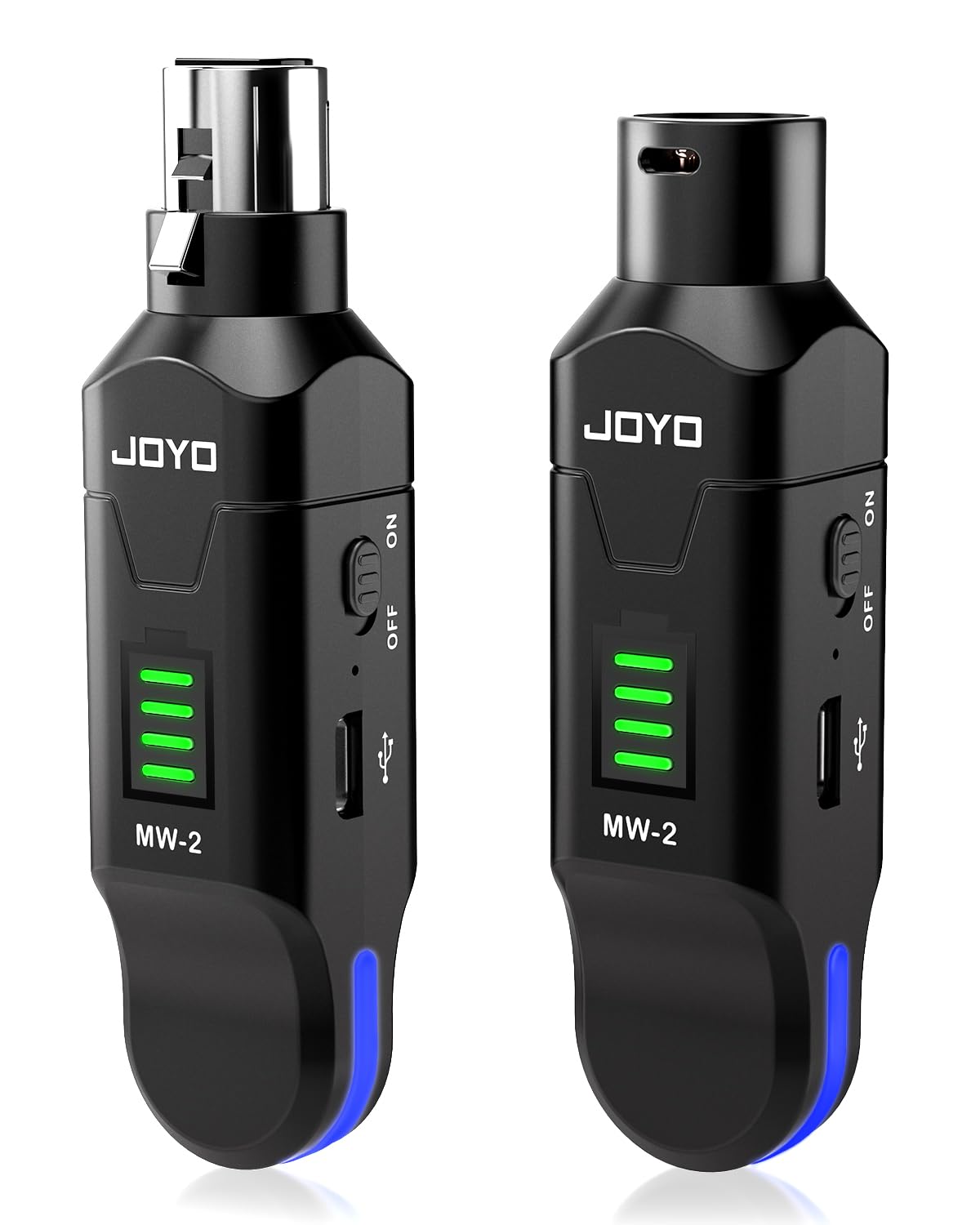
4. JOYO 2.4GHz Wireless XLR Microphone System MW-2
A digital link built to keep your timing tight and your voice clean.
Speech and singing live and die on timing, and this set specifies 16ms of wireless latency — the tiny gap between your voice and the speaker. That is short enough to speak or sing against without the delay throwing you off. The digital signal runs at 24-bit/48kHz with a 105 dB signal-to-noise ratio (the gap between your voice and the background hiss), so vocals stay detailed. Owners back the low-latency experience.
The range figure is where you should set expectations. JOYO rates it at over 100 ft in open areas, which trails the Phenyx Pro PTU-71’s 328 ft, and the run time of 6-8 hours trails that set’s 16 hours too. Where it wins is the type of link: 2.4GHz automatic frequency hopping lets up to four sets share one venue. Two transmitters can pair by powering each one on first, then its receiver.
Two things to plan around. Mute the mixer channel before switching transmitter or receiver on or off — that avoids a loud pop through the speakers. Also keep the mixer’s 48V phantom power off on the XLR input this receiver feeds; it does not want phantom on that channel. Note the rechargeable batteries cannot be used while charging, so a top-up means taking a break.
The timing angle: a 16ms digital link and 24-bit/48kHz audio are why presenters and singers reach for this over an analog set.
The prep list: mute before powering, phantom off, and plan around the no-charge-while-use rule.
Made for: worship leaders, presenters and singers who notice a delay and want clean digital voice capture.
Not the pick if: you roam huge spaces or need a full-day runtime from one charge.
5. EBJ M-ONE Wireless XLR Transmitter and Receiver
One receiver, two transmitters, and volume you can adjust from across the room.
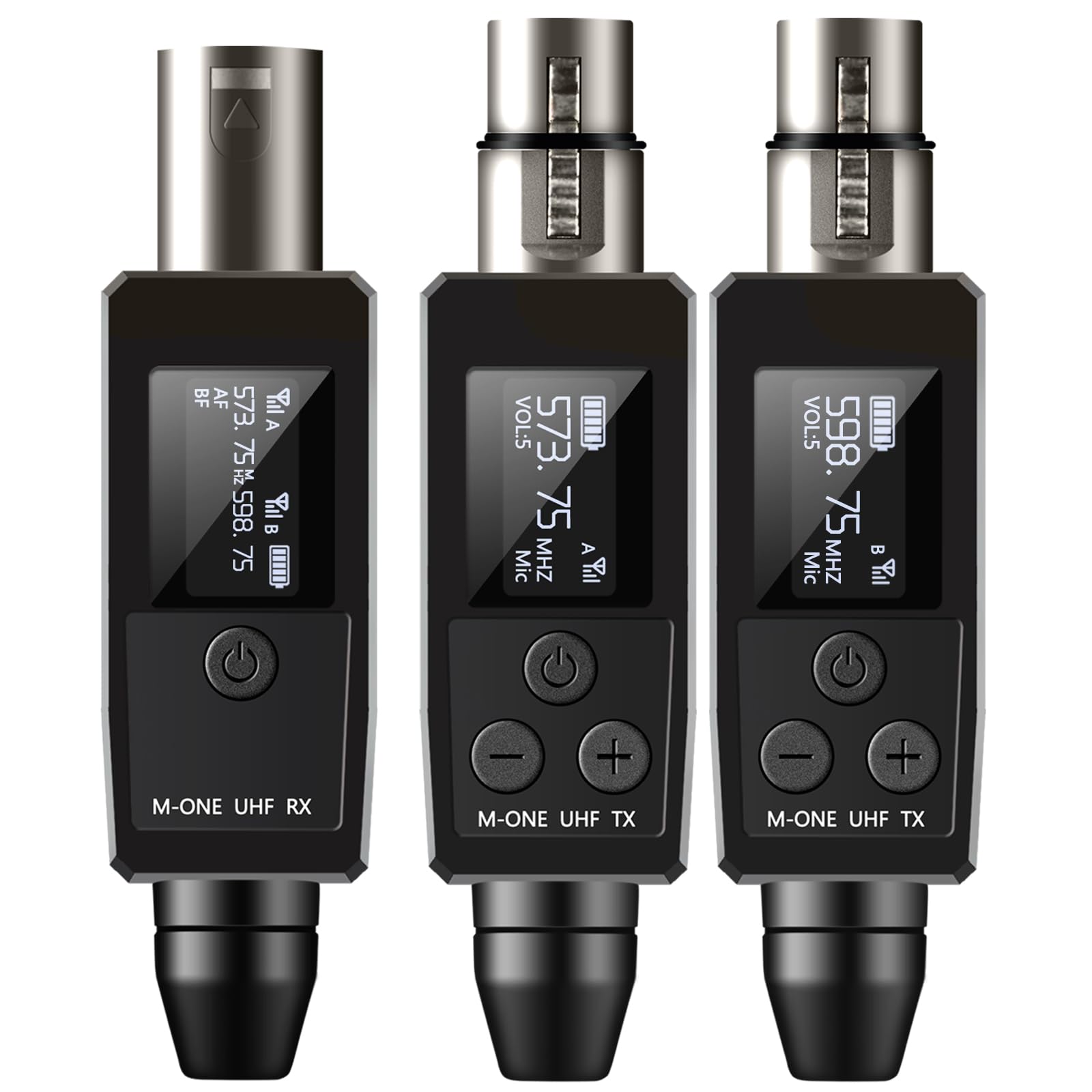
The M-ONE is sold as a “one drag two” kit — one receiver feeding two XLR transmitters — so you can put two of your own mics or instruments on air at once. It handles dynamic and condenser mics and supports up to 15 sets in the same location. The feature that separates it from the pack is remote volume signal adjustment: you can trim levels without walking back to the board.
Because it is a plug-on system, it takes the mic or instrument you already own and cuts the cable. That makes it useful for guitar or bass on the same wireless setup, not just vocals. A 107 dB signal-to-noise ratio keeps the audio clean across the volume range, and the built-in lithium batteries run 6-8 hours. Connectivity is straightforward — power it up and it auto-syncs with its receiver.
Set your expectations on the distance. EBJ rates it at up to 164 ft in the clear, dropping to 100 ft around obstacles, and low battery shortens the reach further. Audio and noise draw mixed feedback, so try it with your specific mic early rather than discovering a mismatch on show night.
Worth it when: you want two of your own mics or instruments wireless and want to ride the level from the room.
Worth a rethink if: you need guaranteed rock-solid noise performance and cannot tolerate any hiss.
6. Bietrun XLR Rechargeable Wireless Microphone WXM19-2

Two mics and a receiver that all recharge from one cable.
If the drawer full of dead AA batteries is your least favorite part of event day, this set answers it. The mic and receiver each hold a built-in 1200mAh lithium-ion battery that runs up to 7 hours and recharges in 3 to 4 hours. One included cable charges the dual mics and the receiver at the same time, so you top up the whole kit from a single plug. The 240 ft UHF range gives you plenty of room to move.
Each handheld uses a dynamic unidirectional core with a 95 dB noise figure and a 50Hz-16KHz response, tuned to lift the vocal. The alloy shell is harder, lighter and more wear-resistant than a plain plastic body, and it gives a more substantial grip. Fifteen adjustable channels per mic let you dodge interference by setting each mic to a different channel. Sound and easy auto-connection are what buyers rate highest.
The receiver won’t always keep its charge — that battery is the recurring gripe — so keep the USB-C cable handy and top it up before a long set. For a short karaoke night that is minor, but plan a top-up before a marathon session.
The case for it
- Two mics plus receiver recharge from one cable — no AA shopping
- 1200mAh cells run up to 7 hours per charge
- 240 ft UHF range and 15 channels per mic
- Alloy body feels solid in the hand
Small print
- Receiver charge retention is the recurring gripe
- 3-4 hour charge time means planning ahead
Choose it if: you want a rechargeable two-mic kit that never needs a battery run to the store.
Pass if: you want to leave gear on a shelf for weeks and grab it — charge retention here wants checking.
7. YXG UHF Wireless XLR Transmitter and Receiver M-ONE

A plug-on pair for the mic collector who runs both dynamic and condenser.
The spec that matters here is 48V phantom power. That lets a plug-on transmitter run a condenser mic, not just a dynamic one, so your studio mic can leave the stand. The digital chain runs 24-bit/48kHz audio with a 107 dB signal-to-noise ratio and a wide 20Hz-20KHz response — detail across the full voice and instrument range. A 160 ft stable connection covers most stages and rooms.
Battery life is a real strength: the built-in lithium cells run 9 hours, which beats the EBJ M-ONE’s 6-8 hours. That headroom matters if you switch on phantom power, which pulls harder. The kit ships “one drag two” — a receiver and two transmitters — with conversion plugs and charging cables included. Functionality is the thing buyers rate most — it does its job without drama.
Where it stumbles is the noise floor. Some buyers report hiss and find the overall quality not quite what they hoped, and the plastic enclosure feels less premium than a metal body. Get it working cleanly with your mic early. For an affordable way to make a condenser mic wireless, it is a genuine option.
The mic freedom: 48V phantom power plus two transmitters makes it the flexible choice for owners of both dynamic and condenser mics.
The honest caveat: noise is the mixed point — test your mic-to-receiver pairing before a live show.
Pair it with: a condenser you want to go wireless and a second mic or instrument you want freed at the same time.
skip it if: you need a dead-silent floor and cannot tolerate any hiss.
8. Phenyx Pro PTU-52-1H1B Wireless Microphone System

Frequency-hopping channels turn a crowded room into a clean one.
Wireless trouble almost always starts with interference, and this set fights it with 30 tunable frequency groups in the 500MHz band. That lets up to three units run in the same space without stepping on each other. If a preset channel gets noisy, you simply switch to another — you are not stuck. A metal receiver and metal bodypack feel built for regular use, and it operates up to 200 ft line of sight.
You get both hands-free and handheld in one box: a metal handheld mic plus a bodypack that pairs with the included lapel and headset mics. Each transmitter has a MUTE button so you can silence a mic during shared use without powering down. Two XLR outputs plus a mixed 1/4” output connect to mixers, amps and speakers directly — a cleaner feed to the board than a single summed jack. The cardioid capsule and enhanced circuitry aim to cut dropouts, hiss and feedback. Sound quality tops the praise, with value close behind.
The wireless link itself is the mixed note — some rooms simply fight back, so test channels before you rely on one. Batteries are AA, not rechargeable, so keep spares on hand for a full day.
Go for it if: your venue is busy with other wireless gear and you want to tune your way clear.
Think twice if: you prefer a set-and-forget single channel and never want to touch a frequency setting.
9. Pyle 8 Channel Wireless Microphone System PDWM8300
A panel-and-podium setup where eight people speak at once.
This is a different animal from the handheld kits above. The PDWM8300 is an eight-channel VHF system with eight table-top microphones and a rack-mountable receiver base — built for a conference table, a panel, or a house of worship where multiple speakers take the floor. Each mic has its own dial volume control, so you balance each voice individually, and there is a 50Hz-16KHz response with a strong signal-to-noise ratio for the room.
The receiver gives 1/4” individual line outputs plus mixed 1/4” outputs, and the dual telescoping antennas help the VHF signal reach 50-180 meters. Rack-mount ears let you install the base in a standard rack for a permanent install. Value for money is what owners highlight most, with quick setup close behind. It is a lot of channels for a room that needs to hand everyone a mic.
Understand what VHF means here. It is an older frequency band, and build quality is the mixed point — some units arrive in better shape than others, so inspect yours on arrival. For a fixed conference install where each seat has its own table-top mic, it puts a dedicated mic at every seat, which handheld sets cannot do.
What it solves
- Eight table-top mics with individual volume for a full panel
- Rack-mountable receiver base for a permanent install
- Dual telescoping antennas on the VHF band
What to watch
- Build quality is the mixed point — inspect on arrival
- VHF band and 9V per mic mean old-school battery management
Built for: conference tables, panels and installs where eight separate speakers need their own mic.
Not for: a single singer or speaker who just wants one reliable handheld.
Know the Specs
Range in feet
Line-of-sight range is the best case, measured over open ground with nothing in the way. Walls, bodies and crowded rooms cut it down, and a flat battery shortens it further. Treat a longer listed figure as extra headroom, not a guarantee through a wall.
Battery and phantom
Runtime depends on what you power. A dynamic mic draws nothing extra; a condenser mic needs phantom power (the DC voltage sent up the cable to run it), and that drains the battery faster. Run phantom only when your mic needs it.
UHF vs 2.4GHz
UHF uses licensed-friendly radio bands and handles rooms with lots of wireless gear; many systems let you switch channels if one gets noisy. 2.4GHz shares space with wi-fi and Bluetooth but often delivers low latency and easy hopping between sets. Match the band to your venue.
Latency
Latency is the delay between your voice and the sound leaving the speaker. For singing and live speaking, a short digital link keeps your timing intact so you are not fighting an echo in your own ear.
Common Questions
Will a wireless XLR system make my existing dynamic mic wireless?
Can I use a condenser mic with a wireless XLR system?
Does phantom power drain the battery faster?
What is the real difference between UHF and 2.4GHz for a wireless mic?
How far can I actually walk from the receiver?
Why does my wireless mic pop when I switch it on?
Should I leave 48V phantom power on at the mixer input my receiver uses?
Are AA batteries or built-in rechargeable batteries better for a wireless mic?
Can I run more than one wireless mic set in the same room?
What range of frequency response should I look for on a wireless handheld?
The Bottom Line
If you want one box that covers a singer, a speaker and a hands-free presenter, the Phenyx Pro PTU-71-1H1B is the set to start with — it pairs a metal handheld, a bodypack and included lapel and headset mics with 328 ft of range and 16 hours of runtime. For freeing the mic you already own, reach for the POGOLAB BKW-X1, which adds 48V phantom for condenser mics. And if your room is packed with other wireless gear, the tunable channels on the Phenyx Pro PTU-52-1H1B give you the escape route the fixed-frequency sets do not.
How we choose
We do not accept paid placement. Every pick is matched to a real buyer and a real use-case; we do not hands-on test units.
Sources
Specifications: manufacturer listings and product documentation. Review insights: verified customer reviews, as of November 2026. Pricing: not shown on this page (it changes often); check the current price via the retailer link.
As an Amazon Associate, Tactical Gear Guy earns from qualifying purchases. This does not affect which products we feature.