Specs are compiled from manufacturer listings and verified buyer reviews and can change over time — please confirm the key details on the product page before buying.
Your Android phone already shoots clean video — the audio is what lets it down. Wind roar, traffic, and that hollow “talking from another room” sound ruin otherwise good footage, and the fix is a wireless lavalier mic that plugs straight into your USB-C port. The picks below all pair with Android, and each one solves a slightly different problem.
This guide is built by comparing the manufacturers’ published specifications and the patterns across verified customer reviews, so you get each pick’s real strengths and trade-offs instead of marketing spin.
The trick is knowing which spec buys you range and which one buys you clean audio. Range, battery, and bit depth do different jobs on a shoot day, and the list below separates them clearly so you can pick with confidence instead of guesswork.
Top Picks
How To Choose The Best Wireless Microphone for Android
Android is the awkward one. iPhones and Androids use the same USB-C plug now, but the receiver still has to be built for your phone’s port and your phone has to allow the handshake — that’s the whole ballgame. Buy a mic whose receiver is USB-C native and you skip the adapter dongle that so often kills the signal.
Check the connector before anything else
A USB-C receiver plugs into your charging port and needs no app, no Bluetooth pairing, and no fiddling. Most picks here work this way. Older Android phones with micro-USB, or phones with a Lightning port, need the matching adapter, so confirm your phone’s port first. That one check saves you a return.
Decide how far you’ll actually roam
Range numbers are line-of-sight, meaning nothing between the transmitter and receiver. Put your body between them and the real distance drops fast. If you’re a talking head at a desk, a short range is plenty. If you’re filming someone walking through a crowd, the longer-range systems are the ones that hold their signal.
Battery math, not battery claims
A single transmitter often runs about 6 to 11 hours on its own. The charging case is what delivers the big total figures, because it recharges the mics between takes. Read both numbers: one tells you the shoot length, the other tells you the trip length.
Side-by-Side Comparison
| Model | Best For | Transmission Range | Battery Life | Audio Format | Amazon |
|---|---|---|---|---|---|
| DJI Mic Mini★ Best Overall | Two-person shoots | 300 m | 11.5 hours | — | Amazon |
| BOYA V30Best Battery Life | All-day events | 328 ft | 36 hours | 48kHz/16bit | Amazon |
| TXTUNE USB-C MiniBest Value | Budget street interviews | 70 ft | 24 hours | — | Amazon |
| Insta360 Mic Air | Pocket-sized travel mic | 300 m | 10 hours | 48kHz | Amazon |
| Hollyland Lark M2 | Long-distance coverage | 1,000 ft | 30 hours | 48kHz/24bit | Amazon |
| MAONO Wave T5 | Voiceover polish | 300 m | 40 hours | 48kHz/24-bit | Amazon |
| RØDE Wireless GO (Gen 3) | Camera-plus-phone work | — | 40+ hours on-board recording | 32-bit float | Amazon |
| Hollyland Lark MAX 2 | Pro film sets | 340 m | 36 hours | 48kHz/32-bit float | Amazon |
Detailed Reviews
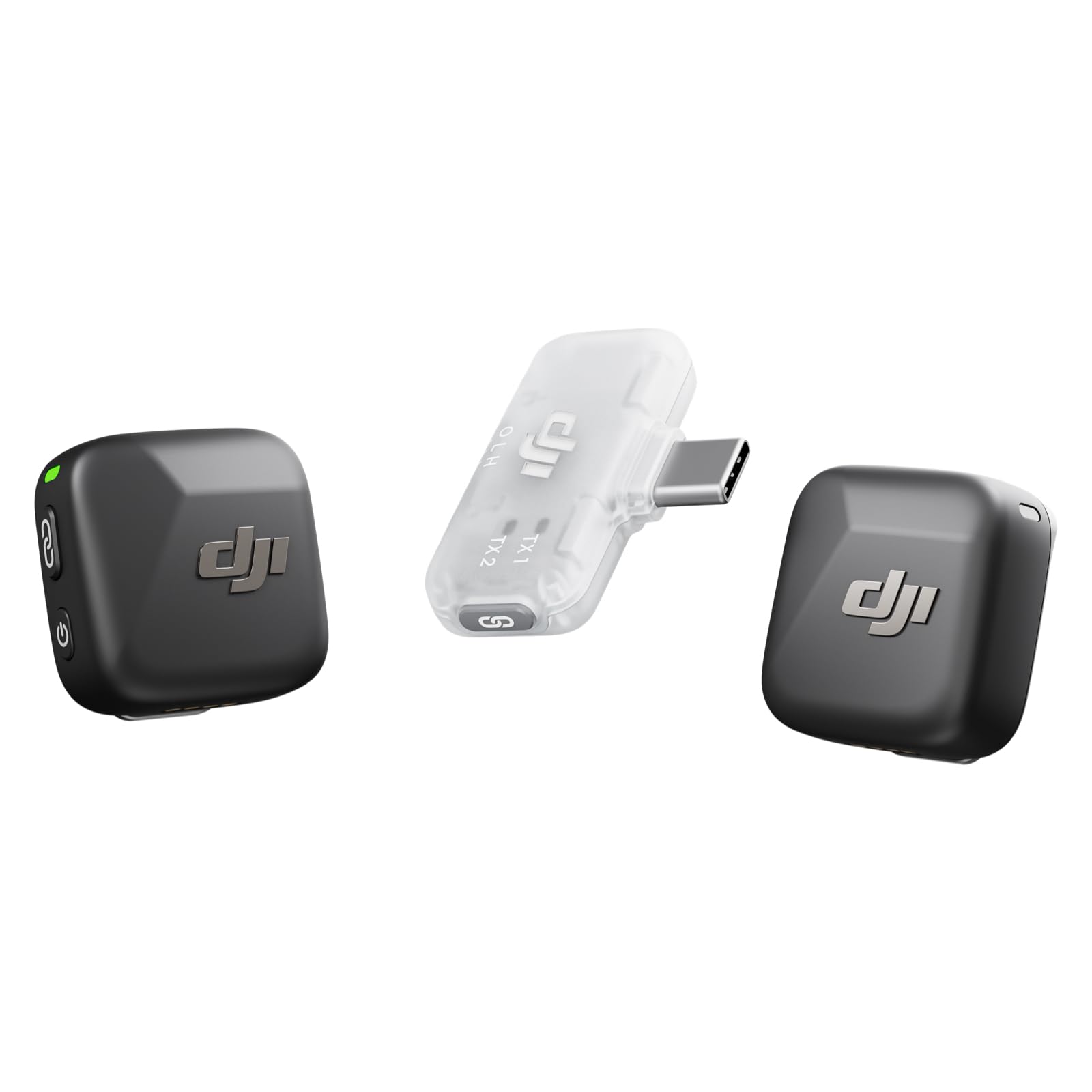
1. DJI Mic Mini (2 TX + 1 Mobile RX)
Our pick — 4.5+★ from 27,000+ verified ratings; the strongest balance of quality and price.
Two mics, one tiny case, and a 300 m lifeline for a conversation.
Two transmitters in one kit is the reason this sits at the top for Android shooters. You clip one on yourself and one on your subject, and the single USB-C receiver feeds both voices into your phone. For an interview, a two-person podcast, or a street conversation, that saves you buying a second system later. The transmitter itself weighs only 10 g, so it disappears on a collar without tugging at the fabric.
DJI’s noise cancelling comes in two levels — Basic for a quiet room and Strong for a noisy street — which is a more useful split than a single on/off toggle. Automatic limiting quietly pulls the volume back when someone shouts, so a loud laugh doesn’t shred the take. That limiting is what keeps a sudden shout from clipping the recording.
The honest number to weigh is the 11.5 hours the system runs on a charge, which is plenty for a shoot day but behind the 36 hours the BOYA V30 reaches with its charging case. Against the Insta360 Mic Air’s 10 hours, though, it leads. The bigger gap is weight: at 26 g per transmitter, it’s heavier than the 7.9 g Insta360 unit, so if absolute invisibility matters, that’s your trade.
What earns it first place
- Two transmitters included — covers two speakers at once
- 300 m transmission range for wide outdoor setups
- Plug-and-play USB-C receiver, no app required on Android
- Two-stage noise cancelling plus automatic volume limiting
What to know before you buy
- 11.5 hours trails the 36-hour charging-case systems
- Heavier per-unit than the featherweight options
Grab this one if: you regularly film two people and want a single USB-C kit that just works on Android.
Think twice if: you need multi-day battery without a wall outlet — the charging-case models stretch further.
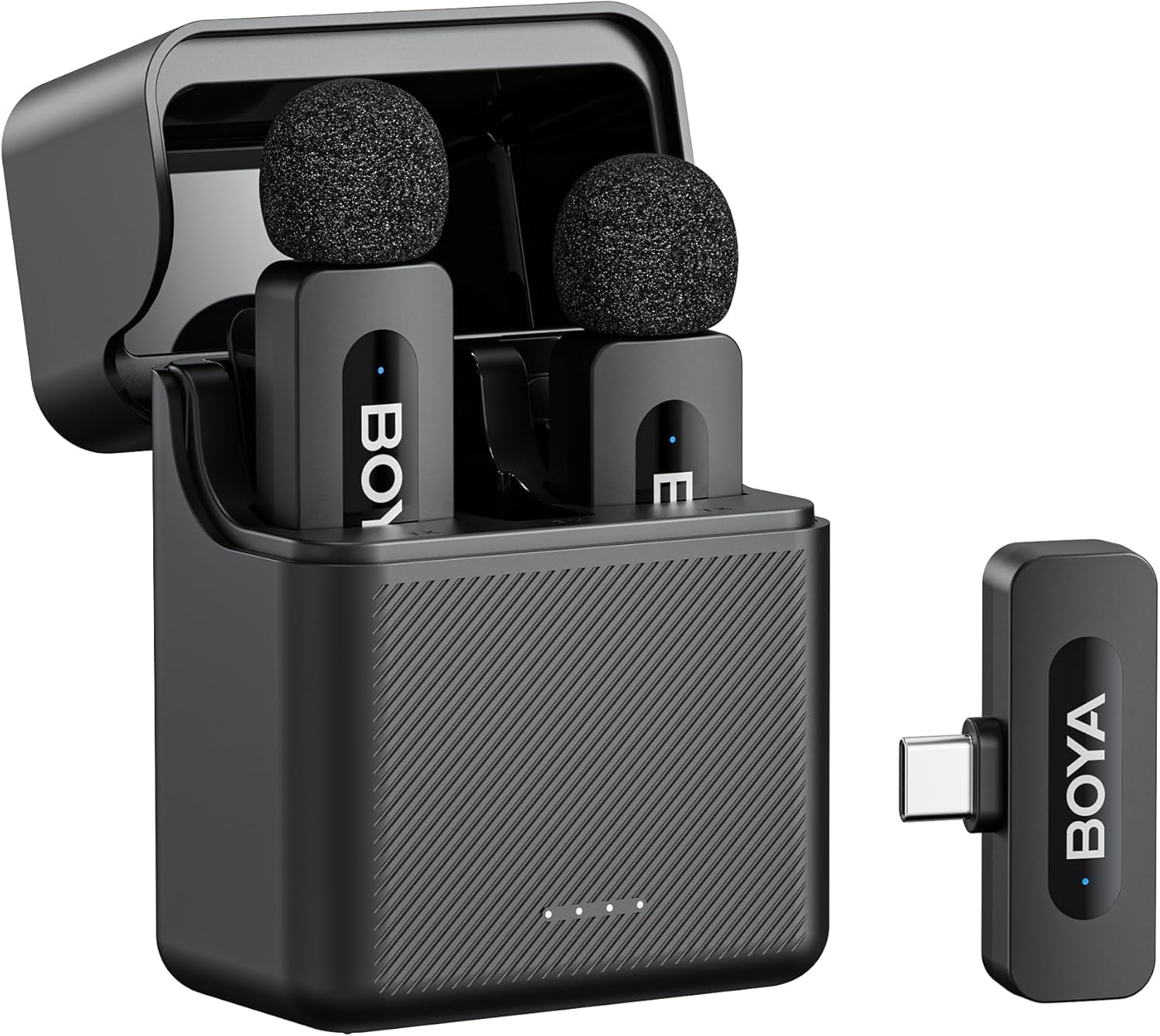
2. BOYA V30 Wireless Lavalier Microphone
A charging case that keeps going long after your shoot would have folded.
Thirty-six hours of total runtime is the headline here, and it comes from the charging case rather than the transmitter alone. Each mic runs up to 9 hours on its own, which covers a full shoot day, and the case tops them back up for the next one. That’s nearly triple the DJI Mic Mini’s 11.5 hours, which matters on a multi-day event with no reliable outlet.
The 328-foot transmission range is the widest in this list, comfortably ahead of the TXTUNE’s 70 feet. Range that long means you can leave your phone on a tripod and roam across a street or a field without the audio dropping. The 360-degree rotatable clip grabs a collar from whatever angle you need, which is a small thing until you’re clipping a mic on someone in a hurry.
Audio is captured at 48kHz/16bit with an 80dB signal-to-noise ratio, meaning the gap between your voice and the background hiss stays wide. Reviewers praise its plug-and-play simplicity: clip it on, plug in the receiver, and record. The one catch is wind: the dual-mode noise cancelling and foam windscreen help, but heavy gusting is still a fight. For calm outdoor work or indoor interviews, it’s a reliable workhorse.
The working reality: plug the USB-C receiver straight into your Android and record — no adapter, no app, no Bluetooth menu to hunt through.
The one caveat: that 9-hour per-charge figure means a long day is fine, but a marathon one needs the case on hand.
The right fit: multi-day events, weddings, and shooters who hate carrying a power bank.
Pass it by if: you film in constant high wind — a furry windshield will do more for you.
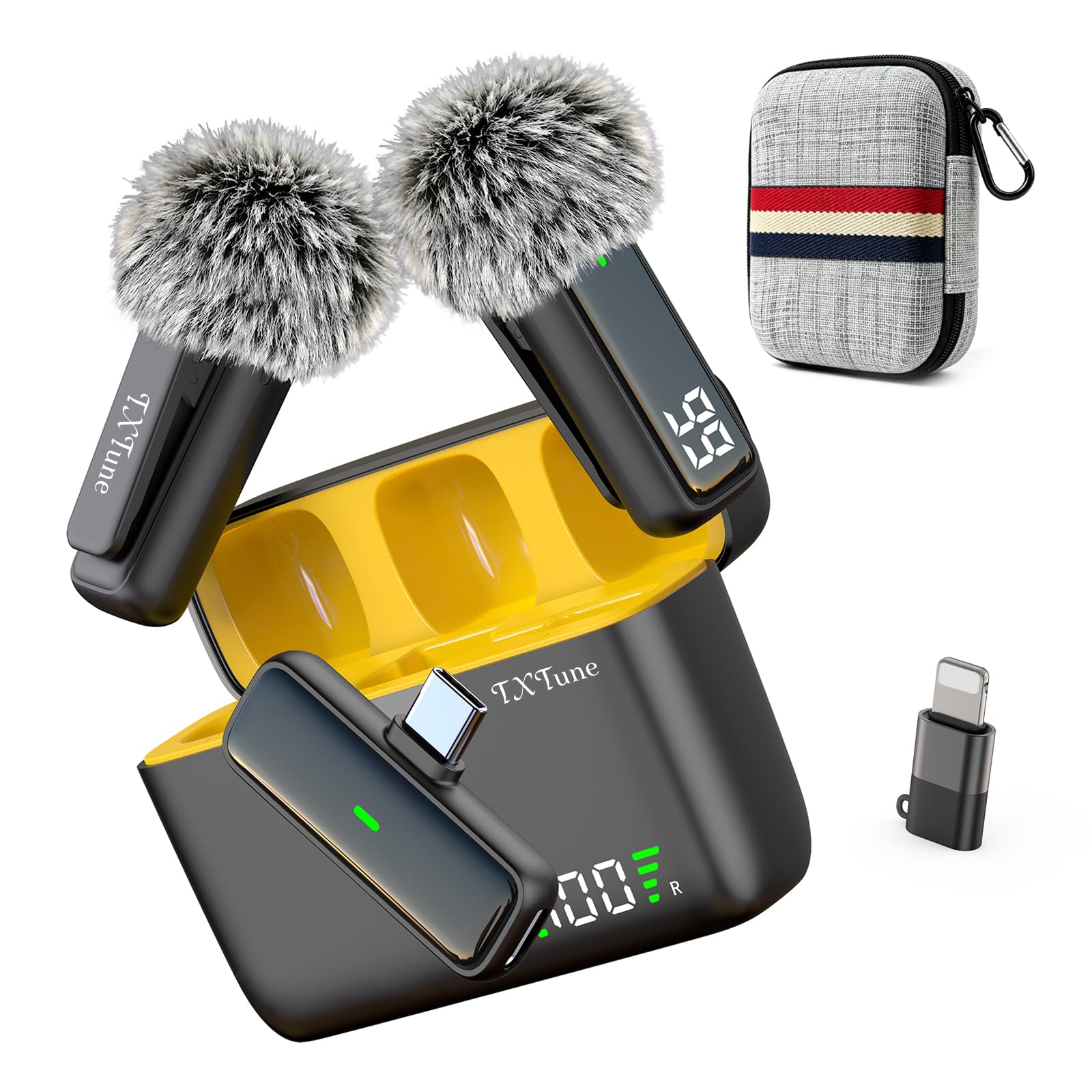
3. TXTUNE Wireless Microphone
The entry ticket that doesn’t feel like one — nine grams and a real battery readout.
At only 9 grams, this clip-on all but vanishes on a shirt, and the charging case building out 24 hours of total use is generous for the price tier. Each transmitter handles up to 6 hours per charge, which covers a standard filming session before the case takes over. If you’re starting out on Android and don’t want to spend much, this is where the value sits.
The DSP noise-reduction chip (digital signal processing, a small processor that filters background hiss) does real work on street noise, and the included furry windshields back it up outdoors. A digital power indicator on each mic shows you exactly how much charge is left before you clip it on — no guessing mid-interview. Buyers regularly note it picks up clean sound from well across a room, and that it holds its own against pricier mics.
Here’s the honest trade-off: the 70-foot range is the shortest here, a fraction of the BOYA’s 328 feet, so this is a close-quarters mic. Some owners also report the wireless pairing is the fiddly part rather than the sound. For vlogging, podcasting, and seated interviews it’s more than enough — for a big outdoor venue, look at the longer-range systems.
Worth it for: first-time Android creators who want clean audio without a big spend.
Look elsewhere if: you need to move far from your phone — this one wants you close.
4. Insta360 Mic Air (1 TX + 1 RX)

Coin-sized and nearly invisible — a mic you forget you’re wearing.
A 7.9 g transmitter is the lightest single unit in this lineup, and the difference is real: it sits on a collar without pulling, and it disappears on camera. Compared with the DJI Mic Mini’s 26 g, it’s in a different class for on-screen discretion. The trade is that this is a one-transmitter kit, so a two-person shoot means buying a second mic.
You get 48kHz sampling for true-to-life voice capture, plus advanced noise cancelling and a windshield to keep outdoor takes clean. The 300 m stable wireless range matches the DJI’s reach, and the 10-hour battery covers a full shoot day. A small remote on the transmitter triggers recording, noise cancelling, or mute, so you’re not reaching for your phone every take.
The one thing to check is compatibility. Buyers report it pairs cleanly with USB-C phones, but a few hit trouble with Insta360’s own X-series cameras, and the system records in Mono mode only. For an Android phone and a single speaker, it’s a tidy, pocketable solution.
Where it shines: portability and a 300 m range in a package that fits a shirt pocket.
Worth knowing: Mono mode only and a single transmitter — fine for solo work, limiting for duos.
Perfect for: solo vloggers and travelers who want a mic they’ll actually carry.
Skip if: you need two voices captured at once or rely on Insta360 X-series cameras.
5. Hollyland Lark M2 Wireless Microphone

A thousand feet of range in a mic that weighs about as much as a paperclip.
One thousand feet line-of-sight is the longest reach in this list — well past the BOYA’s 328 feet and the TXTUNE’s 70 feet. That range lets you leave your phone on a tripod at the back of a stage and walk the room while someone talks. The 9 g transmitter, meanwhile, is light enough to clip on and forget about.
Audio runs at 48kHz/24bit with a 70dB signal-to-noise ratio, and it handles a maximum 115dB sound pressure level — enough headroom for a loud room or a singer who belts. Noise cancelling toggles with one button press on the mic or receiver, and the HollyAudio app lets you pick between Strong and Low levels. The 30-hour battery comes from 10 hours of continuous use plus the charging case topping up your mics.
What people rave about is the sound-to-cost balance: clear voice reproduction that holds up against pricier gear in the same aisle. The one habit to build is carrying the case — 10 hours per charge is a day, not a weekend, without it.
Why it earns its spot
- 1,000 ft line-of-sight range, the longest here
- 48kHz/24bit recording with 70dB signal-to-noise ratio
- Handles up to 115dB sound pressure level
- TX button doubles as a remote shutter for your phone
The fine print
- 10 hours per charge needs the case for multi-day work
- Remote shutter depends on your phone allowing volume-button control
Choose this when: range is the deciding factor and you want pro-grade specs in a tiny package.
Reconsider if: you’ll rarely roam far — the shorter-range mics save you money.
6. MAONO Wave T5 Wireless Lavalier Microphone

Four voice presets and three receivers — the kit that covers every device you own.
Three receivers ship in the box — USB-C for your Android, Lightning for iPhones, and a camera receiver — so this one kit handles your phone, a tablet, and a mirrorless camera without buying extra parts. No other kit here covers phone, tablet, and camera from the start. The four one-tap voice filters are the real draw though: Vocal Enhancer, Brightness, Warmth, and Magnetic Radio each shape your tone without touching an editing app.
Recording runs at true 48kHz/24-bit with an 80dB signal-to-noise ratio and a 120dB maximum sound pressure level, so a loud laugh or a sudden shout doesn’t distort. An ENC chip (environmental noise cancellation, which targets your voice and suppresses everything else) offers 3 modes and 14 levels of adjustment through the Maono Link app, so you can dial the filtering precisely.
Battery reaches 40 hours total from a 9-hour transmitter plus the charging case — the longest total runtime in this list. Sound quality is the thing owners praise most, and it’s the reason to pick this one over a simpler mic. The honest note is pairing: if the blue light on the receiver or transmitter flashes slowly, pairing has failed, and you need to long-press the pairing button on both until they flash rapidly. Follow that exactly and it’s solid.
What makes it different: broadcast-style voice presets you’d normally need a mixing desk to pull off.
The catch to plan for: getting the transmitter and receiver paired takes a careful long-press — read the manual once.
Your pick if: you shoot across phone, tablet, and camera and want tone-shaping built in.
Not for you if: you want pure plug-and-play with zero pairing steps.
7. RØDE Wireless GO (Gen 3) Compact Wireless Microphone

Records 32-bit float to its own memory, so a blown take can be rescued later.
32-bit float on-board recording is the feature that sets this apart. It means the mic stores its own audio files with so much dynamic range that a take recorded too loud or too quiet can be recovered in editing — the RØDE keeps over 40 hours of it inside the units themselves. No other mic here records its own 32-bit backup, and for one-shot interviews that safety net is worth real money.
The metal body and 128-bit-encrypted 2.4 GHz transmission are built for daily use, and it works with phones, cameras, and computers through USB-C and a locking 3.5mm output. GainAssist sets the recording level for you, and a safety channel keeps a backup copy at a lower level in case you clip. Owners single out the sound quality most, and reliability comes next.
Two things to weigh. At 106 g per unit it’s the heaviest here — a metal body has a cost — and the USB-C connection is the part owners find least consistent across different devices. Test your phone before a shoot day and you’ll be fine.
Go for it: if you can’t afford to lose a take and want an in-mic backup recording.
Hold off if: you want the lightest clip-on or you’ll only ever film on one phone.
8. Hollyland Lark MAX 2 Wireless Microphone Ultimate Combo

Open-ear monitors, timecode, and 32-bit audio — a film set in a case.
Two transmitters, two receivers, a camera receiver, and a pair of open-ear monitor earphones all ship together. Those OWS earphones (open-wearable stereo, which rest in your ear without blocking it) let you hear your own audio up to 100 m away with as little as 25 ms of latency, and they double as a Bluetooth headset. No other mic here lets a director monitor audio wirelessly while talent walks.
The audio chain is full 32-bit from capture through transmission, with 48kHz/32-bit float recording, a 128dB SPL ceiling, and 8GB of internal storage holding 10 hours of 32-bit backup. Frame-perfect timecode sync is built for m
atching audio to picture on multi-camera edits. Deep-learning noise cancellation adjusts steplessly from 5 to 25dB, so you can fine-tune exactly how much room you leave in.
Range reaches 340 m line-of-sight with 2.4 GHz frequency hopping, and the whole system runs 36 hours. The 14 g transmitter uses a hover-clip and a magnet option. What buyers confirm is the build — a strong two-stage clip — and a workflow that runs without an app. The catch is that it’s a pro tool: pairing and monitoring settings expect some patience, and it’s the priciest kit here.
Where it goes beyond the others
- 32-bit full-chain audio with 8GB internal backup storage
- Wireless monitoring earphones up to 100 m at 25 ms latency
- 340 m range with frequency-hopping stability
- Frame-perfect timecode for multi-camera sync
The real-world costs
- The most setup-heavy system here — expect a learning curve
- Overkill for simple phone vlogging
Made for you if: you run a multi-camera production and need audio the editor can trust.
Not needed if: you film solo on your phone and want one button to do it all.
Know the Specs
Transmission Range
Range figures are measured line-of-sight, meaning nothing stands between the mic and your phone. Every number quoted here assumes that clear path, so treat a long range as a ceiling, not a guarantee. Once your body, a wall, or a crowd gets in the way, the effective distance shrinks fast. Pick a mic with range well past what you’ll use, and you build in margin for the moments when the signal gets blocked.
Bit Depth: 16 vs 24 vs 32-Bit Float
Bit depth describes how much detail the mic captures between the quietest and loudest sound. A 16-bit recording is standard and fine for clean, controlled audio. 24-bit gives you more room to turn a quiet voice up in editing. 32-bit float is the safety net — it captures so wide a range that a take recorded too hot or too soft can be rescued later without distortion. For one-shot interviews, that resilience earns its keep.
Battery: Per Charge vs Charging Case
Two numbers matter, and they do different jobs. The per-charge figure tells you how long one continuous run lasts — often somewhere between 6 and 11 hours depending on the mic. The charging-case figure tells you the total across a trip, since the case tops the mics up between sessions. A transmitter rated around 9 hours covers a shoot day on its own. The case is what lets you go multi-day.
Noise Cancelling: What It Does and Doesn’t
Noise cancelling on a lavalier targets background sound — traffic, crowd murmur, machinery — and suppresses it while keeping your voice front and center. It usually won’t rescue you from a gale; a furry windshield does more there. Some systems offer a single on/off toggle, others split into levels like Basic and Strong, and others still adjust in fine steps through an app. More levels means more control over how natural you sound.
Common Questions
Will a USB-C wireless mic work with my Android phone?
Is 32-bit float recording actually worth it over 24-bit?
How far can I really move from my phone before the audio drops?
Do I need the HollyAudio app to use the Lark M2?
What is the difference between the Lark M2 and the Lark MAX 2?
Can I charge my phone while the mic receiver is plugged in?
Why does my mic keep failing to pair with its receiver?
How many transmitters do I need for a two-person interview?
Is a lavalier mic better than using my phone’s built-in mic?
Do these mics work with a DSLR or mirrorless camera too?
The Bottom Line
For most people pairing a mic with an Android phone, the DJI Mic Mini is the one to buy — two transmitters, a 300 m range, and a plug-and-play USB-C receiver make it a complete kit from the start. If battery is your worry, the BOYA V30 stretches to 36 hours with its charging case. And for a solo creator who wants the smallest possible mic, the Insta360 Mic Air at 7.9 g is the one that disappears on camera. Start with the connector that matches your phone, then pick the range and battery that match your shoot days.
How we choose
We do not accept paid placement. Every pick is matched to a real buyer and a real use-case; we do not hands-on test units.
Sources
Specifications: manufacturer listings and product documentation. Review insights: verified customer reviews, as of November 2026. Pricing: not shown on this page (it changes often); check the current price via the retailer link.
As an Amazon Associate, Tactical Gear Guy earns from qualifying purchases. This does not affect which products we feature.