Specs are compiled from manufacturer listings and verified buyer reviews and can change over time — please confirm the key details on the product page before buying.
If your wireless mic cuts out mid-sentence, the fix is usually not a new receiver — it is a better antenna. A directional paddle pointed at the stage, or a distribution rig feeding several receivers from one pair of antennas, keeps a clean signal flowing far past the stock whips that ship in the box. This guide covers seven antennas that actually solve the problem, sorted by how you use them: single rig, multi-receiver rack, or bodypack replacement.
This guide is built by comparing the manufacturers’ published specifications and the patterns across verified customer reviews, so you get each pick’s real strengths and trade-offs instead of marketing spin.
Range, frequency band, and connector type decide whether an antenna helps or just adds clutter to your rack. Below you’ll find plain-English picks for every rig size, so you can buy the right wireless microphone antenna the first time and stop chasing dropouts.
Top Picks

How To Choose The Best Wireless Microphone Antenna
Most dropout problems come from one of three things: the antenna is looking the wrong way, it is the wrong band for your receiver, or the signal is dying in a long cable run. Fix those three and your mics get noticeably more reliable before you spend a single dollar on new transmitters.
Match the frequency band first
An antenna only works inside the MHz range it was built for. A paddle rated 400-970MHz covers the widest spread, while a Shure UA874US is tuned to 470-698MHz and will only help receivers inside that window. Buying outside your band is the single most common wrong purchase in this category.
Directional vs omnidirectional
A directional (cardioid) antenna focuses its pickup toward the stage and rejects signal coming from behind it. An omnidirectional antenna picks up from every direction, which suits a fixed install in a room where the performers move around. Directional wins on range and interference rejection; omni wins on setup simplicity.
Active or passive
Active antennas carry a built-in amplifier that compensates for signal lost in a long coax run — the kind of loss that builds up when your rack sits at the back of a hall. Passive antennas need no power and add no noise, so they suit short cable runs and simple single-receiver setups.
Side-by-Side Comparison
| Model | Best For | Channels | Impedance | Max Range | Amazon |
|---|---|---|---|---|---|
| 5 Way UHF Active Distribution Bundle★ Best Overall | Multi-receiver racks | 5 | 50 ohm | 2200 feet | Amazon |
| Sennheiser EWD HW-Q DipoleCompact Pick | EW-D bodypack rigs | 1 | — | — | Amazon |
| Sennheiser A1031-U Wideband | Fixed room installs | 1 | 140 ohm | — | Amazon |
| 2 Pack UHF Paddle with Gain Switch | Long-throw outdoor work | 1 | 50 ohm | 2200 feet | Amazon |
| Shure PA805SWB | Tight-stage interference | 2 | 50 ohm | 12 meters | Amazon |
| Shure UA874US | Shure racks with DC bias | 1 | 50 ohm | 300 feet | Amazon |
| 4 PCS Replacement Whip SMA | Bodypack spares | 1 | 50 ohm | — | Amazon |
Detailed Reviews
1. 5 Way UHF Active Wireless Antenna Distribution System Bundle
Our pick — 4.0+★ from 50+ verified ratings; the strongest balance of quality and price.
One pair of paddles, five receivers fed, and no antenna farm on your rack.
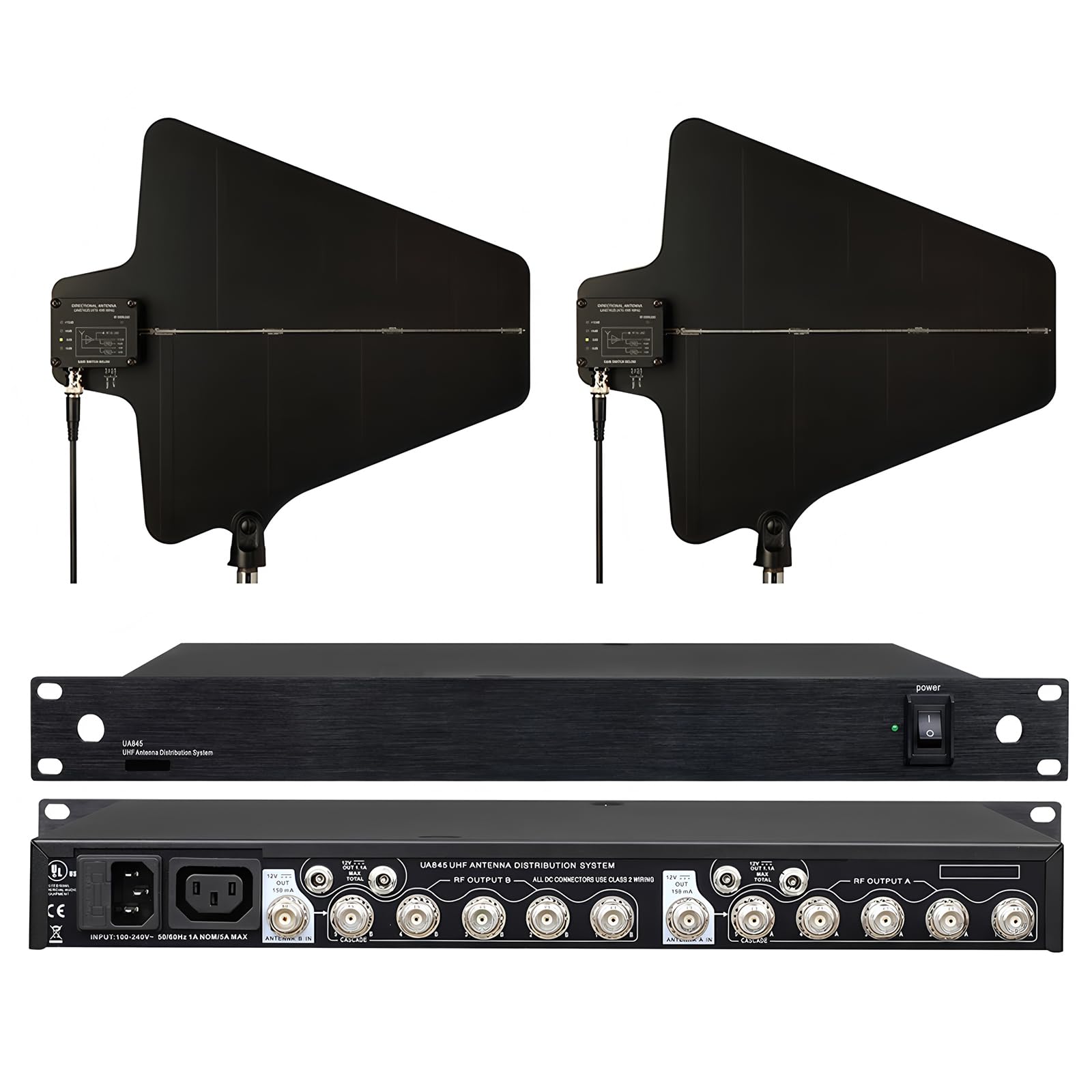
This is the pick for anyone running a real rack — a wedding band, a church, a corporate stage — where four or five wireless receivers all need a clean feed. The bundle pairs two active directional paddles with a 5-way distributor, so 5 receivers share 2 antennas instead of each dragging its own pair around the back of the rack. The 8 outputs plus 2 cascade ports mean the fifth receiver or a second distribution unit plugs straight in.
Range is where this bundle beats the premium Shure paddle. This system is rated to 2200 feet, while the Shure UA874US lists 300 feet — a real gap if your receiver rack sits at the back of a long hall or an outdoor field. Its 400-970MHz window covers most UHF microphone brands, including Sennheiser and AKG systems. The built-in AC100-260V power supply means no external wall wart to lose, and 4 DC 12V ports can power 4 receivers directly.
Where it costs you is in impedance matching and simplicity. The distributor runs at 50 ohm and expects BNC connections — if your receivers are not BNC, you are buying adapters. The rack footprint is 19″L x 9″W x 2″H, so plan a full rack space for it. It is a system, not a drop-in antenna, and it rewards someone who has already thought through their cable runs.
Where the bundle earns its rack space
- 5 receivers sharing 2 paddles — no more antenna forest
- 2200 feet of rated stable reception
- 2 cascade ports for a 5th receiver or a second distributor
- Built-in AC100-260V supply, no brick to lose
Where it asks more of you
- Needs BNC jacks on every receiver you feed
- Takes a full rack space to mount
- More setup planning than a single paddle
Buy this one if: your rack already holds several UHF receivers and you want them all fed from one pair of paddles.
Think twice if: you run a single receiver — this is more system than one bodypack rig needs.
2. Sennheiser EWD Antenna HW-Q
A single Sennheiser-specced dipole for EW-D rigs that need one clean Q-band swap.
Owners of Sennheiser EW-D systems get a direct-fit half-wave dipole tuned to the Q band, and that is the entire pitch. It is meant to replace the antenna on an EW-D receiver or bodypack when the stock one is lost, damaged, or bent. A half-wave dipole is a specific antenna length that matches your frequency band, which is why band matching matters here — the Q-band tune only helps EW-D gear that lives in that range.
You get a 2 year manufacturer warranty with this antenna — a standout for a small accessory that most brands leave uncovered. The data lists a single item and 1 channel. If you run a Sennheiser EW-D rig, this is the exact antenna Sennheiser specifies, and the pricing sits in the entry tier.
The trade-off is narrowness. This is not a general-purpose paddle and it will not extend range the way an active directional antenna does. It is a replacement part, and it fits EW-D and Q-band Sennheiser gear — put it on another brand and you are gambling. For a working Sennheiser owner, though, it is the sensible, documented match.
Why it earns a spot: a documented, Sennheiser-specified Q-band replacement with a 2 year manufacturer warranty behind it.
The honest narrowness: it is a replacement part, not a range booster, and it only makes sense on Sennheiser EW-D Q-band gear.
Right for: EW-D owners replacing a bent or missing Q-band dipole.
Wrong match if: you need more range or you run a different brand.
3. Shure PA805 Directional Antenna

The antenna that fixes a venue where every other wireless in the building is fighting yours.
Where this Shure pick wins is interference, not raw distance. It is a directional antenna with a cardioid radiation pattern, which means it listens toward the stage and largely ignores the rest of the room. The gain spec is 6dBi typical on the PA805X and 6.5dBi typical on the PA805SWB — a measured boost over a passive dipole. The connector is a 50 ohm female BNC, and the swivel adapter adjusts from 0 to 90 degrees on a standard 5/8 in. -27 thread, so it clamps to a mic stand and aims exactly where you point it.
The stated range is 12 meters, which is far shorter than the 2200 feet rated on the JXRYWF paddles. Read that honestly: the PA805 is not built to throw signal across a stadium field. It is built to reduce interference in a tight venue and hand you a cleaner signal at close-to-medium range. That is a different job, and it does it with the build quality Shure is known for on this model.
What owners tend to value most is the build — the quality of the hardware earns the strongest praise in its reviews. Performance gets a solid secondary nod, with the range-extension story showing up in larger-format setups. The catch is that 12-meter figure — if your receiver lives far from the stage, you are better served by an active long-throw paddle.
Why stage crews rate it
- Cardioid directional pattern rejects off-axis interference
- 6.5dBi typical gain over passive dipoles
- 0-90 degree swivel adapter on standard 5/8 in. thread
- Shure build quality that holds up to rack life
What limits it
- 12 meters of rated range — short for big rooms
- Directional aim needs planning, not a plug-and-play swap
Pick for: tight clubs and theaters where dropouts come from other wireless traffic, not distance.
Pass on it if: your receiver rack sits 100 feet from the stage.
4. 2 Pack UHF Active Directional Antenna

Two active paddles with a gain dial, built for the long throw and the outdoor gig.
You get a pair of active directional paddles here, each with an adjustable gain switch, so you can dial the receive boost up or down to match your cable run. Its 400-970MHz coverage fits Shure, Sennheiser, and most other UHF distribution systems, including the Shure UA844, UA845, and UA840. Rated range is 2200 feet — the same long-throw spec as the bundle above, achieved through aviation-material antenna construction that provides high-gain reception.
Physically these are substantial paddles at 2.5 pounds each and 14.17″L x 12.6″W x 1″H, so they mount to a stand or a rack frame and hold their aim. The gain switch compensates for insertion loss in the coax between paddle and receiver. On a long cable run in a big venue, that switch decides between a usable signal and a wall of static.
Two practical cautions for a buyer. First, the antenna splitter is not included — these are paddles only, so you need a distribution unit or a receiver that takes them directly. Second, this carries the lowest rating of the directional paddles here, so it is a value pick rather than a prestige one. For a working rack on a budget, both are manageable.
The real draw: two 2200-foot active paddles with an adjustable gain switch, compatible across most UHF brands.
What to plan for: the splitter is sold separately, and this is a value-tier paddle rather than a premium one.
Best fit: a rack that needs long-throw active paddles on a budget and already owns a splitter.
Look elsewhere if: you were expecting a complete distribution system in the box.
5. Shure UA874US Active Directional UHF Antenna

The rack-standard Shure paddle, tuned to 470-698MHz with a four-position gain dial.
For anyone already inside the Shure ecosystem, this is the antenna that plugs into the distribution unit and just works. It is compatible with all Shure wireless receivers and distribution systems that provide 12V DC bias, and the low-noise signal amplifier compensates for transmission loss in coaxial cable. The four-position gain selector switch lets you set the boost to your actual cable run rather than guessing.
The honest limit is frequency and range. This is tuned to 470-698MHz, so it only helps receivers operating inside that window — put it on a system outside that band and it does nothing useful. The rated maximum range is 300 feet, versus 2200 feet on the JXRYWF bundle and paddle pair. That is a deliberate trade: Shure tunes this for a clean, low-noise signal inside a defined band rather than maximum throw.
Build and mounting are where the premium shows. The integrated threaded adapter mounts straight to a mic stand, and the Shure name on the housing is the reason many rental houses standardize on these. If your rack already runs Shure, this is the least-friction upgrade available.
Go with it if: every receiver in your rack is Shure and supplies 12V DC bias.
Look past it if: you need long-throw range or your gear sits outside 470-698MHz.
6. Sennheiser A1031-U Omnidirectional UHF Antenna
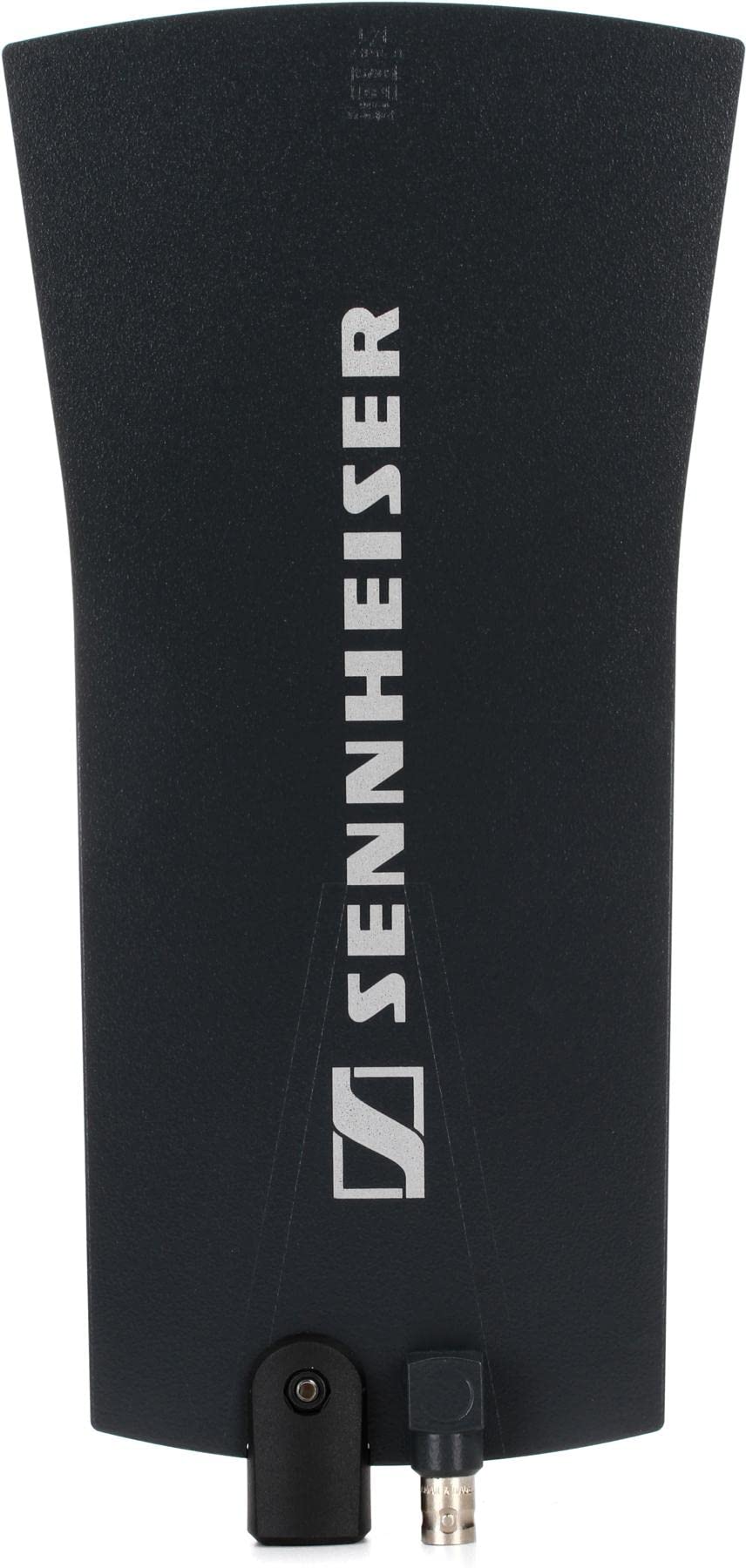
Passive, omnidirectional, and built for a fixed room where performers roam.
Not every rig needs a directional paddle. This wideband passive antenna picks up from every direction, so it suits a UHF receiver (a radio receiver that tunes across a wide frequency range) in closed rooms. That is exactly what you want in a lectern install, a classroom, or a sanctuary where the talker wanders. It is a passive design, so there is no amplifier and no power to run. It is compatible with Sennheiser EM 3031-U, EM 3032-U, EM 3532-U, EM 1046-U, EM 1031-U, and all stationary evolution wireless receivers.
The one spec to note is impedance. It runs at 140 ohm, while the active paddles here run at 50 ohm — so this is not a swap-in for a 50-ohm distribution rack without checking the match. The weight is 10.24 ounces, light enough to mount on a wall bracket or a stand without strain, and it is made in Germany. The 140-ohm figure is the sort of detail installers check before they buy, and it is the reason this list does not treat every antenna as interchangeable.
The catch is that passive plus omnidirectional means no gain and no rejection of off-axis interference. In a crowded RF environment, a directional active paddle will outperform it. In a quiet fixed room with a roaming presenter, this is the simpler, lower-hassle choice — fewer moving parts, nothing to power.
Where it shines: 140-ohm passive omni pickup for closed-room installs with a moving presenter — no power, no aiming.
The trade-off: no gain and no interference rejection, so a busy RF venue will want a directional active antenna instead.
Choose this if: you are installing a fixed Sennheiser rig in a room where the speaker moves around.
Skip the passive route if: your room is RF-crowded or your receivers run 50 ohm.
7. 4 PCS Replacement Whip SMA Antenna

Four spare bodypack whips in one pack — the cheapest insurance in your gig bag.
Whip antennas on bodypacks get bent, snapped, and lost — usually the night before a gig. This pack gives you 4 replacement SMA antennas in the 518 to 698 MHz band, so you have spares on hand instead of a dead transmitter. The SMA connection fits Shure UR1, UR1M, UR5, P9R, P9RA, P10R, ULXD1, QLXD1, AD1, and ADX1 transmitters, plus Lectrosonics and Audio-Technica gear with threaded antenna ports.
Compare this to the single Sennheiser dipole above: this pack gives you 4 antennas versus the Sennheiser’s 1, and at the lowest price in this guide. The trade is that these are replacement whips, not range-boosting paddles — they restore a stock bodypack antenna, not extend your coverage. Each one runs 50 ohm impedance (a measure of electrical resistance) and connects via SMA thread (a small screw-on connector), so check your transmitter port before buying.
The one thing to verify is the frequency window. At 518-698 MHz, these cover Shure’s common UHF bands but will not suit a system outside that spread. For a working player who wants a few spares rattling in the case, this pack does that job cheaply and reliably.
Buy a pack if: you run Shure or Lectrosonics bodypacks and want spares before a gig, not after.
Not the fix if: your dropouts come from range — this restores a whip, it does not extend it.
Know the Specs
Frequency range and band
The MHz window an antenna is tuned to — 400-970MHz on a wideband paddle, 470-698MHz on the Shure UA874US, 518-698MHz on the replacement whips. If your receiver sits outside that window, the antenna will not help. Match band first, then everything else.
Directional vs omnidirectional
A directional antenna (cardioid pattern) focuses on the stage and rejects interference from elsewhere, while an omnidirectional one picks up from every direction — better for a room where the presenter moves. Directional typically wins on range and rejection; omni wins on setup.
Active gain and the gain switch
An active antenna has a built-in amplifier to compensate for signal lost in long coax runs. The gain switch lets you set the boost amount — four positions on the Shure UA874US, adjustable on the JXRYWF paddles. Passive antennas have no amplifier, so they suit short runs.
Impedance (ohms)
How the antenna matches the receiver’s input. Most active paddles and whips run at 50 ohm, while the Sennheiser A1031-U passive runs at 140 ohm. A mismatch can cost signal, so check the figure before you swap an antenna into an existing rack.
Common Questions
Will a UHF antenna work with any wireless microphone receiver?
Do I need an active antenna or a passive one?
What does the gain switch on the Shure UA874US actually do?
Will a replacement whip antenna extend my range?
What does the impedance rating of an antenna mean?
Can the 5 Way distribution bundle handle more than five receivers?
Is a directional antenna better than an omnidirectional one?
Do the JXRYWF paddles include a splitter and a distribution unit?
Which Sennheiser receivers does the A1031-U antenna fit?
What warranty comes with the Sennheiser EWD HW-Q antenna?
The Bottom Line
For most working racks, the wireless microphone antenna winner is the 5 Way UHF Active Distribution Bundle — it feeds 5 receivers from 2 paddles, covers 400-970MHz, and rates 2200 feet of stable reception. If your needs are tighter and you fight interference more than distance, the Shure PA805 is the directional pick with a cardioid pattern and 6.5dBi typical gain. And for a Shure-exclusive rack with 12V DC bias receivers, the Shure UA874US drops in with a four-position gain dial. Pick your band, match your impedance, and point your paddle at the stage — that alone will clean up most dropout trouble in this category.
How we choose
We do not accept paid placement. Every pick is matched to a real buyer and a real use-case; we do not hands-on test units.
Sources
Specifications: manufacturer listings and product documentation. Review insights: verified customer reviews, as of November 2026. Pricing: not shown on this page (it changes often); check the current price via the retailer link.
As an Amazon Associate, Tactical Gear Guy earns from qualifying purchases. This does not affect which products we feature.