Specs are compiled from manufacturer listings and verified buyer reviews and can change over time — please confirm the key details on the product page before buying.
The short answer: for most Android shooters, the Hollyland Lark M2 combo is the pick that keeps your voice clean from across a parking lot, and it does it without an app. Wireless lavalier mics for Android live or die on three things — a receiver that actually fits your USB-C port, a transmission range that survives you walking away from your phone, and noise cancellation that kills wind without mangling your voice. Nail those three and the rest of the spec sheet barely matters.
This guide is built by comparing the manufacturers’ published specifications and the patterns across verified customer reviews, so you get each pick’s real strengths and trade-offs instead of marketing spin.
Don’t mistake a clip-on mic for a toy. A 48kHz/24bit recorder on your collar can out-clean a studio condenser chained to a desk. Below you will find the wireless lavalier mic for android picks that survive real shoots, ranked by what they actually do well.
Top Picks
How To Choose The Best Wireless Lavalier Mic for Android
Your phone is the recorder, so the mic’s job is simple: get clean voice into that USB-C port from wherever you happen to stand. Every extra adapter or pairing step is one more thing to fail mid-shoot.
The receiver is the whole ballgame
A USB-C receiver plugs straight into an Android phone and turns it into a recording device — no app, no Bluetooth pairing menu, no adapter dongle to lose. Look for the words “USB-C” on the receiver itself. A Lightning receiver is iPhone-only and useless to you.
Factory pre-pairing is what makes plug-and-play real. When the receiver is pre-paired at the factory, you clip on, plug in, and hit record — which is exactly what you want when the light is changing and your subject is waiting.
Audio resolution, in plain numbers
A 48kHz/24bit format means the mic samples your voice 48,000 times a second with a wide range of volume detail. In practice that gives you headroom, so a sudden laugh or a dropped pan doesn’t clip into a nasty crackle.
Signal-to-noise ratio, written in dB, tells you how much clean signal you get compared with background hiss. A higher number means a quieter floor under your voice — the 80dB units here are the cleaner option on paper.
Range you will actually use
A 1,000ft line-of-sight rating is really a buffer against trees, bodies and walls. Trees, bodies and walls all eat signal, so a long rated range usually means a rock-solid 50 feet in the real world.
Shorter ranges around 70 to 100 feet are fine for a talking-head shot where your phone sits on a tripod a few steps away. They are the wrong tool for wide walk-and-talk work.
Side-by-Side Comparison
| Model | Best For | Rated Range | Battery (with case) | Audio Format | Amazon |
|---|---|---|---|---|---|
| Hollyland Lark M2 (Combo)★ Best Overall | Overall all-rounder | 1,000ft | 40H | 48kHz/24bit | Amazon |
| BOYA V30Best Value Duo | Budget-friendly duo | 328ft | 36H | 48kHz/16bit | Amazon |
| RIBIU WM01Most Discreet | Discreet everyday clips | 100ft | 16H | — | Amazon |
| DJI Mic Mini | Long-session interviews | 300m | 11.5H | — | Amazon |
| TXTUNE M16 | Phone-charging pass-through | 70ft | 24H | — | Amazon |
| SmaFun TwinCast S2 | Two-receiver travel kit | 328ft | 48H | 48kHz/24bit | Amazon |
| Insta360 Mic Air | Coin-size stealth | 300m | 10H | 48kHz | Amazon |
| Hollyland Lark M2 (USB-C) | Android-first simplicity | 1,000ft | 30H | 48kHz/24bit | Amazon |
| MAONO Wave T5 | Voice presets and polish | 300m (1,000ft) | 40H | 48kHz/24bit | Amazon |
Detailed Reviews
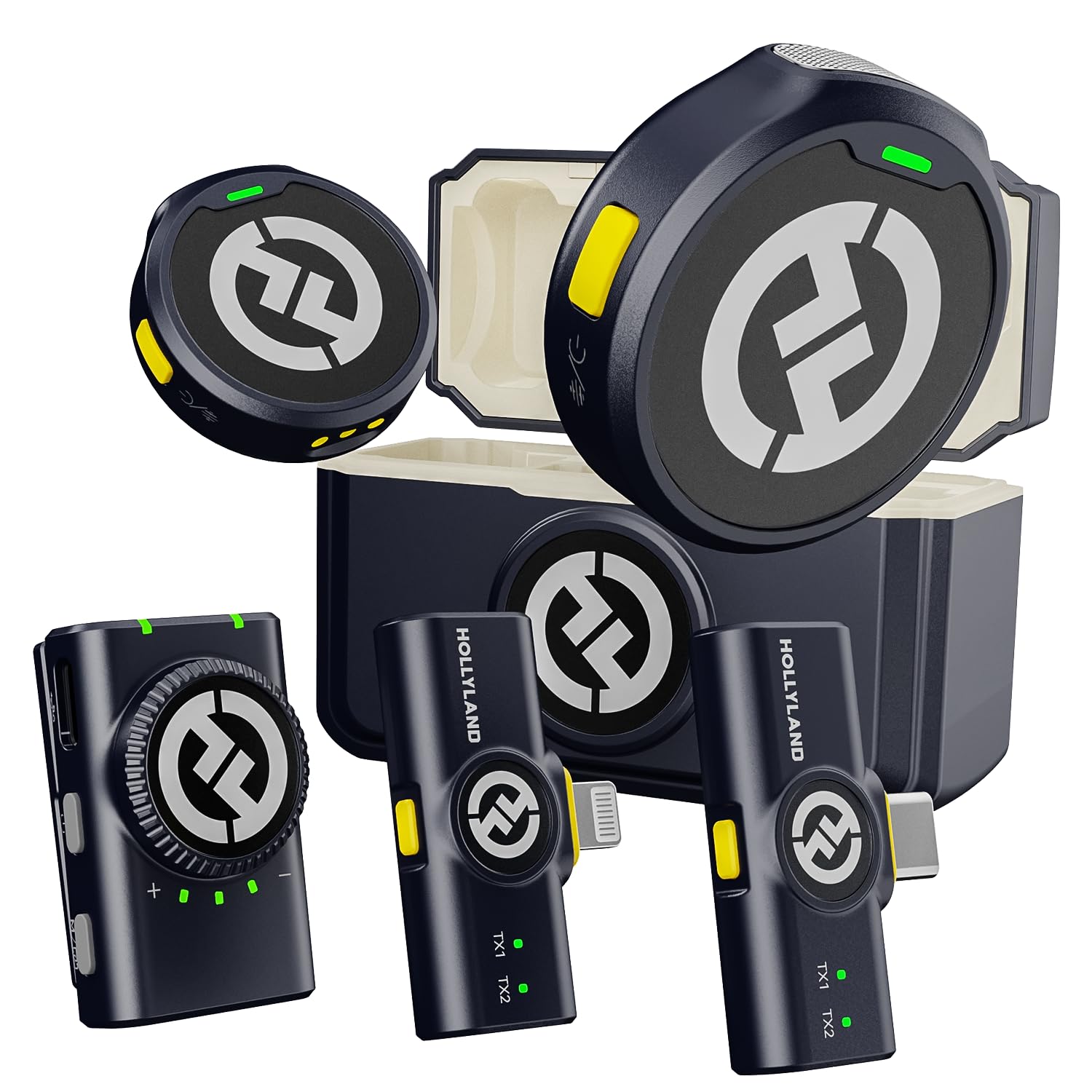
1. Hollyland Lark M2 Wireless Lavalier Microphone Combo
Our pick — 4.5+★ from 750+ verified ratings; the strongest balance of quality and price.
A 1,000ft leash on your voice, in a clip that weighs 9g.
If your shoots involve walking away from the phone — a market, a trail, a garage — this is the kit that stops caring about distance. The Lark M2 combo transmits up to 1,000ft line-of-sight against the 100ft of the RIBIU below, and that margin is the difference between a clean take and a ruined one. It also ships with three separate receivers (camera, USB-C, Lightning), so the same transmitters follow you from Android to a laptop to a friend’s iPhone.
The audio side is properly specified: a 48kHz/24bit format catches your voice with detail a phone’s built-in mic flattens, and a 70dB signal-to-noise ratio keeps the background floor down between words. Voice handling tops out at 115dB maximum sound pressure level, so a shouted line or a cymbal crash records without breaking up. One yellow button on the transmitter kills noise cancellation in a tap; lights on the receiver confirm it’s active, so you are not guessing.
What wins people over is the build and finish — it is the most-discussed strength in its own feedback and the tone of the review pages is consistently settled, not nitpicky. The one catch is weight of expectation versus kit size: the combo is a three-receiver set and its case is 5.35 x 4.15 x 3.4 inches, which is a small pouch, not a pocket. Budget for that in your bag.
Why This One Earns The Top Slot
- 1,000ft line-of-sight range with a high-gain LDS antenna that resists body-blocking
- Three receivers included — USB-C, Lightning, and camera — one kit across every device
- 48kHz/24bit capture with a 70dB signal-to-noise ratio and 115dB max SPL
- Pre-paired at the factory, so plug-in is the entire setup
Where It Asks More Of You
- The full combo case is pouch-sized at 5.35 x 4.15 x 3.4 inches
- Most expensive build here, so it only pays off if you shoot across multiple devices
- Mono and stereo switching only works over the 3.5mm camera jack
Reach for this if: you record on Android today and a camera or laptop tomorrow, and you refuse to buy twice.
Think twice if: a single phone is your only rig — the spare receivers are dead weight you paid for.
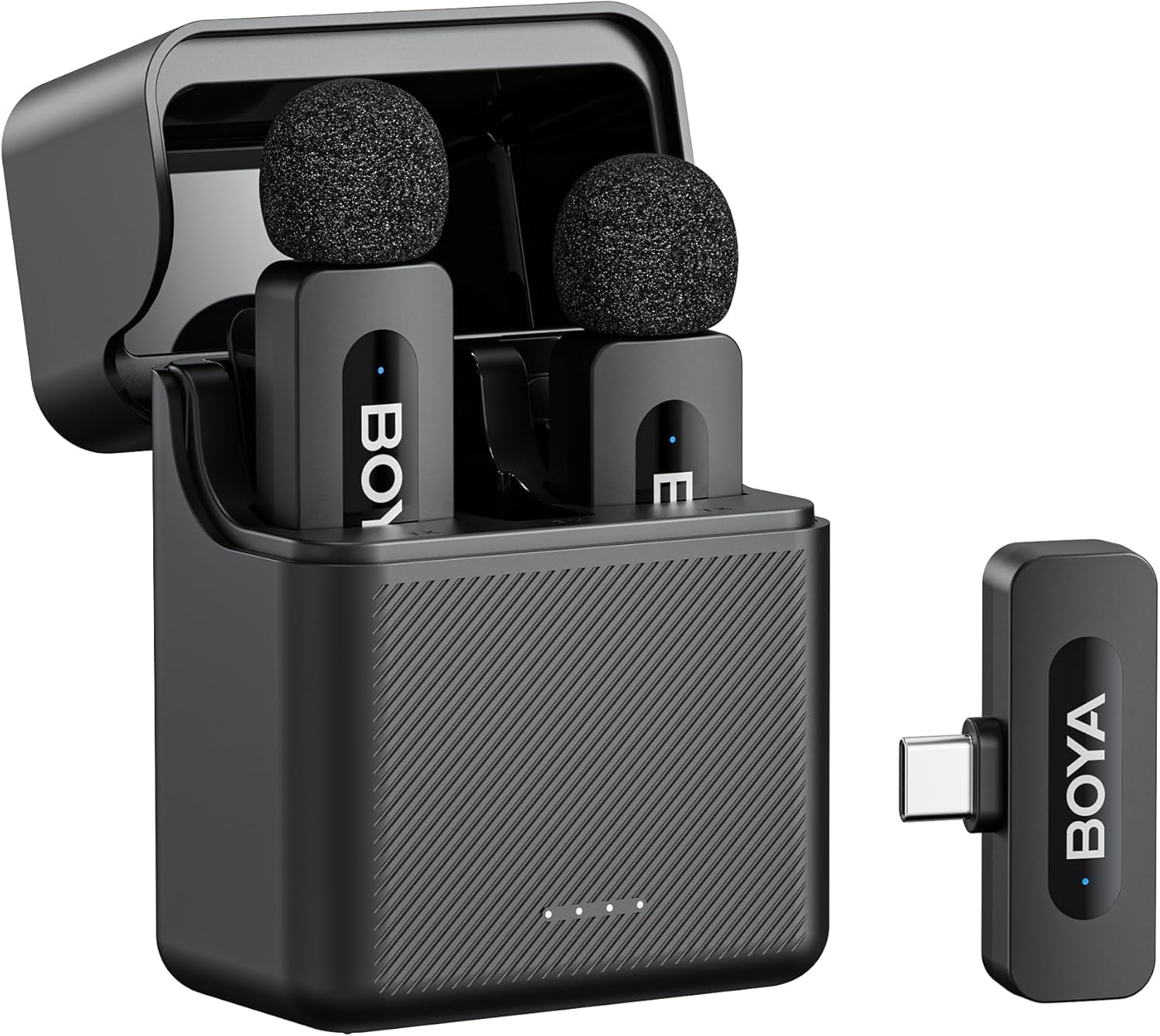
2. BOYA V30 Wireless Lavalier Microphone
Two mics, 328 feet of range, and a charging case that keeps going all day.
Two-on-one interviews are where cheap kits fall apart, and the V30 solves that with two transmitters in the box plus a charging case that totals 36 hours. Each transmitter carries a 95mAh battery good for up to 9 hours on a single charge, and the case adds the rest. That is enough for a full-day conference without hunting for a wall socket.
Its audio chain is honest for the tier: 48kHz/16bit recording, an 80dB signal-to-noise ratio that actually edges the Lark M2’s 70dB, and a 120dB maximum sound pressure level. There is one-click noise cancellation plus a dense foam windscreen, which is the combination that saves you outdoors. A 360° rotatable clip grabs a collar, a lapel or a strap without fuss.
Plug-and-play is the whole story here — no adapter, no Bluetooth menu, no app, just the USB-C receiver into your Android phone and record. Playback works straight from the phone’s own speaker without unplugging the receiver, which sounds minor until you are checking a take in the wind. Most people who buy this find the basics work exactly as promised.
The honest trade-off: 48kHz/16bit is the lower of the two formats in this list, so it gives you less headroom than the 24bit picks when a subject suddenly spikes in volume. For talking heads it is fine; for music or a slammed door it is the weaker link.
Who it suits: a creator who needs two voices on camera at once without paying combo-kit money.
Yes if: two-person interviews and full-day battery are your real needs.
Not if: you want the widest headroom — move up a tier for 24bit.
3. RIBIU Wireless Lavalier Microphone
At 8.53g it disappears on a collar, and the sound is the surprise.
Discreet is the point here. The RIBIU sits at 8.53g, lighter than the BOYA V30’s 10.5g, and that gap disappears the moment you clip it to a thin shirt — nothing sags, nothing pulls. If your on-camera talent hates visible gear, this is the one they will forget they are wearing.
Its 100ft of 2.4G transmission is the shortest leash in this group, which sets your shot list: phone on a tripod a room away, subject moving in a defined area. Do not plan a walk-and-talk with it. The dual noise reduction pairs a DSP chip (digital signal processing — the part that separates voice from rumble) with a windscreen, and each transmitter runs 8 hours for 16 total across the pair.
Owners describe clear sound that lifts the quality of their videos and a pairing process that clicks on the first try. Two functions worth knowing: a reverb effect that adds a 3D sense of room, and a mute button you can hit without shutting the mic down. On a call or a setup change, that is a small but real convenience.
The honest limit: range is the tightest here at 100ft, and 16 hours is the shortest total runtime in the group. Neither is a flaw for a desk or tripod shoot — both are wrong for a roaming documentary.
Suits: creators who want the mic to vanish and the shot to stay close.
Skip when: your scene has you pacing 200 feet from the phone.
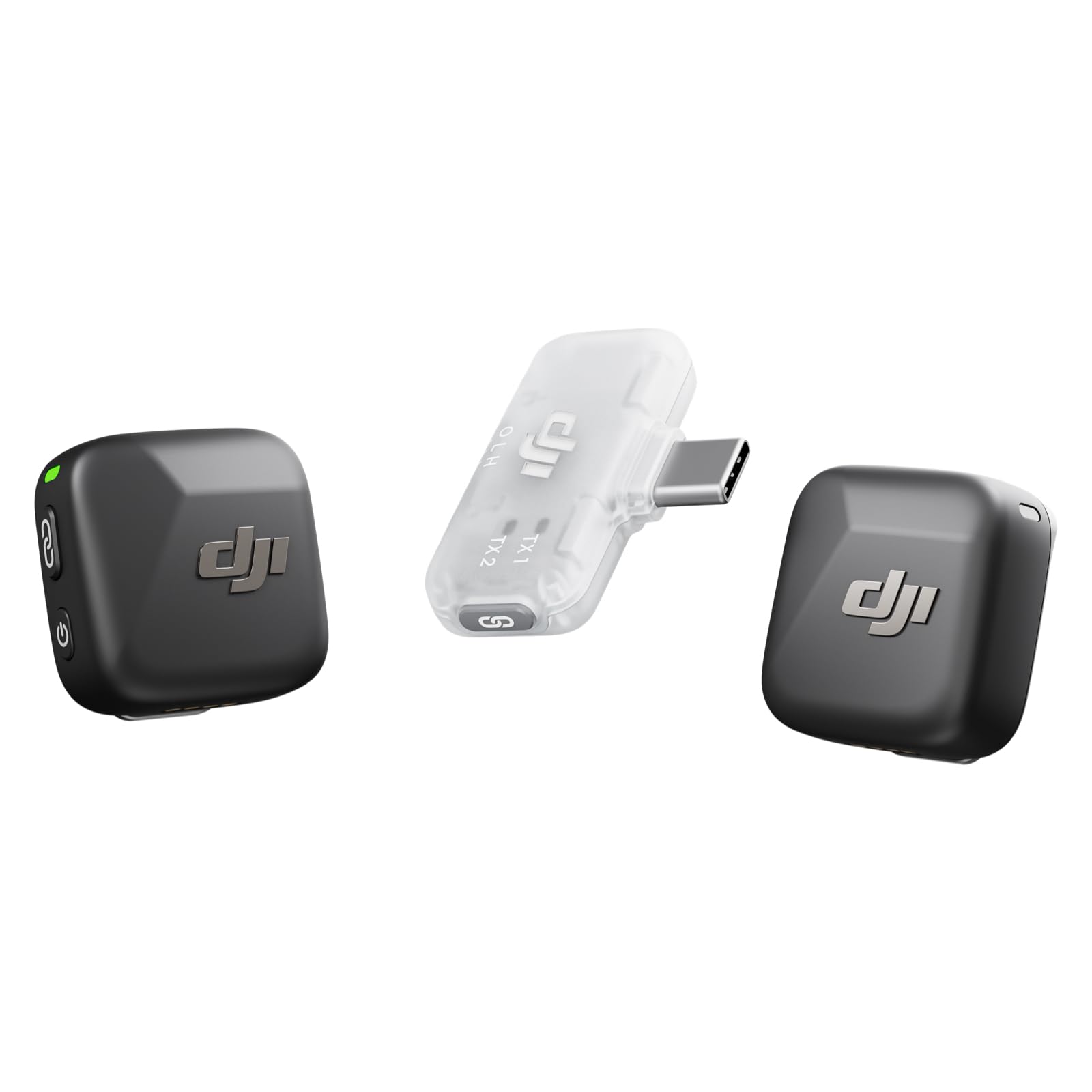
4. DJI Mic Mini (2 TX + 1 Mobile RX)
The 10g transmitter that shrugs off a busy street and keeps your voice intact.
DJI’s first decision was to make the transmitter almost weightless — at 10g it clips to a collar and stays out of the shot. The second was range: 300m max transmission, which is long enough that a busy outdoor street never threatens the signal. Compare that reach to the 70ft of the TXTUNE M16 further down, and the difference is the kind of shot you can attempt.
The noise cancellation arrives in two strengths rather than one switch. Basic suits quiet indoor rooms; Strong goes after real ambient noise when you are outside. Automatic limiting steps the volume down when your input spikes, so a sudden laugh does not clip into distortion. That combination is the reason long interviews come out usable on the first pass.
Battery is the headline for anyone who shoots for hours: two transmitters plus the mobile receiver give a maximum operating time of 11.5 hours, which covers a full conference day without a top-up. Setup is plain USB-C plug-and-play on Android. This is the one caveat worth flagging — it ships with a mobile receiver only, so if you also film on a camera, this kit will not carry over without extra hardware.
Where it stands apart: a 300m range paired with 11.5 hours of runtime is the combination that makes it a serious interview tool, not a starter toy.
The honest limit: the 11.5H figure is the working time here, not a case-extended total, so plan your charging between shoots rather than relying on a dock.
Best fit: long interview days on Android where the phone is your only camera.
Look elsewhere if: you shoot across phone and camera — you will want a kit with a camera receiver.
5. TXTUNE M16 Wireless Microphone for iPhone Android
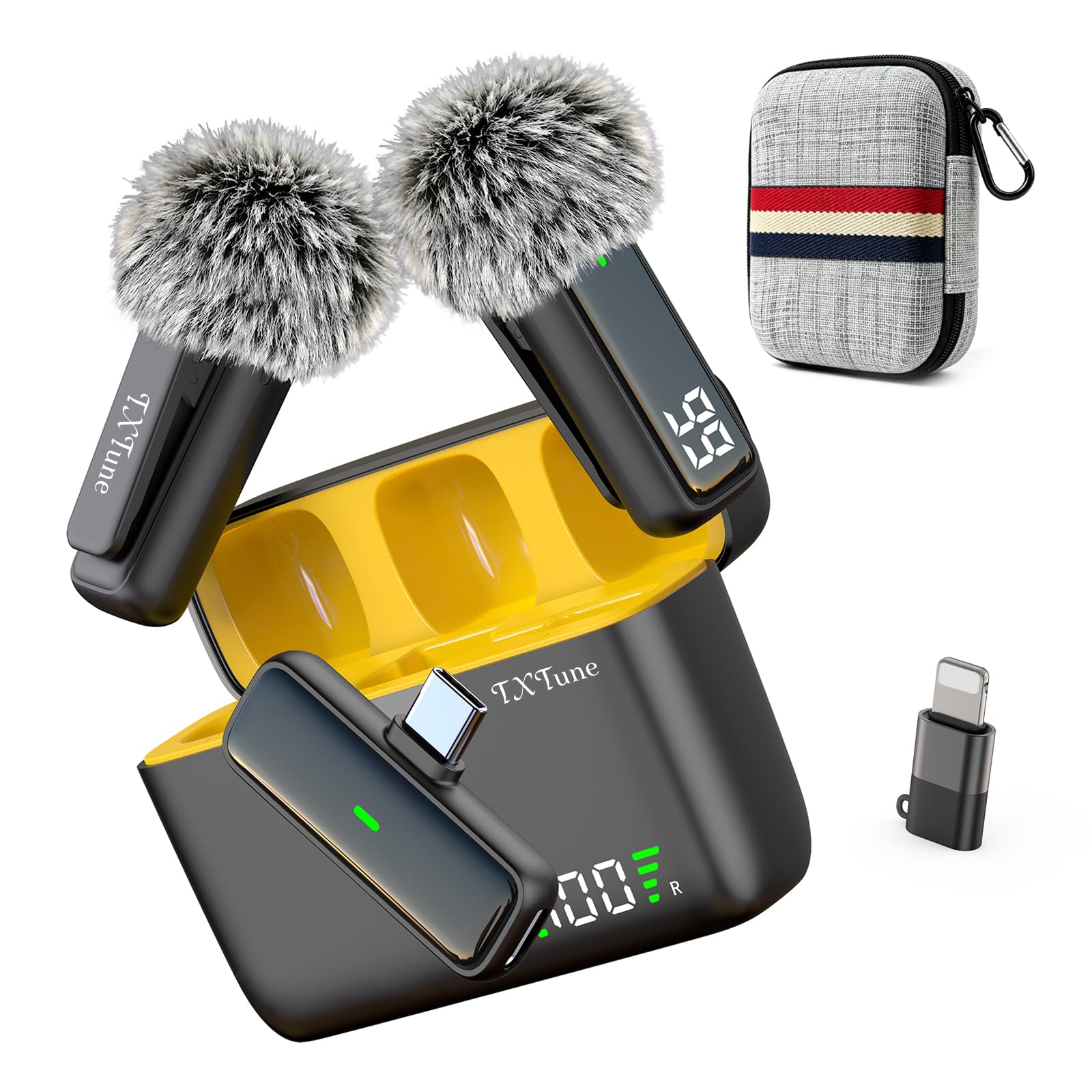
The receiver that lets your phone keep charging while it records.
Battery anxiety is the quiet killer of long shoot days, and the M16 attacks it from the charger side. The receiver lets you top up your phone while it records, so a livestream or a two-hour podcast does not end when your phone’s battery does. Each mic runs up to 6 hours per charge, and the charging case stretches total use to 24 hours.
At 70ft, transmission is the shortest rated range here, so treat this as a close-quarters kit — vlog, podcast, livestream, stage work where the phone is nearby. A DSP noise reduction chip pairs with included furry windscreens for outdoor and street interviews. Both mics carry a digital power indicator, so you can check real battery state at a glance instead of guessing.
Setup is a plug, a button press on the mic, and record — no app, no Bluetooth. The included Lightning adapter pulls double duty for older iPhones and iPads, which matters if your household runs both. Most buyers come away happy with the clarity for the money; the honest note is that a small share find the wireless link less steady than the rest of the kit, so keep your phone within sight on important takes.
What Does What It Says
- Charge your phone through the receiver while recording
- Digital battery readout on each 9g mic
- 24 hours total with the charging case
- Lightning adapter included for mixed-device households
Keep In Mind
- 70ft rated range is the tightest here — close-quarters only
- A minority find the connection less consistent than the audio
- 6 hours per mic means a mid-day top-up on all-day shoots
The right call for: streamers and podcasters who cannot afford a dead phone mid-show.
Pass on it if: you need distance — 70ft will not cover a wide outdoor set.
6. SmaFun TwinCast S2 Wireless Microphone
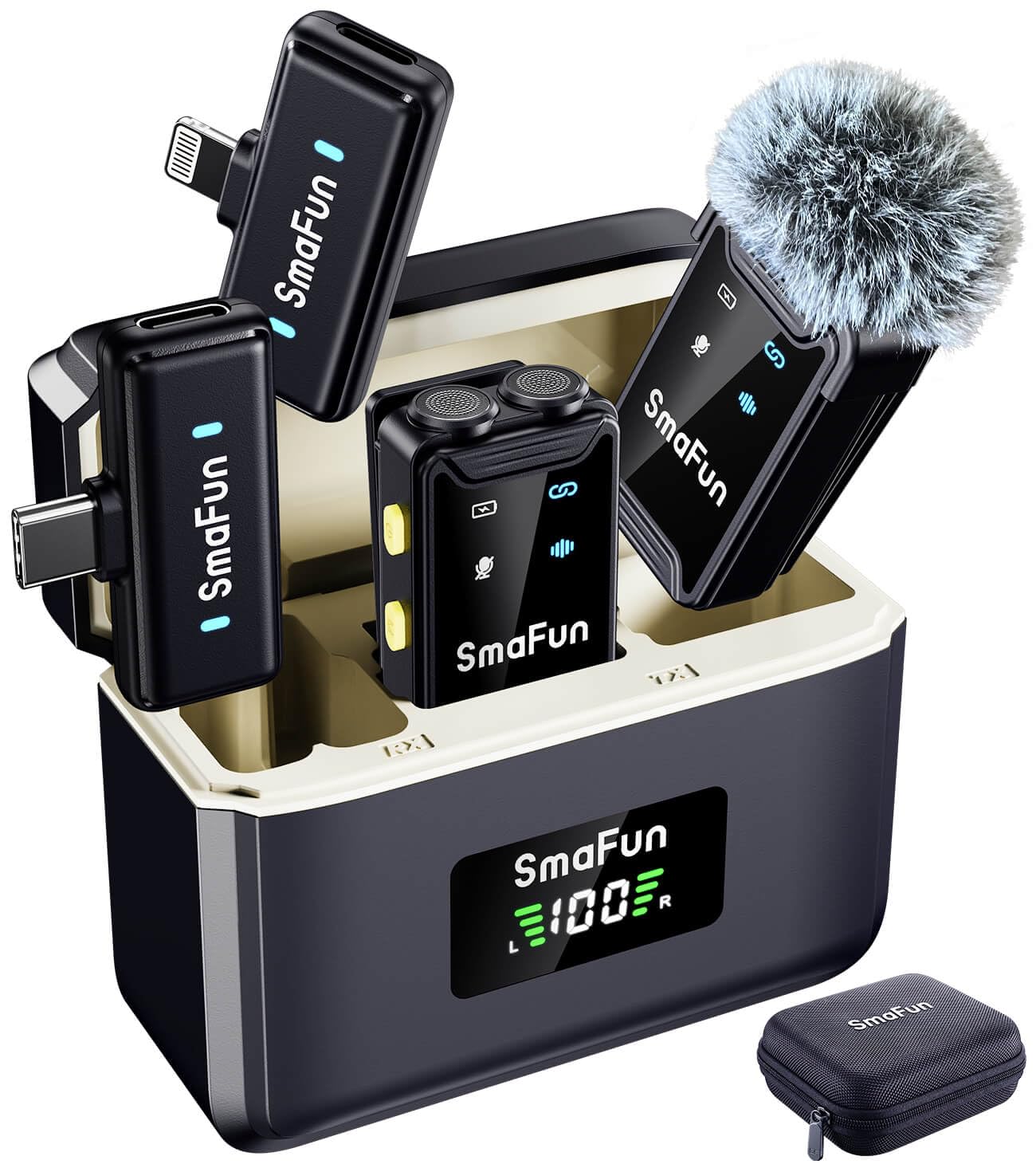
Two mics and two receivers in one case — the travel kit that covers both phones.
Most kits make you pick a side. This one ships with a Type-C receiver and a Lightning receiver together, so the same case works on your Android phone and a collaborator’s iPhone without a dongle hunt. Two transmitters are included, which means a two-person interview straight from the start.
Battery is the other draw: up to 48 hours with the charging case, and the case can fully recharge the set twice at under 2 hours per cycle. Recording runs at 48kHz/24bit with a rated 328ft of distance, so your subject can move across a room or a yard without dropping. The transmitters are pre-paired at the factory and clip discreetly.
Sound quality is what carries this pick in its own feedback — crisp, clear, and good value is the pattern. The trade-off is honest and worth knowing up front: battery and connection get mixed reports, with some owners finding the runtime shorter than the top-line figure and the link fussier than expected. Charge it fully before a big day and keep the receiver line of sight.
The fair read: a dual-receiver travel kit with strong audio and a battery claim that has not landed evenly for everyone. Treat the 48H as a best-case number, not a guarantee.
Buy it for: the two-receiver flexibility and 48kHz/24bit audio.
Hesitate if: you want the most consistent battery record — charge discipline is required here.
7. Insta360 Mic Air (1 TX + 1 RX)

7.9 grams, coin-sized, and it can start your recording from across the room.
The transmitter here is the lightest of the premium set at 7.9g, and Insta360 gives you three ways to wear it — magnet, clip or pendant. That flexibility is real on a shoot: a pendant on a necklace reads differently than a clip on a lapel, and you can swap mid-scene.
On the technical side you get 48kHz sampling for true-to-life voice, plus advanced noise cancellation and a windshield for outdoor work. Transmission runs 300m with a 10-hour battery rating when tested with the receiver and noise cancellation off. The transmitter itself acts as a remote — trigger recording, toggle noise cancellation, or mute without touching your phone.
Compact size and sound quality are the recurring themes in its feedback, and value for money comes up more than you would expect at this tier. The caveat: this is a one-transmitter kit, so a two-person conversation needs a second unit, and it stays in Mono mode. Compatibility is also mixed in reviews, with at least one owner reporting pairing trouble with an Insta360 X5 — check your specific camera body before you buy.
Best for: solo creators who want the mic to be invisible and the control to be remote.
The limit: one transmitter only, Mono recording only, and a battery that stops at 10 hours.
Worth it when: stealth and remote triggering top your list.
Not for: two-person shoots or long marathon sessions.
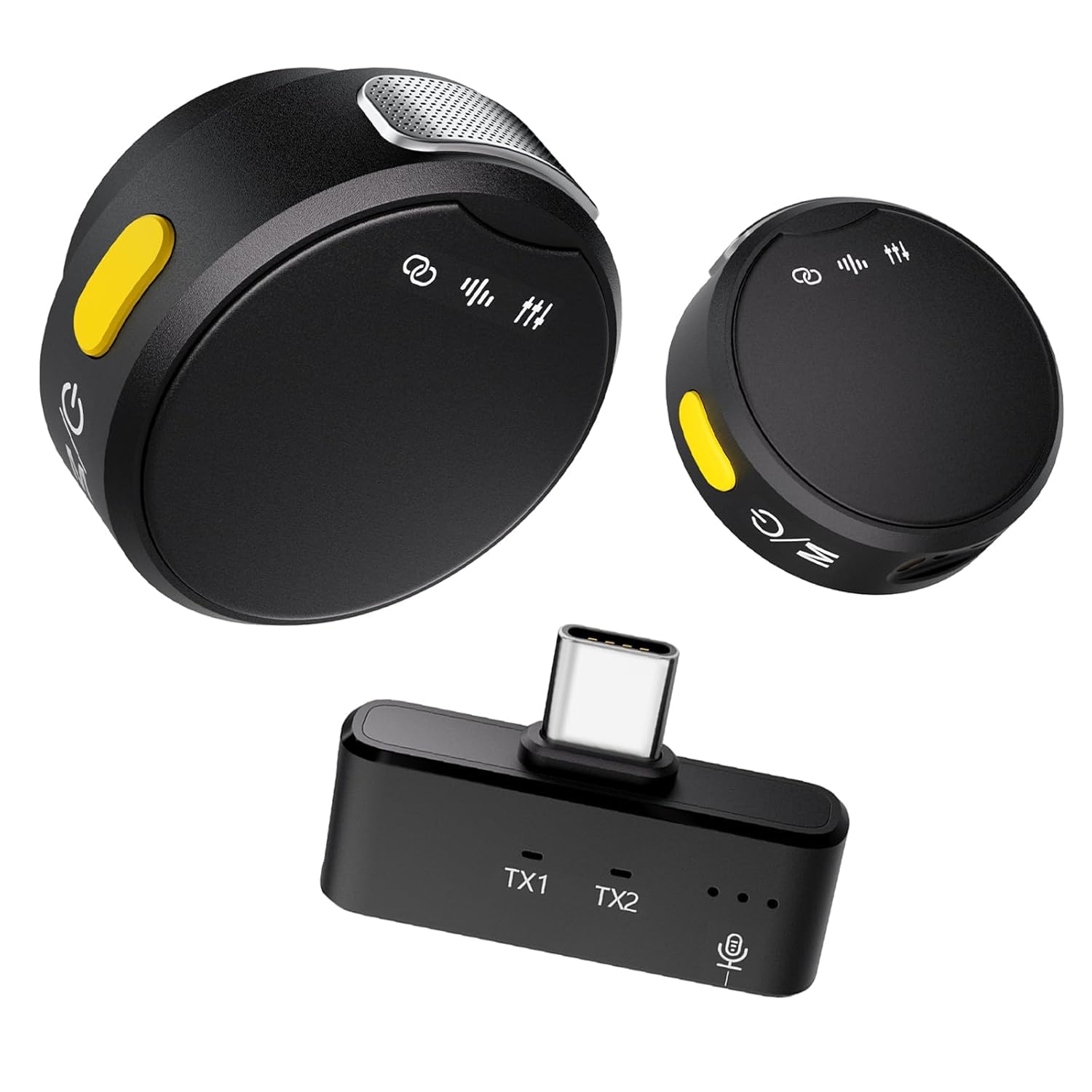
8. Hollyland Lark M2 Wireless Microphone (USB-C)

The same 9g transmitter, now trimmed down to the receivers your Android phone needs.
This is the phone-focused cut of the Lark M2: one USB-C receiver, two button-size mics, and a charging case. You keep the 48kHz/24bit format and a 70dB signal-to-noise ratio, and you keep the 1,000ft line-of-sight range. What you give up versus the combo above is the camera and Lightning receivers — if you only shoot Android, you never miss them.
Battery works out to up to 10 hours of continuous use with ENC off, extended to 30 hours by a case that delivers two full recharges in under 1.5 hours per cycle. The 115dB maximum sound pressure level means a loud room does not flatten your audio. The USB-C receiver is built for Android phones along with Apple 15, action cameras and computers.
Two practical extras separate it from a basic clip mic. The TX button doubles as a remote shutter for your phone’s video recording or photos, which saves you a walk back to the tripod. Firmware, volume and noise-cancellation levels adjust through the HollyAudio app, and with noise cancellation the transmitter rejects wind and room rumble. Buyers routinely put the sound clarity and the price-to-performance near the top of the category.
The case for it: 1,000ft of range in an Android-only kit — the practical middle ground between the combo and the budget picks.
The honest catch: there is no camera receiver, so this kit stops at phones, tablets and computers.
Pick this if: Android is your only camera and you want the longest leash here.
Skip the upgrade if: you already own a camera you film with — the combo is the better fit.
9. MAONO Wave T5 Wireless Lavalier Microphone

Four one-tap voice presets — including a radio filter that makes you sound like a DJ.
Most lavalier mics hand you raw audio and wish you luck in editing. The Wave T5 hands you four presets on the transmitter: Vocal Enhancer for balanced everyday recording, Brightness for vlogs, Warmth for storytelling and teaching, and Magnetic Radio for that deep broadcaster tone. If you dislike post-production EQ work, that alone justifies the tier.
The audio base is strong: true 48kHz/24bit, an 80dB signal-to-noise ratio, and a 120dB maximum sound pressure level that holds up to sudden loud moments. A dedicated ENC chip (environmental noise cancellation — the circuit that separates voice from surroundings) offers 3 modes and 14 levels of adjustment through the Maono Link app. Each transmitter runs up to 9 hours, with 40 hours total from the charging case.
Range is where it goes further than most: frequency-hopping tech is rated for up to 300m in open area and 100m when the transmitter sits behind your back or in a pocket. That second number is the one that matters — you can turn away from the phone and keep recording. Sound quality is the aspect owners praise most, and noise cancellation follows close behind.
What you should know is that reliability carries mixed reports — receivers that act up are the recurring note, and the pairing sequence requires holding the button until the blue light flashes rapidly. Get that ritual right and it behaves; rush it and you will re-pair mid-shoot.
Top choice if: you want broadcast-sounding voice without learning EQ.
Only if you will bother: owners who nail the pairing sequence get the most out of it.
Know the Specs
48kHz/24bit vs 48kHz/16bit
The “48kHz” is how many times per second the mic samples your voice — 48,000 in this case. The second number, 24bit or 16bit, is the volume detail it captures at each sample. More detail means more headroom before a loud moment clips, so a 24bit kit forgives a shout or a slammed door that a 16bit one might distort. Both are perfectly usable for spoken voice; the difference shows up when your subject is loud and unpredictable.
Signal-to-noise ratio in dB
This number tells you how much clean voice you get compared with hiss. A 70dB rating is decent; 80dB is better. Both keep the floor quiet in a normal room, but the higher figure gives you more room to add gain in editing without dragging the background up with your voice.
Line-of-sight versus real range
A “1,000ft line-of-sight” rating assumes nothing between the mic and receiver. Bodies, walls, trees and even a pocket all soak up signal. That is why a long rated range is a buffer rather than a promise, and why a 70ft kit is best kept in a small room or on a tripod shot.
Charging cases and total runtime
Battery specs come in two flavours: per-transmitter hours, and total hours with a case that recharges them. A 9-hour transmitter with a case that delivers two full recharges is your real working window. Always ask which number the listing means, because a case total hides a mid-day top-up on a long shoot.
Common Questions
Will a wireless lavalier mic work with any Android phone?
Do I need an app to use a wireless lavalier mic on Android?
What is the difference between noise cancellation and a windshield?
How far can I walk away from my phone before audio drops?
Can I charge my phone while the mic is plugged into the USB-C port?
Do these mics record in stereo or mono?
How many hours will a lavalier mic actually run on one charge?
Will a lavalier mic pick up my voice clearly in a noisy street?
Is a higher signal-to-noise ratio always better?
Can I use one of these mics with my laptop or camera as well?
The Bottom Line
For most Android creators, the wireless lavalier mic for android winner is the Hollyland Lark M2 combo because 1,000ft of range plus three receivers means you never buy a second kit when your gear changes. Its 4.5+ star rating across 650+ owner reviews backs that up. If you want the same range in a phone-only package, grab the Hollyland Lark M2 USB-C and keep the cash. And for long interview days where battery is the whole story, the DJI Mic Mini is the one to reach for. Buy once for the rig you will have next year, not just the phone in your hand today.
How we choose
We do not accept paid placement. Every pick is matched to a real buyer and a real use-case; we do not hands-on test units.
Sources
Specifications: manufacturer listings and product documentation. Review insights: verified customer reviews, as of November 2026. Pricing: not shown on this page (it changes often); check the current price via the retailer link.
As an Amazon Associate, Tactical Gear Guy earns from qualifying purchases. This does not affect which products we feature.