Specs are compiled from manufacturer listings and verified buyer reviews and can change over time — please confirm the key details on the product page before buying.
You want your yard watered on schedule without standing in the sun holding a hose — and the right wireless irrigation system does that from your phone. The catch most buyers hit is that “wireless” can mean a Wi-Fi hose timer, a multi-zone smart controller with an ethernet port, or a fully solar-powered sprinkler, and each works with a different kind of plumbing. This guide sorts them by what you actually have to water.
This guide is built by comparing the manufacturers’ published specifications and the patterns across verified customer reviews, so you get each pick’s real strengths and trade-offs instead of marketing spin.
The short answer is the RainPoint brass-inlet two-zone timer, a crowd favorite at 4.5+ stars across 300+ owners — it splits your hose into two independent schedules and remembers them. Below you’ll find the full breakdown of the best wireless irrigation system picks, from budget hose timers to full multi-zone controllers.
Top Picks


How To Choose The Best Wireless Irrigation System
Start with your water source, not the app. A hose-bib timer screws onto an outdoor faucet and feeds one or two hoses. A zone controller replaces the box wired to your in-ground valves and runs eight or sixteen separate stations. Buying the wrong type is the single most common mistake here — a hose timer cannot drive buried sprinkler valves, and a sixteen-zone controller has nothing to do with a single garden hose.
Wireless means Wi-Fi, and Wi-Fi means 2.4 GHz
Nearly every timer here connects on the 2.4 GHz band only. If your router broadcasts one merged network name across both bands, the timer often cannot find it. Split the bands and give the 2.4 GHz one its own name before you install anything — this one setup step prevents most “it won’t connect” returns.
Count zones before you count features
Each zone is an independently scheduled watering area. A two-zone hose timer covers a front bed and a back bed. An eight-zone controller handles eight valve stations. Add up your beds, lawn sections, and drip lines first — buying too few zones means doubling up schedules you wanted separate.
Rain skip and weather data pay you back
Weather-based scheduling checks the local forecast and holds off watering before, during, or after rain. That is the feature that quietly trims a water bill, and on controllers it often pairs with an EPA WaterSense certification that signals tested efficiency. On a hose timer, look for automatic rain delay measured in hours.
Side-by-Side Comparison
| Model | Best For | Zones / Stations | Water Source | Weather Skip | Amazon |
|---|---|---|---|---|---|
| RainPoint 2-Zone Brass Inlet Timer★ Best Overall | Two separate hose schedules | 2 zones, 6 schedules each | Garden hose | Smart Scenes weather adjust | Amazon |
| meross WiFi Water Timer (Hub)HomeKit Pick | HomeKit and voice control | Single timer, hub supports 24 | Garden hose | Hyper-local rain skip | Amazon |
| LetPot Drip Irrigation KitDrip Specialist | Potted plants and drip lines | 10 drippers, 10-20 pots | Reservoir + 10 m pipe | Low-water alerts | Amazon |
| RainPoint WiFi Brass Timer | Measuring exact gallons | 3 plans, 2 modes | Garden hose | 24/48/72-hour rain delay | Amazon |
| Rain Bird ARC8 | In-ground 8-station systems | 8 stations | Wired valves | Postal-code forecast skip | Amazon |
| Orbit B-hyve XR | Large multi-zone yards | 16 zones | Wired valves | Forecast-driven scheduling | Amazon |
| Yardian Pro 8-Zone | HomeKit and wired ethernet | 8 zones | Wired valves | ET-based hyper-local data | Amazon |
| Rain Bird OTO | No-trench solar coverage | Unlimited spray zones | Hose, solar powered | Rain and wind skip | Amazon |
| Aiper IrriSense 2 (2 Pack) | Large lawns, 4-in-1 kit | 10 watering maps | Hose + electric valve | Built-in rain sensor | Amazon |
Detailed Reviews
1. RainPoint WiFi Water Timer with Brass Inlet, 2-Zone
Our pick — 4.5+★ from 300+ verified ratings; the strongest balance of quality and price.
Two hose bibs on one timer, each with its own schedule and its own brass threads.
If you water a front bed and a back bed off the same faucet, this is the pick. It splits your hose into two zones that run independently — set up to 6 watering schedules per zone, which adds up to 12 settings across the unit. That is the number to weigh against the meross timer, which offers 10 settings on a single zone.
The build is where it earns its keep. Both the inlet and the housing are metal, and the brass fitting resists the cracking that plastic threads suffer under constant hose pressure. Schedules run in three modes: Normal irrigation from 1 minute to 12 hours, Interval irrigation from 1 second to 60 minutes, and a Cycle & Soak mode from 1 minute to 12 hours. Five frequencies — daily, weekly, odd days, even days, or every 2 to 30 days — cover most yard rhythms without fiddling.
Owners praise its schedule reliability: it waters when you told it to, every time. The app connects over 2.4 GHz Wi-Fi and pairs to a RainPoint hub, and Smart Scenes can adjust your schedule on weather and link multiple RainPoint devices. A seasonal adjustment slider scales watering duration from 10% to 200% each month, so you are not rebuilding your program every time the seasons shift.
Room To Grow
- Two zones that schedule separately — no compromise between front and back beds
- 12 total settings: 6 schedules per zone
- Metal body with a brass inlet that outlasts plastic threads
- Seasonal adjustment runs from 10% to 200% so you set it once per season
- Alexa and Google Assistant voice control plus Smart Scenes weather logic
Where It Gets Fussy
- Needs the RainPoint hub for full app control — it is not a standalone Wi-Fi unit
- RainPoint recommends no more than 4 timers on one hub for system stability
- A handful of buyers report drips at the connection; snug the washer down firmly
Buy it when: you have two beds on one faucet and want each on its own timed program.
Think twice if: you only water one area — a single-zone timer saves you the complexity.
2. meross WiFi Water Timer for Garden Hose with Hub
A compact hose timer that speaks Apple HomeKit natively and skips watering when rain is coming.
The footprint here is deliberately small — 3.9″D x 2.2″W x 6″H — so it tucks against the house without snagging the hose. That is noticeably tighter than the RainPoint two-zone unit at 7.7″D x 3.2″W x 6.3″H, which matters when your faucet sits in a narrow side yard. The body is ABS plastic with brass at both the inlet and outlet, so the threads are the part that holds up rather than wearing smooth.
Weather automation is the headline. It pulls hyper-local forecast data and skips watering before, during, and after rain, and also holds off in freezing or windy conditions. You set start times, durations from 1 minute to 11 hours 59 minutes, and frequencies by day of the week. Automatic shut-off defaults to 15 minutes and is adjustable in the app — a genuinely useful guard if you trigger manual watering and walk away.
One caveat before you buy: the hub that comes in the box determines your smart-home ceiling. The MSH400 hub supports HomeKit voice and remote control on firmware v4.5.35 or newer. The MSH450 hub needs firmware v9.1.17 or newer and does not work with HomeKit at all. If you already own either hub, buy the timer-only version and skip this bundle.
Where it shines: a single hub can support up to 24 water timers, which makes this the cleanest way to blanket a large property with hose timers on one app.
The honest catch: the power compartment is sealed tight for waterproofing, so you need a screwdriver to open it and must watch polarity on the batteries — a five-minute job the first time.
Reach for this if: your home runs on Apple Home and you want your hose timer inside the same app as your lights.
Look elsewhere if: you have a large zone count on an in-ground valve system — you need a controller, not a faucet timer.
3. LetPot Automatic Watering System for Potted Plants
Forty-one pieces of drip kit that turn a row of pots into a self-watering shelf.
This is not a faucet timer and it is not a zone controller — it is a drip kit. The box carries a 10-meter water pipe, 10 adjustable drippers, 10 connectors, 10 brackets, a filter, and an adapter plug, and the system handles 10-20 pots at once. For balcony gardens, herb shelves, and greenhouse benches, that is exactly the hardware you need. At 0.86 kg, the pump unit is light enough to move between seasons, though it carries slightly more heft than the meross hose timer’s 0.74 kg.
The 2.0 chip pushes a faster, more stable connection to the LetPot app, and the app runs up to 5 simultaneous watering tasks. You pick intermittent or continuous drip per plan, which lets soil soak instead of running off. An anti-backflow valve blocks the siphon effect, an advanced spiral lock holds water pressure, and a German-imported silent pump makes it quiet enough to sit in a bedroom. The IP66 rating means it shrugs off rain on an open balcony.
Owners consistently report the setup is friendly and the app does what it promises — one buyer ran it across all 14 of their plants and found every one stayed well hydrated. Install tip that saves a lot of swearing: soak the pipe ends in water above 70 degrees Celsius before pushing on connectors the first time. The thickened PE hose is deliberately tight at room temperature.
Best-fit buyer: someone with a dozen or more pots and no outdoor faucet spare for a hose timer.
Fit note: low-water alerts and the plant diary live in the app — if your phone is not nearby, you lose those nudges, so check the reservoir yourself on long trips.
Pick this for: potted plants, seedling trays, and drip lines that need measured sips rather than a spray.
Wrong tool if: you are trying to water a full lawn — this kit is built for containers, not turf.
4. RAINPOINT WiFi Water Timer with Brass Inlet & Outlet

It waters by the gallon, not by the minute — set a volume and walk away.
Most hose timers only know time. This one can be programmed to deliver a set volume of water, like exactly 8 gallons for a vegetable bed, which is the closest a hose timer gets to precision irrigation. That pairs with 3 customizable plans and 2 modes: Irrigation Mode for continuous flow on lawns and pools, and Mist Mode for intermittent cooling and dust control. Durations span 1 minute to 11 hours 59 minutes across a Monday-to-Sunday frequency.
Weather handling is more granular than most. It delays watering for 24, 48, or 72 hours when rain hits, and ramps watering up when conditions dry out, all according to your own manual settings. Pair a RainPoint WiFi soil sensor (sold separately) and the schedule shifts based on soil moisture instead of guesswork.
The brass inlet and outlet are the durability story — under high water pressure, plastic fittings are the parts that crack, and brass resists that. Owners mention it pairs to 2.4 GHz Wi-Fi quickly and holds its program without reconnecting. Just split your router’s bands first, because a merged network name is the usual reason a timer never sees the network.
Who it suits: gardeners who think in gallons and want rain delays measured in days, not hours.
Watch this: the app is the weakest link in the chain — a few buyers find it clunky, so plan on a little patience during initial setup.
Ideal for: raised beds and vegetable gardens where overwatering costs you fruit.
Not the fit if: you want one button and forget it — this timer rewards someone who likes dialing in the details.
5. Rain Bird ARC8 App-Based Smart WiFi Sprinkler Controller

Eight stations, indoors or out, with a WaterSense badge and an app that follows your postal code’s forecast.
This is the entry point to real in-ground control — it replaces the box wired to your valve manifold and runs eight separate stations. The EPA WaterSense certification signals tested efficiency, and the scheduling logic uses your postal code’s forecast plus historic averages to skip or trim daily watering. Rain Bird estimates up to 30% water savings when the weather logic is active.
Living with it is straightforward on the control side. You set, monitor, and adjust schedules from the phone anywhere, and you can share access with family or a landscaping crew. Manual watering, schedule activation, and a local forecast check are all in the app. The unit installs indoors or outdoors, includes the A/C cord, and is rated to 149 degrees Fahrenheit operating temperature. Installation is the standout — swapping an old controller for this one is a job most owners finish in an afternoon.
Be clear-eyed on the connectivity, though. Wi-Fi reliability and app usability land mixed to negative across the review history, and that is the recurring friction here. On a strong 2.4 GHz signal close to the router it behaves; in a garage at the edge of coverage, you may fight it. Run a Wi-Fi check at the install spot before you commit.
Where it earns its place: the easiest eight-station upgrade for someone replacing an old dial controller.
Second thought: if your controller lives far from the router, budget for a Wi-Fi extender — the app connection is the part that frays.
Best for: a standard eight-station in-ground system with a good signal at the controller box.
Pass if: you need Apple HomeKit — this one speaks Alexa and Google, not HomeKit.
6. Orbit B-hyve XR 16-Zone Indoor/Outdoor Smart Sprinkler Timer
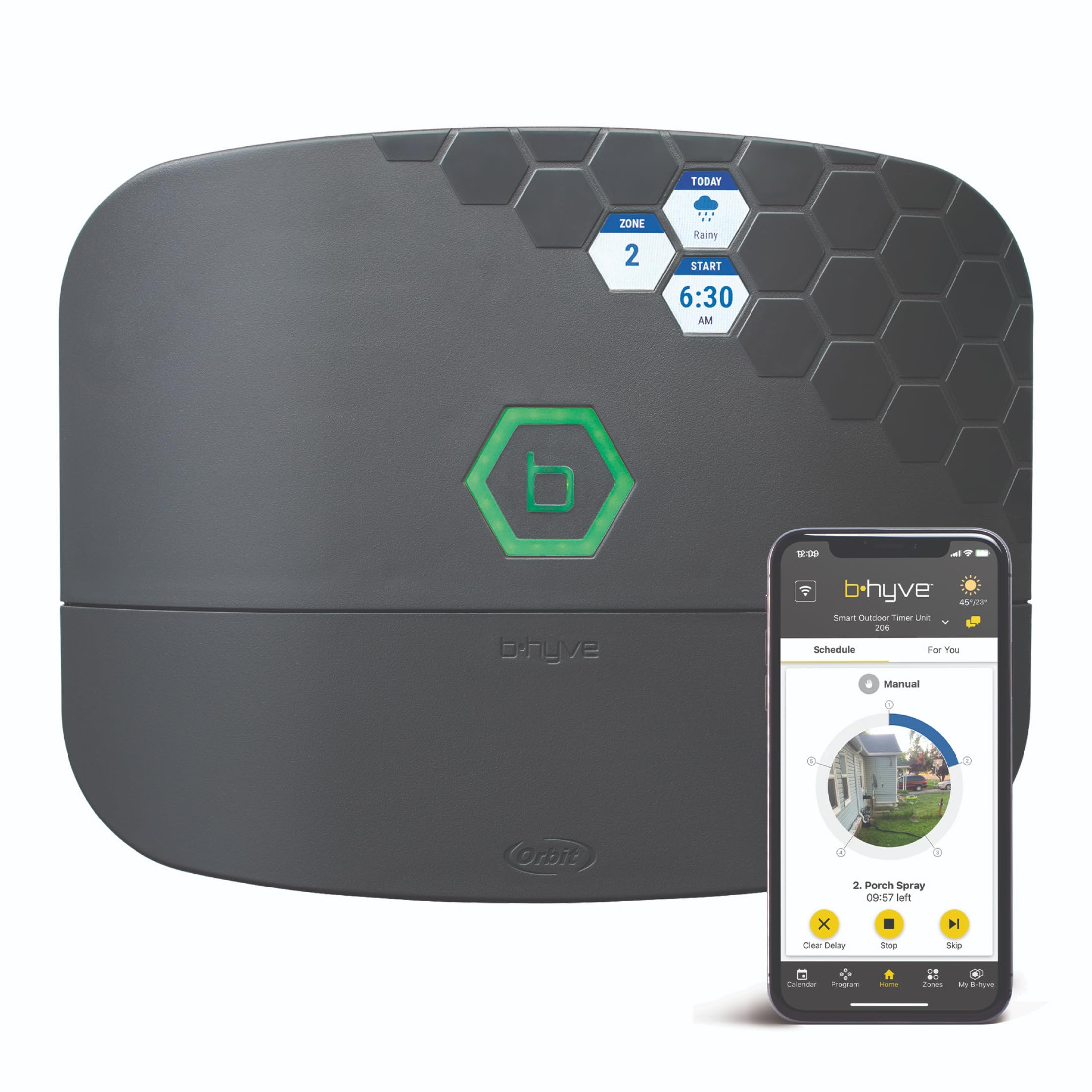
Sixteen stations of app-driven watering for a yard with more valves than a small controller can hold.
Where the Rain Bird ARC8 stops at eight stations, this doubles the count at sixteen — the deciding spec if your property has separate zones for front lawn, back lawn, shrubs, drip beds, and a pool area. Each zone runs its own schedule and personalized watering program, all managed from the app. Forecast-driven logic adjusts your cycles to the weather to cut waste, and a digital display on the front gives you a readout when you are standing at the box.
Daily use is smooth. Adjustments, monitoring, and scheduling all happen from the phone wherever you are, and owners describe the app interface as intuitive. It is Alexa-compatible for voice commands, rated for outdoor install, and comes with a two-year limited warranty against material or workmanship defects for private use. The 11″L x 9″W x 4″H housing fits standard controller boxes.
The honest trade-off is that reliability and Wi-Fi connectivity are the mixed spots in an otherwise strong record. Like most controllers here it prefers a clean 2.4 GHz signal, and a garage-installed box at the edge of coverage will test your patience. Position it well and it settles in; position it badly and you will be reconnecting.
What You Get For The Zones
- 16 independently scheduled zones — room for lawn, shrubs, drip, and pool runs
- Forecast-driven scheduling trims watering on its own
- Digital display plus full phone control
- Two-year limited warranty for private-use defects
What To Plan Around
- Wi-Fi reliability is a mixed experience depending on signal strength at the box
- More zones means more setup time on the front end
- The plastic housing needs a sheltered spot outdoors
Choose it for: a large yard with a dozen or more valve stations you want on one screen.
Skip the upgrade if: eight stations cover your property — you would pay for zones you never wire up.
7. Yardian Pro 8-Zone Smart Sprinkler Controller

The controller that plugs into a cable instead of praying for Wi-Fi in the garage.
Spotty garage Wi-Fi is the single most common failure point for smart controllers, and this one answers it with a built-in RJ45 Ethernet port for a wired connection, plus enhanced Wi-Fi when you cannot run a cable. That alone makes it the pick for anyone whose valve box sits at the far end of the house. It also carries native Apple HomeKit support, and integrates with Amazon Alexa, Google Home, and Home Assistant.
Watering logic is ET-based — evapotranspiration, which means it factors in local weather data and how much water your soil and plants actually lose to sun and wind. Yardian claims up to 50% off water bills from that ET-based automation. It supports both wireless and wired flow sensors, delivering real-time alerts for leaks, burst pipes, or clogged valves, which is genuinely useful protection for a buried system.
The fail-safe is the physical buttons on the unit. You can run a zone or test sprinklers instantly without a phone or an internet connection — exactly what an installer or contractor needs, and a relief when the network drops mid-season. Swap-in takes under 15 minutes per the maker, the compact 6″L x 1.38″W x 6″H body fits existing irrigation boxes, and a 100V–240V universal adapter covers global voltage. There is an IP56 outdoor enclosure available separately.
The reason to pay more: wired ethernet plus HomeKit plus manual buttons is a combination no other controller on this list offers.
Watch the install spot: the unit itself is not fully weatherproof — you want the optional IP56 enclosure if it lives outdoors in the open.
Worth it when: you are tired of reconnecting a controller and want a cable to end the argument.
Not for you if: you only run a couple of hose timers — the wired install is overkill.
8. Rain Bird OTO Lawn Smart Sprinkler
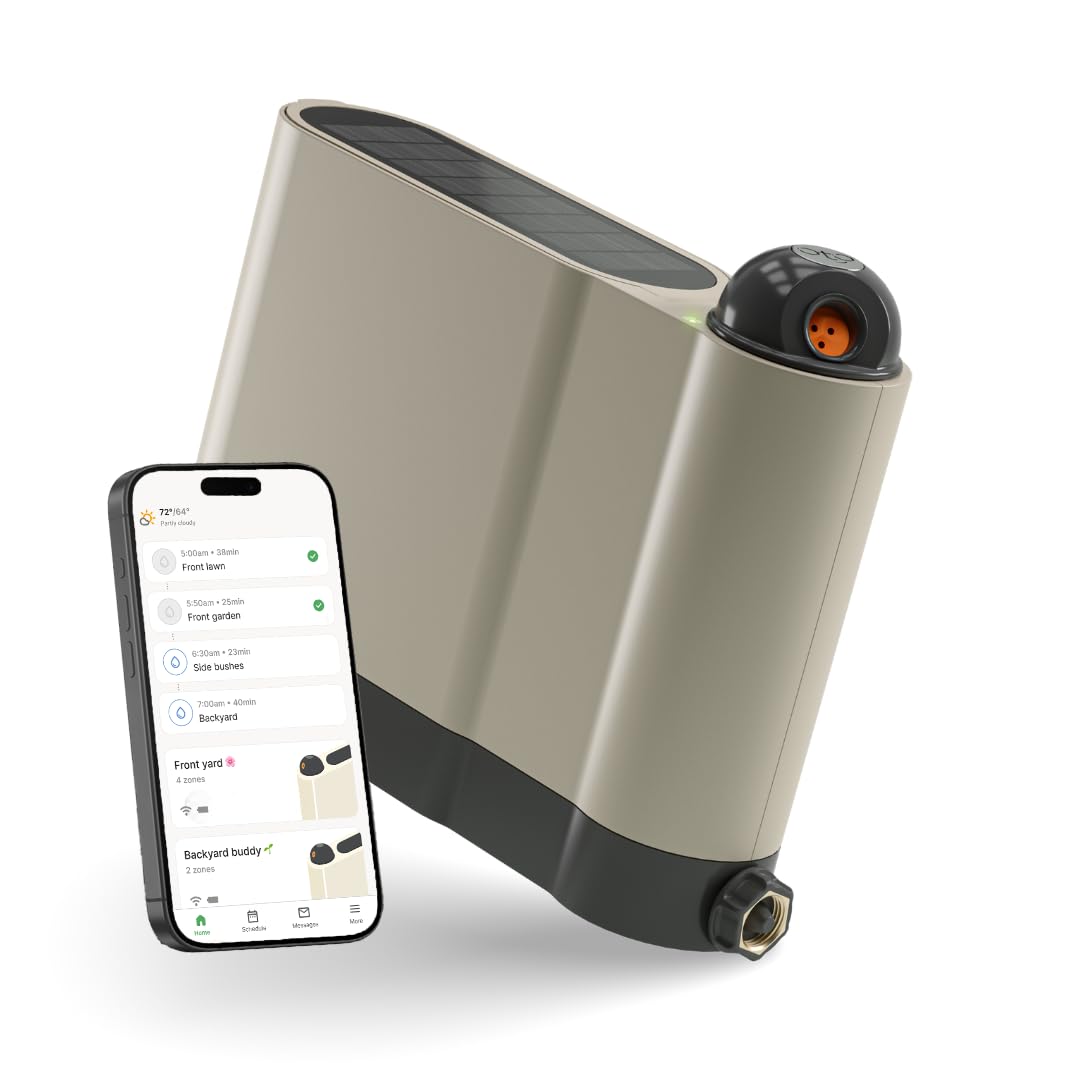
Place it, connect a hose and Wi-Fi, and it waters itself off the sun.
No trenching, no digging, no electrician and no batteries — this runs purely on solar. You set it down, connect a hose, pair it to Wi-Fi, and it handles the rest. One unit covers up to 5,000 sq ft, and you can daisy-chain multiple units for full-yard coverage. If you rent, or you simply refuse to rip up turf, this is the path to automated lawn watering.
Precision zones are unlimited and fully customizable, so you aim spray at lawns, shrubs, gardens, pots, and trees and skip the sidewalk. Weather-intelligent scheduling checks local forecasts and skips watering when it rains or is too windy. The body is UV-resistant with a weatherproof housing rated 32 to 149 degrees Fahrenheit and solid brass fittings, built for hot summers and rainy seasons alike. A security loop lets you lock it to a fixed object.
The catch is range versus claim. Owners consistently love the quality and ease of use, but some find the actual spray distance falls short of the advertised 40 feet, so plan your placement around a tighter arc than you might expect. It shines on smaller lawns and areas where you want more water efficiency, less on sprawling open turf.
Standout feature: solar power with zero wiring means installation is a matter of placement, not construction.
Honest limit: the coverage is best for small to mid lawns — on a large open yard, chain a second unit rather than stretching one.
Made for: renters and no-trench yards where running cable is off the table.
Reconsider if: you need to cover a wide expanse — the spray reach is shorter than the headline figure suggests.
9. Aiper IrriSense 2 Smart Irrigation System (2 Pack)

Controller, sprinkler, valve, and nutrient feeder arrive in one box — two of them, in fact.
The 4-in-1 packaging is the pitch: a controller, sprinkler, electric valve, and nutrient feeder all included, so you are not assembling a system from separate parts. Installation runs about 15 minutes per the maker, no trenching. The two-pack is rated for lawns up to 9,600 sq ft total, which puts it in a different class from the single-unit Rain Bird OTO and its 5,000 sq ft ceiling.
Coverage control is granular. Up to 10 plant-specific watering zones let you set separate maps, schedules, and water output for lawns, flowers, shrubs, and vegetable beds. EvenRain technology simulates natural rainfall with gentle, even coverage, which helps water soak into soil instead of running off. A built-in rain sensor pauses watering during rainfall, and the Aiper app pushes weather alerts so you can adjust schedules. Aiper claims up to 40% water savings from its precision mapping and weather-adaptive logic.
Here is the part to weigh. This is a premium setup, and the review history is thinner than the others here, with reliability landing mixed. Functionality is the bright spot — it is well regarded among smart sprinkler options — but consistent long-term operation is the question mark. For a large property where a two-pack replaces several devices, it can make sense; for a small yard, the complexity is more than you need.
The draw: one purchase replaces a controller, sprinkler, valve, and feeder, and the two-pack covers a genuinely large lawn.
The question to sit with: reliability is the mixed note in a smaller review base, so buy where you value the all-in-one kit and can afford to troubleshoot.
Fits best: larger properties that want a full kit in one order with ten zone-level schedules.
Hold off if: you want the proven track record — the hose timers and single controllers here have far deeper review histories.
Know the Specs
Zones vs. stations
A zone is one independently scheduled watering area. On a hose timer, a two-zone unit like the RainPoint splits your faucet into two programs. On an in-ground controller, “stations” refer to the buried valve wires — the ARC8 runs 8, the Orbit B-hyve XR runs 16. Count your beds and valve wires before you buy; extra zones you never wire are money wasted, and too few forces you to combine areas you wanted separate.
2.4 GHz Wi-Fi and your router
Every timer and controller here connects on the 2.4 GHz band. Many modern routers broadcast one merged network name across 2.4 and 5 GHz, and these devices often cannot see it. Split the bands in your router settings, give the 2.4 GHz one a distinct name, and connect the timer to that. This single step heads off most connection trouble before install day.
Weather skip and rain delay
Weather-based scheduling pulls local forecast data and holds watering before, during, or after rain. On hose timers it often appears as a fixed delay measured in hours — 24, 48, or 72 hours on the RainPoint brass timer. On controllers, it is forecast-driven and adjusts daily. The behavior conserves water and prevents the flooded-yard look after a storm.
Brass vs. plastic fittings
The inlet and outlet threads take constant pressure from a charged hose. Plastic threads wear smooth and crack over seasons; brass resists that. The RainPoint two-zone and the meross both run brass at the connection points to outlast the housing around them, which is why the fitting quality is worth checking on any hose timer you consider.
Common Questions
Will a Wi-Fi hose timer work with my dual-band router?
Do I need a hub to run a smart hose timer?
What is the difference between a hose timer and a sprinkler controller?
How much water can weather-skip scheduling actually save?
Can I use a hose timer with a rain barrel or reservoir?
Does the Rain Bird ARC8 work with Apple HomeKit?
What does IP65 or IP66 mean on an outdoor watering device?
Can one controller handle more than one lawn area with different plants?
How long does installation take on an in-ground smart controller?
Do these systems need batteries or a power outlet?
The Bottom Line
For most yards, the wireless irrigation system answer is the RainPoint 2-Zone Brass Inlet Timer — two zones that schedule independently, a metal body with brass threads, and a seasonal adjustment that saves you rebuilding your program every month. If Apple Home is your ecosystem, the meross timer with hub gets your hose into the same app as your lights. And if you are replacing an old in-ground dial box, grab the Yardian Pro for wired ethernet and manual buttons that work when the network does not.
One honest nudge: a hose timer is the fastest way to stop hand-watering, but measure your Wi-Fi signal at the faucet first — every one of these connects on 2.4 GHz, and a weak signal there is the difference between a system that runs itself and one you fight.
How we choose
We do not accept paid placement. Every pick is matched to a real buyer and a real use-case; we do not hands-on test units.
Sources
Specifications: manufacturer listings and product documentation. Review insights: verified customer reviews, as of November 2026. Pricing: not shown on this page (it changes often); check the current price via the retailer link.
As an Amazon Associate, Tactical Gear Guy earns from qualifying purchases. This does not affect which products we feature.