Specs are compiled from manufacturer listings and verified buyer reviews and can change over time — please confirm the key details on the product page before buying.
You want to know your freezer is still cold and your brisket is not drying out, without walking to the kitchen to look. A wireless internet thermometer sends that reading to your phone, anywhere, so you only act when something is actually wrong. The catch is that this label covers two very different jobs: cold-storage alarms that watch a fridge or freezer, and cooking probes that track meat through a grill lid. Buying the wrong type is the most common mistake here. Below are the eight worth your attention, sorted by what they actually do for you.
This guide is built by comparing the manufacturers’ published specifications and the patterns across verified customer reviews, so you get each pick’s real strengths and trade-offs instead of marketing spin.
Cold-storage units live or die on probe accuracy and alert delivery, while cooking probes live or die on signal strength through metal. The eight picks below cover both camps, and the crowd favorite at 4.5+ stars across 400+ ratings is the one most people should start with. What follows is a plain-English breakdown of the best wireless internet thermometer options and who each one truly fits.
Top Picks


How To Choose The Best Wireless Internet Thermometer
Start by naming the job. Are you guarding food in a freezer, or are you cooking a piece of meat to an exact internal temperature? Those two tasks want completely different hardware, and no single unit does both well. Once you pick your camp, four specs decide everything else.
Wi-Fi band and network compatibility
Most of these units connect on 2.4GHz Wi-Fi only, which is the older, longer-reaching band. That matters because if your home router broadcasts a 5GHz-only network, the device simply will not pair. Check your router settings before you buy, because this is the single biggest setup failure in this category.
Probe accuracy in degrees
Accuracy is written as a plus-or-minus figure, like ±0.5°F, meaning the reading can drift that far either way. A tighter number is better for food safety monitoring and for curing or fermenting, where a couple of degrees over days matters. Looser figures are fine for casual fridge checks.
Signal strength through walls and metal
A freezer is a metal box, and metal blocks radio signals. Sub-1 GHz technology pushes a signal that penetrates walls, smokers, and Dutch ovens far better than standard Bluetooth. If your appliance sits in a garage or basement, prioritize a unit with a strong hub-to-sensor range.
Battery type and data history
You get two power choices: standard AAA batteries you swap every year or two, or a USB recharge. Both work, so pick based on if you want to remember a swap cycle. Data export matters if you need a record — a graph you can pull up later is what turns a thermometer into a monitoring system.
Side-by-Side Comparison
| Model | Best For | Accuracy | Connectivity | Power | Amazon |
|---|---|---|---|---|---|
| Typhur Sync Gold★ Best Overall | Cooking and grilling | ±0.5°F | Bluetooth, Sub-1G, Wi-Fi | Rechargeable base | Amazon |
| MOCREO WiFi Freezer ThermometerBest Value | Fridge and freezer alarms | ±0.9°F | Wi-Fi | 3 AAA batteries | Amazon |
| TempPro TempAirTightest Sensor | Room and greenhouse tracking | ±0.5°F | Wi-Fi, Bluetooth | Rechargeable lithium | Amazon |
| X-Sense Smart Wi-Fi | Multi-room humidity and VPD | ±0.36°F | Wi-Fi | 3 AAA batteries | Amazon |
| PHYSEN WiFi Freezer Thermometer | Long-range cold storage | ±1.8°F | Wi-Fi | AAA freeze-resistant | Amazon |
| SwitchBot WiFi Thermometer 3 Pack | Voice control and spread-out sensors | ±0.36°F | Wi-Fi | AAA batteries | Amazon |
| GoveeLife WiFi Refrigerator Thermometer | Freezer monitoring with probe | ±0.9°F | Bluetooth, Wi-Fi | 4 AAA batteries | Amazon |
| InkGrill 4-Probe Meat Thermometer | Multi-meat cooking | Two sensors per probe | Bluetooth, Wi-Fi, Local | Lithium polymer | Amazon |
Detailed Reviews
1. Typhur Sync Gold Wireless WiFi Meat Thermometer
Our pick — 4.5+★ from 400+ verified ratings; the strongest balance of quality and price.
The wireless probe that punches straight through a closed smoker and keeps talking.
If your cook happens behind a metal lid, this is the one that stays connected. Each probe carries six sensors (five inside the meat plus one ambient tip sensor that reads the air around it), and they feed Typhur’s own algorithm to produce a ±0.5°F reading. Practically, that means you can pull a turkey at the temperature you set instead of guessing and hoping.
Your connection lives or dies on the radio inside. It uses Sub-1 GHz technology (a long-wave signal), so the link survives a kamado grill wall instead of dropping when the lid shuts. A standalone base also shows live readings and lets you adjust targets without hunting for your phone. And a free app for both iOS and Android keeps you covered when you want to wander off.
The probes handle heat up to 932°F and carry an IPX8 waterproof rating, which is an immersion rating meaning they can be dunked and washed. They are dishwasher safe, so cleanup is not a chore. The trade-off is straightforward. A 6.2-inch probe is long enough to reach the center of a big roast but sticks out of smaller cuts, and this is a cooking tool only — it will not watch your freezer. The 4.5+ star rating across 400+ owners reflects a cooking probe that holds its ±0.5°F reading right up to the target temperature.
Where The Sync Gold Delivers
- ±0.5°F accuracy with a 0.5-second response time, so readings update almost instantly
- Sub-1 GHz signal pushes through walls, smokers, and Dutch ovens
- Standalone base works without a phone, and the app covers both iOS and Android
- Probes withstand 932°F and are IPX8 waterproof and dishwasher safe
The Honest Limits
- Cooking-only device with no cold-storage monitoring
- The 6.2-inch probe length is generous for large roasts but bulky for small cuts
Buy it if: you cook on a grill, smoker, or in a Dutch oven and want the reading to survive a closed lid.
Think again if: you need a fridge or freezer alarm — this one watches meat, not cold storage.
2. MOCREO WiFi Freezer Thermometer with Alarm
Three ways to be warned about a warm freezer, including one that yells from the hub itself.
This is the pick for the person who wants redundancy. It fires three alert types: an app push notification, an email, and a loud 80dB hub beep alarm — 80dB being roughly the volume of a noisy kitchen, enough to hear from another room. The slim 1.3mm DS18B20 digital probe reads from -40°F to 257°F with ±0.9°F accuracy, covering freezers, fridges, aquariums, and hot tubs on one device.
Reliability is what wins people over here: a plug-in hub, AAA batteries, and no charging routine. The sensor runs on standard AAA batteries that the maker rates at up to two years, so there is no charging routine. One H3 WiFi Hub can connect up to 30 sensors, which means a basement freezer, a garage fridge, and a wine cellar can all report to the same app from one plug-in hub. Setup is plug the hub into an outlet, pair both pieces in the MOCREO Smart app, and start monitoring.
Here is what to plan around: it works on 2.4GHz Wi-Fi only. It works on 2.4GHz Wi-Fi only, and connectivity is the one area where opinions split, with most setups running cleanly but some homes seeing occasional dropouts. That is typical of the band, not a defect. TempPro’s TempAir runs a tighter ±0.5°F sensor, but MOCREO wins on alert layers and long battery life, which is why it earns the value label. Two years of free data export seals the deal for anyone who needs a record.
The alert advantage: App, email, and an 80dB hub beep give you three separate chances to catch a failing freezer before food spoils.
What to plan for: The 2.4GHz-only radio is the one thing to check against your router before pairing.
Reach for this if: you want layered alerts and a battery that lasts two years without thought.
Look elsewhere if: you need one tight probe for curing or fermentation — the ±0.9°F figure is looser than the TempAir’s ±0.5°F.
3. TempPro TempAir WiFi Thermometer Hygrometer
A humidity-and-temperature checker for the room you actually live in.
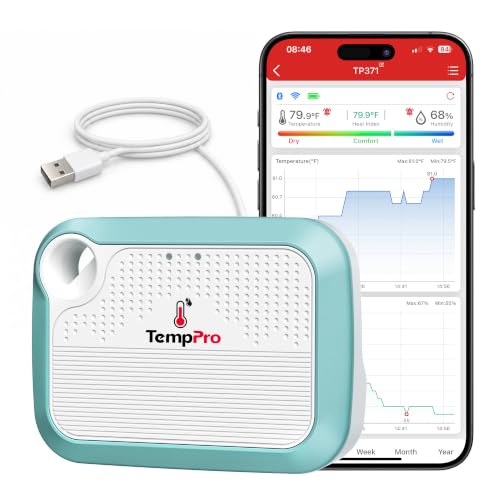
Where the freezer units are built to survive cold and moisture, the TempAir is built to sit on a shelf and tell you about the air around it. The NTC humidity sensor delivers ±0.5°F temperature and ±2% humidity accuracy with a fast response, so you get a clean picture of a nursery, greenhouse, or basement in real time. It logs 24/7 and exports minute-by-minute or hourly records, which is what you want for incubators and any space where conditions change slowly.
The power design is the quietly smart part. It runs on USB power and charges its built-in lithium battery at the same time, so you never buy batteries again. Keep it plugged in and it monitors without a gap. Unplug it and the battery carries it. You can set your own thresholds for temperature and humidity and get an instant notification when levels cross them, which protects plants, pets, and devices from a silent swing.
Be aware of the setup path up front. Bluetooth pairing and an email registration are required before the Wi-Fi features switch on, so this is not a zero-config device. It is also a small unit at 3.58 inches long, which makes it easy to tuck on a shelf but not something you would probe into a roast. The ±0.5°F accuracy is the reason to choose it — it is a meaningfully tighter figure than the ±0.9°F on the MOCREO freezer unit, and the tightness is what makes long-term tracking worth reading.
The accuracy case: ±0.5°F and ±2% humidity put it in a different precision class than the looser ±0.9°F freezer alarm, which matters when you are tracking a slow drift over days.
One thing to know: The account registration and Bluetooth pairing step is mandatory before remote monitoring works.
Pick this one if: you want precise room conditions and a history you can export for a greenhouse, nursery, or wine area.
Pass if: you need to see the inside of a freezer — this reads the room, not the appliance.
4. X-Sense Smart Wi-Fi Thermometer Hygrometer with 3 Sensors
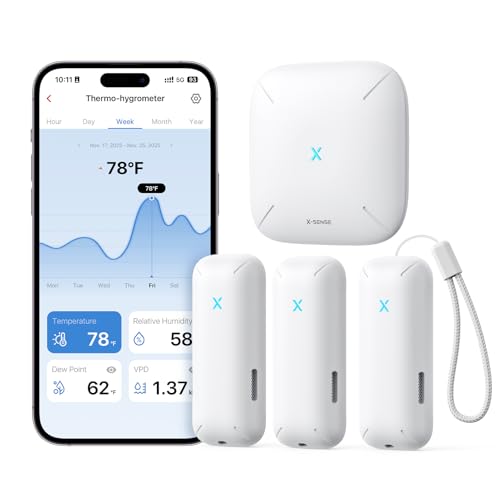
Three sensors and a base station that cover a whole house at once.
The headline here is precision. This unit reads to ±0.36°F and ±2% RH, and it also calculates dew point and VPD, or Vapor Pressure Deficit — a measure of how thirsty the air is, which growers track to keep plants happy. For a wine collection or a grow room, that second number is often more useful than plain humidity, because it tells you whether the environment is actually doing its job.
Coverage is the other reason to look at it. One base station can link up to 50 devices, including a maximum of 10 thermo-hygrometers, with range up to 1700 ft (500 m). In plain terms, you can watch a basement, a bedroom, and a storage room from one app on your phone. If temperature or humidity slips outside your set range, you get a push notification wherever you are. The app also graphs history by day, month, or year and exports the data.
Battery life is rated up to one year from 1200 mAh replaceable AAA batteries, with a low-battery alert pushed to your app so it does not die silently. Buyers report the AAA cells hold up over months of continuous use. It sits at 4.5+ stars and the tighter ±0.36°F beats the ±0.5°F on the TempAir above, though the TempAir’s humidity sensor covers the same ±2% RH figure. The honest catch is the base station: the sensors need it for app alerts, trends, and data export, so it is part of the package rather than optional.
The precision edge: ±0.36°F is the tightest temperature figure on this list, and the dew point and VPD readings give plant and wine keepers more to work with than plain humidity.
What you depend on: The SBS50 base station is required for alerts and export, so plan for that hub in your setup.
Best match for: growers, wine collectors, and anyone who wants three rooms covered from one base station.
Not for: a single freezer reading — the multi-sensor design is built for spread-out spaces, not a metal box.
5. PHYSEN WiFi Freezer Thermometer with 2 Wireless Sensors
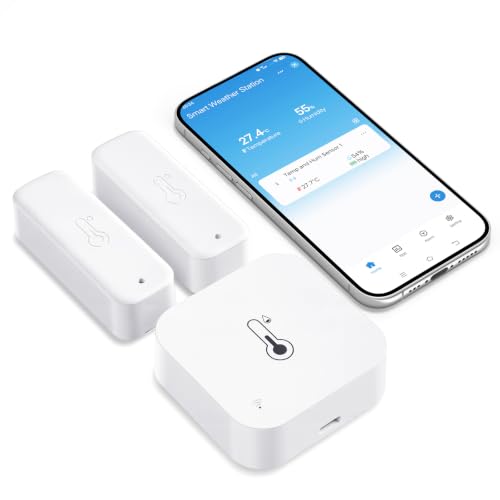
Two sensors, a long reach, and batteries that shrug off a deep freeze.
The range is the reason this one stands out. It reaches up to 492ft (150m) from sensor to hub, so a garage or basement freezer can still report to a unit inside your house. You get two IP65 waterproof sensors — IP65 meaning they are sealed against dust and splashing water — tracking both temperature and humidity, with no probe cables to route through the door seal.
Specs you should weigh before choosing it: it reads from -4°F to 140°F (-20°C to 60°C) with ±1.8°F accuracy, and humidity from 0% to 99% RH. That ±1.8°F figure is the loosest on this list, so if you need pinpoint accuracy for curing or live seafood, look at the tighter TempAir or X-Sense units instead. What this one buys you is coverage and freedom from a charging cable.
It connects over 2.4GHz Wi-Fi and pushes alerts to your phone the moment readings leave your range, so a door left open gets caught early. The batteries are freeze-resistant AAA cells rated at up to two years, and you keep them topped up by swapping in the same freeze-resistant type if you run it in a fridge. Data export covers one year in CSV with no subscription. One note the maker flags clearly: the minimum readable temperature is -20°C, so anything colder will not register.
Why The Range Wins
- Up to 492ft (150m) wireless range reaches a garage or basement fridge
- Two IP65 waterproof sensors for both temperature and humidity
- Freeze-resistant AAA batteries rated up to two years
- One-year CSV data export with no subscription fee
Where It Falls Short
- ±1.8°F accuracy is the loosest figure on this list
- Readings stop at a minimum of -20°C, so ultra-cold freezers will not register
Choose this when: range matters more than pinpoint accuracy and the freezer lives far from your router.
Skip the swap if: you monitor scientific or curing conditions — the ±1.8°F figure cannot match the ±0.36°F on the X-Sense.
6. SwitchBot WiFi Thermometer Hygrometer 3 Pack with Hub Mini

Three waterproof sensors and a hub that lets you ask Alexa about the temperature.
This is the pick for people who like to spread sensors around and ask about them out loud. A Swiss Sensirion sensor inside delivers accuracy of ±0.2°C/0.36°F and ±1.8% RH with a 4-second sampling interval, so the reading stays close to reality as conditions shift. Each sensor is IP65 dustproof and waterproof, which means one can live in a greenhouse or on a patio and still report through rain.
The extras add up: dew point, VPD, and absolute humidity as a scene condition. Beyond temperature and humidity, it reads dew point and VPD, and absolute humidity can act as a scene condition. You get up to 68 days of on-board storage, up to 2 years in the app, and unlimited cloud storage, all exportable as a CSV. The included Hub Mini adds voice control and remote commands through Alexa, Google Home, Siri Shortcuts, and SmartThings, which is more ecosystem reach than any other pick here.
The honest note is on connectivity: some homes see the link drop after a few days. Most setups work well, but a subset of homes sees the connection stop after a few days, and because these units communicate through the hub and Bluetooth, the link is the weakest part of the chain. It also sits at 4.0+ stars, the lowest on this list, reflecting that wider spread of experience. If you want raw simplicity and reliability above all, a single-hub system like the MOCREO may suit you better. If you want three sensors, voice commands, and broad smart-home support, this is the one.
The ecosystem play: The Hub Mini brings Alexa, Google Home, Siri Shortcuts, and SmartThings support that no other pick matches.
The honest caveat: Connectivity is the weak link — some homes see the link drop after a few days, so place the hub close to the sensors.
Suits you if: you want several sensors, outdoor-rated housings, and voice commands in one kit.
Not your fit if: you need set-and-forget reliability with no hub troubleshooting — a simpler single-sensor unit is steadier.
7. GoveeLife WiFi Refrigerator Thermometer 2-Pack with Gateway

Built to stop crying wolf every time you open the freezer door.
False alarms are the quiet killer of any fridge monitor — you open the door, the temperature jumps, and the phone screams for no reason. GoveeLife tackled that directly. Its anti-false alarm feature waits 1 to 10 minutes before notifying you of a temperature overrun, so a quick door-open does not trigger it. It also fixed the low-temperature false alarm that fires when a freezer compressor is simply doing its job.
The sensors are probes rather than standalone units, which lets you drop them right inside the fridge or freezer. The range is -40° to 158°F with ±0.9°F accuracy and a 2-second refresh, so the data stays current. A magnet and lanyard design plus a holder secures the probe neatly, and the LCD display lets you glance at the temperature without opening the app. The gateway supports up to 10 sensors with 197 ft (60 m) reach, all on 2.4GHz Wi-Fi.
Two things to know. The device itself does not sound an alarm, so every alert arrives through the app — no local beep like the MOCREO’s 80dB hub. You also need the H5151 WiFi gateway for remote alerts, which is included, but it is the piece that makes the whole system work. Free data storage covers 2 years, and this is a favorite for chest freezers specifically, where the temperature gap between a closed and open door gets frequent attention.
The anti-false-alarm win: A 1-to-10-minute delay before alerting means a quick door-open does not turn into a phone notification, and the compressor false-alarm fix cuts the other noisy case.
What to remember: There is no local beep — every alert goes through the app via the gateway.
The right tool for: anyone who wants a fridge or chest freezer alarm that does not cry wolf.
Not for: people who need a loud in-home siren — the app is the only alert channel here.
8. InkGrill Wireless Meat Thermometer with 4 Probes

Four probes so four cuts of meat cook at once without a juggling act.
If you regularly cook a steak, chicken, pork, and fish together, four independently marked probes solve a genuine problem. Each probe holds two sensors: one tracks internal meat temperature from 14°F to 212°F, and the other reads ambient air in your grill or oven from 32°F to 572°F. Having both tells you the cooking environment and the doneness in the same view.
Connection is flexible in a way most meat probes here are not. It offers three modes — Bluetooth for the backyard, Wi-Fi for the office, and a Local Mode for weak-signal areas — with range up to 300 feet. The app carries 28 USDA presets or a custom menu, sends alerts to your phone, and the smart base stores 30 minutes of offline data that syncs the moment you reconnect. A 25-minute charge covers 25 hours of continuous cooking, and the IP67 waterproof probes are dishwasher safe.
The base has a magnetic back and a large anti-glare VA display that stays readable in direct sun, which is a real plus on a bright patio. The honest trade-off is per-probe complexity and the fact that this is a four-probe cooking tool with no cold-storage role, so it only earns its place if you actually cook multiple cuts. Reviewers single out build quality and versatility, with overnight brisket and pork cooks as a natural use.
Where It Shines
- 4 probes with 2 sensors each track both meat and ambient air
- Three connection modes with range up to 300 feet
- 28 USDA presets and 30-minute offline data storage
- IP67 waterproof probes are dishwasher safe
What To Expect
- Four probes mean more to manage than a single-probe setup
- No cold-storage monitoring — this is a cooking tool only
Worth it for: the host who cooks several cuts at once and wants each one tracked separately.
Overkill if: you usually cook one piece of meat — a single-probe model is simpler and easier to store.
Know the Specs
Accuracy and the Plus-Minus Figure
Accuracy is written as ±X°F, meaning the reading can drift that far above or below the true temperature. A tighter number is better. The X-Sense at ±0.36°F and the TempAir and Typhur at ±0.5°F are the precise end. The PHYSEN at ±1.8°F is the loosest. For everyday fridge checks, the looser figures work fine. For curing, fermenting, or any long slow drift, tighter is worth paying for.
Wi-Fi Band and Hub Requirements
Almost every unit here connects on 2.4GHz Wi-Fi only, and a few need a dedicated hub or gateway to reach the app. 2.4GHz is the longer-reaching band and the one these devices use, which is why a 5GHz-only network will refuse to pair. The Ty
Signal Range Through Metal
A freezer is a metal box, and metal weakens radio signals. Range figures like the PHYSEN’s 492ft (150m) or the GoveeLife gateway’s 197 ft (60 m) describe how far a sensor can sit from its hub. Stronger signal technology, like the Sub-1 GHz radio in the Typhur, is what keeps a cooking probe connected through a closed smoker lid.
Battery Type and Data History
Power comes in two flavors: swap-in AAA batteries, or a built-in rechargeable cell. AAA units like the MOCREO and PHYSEN rate their cells at up to two years, so you rarely touch them. Rechargeable units like the TempAir charge while plugged in. Data export matters equally — history graphs and CSV downloads are what let you spot a slow trend rather than react to one bad reading.
Common Questions
Will a wireless internet thermometer work if my home uses 5GHz Wi-Fi?
How accurate does a freezer thermometer need to be?
Can I monitor more than one freezer with a single hub?
Do these thermometers send alerts if the Wi-Fi goes down?
Is a meat thermometer the same thing as a fridge thermometer?
How long do the batteries last in these units?
Can a wireless thermometer survive inside a freezer?
What does VPD mean on a thermometer display?
Can I export the temperature history to a spreadsheet?
Do I need a separate hub to get phone alerts?
The Bottom Line
For most people, the best wireless internet thermometer winner is the Typhur Sync Gold because its Sub-1 GHz signal keeps a cooking probe connected through closed smokers and Dutch ovens, with ±0.5°F accuracy. If you want a cold-storage alarm with layered alerts and a two-year battery, reach for the MOCREO. And for watching the whole house with three sensors and voice control, the SwitchBot 3 Pack is the one to grab. Whatever you pick, match the tool to the job — a meat probe will not watch your freezer, and vice versa.
How we choose
We do not accept paid placement. Every pick is matched to a real buyer and a real use-case; we do not hands-on test units.
Sources
Specifications: manufacturer listings and product documentation. Review insights: verified customer reviews, as of November 2026. Pricing: not shown on this page (it changes often); check the current price via the retailer link.
As an Amazon Associate, Tactical Gear Guy earns from qualifying purchases. This does not affect which products we feature.