Specs are compiled from manufacturer listings and verified buyer reviews and can change over time — please confirm the key details on the product page before buying.
Your wireless humidity sensor only helps if the reading actually reaches your phone from where the sensor sits. A sensor in a chest freezer, a basement corner, or a greenhouse forty feet from the house is useless if the signal quits at the door.
This guide is built by comparing the manufacturers’ published specifications and the patterns across verified customer reviews, so you get each pick’s real strengths and trade-offs instead of marketing spin.
Each pick below is a wireless unit that reports to an app, so the real sorting job is matching signal reach and sensor count to your space. You will see how each unit connects, what accuracy it claims, and which spots it truly suits.
Top Picks


How To Choose The Best Wireless Humidity Sensor
The reading on your phone is only as good as the journey it took to get there. Three things decide that journey: the radio the sensor uses, whether it needs a hub, and how often it wakes up to measure. Get those right and the rest is detail.
Pick the radio that matches your walls
Bluetooth is the simplest — it talks straight to your phone, with no hub and no router involved. The catch is reach. One Bluetooth meter in this list claims a 394ft connecting distance with no obstacles, and another lists a 196ft/60m range, both of which shrink fast through drywall and floors. Wi-Fi reaches you anywhere you have internet, but it is hungry on batteries and only ever joins a 2.4GHz network. LoRa is the long-distance specialist — one sensor here is rated to monitor up to 2034 feet in open air, and it deliberately does not use your Wi-Fi at all, so it never crowds your network.
Know if you need a hub before you buy
Several of these sensors are half a system. The Tapo T315 needs a Tapo H100 hub, sold separately, before it will report anything. The GoveeLife mini-sensor kit and the outdoor three-pack both depend on their included gateway to relay data to the app. A hub is not a downside — it is what buys you the longer battery life and the wider coverage — but it does mean one more plug and one more pairing step on setup day.
Match accuracy to the room that matters
For a bedroom or living room, ±3%RH (roughly three percentage points of humidity drift either way) is plenty. For a wine cellar, humidor, or reptile vivarium, the tighter ±2%RH figures are worth chasing — several picks here hit that, including the X-Sense and TempPro units. Temperature accuracy runs tighter across the board, from ±0.36°F up to ±0.54°F, and that difference only really shows up when you are protecting something expensive.
Count your sensors, then count again
A single sensor in the living room tells you nothing about the basement. Multi-packs and expandable gateways solve this — one gateway in this list pairs up to 30 sensors, and another supports up to 10. If you already know you want three or four rooms covered, buy the multi-pack first rather than adding singles later at full price each time.
Side-by-Side Comparison
| Model | Best For | Connection | Humidity Accuracy | Power | Amazon |
|---|---|---|---|---|---|
| YoLink Freezer Kit 3-Pack + Hub★ Best Overall | Freezers and outbuildings | LoRa | ±3% (10%-90%) | 2 AA, up to 5 years | Amazon |
| SwitchBot Thermometer Hygrometer 2-PackTightest Accuracy | Read-it-at-a-glance rooms | Bluetooth | ±2%RH | AAA batteries | Amazon |
| Tapo T315Best Display | Clear e-ink readout | Sub-1G via Tapo hub | ±3% RH | 2 AAA, up to 2 years | Amazon |
| Govee H5075 3-Pack | Cheap coverage of many rooms | Bluetooth | ±3%RH | Battery | Amazon |
| GoveeLife H5179 | Remote checks on the road | 2.4GHz Wi-Fi + Bluetooth | ±3%RH | 3 AA | Amazon |
| TempPro TempAir | No battery swaps, ever | 2.4GHz Wi-Fi + Bluetooth | ±2% | USB power + rechargeable | Amazon |
| X-Sense STH54 3 Sensors + Base | Whole-home multi-room tracking | 2.4GHz Wi-Fi via base station | ±2% RH (0-100%) | Battery | Amazon |
| GoveeLife Gateway Mini 3-Pack | Ten-point coverage on a budget | Wi-Fi gateway + Bluetooth | ±3% RH | 2-year battery life | Amazon |
| GoveeLife Outdoor 3-Pack + Gateway | Patio, greenhouse, outside walls | LoRa + Wi-Fi gateway | ±3% RH | 2 AAA, about a year | Amazon |
Detailed Reviews
1. YoLink Freezer Thermometer Hygrometer Kit: 3-Pack + Hub
Our pick — 4.5+★ from 950+ verified ratings; the strongest balance of quality and price.
The LoRa kit that keeps reporting from inside a sealed freezer when Bluetooth and Wi-Fi units drop out.
Most wireless sensors give up at the freezer door — the metal box blocks the radio, and the reading freezes on the last number that made it out. YoLink solves that by not using Wi-Fi or Bluetooth at all. It runs on LoRa, a long-range, low-power radio protocol that reaches up to 2034 feet in open air, so the signal pushes through a fridge wall, a gun safe, or a detached barn where ordinary wireless simply quits. Nothing else here claims that kind of reach, and it costs you zero Wi-Fi bandwidth because it never touches your router.
You get four pieces in the box — one hub and three sensors — and the listing is upfront that “Number of Items: 4 Pack” means the whole package, not four sensors. Each sensor reports to the YoLink app at a regular interval, and you can set your own thresholds for high and low temperature and humidity. Alerts can arrive as a text, an email, or a push notification, and Apple users can push it through silent mode with Critical Alerts. Battery life is the headline: two AA cells per sensor, rated for up to 5 years, against up to 2 years for the Tapo T315 — a real difference when the sensor lives behind a chest freezer you have to drag out to reach.
Accuracy is commercial-grade rather than lab-tight: ±0.36°F from 0°C to 54°C, ±0.72°F from -20°C to 0°C, and ±3% humidity across the 10%-90% range, with a working span of -4°F to 129°F. The tighter ±0.36°F actually beats the Govee H5075’s ±0.54°F, which is the number to weigh if you are protecting frozen stock. The honest catch is voice control — Alexa reads temperature only, humidity is not supported yet, and triggering Alexa routines is not supported at this time. If your plan was to have Alexa kick on a dehumidifier, this is not the pick for that.
Where it genuinely wins
- LoRa signal reaches up to 2034 feet in open air and works inside a freezer, so remote sheds and appliances stay online.
- Up to 5 years on two AA batteries per sensor — the longest reported span in this group.
- Custom alerts by text, email, or push, with Apple Critical Alerts that break through silent mode.
- Three sensors plus the hub in one box, so you can cover freezer, fridge, and room together.
- Keeps your Wi-Fi network completely uncrowded.
What to weigh first
- Alexa reads temperature only; humidity is not supported at this time and routines cannot be triggered.
- Free text alerts are capped at 5 per device plus 5 — a hub and one sensor gives you 15 free SMS a month.
- At ±3% humidity it is looser than the ±2%RH units here.
The call: Buy this if your sensor has to live somewhere signal normally dies — a freezer, a safe, a barn, a garage three floors from the router.
Look elsewhere if: you need tight ±2%RH humidity tracking in a humidor or vivarium, where the X-Sense or TempPro fits better.
2. SwitchBot Thermometer Hygrometer 2 Pack
A 3-inch wall display you can read across the room, backed by ±2%RH humidity accuracy.
Start with the number that matters in a cellar or a humidor: ±2%RH humidity accuracy across 0-99%RH, which is the tightest claim on this list outside the X-Sense and TempPro. Temperature holds ±0.2°C/±0.4°F from -4°F to 176°F, and the built-in Swiss-made sensor refreshes ten times per second. That speed is overkill for a bedroom and exactly right when you are watching a curing chamber or a greenhouse swing.
The 3-inch bold display is the reason to mount this one where eyes land on it. Vivid icons flag whether conditions meet your custom set parameters, so you get a dry/comfort/wet read at a glance without opening the app. Data is stored on-board for up to 68 days and in-app for up to 2 years, exportable as a.csv file, and the 394ft connecting distance (no obstacles) means you can pull the numbers from another room. Push notifications and dewpoint/VPD readings need a SwitchBot Hub, which is sold separately — worth knowing before you count on phone alerts.
Mounting is more flexible than most: wall plate, magnetic surface, or standing upright on a table in three angles. At 64 g it disappears on a shelf. The real limit is distance — Bluetooth only, so a thick floor between you and the meter will thin that 394ft figure considerably. For a single-room or single-floor setup, that is a non-issue.
Room to breathe: The big screen and fast refresh make this the easiest one to trust at a glance — you glance up, you know the humidity, no phone required.
One honest caveat: Bluetooth range is the ceiling here; alerts to your phone also require a hub you buy separately.
Worth grabbing if: you want tight ±2%RH readings and a display legible from across the room.
Think twice if: the sensor lives two floors from where you sit, since Bluetooth alone will struggle.
3. Tapo T315
A 2.7-inch e-ink panel that stays glare-free from any angle and runs up to 2 years on two AAA cells.
The 2.7-inch e-ink display is the whole personality of this unit. It shows temperature, humidity, comfort level, battery status, and signal strength with a wide viewing angle and no glare — the same trick a Kindle uses, which is why it draws so little power. Data updates every 2 seconds off a Swiss-made sensor chip, at ±0.54°F and ±3% RH accuracy, and the free storage side is generous: two years of data export at no charge, with periodic summaries built in.
Here is the part that trips people up. The T315 needs a Tapo H100 hub, sold separately, plus a secured 2.4GHz Wi-Fi network before it does anything. It talks to that hub over the Sub-1G Low-Power Wireless protocol, which is what buys the wider coverage and the longer battery life compared with plain Wi-Fi. Two AAA batteries are included and rated for up to 2 years, though that figure comes from TP-Link’s own lab results under normal use — real-world numbers will vary with how cold or busy the room is.
Against the GoveeLife H5179 at ±3%RH and ±0.54°F, this matches on paper and adds the e-ink panel the H5179 does not have. The trade-off is that hub dependency — if you are not already in the Tapo ecosystem, you are buying an extra box and a second setup step on day one.
Reach for this if: you want a screen you can read in daylight from across a kitchen, and you are okay adding the Tapo hub.
Look past it if: you want a hub-free sensor that pairs straight to your phone.
4. Govee H5075 3Pack

Three Bluetooth meters in one box, all reporting to the Govee Home app — the cheapest way to cover three rooms.
You get three separate sensors in one box, which is the practical answer to a question every multi-room buyer hits: how do I watch the basement and the bedroom without buying twice? Each H5075 runs a 3-inch bright LCD showing max/min records and dry/comfort/wet indicators, backed by a Swiss-made sensor at ±0.54°F and ±3%RH with a 2-second refresh. Set the app up once — download Govee Home, find H5075, pair — and you are live in about a minute per unit.
The Bluetooth range claim is 196ft/60m, and that is the honest ceiling. Owners love the readings and the price, but the connectivity chatter is the one split note in an otherwise happy crowd — drywall, floors, and distance all eat into a Bluetooth signal. In a single-floor home it is fine; across three floors you may find yourself walking closer to pull data. Storage helps here: 20 days online, with the last 2 years exportable to CSV, so a missed live reading is not a lost record.
Humidity lands at ±3%RH — the Govee H5075 gives up a point to the ±2%RH SwitchBot above, but you are covering three rooms instead of two. For a garage, wine cellar, baby nursery, or plant shelf, that three-pack math is hard to argue with.
Why the three-pack works
- Three sensors in one purchase — realistic coverage of basement, bedroom, and garage.
- 2-second refresh and 3-inch easy-read LCD with min/max records built in.
- 20 days of online storage and 2-year CSV export at no extra charge.
- Setup is genuinely quick through the Govee Home app.
Where it asks patience
- Bluetooth only at 196ft/60m — thick walls and floors shorten that reach.
- ±3%RH is looser than the ±2%RH SwitchBot and X-Sense picks.
- No hub option to extend range the way the gateway kits do.
Worth grabbing if: you want three rooms monitored for roughly the price of one premium unit.
Think twice if: the rooms sit far apart on different floors — Bluetooth will be your bottleneck.
5. GoveeLife H5179

Pushes 2.4GHz Wi-Fi readings to your phone from anywhere — reptile tank, incubator, or greenhouse.
Wi-Fi is the whole point here. The H5179 pushes readings to the GoveeHome app over a 2.4GHz network, so you can glance at the incubator from a hotel room, not just the next room over. It pairs Wi-Fi with Bluetooth for local setup and supports a home-screen widget for a one-tap check. Readings refresh every 2 seconds from a Swiss-made sensor at ±0.54°F and ±3%RH, with a working range of -4°F to 140°F.
Alerts are where this earns its place. Set your threshold for a reptile tank, incubator, or wine cellar, and the app pushes a notification when the number crosses it — enough warning to react before a batch or a habitat is stressed. Storage is 20-day online graphs with export of the last 2 years. Three AA batteries are included, and the listing notes a low-battery indicator and lanyard loop for hanging. It also pairs with GoveeLife smart appliances, so a linked humidifier can adjust the air without you touching anything.
One hard limit: 5GHz Wi-Fi is not supported. If your router splits bands and the sensor cannot see the 2.4GHz side, you will fight the pairing screen. The connectivity feedback on this one runs mixed — some buyers report Wi-Fi hiccups — so it is worth confirming your 2.4GHz network is solid before you buy.
Best use case: a sensor that needs to report to a phone carried out of state — incubators and reptile setups are the classic fit.
The honest snag: 5GHz networks are off the table, and Wi-Fi reliability has been uneven for some owners.
Reach for this if: you want remote Wi-Fi monitoring and a widget on your phone home screen.
Skip if: your only network is 5GHz — this sensor will not join it.
6. TempPro TempAir
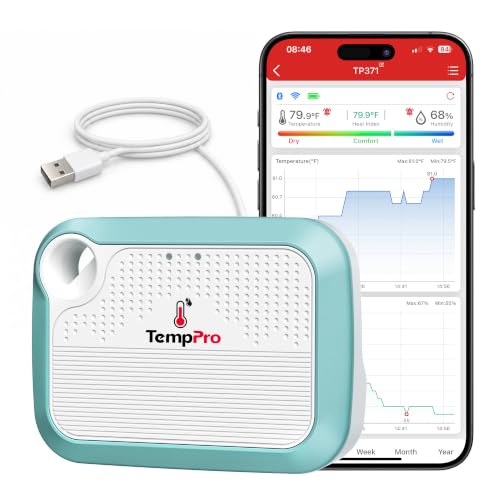
Runs on USB power while its built-in rechargeable battery charges, so it never needs a fresh cell.
Most sensors make you plan for a battery swap in a year or two. The TempAir sidesteps that entirely: it runs on USB power while its built-in rechargeable lithium battery charges at the same time, so a plugged-in unit monitors around the clock without ever asking you for a fresh cell. For a crawl space, attic, or greenhouse you dread crawling into, that is a genuine convenience, not a spec-sheet curiosity.
The sensor is an NTC humidity sensor (a temperature-sensitive resistor type) delivering ±0.5°F and ±2% humidity accuracy — the tight humidity figure puts it alongside the X-Sense and the SwitchBot, not the ±3%RH crowd. Data logs 24/7 with minute or hourly export, which is the sort of trail you want for an incubator or a long-running greenhouse comparison. Thresholds are yours to set, with instant notifications when temperature or humidity crosses them, so plants, pets, and equipment stay inside their safe band.
Setup asks for Bluetooth pairing and email registration, and it is 2.4GHz Wi-Fi only — 5GHz is not supported. The privacy note is right on the listing, which is refreshingly direct. One trade-off worth naming: this is a plugged-in unit at heart, so placement depends on having a USB outlet nearby, unlike the battery-only sensors above that go anywhere.
The call: right pick if a power outlet sits near the spot you want monitored and you never want to think about batteries.
Look elsewhere if: your monitoring spot has no outlet — you need one of the AA or AAA units.
7. X-Sense 3 Sensors & Base Station

Three ±2%RH sensors plus a base station rated for 1,700ft of open-air reach and expandable to 10 sensors.
This is the multi-room system for a big house. Three sensors plus an SBS50 base station go in the box, and that base supports up to 10 sensors total if you expand later. X-Sense rates the open-air transmission range to 1,700 ft (500 m), which is the number that matters when your sensors sit in an outdoor humidor, a detached greenhouse, or the far end of a multi-level home. Add it through the X-Sense app over 2.4GHz Wi-Fi.
The accuracy is genuinely tight: a Swiss-made high-precision sensor at ±0.36°F (±0.2°C) across a -4–140°F range, and ±2% RH across 0-100% RH. That ±0.36°F matches the YoLink’s best-case figure and edges the Govee H5075’s ±0.54°F. The sensors are compact at 1.4 × 0.9 × 3.7 in, so they slot into an electric humidor, a reptile vivarium, or anywhere small — a lanyard loop handles hanging. Alexa can answer questions like “what’s the humidity of the wine cabinet now?” and you get free CSV export of the past year’s data.
The recurring friction on this one is connectivity — the mixed feedback sits there. Expect to confirm that your base station is on a healthy 2.4GHz signal, since 5GHz is not supported. Set that up right and the rest of the system is a well-organized multi-room monitor.
What this kit does well
- Three sensors with a base station that supports up to 10 total.
- ±2% RH humidity and ±0.36°F temperature — the tight end of this list.
- 1,700 ft open-air range suits a large home or a detached outbuilding.
- Free yearly CSV export and Alexa voice queries.
Where it needs attention
- Connectivity feedback is mixed — a strong 2.4GHz signal near the base is essential.
- 5GHz Wi-Fi is not supported.
- The base station is one more piece to place and power.
The call: the right system if you want a big house or outbuilding covered with several tight-accuracy sensors from one app.
Think twice if: you want a single stand-alone sensor — this kit is overkill for one room.
8. GoveeLife 2.0 Mini Sensor 3-Pack
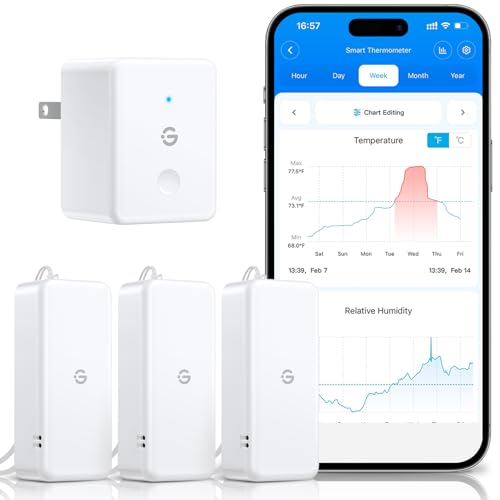
A gateway plus three pocket-sized mini sensors, expandable to 10, at ±3%RH accuracy.
Where the Govee H5075 leans on Bluetooth, this kit puts a gateway in the box and lets the sensors talk through it. That gateway pairs up to 10 humidity sensors, so you can start with three (wine cellar, drawer, guitar case) and add more later without replacing the brain. It supports 2.4GHz Wi-Fi only, and the sensors carry a 2-year battery-life rating — the same span as the Tapo T315, though shorter than the YoLink’s 5-year figure.
Readings come from a Swiss-made sensor at ±0.54°F / ±0.3℃ and ±3% RH (relative humidity — how much moisture the air holds), refreshed every 2 seconds. That is the standard-issue accuracy tier, not the ±2%RH tight tier of the X-Sense or TempPro. Where it earns points is alerting: set your values in the app and you get a notification by app and email when the sensor crosses them, so a wine cellar swing reaches you even if the app is closed. Storage looks back 20 days in trend charts with 2-year export.
The mini sensors are genuinely pocket-sized, lanyard-equipped, and fit in odd spots a big display never would. The mixed notes are wireless connectivity and value — worth knowing you are getting ±3%RH accuracy for your money, not the tight tier.
Worth grabbing if: you want gateway-based reach and up to 10 sensors without paying premium prices.
Look past it if: ±2%RH is a hard requirement for your setup.
9. GoveeLife Outdoor Indoor 3 Pack
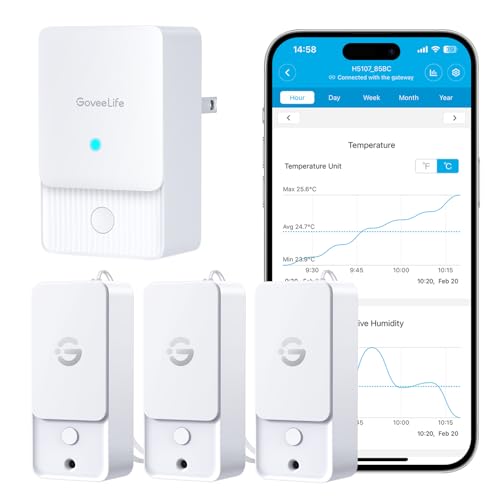
The one built for weather — IP65 sealed and rated to 1,312 feet over LoRa.
Most of the sensors on this list want to live indoors. This three-pack is the exception: IP65 waterproofing means it shrugs off rain and hose spray, so it can sit on a patio, in a greenhouse, or on an outdoor wall and keep reporting. The LoRa radio covers up to 1,312 feet, and the Wi-Fi gateway relays the data to your phone from anywhere. One gateway here can pair up to 30 sensors — the widest expansion in this group.
Accuracy holds up at ±0.54°F temperature and ±3% RH humidity across 0%-99%RH, with a working range topping out at 140°F. Two AAA batteries per sensor are rated for a year, which is the shorter end of the battery spectrum here — plan on an annual swap for the outdoor units. Alerts are customizable so a greenhouse or patio swing pushes a phone notification when it crosses your line.
Two things to know before buying. The H5107 sensors require the gateway to function — a sensor alone will not display data — and they are not compatible with Gateway 5042. Also 5GHz Wi-Fi is not supported. Set expectations there, and this is the outdoor-capable piece the rest of the list is not.
Outdoor-ready strength: IP65 sealing plus LoRa range is a combination none of the indoor-first units here offer, and 30-sensor expansion covers a full acreage.
Honest trade-off: a one-year battery rating on AAA cells means more frequent swaps than the multi-year indoor units, and the gateway is mandatory.
Reach for this if: your monitoring has to survive rain — patio, greenhouse, outdoor wall — and you want room to grow to many sensors.
Skip if: everything you monitor sits indoors and you never want to think about a gateway.
Know the Specs
Humidity accuracy (±2%RH vs ±3%RH)
The ± sign means “give or take” — a ±3%RH sensor can read three percentage points off the true humidity, while a ±2%RH unit holds to two. In a bedroom that gap does not matter. In a wine cellar, humidor, or reptile vivarium, that one point is exactly the margin you want. The tightest claims here come from the X-Sense, TempPro, and SwitchBot at ±2%RH; the rest sit at ±3%RH, which is still fine for everyday comfort tracking.
Radio type: LoRa, Wi-Fi, and Bluetooth
These are three ways a sensor gets its reading to your phone. Bluetooth talks directly to your phone with no hub, but reach is short — 196ft to 394ft in the clear. Wi-Fi reaches you anywhere with internet, but drains batteries faster and joins only 2.4GHz networks. LoRa is a long-range, low-power protocol that reaches up to 2034 feet and deliberately skips your Wi-Fi — the trick that lets one sensor here report from inside a freezer or a distant barn.
Hub or gateway required
Some sensors are only half a system. The Tapo T315 needs a Tapo H100 hub sold separately. The GoveeLife kits ship their gateway in the box. The reason to accept a hub is battery life and range — a sensor relaying through a hub does less radio work itself, so the cells last longer and the signal reaches farther. Check the box contents before you buy a lone sensor.
Refresh rate and data storage
Refresh rate is how often the sensor takes a new reading. A 2-second refresh catches swings a slower unit might miss, which matters for incubators and curing rooms. Storage is the history kept for you — several picks here keep 20 days of online charts and let you export up to 2 years as a CSV file (a plain spreadsheet file), so you can study a season of humidity by hour.
Common Questions
Will a wireless humidity sensor work inside a fridge or freezer?
Do I need a hub to use a Tapo or GoveeLife sensor?
What is the difference between ±2%RH and ±3%RH accuracy?
How often does the sensor send data to my phone?
Can a wireless humidity sensor survive outdoors?
How long do the batteries actually last?
Will these sensors connect to 5GHz Wi-Fi?
Can I export the temperature and humidity history?
How many sensors can one gateway handle?
Is a Bluetooth sensor or a Wi-Fi sensor better for a wine cellar?
The Bottom Line
For most people, the best wireless humidity sensor here is the YoLink Freezer Kit — it reaches where other wireless quits, runs up to 5 years on AA cells, and hands you three sensors plus a hub in one box. That combination of signal reach and battery life is not matched by anything else on this list.
If tight ±2%RH accuracy is your priority, reach for the X-Sense three-sensor kit for a whole house, or the SwitchBot 2-pack for a single room with a big display. For a patio or greenhouse that has to survive weather, the GoveeLife outdoor three-pack is the one to grab. And if you are covering many rooms on a budget, the Govee H5075 three-pack gets three sensors into three rooms while staying affordable.
Whichever you pick, confirm two things before buying: whether a hub is included, and whether your Wi-Fi is 2.4GHz. Get those right and any of these nine sensors will keep your freezer, cellar, or greenhouse reporting reliably.
How we choose
We do not accept paid placement. Every pick is matched to a real buyer and a real use-case; we do not hands-on test units.
Sources
Specifications: manufacturer listings and product documentation. Review insights: verified customer reviews, as of November 2026. Pricing: not shown on this page (it changes often); check the current price via the retailer link.
As an Amazon Associate, Tactical Gear Guy earns from qualifying purchases. This does not affect which products we feature.