Specs are compiled from manufacturer listings and verified buyer reviews and can change over time — please confirm the key details on the product page before buying.
If your fridge, attic, or greenhouse is the thing you actually worry about, buy a sensor that reaches it — and that means looking at range and battery before anything else. The YoLink YS8007 three-pack is the one to beat: it reaches up to 2034 feet in open air and runs up to 5 years on two AA batteries. Everything below is sorted by what you actually need to monitor, from a sub-zero freezer to a crawl space where Wi-Fi simply dies.
This guide is built by comparing the manufacturers’ published specifications and the patterns across verified customer reviews, so you get each pick’s real strengths and trade-offs instead of marketing spin.
Remote monitoring only works if the signal survives the wall, the door, and the distance between you and the reading. That is why the picks here lead with reach, battery life, and accuracy rather than app flash, and it is exactly the filter I used to build this list of the wireless humidity and temperature sensor options that hold their connection where ordinary gadgets give up.
Top Picks

How To Choose The Best Wireless Humidity and Temperature Sensor
The first decision is not the brand — it is how the sensor talks to you. A Bluetooth sensor only reports while you are standing near it. A Wi-Fi sensor needs your home network to reach the spot. A hub-based or RF sensor uses its own radio link, so it can sit in a fridge, a barn, or a sealed cooler and still check in.
Match the radio to the room
If the room already has strong Wi-Fi, a Wi-Fi model gives you live readings from anywhere. If the spot is a metal freezer or a basement corner, look for a system that does not lean on Wi-Fi at all. The YoLink unit uses a LoRa radio (a long-range, low-power signal that bypasses your home network) and quotes up to 2034 feet of open-air reach, while the Ambient Weather sensor runs on RF at up to 300 feet.
Read the accuracy numbers, not the display size
Accuracy is written as a tolerance: ±0.36°F means the reading stays within 0.36 degrees of the true temperature. A ±2% RH humidity figure tells you how far the moisture reading can drift. Tighter tolerances matter when you are protecting a humidor, a reptile vivarium, or a wine cellar where a few points of humidity change the outcome.
Check what powers it and how often it reports
Battery claims range widely — up to 5 years on two AA cells for the YoLink, up to 2 years on AAA cells for the Tapo T315. A rechargeable unit like the TempPro trades battery swaps for a USB cable you keep plugged in. Refresh rate matters too: a sensor that reports every 2 seconds catches a fast swing, while a 71-second refresh is fine for slow room conditions.
Side-by-Side Comparison
| Model | Best For | Wireless Type | Battery Life | Temp Accuracy | Amazon |
|---|---|---|---|---|---|
| YoLink YS8007 3-Pack★ Best Overall | Freezers, barns, long-distance rooms | LoRa (hub required) | Up to 5 years (2×AA) | ±0.36°F | Amazon |
| X-Sense STH54Most Versatile | Whole-home coverage with three sensors | Wi-Fi 2.4GHz + base station | — | ±0.36°F | Amazon |
| TempPro TempAirBest for Long-Term Logging | Long-term logging, no battery swaps | Wi-Fi 2.4GHz + Bluetooth | Rechargeable USB | ±0.5°F | Amazon |
| GoveeLife H5179 | Remote Wi-Fi checks on a budget | Wi-Fi 2.4GHz + Bluetooth | 3×AA (included) | 0.54°F | Amazon |
| Tapo T315 | A display you can read across the room | Sub-1G (Tapo hub required) | Up to 2 years (2×AAA) | ±0.54°F | Amazon |
| Govee H5075 3-Pack | Cheap multi-room Bluetooth coverage | Bluetooth 196ft | — | ±0.54°F | Amazon |
| Ring Temperature & Humidity Sensor | Mold-risk alerts in forgotten spaces | Amazon Sidewalk | — | — | Amazon |
| Ambient Weather WH31E | Adding channels to a weather station | RF 915MHz, 300ft | 2×AA (not included) | — | Amazon |
| GoveeLife H5110 3-Pack | Tiny sensors for drawers and cases | Bluetooth 262ft | Up to 2 years (2×AAA) | ±0.54°F | Amazon |
Detailed Reviews
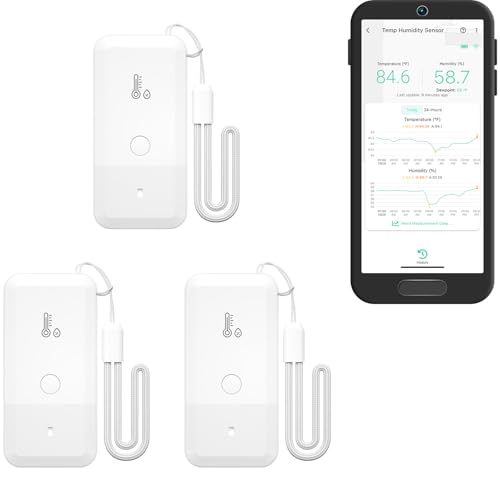
1. YoLink Freezer Thermometer Hygrometer, 3-Pack, YS8007
Our pick — 4.5+★ from 950+ verified ratings; the strongest balance of quality and price.
Up to 2034 feet of LoRa reach and up to 5 years on two AA cells — this is the freezer and barn sensor that Wi-Fi cannot follow.
The YoLink YS8007 solves the problem every other sensor in this category quietly avoids: the signal has to get out of a closed metal box. It runs on a LoRa radio (a long-range, low-power signal that does not touch your home Wi-Fi), and YoLink quotes up to 2034 feet of open-air reach. The Ambient Weather WH31E below tops out at 300 feet, so the YoLink gives you a far wider placement radius for the same job.
Battery life is the other half of the LoRa pitch. Two AA batteries run it for up to 5 years depending on usage and conditions, against a 2-year ceiling on the Tapo T315. For a sensor mounted inside a chest freezer or up in a barn rafter, the 5-year-versus-2-year gap decides how often you climb a ladder with fresh AAAs. Accuracy holds up too: ±0.36°F from 0°C to 54°C and ±3% humidity, which is tighter than the ±0.54°F the Govee H5075 quotes.
Set custom high and low thresholds and the alerts arrive by push, email, or text. Freezers are the use case buyers report most enthusiastically — the sensor keeps reporting temperature on roughly a five-minute cycle so you get a steady stream rather than a single snapshot. You need a hub, sold separately, so factor that into the setup before you buy the three-pack.
Where it wins outright
- Up to 2034 feet of open-air reach, far beyond the 300-foot RF ceiling on the Ambient Weather unit
- Up to 5 years on two AA batteries, with low-battery alerts in the app
- ±0.36°F temperature accuracy and ±3% humidity across 0% to 100% RH
- Text, email, and push alerts with custom thresholds, plus IFTTT and Alexa temperature queries
The fine print before you buy
- A hub is required for the app and all alerts, and it is sold separately
- Alexa voice queries cover temperature only — humidity is not supported there
- SMS is capped at 5 messages per device plus 5
Reach for this if: your sensor has to live in a freezer, a gun safe, a barn, or a building far from your router — the LoRa link and 5-year battery are built for exactly that.
Budget for one extra thing: the hub, because without it the three sensors will not talk to your phone at all.
2. X-Sense Wi-Fi Thermometer Hygrometer
Three sensors and a base station out of one box — whole-home coverage without buying anything twice.
Coverage is the entire argument here. The X-Sense STH54 ships with a base station and three sensors, and that base station handles up to 10 sensors in total. Point them at a humidor, a reptile vivarium, and a wine cabinet and you are watching all of it from one app. The open-air transmission range reaches 1700 feet, so a detached garage or a multi-level house is inside the envelope.
The Swiss-made temperature sensor is rated to ±0.36°F across a -4°F to 140°F range, with humidity at ±2% RH across 0% to 100% RH. That humidity tolerance is the tightest figure on this list. Set your own thresholds and the app pushes a notification the moment a reading crosses them, which is the whole point when you are away and a humidor is drifting.
Data exports as CSV free for the past year, and Alexa answers questions like the humidity in your wine cabinet. Wi-Fi compatibility is 2.4 GHz only — a 5 GHz network will not connect. The connectivity aspect draws the most mixed feedback in this sensor’s reviews, so keep the base station reasonably central rather than buried behind a metal shelf.
The multi-room math: three sensors plus a base in one purchase is the reason this sits so high — you get the coverage of three separate buys with one app and one setup.
Plan your network: it needs 2.4 GHz Wi-Fi and will not join a 5 GHz band, so check your router settings before you unbox.
Buy it if: you want one system watching several rooms at once and a 1700-foot radio link to the base.
Look elsewhere if: your router is locked to 5 GHz only, or you need a sensor inside a sealed metal freezer — Wi-Fi is not the right tool there.
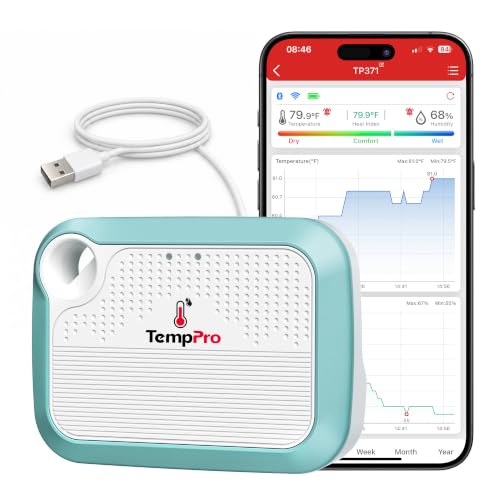
3. TempPro TempAir WiFi Thermometer Hygrometer
The sensor you never feed batteries to — it runs on USB power and recharges its built-in lithium cell while it logs.
Rechargeable is the whole idea: USB power in, lithium cell topped up, no battery swaps. The TempPro TempAir runs on USB power with a built-in rechargeable lithium battery charging at the same time, so it monitors nonstop with nothing to swap. Its NTC humidity sensor (a sensor type that responds quickly to moisture change) delivers ±0.5°F temperature and ±2% humidity accuracy with a fast response — that humidity figure matches the X-Sense unit and beats the ±3% RH quoted by most of the budget sensors here.
Tracking runs 24/7, and minute or hourly records export for analysis. You also get daily, weekly, and monthly views in the app, which is what turns a readout into a trend you can actually act on. Set your own thresholds for temperature and humidity and a notification lands the moment either one crosses the line — useful in a greenhouse, an incubator, or a tent while you are travelling abroad.
One setup step you should know about: Bluetooth pairing plus an email registration are required before the Wi-Fi side works. The connection is 2.4 GHz only and 5 GHz is not supported. Buyers describe the app as quick to check and easy to read, with temperature history viewable on the phone.
Why the recharge matters: a sensor in a crawl space or a camping tent is not one you want to revisit. The USB-powered design removes that chore entirely.
The honest catch: it needs a USB power source at the spot, so a freezer or a distant barn with no outlet is not its home — that job belongs to a battery sensor.
Best suited to: greenhouses, incubators, and offices where an outlet sits within reach and you want continuous logging without battery changes.
Think twice if: the location has no power nearby — this one wants to stay plugged in.
4. GoveeLife WiFi Thermometer Hygrometer H5179

Readings every two seconds over 2.4 GHz Wi-Fi, with batteries already in the box.
Every two seconds is the detail that separates this from slower sensors. The GoveeLife H5179 refreshes on that cycle through a 2.4 GHz Wi-Fi and Bluetooth link, and the Swiss-made sensor holds 0.54°F temperature accuracy and 3% RH humidity across a -4°F to 140°F range. It also supports a widget, so the current numbers sit on your phone home screen without opening the app.
Preset a high and a low, and a notification fires the moment either one is crossed. That covers reptile tanks, incubators, greenhouses, basements, and wine cellars — the places where you are not standing when the trouble starts. Three AA batteries come included, and the lanyard loop lets you hang it where shelf space runs out.
Home automation is a quiet bonus: pair it with a GoveeLife humidifier and the humidity adjusts to a comfortable range without you touching a dial. It is 2.4 GHz only and will not join a 5 GHz network. Connectivity is the aspect that draws the most mixed feedback here, so keep it within solid Wi-Fi range rather than on the far side of a brick wall.
What earns its place
- 2-second refresh keeps the reading current during a fast swing
- 0.54°F and 3% RH accuracy from a Swiss-made sensor
- Batteries included, plus a lanyard loop for hanging
- Widget support and pairing with GoveeLife appliances for automation
What to weigh against it
- No 5 GHz Wi-Fi support
- Wi-Fi connectivity is the shakiest part of the package for some buyers
- No hub backup — if Wi-Fi drops, so does the live reading
Worth picking up for: incubators, reptile tanks, and greenhouses where you want a fresh reading every couple of seconds and a home-screen widget.
The one compromise: it leans entirely on 2.4 GHz Wi-Fi, so a spot with weak signal is a poor fit.
5. Tapo Smart Temperature and Humidity Monitor T315

A 2.7-inch E-ink screen you can read from across the room, glare-free, without draining the batteries.
Most sensors in this category make you open an app to see anything. The Tapo T315 puts it on a 2.7-inch E-ink display (a screen that holds its image without using power to refresh it) showing temperature, humidity, comfort level, battery status, and signal strength. Wide viewing angle, no glare, and it sips power rather than draining it.
Behind the screen sits a Swiss-made sensor chip updating every 2 seconds at ±0.54°F and ±3% RH humidity, across a 0% to 99% RH range. Two AAA batteries come included and are rated up to 2 years, a figure TP-Link ties to its own lab results under normal use. Compare that to the up-to-5-year claim on the YoLink and you can see the cost of a live screen.
The data side is generous: it records temperature and humidity and builds periodic summaries, with 2 years of data export free. You need a Tapo H100 hub, sold separately, and a secured 2.4 GHz Wi-Fi network. The sensor talks to the hub over a Sub-1G low-power protocol, which is how it stretches battery life and broadens coverage beyond a plain Wi-Fi link.
The display advantage: a glanceable E-ink readout is what you want on a kitchen counter or a nursery shelf, where checking a phone every time is annoying.
The hub cost: the H100 is mandatory and not in the box — budget for it or the sensor is a very nice paperweight.
Made for: anyone who wants the numbers visible at a glance on a counter or wall, not buried in an app.
Not the pick if: you refuse an extra hub purchase or need a sensor inside a sealed metal space.
6. Govee Hygrometer Thermometer H5075 3Pack

Three Bluetooth room sensors in one box, each with a 3-inch LCD bright enough to read across a kitchen.
Three sensors in the box is the reason this lands so often on a shortlist. The Govee H5075 pairs through the Govee Home app in about a minute, and Bluetooth reach runs to 196 feet (60 m) — enough for a room-to-room sweep on one floor. The 3-inch bright LCD shows max and min records plus dry/comfort/wet indicators, so you read the room without a phone at all.
Accuracy is quoted at ±0.54°F and ±3% RH from a Swiss-made sensor, refreshing every 2 seconds — the same ±0.54°F figure the Tapo and GoveeLife mini units carry, and looser than the ±0.36°F the YoLink and X-Sense reach. Storage is 20 days of online data, with the latest 2 years exportable to CSV. Set a range and the app notifies you the moment either limit is breached.
Bluetooth is the trade-off. This sensor reports while you are in range, so it is not a leave-the-house-and-check solution. Bluetooth connectivity is the mixed part of the feedback pattern here, and a metal wall between you and the sensor is the usual culprit. Keep them in the same open space and they behave.
Where the value sits: a 3-inch readable LCD on three separate sensors makes this the easiest way to check several rooms without buying three separate gadgets.
The Bluetooth limit: step out of the 196-foot range and you get silence — this is an at-home tool, not a remote alarm.
Reach for these if: you want cheap coverage of a bedroom, a basement, and a wine cellar you check while walking around the house.
Pass if: you need alerts when you are away from home — Bluetooth will not carry that far.
7. Ring Temperature & Humidity Sensor
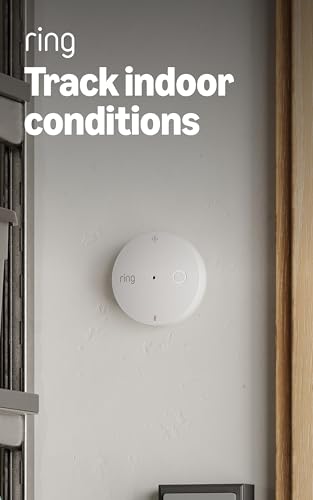
Built for the rooms you forget — and it keeps talking when your Wi-Fi stops.
Humidity creeping up in a crawl space is a problem you find out about too late. The Ring sensor watches basements, attics, crawl spaces, garages, and laundry rooms, and alerts you when humidity changes may signal mold risk or excess moisture. It also tracks bedrooms, nurseries, and living spaces for comfort swings. Indoor use only, and it pairs with the Ring Air Quality Monitor, sold separately, if you want a wider picture of the home.
The clever part is how it stays online. Amazon Sidewalk (a low-power shared network that keeps low-bandwidth devices connected) carries the signal in basements, attics, and other hard-to-reach spaces, with coverage that may vary. You do not need a base station, and the sensor keeps reporting even when the Wi-Fi drops.
Setup is the easy half — pairing is straightforward and temperature readings hold up. Setting high and low thresholds for both temperature and humidity lets you decide what counts as a problem before it happens. Ring does not publish a temperature tolerance figure here, so if you need a documented ± spec to protect a humidor or a vivarium, one of the Swiss-sensor models above is a cleaner fit.
Why it earns a slot: Sidewalk connectivity means the sensor survives a Wi-Fi outage, which almost nothing else on this list can claim.
The gap to know: no published accuracy figure — fine for spotting a trend, less suited to a precision job.
Good fit for: a crawl space, attic, or garage where the real fear is moisture and mold, not a half-degree of drift.
Skip it for: a humidor or reptile vivarium where you want a documented tolerance to hold a tight range.
8. Ambient Weather WH31E Thermo-Hygrometer Sensor

A channel-filler, not a standalone — but inside an Ambient Weather station it does its job cleanly.
Buy this and you get one indoor/outdoor thermo-hygrometer sensor with no screen of its own and no app. It feeds an Ambient Weather Station console instead, over a 915 MHz RF link rated to 300 feet (100 feet in most conditions) with a 71-second refresh. If you already own the station, that is a straightforward add; if you do not, this is not the sensor you are looking for.
Its real talent is expansion. The sensor supports up to 8 channels, so you can spread units across a greenhouse, a shed, a garage, and a basement and read them all from one console. Two AA batteries power it, and they are not included. For comparison, the YoLink reaches 2034 feet against this unit’s 300, so placement matters far more here.
Reliability is what carries it — as owners mention, the device connects instantly to the weather station console and lets you view several sensor locations on the screen at once. The console display, value, and compatibility sit in mixed-feedback territory, so go in expecting a clean signal close to the console and a weaker one at distance. Calibration gets units to agree once they are in range.
Why station owners keep buying it
- Up to 8 channels for multi-point coverage from one console
- Instant console pairing once the batteries go in
- 71-second refresh is steady enough for room and outdoor conditions
What limits it
- Requires an Ambient Weather Station — no app, no phone monitoring on its own
- 300-foot range, dropping to 100 feet in most conditions
- Batteries not included
Only worth it if: an Ambient Weather console already sits on your desk and you want to add another room or an outdoor spot to it.
Wrong tool otherwise: without that console it has nothing to talk to — pick a Wi-Fi or hub sensor instead.
9. GoveeLife Bluetooth Hygrometer Thermometer H5110

Tiny lanyard-hung pucks that disappear into a drawer, a guitar case, or a wine cabinet.
Placement is where these win. Each H5110 measures 2.7 inches and comes with a lanyard, so it hangs or tucks into a drawer, a box, a wine cabinet, or a guitar case without taking up real space. Bluetooth reach runs to 262 feet — wider than the 196 feet the Govee H5075 quotes — and the app delivers a remote alarm for temperature and humidity.
The Swiss-made sensor reads ±0.54°F (±0.3°C) temperature and ±3% RH humidity, refreshing every 2 seconds. Two AAA batteries per sensor are in the box and are rated to run up to 2 years. If you want app monitoring from outside the house, you can buy the H5151 or H5042 Wi-Fi gateway separately and connect them to it — 2.4 GHz only.
Accuracy is where the feedback splits, so treat these as trend-watchers rather than lab instruments. That said, working as designed and the Bluetooth link are what buyers praise most, and setup is quick. For a wine cellar check or a quick read on a guitar case, a small drift is not the end of the world.
The size advantage: three 2.7-inch sensors with lanyards cover the awkward little spaces no countertop unit fits into.
Set your expectations: accuracy is the aspect that splits opinion here, so verify readings before you rely on one for a tight-range wine cellar.
Pick these up for: drawers, guitar cases, wine cabinets, and other small spots where a lanyard beats a shelf.
Ask yourself first: whether you can live with trend-level accuracy — if you need a documented tight tolerance, the X-Sense or YoLink are sturdier bets.
Know the Specs
Radio type and range
The radio is how the sensor gets its reading to you. Bluetooth reaches a few hundred feet and only reports while you are nearby. Wi-Fi runs through your home router and reaches anywhere you have internet, but it struggles through metal and thick walls. LoRa is a long-range, low-power signal that does not use your Wi-Fi at all, which is how the YoLink quotes up to 2034 feet in open air. RF sensors like the Ambient Weather unit pair with a dedicated console over 915 MHz at up to 300 feet.
Accuracy in ±°F and ±%RH
Accuracy is a tolerance, not a guarantee of perfection. A ±0.36°F rating means the reading can sit up to 0.36 degrees either side of true temperature. A ±3% RH humidity figure works the same way for moisture. Tighter numbers matter most in a humidor, a reptile vivarium, or a wine cellar, where a few points of humidity shift changes the outcome. A looser number is fine for spotting a damp crawl space or a drafty attic where you only care about a trend.
Battery life and power source
Battery claims in this category range from up to 5 years for the YoLink to up to 2 years for the Tapo T315, and some units like the TempPro skip batteries entirely with USB power and a rechargeable cell. Longer life matters most when the sensor sits inside a chest freezer or up on a rafter you would rather not climb. A live screen drains more power than a plain readout, which is why a display model tends to have a shorter battery window than a hub model.
Hub, gateway, and app
A hub or gateway is the box that connects a low-power sensor to your phone. The YoLink sensors need a hub sold separately, the Tapo T315 needs a Tapo H100 hub, and the GoveeLife H5110 can connect to a Wi-Fi gateway if you want monitoring from outside the house. Buying a hub-free model like the Ring sensor or a straight Wi-Fi unit like the X-Sense removes that extra purchase, but it usually ties you to a specific network instead.
Common Questions
Do I need a hub to use a wireless humidity and temperature sensor?
Will a Wi-Fi sensor work inside a freezer?
What temperature accuracy do I actually need?
Can these sensors alert me when I am away from home?
How often should a sensor refresh its reading?
Is a Wi-Fi sensor better than a Bluetooth one?
Why do so many sensors specify 2.4 GHz Wi-Fi only?
Can I monitor several rooms from one setup?
Can I export the temperature and humidity history?
Do these sensors work with Alexa or Google Home?
The Bottom Line
For most people, the winner among these wireless humidity and temperature sensor picks is the YoLink YS8007. It reaches up to 2034 feet on a LoRa link that does not touch your Wi-Fi, holds ±0.36°F accuracy, and runs up to 5 years on two AA batteries — the combination that actually survives a freezer, a barn, or a crawl space.
If you want whole-home coverage out of one box, the X-Sense STH54 gives you three sensors plus a base station rated to 1700 feet and a ±0.36°F temperature spec. And if the spot has an outlet and you hate changing batteries, the rechargeable TempPro TempAir tracks and exports 2 years of data while plugged in.
One honest nudge: buy for the room’s walls and distance, not the app’s feature list. If your reading has to escape a metal freezer door or 2000 feet of open air, the LoRa sensor with the five-year battery is the one still reporting when the Wi-Fi and Bluetooth units have gone quiet.
How we choose
We do not accept paid placement. Every pick is matched to a real buyer and a real use-case; we do not hands-on test units.
Sources
Specifications: manufacturer listings and product documentation. Review insights: verified customer reviews, as of November 2026. Pricing: not shown on this page (it changes often); check the current price via the retailer link.
As an Amazon Associate, Tactical Gear Guy earns from qualifying purchases. This does not affect which products we feature.