Specs are compiled from manufacturer listings and verified buyer reviews and can change over time — please confirm the key details on the product page before buying.
If your game audio lags behind the action, or your TV dialogue lags behind the lips, the fix usually isn’t a new soundbar — it’s a dongle. Wireless headphones not Bluetooth is a small but genuinely useful category: each pick here sends audio over a 2.4GHz RF link (a short-range radio band, not the crowded Bluetooth channel) or a dedicated base station, which keeps the sound locked tighter to the picture. Some of these are gaming headsets that pair a low-latency dongle with a secondary Bluetooth hookup for your phone. Others are TV headsets built around a charging dock that doubles as the transmitter. The right pick depends on two things: how far you sit from the screen, and which audio port your TV or console offers.
This guide is built by comparing the manufacturers’ published specifications and the patterns across verified customer reviews, so you get each pick’s real strengths and trade-offs instead of marketing spin.
Below you’ll find nine wireless headphones whose primary audio link skips Bluetooth entirely. Every one lists its dongle, dock, or RF base alongside the real specs that decide whether it fits your setup — so this guide even gets you a shortlist for the best wireless headphones not Bluetooth.
Top Picks


How To Choose The Best Wireless Headphones Not Bluetooth
The whole point of this shelf is getting audio from source to ear without the delay that Bluetooth introduces. So the first question isn’t “which brand” — it’s “what am I plugging the transmitter into?” Mismatch the transmitter to your TV’s ports and the headset simply won’t connect, whatever the rest of the spec sheet says.
Match the transmitter to your TV or console outputs
TV headsets in this category typically take Optical (digital audio out), 3.5mm AUX, or HDMI ARC. Some take all three, some take only two. A few models physically will not work with a TV that offers only HDMI ARC, and others pass Optical through to a soundbar but not HDMI. Check the port panel on the back of your TV before anything else.
Look at the dongle type, not just “wireless”
Gaming headsets here use a USB-C or USB-A dongle for the 2.4GHz connection. A compact USB-C dongle swaps between PC, PlayStation, Switch, and handhelds more easily than a bulky receiver. If you split time between a desktop and a console, a compact USB-C dongle that swaps between them beats a bulky receiver you have to unplug and re-seat.
Battery hours depend on whether the RGB lighting is running
A 70-hour rating and a 20-hour rating describe genuinely different weeks. But the figure often assumes lighting is off. Several headsets in this list drop sharply when RGB is running. Fast-charge figures — 15 minutes for 6 hours of play — matter most if you routinely forget to plug the headset in overnight.
Side-by-Side Comparison
| Model | Best For | Wireless Link | Battery | Weight | Amazon |
|---|---|---|---|---|---|
| SteelSeries Arctis Nova 5P★ Best Overall | PC and console gaming with phone switching | 2.4GHz dongle + Bluetooth 5.3 | 60 hours | — | Amazon |
| Logitech G321 LIGHTSPEEDBudget Champion | Lightweight PC gaming on a tighter budget | LIGHTSPEED 2.4GHz + Bluetooth 5.2 | 20+ hours | 210 g | Amazon |
| Razer BlackShark V3 X HyperSpeedMarathon Pick | Marathon esports sessions | HyperSpeed 2.4GHz + Bluetooth 5.3 | 70 hours | 270 g | Amazon |
| ANSTEN Wireless TV Headphones | Watching TV anywhere in the house | 2.4GHz RF base station | 20 hours | — | Amazon |
| Razer Barracuda X Chroma | Multi-platform play with RGB style | HyperSpeed 2.4GHz + Bluetooth 5.3 | 70 hours (lighting off) | 285 g | Amazon |
| ASUS ROG Pelta | Tri-mode flexibility plus fast charge | ROG SpeedNova 2.4GHz + Bluetooth + USB-C wired | 70 hours | 309 g | Amazon |
| Avantree HT5009 Plus | Shared living rooms with Optical or AUX TVs | RF transmitter + dock | 60 hours | — | Amazon |
| Avantree Opera Plus | HDMI ARC TVs and dialogue clarity | RF transmitter + dock (HDMI ARC/Optical/AUX) | 35 hours | — | Amazon |
| SteelSeries Arctis Nova 7X Gen 2 | Xbox and PC players who want spatial audio | 2.4GHz dongle + Bluetooth | 50+ hours | — | Amazon |
Detailed Reviews
1. SteelSeries Arctis Nova 5P Wireless
Our pick — 4.0+★ from 700+ verified ratings; the strongest balance of quality and price.
The headset that keeps its dongle on the game but never misses your phone call.
One button is the whole pitch here. The Arctis Nova 5P runs its low-latency 2.4GHz link through a compact USB-C dongle for your game, then lets you tap across to Bluetooth 5.3 for a call or a podcast — a feature SteelSeries calls Quick-Switch. Notification beeps tell you a call is coming in while you’re mid-match, so you’re not the person who vanishes from the party chat without explanation. For a multi-system setup (PlayStation, PC, Switch, Meta Quest, phones or tablets), that dongle travels between all of them.
Battery is the number that sells itself: a 60-hour rating, which SteelSeries frames as 8 hours a day for a full week. USB-C Fast Charge tops you up with 6 hours of use in just 15 minutes, so a forgotten charge costs you a coffee break rather than an evening. Audio comes from neodymium magnetic drivers, and the Arctis Nova 5 Companion App open up 100+ game audio presets tuned for titles like GTA V, FIFA, and Call of Duty. The ClearCast 2.X mic is fully retractable and runs a high-bandwidth chipset at 32KHz/16Bit audio — that is, a wider voice signal than a standard headset mic carries, so your callouts come through cleaner.
The honest catch sits in the platform experience. The 5P is a PlayStation-flavoured model, and the feedback splits on how cleanly it lands on PS5 — plenty of buyers pair it with the console happily, and some run into trouble. If PS5 is your main platform, read the model-specific guidance carefully before you commit, because this is the one place the Nova 5P asks you to be sure. Cross-platform PC and Switch duty carry no such caveat.
What earns the top spot
- Quick-Switch button flips between the 2.4GHz game link and Bluetooth 5.3 with one tap
- 60-hour battery, plus 6 hours of use from a 15-minute USB-C fast charge
- 100+ game audio presets through the Companion App
- Fully retractable ClearCast 2.X mic with a 32KHz/16Bit high-bandwidth chipset
- Compact USB-C dongle swaps across PlayStation, PC, Switch, Meta Quest, and phones
Where it asks you to be careful
- PS5 pairing reports are split — check model guidance if that’s your main console
- The best preset library depends on the companion app, not on-device dials
- No weight figure published for this model
Buy it if: you jump between a console or PC and your phone all day and want one headset that follows you.
Look elsewhere if: PS5 compatibility is your single deciding factor — settle that question first.
2. Logitech G321 LIGHTSPEED Wireless Gaming Headset – White
Barely-there weight for the player who forgets the headset is on.
The spec that decides this one is 210 g. Set that against the Razer BlackShark V3 X at 270 g and the Razer Barracuda X Chroma at 285 g, and the G321 is the lightest thing on this list by a clear margin — the kind of gram count you notice at hour four, not hour one. Logitech builds that weight around a thick headband, high-elasticity knit fabric, and memory foam ear cups. A 16 kHz flip-to-mute boom mic handles comms, and flipping the boom up mutes you without hunting for a button.
The LIGHTSPEED wireless link is Logitech’s own 2.4GHz connection, and it delivers 20+ hours of battery for a gaming session. Bluetooth 5.2 is on board too, so you can pair to Discord on your phone or grab-and-go mobile gaming. Audio comes from dynamic drivers tuned for in-game cues, and the controls for power, Bluetooth, and volume sit right on the ear cup.
Here’s where a buyer needs to calibrate expectations. Sound quality is the most-discussed subject in the feedback, and it’s genuinely mixed — plenty of players call the audio top-notch, while others describe poor audio and occasional connection trouble. At this price tier that variance is the trade you make for the featherweight build. The comfort and the 210 g weight are what buyers praise most, so treat the G321 as a comfort-first pick that happens to game, not an audiophile statement.
The gram-count argument: at 210 g this sits against the 270 g Razer BlackShark V3 X and the 285 g Barracuda X Chroma. If long sessions leave your neck stiff, weight is the spec to shop by, and nothing here beats the G321.
The trade you accept: audio impressions run both directions, so buy this for the fit and the price tier rather than expecting a reference-grade soundstage.
The right call for: light-duty PC and console players who prize a 210 g fit and a flip-to-mute boom over sonic perfection.
Think twice if: you want the audio to be the standout feature — the mixed feedback on sound makes this a fit-first purchase.
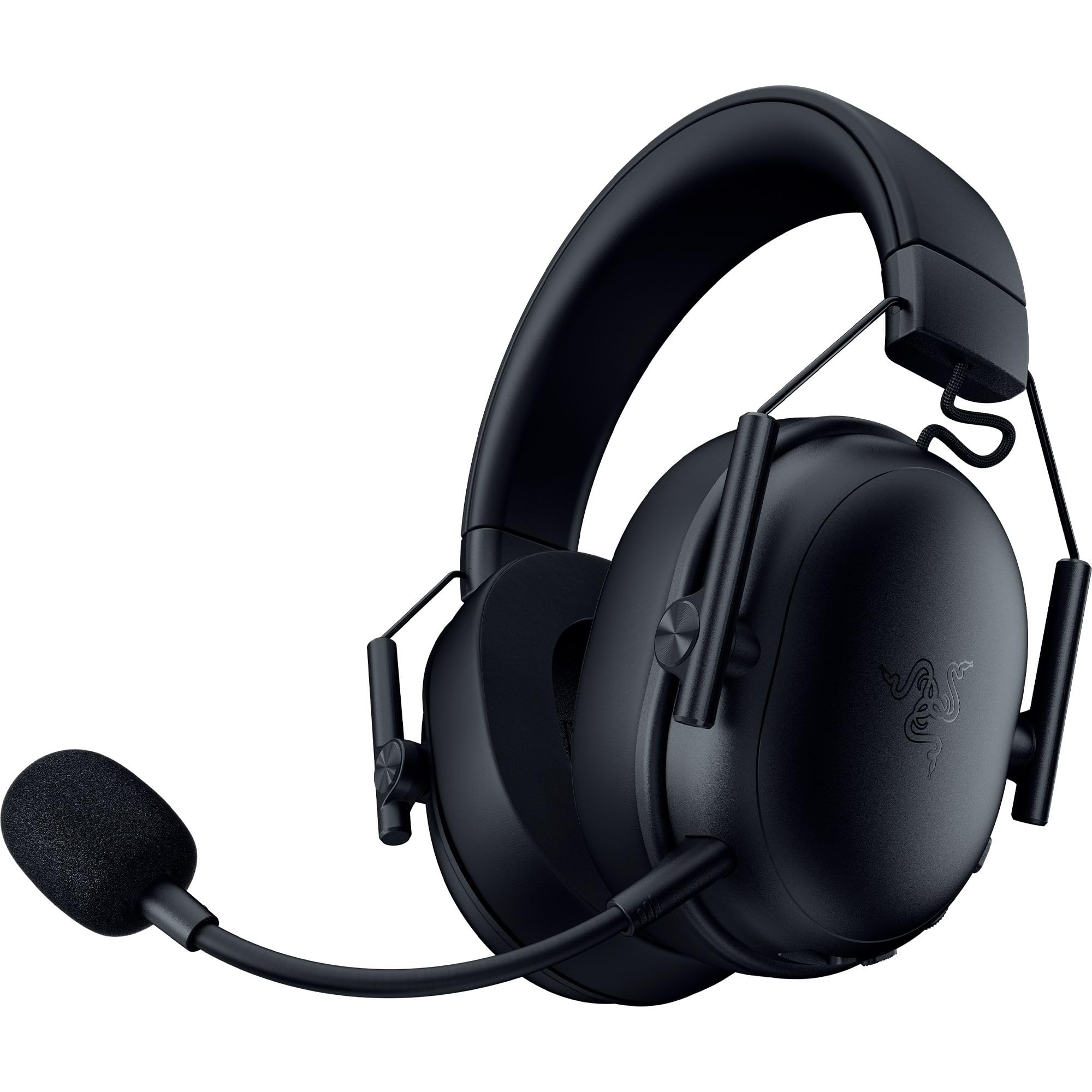
3. Razer BlackShark V3 X HyperSpeed
Seventy hours of charge means you can genuinely stop thinking about the cable.
Battery is the headline and it’s not close. The BlackShark V3 X runs up to 70 hours on a single charge — compare that with the 20 hours of the ANSTEN TV headset on this list. For a competitive player who racks up scrims, tournaments, and travel days, that math changes how you travel: the charger stops being a daily carry item. Razer pairs it with a HyperSpeed 2.4GHz dongle for the low-latency game link, and Bluetooth 5.3 rides along for mobile and work duty, plus straight USB when you want it.
Audio hardware is serious for the tier: 50 mm TriForce Gen-2 dynamic drivers tuned for positional accuracy, so footsteps and reloads sit where they should in an FPS or battle royale. On Windows you can activate 7.1 Surround Sound (virtual surround, which spreads directional cues around your head) to track gunfire and movement. The mic is a detachable Razer HyperClear Cardioid 9.9 mm unit built to prioritise your voice and push background noise down. Weight lands at 270 g with hybrid fabric and leatherette memory foam cushions — versus the 210 g Logitech G321, so it trades a little lightness for the bigger battery.
Two things to know before you buy. The noise-canceling mic works well for callouts, but the headset itself has no active noise cancellation — it quiets your voice going out, not the room coming in, and some buyers expected otherwise. Comfort also draws mixed feedback: the plush ear cups are soft, and a few players report neck pain over long stretches, which lines up with that 270 g frame. Neither is a dealbreaker for most, but they are the two honest asterisks on an otherwise strong competitive package.
Why competitive players gravitate here
- 70-hour battery — the longest on this list by a wide margin
- 50 mm TriForce Gen-2 drivers tuned for positional cues
- 7.1 Surround Sound on Windows for directional tracking
- Detachable HyperClear Cardioid 9.9 mm mic
- HyperSpeed 2.4GHz dongle plus Bluetooth 5.3 and USB
The two asterisks
- No active noise cancellation on the headset itself — only mic noise reduction
- Comfort feedback splits, with some long-session neck strain reported
Reach for this if: you want the longest battery on the shelf and FPS-grade positional audio for the money.
Weigh the fit: the 270 g frame is heavier than the Logitech G321, so if lightness is your priority, look there instead.
4. ANSTEN Wireless Headphones for TV

Walk to the kitchen mid-episode and the dialogue comes with you.
RF range is the reason this one exists. The ANSTEN runs a 2.4GHz RF base-station link that carries audio through walls, ceilings, and out to the yard up to 100 ft / 30 m. That is 100 ft / 30 m of reach versus the 33 ft quoted for a traditional Bluetooth headset, and it is a different kind of freedom: you’re not tethered to the couch cushion. Plug and play means no pairing dance — you set the base, drop the headset in, and listen. RCA and 3.5mm outputs cover smart TVs, PCs, DVDs, MP3s, and phones, though the base can’t take a device that only offers OPTICAL or HD output directly, so check that port panel first.
Zero lip-sync delay is the promise, and for movie night that matters more than any driver spec. The base also supports multi-link, so you can add a second pair of headphones — provided that second set also receives the RF signal, because a Bluetooth pair won’t sync with it. Comfort comes from an ergonomic adjustable headband and well-padded over-ear earmuffs, and there’s a nice touch in the charging dock: set the headset on the transmitter base and it charges itself. Fully charged, it runs 20 hours straight.
Charging is where this one asks for a little patience. It’s the single most-polarising point in the feedback — plenty of buyers describe clear sound that blocks out background noise, easy setup, and a comfortable fabric over the ears, while a slice run into charging trouble. The dock works best when you make sure the headset and base make clean contact. Treat it as a bedside ritual rather than a toss-and-go.
The range, in plain terms: 100 ft / 30 m means you can brew tea during the advert break and still hear it. That’s the whole reason to pick an RF base station over a dongle headset.
Best for: living rooms where one person wants the volume up and everyone else wants it down — and where the TV has RCA or AUX out.
A fair warning: the charging dock wants clean contact each time; if you’re the type to drop and run, budget a moment to seat it properly.
5. Razer Barracuda X Chroma

The one that lights up your ear cups and keeps two devices connected at once.
Razer SmartSwitch Dual Wireless is the practical star: the Barracuda X Chroma holds a 2.4GHz game link and a Bluetooth pairing at the same time, so you can go from PC or console play to a mobile call without re-pairing anything. The connection hardware is a USB-C HyperSpeed dongle for gaming and Bluetooth 5.3 for the rest, which covers PC, console, handhelds, and mobile. The flashier half is the lighting — 6-zone ear cup illumination driven by Razer Chroma RGB, with 16.8 million colours and effects that sync with over 300 games and 500 devices.
Battery needs the lighting caveat spelled out: Razer quotes up to 70 hours with lighting off and up to 30 hours with lighting on. Fifteen minutes of charging gets you roughly 6 hours of gameplay, so a quick top-up covers a session. The body is a 285 g ergonomic frame with breathable memory foam cushions, an adjustable headband, and swivelling ear cups. Drivers are Razer TriForce 40 mm units that tune highs, mids, and lows separately, and the detachable HyperClear Cardioid mic suppresses background noise for team chat or online meetings.
Two buyer realities to plan around. Sound feedback splits hard — some love it, others reach for the words “tin-can-like” — and the same goes for durability and wireless reliability, which both come up as mixed. The build is plastic, and this is a headset you treat with reasonable care. What wins people over is the overall quality of the package and the comfort: the soft ear padding and plush fit get the most consistent praise, and the battery genuinely stretches for weeks between charges if you keep the RGB off.
The dual-device trick: holding 2.4GHz and Bluetooth at once is rare at this tier, and it’s the feature that actually simplifies a desk cluttered with a PC and a phone.
The lighting tax: 70 hours with the RGB off versus 30 with it on is a big swing. Decide if you want the glow or the runtime, because you’re choosing between them.
Pick this one if: you want Chroma RGB, a simultaneous dual-wireless connection, and a comfortable 285 g frame for mixed work and play.
Skip the glow if: you’d rather have the longer 70-hour runtime — the 30-hour lit figure is the honest cost of the light show.
6. ASUS ROG Pelta Wireless

Three ways to connect, one very fast charge — the versatility play.
Tri-mode is the pitch and it’s literal: ROG SpeedNova 2.4GHz wireless for low-latency gaming, Bluetooth for mobile, and USB-C wired for a dead-battery rescue. That gives you an honest fallback the pure-wireless picks don’t offer. The dongle is USB-C, and the headset is pitched across PC and Mac, PlayStation (PS4/PS5), Nintendo (Switch 1/Switch 2), and mobile. Audio latency is rated at 20 ms, and the drivers are 50 mm titanium-plated diaphragms with a 20 Hz–20 kHz frequency response — that range spans the full band human hearing is typically quoted against, so nothing in the game mix gets clipped off the top or bottom.
Battery is a genuine strength: up to 70 hours in 2.4GHz mode with RGB off, plus 3 hours of use from a 15-minute charge. The mic is a 10 mm detachable boom running a super-wideband frequency range, which is a wider voice band than a standard headset mic, aimed at cleaner callouts and work calls. Comfort is handled by a three-level adjustable elastic headband and a 309 g over-ear frame, so you can dial the fit rather than accept it.
The catch worth knowing is consistency. Sound quality is the standout — it’s the aspect buyers praise most by a wide margin, with battery close behind — but reliability is split, and a slice of buyers report a unit that never settles into consistent operation. That’s a “check it thoroughly in the first week” note rather than a mark against the design. The 309 g weight is also the heaviest figure on this list, so if featherweight comfort is your goal, the Logitech G321 runs lighter.
What buyers consistently like: the 50 mm titanium-plated drivers are the most-praised part of the package, and the 3-hours-from-15-minutes charge makes it forgiving of forgetfulness.
The caution: mixed reliability reports mean you should test the 2.4GHz link and the mic in the return window, not weeks later.
Great match for: the player who wants three connection paths — SpeedNova wireless, Bluetooth, and USB-C wired — plus a fast charge.
Consider the alternative if: you want the lightest fit possible; at 309 g this is the heaviest headset here.
7. Avantree HT5009 Plus
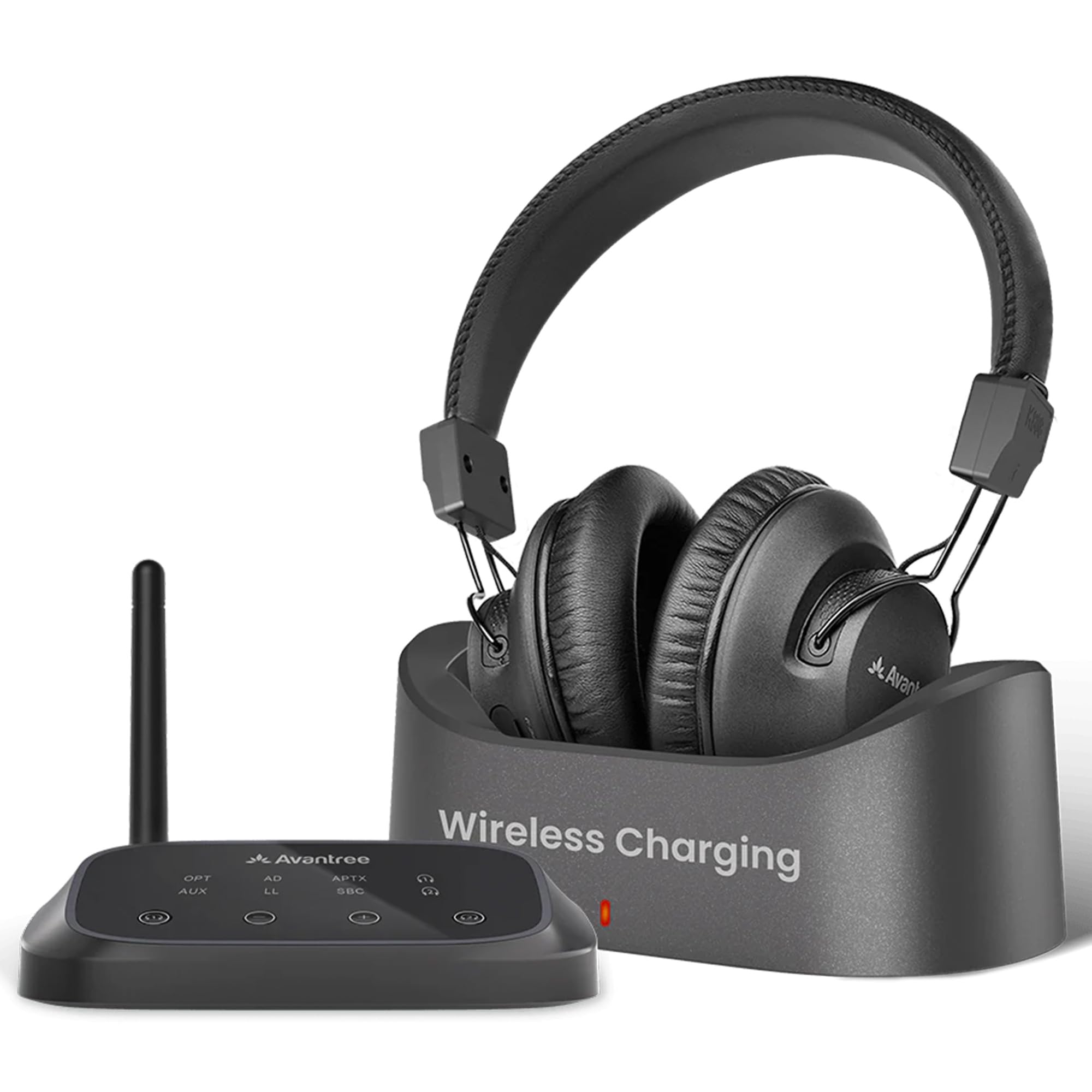
Dialogue-first listening for the person who keeps asking everyone to repeat themselves.
Clear Voice is the feature to lead with. When you pair this headset with its included transmitter, Clear Voice mode lifts dialogue so speech is easier to follow on shows, news, and movies — exactly the complaint that sends most people shopping for a TV headset. The system runs through a wireless transmitter and a charging dock, with aptX-Adaptive handling the audio coding, and it works with TVs that offer Optical (Digital Audio Out) or 3.5mm AUX. It will not work with a TV that only has HDMI ARC, so confirm your port before ordering.
Comfort and stamina are built for long evenings: over-ear pads, a charging dock you drop the headset onto, and a battery figure the listing describes as up to 60 hours while the spec table lists 50 hours average life — either way, it is measured in weeks of evening viewing, not single sessions. The transmitter also handles soundbars over Optical, so a paired setup is possible. Worth saying plainly: this is a TV headphone system, not a hearing aid, and it is not built for medical-level amplification.
Where it runs into trouble is connectivity — the one soft spot in the feedback, and it traces back to ports. Optical and AUX TVs work cleanly; HDMI-ARC-only TVs don’t, and that mismatch is the recurring friction. On the strengths side, sound quality leads the praise and reliability is close behind, with easy setup and the free walk-around-the-house range also earning consistent approval.
What the dock buys you: dropping the headset on its base each night keeps it topped up without a cable hunt — the simplest charging habit in this whole category.
The one thing to verify: your TV’s audio output. Optical or AUX, and you’re set. HDMI ARC alone, and this model stays on the shelf.
Made for: shared living rooms where one viewer needs dialogue clarity and the rest want quiet — on an Optical or AUX TV.
Rule it out if: your TV offers only HDMI ARC, or if you’re expecting hearing-aid-level volume.
8. Avantree Opera Plus

The port the other TV headset can’t take — HDMI ARC, handled.
This is the direct answer to the AV question that trips up TV headset shopping. The Opera Plus supports HDMI ARC, Optical, and AUX outputs, where the HT5009 Plus above tops out at Optical and AUX. If your TV only offers HDMI ARC and it’s free, this is the one that connects. The transmitter doubles as a charging dock, audio latency is rated at 30 ms to keep lips and voices together, and there’s adjustable volume boost for comfortable listening without cranking the television for the whole room. Like its sibling, it is a TV headphone system, not for severe hearing loss or hearing-aid-level amplification.
Two setup details matter. First, if you run a soundbar, the transmitter supports Optical (OPT) passthrough so the soundbar and headphones play together — but HDMI soundbar passthrough is not supported. Second, the headphones double as ordinary Bluetooth headphones for phones and tablets when you’re not watching TV, which is a useful second life. Battery is listed as 35 hours average life with a 2-hour charge time, and the charging cable runs to the headphones directly while the transmitter takes its own Type-C power cable.
The experience lands well overall. Sound quality is the strongest theme by a distance, ease of use follows, and noise cancellation and value both rate positively alongside comfort that holds up over hours. As with any HDMI ARC device, connectivity is the variable — make sure the ARC port isn’t already occupied by a soundbar before you buy, because that’s the setup snag that comes up.
Why it solves the ARC problem
- HDMI ARC, Optical, and AUX inputs in one transmitter
- Adjustable volume boost for dialogue
- OPT passthrough so a soundbar and the headphones run together
- Works as standard Bluetooth headphones for phone and tablet
- 30 ms audio latency keeps voices in sync with the picture
Setup notes to check first
- HDMI soundbar passthrough is not supported — Optical only
- Your TV’s ARC port must be free before you can use it
- Not intended for hearing-aid-level amplification
Right for: HDMI ARC households, soundbar owners using Optical, and anyone who wants boostable dialogue plus a Bluetooth second life.
Not for: severe hearing loss, or a setup where the ARC port is already taken by a soundbar.
9. SteelSeries Arctis Nova 7X Wireless Gen 2

Mix game audio and phone audio at once, with a rugged steel frame holding it all together.
Simultaneous 2.4GHz and Bluetooth is the upgrade that separates this from a standard single-link headset: you can keep the game mix running while a call or mobile audio blends in on top. The wireless link runs through a compact USB-C dongle with a USB-A adapter in the box, so PC, console, handhelds, and tablets all plug straight in. The preset library is enormous — 200+ game-specific audio presets for real-time control of what you hear, well beyond the 100+ offered on the Nova 5P above.
Audio hardware leans premium: neodymium magnetic drivers with 360° Spatial Audio support (a surround-style effect that places sounds around your head), plus a ClearCast Gen 2 mic that SteelSeries says reduces background noise by up to -25db, with Sonar AI enhancement on PC. That’s built to cut keyboard clicks, fans, and room noise so your voice stays clear. The frame is steel with an elastic headband and memory foam cushions, and battery is quoted at 50+ hours with USB-C fast charge.
The trade-off is the platform fold. This is the Xbox-oriented model, and owners mention it working across Xbox, Switch, PC, and phone, so it’s genuinely multi-device rather than Xbox-only. Comfort also lands well, with the elastic headband and light-feeling fit drawing steady approval. The reasonable question is whether the spatial audio and the preset count justify moving up from the Nova 5P — if you play a wide spread of titles and want the bigger preset library, they do.
The upgrade logic: 200+ presets, simultaneous dual wireless, and 360° Spatial Audio on a steel frame. Against the Nova 5P’s 100+ presets, this is the deeper preset library for a serial game-hopper.
The honest note: it’s the priciest pick here, so buy it for the dual-wireless mixing and spatial audio, not for a bigger battery — the 50+ hour figure is strong but the BlackShark V3 X still runs to 70.
Choose it if: you want game audio and phone audio mixed at once, 200+ presets, and a steel-framed build that spans Xbox, PC, and Switch.
The case against: it’s the most expensive option on the list, so budget-conscious buyers get most of the tech in the Nova 5P.
Know the Specs
2.4GHz RF vs Bluetooth
Bluetooth and 2.4GHz RF both send audio wirelessly, but they behave differently. A 2.4GHz RF link — through a dongle or a base station — is a dedicated point-to-point radio connection, which is why these headsets can keep audio tightly synced to the picture and reach farther. Bluetooth is a shared, general-purpose standard with its own latency, which is why it’s the thing these picks route around. Many headsets on this list pair a 2.4GHz game link with Bluetooth for your phone, giving you both worlds.
Audio Latency in Milliseconds
Latency is the delay between the sound leaving the source and reaching your ear, measured in milliseconds (ms). Lower latency is better for games and TV dialogue, where sound has to stay locked to the picture. Some listings publish the figure, such as the 30 ms rating on the Opera Plus and the 20 ms on the ROG Pelta; when it isn’t published, the 2.4GHz RF connection itself is the guarantee against the lip-sync drift that Bluetooth is prone to.
Battery Hours and the RGB Caveat
A battery rating tells you how long the headset runs per charge, but read the conditions. One headset here quotes 70 hours with lighting off and 30 hours with it on — a real daily difference. Fast-charge figures, like hours of use from a 15-minute top-up, are often more useful day to day than the total, because they describe the recovery you actually get between sessions.
TV Ports: Optical, AUX, and HDMI ARC
TV headsets in this category connect through audio outputs on the back of your television. Optical (also called TOSLINK, a digital audio cable) and 3.5mm AUX (a standard round analog jack) are the most widely supported. HDMI ARC (Audio Return Channel) sends audio back down an HDMI cable and is available on some TVs and not others. A few models here take all three; others take only two, so matching the port to your TV is a must before buying.
Common Questions
What does “not Bluetooth” actually mean for a wireless headset?
Will these work with my TV if it only has HDMI ARC?
Do 2.4GHz wireless headsets really have zero audio lag?
How far can I walk from the TV or transmitter?
Can I use a TV headset for gaming as well as watching television?
Why does the battery rating drop when the RGB lighting is on?
Are these headsets any use for someone with hearing difficulty?
Can I connect two pairs of headphones to the same TV transmitter?
Do I need a dongle for every console I own?
Is a lighter headset better for long gaming sessions?
The Bottom Line
For most buyers, the wireless headphones not bluetooth winner is the SteelSeries Arctis Nova 5P because it does the hardest thing in this category well: it keeps a genuine low-latency 2.4GHz game link running on a 60-hour battery while a single button flips you to Bluetooth for a phone call. That mix of dongle reliability, preset depth, and phone-friendly switching is what most people actually need day to day. If your priority is raw battery and competitive positional audio, the Razer BlackShark V3 X HyperSpeed leads the shelf with up to 70 hours. And if you’re outfitting a living room, the Avantree Opera Plus is the one to reach for — its HDMI ARC input plus Optical passthrough handles the TV setups where the other TV headset simply can’t connect.
One last nudge for the undecided: the Nova 5P’s combination of a 60-hour battery, a 15-minute charge that returns 6 hours of play, and a dongle that hops between PlayStation, PC, Switch, and phones is a genuinely hard spec sheet to beat at its tier. Buy the version that matches your main platform, seat the dongle once, and the wire and the Bluetooth bottleneck both stop being part of your evening.
How we choose
We do not accept paid placement. Every pick is matched to a real buyer and a real use-case; we do not hands-on test units.
Sources
Specifications: manufacturer listings and product documentation. Review insights: verified customer reviews, as of November 2026. Pricing: not shown on this page (it changes often); check the current price via the retailer link.
As an Amazon Associate, Tactical Gear Guy earns from qualifying purchases. This does not affect which products we feature.