Specs are compiled from manufacturer listings and verified buyer reviews and can change over time — please confirm the key details on the product page before buying.
If you are tired of taping XLR cable across a dance floor and still finding a dead run at soundcheck, the fix is a wireless DMX link — a transmitter on your console and receivers on your lights. The picks below cover every realistic setup: a five-pack for a bar install, a single-universe hub for a touring rig, and an app-driven box for anyone who would rather tap a screen than program a desk.
This guide is built by comparing the manufacturers’ published specifications and the patterns across verified customer reviews, so you get each pick’s real strengths and trade-offs instead of marketing spin.
You want to cut the cable runs without losing control of your lights. This shortlist shows which units carry their own batteries, which need a wall socket at every fixture, and where the real range limits land in a crowded room. Every pick here speaks DMX512 (the standard lighting-control signal), so the choice depends on receiver count, group channels, and how much cable you want to retire. Each pick is sorted by what it actually does on a stage.
Top Picks


How To Choose The Best Wireless DMX Controller
Start with the number of lights you actually need to reach. A wireless DMX controller is only useful if it has enough receivers, because each DMX fixture in the chain needs its own receiver box (or a receiver built into the fixture). Count your fixtures before you count features — a five-receiver pack for a four-light bar install beats a two-receiver pack with better specs.
Match the receiver count to your fixture count
Every receiver in a pack replaces one run of XLR cable between your console and a light. If you run eight PAR cans across a stage, you either need eight receivers or a wireless fixture that already has one inside. Buying short means you still run cable; buying long just costs more upfront and leaves spares in the case.
Check whether the receivers carry their own power
Some receivers run on a rechargeable battery, which means fewer wall sockets to find behind a truss. Others need a power adapter at every unit, so the packing list grows. Neither is wrong — but if your venue is short on outlets, the rechargeable design saves you a real headache on load-in.
Group ID codes decide how many rigs can share a room
A group ID is a channel code that keeps one wireless network separate from another. Five groups means five independent lighting setups can run in the same building without triggering each other’s fixtures. Multi-room venues and festival stages with neighboring rigs need more groups, not fewer.
Understand what the range figure really means
Published distance is measured with a clear line of sight, with nothing between the transmitter and receiver. In a real venue, bodies and walls cut into that. Choose a unit with distance to spare rather than one that only just covers the room.
Side-by-Side Comparison
| Model | Best For | Receivers | Group IDs | Weight | Amazon |
|---|---|---|---|---|---|
| Donner 6PCS Transmitter + 5 Receivers★ Best Overall | Filling a whole bar or small stage | 5 | 5 | 2.16 lb | Amazon |
| Lixada DMX 512 2.4G Transmitter ReceiverBest Value | Budget single-link wireless start | — | 16 | 13.7 oz | Amazon |
| JERRAY 3Pcs 2 Receivers + 1 TransmitterFast Setup | Fast mobile DJ setup | 2 | 7 | — | Amazon |
| Donner 3 Receivers + 1 Transmitter (Battery) | Rechargeable receivers, fewer outlets | 3 | 7 | 1.46 lb | Amazon |
| FENIXFIT 4PCS Transmitter + 3 Receivers | Long-throw outdoor work | 3 | 7 | 1.12 lb | Amazon |
| JERRAY 8Pcs 7 Receivers + 1 Transmitter | Big rigs on a per-light budget | 7 | 7 | 1.96 lb | Amazon |
| CHAUVET DJ D-Fi Hub | Touring rigs that need a hub unit | Hub unit | Auto frequency sync | 0.25 kg | Amazon |
| ADJ Products MyDMX Go | App-based control, no desk | — | — | 16 oz | Amazon |
Detailed Reviews
1. Donner Wireless DMX512 Transmitter Receiver 6PCS
Our pick — 4.5+★ from 350+ verified ratings; the strongest balance of quality and price.
Five rechargeable receivers in one box — the fastest way to retire a whole stage of XLR runs.
One transmitter feeding five receivers is the whole reason this pack wins the top slot. Each of those receivers carries a built-in battery, so you don’t have to hunt down a wall socket at every truss position — a real convenience on load-in when outlets are already spoken for. The console side stays simple: one box and you are broadcasting, with tricolor LED indicators confirming the link.
It runs 126 channels of automatic frequency hopping (constantly changing channel to dodge interference), which is what keeps the signal steady when the venue is thick with WiFi. Donner rates communication at 500M on visible distance, and there are 5 Groups ID codes to work with — meaning five separate wireless nets can share the same building without cross-firing.
Where it earns its reputation is build feel and value — quality and value-for-money are what come up most, and owners are consistently happy with how the gear holds up. The honest catch is the battery side: a share of the receivers have given people trouble with holding a charge. Treat the rechargeable cells as convenience, not a guarantee, and keep the six included power adapters in the case as your fallback. Worth knowing, too, that the transmitter itself has no built-in battery — only the receivers do.
Where it earns the crown
- Five receivers means one purchase covers a full small-stage fixture count.
- Rechargeable receivers cut the number of power sockets you have to find at load-in.
- 126-channel hopping with 5 Groups ID keeps big, busy venues clean.
- 500M visible-distance rating leaves headroom in most rooms.
Where it asks for care
- Battery hold-up is the split in owner feedback — plan on the adapters as backup.
- The transmitter runs without a built-in battery, so it needs a power source.
Reach for this if: you are outfitting a bar, club, or small stage and want five lights freed from cable in one order.
Think twice if: you want a transmitter that runs untethered — this one wants a socket.
2. Lixada DMX 512 Controller 2.4G
Sixteen group codes in a single-link budget box — the most rigs-per-room of anything here.
Sixteen groups is double what most of this list offers, and it costs you a single transmitter-and-receiver pair instead of a pack. That is the pitch: if your problem is two or three lighting setups fighting for the same airwaves, or you rotate between rooms, this one gives you the most separation for the least outlay. A group ID is a channel code that fences one wireless network off from another, so more of them simply means more independent rigs can coexist.
The build is small — 13.7 oz and a 6.1 x 6.02 x 2.05 inch package — so it disappears into a gear bag. The LCD display and 4-grade power output give you adjustment on the unit itself, and 126-channel hopping plus anti-jamming logic keeps the data moving in real time. What buyers fix on most is quality, followed by signal strength, which lines up with the brief: strong, stable, no dropouts.
Compatibility is the reassuring part — it plays nicely with a spread of wireless DMX devices, so it slots into gear you already own rather than forcing a brand switch. At 4.5+ stars across 100+ ratings it is the highest-scored pick in this lineup, and if you only need one link, it is also the slim-spend route. The limitation is simply scope: it is one transmitter and one receiver, so a multi-fixture rig still needs more receiver boxes.
Signal and stability: the reviews home in on a strong, steady link with no dropouts, and 126-channel hopping backs that up in a room full of WiFi.
The trade-off: it is one transmitter and one receiver — great for a single link, not a full stage in one box.
The verdict: the smart spend if you want the most group separation and a rock-solid single link, without buying a package of receivers.
The single caveat: plan extra receiver purchases if your fixture count runs past one.
3. JERRAY Wireless DMX 2.4G Controller 3Pcs
Built for the mobile DJ who wants the rig up and running, not taped and tested.
The maker claims ditching XLR cable cuts install time by 80% — the argument that matters for a wedding or party where setup minutes are money. Seven Group ID codes let you run separable rigs in the same venue, and the tricolor LED indicators make which group you are on easy to see at a glance. Two receivers plus the transmitter is a natural fit for a pair of moving heads or a couple of PARs.
The wireless side runs 2.4G ISM with 126-channel automatic hopping, the mechanism that keeps it stable in WiFi-crowded rooms. JERRAY lists a 1000ft range, and the anti-interference design is aimed squarely at busy multipurpose venues. The unit is small and light enough to live in a road case without complaint.
What it is not is battery-powered — this model needs a power adapter at each unit, which is why three of them ship in the box. For long events that means continuous performance with no recharge anxiety, but it also means you are hunting sockets again, just not cable. It arrives with a one-year warranty from the maker. If your setup is a couple of lights and a tight timeline, this is the honest, capable pick.
Strong points
- Fast rig-up — the cable-free design targets setup speed directly.
- 7 Groups ID and tricolor LED indicators keep multiple rigs separate.
- 126-channel hopping for stability in WiFi-heavy rooms.
- Adapters included for all three units, so no extra shopping.
Points to weigh
- Not battery-powered — a power adapter is needed at each unit.
- Two receivers only, so larger rigs need extra boxes.
Good fit for: mobile DJs and wedding setups with two or three fixtures and a tight load-in.
Less of a fit for: anyone who needs the receivers to run free of wall power.
4. Donner Wireless DMX Controller 4PCS

Three receivers that carry their own charge — fewer sockets, less winding, faster out.
The reason to pick this Donner set over the bigger pack is right in the name: rechargeable receivers. Three of them, plus a transmitter, and the rechargeable design means fewer power sockets to find during use. If your venue’s outlet situation is thin, that is a genuine day-of difference. The whole kit is 1.46 pounds, light enough to carry one-handed with your console.
The wireless spec matches the brand’s playbook: 126-channel automatic hopping, 7 Groups ID codes, anti-jamming logic, and a 500M visible-distance rating. One transmitter drives multiple receivers, so the three here cover a compact stage or a cluster of heads. Setup is the recurring theme in owner feedback — this unit makes cabling simpler by removing it, and that is the reason people keep it in the rig.
The split in feedback is on value: some owners feel it works well for what it is, others wish it did more for the money. That is a fair cue to weigh receiver count against your fixture count before you buy. Note, as with the other Donner set here, the transmitter itself has no built-in battery — the rechargeable cells live in the receivers.
Why it earns its slot
- Three rechargeable receivers slash the number of wall sockets you need.
- 1.46 pounds for the whole kit — easy to carry alongside a console.
- 7 Groups ID and 126-channel hopping for clean multi-rig venues.
- 500M visible-distance rating covers most rooms with margin.
The trade-offs
- Value is the split — check the receiver count against your fixtures first.
- The transmitter is adapter-fed, not battery-powered.
Pick this if: wall power is scarce and you want three rechargeable receivers plus a transmitter in a light kit.
Hold off if: your fixture count needs more than three receivers.
5. FENIXFIT Wireless DMX512 Transmitter Receiver

1600FT of range in a zinc alloy body — built for the long throw and the wet night.
For a big outdoor run or a venue with distance to cover, the 1600FT transmission range is the number that sells this one. It uses efficient GFSK modulation over the 2.4G global open ISM band, with 126-channel automatic frequency hopping that picks anti-interference bands by itself. The maker says it is unaffected by Bluetooth and WiFi signals — a claim a busy festival crowd will test hard.
The body is zinc alloy, and FENIXFIT says it works through rainy weather and low temperatures — note if half your gigs are outdoors. Seven groups ID code keeps multiple rigs separate. Pairing is already done at the factory, so the transmitter and receiver are linked before you open the box: plug in and go. The maker claims this saves about 30 minutes off setup and breakdown — plausible for a cable-free install hung from a ceiling.
Functionality is what the reviews hang on — it works, and it works across both small and large venues. Quality, connectivity, and the cable-free design round out the sentiment. The one caveat is practical: with only three receivers, you still need to count fixtures carefully. For an outdoor stage or a long truss run, though, that range makes the choice easy.
The standout: 1600FT range and a zinc alloy shell that the maker says holds up through rain and cold — rare in this group.
The one limit: three receivers means a larger rig still needs more boxes.
Best matched to: outdoor stages, long truss runs, and anyone who needs distance to spare.
Skip over if: your rig has more than three fixtures and you want a one-box solution.
6. JERRAY 8Pcs DMX Wireless (7 Receivers + 1 Transmitter)

Seven receivers in one order — the most per-light coverage of anything on this list.
When your rig is wide and you want a receiver on every fixture, seven of them in a single buy is hard to argue with. JERRAY’s 8-piece set pairs one transmitter with seven receivers, so a big PAR or strobe spread can go wireless without buying boxes in dribs and drabs. The 2.4G ISM link uses high-effective GFSK modulation and 126 channels of automatic hopping, with the same no-delay, real-time data claim as the rest of the family.
Seven groups ID code, plus a seven-color LED display for working status and parameters, make it easy to see which group you are on and keep rigs apart. A single-key operation runs the 126 frequency bands and picks an anti-interference section automatically. It is aimed at stage, strobe, theater, concert, and performing-arts lighting — the places where cable runs get long and winding them down at the end of the night is the chore nobody wants.
What it is not: the highest-scoring unit here. It carries a lower rating than the single-link picks, so if you only need one or two links, the smaller sets will serve you with more margin. This one is for the rig that needs a receiver on every can and values volume over a perfect score. At 1.96 pounds for the kit, it still packs down tight.
Where it delivers
- Seven receivers cover a wide fixture spread in one purchase.
- 7 Groups ID plus seven-color LED display for clear separation.
- 126-channel hopping with single-key anti-interference selection.
- Packs to 1.96 pounds for the whole kit.
What to know
- Lower owner sentiment than the single-link picks — best when you truly need volume.
- Overkill if your rig runs one or two fixtures.
Built for you if: you run six or seven fixtures and want a receiver on each without endless add-on purchases.
Not your pick if: a small link or two is all your setup calls for.
7. CHAUVET DJ D-Fi Hub Wireless DMX Controller
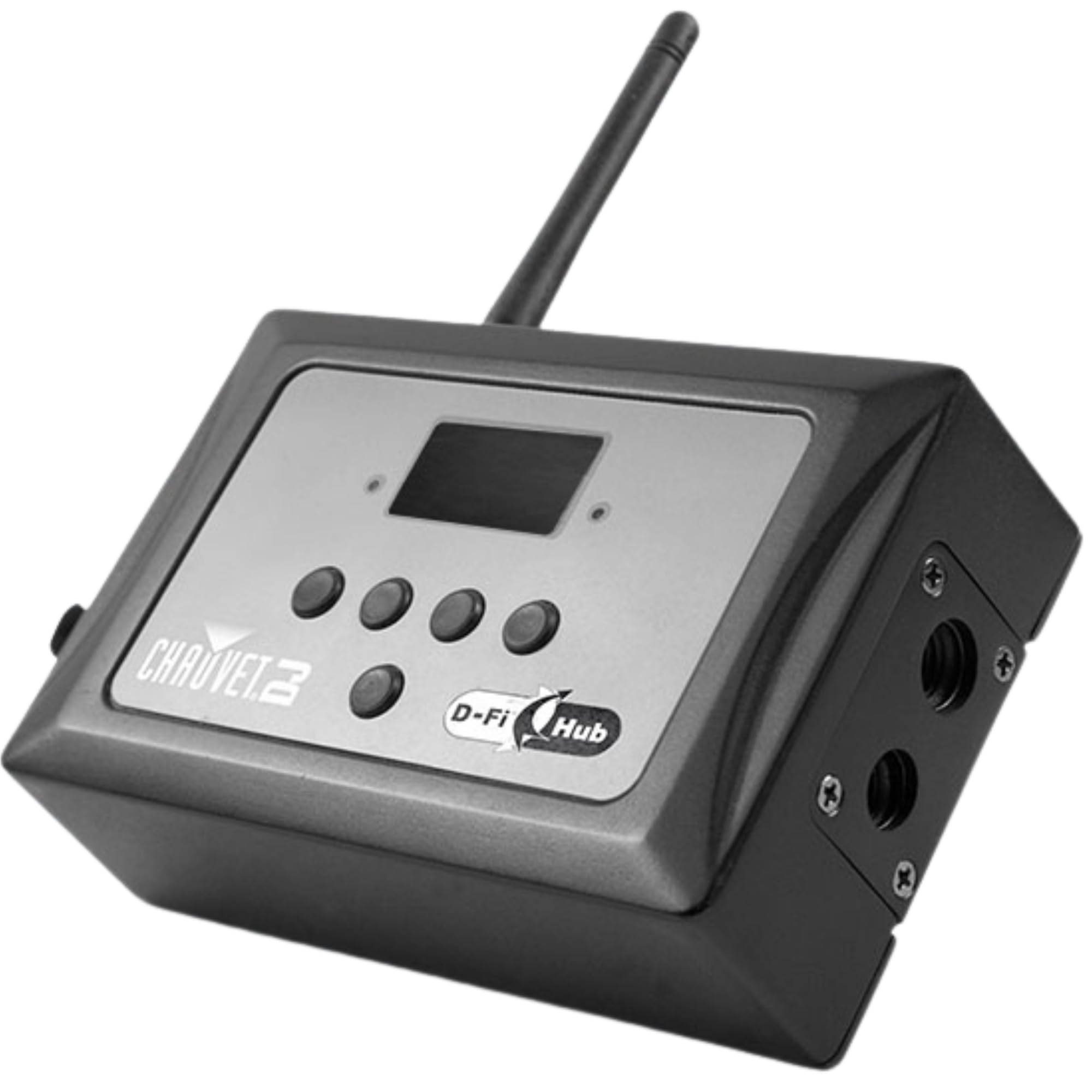
One compact box that is both transmitter and receiver — the touring pro’s single hub.
This is the pick for the rider that says D-Fi. The D-Fi Hub is a transmitter and a receiver in a single unit, so it does not care which side of the link it sits on — point it at the console or point it at the lights. It runs on the 2.4 GHz band and has a built-in auto mode that picks the best channel for you, so sync between units happens without you hand-tuning anything.
The scale claim is the real headline: it wirelessly syncs an unlimited number of D-Fi-ready fixtures and receivers at once, so a large lighting system grows without signal degradation. For a venue install or a stage with dozens of fixtures, that removes the receiver-count math entirely. An OLED digital display makes channel selection and system control readable in a dark wing, and the whole unit is small — 0.25 kg — so it tucks into a case. It is FCC and RTTE compliant, built for professional and touring environments.
The one thing to check before you commit: this pairs with D-Fi-ready fixtures and receivers. If your lights are not D-Fi, the hub cannot speak to them, and you would want one of the transmitter-and-receiver packs instead. For anyone already in the D-Fi ecosystem, it is the cleanest single unit on this list.
Its reason to exist: one hub that is both ends of the link, with auto frequency sync and unlimited D-Fi fixture connectivity.
The compatibility catch: it talks to D-Fi-ready gear — outside that ecosystem, look at a paired pack instead.
The right call for: D-Fi users and touring rigs that want one do-everything hub with an OLED display.
Step past it if: your fixtures are not D-Fi-ready.
8. ADJ Products MyDMX Go Wireless DMX Lighting Controller

A 256-channel lighting desk that lives on your tablet — no programming required.
If you would rather run lights from a screen than a fader bank, this is the pick. MyDMX Go is a 256-channel DMX controller built as an app for iPad or Android tablets, driven over WiFi and USB. You connect through the 3-pin XLR input and control your rig wirelessly. It is the most different product on this list — a control brain rather than a transmitter-and-receiver set — so judge it on that basis.
The library is huge: 15,000+ fixtures, so you can plug in many brands and varieties of stage lighting without buying new lights. Zero programming is the promise — build effects with speed, color pallet, size, shift, and fan control. You get 50 user presets and 21 automatic effects for quick shows, plus manual display creation and saving. It mounts with the included O-Clamp brackets onto a truss and supports up to two lighting universes over a standard 3-pin XLR and USB power.
The honest picture is split. Many owners find it works great and simple to use; others hit a wall setting it up, and some report it stops working after a single run. That spread is worth knowing before you buy — the app route is powerful and fast once it clicks, but it is not the plug-and-go reliability of a hardware link. It also needs a nearby WiFi signal to control, so a venue with weak WiFi is a real consideration.
What makes it different
- 256 channels and 15,000+ fixtures mean broad fixture support from one app.
- 50 user presets and 21 automatic effects get a show running fast.
- O-Clamp brackets mount it to a truss; two universes supported.
- Zero programming for anyone who would rather tap a screen.
What to go in eyes-open on
- Setup divides opinion — some find it simple, others bump against it.
- It leans on WiFi for control, which a weak-signal venue can challenge.
Made for you if: you want a tablet-based control desk with deep fixture support and quick presets.
Consider a hardware pack if: you want plug-and-go simplicity without a WiFi dependency.
Know the Specs
Receiver count and pack sizing
The number of receivers in the box decides how many fixtures you can free from cable. Each receiver box replaces one run of XLR; a fixture with a receiver built in counts as its own. Count your lights first, then match the pack. Buying a pack that matches your fixture count avoids both extra cable runs and unused boxes in the case.
Frequency hopping and anti-interference
Frequency hopping means the link constantly changes channel to dodge interference, so 126 channels gives it more room to work in a crowded venue. A 2.4G band is the same airspace WiFi and Bluetooth use, which is why hopping matters. The result is a stable link with no data-transmission delay.
Group ID codes
A group ID keeps one wireless network separate from another. Five groups lets five setups share a room; seven or sixteen gives more breathing room for multi-rig venues. If you run more than one lighting setup in the same building, more groups is the safer choice.
Battery versus adapter power
A rechargeable receiver means fewer wall sockets to find during use. An adapter-powered receiver means a plug at each unit, but no charge to manage. Neither is better — it depends on your venue’s outlets and the length of your events.
Common Questions
How many receivers do I need for my stage lighting rig?
Will a 2.4G wireless DMX link interfere with my WiFi?
What does a group ID code actually do?
Do I need a DMX console to use one of these?
Can I use a wireless receiver with a fixture that has no DMX512 port?
Is a rechargeable receiver better than an adapter-powered one?
How far will one of these actually reach in a venue?
Does the CHAUVET D-Fi Hub work with my existing lights?
What is the difference between the MyDMX Go and a transmitter set?
Do wireless receivers remove the need to run cable completely?
The Bottom Line
For most rigs, the winner is the Donner 6PCS set because five rechargeable receivers retire a whole stage of XLR runs in one purchase, with 5 Groups ID and 126-channel hopping to keep a busy venue clean. If you run a single link and want the most group separation, grab the Lixada with its 16 groups — the highest-scored pick here. And for an outdoor stage where the long throw matters, the FENIXFIT at 1600FT is the one to reach for. The one honest nudge: the Lixada’s 4.5+ stars and steady link make it the safest single-link buy in the group, and it costs you only one receiver’s worth of commitment.
How we choose
We do not accept paid placement. Every pick is matched to a real buyer and a real use-case; we do not hands-on test units.
Sources
Specifications: manufacturer listings and product documentation. Review insights: verified customer reviews, as of November 2026. Pricing: not shown on this page (it changes often); check the current price via the retailer link.
As an Amazon Associate, Tactical Gear Guy earns from qualifying purchases. This does not affect which products we feature.