Specs are compiled from manufacturer listings and verified buyer reviews and can change over time — please confirm the key details on the product page before buying.
You are reversing a 30-foot trailer into a site you have never seen, and the person waving directions behind you is out of sight in the mirror. A wireless camera for your RV fixes that blind spot without running a cable the length of the rig. The picks below cover every budget and every wiring situation, from plug-and-play Furrion setups to magnetic solar units you stick on in a minute.
This guide is built by comparing the manufacturers’ published specifications and the patterns across verified customer reviews, so you get each pick’s real strengths and trade-offs instead of marketing spin.
The deciding factors are your RV’s existing wiring and your dash space, not the biggest number on the box. Signal range, mounting style, and screen clarity decide whether a system actually helps on the road, which is exactly what this breakdown of the wireless camera for rv field sorts out for you.
Top Picks

How To Choose The Best Wireless Camera for RV
The first thing to settle is not the camera, it is your rig. Do you already have a Furrion pre-wired mounting spot, or are you starting from nothing? That one answer eliminates more cameras than any spec sheet. With your wiring settled, weigh range, screen size, and mounting style against how you actually camp.
Match the wiring to your RV first
A “wireless” RV camera sends video through the air, but the camera lens itself almost always needs power from the vehicle. The Haloview BT7 and the AMTIFO and ZEROXCLUB units are built to connect to a Furrion pre-wired jack, so they plug in with the included adapter and pigtail wire. If your RV has no pre-wired mount, you tap the camera into a running-light, marker-light, or reverse-light circuit instead. Magnetic, battery-powered cameras skip that entirely — they run on their own rechargeable cells and a solar panel, so you mount one and go.
Think about range as line-of-sight, not real-world
Every spec here quotes a signal distance, but that number assumes a clear, open path with nothing between camera and monitor. A trailer wall, a load of cargo, and a rainstorm all cut into it. Look at the working range stated alongside the open-air figure, and pick a system with an antenna design that resists interference for your rig length.
Decide how big a monitor you can live with
You glance at this screen while driving, so pick a size you can read at a glance without blocking your view. A 5-inch screen fits tight dashes. A 7-inch screen shows more lanes of traffic behind you but takes up more windshield real estate. Touchscreen controls are easier to adjust on the move than button-only panels, but a sunshade cover makes a bigger difference on a bright day than any menu feature.
Side-by-Side Comparison
| Model | Best For | Monitor | Field of View | Signal Range | Amazon |
|---|---|---|---|---|---|
| Haloview BT7★ Best Overall | Full-time RVers who want recording | 7″ LCD + DVR | 120° | 984 ft open | Amazon |
| FEISIKE Magnetic SolarNo-Drill Pick | No-drill trailer towing | 5″ IPS | 150° | 830 ft open | Amazon |
| AMTIFO HD 1080PFurrion Plug-In | Furrion pre-wired RVs | 7″ touch key + DVR | 130° | 825 ft open | Amazon |
| VEKOOTO VK7 Pro | Big battery, no wiring | 7″ IPS touchscreen | 150° | 500 ft open | Amazon |
| ZEROXCLUB BW7M | Fast install on pre-wired rigs | 7″ IPS | 120° | 100 ft | Amazon |
| AUTO-VOX WF1 | Widescreen campsite visibility | 7.2″ DVR | 114° | 500 ft | Amazon |
| VOONOA Dual Magnetic | Two-angle monitoring | 7″ HD DVR | 170° | 300 ft | Amazon |
| Furrion Vision S+ | Factory Furrion RVs | 7″ touchscreen | 140° | 492 ft open | Amazon |
Detailed Reviews
1. Haloview BT7 RV Backup Camera
Our pick — 4.5+★ from 500+ verified ratings; the strongest balance of quality and price.
The recorder-equipped flagship that sees 984 feet down an open road and keeps the tape rolling.
If you tow a long fifth wheel and want proof of what happens back there, the built-in DVR is the reason to start here. The system records at 1080P and 30 frames per second (fps, the number of still images it captures each second), so the footage stays smooth enough to read a licence plate after a bump in a lot. It also plays that video back on the 7-inch LCD monitor right in the cab, which means no laptop and no card reader when you need to check something.
The range figure is the headline for long rigs. Haloview lists a line-of-sight signal of up to 984 feet, and the system is rated for vehicles up to 65 feet — you can run it on a travel trailer, a truck, a camper, a van, a pickup, a tractor, a fifth wheel, or a motorhome. A 120-degree viewing angle is narrower than some rivals on this page, but owners consistently describe the rear view as clear and to the point. Buyers report it can see up to 70 feet behind the vehicle, and that ease of installation, the wide field of view, and the value all come up as reasons people keep it.
Where it earns its keep at night is the dim-light sensor, which is rated down to 0.1 lux (a very low light level, roughly a moonlit night). Colour survives in low light instead of flipping to grey, and the fill lights can be switched on or off from the monitor when the darkness gets extreme. The 10-32V wide voltage input means it tolerates the voltage swings a coach electrical system throws at it. The honest catch: at 11.02″L x 9.06″W x 4.33″H this is the largest box here, and it is a bigger footprint to place on a small dash than the compact magnetic units.
What earns the top spot
- Built-in DVR records 1080P at 30fps and plays back on the 7-inch monitor
- 984 ft line-of-sight range, rated for rigs up to 65 ft
- 0.1 lux dim-light sensor keeps colour when it gets dark
- Accepts up to four wireless camera inputs for full coverage
The honest trade-off
- 120-degree view is tighter than several rivals here
- Largest physical footprint of the group
Go for this if: you tow a long trailer and want recorded evidence plus long-range signal in one box.
Think twice if: you are short on dash space and want the smallest possible monitor.
2. Magnetic Solar Backup Camera 5 Inch
Stick it on, drive off: a magnetic, solar-charged camera that needs zero wiring and no tools.
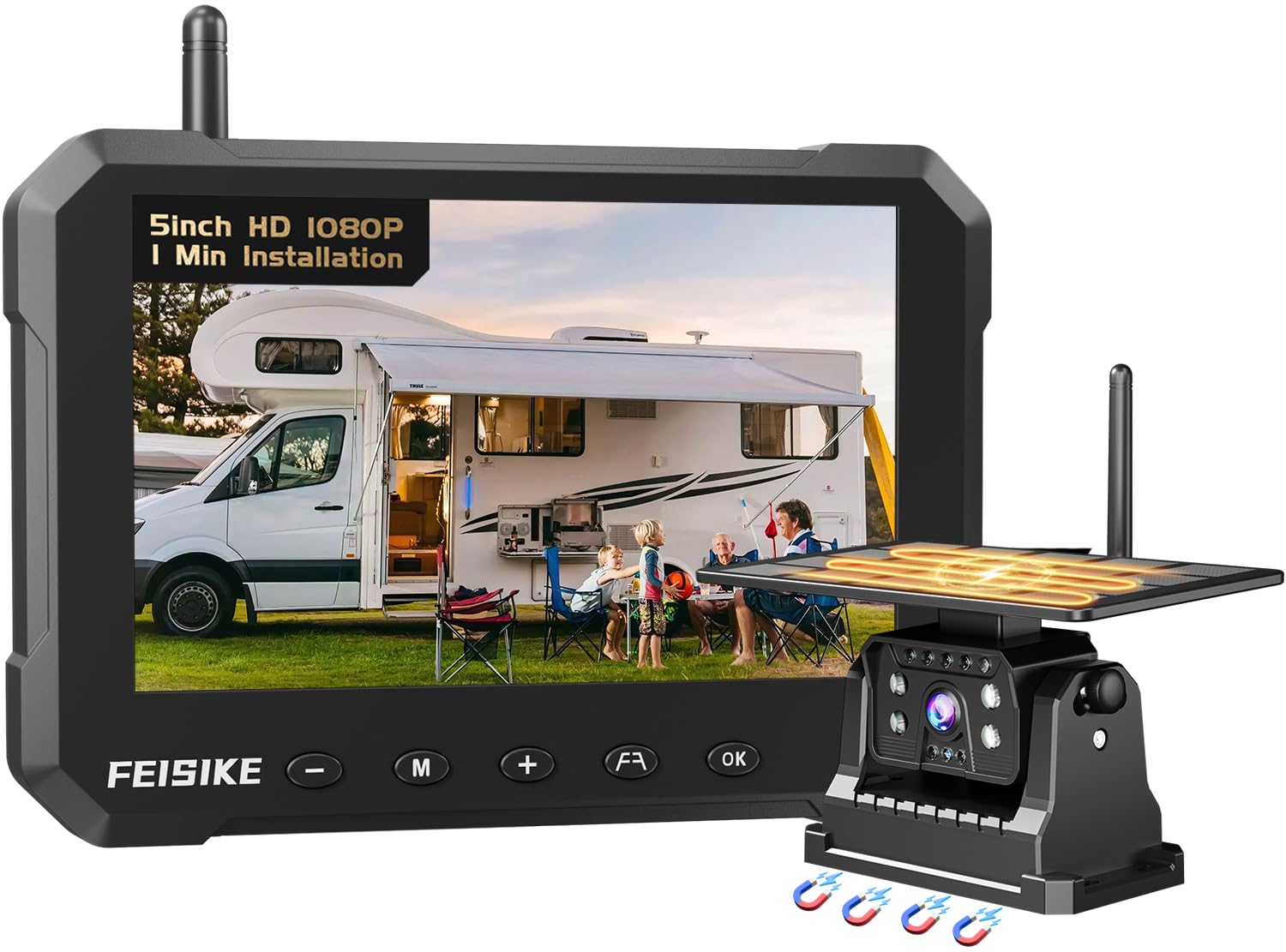
The first thing you notice with this FEISIKE unit is the 150-degree field of view — the widest of the wired-style picks here, and 25 degrees broader than the Haloview BT7’s 120 degrees. For a bumper-height camera that means you see more of the lane either side of the trailer, which is exactly what saves you when reversing into a tight site. The 5-inch IPS screen (IPS being a panel type that keeps colours and brightness stable when you look at it from an angle) comes with a sunshade cover, so glare off the windshield does not wipe out the picture.
Mounting is the party piece. Six built-in magnets hold the camera to any steel surface, so you can move it between vehicles or pull it off in a minute with no drilling and no complex wiring. Around 830 feet of open-air signal is listed, and the 2.4GHz transmission is built to resist interference so you get less frame drop. The battery is a 9600mAh pack paired with a 5W solar panel, rated for about 25 hours of use on a full charge, and the camera drops into a sleep state when you switch the screen off to stretch that further. A full 8″L x 8″W x 5″H body is compact enough to tuck away, and the IP69 waterproofing (a rating for surviving powerful water jets, not just rain) is built for real weather.
What wins most people over is the build and the performance — the magnetic plate holds firm and the picture comes through clean. Where it will not suit everyone: the battery and connectivity are the two points that draw mixed feelings, so if you want to run it in constant observation mode rather than for reversing, plan on keeping the solar panel in good light. It is also a 5-inch screen, smaller than the 7-inch units further up this page, so if you want a big rear-view panorama this is not that camera.
Best fit: anyone who swaps the camera between a tow vehicle and a trailer, or owns a rig with no pre-wired mount and no appetite for drilling.
Fair warning: the solar panel needs decent light to keep up, so heavy constant-use duty is better served by a hardwired camera.
Worth grabbing if: you want a no-tools install and a wide 150-degree view on a smaller screen.
Pass if: you need a large 7-inch display or a permanent wired power feed.
3. AMTIFO HD 1080P RV Backup Camera
A metal-bodied, Furrion-ready system that swaps out in minutes and keeps recording while you drive.
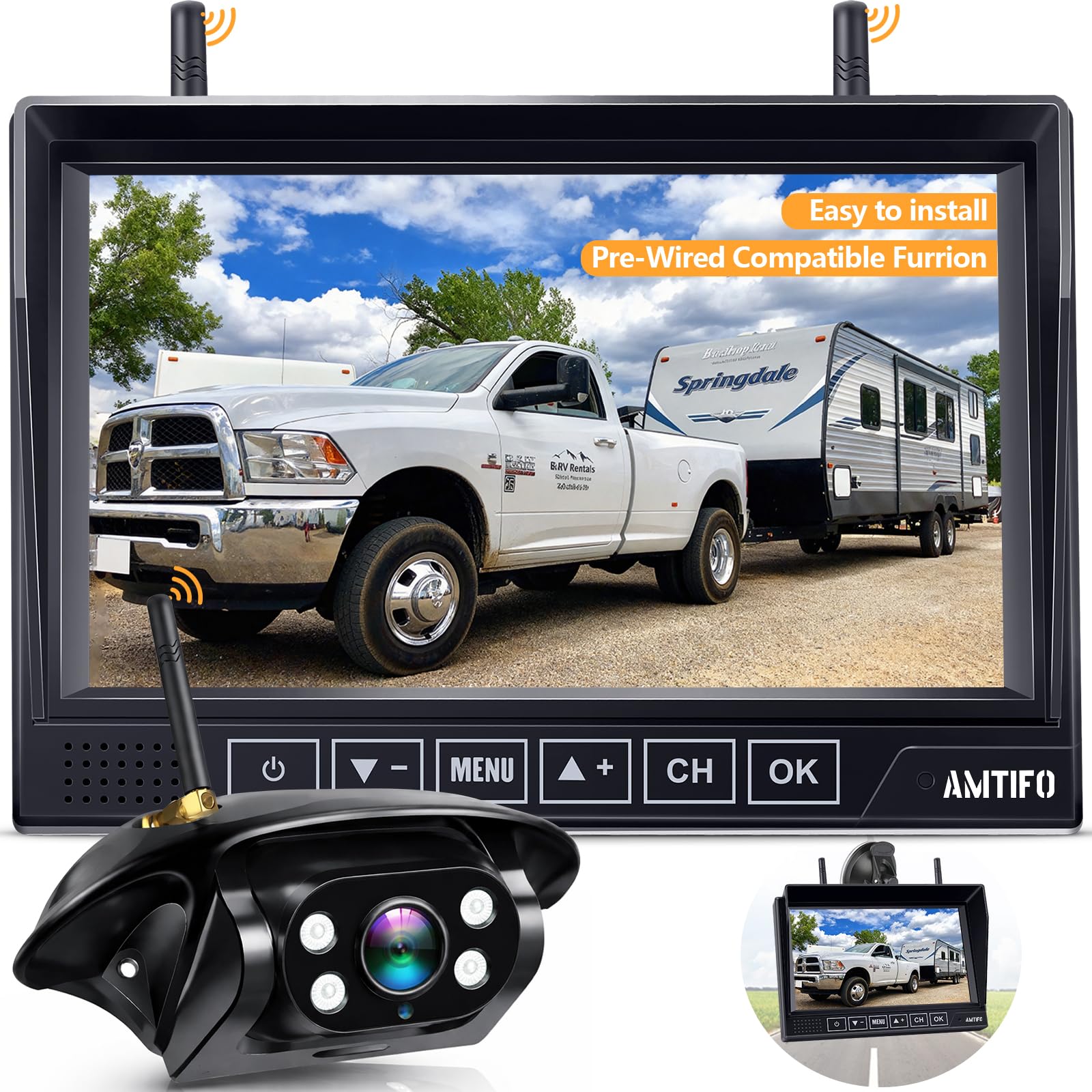
If your RV arrived from the factory pre-wired for Furrion, this is the closest thing to a straight swap. The kit includes the Furrion mounting bracket adapter plate and pigtail wire, so the AMTIFO connects to the existing jack and, in practice, is plug and play. Any owner who has priced the Furrion branded system roughly twice this price will recognise the appeal. Around 825 feet of open-air signal, working range under 320 feet, gives you plenty of headroom on a big trailer.
Unlike the plastic-bodied units, this one is built from all-metal construction with an IP69 waterproof rating, so heat and cold do not warp it and a knock is less likely to crack it. The power IC on the motherboard is upgraded from 35V to 60V to handle voltage spikes that shut down lesser cameras. Night vision is rated to 20 feet of infrared (IR) range — IR being an invisible light the camera throws out so it can see in the dark. The 130-degree field of view and the large 7-inch touchscreen display with capacitive keys round out a genuinely rugged package, and at 2.7 pounds it is still light enough to mount up top.
The catch worth knowing: range and rubber meets road — the 130-degree view is narrower than the 150-degree magnetic cams, and the 2.4-GHz link still drops when you put too much metal between camera and screen. It handles all weather well in owner experience, and the picture is described as large and clear. For a Furrion-prepped owner who wants a metal-bodied camera with a built-in DVR and a forgiving price point, this is a genuinely serious value.
Why it holds up
- All-metal construction with IP69 waterproofing
- Power IC upgraded from 35V to 60V for voltage spikes
- SD card recording acts as a dash cam for the rig
- Plug-and-play into Furrion pre-wiring
Where it leaves room
- 130-degree view is tighter than the widest picks here
- 2.4-GHz signal still suffers if metal blocks line of sight
Reach for this if: your RV is Furrion pre-wired and you want a tough metal camera with built-in recording.
Look elsewhere if: you need maximum field of view or a no-wiring magnetic setup.
4. VK7 Pro Magnetic Solar Backup Camera

A 15,800mAh battery and a true solar top-up mean you can go days without thinking about a charger.
This is a magnetic camera with a big-battery sole purpose: to keep running without a plug. The 15,800mAh rechargeable pack is rated for up to 30 hours of continuous use, and a monocrystalline solar panel feeds it up to 400 mA on sunny days. USB-C fast charging is the backup route. Auto power sync does the thinking for you — the camera switches on and off with the monitor, so you never have to climb up to a roof-mounted unit to tap a button.
The 7-inch IPS touchscreen is 1024 x 600, which is sharp enough to tell a cone from a campsite post in the rear view. DVR loop recording overwrites the oldest footage once the microSD card tops out — cards up to 128 GB are supported, so you can check a hard-to-remember incident without a card swap. The 150-degree view keeps the blind spots small, and infrared night vision reaches up to 30 feet in complete darkness. A 500 ft open-air 2.4GHz signal, with built-in spherical antennas so nothing works loose, covers most trailer setups. Six magnets do the mounting, and the brand will send a free metal plate for aluminium or fibreglass coachwork.
The honest snag: the battery life is the one feature people feel strongest about, and it splits both ways — the big cell helps, but heavier constant use can still drain it faster than the panel refills it. If you monitor constantly rather than when hitching, this is a camera to plan charging around. Everyone else gets what the functionality and picture-quality reviews describe: clearer visuals than a phone screen, a magnet that grips hard, and an install that takes minutes.
Standout strength: the biggest battery of any magnetic camera here at 15,800mAh, backed by a real solar panel and USB-C charging.
Where it wobbles: battery is the mixed signal in reviews — constant observation is heavier than the panel can keep up with.
Best for: campers who want a 7-inch touchscreen and solar top-up with no drilling at all.
Skip if: you plan to leave it watching all day, where a wired camera is steadier.
5. ZEROXCLUB 1080P 7″ DVR Monitor
Connects straight to your Furrion jack and starts recording with a single SD card.
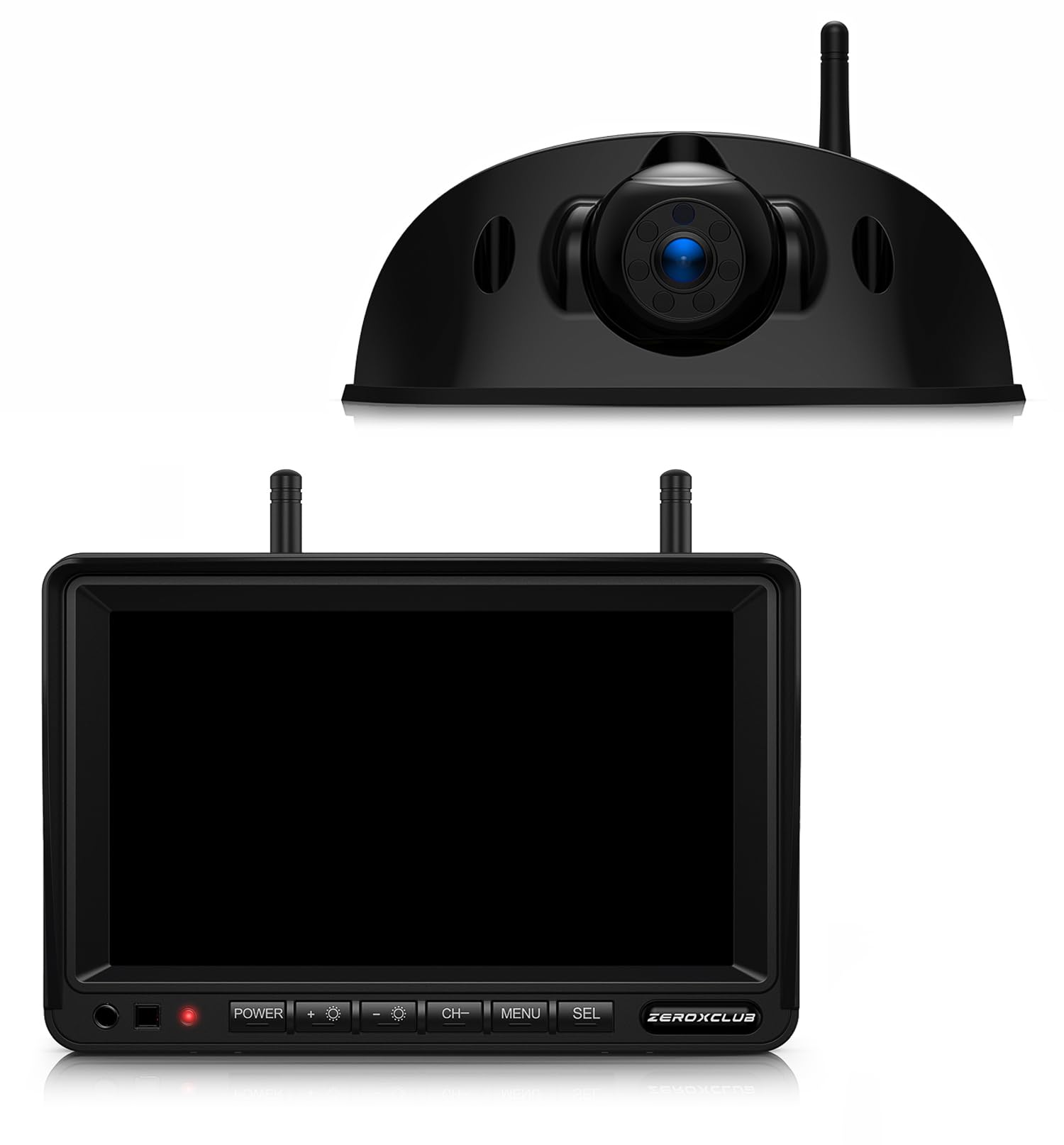
Installation is the reason this one lands near the top of shortlists. ZEROXCLUB made this for pre-wired Furrion RVs, so the camera plugs into the existing jack and automatically powers on when your headlights or running lights come on. No video cable, no drilling, no complex wiring. For a rig without a pre-wired mount, you still just secure the camera and feed it from the vehicle’s power supply. Setup is what people rave about here, and the clear colour picture on the 7-inch IPS screen backs it up.
The camera is rated IP69k — the tougher end of the waterproof scale, built for heavy rain and snow — and it packs six infrared lights plus a light sensor so it flips to night mode on its own. The 120-degree view is on the tighter side, but the dual-antenna 2.4GHz link is listed at a high-speed reception range of up to 100 feet, which suits trailer work. Both a windshield suction mount and a desktop stand come in the box, so you can set the screen up where you can glance at it. Parking guidelines help on the reverse, and it accepts up to four cameras for a fuller picture.
The one thing to check before you buy: some GMC, Chevy, Ford, and RAM vehicles use PWM power (pulse-width modulation, a way of sending power in rapid pulses) that can make the video flicker or freeze. ZEROXCLUB is upfront about it and recommends a Furrion 7-way adapter or a 12V PWM filter, neither included, to clean the supply. Confirm your vehicle is PWM before you mount, and everything else here works as advertised.
What makes install painless
- Plugs into Furrion pre-wiring, powers on with the lights
- IP69k camera with auto night mode from 6 IR lights
- Includes both suction-cup and desktop monitor mounts
- Loop recording via SD card acts as a dash cam
What to verify first
- 120-degree view is narrower than the wide-angle picks
- PWM vehicle power can cause flicker without a filter (sold separately)
Pick this if: your RV is Furrion pre-wired and you want the simplest possible install plus recording.
Check first if: you drive a PWM-power truck, where you may need a filter for a clean picture.
6. AUTO-VOX RV Backup Camera
A 7.2-inch widescreen that shows more lanes and still fits a normal dash.
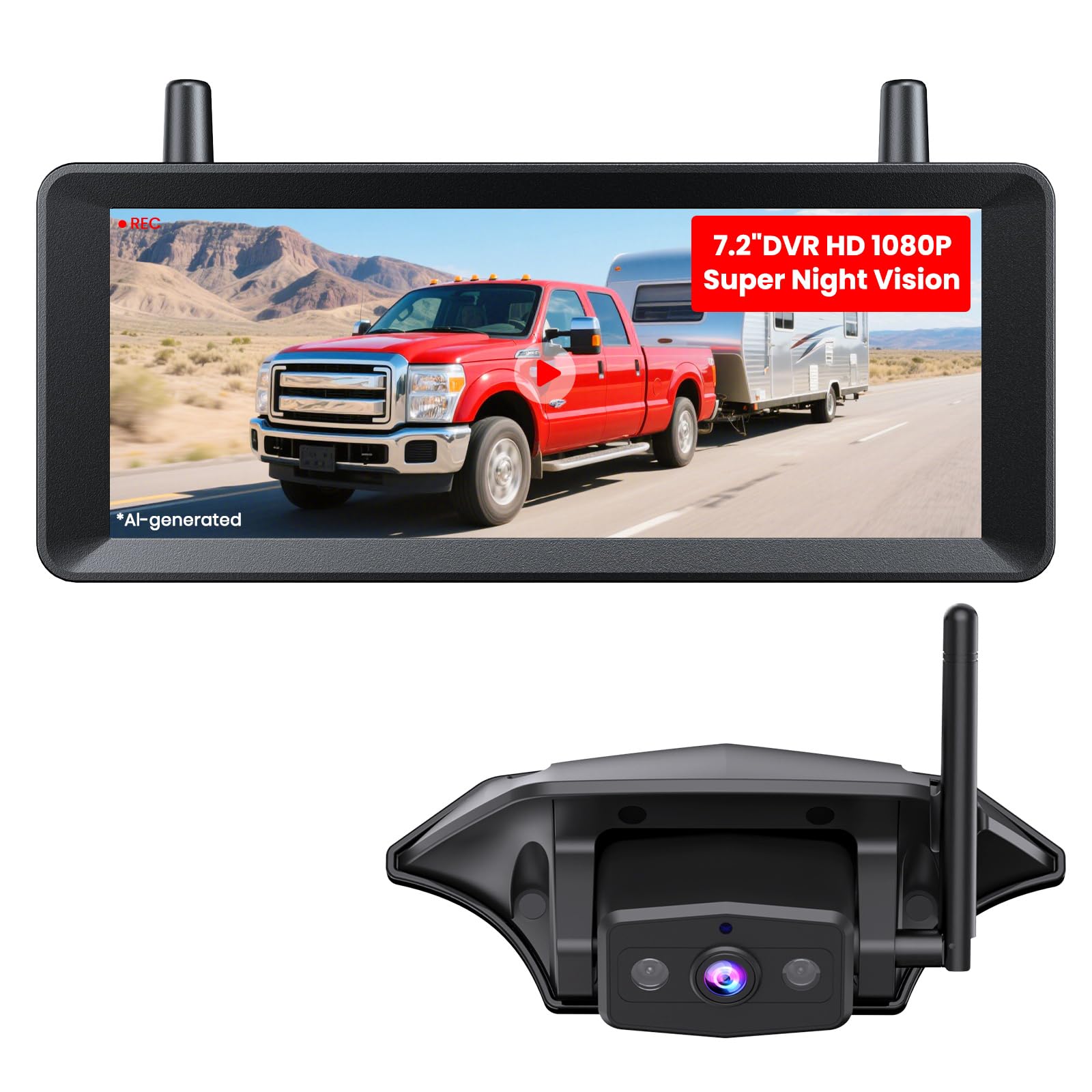
AUTO-VOX sizes the monitor just a touch wider than the 7-inch crowd, which on a winding two-lane road means a bit more of what is beside you. The system handles up to three cameras — a rear view plus sides — so you can watch your blind spots on narrow roads or add a camera inside for the horses or the gear. It is compatible with pre-wired RV systems for plug-and-play installation, with the mounting bracket and pigtail wire in the box, and you can tap a non-pre-wired rig into the taillights, running lights, or marker lights the same easy way.
Signal range is listed at a tested 500 feet, with dual antennas to keep it stable, and owners describe the picture as crisp HD wide-angle on the large display. The 1080P colour chip reproduces true colour, and infrared night vision handles dark roads and lets you check the perimeter from inside. The DVR recording (SD card supported) captures the journey and any nighttime visitors, so you have a record without staying up to watch.
Buy here with your eyes open on connectivity, though. Views and signal are the two areas where owner experience splits — it pairs fast for many, while others hit signal loss on the move. It earns strong marks for functionality, build, and installation, so the honest read is that it rewards you more often than it disappoints, but a clear line of sight between camera and monitor keeps it at its best. The 114-degree view is also the narrowest on this page, worth balancing against that wider screen.
Best for: campers who want a 7.2-inch display and multi-camera coverage for tight sites and night-time security.
Fair note: signal loss on the move is the point that splits reviews, so mount the camera where the antennas see the monitor.
Choose this if: you want the biggest screen here and room to add side or interior cameras.
Look wider if: a broad field of view matters more to you than screen size.
7. VOONOA 2 Magnetic Wireless Backup Camera
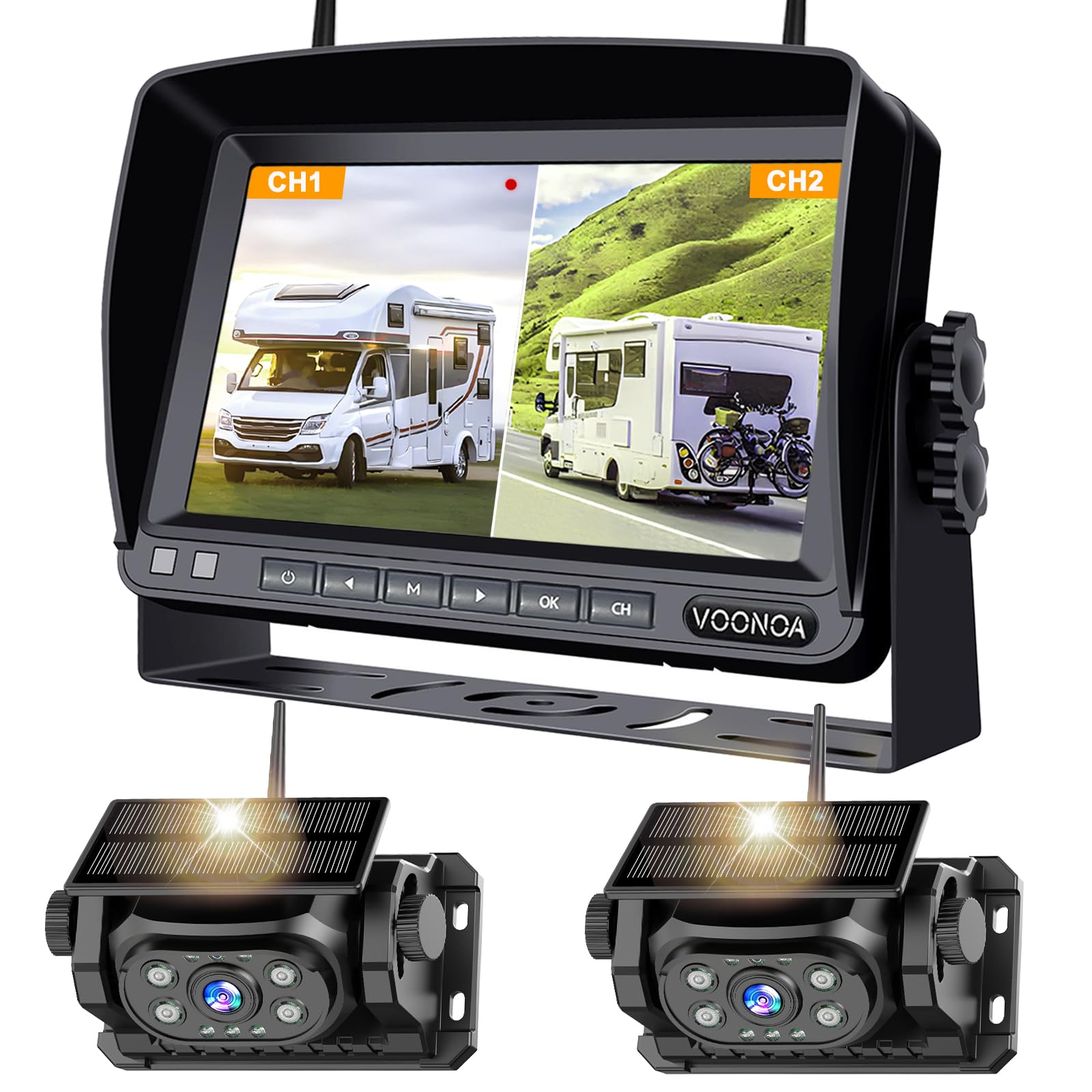
Two magnetic cameras and a 15,000mAh battery: one system covers the hitching and the highway.
Most kits here give you one camera. VOONOA hands you two — one on the hitch for backing up and one aimed rearward for the road — both feeding a 7-inch 1080P HD monitor that shows two channels at once. The 170-degree field of view is the broadest in this whole roundup, so the picture on that monitor covers a huge arc behind the rig. A 1920-pixel sensor carries the resolution, and the magnetic mounts use six strong magnets so both cameras pull off in seconds.
The big 15,000mAh battery is rated to last over 24 hours on a single charge, and a solar panel adds charge on sunny days to stretch the run time further. The system is 100% wireless in the mount-and-go sense, with a 2.4G digital wireless link listed up to 300 feet. There is a clever extra: the camera is remote-controlled through the monitor, so switching it on and off happens from the cab rather than a climb outside. A DVR on the 7-inch monitor records your drive for later. The whole thing is built for RV, truck, trailer, camper, and fifth-wheel duty.
What people count on is the clarity of the 1080P HD video and how instantly the wireless link works, with the magnetic mount gripping hard and no wiring to wrestle. The charging is the one thing to keep an eye on — some units stay topped up all day on the solar, while a few run low faster, so plan to plug in on heavy-travel stretches. Two cameras on one monitor takes a minute to get used to; once you do, the hitch view and the highway view together make tight manoeuvres far less stressful.
Why it stands apart: two cameras and a 170-degree view in a single kit, plus a 15,000mAh battery that lasts over 24 hours per charge.
Keep an eye on: solar top-up varies with sun, so long non-stop days can outrun the charge.
Ideal when: you want hitch and highway coverage from one monitor and two magnetic cameras.
Not ideal if: one camera does the job and you would rather keep the setup simple.
8. Furrion Vision S+ Wireless RV Observation System
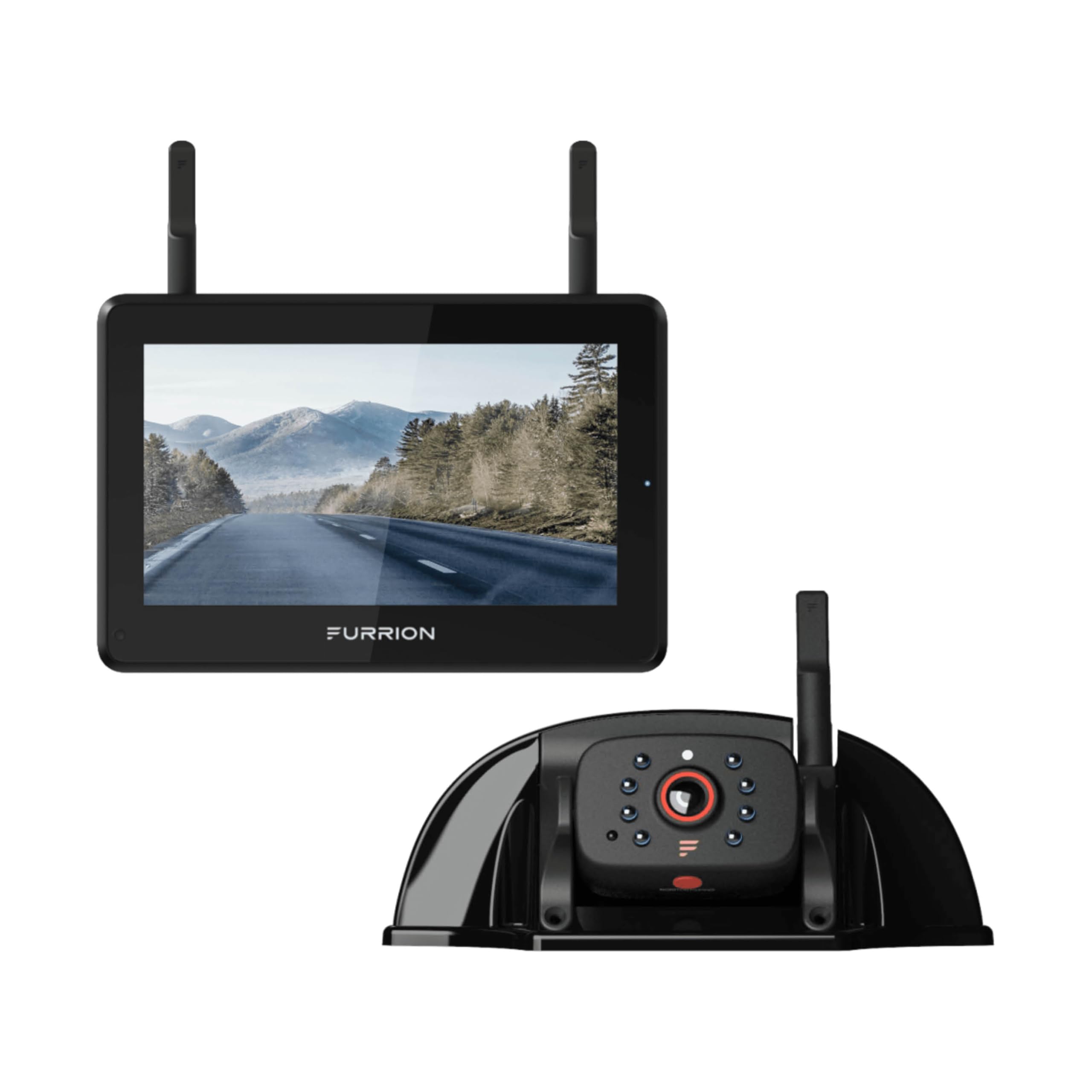
The brand-name system built for RVs that already wear the Furrion badge on the side.
If your rig was sold with Furrion pre-wiring, this is the factory-matched option and the install reflects it. Most RVs are already prepped for the Vision S+ system, so drilling is kept to a minimum. The sharkfin camera is a high-resolution 1080p unit rated IP65 for water resistance, with infrared night vision, live streaming, smart IR cut filters (they strip out false colour in the dark), and a 140-degree viewing angle. Around 492 feet of open-air signal and a tested range of up to 100 feet at high speed cover typical RV and motorhome duty. It works across RVs, motorhomes, trucks, semi-trailers, box trucks, shuttle buses, commuter buses, and tractors.
The touchscreen anti-glare monitor carries park assist marker lines and can display up to four cameras for all-around coverage, with both windshield and table mounts included. There is a genuinely useful security angle: the camera can be wired to watch the vehicle when parked, and its motion sensors auto-wake the display. A microphone in the camera even sends audio, so a spotter can talk you back. Signal quality and build are the traits it is most admired for — the picture is described as clear and steady, and it is reliable on a long 42ft 5th wheel.
Premium brand, premium expectation, and that is the honest friction. The price side and the connectivity side both split opinion, with some owners reporting frequent disconnections and others finding it a fine buy. It is also IP65 rather than the IP69 of the cheaper cameras here, which is still plenty for rain but not built for high-pressure jet washing. If your RV is Furrion-native and you want the pieces that simply slot in, the Vision S+ is the tidy choice.
Tidy for Furrion rigs: factory-matched install, 1080p sharkfin, motion-sensing security mode, and monitor audio for parking guidance.
The friction: connectivity splits reviews and the IP65 rating sits below the IP69 of cheaper rivals.
Built for: Furrion-native RVs where the factory pre-wiring makes install a quick fit.
Consider carefully if: you want maximum waterproofing or a rock-bottom spend.
Know the Specs
Wireless Means Video, Not Power
A wireless RV camera sends its picture through the air, but the camera lens still needs 12V power from somewhere. Some units plug into Furrion pre-wiring; others clip to a running-light or reverse-light circuit. Magnetic, battery-and-solar cameras are the exception — they carry their own rechargeable cells, so no vehicle wiring is needed at all. Know which type your rig can support before you buy.
Field of View: What the Degree Number Tells You
The field of view is the angular spread the camera captures, written in degrees. A tighter angle like 114 or 120 degrees zooms in and shows detail; a wider 150 or 170 degrees pulls in more of the lane either side, which helps with blind spots and hitching. A very wide lens shrinks distant objects, so pick a degree figure that matches how you use the camera.
IP Waterproof Ratings
The IP number tells you how well the camera survives water and dust. IP65 handles rain and low-pressure spray. IP69 and IP69K are higher grades built for powerful, high-temperature jets, which matters if you wash the rig with a pressure washer. A rear-facing camera takes constant road spray, so check this rating before you buy.
Signal Range and Real-World Range
Ranges like 984 feet or 500 feet are line-of-sight figures measured in the open with nothing in the way. Put a trailer wall, cargo, or heavy rain between camera and monitor and the usable distance shrinks. Look for a working range listed next to the open-air figure, and favour dual antennas for a steadier signal.
Common Questions
Will a wireless RV camera work on my trailer if it is not Furrion pre-wired?
What does “wireless” actually mean on these cameras?
How far can a wireless RV camera really transmit?
Do I need a 7-inch monitor or is a 5-inch screen enough?
Will a magnetic backup camera stay on at highway speed?
How long does a solar RV camera battery last?
Why does my camera flicker or freeze on a Ford or RAM truck?
Can I add more cameras to the system later?
Does night vision work in total darkness?
Is the Furrion Vision S+ worth it over the cheaper alternatives?
The Bottom Line
For most RV owners, the strongest all-round pick among these wireless cameras for RV use is the Haloview BT7, because its built-in DVR, 984 ft open-air range, and 0.1 lux night sensor cover long rigs and give you recorded proof of what happens behind you. And if your RV is already Furrion pre-wired, the metal-bodied AMTIFO HD 1080P is the closest thing to a straight swap, with recording baked in and a build that shrugs off weather. Anyone shopping this list should start with the Haloview’s combination of range and recording — it is the most complete system here for a serious tower.
How we choose
We do not accept paid placement. Every pick is matched to a real buyer and a real use-case; we do not hands-on test units.
Sources
Specifications: manufacturer listings and product documentation. Review insights: verified customer reviews, as of November 2026. Pricing: not shown on this page (it changes often); check the current price via the retailer link.
As an Amazon Associate, Tactical Gear Guy earns from qualifying purchases. This does not affect which products we feature.