Specs are compiled from manufacturer listings and verified buyer reviews and can change over time — please confirm the key details on the product page before buying.
You want your own headphones on a plane, a hotel TV, or a gym machine that still uses a round headphone jack — and you want no cord dragging across your lap. That is the whole job of these adapters: they take the audio out of an old 3.5mm socket and hand it to your Bluetooth headphones. Below you get the pick that handles the most situations, the ones built for long flights, and the budget-friendly starter. A quick honesty note: this list uses flexible, human-like matching for wireless Bluetooth audio adapter for headphones, so not every pick is the exact model you typed into the search bar — the nearest same-type adapter serves the same purpose, and each entry tells you exactly what it does.
This guide is built by comparing the manufacturers’ published specifications and the patterns across verified customer reviews, so you get each pick’s real strengths and trade-offs instead of marketing spin.
Start with the connector, then check latency, battery, and whether it sends or receives. The right wireless bluetooth adapter for headphones turns any headphone jack into a cord-free link in about a minute.
Top Picks


How To Choose The Best Wireless Bluetooth Adapter for Headphones
Almost every disappointment with these adapters comes from buying the wrong mode or ignoring one number. Get these four things straight and the rest is comfort.
Transmitter or receiver — work out which direction the audio flows
A transmitter takes sound out of a jack and sends it to your headphones. That is the airplane, hotel TV, and gym-machine job. A receiver does the opposite: it takes audio from your phone and pushes it into a wired speaker or car stereo. Several picks here do both, so check the switch before you assume. If a listing says it is transmitter-only, it will not feed your car’s AUX port from your phone.
Latency in milliseconds — the number that decides lip-sync
Latency is the delay between the picture and the sound reaching your ears. Under 40ms reads as synced on a movie; around 100ms is fine for music but can drift on dialogue. Many adapters only hit their lowest number when your headphones support the same low-latency codec, so the pairing matters as much as the adapter.
Battery hours, charge time, and pass-through charging
A long-haul flight plus a layover can run past a short battery. Look at the hours on a single charge and whether it can play while plugged into USB-C. Pass-through charging means the adapter keeps working during a top-up instead of going dark mid-film.
Plugs, adapters, and the airplane armrest trap
Older planes use two small prongs in the armrest instead of one round socket. A kit that includes a dual-prong adapter saves you from digging through a seat pocket for a spare. The same rule applies at home: RCA jacks on a stereo need an RCA-capable unit, not just a 3.5mm one.
Side-by-Side Comparison
| Model | Best For | Battery | Bluetooth | Latency | Amazon |
|---|---|---|---|---|---|
| Syntech Airplane Bluetooth 6.0 Transmitter Receiver★ Best Overall | All-rounder for flights and daily use | 15 hours | 6.0 | 100 ms | Amazon |
| Beeitzie Bluetooth Transmitter ReceiverMost Popular | Long flights and dual-headphone sharing | 24 hours | 5.4 | Under 40 ms | Amazon |
| FiiO BTR11Best Sound Quality | Turning wired headphones wireless | 15 hours | 5.3 | — | Amazon |
| LAICOMEIN Ultra Pro | Older aircraft with dual-prong jacks | 20 hours | 5.4 | Under 40 ms | Amazon |
| Avantree SoundJet R1 | Long-haul movie marathons | 25 hours | — | aptX Adaptive/HD | Amazon |
| 1Mii ML302+ | TV and home stereo with RCA | 30 hours | 5.3 | aptX Low Latency | Amazon |
| Twelve South AirFly SE | Simple carry-on travel | 20+ hours | — | — | Amazon |
| Twelve South AirFly Pro | Frequent flyers who want reach | 25+ hours | 5.0 | aptX Low Latency | Amazon |
Detailed Reviews
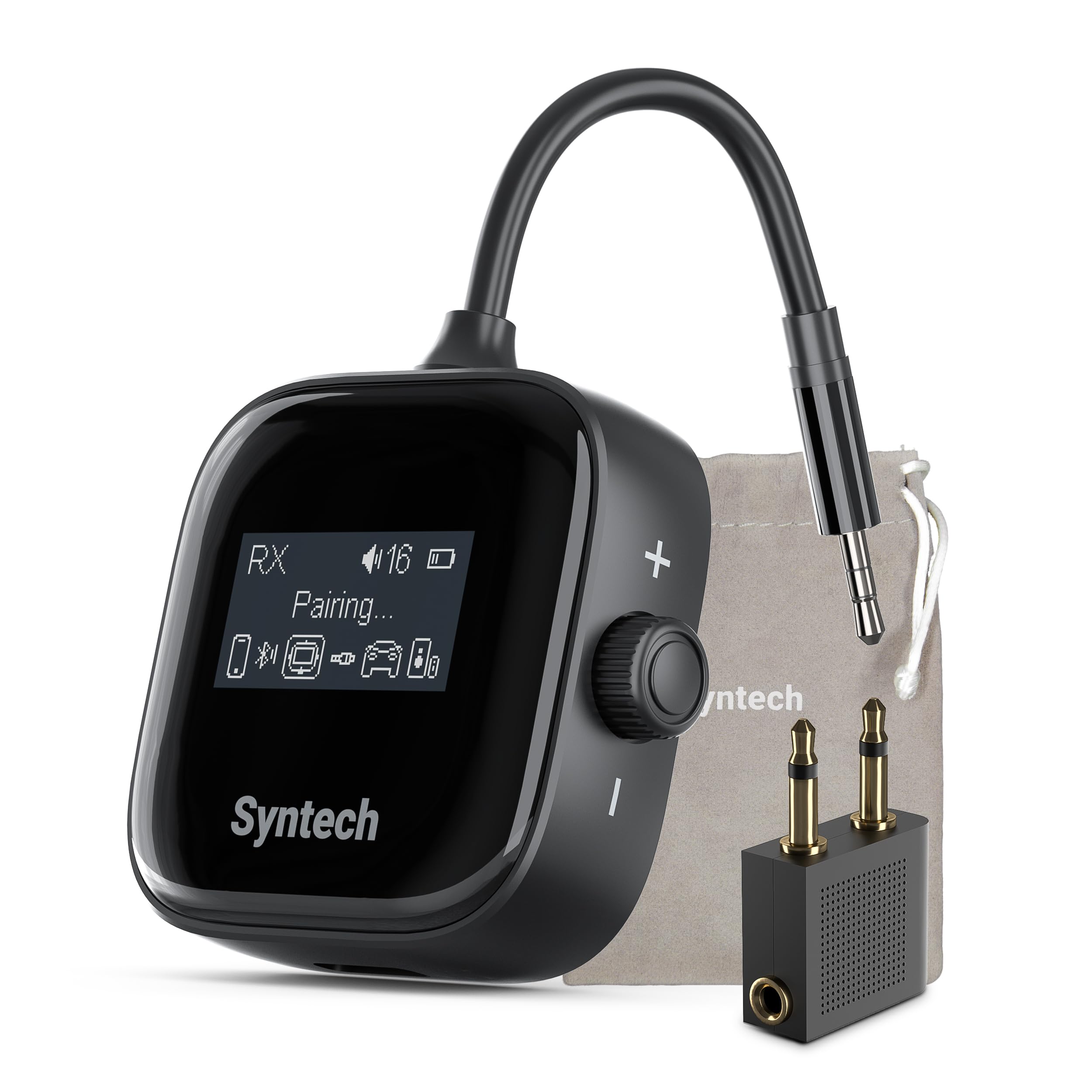
1. Syntech Airplane Bluetooth 6.0 Transmitter Receiver
Our pick — 4.5+★ from 150+ verified ratings; the strongest balance of quality and price.
A 2-in-1 transmitter and receiver with an HD screen for pairing, battery, and mode.
The feature that settles most buying decisions here is the screen. A clear HD display shows you the pairing state, the battery level, and which mode you are in, so you are not guessing why audio is not coming through. That screen is why it suits anyone who wants one adapter for flights, the gym, and the car stereo without re-reading the manual each time.
On the wireless side it runs Bluetooth 6.0 — the newest version in this lineup — with a stated 49ft connection range so you can leave your headphones on and walk to the kitchen. It is backward compatible with older versions, though the maker warns latency climbs noticeably with devices below Bluetooth 5.2. The 100ms figure holds in SBC/AAC mode, which is fine for music and podcasts but the one place it trails sharper picks: the Beeitzie unit claims under 40ms, so for lip-synced movies the Syntech is the slower of the two.
Owners single out the quick AirPods pairing and the plug-and-play start as the least fussy part of the connection. Dual pairing lets two sets of headphones share one screen, and the 15-hour battery recharges in 1.5 hours, the quickest top-up in this lineup and faster than the Ultra Pro’s 2 hours. At 15 hours it covers a transatlantic flight, and the 1.5-hour recharge beats every other adapter here.
What earns it the top slot
- HD display shows pairing, battery, and mode at a glance — no blind troubleshooting
- Bluetooth 6.0 with a 49ft range, the longest reach on this list
- 1.5-hour charge for 15 hours of playback — the fastest refill here
- Dual pairing so a partner can plug into the same seat-back screen
Where it gives ground
- 100ms latency is the highest figure in this comparison — music is fine, tight lip-sync is not its strength
- Will not work with devices that demand a pairing code
Reach for this if: you want one adapter for the plane, the TV, and the gym, and you like seeing the mode and battery without an app.
Look elsewhere if: movie lip-sync is your dealbreaker — the sub-40ms picks below close that gap.
2. Bluetooth Transmitter Receiver
Built for the six-hour flight: synced picture, all-night battery, two headphones at once.
If your flights are long and your patience for lag is short, this is the one to beat. Under 40ms latency means the dialogue lands with the lips, which matters the moment you are watching a film rather than a podcast. That is less than half the Syntech’s 100ms figure, and it is the difference you actually feel on screen.
The battery number is the headline for travellers: 24 hours of playtime on a 2-hour USB-C charge, against 15 hours on the Syntech — a gap note when a red-eye plus a connection stretches your day. A dual-prong airline adapter is in the box, so older armrest jacks are covered without buying anything extra. Two pairs of Bluetooth headphones can link in transmitter mode, which turns one seat-back screen into a shared movie for you and whoever is beside you.
Owners describe it as simple to set up and reliable once it is running, with clear sound and enough battery to get through a trip on a single charge. The pairing note is worth memorising: keep AirPods inside their case and switch off nearby Bluetooth on your phone during the initial link, or the adapter can chase the wrong device.
Why it places high: under 40ms latency, 24 hours of playback, dual pairing, and an airplane adapter included — a combination that covers the whole trip without extra parts.
The catch: it leans hard toward the travel and TV job, and the pairing routine in the manual is not optional — skip the case-and-switch-off step and the first connect can frustrate you.
Pick this when: movies on a long flight are the main event and you want the sound locked to the picture.
Think twice if: you mostly want a quick music link and would rather not manage a pairing sequence.
3. FiiO BTR11 Bluetooth 5.3 Receiver
A receiver with a real amplifier inside, made to wake up wired headphones.
This is the one that does a different job from the travel adapters: it receives, so it turns your wired headphones into wireless ones. The part that makes it stand out is the built-in ear amplifier pushing 45mW (16Ω) — that is real output power, the reason a pair of wired cans sounds alive rather than thin over Bluetooth. Add LDAC support and you get a higher-quality Bluetooth audio format, which is the whole point of buying this over a no-name dongle.
It weighs 12.5g and measures about 5.5cm, with an elastic back clip and a lanyard so it can hang off a collar or a bag. Fifteen hours of music playback and a 1-hour charge to 90% fit the same long-session idea. A built-in omnidirectional microphone with call noise reduction means it can double as a headset for calls. Build quality is the thing everyone raves about here, and the sound quality sits right behind it — the pair of them are what keeps IEM owners coming back.
Set your expectations on the wireless side honestly. Connectivity, battery life, and reliability all draw mixed reactions, so the first pairing can take a second attempt and the runtime picture is not uniform across phones. Note too that this is a receiver, not a transmitter — it will not push a seat-back screen into your AirPods.
The spec that sells it: LDAC plus a 45mW amplifier turns a wired pair of headphones into a genuinely good wireless set, at a modest 12.5g on a clip.
Fit note: receiver-only — great for headphones and speakers, wrong tool for a flight if you need to transmit.
Buy it for: turning good wired headphones into wireless headphones without losing the sound.
Leave it be if: the job is getting audio out of an airplane screen — you need a transmitter for that.
4. Ultra Pro Bluetooth Transmitter Receiver
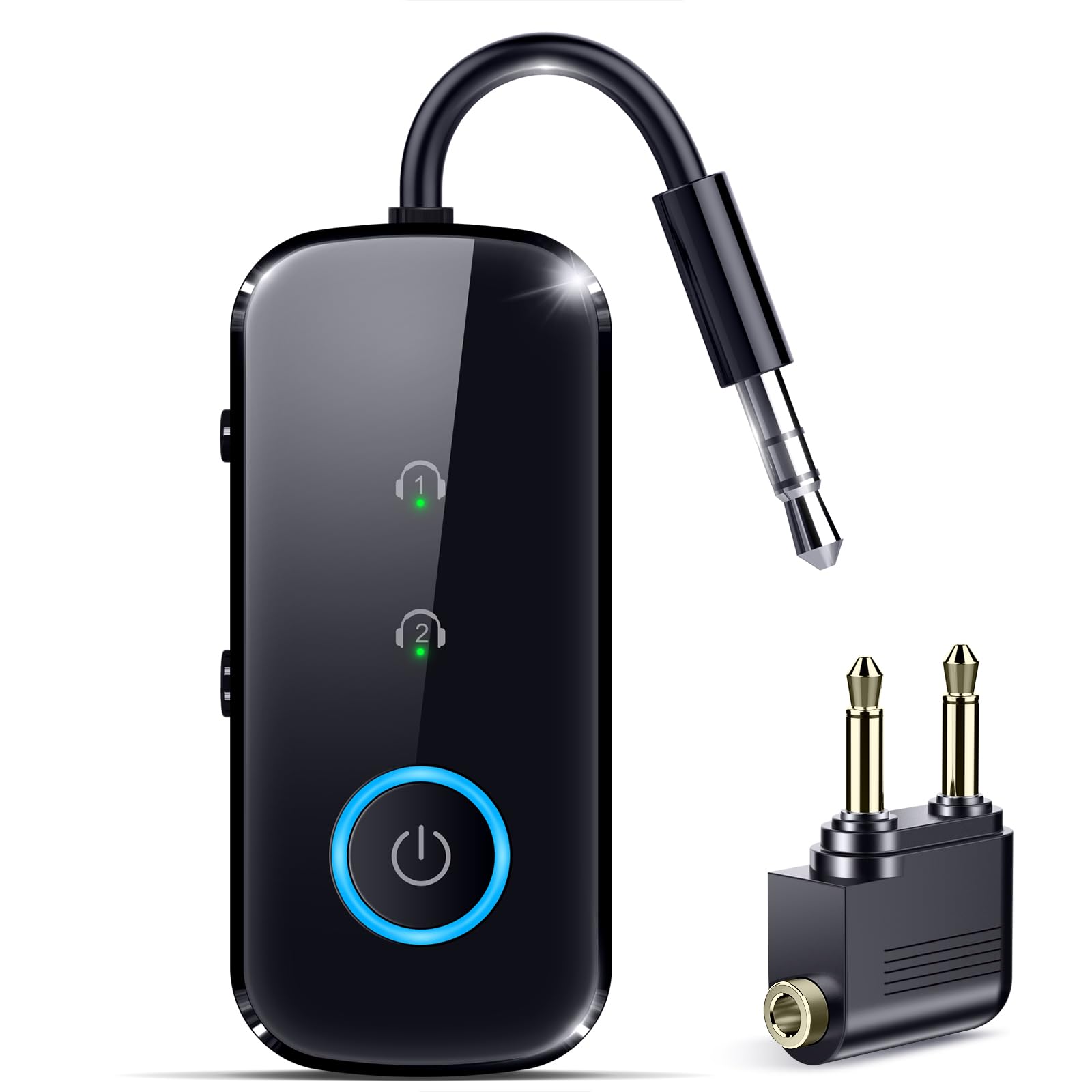
The kit that covers both the modern jack and the old two-prong armrest port.
Older aircraft are where travel adapters embarrass themselves, and this one plans for it. A dual-prong adapter for legacy armrest ports comes in the box, alongside the standard single 3.5mm path, so you are not caught out on an older cabin. It is lipstick-sized, so it disappears into a carry-on pocket.
Latency sits under 40ms on aptX Low Latency, and the maker quotes a 33ft range against the Syntech’s 49ft — shorter reach, but still enough to leave the adapter on the tray table while you stretch your legs. Battery runs 20 hours, with a 2-hour recharge, which lands between the Syntech’s 15 hours and the 24-hour Beeitzie unit.
Dual pairing with dedicated ‘1’ and ‘2’ indicator lights is a smart touch: you can see each headphone confirmed instead of decoding a blinking pattern. The second pair only joins once the first is connected, so add them in order. Range and latency both draw a mix of reactions from owners, so keep the adapter in sight of your headphones for the steadiest signal.
Reasons it earns a spot
- Includes a dual-prong adapter for both modern and older aircraft jacks
- Dedicated ‘1’ and ‘2’ LEDs for each paired headphone
- Under 40ms with aptX Low Latency for synced viewing
- 20 hours of playback on a 2-hour USB-C charge
Worth knowing before you buy
- 33ft range is shorter than some rivals — keep it within line of sight
- Will not work with Bluetooth hearing aids or 2.4G-sync devices
Best for: travellers who fly a mix of aircraft and do not want to gamble on the armrest socket.
Skip the gamble if: you fly mostly newer planes and want the longest reach instead.
5. Avantree SoundJet R1
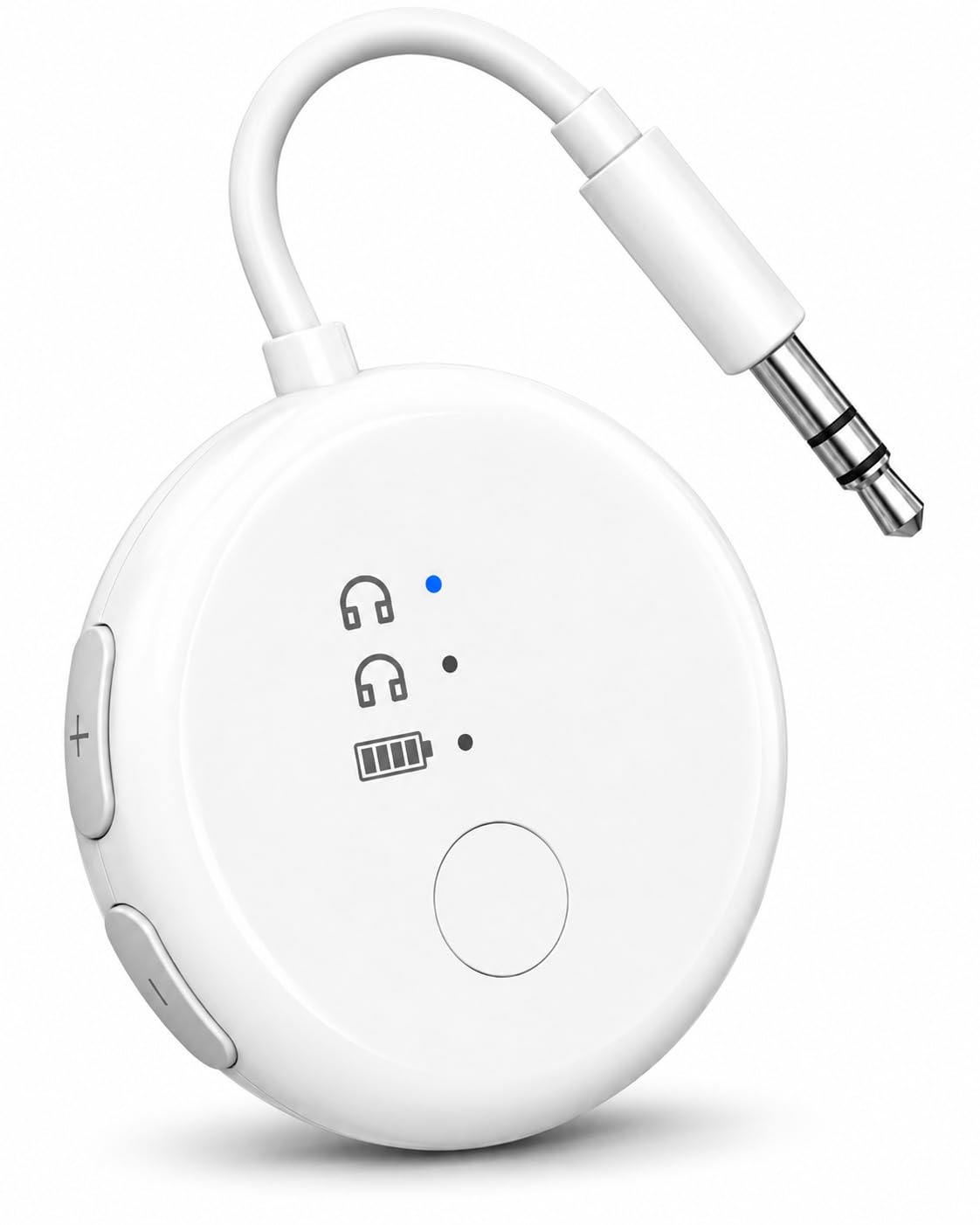
25 hours of playback and pass-through charging — built for the flight that has no end.
Two travellers, one screen, one battery that outlasts the flight: that is the pitch. Pair two Bluetooth headphones at once and the dedicated connection indicators show you when each pair is ready. The 25-hour run time sits above the 15-hour Syntech and the 20-hour Ultra Pro, and USB-C pass-through charging means the adapter keeps playing while it tops up — no dead gap in the middle of a film.
Avantree has spent years in wireless audio, and the premium Qualcomm chipset here supports aptX Adaptive and aptX HD for headphones that offer them. AirPods fall back to the codec both devices share, which is normal and not a fault. Buyers praise the build quality above all else, with the 25-hour battery a close second. A zippered storage bag is included.
The limitation is worth saying plainly: this is a transmitter only. It sends audio from a 3.5mm output to Bluetooth headphones and is not a receiver, so it will not feed music from your phone into a car stereo. It also is not built for phone calls, musical instruments, or TVs without a 3.5mm headphone output.
Why frequent flyers like it: 25 hours plus pass-through charging means the adapter never becomes the reason the movie stops.
The trade-off: transmitter-only — check the direction of your audio before you commit.
Made for: the long-haul flyer who wants a single charge to carry the whole trip and shares the screen with a partner.
Wrong pick if: you need a receiver to push phone audio into wired speakers.
6. 1Mii RCA Bluetooth Transmitter Receiver
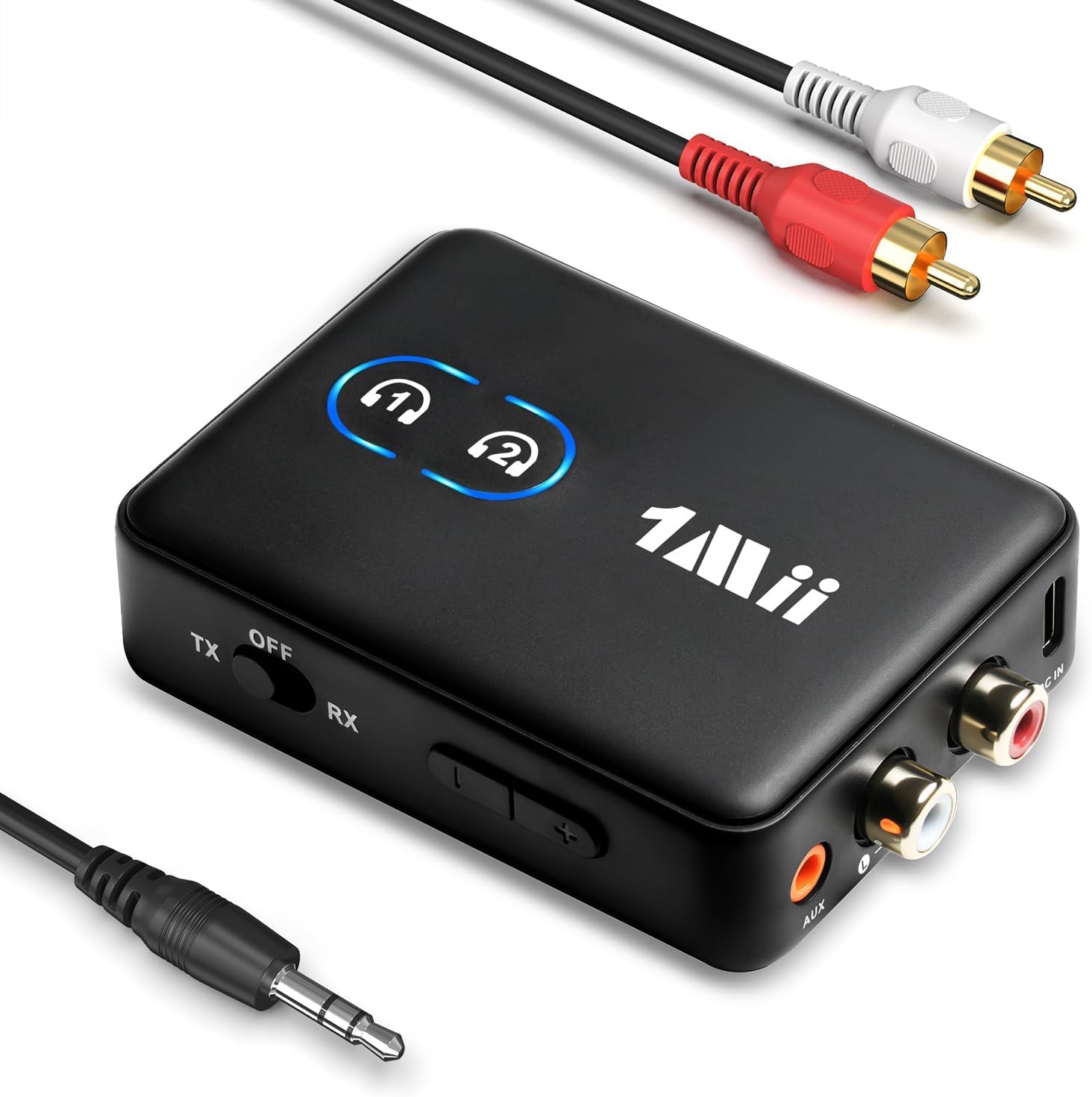
RCA jacks plus a 30-hour battery — the one tuned for the living-room stereo.
Volume buttons on an adapter are rarer than you would think, and here they let you trim levels without reaching for the phone. Pair that with both RCA and 3.5mm connections and the 1Mii covers a non-Bluetooth TV, a projector, or a home stereo that predates wireless. In transmitter mode it sends to your headphones; flip to receiver mode and it feeds a wired car or home system. Thirty hours of playback on 3 hours of charge is the longest battery figure on this list.
There is a neat battery check too: press the Bluetooth button three times and the LEDs flash to show the level. Bluetooth 5.3 with aptX Adaptive and aptX Low Latency keeps audio in sync — but only when your headphones support the same low-latency codec. Otherwise it drops to SBC or aptX with a 70-200ms delay, which the maker states up front. Two Bluetooth headphones can connect at once for shared viewing.
Setting it up is the part owners like, and the value reads well. Connectivity draws a mixed reaction, with the initial link being more work for some than others, and volume and sound quality also split opinion. The fix is usually the plug: transmitter mode goes into the AUDIO OUT jack, receiver mode into AUDIO IN. Get that right and it behaves.
What it does best: RCA and AUX in one body, a battery-level readout on demand, and a 30-hour run time for the stereo that lives in one place.
Worth flagging: low latency depends on your headphones supporting the same codec — the manual is explicit that without it you get 70-200ms of delay.
For you if: the job is a stationary TV or stereo and you want RCA compatibility with the longest battery here.
Not for you if: you want a pocket travel adapter — this is the home-focused unit.
7. Twelve South AirFly SE

The plug-it-in-and-forget-it transmitter that made these adapters a travel staple.
Pick this if your goal is getting on the plane with zero setup homework. It turns any 3.5mm jack into a Bluetooth feed for your AirPods, earbuds, or wireless headphones, then stays out of the way. Built-in volume buttons mean you can nudge the level without touching your phone, and the quick pairing mode links in seconds.
More than 20 hours is the reserve here, and it can run while plugged into USB-C — so a long flight plus a delay does not strand you. That battery is higher than the Syntech’s 15 hours, though short of the 25-hour Avantree unit. Weight is light enough to live in a carry-on permanently, which is the point of the AirFly line.
The honest wrinkle is consistency: on planes it works well, and elsewhere some units simply fail to connect, so test it at home before you rely on it at altitude. It does not carry a low-latency codec spec or a stated range figure, so treat it as a music-and-movie companion rather than a badge of radio engineering.
The honest value read: a proven travel shape, quick pairing, and over 20 hours of playback in a body you won’t notice in a bag.
The honest caveat: connectivity is not guaranteed on every source — pair it at home first rather than discovering a problem at the gate.
Suits you if: you want a simple, well-known transmitter for flights and don’t care about latency specs.
Better to pass if: you want stated latency and range figures to compare up front.
8. Twelve South AirFly Pro

The step up that adds range, codecs, and a receiver mode for the car.
Where the SE stops at transmitting, the AirFly Pro does both. It sends audio from any 3.5mm jack to your wireless headphones, and in receiver mode it feeds a car or boat AUX port from your phone. Over 25 hours of battery and the option to play while charging mean it holds the line on long trips.
The radio side is the upgrade worth paying for: Bluetooth 5.0 with aptX Low Latency, aptX, and SBC, plus a stated 10m/33ft reach so you can move around the cabin or room. That range matches the Ultra Pro’s 33ft and trails the 49ft on the Syntech. Volume is on the buttons, or you can use the app.
Fliers tend to like its portability, and the wireless link gets good marks for hooking up to seat-back systems. It carries more reviews than any other pick here, largely from travellers who have flown with one before.
Why it’s the safe bet: dual-mode flexibility, aptX Low Latency, and 25+ hours in a package that lives easily in a carry-on.
Where the SE above wins: if you only ever transmit, the SE saves you the extra cost of a receiver mode you won’t use.
The one to reach for: if you want one proven adapter for flights and your car, with codec support and range spelled out.
Look elsewhere if: you want the newest Bluetooth version — this one runs Bluetooth 5.0.
Know the Specs
Transmitter vs Receiver Mode
A transmitter sends audio out of a 3.5mm jack to your headphones — that is the airplane, hotel-TV, and gym-machine job. A receiver pulls audio from your phone and pushes it into a wired speaker or car stereo. Some adapters switch between the two; others, like the Avantree SoundJet R1, are transmitter-only. Check the direction before you buy.
Latency in Milliseconds
Latency is the gap between picture and sound. Lower is better for movies and games; under 40ms reads as synced, while 100ms suits music more than dialogue. The lowest figure only applies when your headphones support the matching low-latency codec — otherwise an adapter can fall back to a slower mode.
Bluetooth Version and Codecs
The version number (5.3, 6.0) describes the radio; codecs like aptX, aptX HD, and LDAC describe how the audio is packed. Higher versions tend to mean steadier links, but codec support is what changes the sound quality. Both ends must speak the same codec for the better format to kick in.
Battery Hours and Pass-Through Charging
A stated run time tells you whether the adapter outlasts your flight. Pass-through charging lets it keep playing while plugged into USB-C, which removes the dead gap mid-film. Charge time matters too — a 1.5-hour refill is quicker than a 2-hour one when you are rushing between gates.
Common Questions
Will an adapter work with older airplanes that have two-prong armrest jacks?
Do I need low latency to watch a movie on a plane?
Can I use one adapter with two pairs of headphones at the same time?
Why won’t my AirPods connect to the adapter?
Is a transmitter the same thing as a receiver?
How long does the battery actually last on a long-haul flight?
Will LDAC or aptX improve my wireless headphone sound?
Can these adapters connect to a car stereo?
Do these work with Bluetooth hearing aids?
What connection range should I expect from an adapter?
The Bottom Line
The strongest all-rounder for most people is the Syntech Airplane Bluetooth 6.0 — Bluetooth 6.0, a 49ft range, a screen that shows mode and battery, and a 1.5-hour charge for 15 hours of playback. If movie lip-sync is what keeps you up at night, the Beeitzie transmitter receiver closes the gap with under 40ms latency and a 24-hour battery. For turning wired headphones wireless, the FiiO BTR11 and its LDAC plus 45mW amp is the pick. And if two travellers need to share one screen, the AirFly Pro 2 handles dual pairing with the newest wireless standard. Whichever route you take, confirm the direction (transmit or receive), the latency figure, and the plug type before you buy.
How we choose
We do not accept paid placement. Every pick is matched to a real buyer and a real use-case; we do not hands-on test units.
Sources
Specifications: manufacturer listings and product documentation. Review insights: verified customer reviews, as of November 2026. Pricing: not shown on this page (it changes often); check the current price via the retailer link.
As an Amazon Associate, Tactical Gear Guy earns from qualifying purchases. This does not affect which products we feature.