Specs are compiled from manufacturer listings and verified buyer reviews and can change over time — please confirm the key details on the product page before buying.
You want headphones that sound right the moment you plug them in, with no charging, no pairing, and no lag. The short answer: the Audio-Technica ATH-M50X is the safest pick for most people because it balances strong sound, a detachable cable, and proven long-term owner satisfaction. The rest of this list covers the specific jobs a wire still does better than any wireless set — studio monitoring, silent guitar practice, DJ cueing, and low-volume listening on a laptop.
This guide is built by comparing the manufacturers’ published specifications and the patterns across verified customer reviews, so you get each pick’s real strengths and trade-offs instead of marketing spin.
A corded headphone lives or dies on three things: what the drivers do, how the cable attaches, and whether the pads survive daily wear. This breakdown of the wired headphones worth your money walks through all three on every pick.
Top Picks


How To Choose The Best Wired Headphones
Buying corded headphones is mostly about matching one pair to one job. A set that is built to survive a mixing desk is not the set you want for a long commute on a laptop. Get the jack, the cable, and the job right first, and the rest sorts itself out.
Start with the jack, not the brand
Almost every pair here ends in a 3.5mm plug — the small headphone jack on a phone, tablet, or laptop. What varies is whether a 1/4-inch adapter is included for amplifiers, mixers, and audio interfaces. If you play guitar through an amp or record into a mixer, you need that adapter in the box or you are buying one separately.
Not every 3.5mm plug behaves the same on a computer, either. The AILIHEN C90’s own product notes warn that its inline volume buttons may not work when plugged into a computer. On a laptop, plan on controlling volume from the screen instead of the cord.
Detachable versus fixed cables
A detachable cable is the single most useful feature for long-term ownership. When the wire frays or a channel cuts out, you swap the cable instead of the whole headphone. The Audio-Technica ATH-M50X, the OneOdio, the Shure SRH440A, and the beyerdynamic DT 770 Pro X all use detachable designs. The Sony MDR7506 has a cord that is not detachable, so treat that wire as a permanent part of the set.
Match impedance to what you plug into
Impedance, measured in ohms, is how hard the headphones are to drive. A low-ohm pair runs loudly straight from a phone or laptop. The beyerdynamic DT 770 Pro X is a 48-ohm set, and the maker states it plugs straight into any source — laptop, interface, phone, or console — with no headphone amp needed. If you plan to run an interface or mixer at the same time, a low-impedance closed-back pair keeps things simple.
Closed-back versus open, and what you give up
Every pick on this list is closed-back, meaning the earcups seal around your ears instead of letting air through. That seal is what blocks room noise and keeps your music from leaking into a microphone. The trade-off is that a tight seal can feel clampy after a few hours, which is the recurring note on several pairs here.
Side-by-Side Comparison
| Model | Best For | Driver Size | Cable | Impedance / Rating | Amazon |
|---|---|---|---|---|---|
| Audio-Technica ATH-M50X★ Best Overall | Most people, all-round use | 45 mm | Detachable | — | Amazon |
| Sony MDR7506Long-Session Pick | Long monitoring sessions | 40 mm | Fixed, 9.8 ft | — | Amazon |
| Yamaha HPH-MT5Balanced Pick | Balanced, portable monitoring | 40 mm | Detachable, 3 m | — | Amazon |
| Shure SRH440A | Recording and mixing | — | Detachable, locking | — | Amazon |
| beyerdynamic DT 770 Pro X | Home studio, plug-and-play | 45 mm | Detachable mini-XLR | 48 ohm | Amazon |
| Audio-Technica ATH-M20x | First studio pair on a budget | 40 mm | Fixed, single-side exit | — | Amazon |
| JOYO JMH-02 | Guitar practice and amps | 50 mm | Fixed, 3 m | — | Amazon |
| OneOdio Pro-10 | DJ cueing on a budget | 50 mm | Detachable | — | Amazon |
| AILIHEN C90 | Budget calls and laptop use | 40 mm | Fixed, braided | — | Amazon |
Detailed Reviews
1. Audio-Technica ATH-M50X Headphones
Our pick — 4.5+★ from 33,500+ verified ratings; the strongest balance of quality and price.
The do-everything corded pair that studios and bedroom listeners keep buying.
If you want one pair for mixing, gaming, and long listening sessions, start here. The ATH-M50X runs 45 mm large-aperture drivers with rare earth magnets and copper-clad aluminum voice coils — the moving parts that turn an electrical signal into sound. In plain terms, bigger drivers with strong magnets move more air, which is why these deliver deep, accurate bass without the vocals getting buried.
The feature that keeps owners happy for years is the detachable cable. Audio-Technica ships the M50X with three cables, and that bundle is exactly what reviewers point to time after time. A chewed wire or a crackling channel is a cable swap, not a funeral for the whole headphone. The 90-degree swiveling earcups also let you fold one side back for single-ear monitoring, which is handy when you need to hear a room or a co-host while the other ear stays on cue.
What wins owners over, though, is the sound itself. The M50X is the crowd favorite here — 4.5+ stars across 33,000+ owners — and the praise clusters around sound quality above all else, followed closely by value and comfort. The circumaural pads seal around the ears rather than pressing on them, so the isolation holds up in a noisy room. The honest note is fit: it comes up as the most-mixed aspect in owner feedback, so plenty of heads love the clamp and a handful find it snug.
studio monitoring staple
- 45 mm drivers give deep, accurate bass while keeping vocals clear
- Detachable cable ships with three cord options in the box
- 90-degree swiveling earcups allow single-ear monitoring
- Circumaural seal blocks room noise in loud spaces
clamp force tight
- Fit is the most mixed aspect in owner feedback — some heads feel the clamp
- Pricier than the entry-level picks further down
track work: anyone who wants one corded headphone for studio work, gaming, and daily listening without compromising on the big three.
long sessions: you have a wide head and have felt clamp pressure from closed-back pads before.
2. Sony MDR7506 Professional Large Diaphragm Headphone
A field-standard monitor with a long reach cord and a fold-up frame that travels.
If you cut audio or monitor a feed for hours, the MDR7506 is built for that shift. It sits on more broadcast and edit desks than almost anything else, and it earns that spot with a broad 10 Hz to 20 kHz frequency response — the range of pitches the drivers can reproduce, from the lowest rumble to the highest sparkle. Neodymium magnets (strong, lightweight magnets) and 40 mm drivers do the work.
what separates it from the M50X is reach. The cord runs 9.8 feet and ends in a gold-plated plug, with a 1/4-inch adapter included for interfaces and mixers. That length means you can move around a desk without dragging the laptop with you. It folds into a soft case for travel, too. The catch is that the cord is not detachable — a damaged wire means a repair rather than a quick swap, unlike the M50X and the beyerdynamic below. Comfort is what carries the long days here; buyers report that ear fatigue over a full shift is the complaint these avoid.
Owners rate these 4.5+ stars, and the pattern in feedback is clear: sound first, then comfort, then solid build. The noise isolation from the closed design holds its ground in a shared room. If you want the same monitoring character with a cable you can replace down the road, the detachable picks on this list will suit you better.
foldable field favorite: a 9.8-foot fixed cord and a fold-up frame make this the most portable full-size monitor here — no adapter hunt and no tangling over a desk.
coiled cable only: the wire is permanent, so treat the cable gently and store it in the included case.
location recording: you need a long cord, a folding frame, and a monitor that stays comfortable through an eight-hour desk day.
wireless needs: a detachable cable is non-negotiable for you.
3. YAMAHA HPH-MT5 Monitor Headphones
Light on the head at 250 grams, and faithful to the source without coloring the mix.
Here is the number that matters for a long session: 250 grams. That is about the weight of a thick paperback, and it is why the MT5 stays comfortable through extended monitoring while heavier sets start to press. Yamaha pairs that light frame with 40 mm custom drivers and ccaw voice coils — the wire winding inside the driver that moves the diaphragm — covering a 20 Hz to 20 kHz range. The sound stays faithful to the source rather than flattering it, which is what you want when you are checking a mix instead of enjoying one.
The closed-back, circumaural design seals around the ears for isolation, and a carrying bag comes in the box. Cable duties fall to a detachable straight 3-meter cord, with a gold-plated 6.3 mm stereo adaptor and a gold-plated stereo mini-plug included. Three meters gives you real slack at a mixing desk. It is the lightest full-size monitor in this lineup, and the closed seal performs well on pianos and other instruments where you need to hear only the feed.
The trade-off is that the airy, honest tuning is not built to flatter bass-heavy tracks — this is a tool, not a party. The MT5 is rated 4.5+ stars, and the tenor of the praise runs to crisp, clear sound and strong isolation. If you want extra low-end warmth for casual listening, the Sony or the beyerdynamic will feel more satisfying; if you want a neutral reference on a long day, this is the lighter one to wear.
mixing desks: anyone who monitors for hours and feels every gram by the end of it.
bass lovers: the neutral tuning does not add bass, so it rewards accuracy over punch.
4. Shure SRH440A Over-Ear Wired Studio Headphones for Recording

Built for the booth: a locking cable, a collapsible frame, and a balanced signature for critical listening.
Shure built the SRH440A on the frame of the original and updated the design for durability and comfort, and the recording workflow is clearly the target. The closed-back, over-ear design keeps sound contained so it does not bleed into your mic, and the sound signature is balanced and detailed across an extended frequency response. That means you hear a mix as it was built instead of a version sweetened by extra bass.
The standout hardware detail is the detachable locking cable — it clicks in and stays put, which matters when you are moving around a booth. Shure also tune impedance and power handling so the pair behaves consistently across audio interfaces, mixers, laptops, and portable players, so you are not re-tuning your gain every time you switch sources. Add the collapsible design and cushioned earcups and you have a set that folds down for storage yet sits comfortably through a long tracking session.
Owners are warm on the sound, especially the bass response, and the comfort holds up over hours. The mixed side is long-term reliability, with some cable-connection and fit notes showing up alongside the praise. It is a recording tool aimed at people who value a locking connection and a neutral ear; casual listeners who want thump may find it flat. The trade-off is fine for the job it is meant to do.
closed booth isolation
- Locking detachable cable stays connected under movement
- Closed-back design keeps headphone bleed out of the mic
- Extended frequency response stays balanced, not bass-hyped
- Collapsible frame folds away between sessions
headband pressure
- Long-term reliability and cable connection are mixed in owner notes
- Neutral tuning gives less boom for casual listening
vocal tracking: home recorders who need a locked cable and a clean reference while tracking.
casual listening: people who mostly want deep bass for music enjoyment rather than accuracy.
5. beyerdynamic DT 770 Pro X Headphones
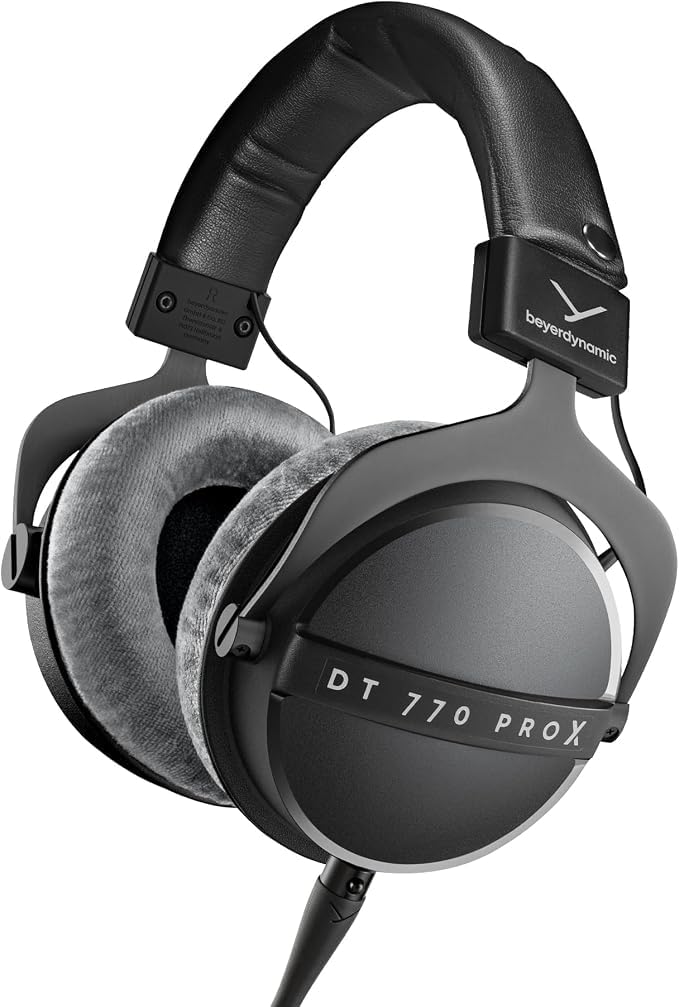
Forty-eight ohms and a flagship driver — studio sound you can plug straight into a laptop.
Here is the spec that shapes your whole experience: 48 ohm. That is the impedance, or how hard the headphones are to drive, and 48 is low enough that beyerdynamic says you can plug straight into any source — laptop, interface, phone, or console — without a headphone amp. Compare that with the M50X above, which has no listed impedance figure, and you can see why the DT 770 Pro X is the easiest premium option to run off everyday gear. The Stellar.45 driver, the flagship transducer in beyerdynamic’s lineup, does the sound work with high resolution at any level.
Your mic stays clean while you record, because the closed-back design (cups that seal around your ears) keeps sound from bleeding out. The detachable mini-XLR cable (a small locking audio connector) swaps in seconds if it wears. Replaceable velour ear pads push the lifespan out for years of daily use. In the box you get the DT 770 Pro X, a detachable 3 m cable, and a bag, handmade in Germany. For a home studio that wants studio sound without a separate amp, that combination is tough to top on convenience.
It is the priciest pick on this list, and part of that is buying into beyerdynamic’s build and Germany-based manufacturing. The sound and durability draw strong praise, with owners calling the detachable cable a real plus. The mixed side is comfort and fit — while plenty of people wear them for hours, some find the clamp too tight. If a light touch on the head matters most to you, the 250-gram Yamaha above is the softer option.
low-ohm easy drive: 48-ohm drive plus a detachable mini-XLR cable and replaceable velour pads means this runs off anything and repairs instead of dying.
non-detachable cable: comfort and fit split opinion, so those sensitive to clamp should try the lighter Yamaha first.
phone playback: you want premium studio sound that works on whatever jack you have without extra gear.
cable swappers: it is the highest-priced pair here, and the clamp is not for every head.
6. Audio-Technica ATH-M20x Headphones

The first proper studio pair — tuned low, built simple, and easy to live with.
The M20x takes the same 40 mm driver recipe that Audio-Technica is known for and tunes it for enhanced low-frequency performance, so you get more weight in the bottom end than its size suggests. It sits a notch below the M50X above in the range, with a single-side cable exit that keeps the wire out of your way when you turn your head. Rare earth magnets and copper-clad aluminum voice coils do the driving. For someone setting up a first home studio without overcommitting, this is the sensible entry point.
The circumaural pads contour around the ears, and that seal does the isolation work in a loud room. It is designed for studio tracking and mixing, though plenty of owners run it for gaming as well. Sound quality is what the following is built on, matched by a strong sense of value — this is the pair most people mention when they talk about getting real monitoring without a big outlay. The cord, comfort, and fit all come up mixed in owner notes, so expect a modest set of pads rather than a plush lounge chair.
The honest limit is that the fixed cable means no swaps later, unlike the M50X and the beyerdynamic, and the pads are basic. But if you are testing whether studio headphones suit your workflow, the M20x gets you a tuned monitor and a sealed fit at the lowest buy-in on this list. Upgrading to detachable cables later is a jump in price, not a small step, so start here if you are unsure.
first monitors: you are building a first setup and want a tuned studio monitor without the premium step-up.
heavy use: fixed cable and basic pads — comfort and cord both come up mixed in owner feedback.
7. JOYO JMH-02 Headphones

Fifty-millimeter drivers and a quarter-inch adapter — a practice-room monitor for guitar and drums.
Plug a guitar in and you want to hear the amp, not a boosted version of it. The JMH-02 runs 50 mm neodymium drivers tuned for a flat, balanced 15 Hz to 25 kHz response, with no artificial bass boost. That means rich treble, smooth mids, and tight un-hyped bass, so your synth patch or mix comes through as it actually is. For tracking vocals without bleeding into the mic, the closed circumaural design does passive isolation — a physical seal, not electronics.
The 3-meter straight cable gives room to move, and JOYO includes a 6.35mm gold-plated adapter that connects securely to guitar amps, audio interfaces, mixers, digital pianos, and drum modules. That single adapter is what makes this pair work for amp practice from the start rather than requiring a separate purchase. A self-adjusting leather-cushion headband and soft over-ear pads suit a range of head sizes, from younger players through adults.
What wins people over is the accurate, flat voicing — it is the sound of a real reference, not a hype machine. A note of caution: the cable is non-removable, so it is not a swap-later design like the detachable picks. Still, owners praise it for guitar room and electric drum work, and the fit flexibility means it can be shared across a household. Take short breaks on long sessions, as the brand itself suggests. If you practice through an amp or a modeler most nights, this is the sensible match.
home studio: guitar players and drummers who want a flat, honest monitor that plugs straight into an amp or interface.
travel bags: the cable is fixed — if a detachable cord matters, the OneOdio below or the M50X covers you.
8. OneOdio Wired DJ Hi-Res Over-Ear Headphones

Big 50 mm drivers and a swivel cup for cueing — DJ-ready at the lowest buy-in here.
OneOdio fits the biggest driver on this list into the cheapest DJ bracket, and it makes a real difference. The 50 mm speaker drivers and neodymium magnets (strong, lightweight magnets) push strong bass and clear vocals. The AILIHEN C90’s 40 mm drivers sit 10 mm smaller by comparison — a 25% narrower driver, which explains why these push more punch. The 90-degree swiveling earcups let you slide one ear out for single-ear cueing, the move every DJ needs.
It runs in wired mode only and connects with a 3.5 mm or 6.35 mm jack, so it works with smartphones, laptops, tablets, desktops, audio interfaces, DJ mixers, and amplifiers. There is also a shared audio port, so you can plug in a second pair and share without splitters or special cables. The soft padded cushions with a stretchable headband aim straight at fatigue, and the cable is detachable if it comes time to replace it.
The trade-off is fit and clamp — the seal on a DJ-style pair is firmer than a studio monitor, and the stretchy band runs toward snug for some heads. Still, owners mention clear sound and multiple connection options, and it comes with a protective case. Between the driver size and the swivel cup, this is the DJ pick for someone who wants the job done without spending studio money.
swivel cup DJing: a 50 mm driver plus a 90-degree swiveling cup is exactly what single-ear cueing needs.
tight headband: the stretchy headband and firm seal can run snug, so it rewards a trial run on your head.
club mixing: DJ sets and mixed-source listening where a swivel cup and a shareable port matter.
glasses wearers: you want the lightest, airiest fit on the list.
9. AILIHEN C90 Wired Headphones with Mic and Volume Control
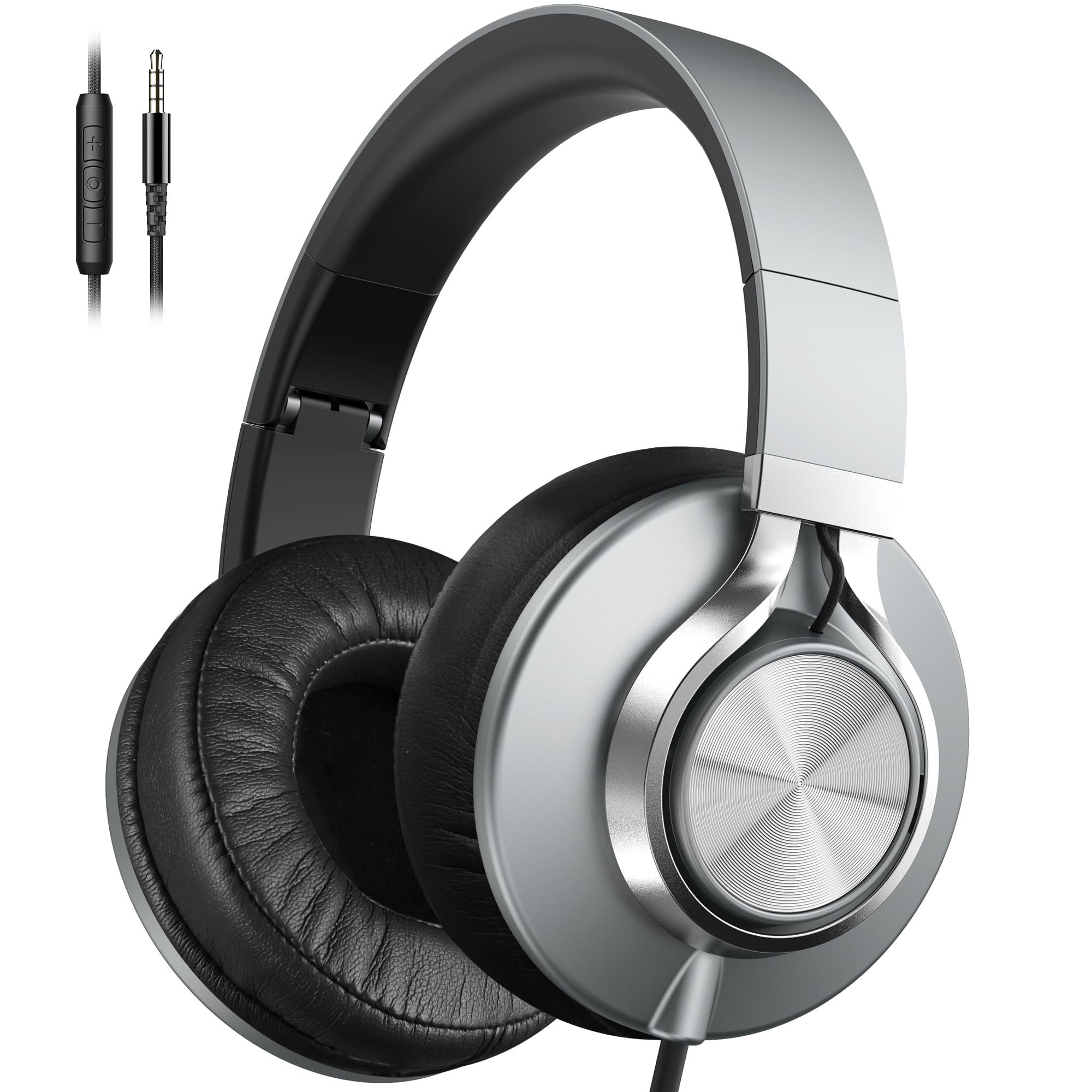
Calls, commute, laptop — a light 7-ounce corded pair with a mic that gets the basics right.
If you mostly take calls and listen on a laptop, the C90 is built for that. It weighs 7 ounces, packs into a foldable frame with a tangle-free nylon-braided cable, and a carrying bag comes in the box. The 40 mm DLC dynamic drivers cover a balanced blend of bass and treble with a crisp stereo mid-range, and The over-ear cups are designed to block over 90% of ambient noise. The high-definition built-in mic handles clear voice pickup on calls, and inline volume controls put the buttons where your hand already is.
The 3.5 mm gold-plated plug works across phones, tablets, Chromebooks, and laptops. One thing the brand flags directly: the inline volume buttons may not work when plugged into a computer. On a laptop, plan to control volume from the screen. It is a small quirk on a pair whose fit is adjustable for teens through adults, and whose protein cotton pads aim at softness for extended wear.
Owners are warm on the quality and sound, especially the bass and the foam padding. The mixed side is durability and the volume control, so expect a lighter build than the studio pairs above. Still, on value it delivers the least risky way to get a corded pair with a mic and noise isolation. If you want rock-solid cable feel and comfort, the M50X above or the OneOdio are sturdier steps up; for everyday calls and laptop listening, this does the job.
calls and class: everyday calls and laptop listening where a mic and light weight matter more than studio-level sound.
studio mixing: durability and the inline volume control are mixed in owner notes, and the buttons may not work on a computer.
Know the Specs
Driver size and sound character
Driver size, given in millimeters, is the diameter of the cone that actually moves air inside the cup. A larger driver can shift more low-end, which is why the 50 mm OneOdio and JOYO lean harder on bass than the 40 mm sets. Bigger is not automatically better — a well-tuned 45 mm driver in the Audio-Technica ATH-M50X delivers deep, accurate bass without overpowering the mids. Match driver size to the bass and detail you want, not to a bigger-is-better rule.
Impedance and what can drive it
Impedance, measured in ohms, is how hard the headphones resist the signal feeding them. A low-ohm pair like the beyerdynamic DT 770 Pro X at 48 ohm runs at full volume from a phone or laptop, while a high-ohm set can need a dedicated headphone amp to reach loudness. If you plan to listen straight from a phone or a laptop’s headphone jack, keep impedance low and check the maker’s statement about what it drives — that is the number that still works when you move rooms.
Common Questions
Do wired headphones work with a phone that has no headphone jack?
What is the difference between 3.5mm and 6.35mm plugs on these headphones?
Is a detachable cable really worth paying more for?
Can I use studio monitor headphones for gaming?
What does impedance in ohms mean for plugging into a laptop?
Do these headphones need charging or a battery?
Will the inline volume control work on a computer?
Can I use these headphones for guitar practice through an amp?
Do closed-back headphones leak sound into a microphone?
How long do these wired headphones last?
The Bottom Line
For most people, the wired headphones winner is the Audio-Technica ATH-M50X. Its 45 mm drivers, three included cables, and swiveling cups cover studio work, gaming, and daily listening in one pair — and it holds the top rating and review volume here. If you monitor for hours and want a lighter frame, grab the Yamaha HPH-MT5 at 250 grams. And for a home studio that wants studio sound without a separate headphone amp, the beyerdynamic DT 770 Pro X runs straight from a laptop at 48 ohm (a measure of electrical resistance).
How we choose
We do not accept paid placement. Every pick is matched to a real buyer and a real use-case; we do not hands-on test units.
Sources
Specifications: manufacturer listings and product documentation. Review insights: verified customer reviews, as of November 2026. Pricing: not shown on this page (it changes often); check the current price via the retailer link.
As an Amazon Associate, Tactical Gear Guy earns from qualifying purchases. This does not affect which products we feature.