Specs are compiled from manufacturer listings and verified buyer reviews and can change over time — please confirm the key details on the product page before buying.
If your wire keeps snagging halfway down a wall cavity, the tool is usually the problem, not your technique. A fish tape that flexes around a 90-degree bend, a pulley that rolls the bundle over the corner, and a magnetic puller that never opens the drywall each solve a different snag. Below are nine picks that solve the three jobs that actually come up: feeding cable through conduit, dropping line behind a finished wall, and dragging a heavy bundle across a long run.
This guide is built by comparing the manufacturers’ published specifications and the patterns across verified customer reviews, so you get each pick’s real strengths and trade-offs instead of marketing spin.
Every pick is grouped by the job it handles best, from a pulley that guides twenty cables at once to a magnetic puller that never opens your drywall. By the end you will know exactly which one belongs in your bag, and this breakdown of the wire pulling tools worth carrying covers the rest.
Top Picks


How To Choose The Best Wire Pulling Tools
Start with the obstacle in front of you, because the tool follows from it. A run through metal conduit, a drop behind painted drywall, and a long horizontal drag across a warehouse floor each want a different puller. Buying one tool to do all three usually means it does none of them well.
Match the material to the conduit
Fiberglass, polyester, and steel fish tapes behave very differently. A fiberglass rod gives you stiff push through open runs but can break if forced around a hard bend. A polyester tape is non-conductive (it will not carry current), which matters when you are working near live wiring. Steel is the traditional choice and is not on this list for a reason: it bends and rusts.
Fish tape versus pulley versus magnetic puller
A fish tape pushes through the inside of a wall or pipe. A cable pulley hangs at the far end and lets the cable roll over it, so you are not dragging against a raw edge. A magnetic puller uses a strong magnet to link a handheld unit to a leader behind drywall, letting you fish a line without cutting a hole. Pick the pulley for long low-voltage runs and the magnetic puller for finished walls.
Side-by-Side Comparison
| Model | Best For | Type | Length | Weight | Amazon |
|---|---|---|---|---|---|
| CableSlinger Pulling Pal (2-Pack)★ Best Overall | Long low-voltage runs | Cable pulley | — | — | Amazon |
| ISLEWIRE 125 ft PET Fish TapeBest for Conduit | Conduit with tight bends | Polyester fish tape | 125 ft | 3.8 pounds | Amazon |
| SETROVIC 50′ Fiberglass RodsBudget Champion | Walls and attic runs | Fiberglass rods | 50 ft | 1.1 pounds | Amazon |
| Klein Tools 50550 | Dark spaces and DIY | Fiberglass fish tape | 20 ft | 8.8 ounces | Amazon |
| YANBORUI 82 ft Rodding Kit | Indoor wiring work | Flexible rod kit | 82 ft | 3.01 pounds | Amazon |
| Right Rope Power-Tape | Heavy pulls through conduit | Polyester pull tape | 500 ft | — | Amazon |
| Jonard Tools CP-475 | Big bundle pulls | Cable pulley set | — | 1.3 pounds | Amazon |
| KAZATOOL 100 Ft Polyester | Complex multi-obstacle pulls | Polyester fish tape | 100 ft | 3.3 pounds | Amazon |
| Klein Tools 50611 | Finished walls, no cutting | Magnetic puller | — | 1.6 pounds | Amazon |
Detailed Reviews
1. CableSlinger Pulling Pal Low Voltage Cable Pulley (2-Pack)
Our pick — 4.5+★ from 350+ verified ratings; the strongest balance of quality and price.
The pulley that turns a two-person cable pull into a one-person job.
Here is the number that decides the job: these rollers carry up to 20 CAT6 network cables in a single pull. That means one pass feeds a whole rack instead of twenty separate drags. The roller body is molded from impact-resistant ABS plastic with extra-deep cable grooves, so the bundle sits inside the channel instead of riding up the edge.
The brackets are the part that matters for safety. Each one is Extruded 6063-T3 Anodized Aluminum, a hard, corrosion-resistant aluminum alloy, and there is a gap of only 0.015” between the bracket shoulder and the outer edge of the roller. That tight tolerance (the tiny clearance between two parts) is what stops a cable from snagging or hopping off the wheel on a long corner. A 360-degree swivel fixing clip rotates freely so the cable stays aligned with the direction of pull around a 90-degree turn.
The anodized aluminum brackets and smooth bearings are what reviewers cite for these holding up on repeat jobs. The split-style bracket pops off without threading anything, so you are not back on a ladder untangling line after the pull is done. The catch is that these are for low-voltage cable, coax, fire alarm, access control, and audio — not for hauling heavy feeder wire. And a few buyers feel the two-pack costs more than they expected, so if you only ever pull one run at a time, a single tape may suit you better.
Where It Earns Its Place
- Holds up to 20 CAT6 cables per pull, so one pass covers a full rack.
- Swivel clip keeps the cable aligned through 90-degree corners.
- Split bracket removes without re-threading either end.
What To Keep In Mind
- Low-voltage only; not built for heavy feeder pulls.
- Two-pack value draws mild pushback from some buyers.
The case for it: If you run network or coax over long distances and around corners, this is the pair to buy first.
The trade-off: Homeowners pulling a single line once a year may not need two pulleys.
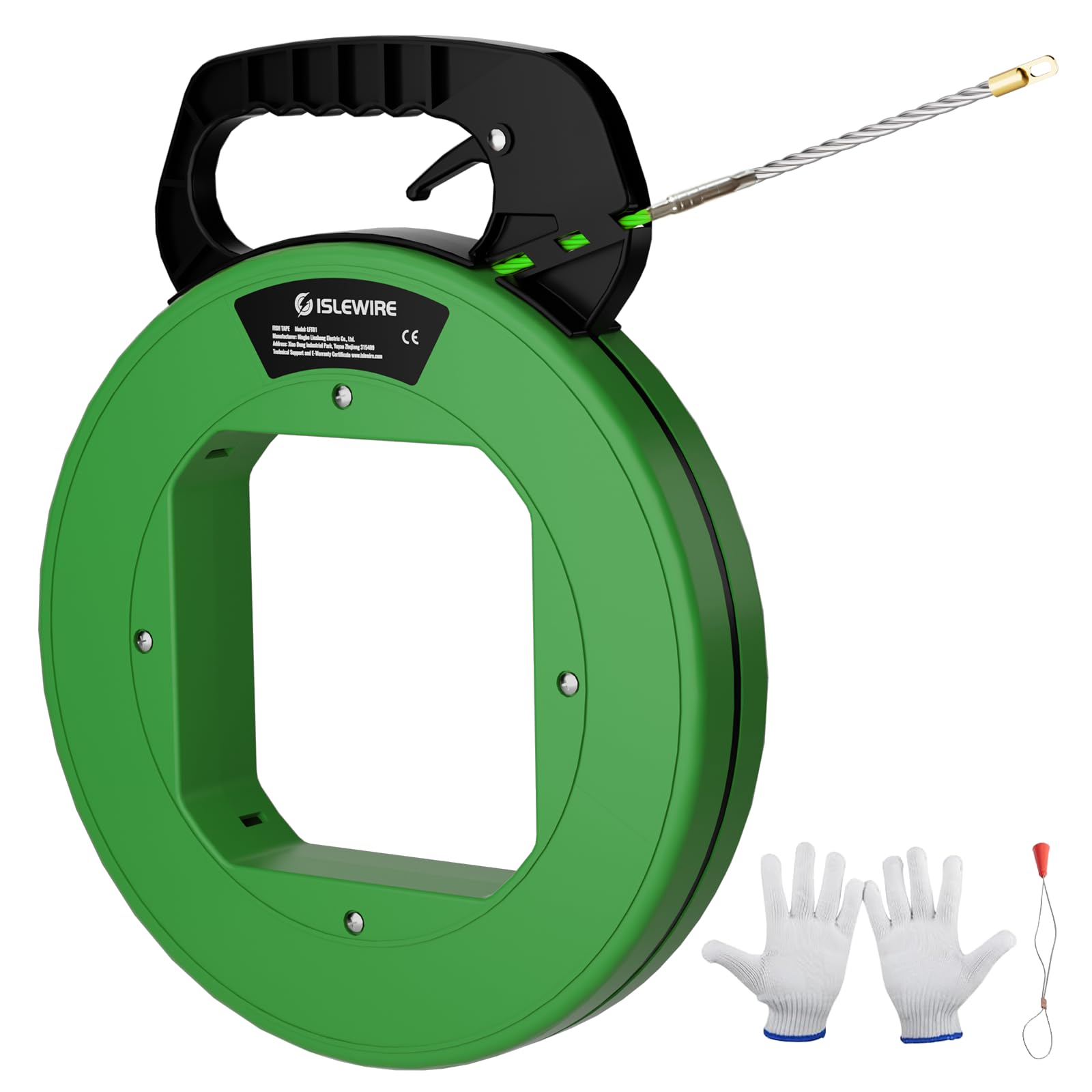
2. ISLEWIRE 125 ft PET Fish Tape Wire Puller
A five-times-longer polyester tape that slides through tight bends a steel tape fights.
Compare this to the 50′ fiberglass kit below and the reach difference is stark: 125 ft against 50 ft. More importantly, this tape is built from high-strength PET polyester, a braided plastic line that is non-conductive — it will not carry current the way a steel tape would, which matters when wiring near live circuits. It bends through 90° conduits and corners without rusting or breaking the way a metal tape can.
The thumb lock is the detail that earns its keep. It is a built-in brake that holds the wire and keeps tension while you guide and pull, so the tape does not slip backward on you mid-run. The large ergonomic handle sits in the palm during long jobs, and the heavy-duty PP (polypropylene, a tough plastic) case absorbs jobsite knocks while the tape retracts smoothly into it.
The catch is weight: it tips the scale at 3.8 pounds against the 50′ fiberglass kit’s 1.1 pounds, which is the trade you make for 125 ft of reach. Its low-friction braided line cuts snagging but the tape still needs to be fed steadily, not forced. It ships with an instruction manual and a pair of white gloves. For anyone tackling residential, commercial, or industrial conduit runs, this beats a steel tape on both reach and safety.
Straight read: The braided PET line clears 90° bends without sticking, which is the single feature this category lives or dies on.
Honest limit: It is heavier and bulkier than a compact fiberglass relic, so don’t expect to toss it in a pocket.
Reach for this if: Your runs are long and loaded with bends that a stiff tape keeps jamming on.
Look elsewhere if: You only ever do short, straight drops where 50 ft is plenty.
3. SETROVIC 50′ Fiberglass Fish Tape Rod Kit
Fifteen screw-together rods that build whatever length you need, up to 50 ft.
What you get is a modular kit: fifteen fiberglass rods, each with a diameter of 3/16″, joined by threaded brass connectors and an acrylic connection. Screw them together for however far you need to go, or run a single rod for a short poke. The whole kit is 1.1 pounds, light enough to carry one-handed into an attic.
The rods are colored bright yellow so you can spot them against a bundle of cable in a dark crawl space or above a suspended ceiling. Fiberglass resists wear, corrosion, and oxidation, which is why it holds up in dusty attic conditions. A plastic storage case with two end caps keeps the set together, and the functionality holds up — these rods make aggressive turns without complaint.
The honest catch is the bend limit. The maker is explicit that the rods are flexible but will break if you bend them too hard, so this is a firm-turning tool, not a soft rope. If your runs are full of tight radius 90s, a polyester tape handles them with less risk. For wall runs, attics, crawl spaces, sub-floors, and suspended ceilings, this kit covers the standard jobs at a very fair price.
Why it earns a slot: It is the cheapest way to own a full-length fishing tool, and it does the bread-and-butter wall and ceiling jobs without fuss.
Watch the bend: Push firmly on hard corners and fiberglass will snap, so go gentle around tight 90s.
Best suited to: DIYers and pros who want an adjustable-length kit for routine wall and attic fishing.
Pass on it if: Your runs are all tight-radius bends that need a limber tape instead of stiff rods.
4. Klein Tools 50550 20-Foot Fiberglass Fish Tape

A 20-foot tape that glows in the dark so you can see where you are fishing.
The defining trick here is a fiberglass tape with glow material built in and a nylon tip. The clear housing lets that glow material charge while the tape sits in the case, so it arrives lit for a dark ceiling or under-floor run. That is a real convenience when you are working by headlamp in a joist bay.
The case is removable entirely, which opens up a different way to use it: pass-through wire feeding, where you hold the tape free of the reel. The anchoring end uses a stainless steel connector that fits Klein Fish Rod attachments under catalog number 56511, so it plugs into a rod system you may already own. It is made in the USA, weighs 8.8 ounces, and the reel measures 7.5 inches across.
Two honest notes. The build divides opinion: the glow and overall quality win praise, but a slice of buyers describe the tape as flimsy, and getting the tape back out of the spool takes some patience the first few times. There is also a tip durability concern — the nylon tip has been known to give out over time on hard use, so treat it as a light-duty tape. At 20 ft, this is a short-reach helper, not a long conduit runner.
What Buyers Keep Coming Back For
- Glow-in-the-dark tape charges in the clear case and lights up dark runs.
- Removable case lets you use it for pass-through wire feeding.
- Stainless connector fits Klein Fish Rod attachments.
The Honest Hiccups
- Some find the tape flimsy and fiddly to pull from the spool.
- Nylon tip durability is a recurring note on hard use.
Short-reach helper: Ideal for dark attics, short drops, and DIY jobs where you want to see the tape end.
Size it right: Twenty feet goes fast, so plan a longer tool for any conduit that runs farther than that.
5. YANBORUI 82 ft Flexible Wire Rodding Kit

A reel-style kit with a spinning head wheel built to roll over bends.
The head wheel at the end of the steel wire is the part designed to solve corners — it pivots a full 360°, so it rolls across the inside of a bend instead of catching. Combined with strong tensile strength, that lets it pass quickly through thin pipes and navigate curves during indoor wiring and entry work.
Around the bench it is easy to live with. There is a large handle built for a steady, stable pull, and the line feeds out and retracts smoothly into an ergonomic storage case. The set runs to 82 ft of reach and covers rough drops, with a one-year warranty on the wire behind it. This is one for electricians, contractors, and DIYers who run interior circuits regularly.
Go in knowing two things. A few buyers report it broke on first use, so inspect the line before you load it hard, and treat tight pulls with some caution. The flexibility also splits opinion — some call it too flexible for insulated walls, where a stiffer tool holds a straighter line. If your work is all open studs and interior circuits, that limberness is a help rather than a hindrance.
Where it shines: The 360° head wheel rolls over bends with less snagging, which is exactly where a stiffer rod stalls.
Know the fence: Too-flexible is the recurring gripe for rigid-wall work, so a stiffer kit wins on insulated walls.
Choose it when: You are running interior wiring through bends and want a reel-style rod kit with a rolling head.
skip it if: Your run needs extra rigidity through insulated walls.
6. Right Rope Power-Tape Pull Tape

A 500-foot flat webbing rated at 1250 lb for the long, heavy duct run.
This is a different animal from a fish tape. It is a 100% woven polyester pull tape, meaning a flat rope that runs before the cable and gets hauled back with it. The width is 1/2 inch and the tensile strength is 1250 lb, so it is built for pulling serious cable through conduit over a long distance.
The details reward the careful installer. It comes pre-lubricated with a very low coefficient of friction — the slickness in the weave — to minimize abrasion inside a duct. It is also printed with accurate sequential markings every foot, so you can read exactly how far your pull has progressed. The whole 500 ft length is coiled on a heavy-duty plastic reel. Owners use it for fiber optic cable over long distances and for pulling wire through PVC conduit.
The trade-off is that it is not a solo push tool. It needs a pull at the far end — you feed first, then drag. Its low-stretch polyester keeps it from giving under load. If your work is short residential drops, this is overkill, but for long industrial or commercial duct work it is the workhorse.
The heart of it: 1250 lb of tensile strength in a 1/2 inch flat weave turns a strained pull into a controlled one.
Use it right: It wants a second set of hands at the far end, so it is a two-person job from the start.
Made for: Long conduit and duct pulls where the tape must run first and the cable follows.
Not your tool if: You need a solo push-through helper for a short drop.
7. Jonard Tools CP-475 Cable Pulley Set (2-Pack)
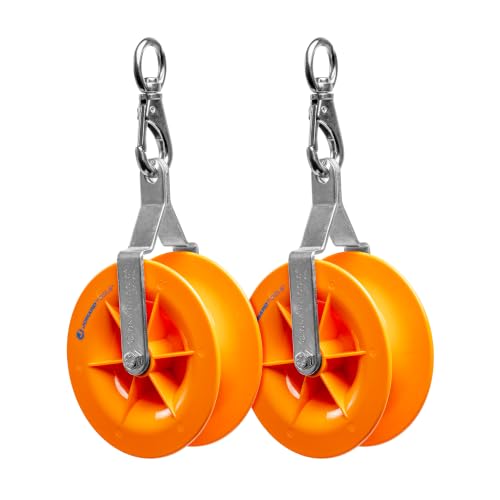
The pro-grade pulley pair that pulls a full bundle while you steer with two fingers.
At 4.5+ stars it is the highest-scoring tool on this list, and the spec behind that is simple: deep grooves hold up to 20 CAT5/6 network cables at once. The anti-friction roller bearings let the loaded bundle roll smoothly rather than drag. The swivel snap hooks keep each pulley aligned with the direction of pull so the cables never kink.
The construction is a blend of plastic and stainless steel, and the pulley wheel measures 4.75 inches across. Each unit weighs 1.3 pounds. Removing them once the cable is installed takes nothing more than unhooking the latch — no re-threading the bundle. Owners compare the swivel snap hooks and roller bearings to having an extra set of hands, letting you steer a loaded bundle with a light touch.
The recurring trade-off is cost: some buyers feel they pay a premium for the Jonard name. But for the person running structured cabling day in and day out, the time they save on big pulls is the return. This is a job-site tool, not a once-a-year gadget, and it is best in the hands of someone who loads it with a full fiber or CAT6 bundle.
The reason it tops out: The swivel snap hooks and anti-friction roller bearings working together are what make a 20-cable pull feel light.
Fair caveat: You pay for the name, so casual users may find it more tool than they need.
Belongs with: Structured-cabling installers who pull full CAT5/6 bundles every day.
Think twice if: You only run a cable now and then and want a simpler, single-roll tool.
8. KAZATOOL 100 Ft Polyester Fish Tape
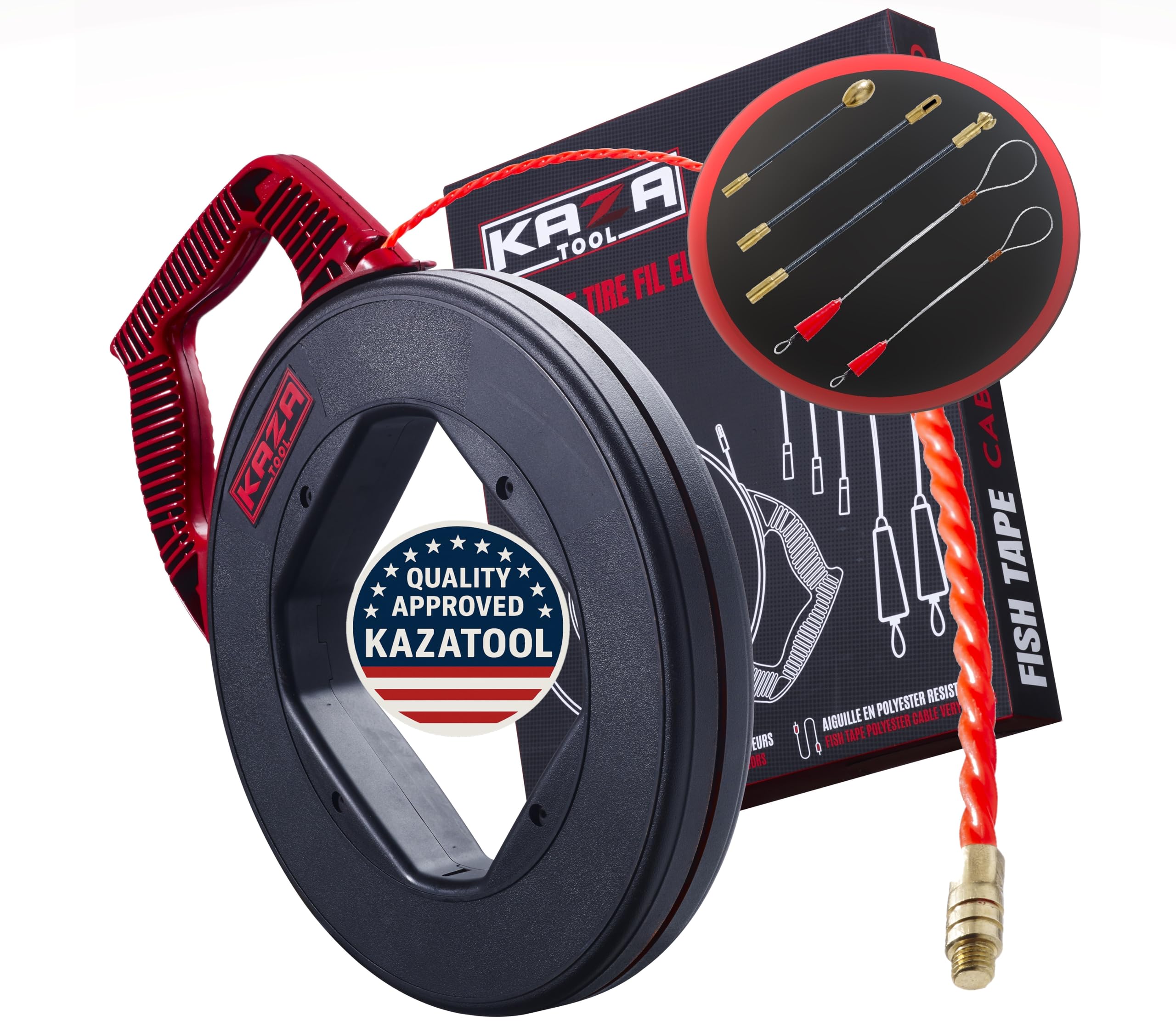
A 100-foot polyester tape that comes with five different heads for tricky jobs.
The extra gear is the reason to look here. This kit ships with five wire pulling tools — a flexible head, a hook, a loop, and more — so you can switch heads to match the obstacle in front of you. That makes it a versatile single package for walls, attics, floors, and narrow conduits.
The tape itself is heavy-duty polyester, which the maker positions as stronger than nylon and more flexible than fiberglass. It is non-conductive, so it will not carry current near live wiring. It is built to glide through bends, elbows, and junctions without kinking or snagging, and the body weighs 3.3 pounds with 100 Ft of reach. The maker also points to UV resistance and low distortion in the polyester build.
The one thing to weigh is that flexibility is a double-edged tool. A very limber tape handles tight bends beautifully but can want to wander on a straight run, so feed it with a steady hand. For complex jobs where the obstacle changes mid-pull, the five-head setup earns its place in the case.
Best trick: Five interchangeable heads mean you can adapt to a wall, a bend, or a narrow conduit without a second tool.
One trade: Polyester this flexible can lose its line on long straight pulls, so guide it firmly.
Worth grabbing for: Mixed jobs where you want one kit with multiple heads and a long reach.
Look past it if: You want a stiff tool that holds a dead-straight line through open framing.
9. Klein Tools 50611 Magnetic Wire Puller
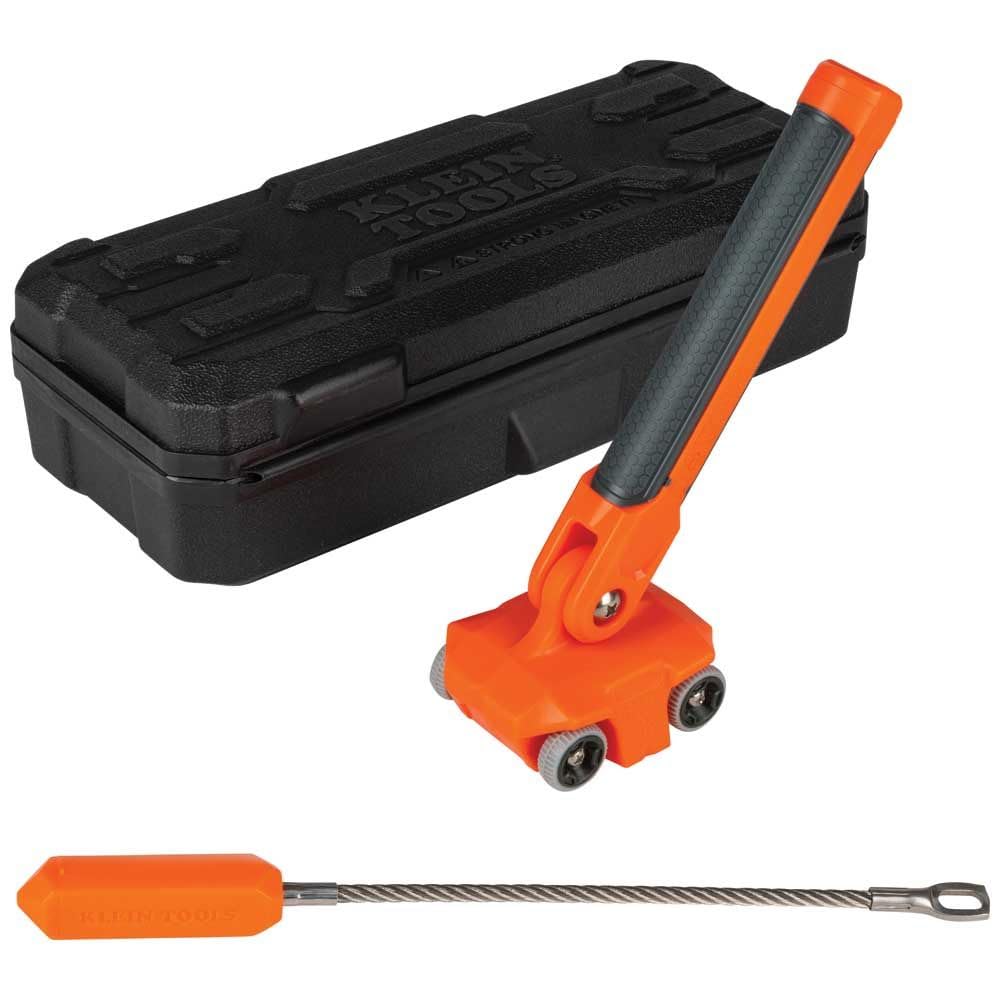
The fish tape alternative for pulling line behind a wall you do not want to open.
This works on a different principle. A handheld magnetic unit outside the wall links to an in-wall unit that is a strong Rare-Earth magnet (a powerful permanent magnet) on a flexible stainless-steel leader with an eyelet. The two connect through the drywall, letting you fish cable behind a finished wall or a closed space without cutting it open.
The handheld piece rolls on mar-resistant wheels, so it does not scuff painted walls as you move it. The handle pivots 180 degrees with a comfort grip, which gives you fine control on a tight maneuver. There is also a hidden second job: marking notches on all four sides of the handheld unit let it double as a metal stud finder, so you can locate framing before you fish. Everything stores in a hard plastic carrying case, and the whole kit weighs 1.6 pounds.
Go in with honest expectations on the magnet. Magnetic strength is the aspect owners debate most — it holds firmly through thinner material, but pulling through a thick ceiling can exceed its grip. Value is debated too, with some buyers feeling the kit is overpriced for what it does. For finished-wall drops where cutting drywall is not an option, it is the tool that saves the patch job.
The win: It skips the drywall repair entirely, linking two magnets through a finished wall to grab and pull.
Set the expectation: It is only as strong as the magnet link allows, so thick ceilings can strain it.
Pick it for: Finished-wall retrofits where opening drywall is off the table.
Second-guess it for: Big pulls through heavy ceiling assemblies, where a fish tape still wins.
Know the Specs
Tape Type: Fiberglass, Polyester, Steel
Fiberglass gives you stiff push through open runs, but it snaps when forced around a hard bend. Polyester is springy and non-conductive, so it clears tight conduit without carrying current. Steel is traditional but bends and rusts. Match the material to your bends, not to the shelf label.
Reach and Length in Feet
A longer tape handles farther runs, but more length usually adds weight. The 125 ft PET tape weighs 3.8 pounds, while the 50 ft fiberglass kit comes in at 1.1 pounds. Decide how far your real runs go before you buy the longest option you can find.
Tensile Strength and Grooves
Tensile strength is the load the tool can pull before it strains — the 1250 lb pull tape is built to haul heavy cable through conduit. Grooves on a pulley keep a bundle seated in its channel. Both numbers describe how much work the tool can take before it slips or snaps.
Magnetism and Pulley Guidance
A magnetic puller trades reach for a clean drop behind a finished wall — its strength limits what it can pull through. A pulley trades a ladders-and-hands job for roller bearings. Choose the mechanism that matches your obstacle: a wall you cannot cut, or a long run you want to guide smoothly.
Common Questions
Is a polyester fish tape better than fiberglass for conduit bends?
Will a magnetic wire puller work through a thick ceiling?
How many CAT6 cables can a single pulley hold?
Do I need a pull tape or a fish tape for a heavy conduit run?
Can fiberglass rods break inside a wall?
What is the difference between a fish tape and cable rods?
Is a non-conductive fish tape safer near live wiring?
How do I stop a fish tape from snagging halfway through a run?
Do I need separate tools for a finished wall and an open conduit run?
What does the pound rating on a pull tape mean?
The Bottom Line
The smartest place to start is the CableSlinger Pulling Pal, because it turns a twenty-cable bundle into one guided pass and its swivel clips keep the pull clean around corners. If your work is mostly conduit and tight bends, reach for the ISLEWIRE 125 ft PET Fish Tape and let its non-conductive 125 ft length do the hard corner work. For drops behind a finished wall, the Klein Tools 50611 Magnetic Wire Puller is the one that saves you a drywall patch. Match the tool to the obstacle — pulley for long low-voltage runs, polyester tape for tight conduit bends, magnetic puller for finished walls — and the next pull goes far smoother.
How we choose
We do not accept paid placement. Every pick is matched to a real buyer and a real use-case; we do not hands-on test units.
Sources
Specifications: manufacturer listings and product documentation. Review insights: verified customer reviews, as of November 2026. Pricing: not shown on this page (it changes often); check the current price via the retailer link.
As an Amazon Associate, Tactical Gear Guy earns from qualifying purchases. This does not affect which products we feature.