Specs are compiled from manufacturer listings and verified buyer reviews and can change over time — please confirm the key details on the product page before buying.
If you have ever pulled a connector off a trailer light or a battery cable and found the wire slid clean out, you already know the real question: does this tool produce a crimp that holds? That is what separates the tools below. Some squeeze the terminal into a lump. Others drive it home in one full cycle and refuse to release until the job is actually done. The nine picks here split along that line, and knowing which one you need before you buy saves you a rewire.
This guide is built by comparing the manufacturers’ published specifications and the patterns across verified customer reviews, so you get each pick’s real strengths and trade-offs instead of marketing spin.
Every option here has been sorted by what it actually does in your hand — the jaw style, the wire range, and whether the ratchet protects you from a half-finished crimp. Below you will find honest fit notes, plain-English spec explanations, and a head-to-head read on which pick suits which job when you are shopping for the best Wire Crimper Tool.
Top Picks


How To Choose The Best Wire Crimper Tool
Most bad crimps come from the tool, not the operator. Pick the right mechanism for your connectors and the pull-test takes care of itself. Here are the four decisions that actually change the outcome.
Ratchet or plain squeeze — the decision that matters most
A ratchet crimper locks the jaws shut until you have applied the full crimping force, then releases on its own. That one behaviour is why a ratchet tool turns out repeatable connections while a bare plier gives you whatever force your hand happened to supply that afternoon. If you are crimping anything that vibrates — trailer wiring, boat circuits, engine bay work — a full-cycle ratchet is the feature worth paying for. A quick-release lever matters too: it lets you open the jaws early if you mis-seated a terminal.
Match the AWG range to your connectors
AWG is the wire-thickness scale, and the numbers run backwards: 22 AWG is thin control wire, 10 AWG is stout. Before you buy, look at the wire and terminal you actually use. A tool rated 10 to 22 AWG covers most household and automotive jobs. A tool rated 22 to 6 AWG reaches much heavier battery and marine cable, but the jaws suit non-insulated terminals specifically. Buying a tool that stops at 10 AWG and then trying to crimp 8 AWG battery lugs is the most common mismatch.
Fixed jaws versus interchangeable dies
A fixed-jaw tool does one family of terminals and does it well — grab it, squeeze it, done. An interchangeable-die set swaps the crimping profile so the same handle handles heat shrink, insulated nylon, non-insulated, ferrules, open barrel and solar connectors. The trade-off is changeover time. Die sets with a side-release tab swap in seconds; older screw-in designs mean removing two screws each time. If your work spans several connector types, the die set earns its keep. If you crimp the same terminal every week, a dedicated jaw is faster in the hand.
Insulated versus non-insulated crimp profiles
These are not the same jaw. An insulated terminal has a plastic colour sleeve that the die must wrap around without cutting through. A non-insulated terminal is bare metal, and the die rolls the barrel into a clean seam. Running an insulated terminal through a non-insulated die crushes the sleeve and leaves a weak joint. Check that your chosen tool’s dies match the connector family you buy, and read the AWG marks stamped on each jaw, because they tell you which cavity is for which wire size.
Side-by-Side Comparison
| Model | Best For | Wire Range | Mechanism | Dies / Jaws | Amazon |
|---|---|---|---|---|---|
| Klein Tools J1005★ Best Overall | All-round everyday crimping | 10 to 22 AWG | Hot-riveted manual plier | Single fixed jaw | Amazon |
| iCrimp IWS-16Best for Heavy Cable | Heavy battery and marine cable | 22 to 6 AWG | Full-cycle ratchet | Single non-insulated jaw | Amazon |
| Plustool 6PCS SetSix Dies in One Case | Six connector families, one case | Varies by die | Full-cycle ratchet | 6 chrome dies | Amazon |
| Vesmikit 6PCS Set | Covering many jobs on a budget | A: 22-10 to F: 14-10 AWG | Full-cycle ratchet | 6 interchangeable dies | Amazon |
| Klein Tools 3007CR | Heat shrink terminals, both sides | 10 to 22 AWG stranded copper | Compound action, full-cycle ratchet | 3 fixed cavities | Amazon |
| haisstronica 6PCS Set | Professional results, many dies | Varies by die | Full-cycle ratchet | 6 chrome dies | Amazon |
| OTC 5950A CrimPro | Tight spaces and one-hand work | 12 to 20 AWG | Manual 4-in-1 plier | Angled head, fixed jaws | Amazon |
| Astro Pneumatic 9477 | Quick jaw swaps across many terminals | C: 20-10, D: 22-12, F: 10-6, H: 22-8 AWG | Full-cycle ratchet | 4 interchangeable jaws | Amazon |
| haisstronica 8PCS Kit | Crimper plus stripper, one kit | 10 to 24 AWG stripping | Full-cycle ratchet with quick release | 6 quick-change dies + stripper | Amazon |
Detailed Reviews
1. Klein Tools J1005 Crimping and Cutting Tool
Our pick — 4.5+★ from 650+ verified ratings; the strongest balance of quality and price.
The forged-steel workhorse that crimps, cuts, and squeezes into spaces the bulky tools cannot.
This is the tool you reach for without thinking about it. It crimps both insulated and non-insulated 10 to 22 AWG solderless terminals and connectors — the everyday range for automotive, household, and low-voltage wiring. It also cuts, thanks to a specially hardened cutter set into the nose. One handle does two jobs, which is why it lives in thousands of tool bags rather than a drawer.
What wins people over is the construction. Forged in the USA from steel, it uses a hot-riveted joint that keeps the pivot smooth and stops the handles from loosening over years of use. The Journeyman dual-material handles give you a grip that does not slide even with slightly oily hands. The long handles give you real leverage, so a 10 AWG terminal goes down without you hanging off the tool with both arms.
The tapered nose is the quiet hero here — it reaches into confined spaces where a full-width crimper physically will not fit, like inside a junction box or behind a dash. The trade-off is simple: this is a manual plier, not a ratchet. There is no full-cycle lock, so your crimp quality depends on your hand delivering consistent force. For most people doing occasional connectors that is fine. If you want a guaranteed full-force crimp every single time, the Klein 3007CR below adds the ratchet you are missing. This one has earned its following — a crowd-pleasing 4.5+ stars across 600+ ratings — and it is the safest all-round pick on this list.
Where it earns its keep
- Forged steel body with a hot-riveted joint — no handle wobble over years of use
- Tapered nose reaches terminals in tight junction boxes and behind panels
- Crimps and cuts in one tool, across insulated and non-insulated 10 to 22 AWG
- Long dual-material handles give leverage without a ratchet mechanism
What to weigh first
- No ratchet — crimp consistency depends on your squeezing force
- Single fixed jaw means one connector family only
- At 13.4 ounces it has real heft in a pocket
Reach for this if: you want one forged, US-made plier that crimps and cuts and will outlast the job it was bought for.
Look elsewhere if: you need a ratchet to guarantee full-force crimps every cycle, or you work across several terminal families.
2. iCrimp Non Insulated Terminal Crimper IWS-16
Battery cable and marine lugs go down hard here, all the way down to 6 AWG.
Most crimpers tap out around 10 AWG. This one reaches 6 AWG — thick battery cable and marine lug territory — and does it with a full-cycle ratchet, meaning the jaws stay locked until the crimp is complete and then release on their own. That mechanical guarantee is the whole point: you cannot accidentally under-crimp and walk away. A ratcheting release trigger lets you back out if you seat a terminal crooked.
The body is S50C carbon steel with a black oxide finish to resist rust, and the jaws are polished so the crimp comes out clean rather than chewed. Each jaw carries its wire size stamped on it, which matters when you are switching between 22 AWG control wire and 6 AWG lug in the same session. Specific uses named by the maker are automotive, marine, and electrical work. At 0.55 kg it is noticeably lighter than the Plustool set at 1.14 kg, and that matters when you are working overhead or under a dash for an hour.
The honest catch is that this is a non-insulated-terminal tool. The jaws are built to roll bare metal barrels into a seam, not to wrap around a plastic colour sleeve. Crimp an insulated terminal in it and you risk cracking the sleeve. It is the right tool for exactly one connector family, done extremely well. It also makes very tight, solid connections that hold under vibration — the quality buyers praise most about it, and the reason it holds a 4.5+ star score across 500+ ratings.
Where it stands out: battery cable, marine lugs, and heavy non-insulated work — the 22 to 6 AWG range is far wider than most hand crimpers offer.
One note worth knowing: a few find the ratchet handle stiff on the first few squeezes. It eases up as the mechanism breaks in.
Pick this one when: your work involves battery cable, marine lugs, or heavy non-insulated terminals and you want an automatic full-close crimp every single time.
Think twice if: your terminals have plastic colour sleeves — this tool is built for bare metal only.
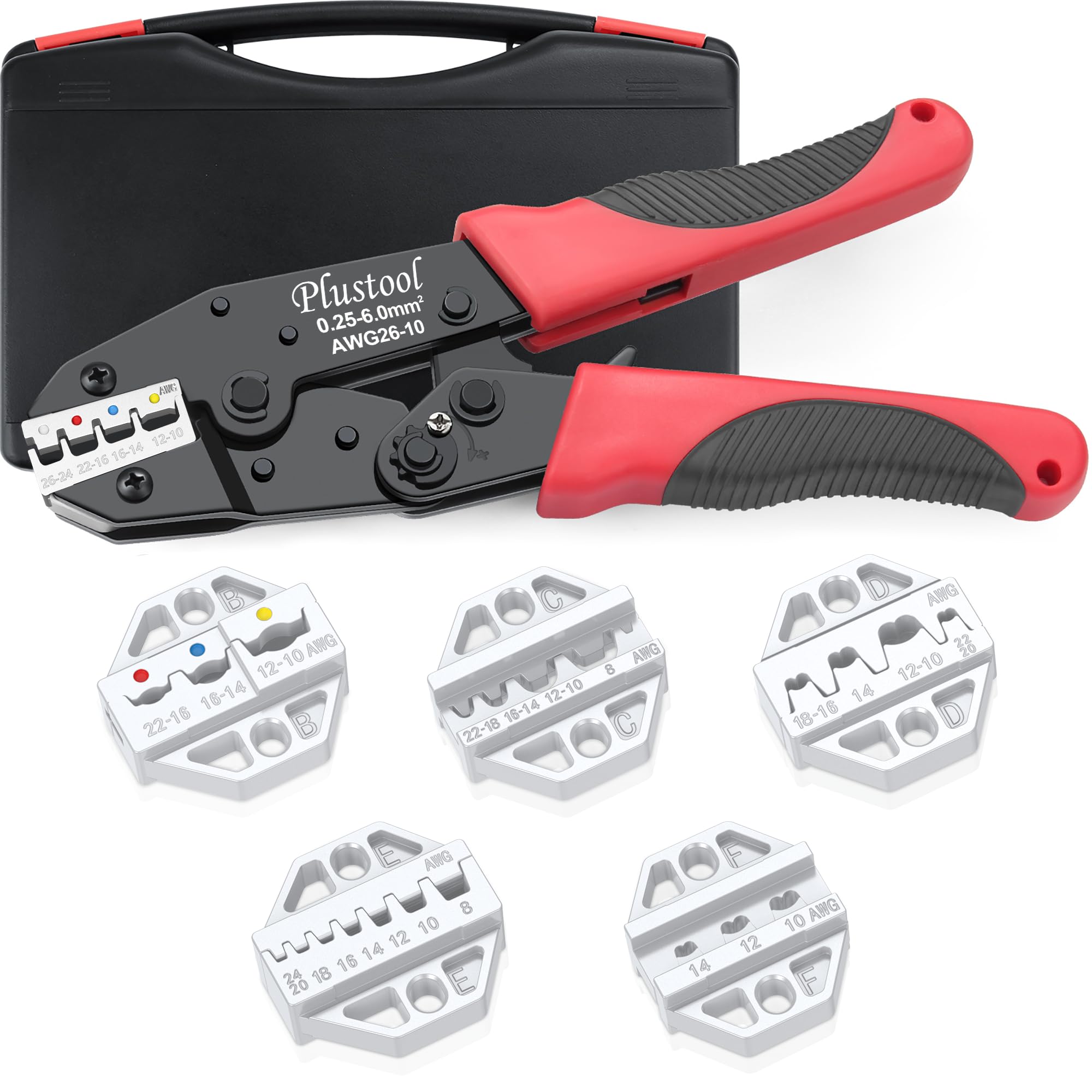
3. Plustool 6PCS Crimping Tool Set
Six chrome dies cover the connector families that usually force you to buy six separate tools.
Here is the value math: one handle, six chrome-plated dies, each one imprinted with its AWG range. The dies cover heat shrink connectors, insulated and nylon wire terminals, non-insulated terminals, insulated cable-end sleeves, open barrel terminals, and solar connectors. That is a whole drawer of single-purpose crimpers collapsed into one case — and the case really does keep it organised.
The jaws are forged with 40CR precision technology and tighten securely into the handle, so there is no jaw drop mid-crimp. Squeezing through a full ratcheting cycle crimps the connector and releases the handle automatically once the required force is applied. There is also a quick-release lever, so you can open the jaws in any position if you mis-seat a terminal. The star-wheel adjuster lets you dial crimping height up or down to suit the project, which is useful when a thin terminal wants less force than a chunky one.
Where it asks patience: the set is best suited to occasional use rather than production-line pace, and you should check your first few crimps before committing to a whole harness. The wire range varies from die to die rather than coming from one stamped figure, so knowing which die matches your connector is on you. It carries a 4.5+ star score across 200+ ratings.
The versatility payoff: heat shrink, insulated, non-insulated, ferrules, open barrel, and solar connectors all run through one tool — that breadth covers almost every home and vehicle wiring job.
The honest limit: this is an occasional-use set. If you are cranking out connectors daily, a dedicated single-jaw tool will feel faster in hand.
Best matched to: the household or hobbyist who wants one case to cover every connector family the project throws at them.
skip it if: you already know the exact die you need and would rather have that single jaw in a faster, lighter handle.
4. Vesmikit Crimping Tool Set 6PCS
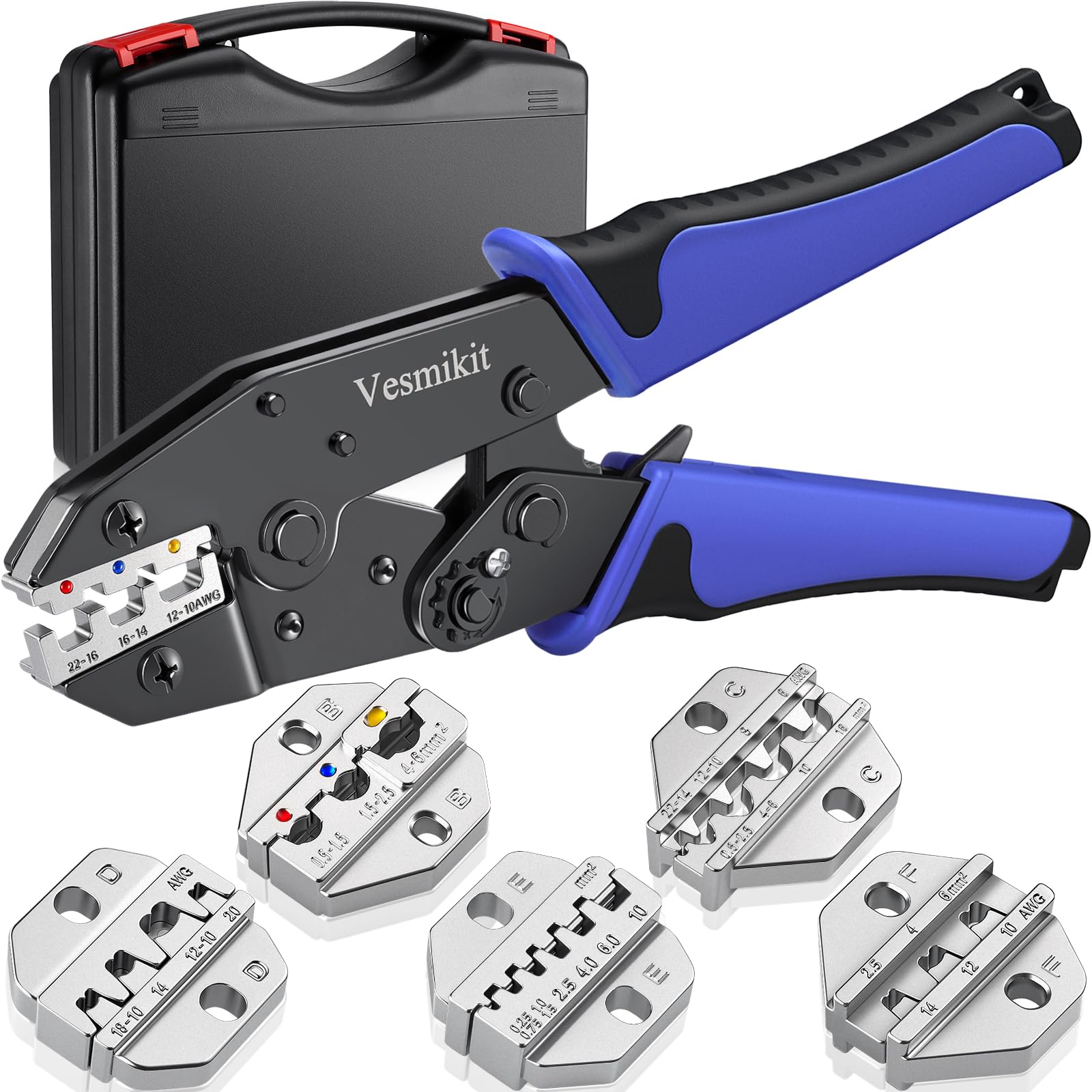
A hard case, six clearly lettered dies, and a reference card that tells you which one goes where.
You spend less time guessing which jaw to grab, because each die is lettered from A to F with its AWG range (the wire gauge number, where lower means thicker wire) printed right on it. A is 22-10 heat shrink, B is 22-10 insulated and nylon, C is 22-6 non-insulated, D is 20-10 open barrel, E is 24-8 insulated cable-end sleeves, and F is 14-10 solar connectors. A reference card attached to the set spells out which die suits which terminal, so you match jaw to connector without trial and error. The hard plastic case keeps the tool and the extra jaws together instead of scattering them across a workbench.
One squeeze gives you a firm crimp, because the jaws are forged with 40CR precision technology (a chromium-alloy steel chosen for hardness). Squeeze the handle through a full ratcheting cycle (a ratchet is a toothed mechanism that locks until the full squeeze is done) and the handle releases on its own once the crimping force is reached. The crimp then holds tight against the wire terminal, which the maker describes as “like a solder.” A star wheel adjusts crimp height so you set the right force per project, and a quick-release lever opens the jaws inside the handle. The nylon non-slip handle keeps your grip comfortable over a long run of terminals.
The fair caveat here is changeover speed. Because you fully remove a screw on each side to swap a die, moving between connector types takes a minute longer than a tab-release design. Budget that time if you are switching families mid-job. On the plus side, the build is solid and the range of dies covers rewiring boats, trailers, automotive, and appliances — versatility the owners keep coming back to.
The strong points
- Six lettered dies from A to F, each with its AWG range stamped on
- Reference card removes the guesswork on die selection
- Hard case keeps tool and extra dies together
- Full-cycle ratchet releases automatically on complete crimp
Where it asks more of you
- Die changes need two screws removed — slower than a side-release design
- Crimp accuracy is the point to verify on your own connectors first
Your match if: you want a neatly cased die set with clear labelling so you never grab the wrong jaw.
Better elsewhere if: you will be swapping dies constantly and want a side-release changeover instead of screws.
5. Klein Tools 3007CR Crimping Tool

Built to seat heat shrink terminals from both sides, so the sleeve stays intact and the joint stays tight.
Heat shrink connectors are fussy. Crimp them wrong and you either crush the sleeve or leave a loose barrel underneath it. This tool is purpose-built for them: a three-cavity die crimps 22–16 AWG (colour-coded red), 16–14 AWG (blue), and 12–10 AWG (yellow) terminals onto 10 to 22 AWG stranded copper wire. The cavities are shaped so the crimp comes out consistent from both sides of the tool, which is the difference between a joint you trust and one you hope holds.
Two mechanisms do the work. Adjustable compound action boosts crimping force so you are not fighting the handle, and a full-cycle ratchet guarantees the crimp completes before the jaws release. It is a fixed three-cavity die rather than a swappable set, so it covers heat shrink and nothing else — but it covers that job completely, and the ergonomic handles keep it comfortable over a run of connectors.
Owners describe it as sturdy and solid in hand, and the results repeat from one terminal to the next — the reliability you want when a loose heat shrink joint means chasing a fault later. Some find the value question fair rather than obvious, since the price sits above simpler pliers and this one only handles the heat shrink family. If heat shrink is your connector of choice, though, there is little reason to look at a general-purpose tool.
Why it earns a spot: colour-coded cavities for red, blue, and yellow heat shrink terminals make the right die obvious, and the full-cycle ratchet protects every crimp.
The honest trade: fixed three-cavity die — a superb specialist for heat shrink, not a universal replacement for a die set.
Made for: anyone whose work runs mainly on heat shrink connectors and wants a dedicated tool that gets that one job right every time.
Not the one if: your projects mix in open barrel, ferrule, or solar connectors — this die does not swap.
6. haisstronica 6PCS Crimping Tool Set
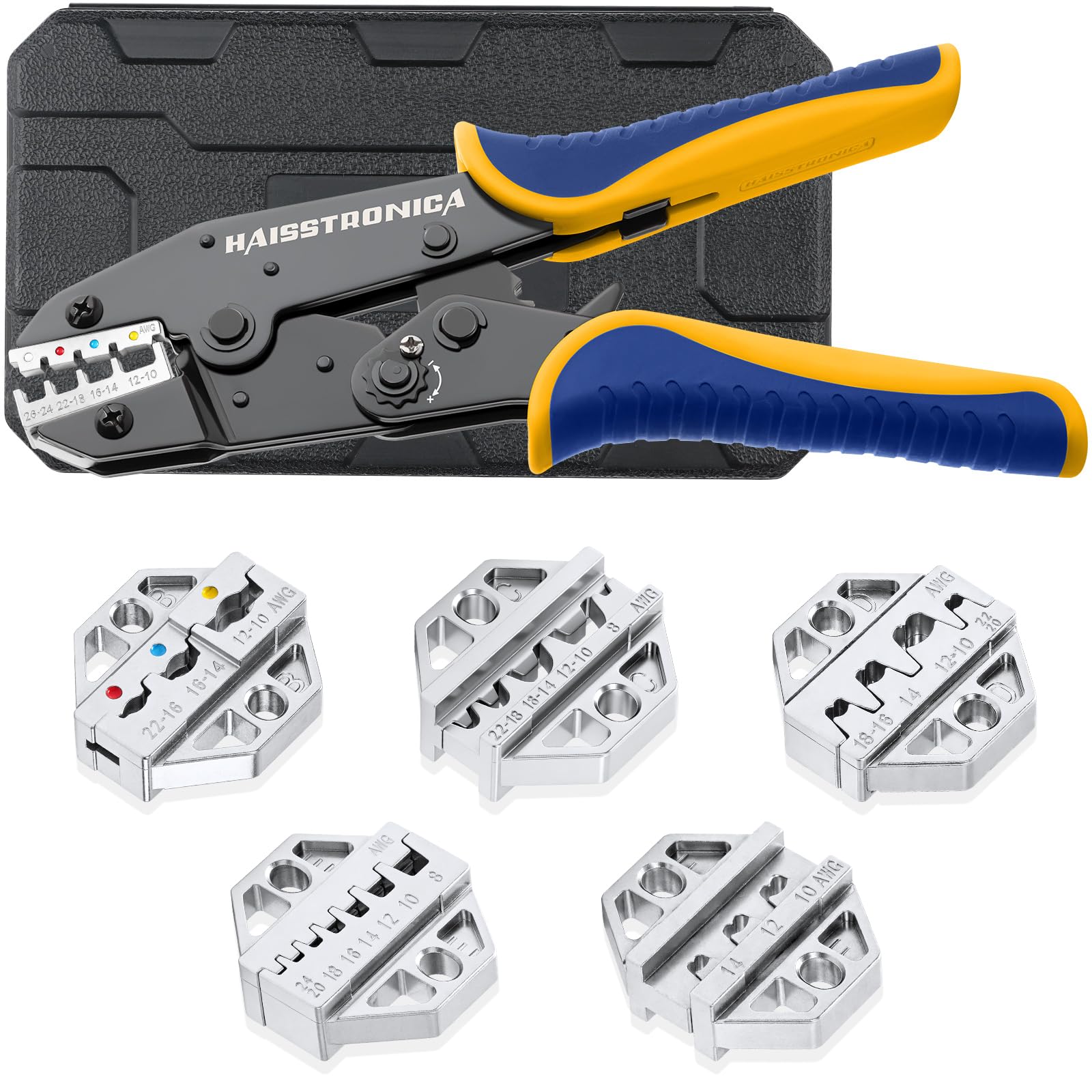
The die set that turns out clean, professional-looking crimps without chewing up the connector.
The core claim here is crimp quality, and it is backed by the jaw design. The dies are forged with 40CR precision technology and tighten securely so there is no jaw drop mid-squeeze. The result, as the maker puts it, is a crimp that secures tight “like a solder” — no squashed heat shrink, no half-crushed barrel. One handle takes six chrome dies covering heat shrink, insulated and nylon, non-insulated, insulated cable-end sleeves, open barrel, and solar connectors.
What makes this the premium step up from the Plustool and Vesmikit sets is consistency at volume. The ratchet action is firm and smooth, releasing on its own at the end of a full crimp cycle. The nylon ergonomic handles stay comfortable over a long wiring run. And the case holds all seven pieces — the tool plus six dies — so a workshop bench stays organised. Owners describe the ratchet action as firm and the body as stout, and it holds a 4.5+ star score across 900+ ratings despite the higher price.
Be honest about the changeover: the dies are held by screws you remove each time you swap, and that is the step that slows the set down. It is a small annoyance on a one-off job and a real consideration if you interleave terminal types all day. Otherwise this is about as close to a pro-grade die set as the category gets, with the range and the build to cover home and workshop wiring alike.
What earns the price
- Six chrome dies for heat shrink, insulated, non-insulated, ferrules, open barrel, and solar
- 40CR forged jaws clamp down without jaw drop
- Firm full-cycle ratchet releases on complete crimp
- Stout steel body and firm ratchet that hold up to repeated workshop crimping
The fair catch
- Die changes need screws removed, slowing swaps
- Premium price sits above the other multi-die sets
- Ratchet action takes some getting used to on the first crimps
Go here if: you want pro-quality crimps across many connector families and will pay more for consistency over a long run.
Handle elsewhere if: constant die changeover is part of your day and screw removal would drive you up the wall.
7. OTC 5950A CrimPro 4-in-1 Angled Wire Tool

A compact angled plier that reaches behind the dash when a full-size crimper will not fit.
You reach spots a straight tool simply cannot, thanks to the shape: a compact 7-inch design with an angled head gets under a dash, inside a tight panel, or behind equipment. It crimps 12 to 20 AWG (the wire gauge number) insulated and non-insulated wire, and strips that same 12 to 20 AWG range. It also cuts above and below the pivot on both solid and stranded wire, and its gripping nose pulls, twists, bends, and shapes. Crimp, strip, cut, and grip — four functions in one 7-inch plier.
Performance in those tight spots is what owners single out most. Being small enough to keep handy means you grab it for quick jobs rather than digging out the bench crimper. The contoured handles and blue-silver finish make it easy to spot and easy to work. At 7 inches it stows in a glovebox or work-bag pocket, so a surprise connector does not send you back to the bench.
The real caveat is durability, and it is worth taking seriously. The tool is built as a handy, portable multi-tool rather than a beefy crimping station — those who lean hard into heavy, repeated crimping on the tool’s limits have found it can fail at the hinge. Treat it as the compact companion to a heavier crimper, not a replacement for one, and it will serve you well. Some also wish it were a touch longer for extra reach and leverage; others love that it tucks into a pocket.
The accessibility payoff: an angled 7-inch head gets into spots a straight crimper cannot, and it crimps, strips, cuts, and grips in one compact body.
Use it as intended: it is a handy portable multi-tool, not a heavy-duty crimping station — save the big-crimp workload for a heavier tool.
Keep it for: tight-space repairs and grab-and-go jobs where having a compact angled crimper on hand beats walking back to the bench.
Pair it with: a heavier dedicated crimper if you also do frequent, high-force crimping work.
8. Astro Pneumatic Tool 9477 7-Piece Ratchet Crimping Set

Quick-change jaws that swap in seconds and handle open barrel, cord-end, and D-Sub terminals alike.
You swap the head instead of buying a second tool, and that quick interchangeability is the whole story with the 9477. The C jaw handles open barrel terminals from 20 to 10 AWG (the wire gauge number); the D jaw takes insulated cord-end terminals from 22 to 12 AWG; the F jaw covers huge insulated cord-end terminals down to 10-8-6 AWG; and the H jaw handles open barrel and D-Sub (a D-shaped multi-pin connector) down to 22-8 AWG. The heads swap fast, which owners credit as one of its best features.
The frame is a steel design with contoured rubber grips, and it works easily in either the left or right hand. Full-cycle ratcheting means the jaws drive to completion before releasing. The crimp heads make secure connections across a wide range of terminals, and the tool handles heat shrink terminals especially well. It carries a 4.5+ star score across 900+ ratings — a large body of owners from a serious professional brand.
The design quirk to know about is the dies themselves. They are held in place but sit loosely enough that they can work free and drop out if you are not watching. It does not affect the crimp once seated, but it is the reason this pick rewards a little care when you swap heads. With that handled, this is among the most adaptable ratchet crimpers for the money.
Why owners trust it
- Four jaws cover open barrel, insulated cord-end, huge cord-end, and D-Sub terminals
- Quick head changes make short work of switching terminal types
- Steel frame with contoured rubber grips works left or right handed
- Full-cycle ratchet produces secure, consistent crimps
One care note
- Dies are loosely held and can drop out — seat each one carefully before crimping
- Professional-tier price at the top of the range
Worth it for: the pro or serious DIYer who works across open barrel, cord-end, and D-Sub terminals and wants quick head swaps.
Mind the seat: check that each die is firmly in place before you squeeze, because they can work loose.
9. haisstronica 8PCS Quick Change Crimping Tool Kit

Crimper, six dies, stripper, and case — the full bench setup in an eight-piece kit.
This kit adds the tool most crimping jobs need next: a self-adjusting wire stripper. The 3-in-1 stripper has self-adjusting jaws and heat-treated alloy-steel blades that strip 10 to 24 AWG solid or stranded wire, with a built-in cutter and a terminal crimper for quick prep. Adjustable pressure and strip length give you control so you are not nicking strands. Paired with the ratcheting crimper and six dies, that is a complete wiring bench in one hard case.
Die changes here skip the screws entirely. Press the release tab on the side, pull the die out, and slide the next one in — the side-locking design keeps it securely seated. A star-wheel dial fine-tunes crimping force for different terminals and wire sizes, and a full-cycle ratchet applies steady pressure with a quick-release lever to open the jaws early when needed. Cushioned ergonomic handles keep the grip comfortable. The six dies cover heat shrink, insulated, non-insulated, open barrel, ferrule, and male/female and solar connectors — plus the stripper handles prep.
The mixed signals to weigh are on crimp strength and long-term durability. Some owners find the tool strong and lasting; others have had wires pull free after a crimp or the tool give out. Treat it as a versatile, well-organised kit for home, hobby, and light professional use rather than a heavy production tool, and verify your early crimps hold. It scores 4.5+ stars across 200+ ratings, with the easy die changes and the included stripper chief among the reasons.
What the kit delivers
- Self-adjusting stripper covers 10 to 24 AWG solid or stranded with a built-in cutter
- Side-release dies change in seconds with no screws
- Star-wheel adjuster tunes crimp force per terminal
- Crimper, stripper, and six dies all ride in one hard case
What to verify
- Crimp strength is the point to test on your first terminals
- Built for light-to-medium work, not heavy production crimping
Reach for it when: you want crimping and wire stripping handled by one tidy kit with fast side-release die changes.
Save it for: home, hobby, and light shop work — heavy production runs want a sturdier dedicated tool.
Know the Specs
AWG wire range
AWG is the wire-thickness scale, and the numbers run backwards — 22 AWG is thin control wire, 6 AWG is thick cable. A tool’s AWG range tells you the heaviest and thinnest wire its jaws can reliably crimp. Match that range to your connectors before you buy. A 10 to 22 AWG tool covers most household and automotive work; a 22 to 6 AWG tool reaches heavy battery and marine lug territory.
Full-cycle ratchet
A ratchet mechanism locks the jaws until you have applied the full crimping force, then releases automatically. This is what guarantees a repeatable crimp — you cannot stop halfway. A quick-release lever lets you open the jaws early if you seated a terminal wrong. For wiring that vibrates, this single feature is worth paying for.
Insulated vs non-insulated dies
An insulated terminal has a plastic colour sleeve the die must wrap around without cutting through. A non-insulated terminal is bare metal, and the die rolls the barrel into a clean seam. These are different crimping profiles. Using the wrong die crushes the sleeve or leaves a weak joint, so check that your tool’s dies match the connector family you buy.
Interchangeable dies vs fixed jaws
A fixed-jaw tool does one connector family fast — grab it, squeeze it, done. A die set swaps the crimping profile to cover heat shrink, insulated, non-insulated, ferrules, open barrel, and solar connectors from one handle. Die sets with a side-release tab swap in seconds; screw-in designs take a minute longer. Choose fixed jaws for one repeated job, dies for variety.
Common Questions
Do I really need a ratchet crimper or will a plain plier do?
How do I know which AWG range I need for my terminals?
Can I use a non-insulated crimper on insulated terminals?
What is the difference between interchangeable dies and fixed jaws?
Why are the die changes different from one multipurpose set to another?
Is a compact angled tool a real replacement for a bench crimper?
Do heat shrink terminals need a special crimper?
How long should a good crimper last?
Will a crimper from a die set handle heavy battery cable?
The Bottom Line
For most people buying thewire crimper tool, the winner is the Klein Tools J1005. It is forged steel and made in the USA, it crimps and cuts across the everyday 10 to 22 AWG range (the wire gauge number), and its hot-riveted joint keeps the pivot tight instead of loosening into handle wobble. If you work heavy battery or marine cable, grab the iCrimp IWS-16 with its 22 to 6 AWG range and full-cycle ratchet (a ratchet that locks until the full squeeze is done). And for a complete bench setup with crimper and stripper together, the haisstronica 8PCS Kit is the one to reach for. Every pick here was judged on jaw construction and crimp mechanism, so match the tool to the terminals you actually crimp and it will outlast the job.
How we choose
We do not accept paid placement. Every pick is matched to a real buyer and a real use-case; we do not hands-on test units.
Sources
Specifications: manufacturer listings and product documentation. Review insights: verified customer reviews, as of November 2026. Pricing: not shown on this page (it changes often); check the current price via the retailer link.
As an Amazon Associate, Tactical Gear Guy earns from qualifying purchases. This does not affect which products we feature.