Specs are compiled from manufacturer listings and verified buyer reviews and can change over time — please confirm the key details on the product page before buying.
If you have ever shrunk a window film and watched a corner curl instead of lay flat, the tool was the problem — not your hands. A window tint heat gun has one job: deliver steady, controllable hot air so vinyl and film shrink smoothly onto curved glass without scorching, bubbling, or lifting at the edges. The picks below range from a compact craft gun that doubles as a detail tool to a professional unit built with window tinting in its job description, and each one is here because its heat control actually holds where it matters.
This guide is built by comparing the manufacturers’ published specifications and the patterns across verified customer reviews, so you get each pick’s real strengths and trade-offs instead of marketing spin.
You will see exactly which guns hold a low, even temperature for film work and which ones are really paint-stripping tools with a shrink nozzle bolted on. The short version: match the gun’s lowest controllable heat to your film, and the rest of the job gets easy — which is the whole point of this window tint heat gun breakdown.
Top Picks


How To Choose The Best Window Tint Heat Gun
Film work punishes a sloppy heat source. Window film shrinks at a fairly narrow band of temperature, and if the gun jumps straight to its maximum setting you get a scorched edge before you can pull back. The guns that work best for tinting are the ones you can dial down and hold steady, not the ones with the biggest top-end number on the box.
Start with the low end of the temperature range
A gun that starts at 120°F or 122°F gives you room to work gently on thin film. A gun that starts at 750°F gives you almost nothing to work with — that is paint-stripper territory. When you compare listings, read the bottom of the range first, because that is the setting you will actually use on curved rear glass.
Airflow moves heat, not just temperature
Heat alone does not shrink film; moving hot air does. Guns here list airflow in L/min (liters of air pushed per minute), and a lower fan speed keeps the heat from blasting a single spot. Two speed settings let you drop to the gentle mode for a corner and step up when you need to move quickly across a large pane.
Nozzles decide where the heat lands
A flare or fish-tail nozzle spreads heat across a wide strip, which suits a long edge. A cone nozzle concentrates it, which is what you want when a small buckle needs a quick, targeted pass. Guns that ship with three or four nozzles give you that choice without buying extras.
Weight and grip matter over a full windshield
You will hold the gun at odd angles for a while. A gun under about two pounds is far easier to keep steady than a heavier unit, and a pistol grip with a stand lets you set it down hot without laying it on the film.
Side-by-Side Comparison
| Model | Best For | Heat Range | Settings | Weight | Amazon |
|---|---|---|---|---|---|
| BLACK+DECKER HG1300★ Best Overall | Everyday film and craft work | 750°F – 1,000°F | Dual temperature | 739 g | Amazon |
| SEEKONE 1800WBest Nozzle Set | Nozzle variety on a budget | 122°F – 1202°F | 2 modes, 4 nozzles | 1.91 pounds | Amazon |
| Heat Gun 1800W with 4 NozzlesEasiest Control | One-hand temperature changes | 122°F – 1202°F | Button control, LED display | 1.94 pounds | Amazon |
| Vaper 22400 | Simple two-setting workshop gun | Dual temperature | 3-position rocker switch | 1.8 pounds | Amazon |
| Chandler Tool Mini | Detail and hobby film work | Dual temperature | Dual heat and speed | 1.04 pounds | Amazon |
| Wagner FURNO 700 | Precision dial-in work | 125°F – 1300°F | 5 fan settings, digital | 2.8 pounds | Amazon |
| CRAFTSMAN CMEE531 | Long reach and pistol grip | 120°F – 1200°F | 2 fan speeds | — | Amazon |
| Steinel HL 2020 E | Professional window tinting | 120°F – 1150°F | 3 airflow settings, LCD | 2.2 pounds | Amazon |
Detailed Reviews
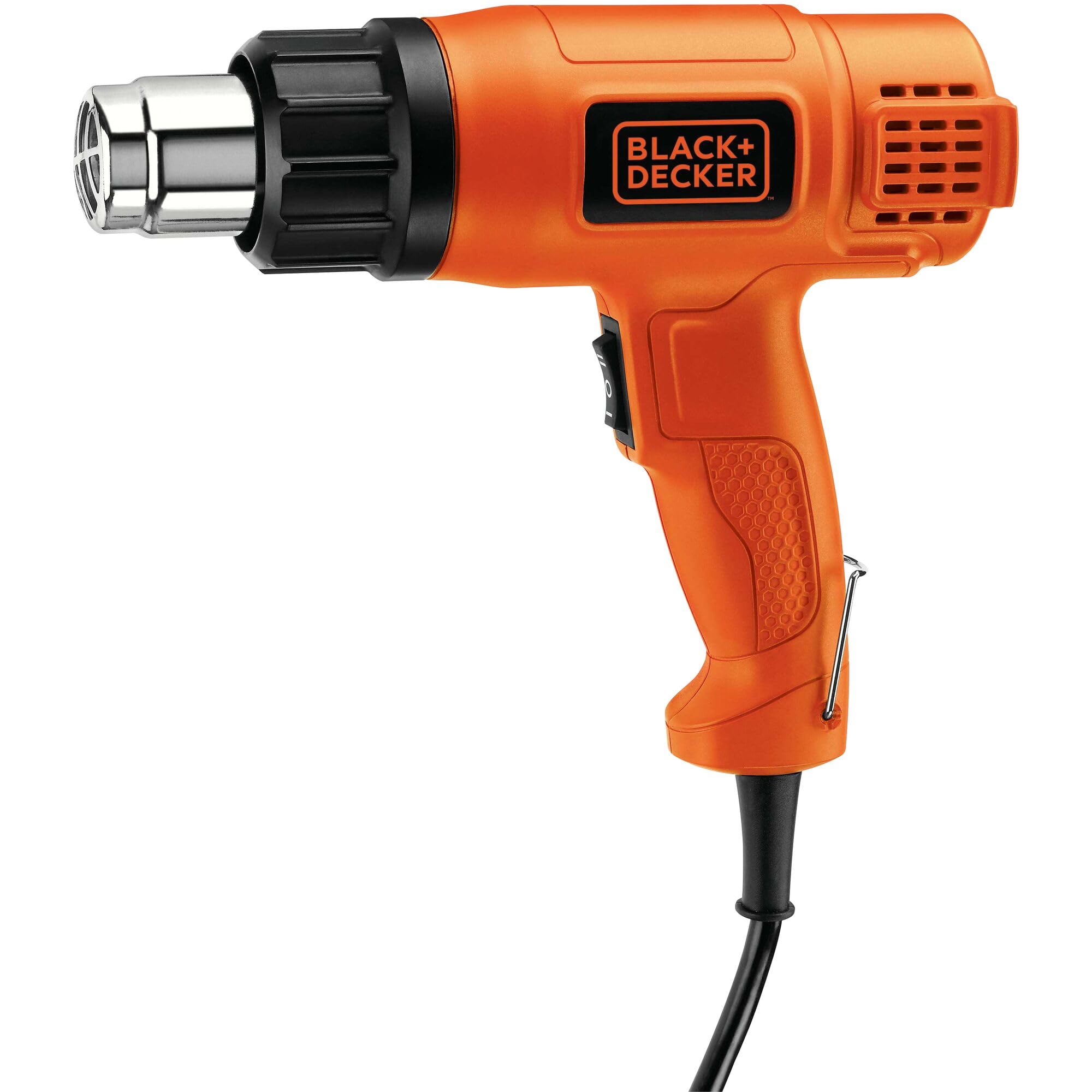
1. BLACK+DECKER HG1300 Heat Gun
Our pick — 4.5+★ from 10,500+ verified ratings; the strongest balance of quality and price.
The two-setting gun that keeps working job after job without asking you to learn a menu first.
Stripping paint, loosening a rusted nut, thawing a pipe, shrinking film — this 1,350-watt gun covers all of it with two settings, 750°F and 1,000°F, chosen by a simple switch. That 1,000°F ceiling is deliberately lower than the 1,202°F guns further down this list, and for window film that is a feature: you have less top-end heat to accidentally dump into thin vinyl.
The parts that make it easy to live with are the boring ones. A built-in stand lets you set the gun down while it cools, so it never rests hot against a sill or a roll of film. The three-position side handle lets you rotate the grip to whatever angle the glass in front of you demands, and the whole thing weighs 739 g, light enough that your wrist is not complaining halfway through a rear window. It ships with a glass protect nozzle, which is exactly the accessory you want when heat and a fragile surface share the same square foot.
What wins people over here is plain function — it does the job it was sold to do, and it does it for a long time for most buyers. The honest catch is durability at the margin: a small number of units give up early, so treat the cooldown stand as a habit rather than a suggestion. The two fixed heat steps also mean you cannot dial in a precise number the way you can on a digital gun — you get low or high, and your technique does the fine-tuning.
What earns its keep
- Two heat steps (750°F and 1,000°F) keep accidental scorching less likely on film
- Built-in stand makes safe cooldown between passes genuinely easy
- Rotating three-position side handle suits awkward glass angles
- 739 g body is light enough for long handheld stretching sessions
- Includes a glass protect nozzle for delicate surfaces
Where it asks patience
- No variable dial — you pick low or high, nothing between
- A minority of units fail early, so the cooldown habit matters
- Top heat stops at 1,000°F, less headroom than 1,202°F rivals
Reach for this if: you want one corded gun for tinting plus general shop and craft tasks, without learning a control panel.
Look elsewhere if: you need to hold an exact temperature number on a digital readout for repeatable film work.
2. SEEKONE 1800W Heat Gun
Four nozzles, one low starting temperature, and enough power to finish the pane before your arm tires.
The number that matters for film here is 122°F — the bottom of this gun’s range, which is exactly where you want to begin on a fresh sheet of tint. From there the 1,800-watt element climbs all the way to 1202°F (650°C) on mode II, while mode I tops out at 450°C. Mode I also breathes 190-210 L/min of air and mode II pushes 250-500 L/min, so you can warm a corner gently or sweep a whole panel quickly.
The accessory kit is the real story. You get a spoon reflector for heat shrink, a cone for welding and sleeving, a fish-tail surface nozzle for drying and thawing, and a BBQ lighter head. For tint work the fish-tail and cone do the heavy lifting — one spreads heat along an edge, the other pinpoints a buckle. Ventilation slots in the body cool the motor while you work, which is the kind of detail that decides whether a gun survives a long afternoon.
Owners consistently describe it as doing small jobs and big ones equally well, and the build is rated highly for the money. Set against the BLACK+DECKER above, it gives you far more temperature range and a proper nozzle set, but it is heavier at 1.91 pounds versus 739 g for the BLACK+DECKER above. The fair caveat is long-term durability — most guns hold up, yet a few do not, so register the warranty and do not run it flat-out for hours.
The film-work read: starting at 122°F and stepping airflow up in two modes is a better match for vinyl than a two-step high-heat gun, and the four nozzles let you change heat placement without shopping for extras.
Watch this: the 1.4-meter cord is fine at a workbench but short if you are moving around a parked car.
Built for: anyone who wants maximum nozzle flexibility and a wide controllable range without stepping into professional pricing.
Rather not: you need to work far from an outlet — that 1.4-meter cord keeps you close to the wall.
3. Heat Gun 1800W
A three-color light tells you where the heat sits so you never have to guess mid-pass.
Instead of twisting a knob and hoping, this gun shows you its state at a glance. A three-color LED on the front reports low, medium, or high temperature in real time, and you nudge the setting with a button you can press one-handed — 122°F up to 1202°F. When your other hand is holding a squeegee against wet film, being able to change heat with one thumb is a genuinely practical advantage over a knob.
Under the shell it is an 1,800-watt unit with a high-strength body and a thick, stable structure, and it ships with four nozzles. The electronic switch replaces the mechanical kind, which is the part that tends to stick or fail on cheaper guns, and it turns on and off with a single press. At 1.94 pounds it sits close to the SEEKONE’s 1.91 pounds, a gap that will not decide anything for you.
The recurring praise is simply that it heats fast and the adjustable control behaves predictably — exactly what you want when film starts to move under the air. Since this is a newer listing, the long-term track record is thinner than the older guns on this page, so think of it as a strong performer still building its history. The glass-protect duty you would want for tinting is better served by a dedicated nozzle, so check your kit before starting on a windshield.
Why it is on the list: the LED temperature readout plus one-hand button adjustment makes repeatable passes easier, and 122°F at the low end gives thin film room to relax rather than scorch.
Go with it when: you want to see your heat setting without stopping the work, and you like the feel of a modern electronic switch.
Hold off if: you want a gun with years of proven service behind it — this model is too new for that.
4. Vaper 22400 12.5A 120-Volt Heat Gun

A plain, durable shop gun with a three-position rocker switch — no screens, no menus, no drama.
Some jobs do not need a digital display. This 12.5-amp, 120-volt gun runs off a three-position rocker switch — off, high, low — and its dual temperature settings handle plastic welding, heat-shrink tubing, and paint stripping. The ABS body is built to take the knocks of a garage bench, and at 1.8 pounds it is among the lightest full-size guns in this group.
What buyers value most is simply what they get for the outlay, and instant heat. There is a genuine story worth repeating: as buyers report, one customer used it to remove dent damage in about 10 minutes, which tells you the heat comes up hard and fast when you point it at a surface. For film, that same speed means you keep the pass short and keep the gun moving.
The recurring gripe is smoke coming off the unit during use. It is worth knowing before you buy, and it is why many owners use this as a general-purpose shop tool rather than a precision film gun. If you spend most of your time on delicate vinyl shrinking, a variable-temperature model is a friendlier fit; if you want a tough, cheap second gun for stripping and thawing, this is honest value.
The real-world take: instant heat and a rugged ABS body at the lightest full-size weight in the bracket make it a great knockaround tool.
One thing to weigh: some units emit smoke while running, so it suits shop jobs over precise film finishing.
Pick it for: paint stripping, thawing, and general garage abuse where a simple rocker switch beats a control panel.
Not for you if: you need a clean, smoke-free gun for finishing work on window tint.
5. Mini Dual Temp Hot Air Gun
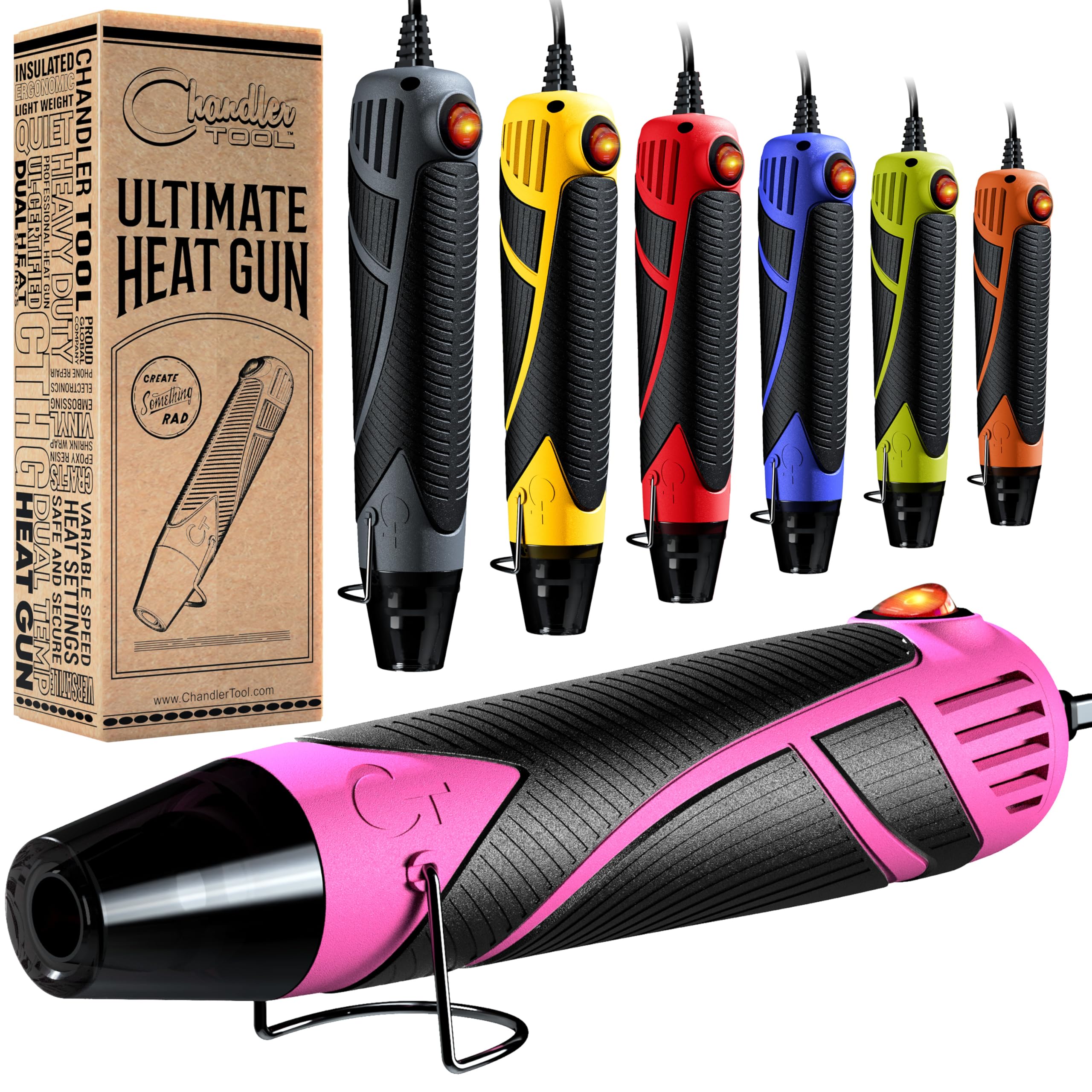
The 1.04-pound mini that handles the small, fussy film edges a full-size gun is too clumsy for.
At 1.04 pounds this is the lightest tool here by a wide margin, and that changes how you work. You can hold it over a curved corner for a long stretch without fatigue, tilt it into tight spots a full-size gun cannot reach, and keep a steady hand where precision matters. It is the closest thing to a mini and a full-size gun in one, with dual temperature and speed settings — low heat and low speed for delicate detail, high heat and high speed for bigger volume work.
It ships with a shield and a wire stand, then goes to work on resin, embossing powder, shrink wrap, vinyl wrap, decals, candle making, and phone repair. It is built compact and low-noise, which is note if you tint indoors or in a small bay. It is also UL certified, and the maker backs it with a customer care line if something goes wrong.
Owners find it makes projects easier than wrestling a larger model, especially for candle and resin work, and the two heat levels keep control in your hands. The trade-off is scope — this is a detail crafter, not a heavy-duty paint stripper, and its compact size means fewer watts to throw at a huge windshield. For the small, tricky film work that decides whether a tint job looks clean, it earns its place.
Where it shines: 1.04 pounds and dual heat and speed settings make delicate vinyl edges far easier to control than with a heavy gun.
Know the limit: it is a crafting tool, so it will not have the brute power of the 2,000-watt models for large flat panels.
Made for: detail and hobby tinting, resin, embossing, and small vinyl wrap jobs where a light hand wins.
Look past it if: your work is mostly large panels and industrial stripping — you want more wattage than a mini delivers.
6. Wagner Spraytech FURNO 700 Heat Gun
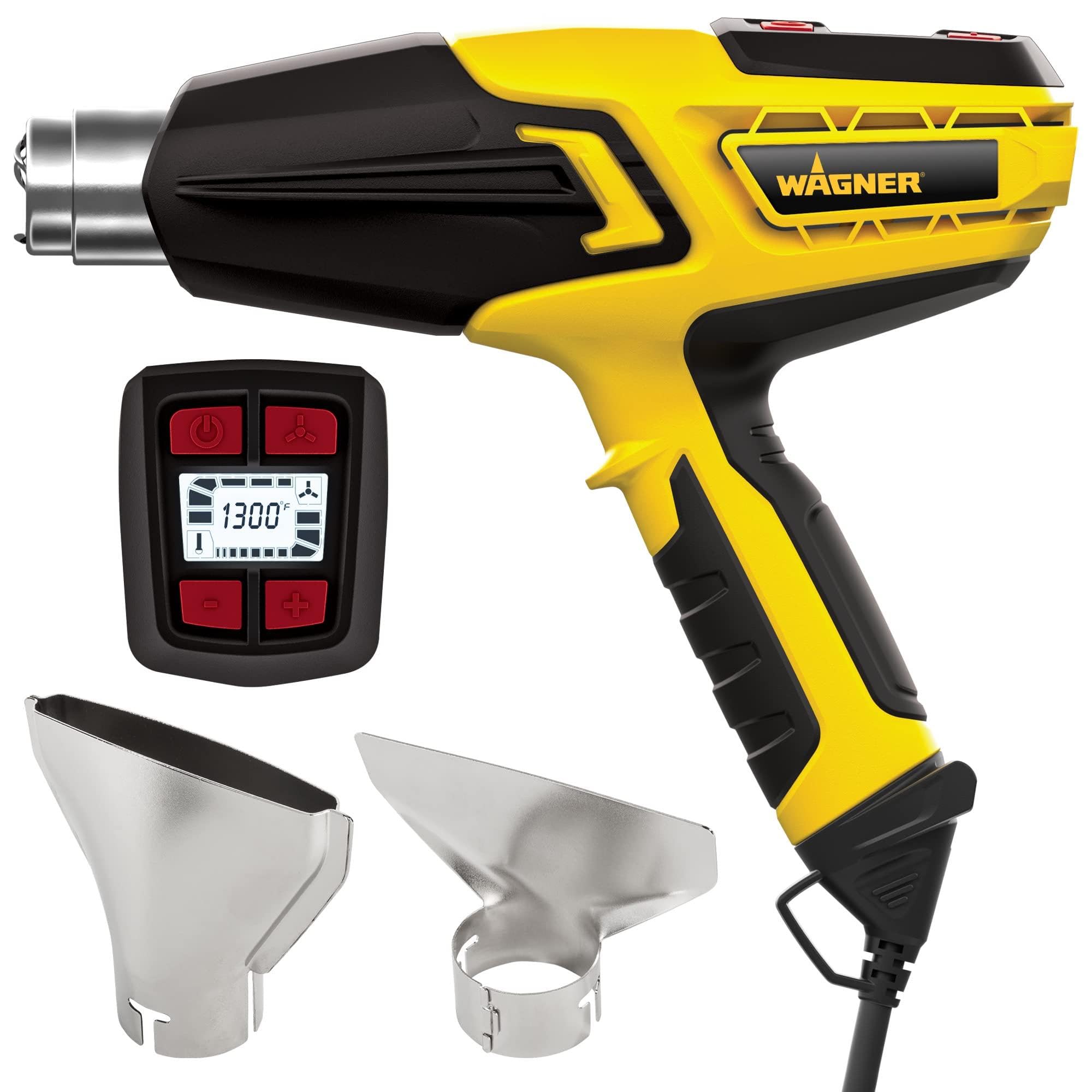
A push-button LCD that lets you set 125°F and trust it, which is exactly what film wants.
If you want to stop guessing and start repeating, this is the tool. The FURNO 700 runs from 125°F to 1300°F with push-button precision on a graphic LCD screen, plus five fan settings and a cool-down mode. That cool-down mode is quietly useful on tint — it lets you step the temperature down instead of yanking the gun away and letting the nozzle sit hot.
It ships with two nozzles: a glass protector that shields fragile surfaces from direct heat, and a flare nozzle that spreads heat across a long, narrow strip for edge work. Wagner lists over 101 uses, from bending PVC pipe to thawing frozen pipes and removing decals. It is ETL Listed — tested and approved to UL and CSA safety standards by Intertek — and covered by a 5-year limited warranty, the longest in this group.
The gun is praised for its fast heat-up and its excellent temperature control on precision work, and reliability comes up again and again. Against the SEEKONE above it, you give up raw 1,800-watt output but gain a digital number you can set and hold. At 2.8 pounds it is the heaviest pick here, so long handheld passes will remind you it is there.
Why precision buyers like it
- 125°F-1300°F with push-button LCD control for repeatable settings
- Five fan settings plus a cool-down mode
- Glass protector and flare nozzle included
- ETL Listed to UL and CSA safety standards, 5-year limited warranty
What to accept
- 2.8 pounds is the heaviest gun on this list
- Less raw wattage than the 1,800-to-2,000-watt budget guns
The one to choose: when dialing a specific temperature and repeating it matters more than raw wattage.
Pass on it if: you want a light, cheap gun for occasional small jobs — this one is heavy and built for serious work.
7. CRAFTSMAN CMEE531 Heat Gun
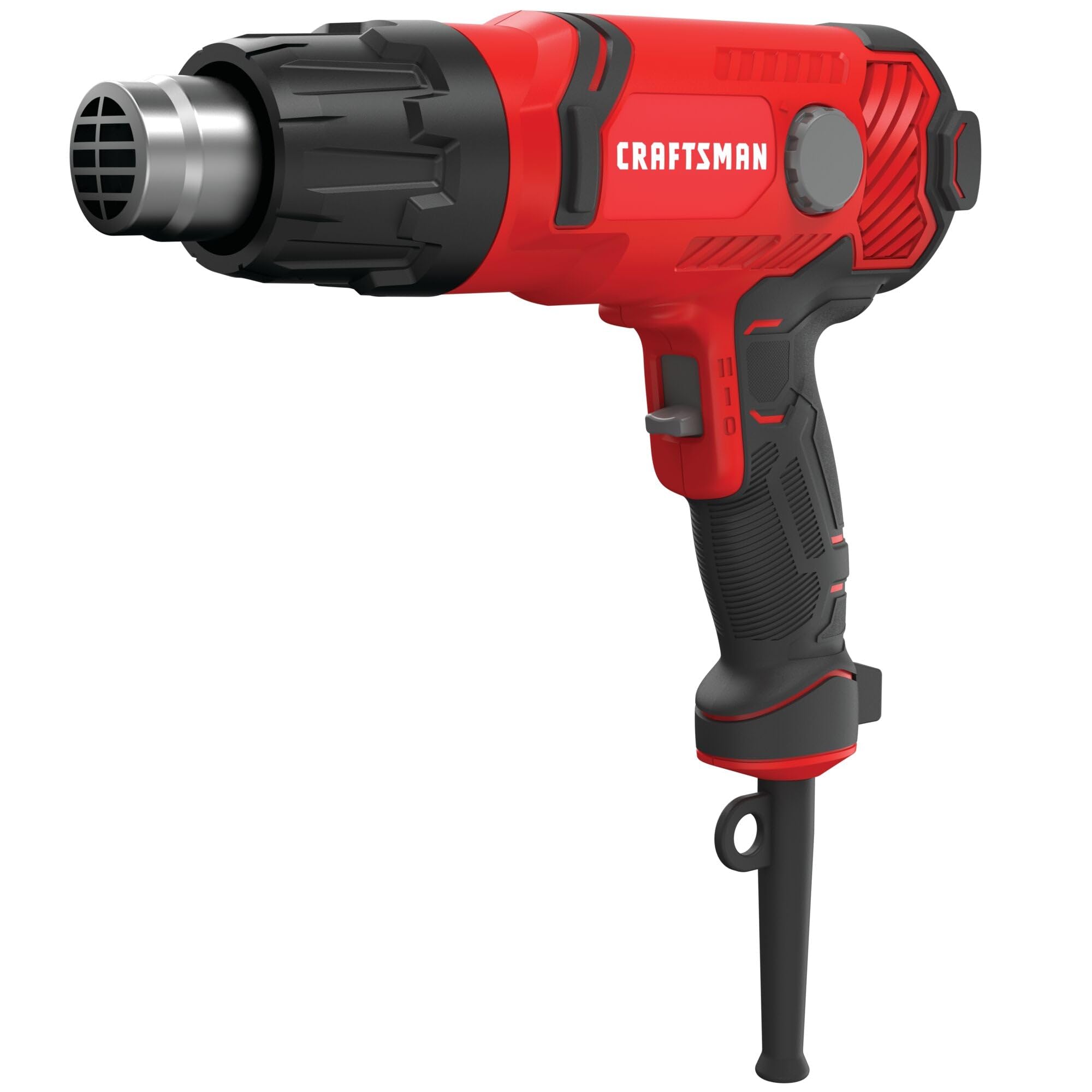
A six-foot cord and pistol grip that let you walk around the car instead of dragging an extension lead.
That 6 ft. cord is the detail that decides real jobs. You can circle a parked car, reach the far side of a rear glass, and not fight a short lead for every inch. The pistol grip sits naturally in the hand, the integrated support stand lets it sit upright between passes, and a variable dial takes you from 120°F up to 1200°F on a 1,500-watt element with two fan speeds for airflow.
Owners call it well-made and versatile, and it turns up doing everything from shaping Kydex to stripping paint and thawing pipes. The 120°F floor is a genuinely low starting point for film, giving you room to work gently before stepping the dial up. CRAFTSMAN also backs it as a known name in the shop, which counts for some buyers choosing a gun they will keep for years.
The honest limits: the heat output and durability both draw mixed feedback, so it is not the gun to run flat-out for hours without a break. It is also heavier in feel than its pistol-grip shape suggests, and the specs do not list a weight, so judge the heft in hand rather than by the numbers. For a long-cord, dial-control gun at a fair mid-range spot, it is a sound pick.
The practical edge: 120°F-1200°F variable control, two fan speeds, and a 6 ft. cord that reaches around a whole vehicle.
Fair warning: heat output and durability get mixed owner feedback, so pace long sessions and let it cool.
Suits you when: reaching around a car matters and you want a dial plus a long cord from a name you recognize.
Not the pick if: you need proven all-day durability at full heat — pace this one carefully.
8. Steinel HL 2020 E Heat Gun
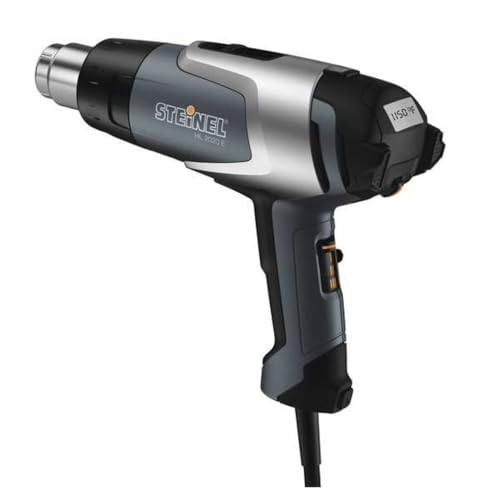
The 1,600-watt professional gun that actually names window tinting on its own spec sheet.
This is the only pick built and marketed for tinting by name, and the specs back it. The 1,600-watt unit adjusts in 10°F steps from 120°F to 1150°F — fine, repeatable increments that suit shrink film precisely — and airflow has three settings at 4 cfm, 4-8 cfm, and 6-13 cfm. An LCD display plus a heat build-up warning keeps you aware of exactly where the tool is, and the nozzle fits standard 1.34-inch accessories.
Safety is where it separates itself. Double insulation, a thermal cut-out, and a residual heat indicator that warns you when the nozzle is still hot all work together to prevent burns — meaningful when you are leaning over glass with a hot tool. A ceramic heating element and an ergonomically shaped pistol grip with tune weight balance make it fatigue-free to hold, and the integrated hands-free stand lets you set it down hot. Steinel rates the heating element at 20 percent more durable than the previous model’s.
The catch is real and worth stating plainly: this sits at premium pricing, has the smallest owner base of the group, and its rating is the lowest here. Fewer buyers means fewer voices, so weigh the professional build against a thinner track record. There is also no warranty listed, which you should factor in when buying a tool built for shop use. If you are tinting for a living and want a gun whose spec sheet literally says window tinting, this is the one.
Pro-grade strengths
- 120°F-1150°F in fine 10°F steps for precise film control
- Three airflow settings (4 cfm, 4-8 cfm, 6-13 cfm)
- Double insulation, thermal cut-out, and residual heat warning
- Ceramic element and tune weight balance for long sessions
The honest catch
- Premium pricing puts it at the top of the group
- Smallest owner base here, so less long-term evidence
- No warranty listed in the product data
Worth it for: professional tinters who want fine 10°F steps and burn-prevention features on the job.
Skip the splurge if: you are a weekend DIYer — a mid-range gun will tint your one car just fine.
Know the Specs
Temperature Range and Steps
The two numbers that bookend a gun’s heat — the floor and the ceiling — tell you more than the wattage. The floor is what you actually use on thin film, so a gun that starts at 120°F or 122°F gives you gentle room to work. The ceiling is your headroom for stripping and thawing. A gun that adjusts in small steps, like the Steinel’s 10°F increments, lets you repeat the same setting on the next panel.
Airflow (L/min and cfm)
Heat without moving air does not shrink film evenly. Airflow is measured in L/min (liters per minute) or cfm (cubic feet per minute), and two or three speed settings let you drop to a gentle stream for a corner and step up for a wide panel. Lower airflow keeps the heat from blasting a single spot, which is the difference between a smooth shrink and a scorched buckle.
Wattage and Heat-Up Time
Wattage is how fast the gun can build heat. A 1,350-watt gun and a 2,000-watt gun both shrink film, but the higher wattage gets there faster and holds up better on big panels. Look at the warm-up claim too — one gun here reaches 1202°F in 1.5 seconds, which means no waiting between passes.
Nozzles and Safety Features
A flare or fish-tail nozzle spreads heat across a strip; a cone nozzle pinpoints it; a glass protector shields fragile surfaces from direct heat. Safety features like a built-in stand, cool-down mode, residual heat warning, and thermal cut-out decide whether you can set the gun down safely while it is still hot. Those are the details that prevent burns and protect the film.
Common Questions
Can any heat gun be used for shrinking window tint?
What temperature should I use to shrink window film?
Do I need a variable temperature gun or are dual settings enough?
Which nozzle should I use for tinting curved glass?
Is a 2000W heat gun too hot for window film?
How much does the weight of the heat gun matter for tinting?
What is a cool-down mode and do I need one?
Can I use a craft heat gun for car window tint?
Does a longer cord matter for tinting a car?
What safety features should a heat gun for tinting have?
The Bottom Line
For most people shrinking film at home, the BLACK+DECKER HG1300 is the easiest place to start — dual 750°F and 1,000°F settings, a built-in stand, and a light 739 g body that keeps your wrist fresh. If you want a wide controllable range and a full nozzle set, the SEEKONE starts at 122°F and climbs to 1202°F with four attachments for the money. And if tinting is your trade, the Steinel HL 2020 E is the only one whose spec sheet names window tinting, with fine 10°F steps and burn-prevention features.
The one honest nudge: the BLACK+DECKER has the deepest owner base of the group by a wide margin, and that crowd of happy users is a real reason to trust it on your first or fiftieth panel. Buy the gun that matches your lowest comfortable heat, keep it moving, and the film will do what you ask.
How we choose
We do not accept paid placement. Every pick is matched to a real buyer and a real use-case; we do not hands-on test units.
Sources
Specifications: manufacturer listings and product documentation. Review insights: verified customer reviews, as of November 2026. Pricing: not shown on this page (it changes often); check the current price via the retailer link.
As an Amazon Associate, Tactical Gear Guy earns from qualifying purchases. This does not affect which products we feature.