Specs are compiled from manufacturer listings and verified buyer reviews and can change over time — please confirm the key details on the product page before buying.
A windmill fan is bought for its looks — the wagon-wheel silhouette that turns a plain ceiling into a farmhouse centerpiece. That’s exactly why so many buyers get burned. Plenty of these fans hang beautifully and then barely stir the air. The four picks below all carry genuine windmill-style blades, and each one has been matched to the room it actually suits, so you can pick on airflow and finish instead of guessing from a photo.
This guide is built by comparing the manufacturers’ published specifications and the patterns across verified customer reviews, so you get each pick’s real strengths and trade-offs instead of marketing spin.
You’ll see which finishes read rustic and which read industrial, how many blades each fan spins, and how much air each one actually pushes. Below is the honest rundown of the windmill fans worth putting on your ceiling.
Top Picks
How To Choose The Best Windmill Fans
The shape is the easy part — they all look like a wheel of blades. What separates a fan you love from one you regret is airflow, motor type, and whether it will actually hang in your room. Here is what to weigh before you buy.
Match the blade sweep to the room
A wider blade sweep (the diameter the blades trace as they spin) covers more floor. The picks here run from 52 inches up to 65 inches. A 52-inch fan suits a bedroom or a standard living room; a 65-inch model is built for a great room or a vaulted space where the air has a long way to travel. Going too small for a big room leaves the far corners still and stuffy.
Read the airflow number, not the blade count
More blades look dramatic, but blade count tells you almost nothing about how much air a fan moves. That figure is CFM — cubic feet per minute, the volume of air pushed in a minute. It varies enormously across this category: one fan here is rated at 9187.52 cfm and another at 2881 cfm. Check the CFM rating against your room size before you fall for the finish.
DC motors: quieter and cheaper to run
A DC motor (a direct-current motor) is the current standard in better windmill fans. These motors typically run quieter and draw less power than older AC motors, and they usually offer more speed settings. Several picks here pair a DC motor with a hand-held remote, so you get six speeds without pulling a chain.
Ceiling height and downrods
A downrod is the metal stem that holds the fan away from the ceiling. Windmill fans hang deeper than flat fans, so the right downrod length matters for head clearance. Check whether your ceiling is flat or sloped too — some fans ship with a canopy that handles a slope, and some need a separate adapter. Get this wrong and you’ll be reordering parts before the fan ever spins.
Side-by-Side Comparison
| Model | Best For | Airflow (CFM) | Blade Sweep | Downrod | Amazon |
|---|---|---|---|---|---|
| Progress Lighting Springer P250065-31M★ Best Overall | Farmhouse bedrooms and living rooms | 4632 cfm | 52 in | 8 in | Amazon |
| Parrot Uncle 60 Inch Windmill Chandelier Fan | Large living rooms and covered patios | 6300 CFM | 60 in | 4 in and 10 in | Amazon |
| MINKA-AIRE F864L-HBZ Barn 65 | Big rooms that need serious air | 9187.52 cfm | 65 in | 10 in | Amazon |
| Quorum 95210-9 Windmill 52 | Statement-piece farmhouse interiors | 2881 cfm | 52 in | — | Amazon |
Detailed Reviews
1. Progress Lighting P250065-31M Windmill Ceiling Fan
Our pick — 4.5+★ from 650+ verified ratings; the strongest balance of quality and price.
Twelve charcoal blades that turn a plain ceiling into a farmhouse room, without drowning out the conversation.
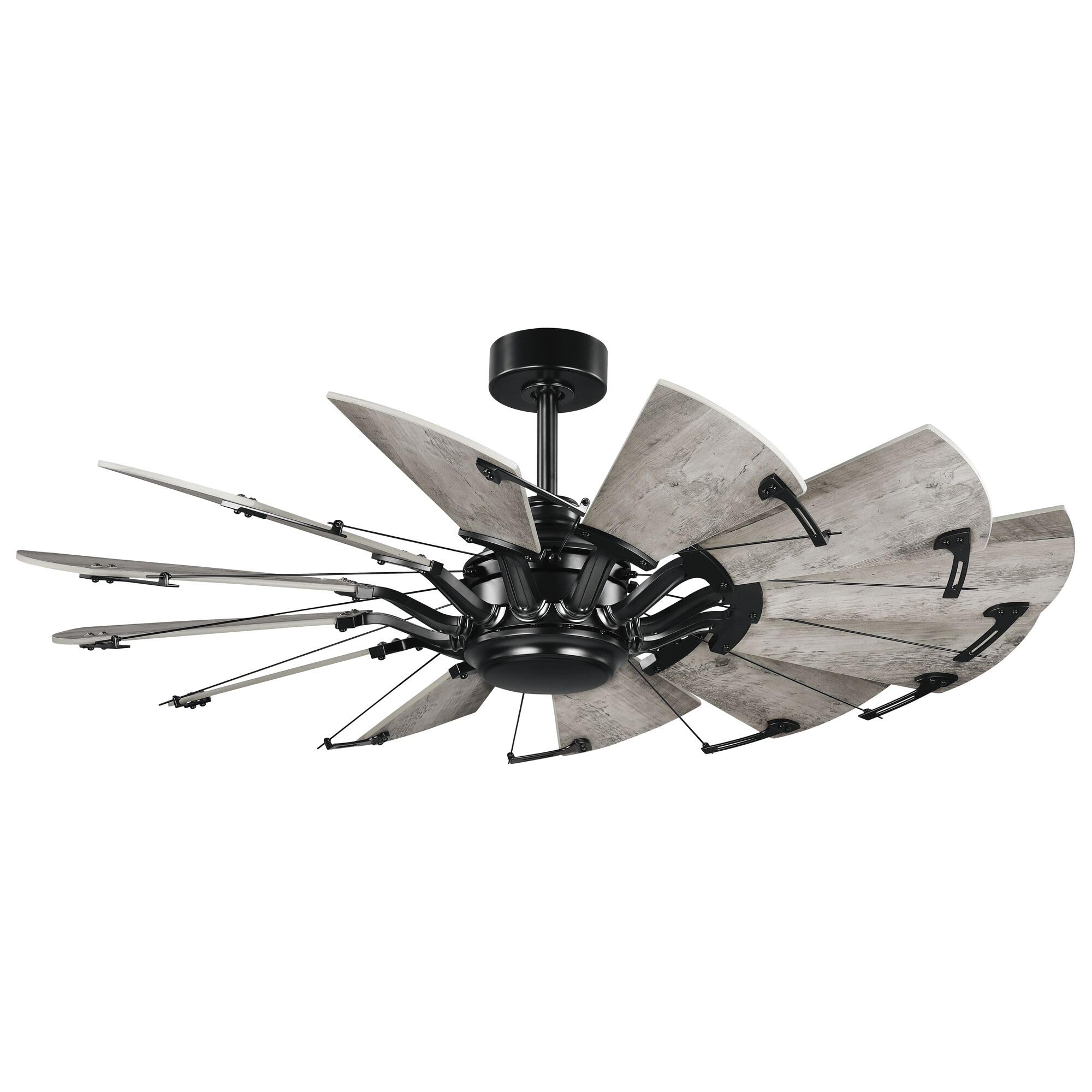
The Springer makes its case on the wall before it ever spins. Twelve blades in a rustic charcoal finish with matte black accents fan out into a wide windmill pattern, and that silhouette is what buyers talk about longer than anything else. It measures 52 inches across and sits 17-3/8 inches deep, so you get a real chandelier-scale presence over a living room or breakfast table.
Airflow is rated at 4632 cfm (cubic feet per minute — how much air the fan pushes), driven by a DC motor that runs smoothly and quietly. In practice that means a bedroom or a standard living room cools without a whirring hum overhead. The full-function remote ships with batteries included, and a dual-mount canopy lets the fan hang on a flat ceiling or a sloped one. That forgiving mount is a big reason it tops this list: fewer surprises on install day.
The honest catch is installation. Some homes go up smoothly; others run into trouble, so budget for a helper or an electrician if you’re not comfortable on a ladder with wiring. A small number of units have also quit early, which is why reliability is a genuine caveat rather than a given. Against the Quorum below, this fan’s 4632 cfm beats that fan’s 2881 cfm — a wide margin in air delivery for a similar footprint.
What earns the top spot
- Twelve-blade charcoal windmill silhouette that reads farmhouse right from the start
- 4632 cfm of airflow with a DC motor and full-function remote included
- Dual-mount canopy handles flat or sloped ceilings without a separate adapter
- 52-inch sweep suits a bedroom or a standard living room
What to weigh first
- Installation is mixed — some buyers sail through, others struggle
- Reliability isn’t guaranteed; a few units stop working early
- Hangs 17-3/8 inches deep, so low ceilings need checking
Reach for this if: you want a true 12-blade farmhouse centerpiece that also moves real air in a bedroom or living room.
Think twice if: you have a low ceiling or want to install it solo without any wiring confidence.
2. MINKA-AIRE F864L-HBZ Barn 65 Ceiling Fan

The heaviest hitter here — a 65-inch windmill rated at 9187.52 cfm for big rooms that stay stuffy.
If your problem is a great room or a vaulted space that never quite cools, start with the airflow number. The Barn is rated at 9187.52 cfm, which dwarfs the 2881 cfm of the Quorum further down — a stacked gap in raw air delivery. That figure comes from a 65-inch blade sweep, versus 52 inches for the Progress above. Big rooms feel the difference.
It runs a 6-speed reversible DC motor you steer with the included RC400 hand-held remote. In winter, flip the direction to pull air up and circulate the warm air trapped near the ceiling. The bronze heirloom finish and windmill blade pattern read country farmhouse rather than industrial. An integrated 40-watt dimmable LED module in clear ribbed glass also lights the room, so you’re buying a light fixture and a fan in one housing.
What wins people over is the look — it gets described as a centerpiece, and the airflow backs that up in large spaces. Installation is generally reported as manageable, and a 10-inch downrod comes in the box. Two things to note: the fan drops 20.5 inches from the ceiling to its lowest point, so a low ceiling will feel tight, and value is a mixed bag for some buyers who expect more for the finish. Below, both numbers for the record: the Barn’s downrod is 10 inches and the Progress’s is 8 inches.
For a great room, a loft, or a vaulted farmhouse living space, nothing else here comes close on raw output.
Where it sprains: a 20.5-inch drop and mixed value feedback mean it wants a room with real ceiling height and a buyer who isn’t chasing the cheapest windmill.
Buy it for the output: large, tall rooms that need the blades to actually reach the seating area.
Not the one if: your ceiling is low or you want the most visual drama for the least money.
3. 60 Inch Ceiling Fan with Light
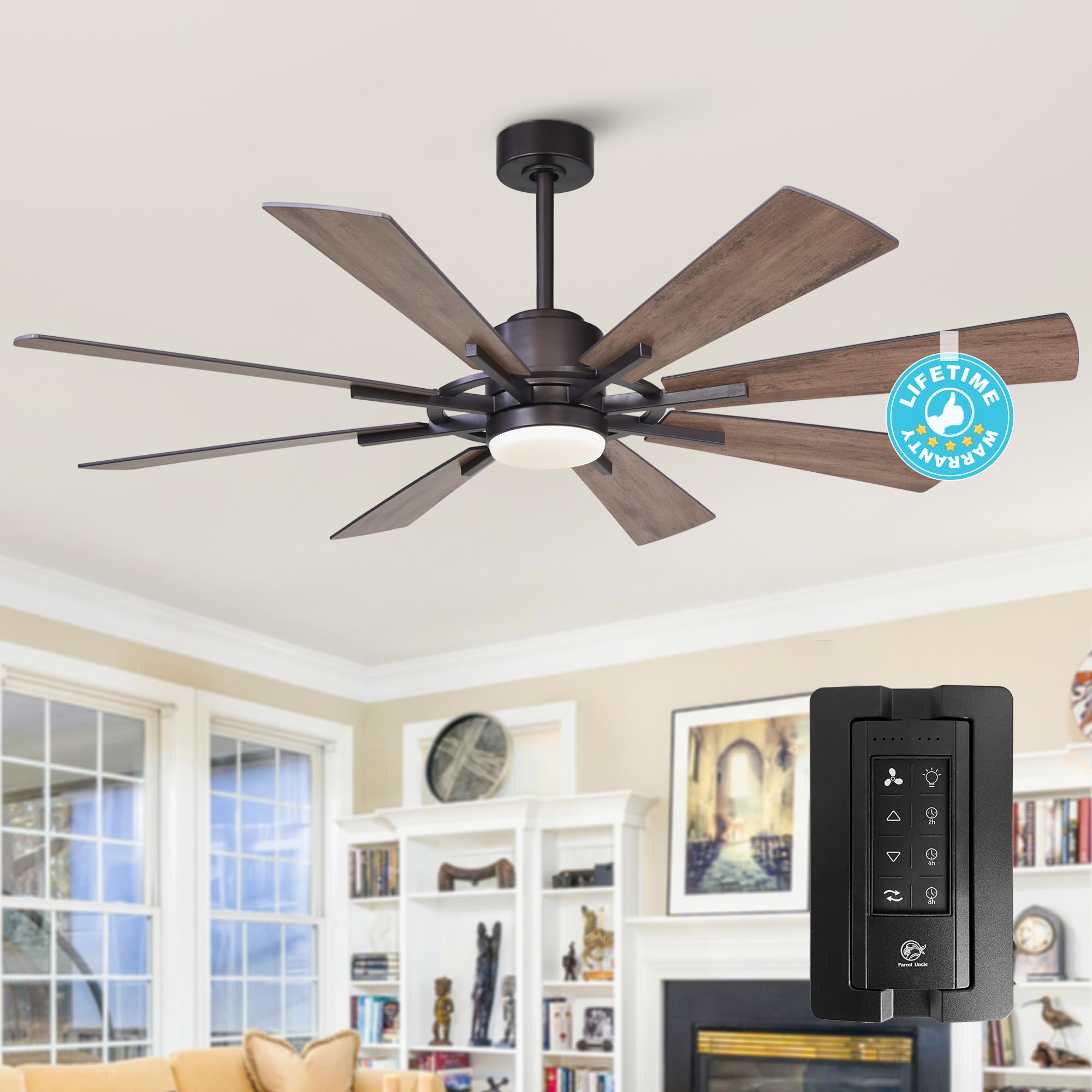
Sixty inches, eight reversible blades, and two downrods in the box — the friendly install for tricky ceilings.
This is the windmill fan that thinks about your ceiling. It ships with two downrods, a 4-inch and a 10-inch, so you can pick the drop your space needs without ordering an extra part. It also handles flat ceilings and sloped ones up to 15 degrees.
The 60-inch sweep is rated at 6300 CFM, delivered by a whisper-quiet DC motor. That places it between the Progress at 4632 cfm and the MINKA-AIRE at 9187.52 cfm — plenty for a large living room or master bedroom. Eight reversible blades in an oil rubbed bronze finish flip to a second look, and a multifunctional remote gives you 6 variable speeds, light on/off, and a 1/2/4/8-hour auto-off timer. Set the timer before bed and the fan shuts itself down.
The built-in LED shines 1500 lumens at 3000 Kelvin — a warm, soft light that suits a cozy room better than a bright work light. One trade-off: setup and the light fit get mixed report cards. Some buyers find it straightforward; others hit difficulty, and a few units have arrived with a light that wouldn’t come on. Buy from a seller with a solid return path and the 3-year parts warranty covers you. It also carries ETL certification for safety, which matters on any ceiling fixture.
The case builders like
- Two downrods included — 4-inch and 10-inch — for different ceiling heights
- Handles sloped ceilings up to 15 degrees from the start
- 6300 CFM DC motor with 6 speeds and a 1/2/4/8-hour timer
- 1500-lumen warm LED light built in
Keep an eye on
- Installation and light fit draw mixed experiences
- An occasional unit arrives with a light that won’t power on
- 8-blade wagon-wheel look is busier than a cleaner 5-blade fan
Go here for: a large room with a sloped ceiling where the included downrods save you a shopping trip.
Look past it if: you want a minimalist silhouette — the eight-blade wheel is a bold focal point.
4. Quorum 95210-9 Windmill 52 Inch Ceiling Fan
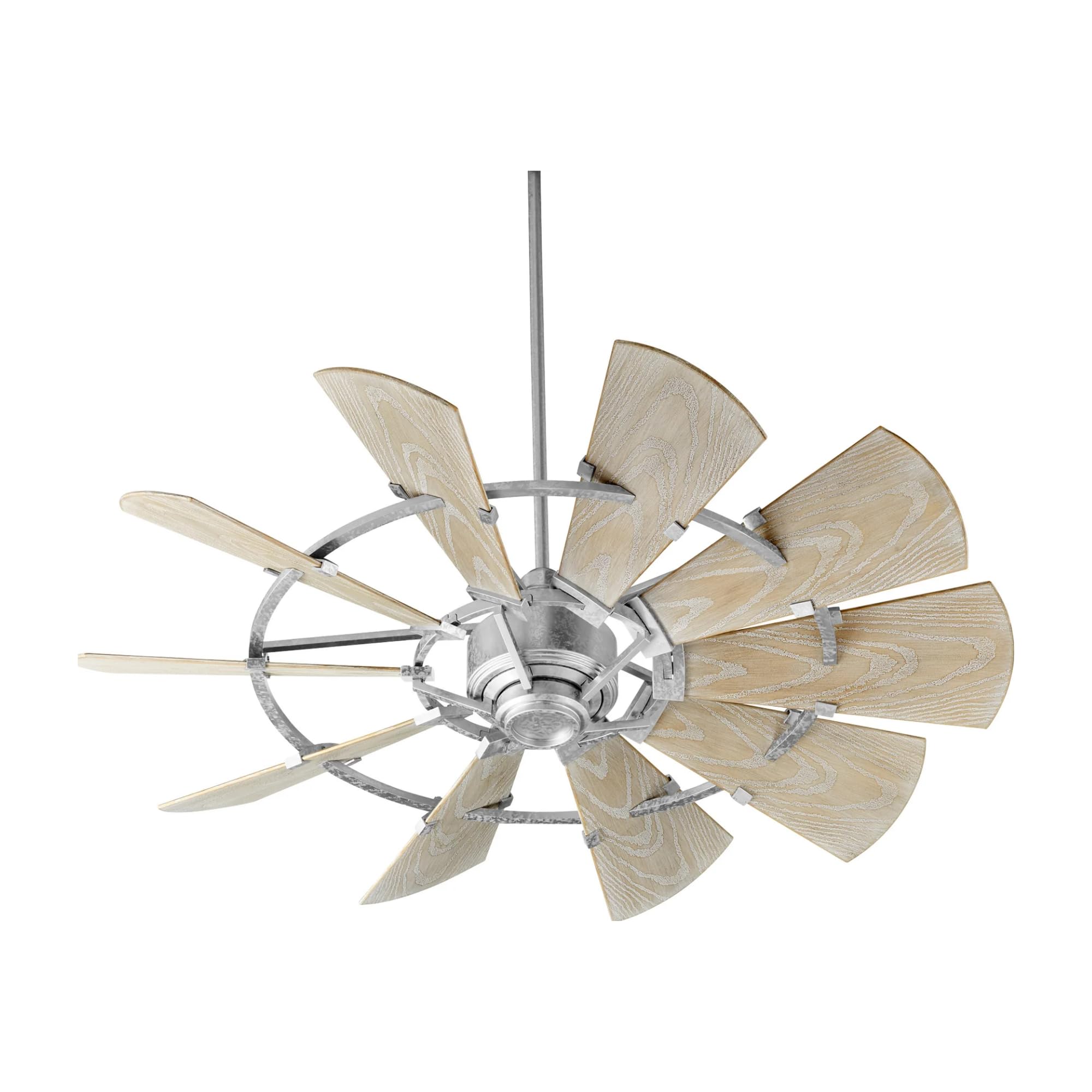
Ten weathered oak blades on a galvanized frame — the one that looks like it belongs in a barn loft.
Some windmill fans go for a polished farmhouse look; this one goes for honest rustic. The 10-blade wagon-wheel silhouette pairs plywood blades in weathered oak against a galvanized steel frame, and that contrast gives a barn or loft a genuine agricultural feel. It’s the most design-forward pick here, and the one most likely to draw comments from guests.
On airflow it’s the modest one. It’s rated at 2881 cfm across a 52-inch sweep — the lowest here, and noticeably under the MINKA-AIRE’s 9187.52 cfm. If your room is compact and you want a statement overhead, that’s fine. In a big open space you’ll notice the air is gentler than the other three. The DC-165M motor runs at 6 speeds with a reversible airflow setting, and a handheld remote lets you switch direction for winter without a ladder.
Two things to plan around. There’s no light kit in the box, though the design accepts compatible accessory light kits sold separately if you need overhead light. And assembly draws mixed feedback — a 10-blade wheel is more to fit together than a simple three-blade fan. Quiet operation and sloped-ceiling performance both get solid notes. Value is mixed, so weigh it as a design purchase rather than an airflow champion.
The rustic ace: the galvanized frame and weathered oak blades make this the most authentically barn-loft windmill in the group. If the look is the whole reason you’re shopping, this delivers it.
The airflow toll: 2881 cfm is the least air movement on this list, so reserve it for rooms where looks carry as much weight as cooling.
Pick this one when: the look leads and you’re lighting the room another way — it’s a design centerpiece for a compact, rustic space.
Skip the temptation if: your main goal is fast cooling in a large room; the higher-CFM picks serve that better.
Know the Specs
CFM (Cubic Feet Per Minute)
This is the number that tells you how much air a fan actually moves. Higher CFM means more air pushed through the room every minute. The picks here range from 2881 cfm up to 9187.52 cfm. Match a high CFM to a big or vaulted room, and a lower one to a bedroom where you want a gentle breeze, not a wind tunnel.
Blade Sweep and Blade Count
The blade sweep is the diameter the blades trace as they spin — 52 inches, 60 inches, or 65 inches in this group. A wider sweep covers more floor. Blade count is a separate thing: it shapes the windmill look (10 blades versus 12) but doesn’t dictate airflow on its own. A 10-blade fan and a 12-blade fan can move very different amounts of air, so always read the CFM figure too.
DC Versus AC Motors
A DC motor runs on direct current and typically uses less power and spins more quietly than an older AC motor. Most of the picks here pair a DC motor with a multi-speed remote, often 6 speeds, plus a reversible mode to flip the airflow direction between seasons. A reversible motor pulls air up in winter to move the warm air stuck near the ceiling.
Downrods and Sloped Ceilings
The downrod is the stem holding the fan below the ceiling. A longer downrod drops the fan lower for a high ceiling; a shorter one keeps it tight to a low ceiling. Some picks include two downrods so you can choose, and some have a canopy that handles a sloped ceiling up to a stated degree. Check both before buying — a windmill fan hangs deeper than a flat fan, so clearance matters.
Common Questions
Do windmill fans actually move as much air as they look like they should?
What size windmill fan do I need for a large living room?
Can a windmill fan go on a sloped ceiling?
Is a DC motor worth it on a windmill fan?
Do these windmill fans come with a light?
How much ceiling drop does a windmill fan need?
Can I install a windmill fan myself?
What does the remote control add on a windmill fan?
How do I keep a galvanized and weathered oak windmill fan clean?
The Bottom Line
For most buyers looking at windmill fans, the winner is the Progress Lighting Springer — it pairs the true 12-blade farmhouse look with 4632 cfm and a dual-mount canopy that fits flat or sloped ceilings. If your priority is raw airflow for a big room, the MINKA-AIRE Barn 65 pushes 9187.52 cfm across a 65-inch sweep. And if your ceiling is sloped and you want the downrods handled, the Parrot Uncle 60-inch ships with two of them and a built-in LED light. The Progress earns the top spot on balance — just measure your ceiling drop and plan for a helper on install before you commit.
How we choose
We do not accept paid placement. Every pick is matched to a real buyer and a real use-case; we do not hands-on test units.
Sources
Specifications: manufacturer listings and product documentation. Review insights: verified customer reviews. Pricing: not shown on this page (it changes often); check the current price via the retailer link.
As an Amazon Associate, Tactical Gear Guy earns from qualifying purchases. This does not affect which products we feature.