Specs are compiled from manufacturer listings and verified buyer reviews and can change over time — please confirm the key details on the product page before buying.
The short answer: buy the GlocalMe Numen Air 5G for true 5G speeds with no SIM card, or the TP-Link Roam 6 to re-share an existing signal as a private network. Below, each of the nine boxes is judged on the specs that keep a car connected — bands, throughput, battery, and power source.
This guide is built by comparing the manufacturers’ published specifications and the patterns across verified customer reviews, so you get each pick’s real strengths and trade-offs instead of marketing spin.
A car router is not a home router with a longer cable — it has to pull a cellular signal inside a moving metal box, run off a USB socket, and hold on where towers are far apart. This breakdown covers nine portable units and the exact specs — rated throughput, connected devices, battery, and band support — that decide whether your back seat gets a signal. Every pick below depends on one question: does it create a new cellular connection, or just re-share one you already have?
Top Picks

How To Choose The Best WiFi Router for Car
Start with the type of box: a cellular hotspot or a travel router. A cellular hotspot carries its own data plan and creates internet out of thin air — that is what you want for a road trip or a remote work site. A travel router re-shares a signal that already exists, like hotel WiFi or a phone hotspot, and turns it into a private network for the whole car.
Cellular hotspot or travel router?
Buy a hotspot if your passengers need internet where there is no WiFi at all. Buy a travel router if you already pay for a phone data plan and want to pipe it into a laptop, a tablet, and a dash cam at the same time without tethering each one by hand. Pick the wrong type and you either pay for data you already have or carry a box that cannot connect on its own.
Does it survive a car?
A moving vehicle means heat, vibration, and a power socket that is only live when the engine runs. Look for units that run on 5V PD power from a USB-C port or carry their own rechargeable battery. A router that only accepts a wall adapter will sit dead in your console.
The band question
Cellular bands are the radio frequencies a tower broadcasts on. A hotspot that lists support for the bands your carrier uses will connect; one that skips them simply will not, no matter how good the hardware is. If you drive across borders, check that the device lists the regions you actually visit.
How many devices can share it
The connected-device number is the hard ceiling on how many phones, tablets, and laptops can ride the same connection. A family car with three screens and a couple of phones needs headroom, and a low ceiling forces people off the network mid-trip.
Side-by-Side Comparison
| Model | Best For | Rated Throughput | Connected Devices | Power Source | Amazon |
|---|---|---|---|---|---|
| GlocalMe Numen Air 5G★ Best Overall | Fastest overall connection | 2.5 gigabits_per_second | 16 | Rechargeable battery / power bank | Amazon |
| TP-Link Roam 6 AX3000Most Versatile | Sharing an existing signal privately | 3000 megabits_per_second | — | USB-C 5V PD | Amazon |
| Global Pocket WiFi (T8)Best for Travel | Plug-and-play global travel | — | 8 | 3500mAh battery | Amazon |
| Franklin JEXtream RG2100 | T-Mobile users who want a charger too | — | — | 5,000mAh rechargeable battery | Amazon |
| GlocalMe UPP 4G | Data included from the start | 150 megabits_per_second | 8 | 3,000mAh battery | Amazon |
| TravlFi JourneyGo | Automatic network switching on the road | 150 megabits_per_second | 10 | 16H battery | Amazon |
| GL.iNet MUDI GL-E750V2 | VPN and privacy on the move | 433 megabits_per_second | — | 7000mAh battery (up to 8 hours) | Amazon |
| GL.iNet Spitz AX GL-X3000 | RV and rural multi-WAN setups | 3000 megabits_per_second | — | Power adapter (wall) | Amazon |
| KuWFi 4G LTE L100EU | Budget entry into cellular WiFi | 150 megabits_per_second | 10 | 2400mAh battery | Amazon |
Detailed Reviews
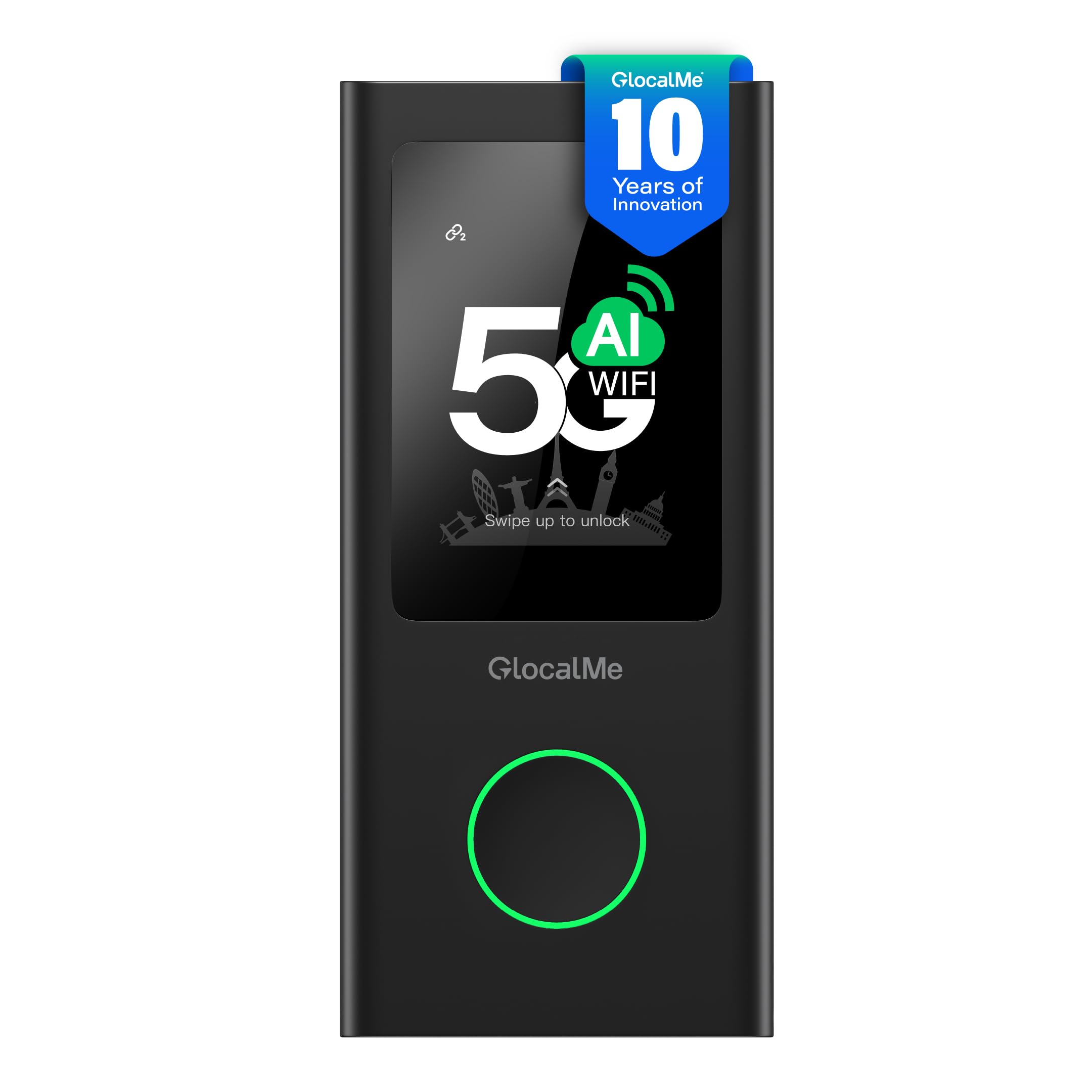
1. GlocalMe Numen Air 5G Mobile Hotspot
Our pick — 4.0+★ from 500+ verified ratings; the strongest balance of quality and price.
A pocket box that pulls real 5G out of the air and beams it to sixteen screens at once.
The GlocalMe Numen Air is the one to buy if you want the fastest connection this category offers. It is rated for data transfer up to 2.5 gigabits_per_second — roughly 2,500 megabits every second, which is enough for several passengers streaming different shows without anyone noticing the other. That figure dwarfs the 150 megabits_per_second the KuWFi below manages, and it is the whole reason this unit sits at the top.
It handles that speed without a SIM card. GlocalMe’s CloudSIM picks the strongest local network for you and lets you buy data by the day, month, region, or gigabyte — so a cross-country drive does not mean hunting for a phone shop at a rest stop. Coverage spans more than 90 commercialized 5G countries and over 390 operator networks, with support for both 2.4GHz and 5GHz bands. And it connects up to 16 devices simultaneously, versus the 8 the Global Pocket WiFi T8 allows.
Managing it happens on a 2.4-inch LCD touch screen — that is a small display you tap to check signal strength, data used, and who is connected, without reaching for a phone. It doubles as a power bank for your other devices, and you can drop in your own SIM card if you would rather use a plan you already pay for. Buyers report it holds up well in mountain and valley areas, and that T-Mobile connections land in the mid-200 Mbps range. The catch is the honest one: this is the most expensive device here, and those real-world speeds sit well below the rated ceiling depending on your carrier.
Where it wins the car
- 2.5 gigabits_per_second rated throughput — the highest cellular rating here, and the difference you feel when three people stream at once
- 16 connected devices, so the whole family rides one connection
- No SIM needed, with flexible day, month, region, or GB data plans
- Doubles as a power bank for a dying phone in the back seat
What to weigh first
- Premium-tier cost — the priciest unit on this list
- Real speeds fall back toward carrier coverage, not the rated maximum
- You are buying into GlocalMe’s data ecosystem if you skip your own SIM
Reach for this if: you want the fastest, most flexible connection in the car and do not mind paying for top tier.
Think twice if: you already have a strong carrier plan — the TP-Link below shares it for far less.
2. TP-Link Roam 6 AX3000 Dual-Band Wi-Fi 6 Travel Router
Take one public signal and turn it into a private network the whole car can trust.
Here is the important distinction that trips up most car buyers: the Roam 6 does not make internet on its own. It grabs a signal that already exists — hotel WiFi, a cafe network, your phone’s hotspot over USB or Ethernet — and rebuilds it into a private Wi-Fi 6 network for everyone in the vehicle. It is not eSIM or SIM compatible. If your car has no existing signal to work from, this is the wrong tool.
What it does with that signal is impressive. Its rated 3000 megabits_per_second throughput towers over the KuWFi’s 150 megabits_per_second, and its Wi-Fi 6 speeds reach up to 2402 Mbps on 5 GHz and 574 Mbps on 2.4 GHz. A 2.5 Gbps WAN/LAN port and a 1 Gbps LAN port let you wire in a dash cam or a laptop while wireless devices ride along. Power comes from a USB-C port fed by the included adapter or any 5V PD source — a car charger or power bank keeps it alive without a wall socket.
Security is where it earns its keep on the road. It runs OpenVPN and WireGuard for both client and server, plus PPTP and L2TP, so public WiFi in a parking lot becomes a private tunnel. One-step captive portal authentication means you log in once through the Tether app and every device connects without repeating it. Owners mention speeds landing around 140Mbps and love how small it packs, though some find setup convoluted rather than simple. Attach a microSD card up to 512GB or a USB 3.0 drive and it doubles as a file share.
Why it belongs high: for anyone who already pays for data, this is the cheapest way to spread one connection across a car full of devices — and the VPN support makes open WiFi safe to use.
The honest limit: it is a re-sharer, not a source. No signal going in means no signal coming out, and the setup asks more of you than a plug-and-play hotspot.
Best for: the driver who already has a phone plan or hotel WiFi and wants it private and shared.
Not your box: if you need internet where nothing exists yet, pick a cellular hotspot instead.
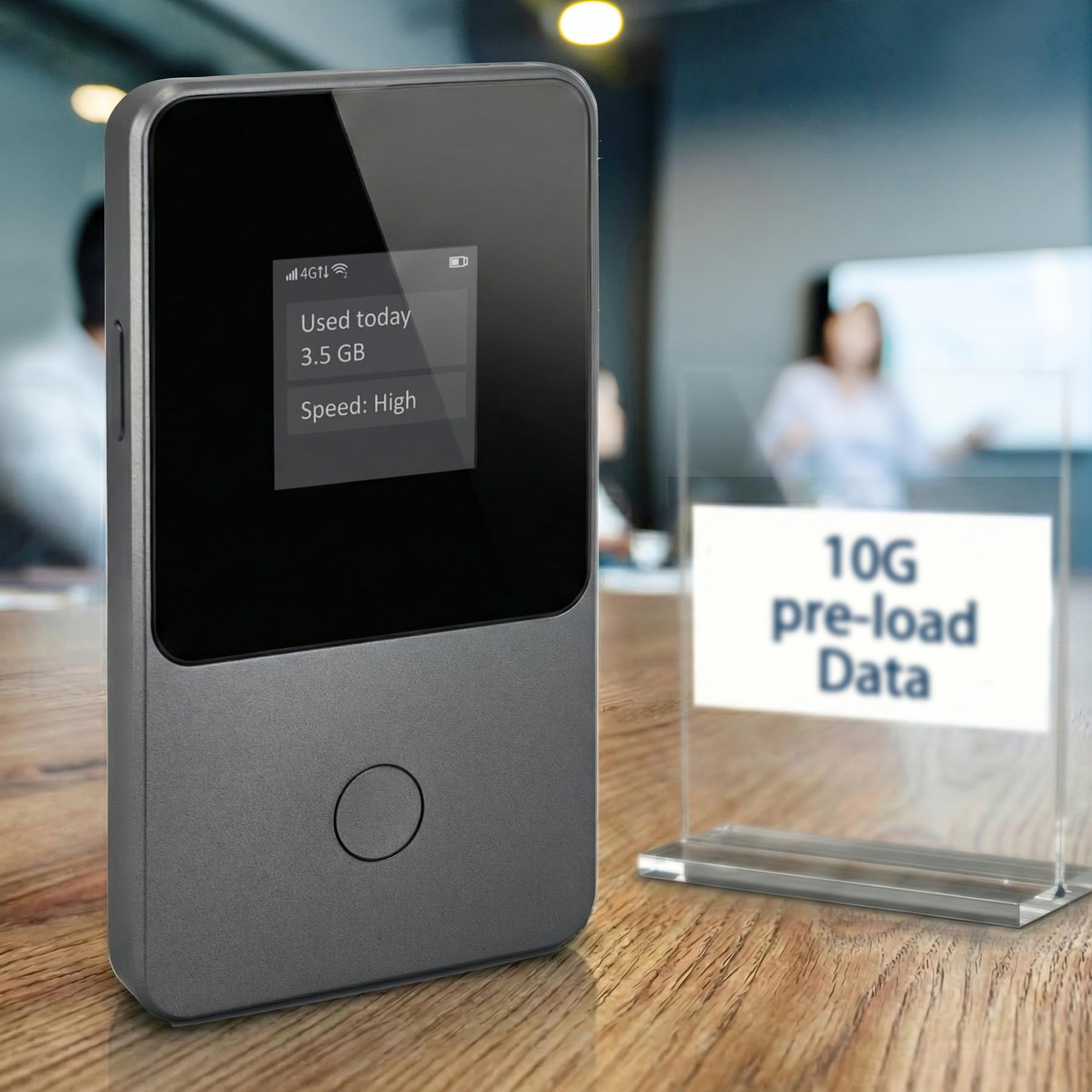
3. Global Pocket WiFi Hotspot T8
Unbox it, switch it on, and the car has internet before you leave the driveway.
Most hotspots make you hunt for a SIM and a data plan before anything works. The T8 skips that entirely — it arrives with 10GB of preloaded US data ready to use, so the first drive is connected without a single top-up. That out-of-the-box readiness is the reason to pick it over a device that needs setup first.
Once that data runs out, its eSIM (vSIM) technology keeps you online across 140+ countries by automatically latching onto the best local network — no SIM cards to buy or swap at a border. It runs on 4G LTE, connects up to 8 devices, and packs a 3500mAh battery rated for up to 15 hours of continuous use. At only 100g, it slips into a pocket or glovebox without a second thought. Compare that battery to the KuWFi’s 2400mAh and the difference in staying power is easy to see on a long drive.
A companion app handles data purchases and usage tracking in real time, and support reaches networks from over 300 global carriers. Buyers describe it as reliable for travel, compact, and easy to set up — one noted connecting a phone and a laptop without trouble. The trade-off worth knowing: the included data is a starter, not a lifetime supply, so you will be buying plans through the app once it is spent.
The quick-trip read: this is the least fuss of any cellular unit here — power on and go, no SIM, no contract, no shop visit.
The catch: the preloaded data is finite and the app is your gateway to buying more, so budget for ongoing plans.
Grab it if: you want internet in the car immediately with zero setup and plan to travel abroad.
Look elsewhere if: you need the fastest throughput — this is a 4G LTE device, not a 5G one.
4. Franklin Wireless JEXtream RG2100 5G Mobile Hotspot

A 5G hotspot and a spare battery pack rolled into one console-friendly box.
The RG2100 runs on T-Mobile’s 5G and LTE network, so it is a straight match if that carrier already covers the roads you drive. It carries a 5,000mAh rechargeable battery and doubles as a portable charger for your phone. Its dual-band setup runs on the 5 GHz frequency, and its internal antennas are tuned for remote work, travel, gaming, and streaming.
This is a renewed unit, which is worth naming plainly: it is a previously owned device that has been restored, not a brand-new one. Buyers describe it looking like new, connecting to T-Mobile without trouble, and handling multiple devices at once. The thing that wins people over is the value — it does the job of a pricier 5G hotspot without the pricier outlay. Setup is described as easy, and the speed holds up for streaming in the car.
Battery life is the one split note. Some owners say it lasts hours, while others report it will not charge completely — a mixed picture rather than a firm verdict. It is also carrier-locked to T-Mobile, so if your coverage comes from another network, this box is not for you. For the right driver, though, the combination of 5G speed and a 5,000mAh power reserve in one pocket-sized unit is genuinely useful on a long haul.
The big reserve: 5,000mAh is a large battery for a hotspot, and the phone-charging function means one fewer cable in the car.
The fine print: T-Mobile-only and renewed — check your carrier coverage and accept a restored device before you commit.
Fits you if: you are on T-Mobile and want 5G with a built-in power bank for your phone.
Pass if: you are locked to a different carrier or want a factory-new unit.
5. GlocalMe UPP 4G Mobile Hotspot with 72GB Data
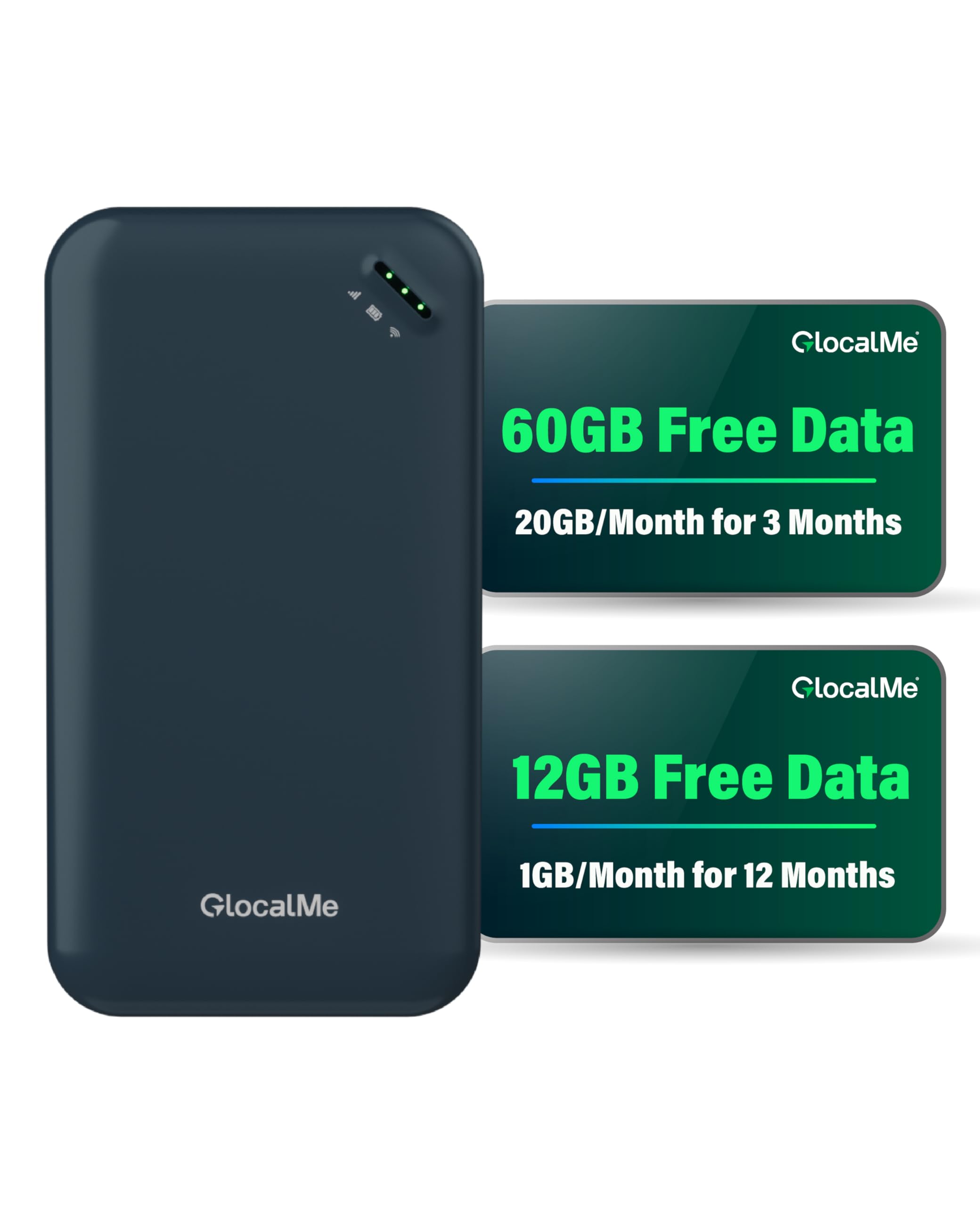
Comes loaded with 72GB of data, so the first three months of driving are already paid for.
The UPP is built around one idea: get you online without buying a plan first. It ships with 20GB of US data monthly for the first 3 months and 1GB of global data monthly for 12 months — a preloaded total of 72GB. Download the GlocalMe app, register, and the data is waiting in your profile. No SIM card, no additional purchase, nothing to configure before your first drive.
Its global coverage reaches 200+ countries and over 390 carriers, automatically selecting the strongest local signal. Throughput is rated at 150 megabits_per_second — the same ceiling as the KuWFi and the TravlFi, so it is built for browsing, video calls, and streaming rather than heavy downloading. Up to 8 devices share the connection, and a 3,000mAh battery delivers over 13 hours of continuous use, which covers most full days of driving. It also accepts your own SIM card if you would rather use a plan you already hold.
Buyers describe it as easy to set up and convenient for traveling with family, with a slim, lightweight body that packs into a bag. The trade-off is straightforward: this is a 4G LTE single-band device, so it will not chase the raw speeds of the 5G units here. If you want a device that arrives ready with a generous data cushion and you do not need 5G throughput, the included 72GB makes the value case for itself.
The value play: 72GB of preloaded data across US and global coverage removes the biggest first-day hurdle in this category.
The ceiling: 4G LTE only — plenty for streaming, not the fastest on the list.
Worth it for: families who want a ready-to-go hotspot with data already included for months of trips.
Skip it for: 5G speeds — the Numen Air or RG2100 handle that end of the market.
6. TravlFi JourneyGo Pocket WiFi
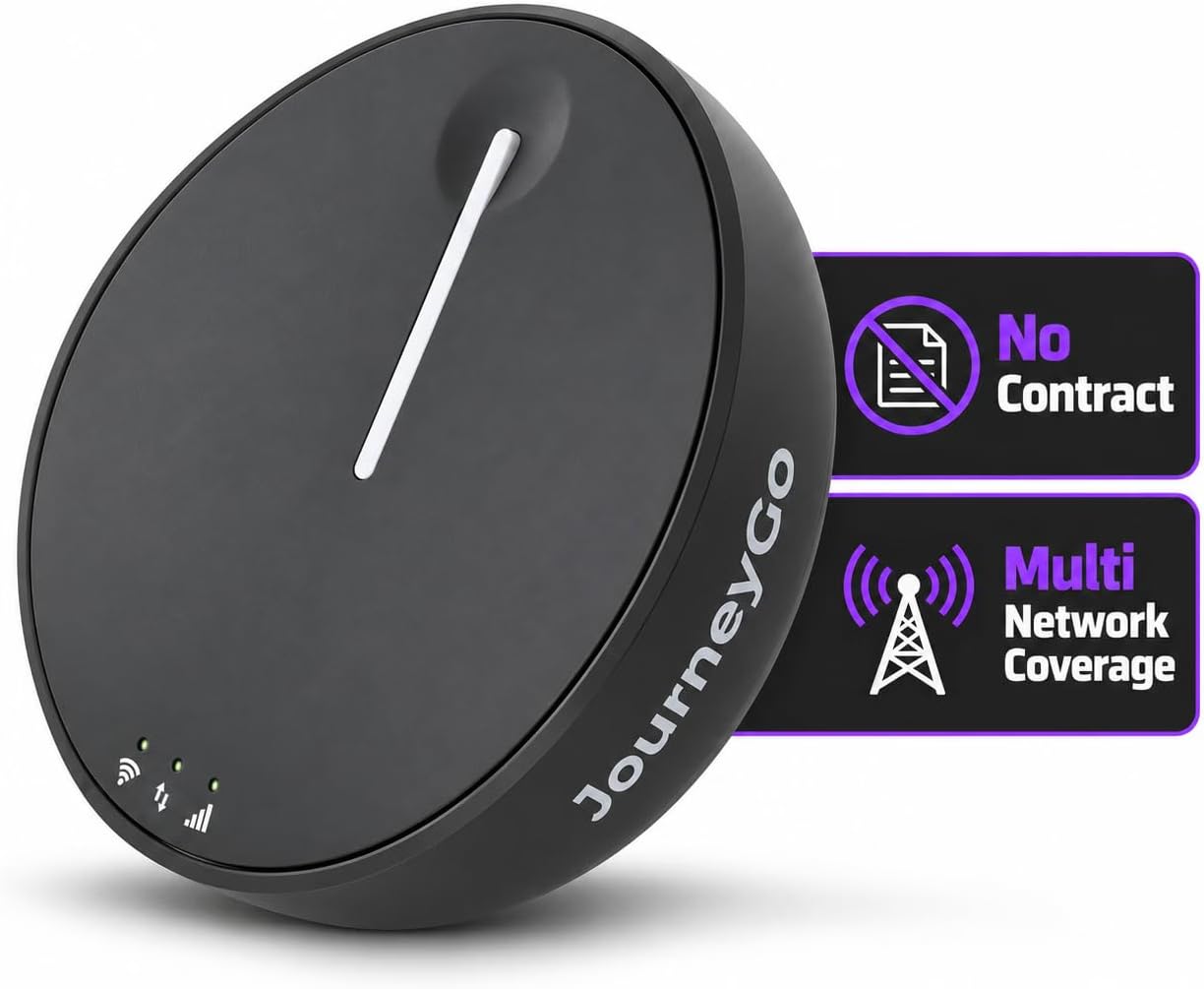
Scans the towers around you and hops to the strongest one as you drive.
The problem with a fixed-network hotspot is that once you leave a city, you can be clinging to a dying tower for miles. JourneyGo tackles that directly: it scans available cellular networks and reconnects to the strongest local signal every time you move to a new location. That automatic switching is the feature to buy it for, and it suits road-trippers and remote-work drivers who cross coverage zones all day.
It runs 4G LTE at a rated 150 megabits_per_second, connects up to 10 devices, and uses eSIM — nothing to insert or swap, just activate a prepaid plan for the length of your trip. Its advertised battery life runs to 16 hours, which handles a long day of driving plus an evening. Plans are no-contract and pay-as-you-go, running from a small prepaid allowance up to unlimited data depending on what you choose.
What wins people over is performance — it is the praise it draws most — followed by how fast it is to set up, often under five minutes. Portability is the third thing owners like. The honest note is reliability: that is the most-discussed theme in its feedback and it is genuinely mixed, so treat this as a strong daily driver in decent coverage rather than a guaranteed lifeline in true wilderness. Value also splits between those who feel it pays off and those who do not.
The road-trip logic: automatic network hopping plus a 4G LTE connection and 10-device sharing make it a natural fit for a car full of screens on the move.
Set expectations: performance and setup get strong praise, but reliability feedback is mixed — great in populated coverage, less certain where the map goes blank.
Great match for: drivers who move between towns and want the hotspot to chase the best signal on its own.
Look past it if: you need bulletproof coverage in truly remote stretches — nothing here guarantees that.
7. GL.iNet GL-E750V2 MUDI 4G LTE Portable Travel Router

A pocket router for the driver who wants every byte encrypted before it leaves the car.
MUDI puts a VPN in your glovebox. It carries a SIM card slot for 4G LTE and rates its wireless at 300Mbps on 2.4GHz plus 433Mbps on 5GHz. Built-in OpenVPN and WireGuard run alongside a customized DNS server, and you can connect through 30+ VPN servers so public networks stay private while you work from a roadside stop.
The power story is the standout. A built-in 7000mAh battery — the largest of any portable router here — gives up to 8 hours of use, and it recharges over USB-C. Its body measures 5.7 by 3.1 by 0.9 inches and weighs 285g, so it fits a console or a jacket pocket. For storage, it holds DDR2 128MB RAM, 16MB NOR Flash, and 128MB NAND Flash, with a microSD slot accepting up to 1TB and a USB 2.0 port for peripherals.
VPN throughput is the honest consideration: WireGuard runs up to 50Mbps and OpenVPN up to 10Mbps, so this is a secure connection rather than a fast one — fine for browsing and files, not for heavy 4K streaming through the tunnel. It also supports GL.iNet’s physical eSIM card, which must be bought separately, and the modem is restricted in a handful of listed countries. Setup splits opinion in its feedback, with some finding it easy and others wrestling with it. For a privacy-first traveler who values the big battery over raw speed, MUDI is a strong fit.
The privacy engine
- OpenVPN and WireGuard built in, with 30+ servers to route through
- 7000mAh battery delivering up to 8 hours away from a socket
- 1TB microSD support for storing files on the road
What it trades away
- VPN speeds cap at 50Mbps (WireGuard) and 10Mbps (OpenVPN)
- Setup splits between easy and difficult for different drivers
- eSIM support needs a separate physical card purchase
Pick it for: secure work from the road with a battery that outlasts the drive.
Choose the Numen Air instead if: raw 5G speed matters more to you than encryption.
8. GL.iNet GL-X3000 (Spitz AX) 5G Cellular Gateway

Six detachable antennas and dual SIMs built for an RV that parks far from civilization.
The Spitz AX is the biggest unit here in ambition, not just size. It is a Wi-Fi 6 cellular router rated at up to 574Mbps on 2.4GHz and 2402Mbps on 5GHz, with combined throughput data of 3000 megabits_per_second — the same headline figure as the TP-Link, though this one makes its own cellular connection rather than re-sharing one. It runs 5G under both NSA and SA standards and is certified for T-Mobile and AT&T.
For a vehicle parked in the middle of nowhere, redundancy is the point. Dual-SIM with single standby lets it fail over to whichever carrier is stronger, and multi-WAN technology spreads load across Ethernet, repeater, cellular, and tethering, with configurable failover priorities. Six detachable antennas are the standout hardware feature — you can attach a wired dome antenna for extra stability in weak areas, which is why RV owners favor it. Buyers single out its excellent WiFi signal and how the external antennas sharpen reception.
Software is GL.iNet’s own firmware built on OpenWrt v21.02, with over 5,000 plug-ins for advanced customization and a no-code interface inside the admin panel. VPN support covers OpenVPN and WireGuard at up to 150Mbps and 300Mbps respectively. The catch for a pure car buyer: it is powered by a wall adapter rather than a battery, so in a vehicle you need an inverter or a 12V-to-wall solution to run it — this is an RV gateway, not a pocket hotspot.
Built for the long park: 5G, Wi-Fi 6, dual-SIM failover, six detachable antennas, and 3000 megabits_per_second combined throughput make it the most capable install here.
The vehicle caveat: no battery — it needs a wall-style power source, so it suits an RV with an inverter, not a compact car with only a USB port.
Suits you if: you are outfitting an RV or camper and want multi-carrier redundancy with antennas that reach.
Not for a dash pocket: the wall-power requirement rules out simple car use.
9. KuWFi 4G LTE Mobile WiFi Hotspot L100EU
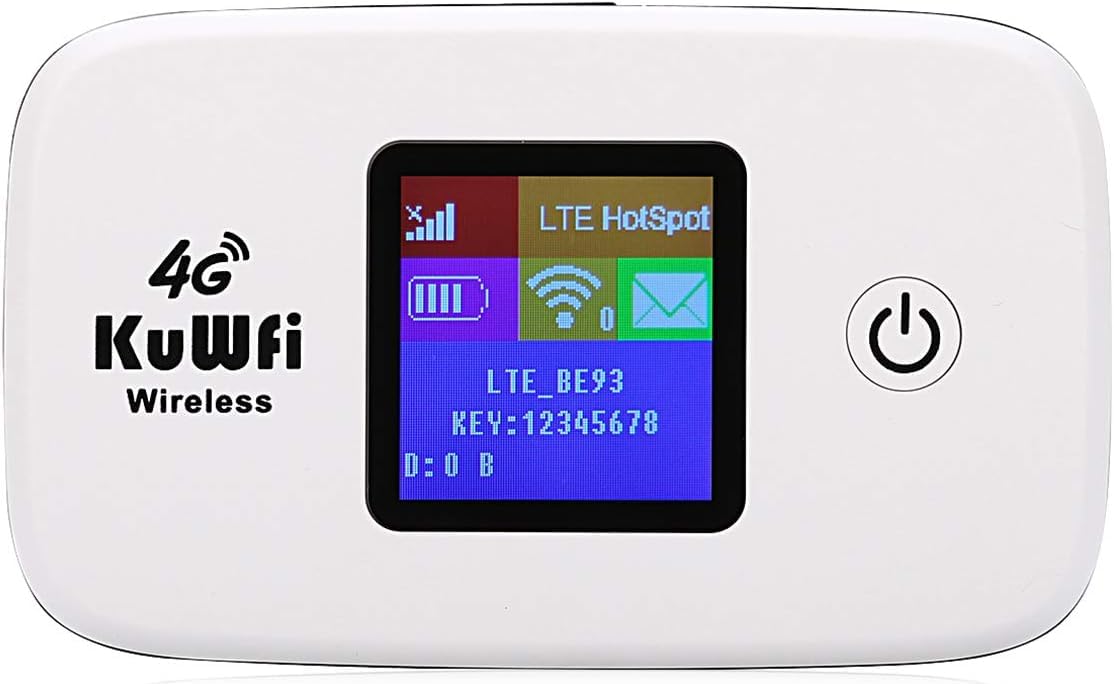
The cheapest way into a cellular hotspot — if the signal and the setup cooperate.
KuWFi’s L100EU is the entry point to this category. It takes a 4G LTE data SIM and broadcasts WiFi to up to 10 users, with a rated throughput of 150 megabits_per_second. The 2400mAh lithium battery makes it pocket-portable, and a small screen shows what is happening. Its supported 4G FDD bands are B1/B3/B5/B7/B8/B20, aimed mainly at Europe, Asia, Southeast Asia, Australia, Africa, the Middle East, and parts of South America.
This is not plug-and-play. Even with a compatible SIM, you may need to disable the PIN code and edit the APN by logging into 192.168.0.1 — a back-end menu most people never touch on a modern hotspot. It also does not support roaming, virtual SIM, or IoT SIM cards, so you need an activated data SIM and a bit of patience. That setup friction is the reason to weigh it carefully against a no-SIM unit like the Numen Air.
The feedback is blunt and worth hearing straight: functionality, value, compatibility, and battery life all come in for criticism, and the device draws mixed reviews overall. That makes it a fit for a tinkerer on a tight budget who can work the APN settings and already has a working SIM for the regions listed — not for someone who wants internet on the first try. If you want set-and-drive reliability, spend up.
The entry ticket: a genuinely low-cost hotspot with a 2400mAh battery, a SIM slot, and 10-user sharing.
Be ready to tinker: APN editing and PIN removal are often required, and it will not work with roaming, virtual SIM, or IoT SIM cards.
Right for: a hands-on buyer with a data SIM for the listed bands who wants the lowest-cost entry.
Wrong for: anyone expecting instant, plug-and-play internet in a new country.
Know the Specs
Data Transfer Rate (Mbps / Gbps)
This is the maximum throughput the device can push, measured in megabits per second (Mbps) or gigabits per second (Gbps). Think of it as the width of the pipe — a 3000 megabits_per_second router carries far more simultaneous traffic than a 150 megabits_per_second one. Note that rated speed is a ceiling; real-world speed depends on the cellular signal feeding it and how far devices sit from the router. For a car full of streaming screens, higher is better; for one laptop doing email, even the lower figure is plenty.
Connected Devices
The device count is how many phones, tablets, laptops, and cameras can share the connection at once. Exceed it and a new device simply cannot join until another drops off. A family car with three screens plus two phones needs headroom, so a 16-device unit like the Numen Air covers a crowd while an 8-device unit works for a couple or a small group. Match this number to the number of screens you actually haul around.
Battery Capacity (mAh)
Milliamp-hours (mAh) describe how much charge a battery holds — the bigger the number, the more minutes of use away from a socket. A 7000mAh pack in the MUDI runs up to 8 hours, while a 2400mAh cell needs charging far sooner. If your car has a live USB socket, capacity matters less; if you park and walk away, it decides whether the hotspot survives the afternoon. Some units also double as power banks for your phone.
Cellular Bands & SIM Support
Bands are the specific radio frequencies a carrier broadcasts on, written like B1, B3, or B20. A hotspot must list the bands your carrier uses, or it cannot connect at all. eSIM units skip the physical card and pick a network for you, which is convenient across borders; SIM-slot units let you drop in your own plan but often need APN edits to work. Always confirm the bands and regions match where you drive.
Common Questions
Will a travel router work in my car without a separate data plan?
Can I power these routers from my car’s USB port?
Do I need a SIM card for a car hotspot?
Which of these handles the most devices at once?
Is 5G worth it in a car over 4G LTE?
Will the KuWFi L100EU work in the United States?
How long does a hotspot battery last on a road trip?
Do these routers improve my signal or just share it?
Can several family members share one hotspot at once?
How much data will a car hotspot use per hour?
The Bottom Line
For most drivers, the wifi router for car winner is the GlocalMe Numen Air 5G — it is the only unit here that pairs a 2.5 gigabits_per_second rating and 16-device sharing with no-SIM flexibility, and it throws in a power bank for good measure. If you already have a phone plan and simply want a private network for the wholecar, the TP-Link Roam 6 shares it for less and wraps it in OpenVPN and WireGuard. And for a trip where you want internet the second you unbox, the Global Pocket WiFi T8 arrives with 10GB preloaded and a 3500mAh battery rated for 15 hours.
One honest nudge before you decide: the Numen Air is the crowd favorite with 4.0+ stars across 500+ owners, and that rating holds up because it delivers the fastest cellular throughput rating on the list. But if you are outfitting an RV rather than a compact car, the GL.iNet Spitz AX‘s six detachable antennas and dual-SIM failover are worth the trade-off of needing a wall power source. Match the box to your coverage and power setup, and the connection holds.
How we choose
We do not accept paid placement. Every pick is matched to a real buyer and a real use-case; we do not hands-on test units.
Sources
Specifications: manufacturer listings and product documentation. Review insights: verified customer reviews, as of November 2026. Pricing: not shown on this page (it changes often); check the current price via the retailer link.
As an Amazon Associate, Tactical Gear Guy earns from qualifying purchases. This does not affect which products we feature.