Specs are compiled from manufacturer listings and verified buyer reviews and can change over time — please confirm the key details on the product page before buying.
You already know the feeling: you swap in fresh cells for a trail camera or flashlight, the temperature drops overnight, and the thing is dead by morning. Cold and heat quietly kill ordinary batteries, and that is the whole reason wide temp batteries exist. This guide covers the 9 picks worth your money and the exact temperature rating, capacity, and chemistry behind each one.
This guide is built by comparing the manufacturers’ published specifications and the patterns across verified customer reviews, so you get each pick’s real strengths and trade-offs instead of marketing spin.
You will see which cells hold their charge in sub-freezing weather and which deep-cycle lithium packs run a trolling motor all day. Below you will find the Best Wide Temp Batteries compared side by side, with plain-English notes on what each temperature spec actually means for your gear.
Top Picks


How To Choose The Best Wide Temp Batteries
Start with the temperature range, not the amp-hour number. A battery rated only for mild conditions will fail exactly when you need it — in a snowbound trail camera, a winter deer stand, or a boat left on the water. The spec you are looking for is a stated operating range in both Fahrenheit and Celsius.
Temperature range first, capacity second
An Energizer AAA cell rated from -40°F to 140°F runs in a metal hunting flashlight through a January overnight. A rechargeable deep-cycle pack with charge pause below 32°F protects itself instead of letting cold damage the cells. Match the rating to where the battery lives, not to the biggest capacity on the box.
Single-use cells versus rechargeable packs
If you are stocking a bug-out bag or powering a small optic, disposable lithium cells like the CR123A or AA are right — they sit for a decade and still have charge. If you are running a trolling motor, an RV, or a solar bank, you need a rechargeable LiFePO4 pack with a battery management system (BMS, the built-in circuit that watches voltage and temperature).
Low-temp cut-off and BMS protection
A battery management system can pause charging when it gets too cold and resume once the battery warms. That charge pause is what separates a wide-temp pack from a fair-weather one. Check both the charge cut-off temperature and the discharge protection temperature before you buy.
Side-by-Side Comparison
| Model | Best For | Chemistry | Capacity | Temp Range | Amazon |
|---|---|---|---|---|---|
| Duracell CR123A 3V Lithium Battery, 6 Count★ Best Overall | Tactical flashlights and security cam spares | Lithium | 1500 | Sub-freezing to high heat | Amazon |
| Energizer Ultimate Lithium AAA L92, 12 CountCold-Weather Pick | Smoke detectors and cold-weather trail gear | Lithium | — | -40°F to 140°F | Amazon |
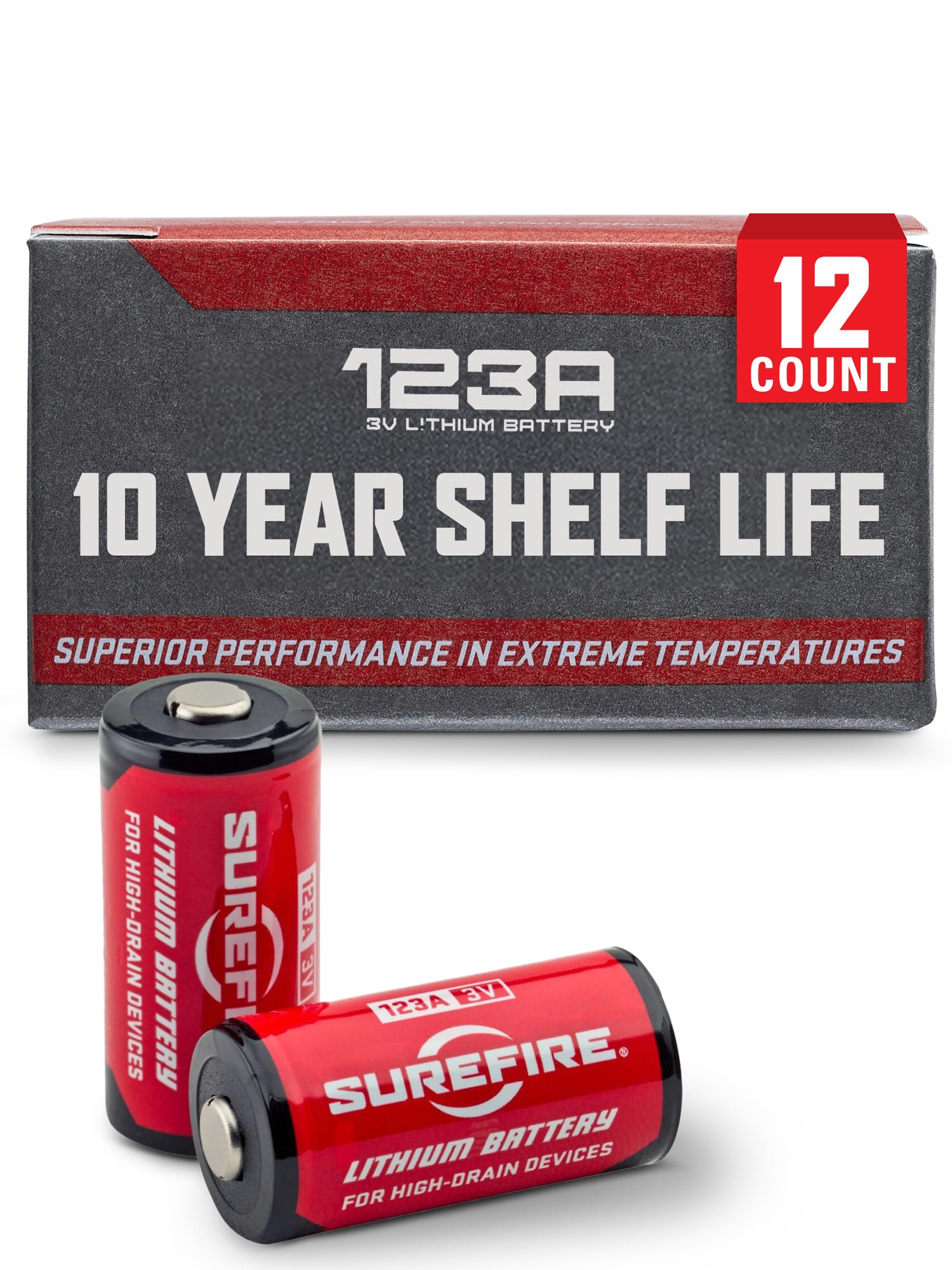
| SureFire CR123A SF123A, 12 PackTactical Standard | High-drain tactical lights | Lithium Metal | 1550 mAh | Extreme heat or cold | Amazon |
| Energizer Industrial Lithium AA L91, 24 Pack | Bulk emergency and security device stock | Lithium | — | -40°F to 140°F | Amazon |
| DC HOUSE 12V 100Ah LiFePO4 | Trolling motors and marine use | Lithium-Phosphate | 100 Ah | Charge pause below 19.4°F | Amazon |
| ECO-WORTHY 12V 100Ah with SOC Display | RV and solar off-grid setups | Lithium Ion | 100 Ah | Low-temp protection | Amazon |
| SUPER EMPOWER 24V 100Ah | 24V trolling motors and marine backup | Lithium Ion | 2560 Wh | Charge pause below 32°F | Amazon |
| Litime 12V 100Ah Self-Heating | Cold-climate RVs and winter camping | Lithium-Phosphate | 100 Ah | Heats below 41°F | Amazon |
| ECO-WORTHY 12V 314Ah Bluetooth | Whole-home backup and large solar banks | Lithium-Phosphate | 314 Ah | Charge pause below 19.4°F | Amazon |
Detailed Reviews
1. Duracell CR123A 3V Lithium Battery
Our pick — 4.5+★ from 22,000+ verified ratings; the strongest balance of quality and price.
The CR123A cell that security techs and flashlight carriers keep stocked by the handful
If your gear runs on CR123A cells — tactical lights, Ring or Nest cams, alarm sensors — this is the pack to buy first. Duracell rates it for extreme temperatures from sub-freezing cold up to high heat, so a camera mounted outside stays powered through a hard frost and a summer afternoon. That sub-freezing-to-high-heat range is why this pick sits at the top.
Each cell holds its charge for a guaranteed 10 years in storage. That shelf life is why the spare in your kit bag still works when you actually need it. The six-count pack keeps a flashlight plus a couple of security spares ready without a trip to the store.
What wins people over is the raw quality of the cell. The two things owners single out most are battery quality and reliability, and those reflect real use in demanding gear. At 3.68 ounces for the pack, these are heavier than the featherweight SureFire 12-pack at 17 g, because Duracell builds a denser cell here.
Where It Earns Its Place
- Rated for sub-freezing cold up to high heat — the core wide-temp spec you need
- 10-year guaranteed storage keeps spares ready in a kit bag or camera case
- Fits Ring, Nest Cam, Arlo, and alarm sensor brands owners use it in
- Lithium chemistry pushes more energy into high-drain lights than standard alkaline
What To Keep In Mind
- Battery life is the split verdict here — some buyers report cells running out faster than expected, mostly in always-on devices
- Single-use only, so there is nothing to recharge
Go for it: anyone arming security cameras, alarm sensors, or a carry flashlight who wants spares that survive years in a drawer.
Think twice: if your device drains cells weekly, a rechargeable pack will cost you less over time.
2. Energizer Ultimate Lithium AAA L92 Batteries
The AAA that keeps a smoke detector alive through a deep freeze
The printed range tells the story: these AAA cells are rated to perform from -40°F to 140°F. That is the widest stated range in this lineup, and it turns an ordinary AAA slot into cold-weather power. Owners mention the cells handle that full -40 to 140 range in practice, with the most common real use being Nest smoke detectors.
When not in use, they hold power for 15 years. In a camera that switches on a few times a night, that shelf life plus the wide range is what you are paying for.
Cold and heat are not the only reason to pick these — owners point to their lack of leakage as a real plus in gear that sits mounted for years. The value and power both get called out as solid. The honest limit is the AAA size: it fits small devices, and if you need CR123A or AA it is simply the wrong cell.
What it delivers: the coldest rated AAA cell here, a full -40°F to 140°F window, plus 15-year storage so a spare is never a dead spare.
The trade-off: AAA only — no CR123A or AA option in this pack, so it lives in small devices, not your flashlight.
Worth grabbing: for smoke detectors, remotes, and any small device that sits in an unheated cabin or garage.
Not your cell: if your gear takes CR123A or AA, move down this list.
3. SureFire CR123A 3V Lithium Battery
A high-drain CR123A built to hold full brightness to the last click
Each cell carries 1,550 mAh of high-drain capacity in a 3-volt lithium package. That capacity is what keeps a tactical flashlight at peak output instead of fading dim. SureFire builds these for high-drain gear, so voltage holds steady as the cell drains instead of sagging into a weak beam.
The 12-pack is the tightest CR123A pack here at 17 g per unit, so a full dozen travels without bulk in a patrol bag or glovebox. SureFire rates the shelf life at 10 years with wide temperature tolerance — the maker’s claim is no degradation in extreme heat or cold. That is the wide-temp rating you are paying for.
Owners run these in Surefire flashlights and Arlo cameras, and the praise centers on consistent power and performance. The brand’s reliability is the other consistent note, and the high capacity gets called out as a plus. Note the pack size ladder: this one is the 12-count, and SureFire offers 24, 48, and 72 counts for a deeper stockpile.
The defining spec: 1,550 mAh in a 3V CR123A — the highest stated capacity cell on this list, aimed squarely at high-drain lights.
Honest limit: it is a single-use cell, so budget for replacing rather than recharging, and 12 cells go fast if several lights ride in your kit.
Reach for it: when your flashlight or Arlo cam is the priority and you want 1,550 mAh of steady high-drain power.
Look elsewhere: if you want the largest cell count — the Duracell 6-count is a lighter grab for camera spares only.
4. Energizer Industrial Lithium AA Batteries L91

Twenty-four AA cells that stay shelf-ready for two decades
The headline here is 24 AA cells and a 20-year shelf life. That is double the Duracell CR123A’s 10-year storage window, so an emergency stash bought now is still fresh years from now. The pack weighs 12.8 ounces against Duracell’s 3.68 ounces, because you are getting four times the cell count.
Each cell is rated safe in temperatures from -40°F to 140°F — the same wide window as the Energizer AAA pick above, but in a full AA size. Leak-resistant construction protects the gear you drop them into. The maker backs them with a limited lifetime warranty, and owners note a leak-proof design as a reason they trust them.
Real-world use spans toys, security cameras, and Blink outdoor cams, and the cells hold up even in freezing weather. Battery life and value for money are the two things buyers praise most, which tracks: a 24-pack is the practical choice when you are stocking many devices at once. The trade-off is sheer volume — you are committing to AA only.
Why A Bulk Buyer Picks It
- 24 AA cells sized for whole-system stocking in one order
- 20-year shelf stability keeps a long-term emergency stash viable
- Leak-resistant build protects cameras and other gear from damage
- Rated safe from -40°F to 140°F for outdoor and cold-weather devices
The Other Side
- Commits you to AA only — no CR123A or AAA cells in the box
- Smaller review base than the flagship Duracell and SureFire packs
A solid call: for anyone stocking Blink cams, security gear, or a vehicle emergency kit who wants a deep AA reserve.
Skip if: your devices are all CR123A or AAA — buy the matching cell instead.
5. DC HOUSE 12V 100Ah Bluetooth LiFePO4 Battery

A 100Ah marine pack that shuts down charging before the cold can hurt it
This is the big pack for a trolling motor and a weekend on the water. It is rated to cut off charging when the internal sensor reads below 19.4°F, and it stops discharge below -4°F, then recovers on its own once it climbs back to 32°F. That low-temperature protection is what makes it a genuine wide-temp battery rather than a fair-weather one.
Bluetooth 5.1 lets you watch state of charge, voltage, and current on the DC HOUSE app, with a reported signal range of 5 to 10 meters. It drills down to individual cell data and pushes a notification when it sees an anomaly. For a boat owner who cannot see the battery under a hatch, that is a real convenience.
Owners note power enough for a 45lb thrust trolling motor, and Bluetooth connectivity earns praise for its useful features and range. Battery quality is what wins people over most. The recurring gripe is runtime — some see the pack use about a quarter to a third of its capacity overnight, so plan a recharge before a long day. At 10.8 kg it is far heavier than a pocket CR123A pack, but that is the price of 100Ah of stored power.
The reason to buy: a 100Ah LiFePO4 pack with Bluetooth 5.1 monitoring and a charge cut-off below 19.4°F, so marine use in cold weather stays protected.
The catch: it is not a starting or cranking battery, and overnight draws can eat a chunk of capacity, so size your trips to the reserve.
Best fit: trolling-motor and boat owners who want app-visible power and built-in cold protection for the off-season.
Not for you: if you need a cranking battery to start an engine, this deep-cycle pack is not built for that job.
6. ECO-WORTHY 12V 100AH LiFePO4 Battery
A 100Ah pack you can read at a glance without reaching for your phone
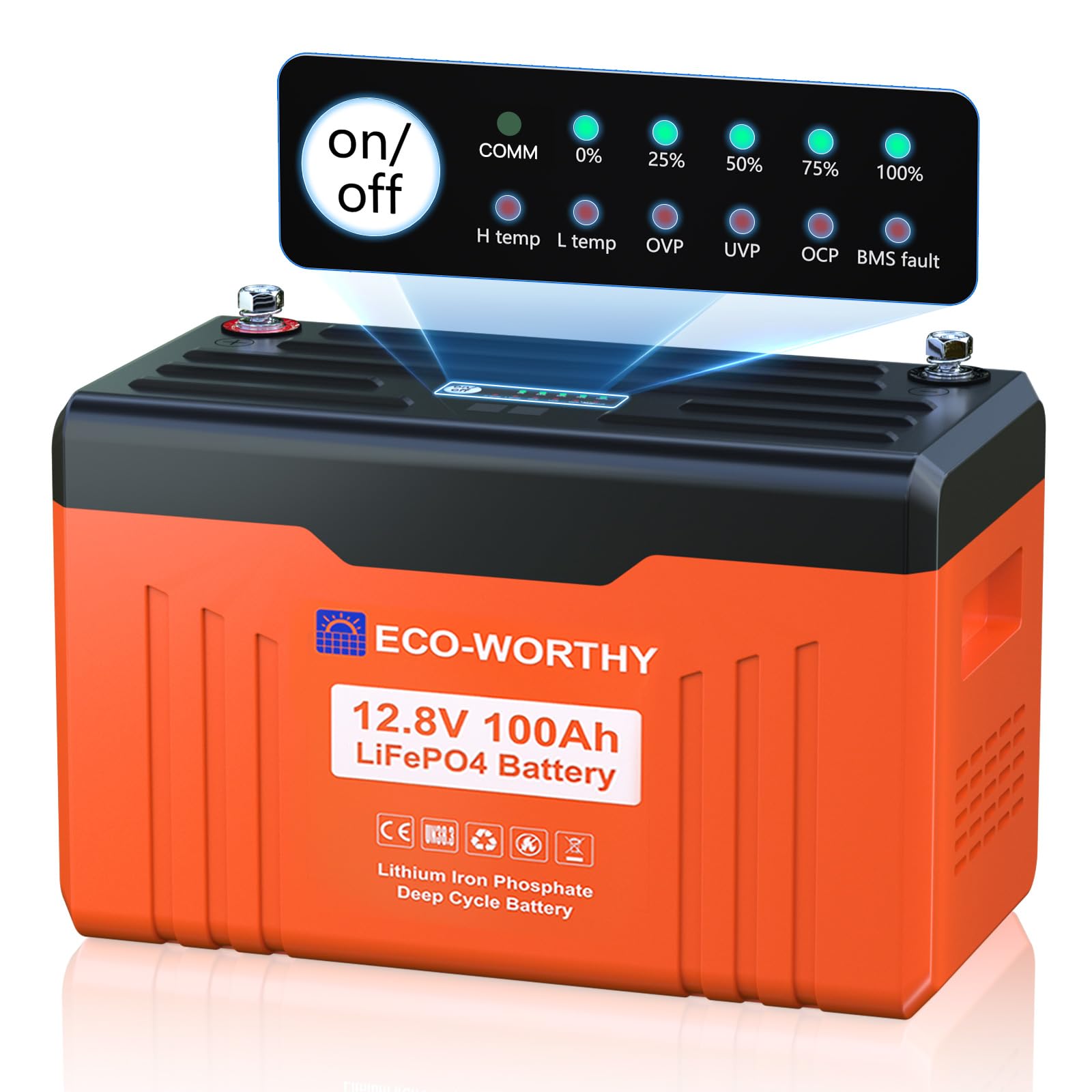
Most smart batteries make you open an app to see where you stand. This one puts an LED panel right on the case showing state of charge and any abnormality — no phone, no steps. That alone makes it easier to live with in an RV or a cabin where you walk past the battery bank.
It still has an app for the deeper detail: built-in Bluetooth lets you watch voltage, current, capacity, runtime, and cell voltages within 98 feet through the ECO-WORTHY app. A built-in buzzer also sounds when the BMS reports a fault. The wide-temp side comes from a 100A BMS with low-temperature protection, the circuit that guards the cells when it turns cold.
Owners are impressed by the build quality, and it earns praise for value. The honest caveat: battery life gets mixed feedback, with some reporting it dies at 40% of charge. Bluetooth also draws mixed notes. A metal fixture holds the cells to resist swelling, and the pack supports 4P2S expansion up to 10.24KWH for a bigger bank.
What stands out: an on-board LED state-of-charge display and a fault buzzer — two things most lithium packs make you check on a phone instead.
The trade-off: charge-level behavior at the bottom of the curve draws uneven reports, so budget a reserve rather than running it flat.
Choose it: RV and off-grid owners who want to glance at the case and know the charge without an app.
Consider another: if Bluetooth reliability tops your list, weigh the DC HOUSE app-tuned pack above.
7. 24V 100Ah LiFePO4 Lithium Battery
The 24-volt pack built to push a trolling motor, not start a car
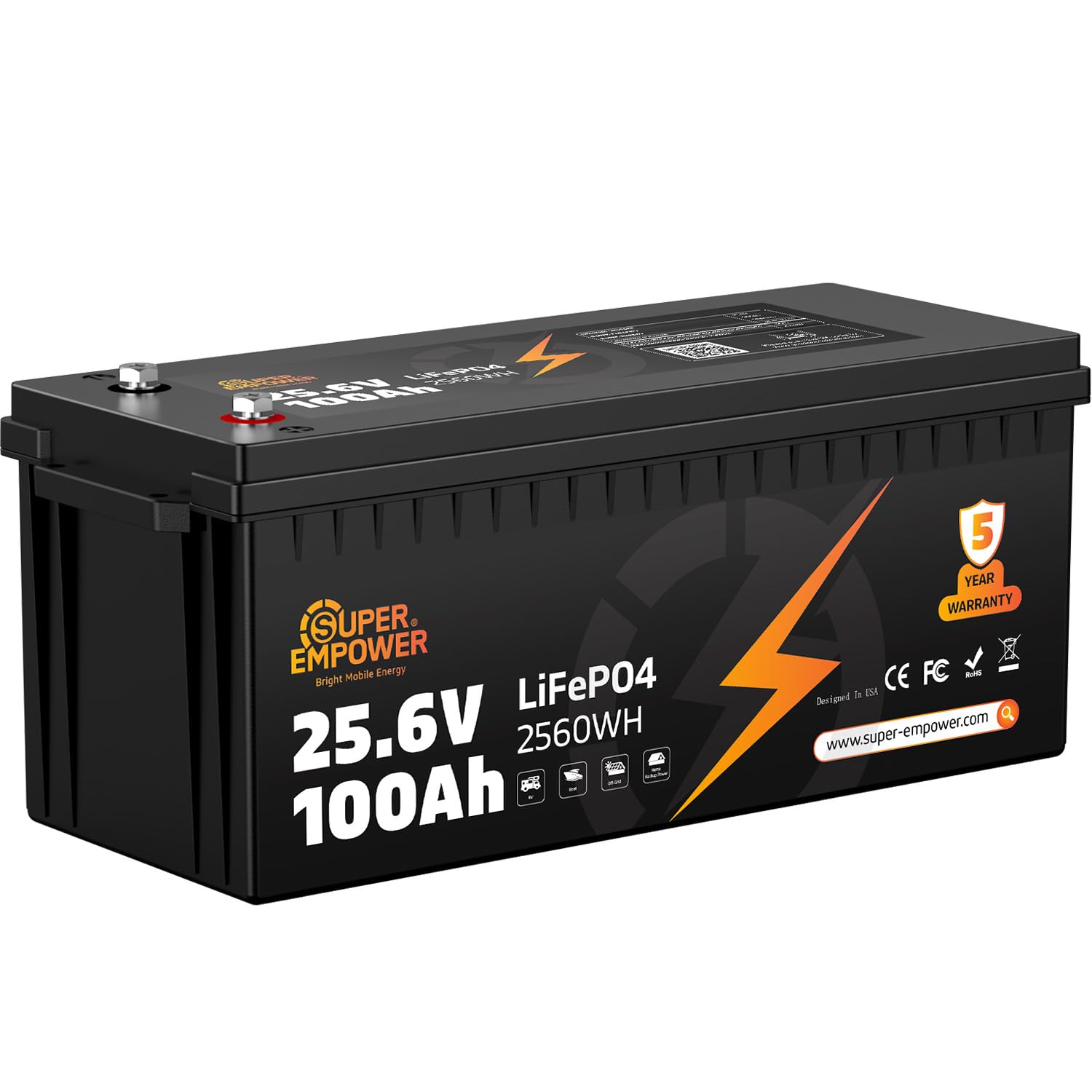
Rated energy is 2560Wh in a single enclosure, from Grade A LiFePO4 cells with a 25.6V nominal voltage. If your trolling motor runs on a 24V system, this is a direct fit rather than two 12V packs wired together. The integrated 100A BMS balances cells and guards against over-current, over-voltage, and temperature extremes.
Cold-weather protection is built in — charging pauses automatically below 32°F, and discharge protection kicks in below -4°F. That means a cold snap will not cook the cells mid-trip. It is a deep-cycle pack for repeated charge and discharge, and it is not for engine starting or cranking.
Owners point to strong performance with trolling motors and long power that still holds charge when the battery sits. Weight and small size get positive notes too, and it installs with ease — one report has it powering a small microwave for nearly an hour. At 41.7 pounds it is a hefty lift compared to a pocket battery pack, but that enclosure carries 2560Wh. The 5-year limited warranty covers manufacturing defects, and it expands up to 8 matching batteries for a larger bank.
Where The 24V Shines
- 2560Wh of rated energy in one enclosure for 24V trolling motors
- Charging pauses below 32°F and discharge protection below -4°F
- 100A BMS balances cells and guards against over-current and over-voltage
- Expandable with up to 8 matching batteries for a larger storage bank
Before You Commit
- At 41.7 pounds it is a real lift to move or mount
- Auxiliary and storage power only — never for engine cranking
Right answer for: 24V trolling-motor owners who want one clean 2560Wh pack with cold-charge protection.
Keep shopping: if your system is 12V, the DC HOUSE or ECO-WORTHY 12V packs fit without rewiring.
8. Litime 12v 100Ah Self-Heating LiFePO4 Battery

The lithium pack that warms itself so cold weather cannot stop the charge
Most wide-temp packs just pause when it gets cold. This one heats itself. In Regular mode it warms the cells when the temperature drops below 41°F while charging, then stops heating at 50°F to begin charging — an adequate answer to winter RV use. An Energy-Efficient mode gives you a second option for milder conditions.
Fitting matters as much as heat here: it is built to the Group 24 size, so it drops into a standard Group 24 box and directly replaces an old lead-acid battery with no modification and no maintenance. Bluetooth 5.0 lets you track status in real time through the LiTime App, so you can see the charge before a cold night drains it.
What owners value most is reliability, with the pack running all day and lasting almost twice as long as a 120ah AGM battery. Bluetooth phone monitoring draws praise, and the lighter build is a practical win — it can cut tongue weight by 60lbs in a trailer. Protection runs to 20+ safeguards plus IP65 dust and water resistance for rain, saltwater, and humidity. The noted limit: charge it with a lithium-activation or MPPT charger to wake Bluetooth on first receipt.
Best feature: self-heating below 41°F with a Group 24 fit that swaps straight into a lead-acid spot — cold-weather RV power without a wiring project.
Setup note: Bluetooth needs a lithium-activation or MPPT charger to wake the first time, so plan that into the install.
Made for: RV and camper owners in cold regions who want a lithium upgrade that fits the existing Group 24 box.
Not the one: for golf carts, jacks, or engine starting — this is a deep-cycle house battery.
9. ECO-WORTHY 12V 314AH LiFePO4 Battery
The biggest reserve in this lineup — 4019Wh of power in one 12V case
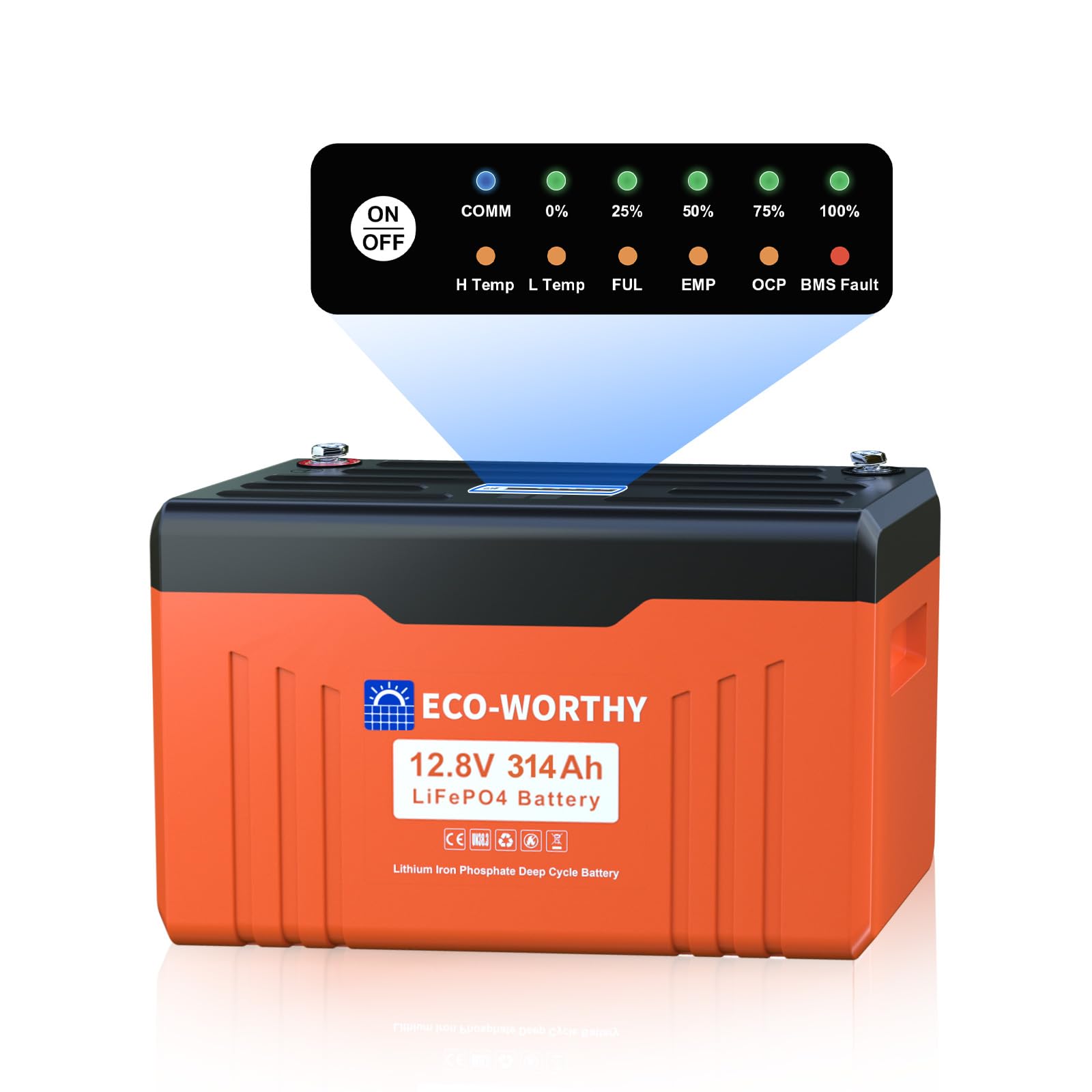
This is the capacity monster of the group. It stores 4019.2Wh of energy at 314Ah, and that number is the reason it belongs on a list for people running serious backup or off-grid systems. It expands up to 4P2S or 2P4S for a total of 32.15kWh, so a single battery can grow into a household-scale bank.
The 200A BMS carries low-temperature protection that pauses charging below 19.4°F, which protects the cells in a cold snap. A bright LED status screen shows the charge level at a glance, and Bluetooth lets you watch and control it remotely through the ECO-WORTHY app. A built-in buzzer flags faults so you can troubleshoot fast instead of guessing.
Owners praise the build and the performance, including one who reports it powering a greenhouse effectively, and the pack holds its charge for up to five full days. Value is a consistent plus. At 60.4 pounds it is the heaviest pick by a wide margin — that is the trade for 314Ah — so plan how you will lift and mount it before it arrives.
Why Big Systems Want It
- 314Ah and 4019.2Wh in a single 12V enclosure for deep reserves
- 200A BMS with charge cut-off below 19.4°F for cold protection
- LED status screen plus Bluetooth app monitoring and control
- Expands up to 32.15kWh for a whole-home or cabin bank
The Real Trade
- 60.4 pounds — it takes planning to lift and mount
- Big capacity means a bigger upfront commitment than a 100Ah pack
Sized for: home-backup and off-grid builds that need every last watt-hour in the smallest number of batteries.
Overkill if: you are powering a small trolling motor — a 100Ah pack covers that with far less weight.
Know the Specs
Temperature Range in °F and °C
The operating range tells you how cold and how hot a battery will still work. A cell rated from -40°F to 140°F covers deep winter and full summer sun. A rechargeable pack often lists a low-temperature charge cut-off instead — the point where it pauses charging so cold cannot damage the cells. Check both the charge and discharge limits, since they are usually different numbers.
Capacity in Ah and Wh
Amp-hours (Ah) measure how much current a battery can deliver over time; watt-hours (Wh) measure total stored energy. A 100Ah deep-cycle pack fits most trolling motors and RV house needs, while a 314Ah pack carries the larger reserve a home-backup bank wants. Match Ah and Wh to your run time, not to the biggest number on the listing.
BMS and Low-Temp Protection
The battery management system is the built-in circuit that watches voltage, current, and temperature. A wide-temp pack uses it to pause charging when it gets too cold and to guard against over-current and short circuits. More protection stages mean fewer ways for the pack to be damaged during a hard winter.
Shelf Life and Cycle Count
Shelf life is how long a single-use cell holds its charge in storage — 10 or 20 years here. Cycle count is how many charge-discharge rounds a rechargeable pack survives, and it is measured against lead-acid, which the lithium packs here outlast by a wide margin. For a spare kit, shelf life is king; for a daily power bank, cycle count is.
Common Questions
What actually makes a battery a wide temp battery?
Will a CR123A battery work in freezing cold?
What does low-temperature charge cut-off do on a LiFePO4 battery?
Can I use a deep-cycle LiFePO4 battery to start an engine?
Is a 100Ah battery enough for a trolling motor?
What is the difference between the 12V and 24V lithium packs here?
How long do these batteries last in storage?
Do I need a special charger for a lithium battery?
What does the self-heating feature on the Litime battery do?
Can I connect multiple batteries together?
The Bottom Line
The winner for most people is the Duracell CR123A 6 Count because it covers the widest set of everyday wide-temp jobs — security cameras, alarm sensors, and tactical lights — with a sub-freezing-to-high-heat rating and a guaranteed 10-year shelf life. It also carries a 4.5+ star rating across 22,000+ owners.
If you need a rechargeable marine pack, grab the DC HOUSE 12V 100Ah for its Bluetooth 5.1 monitoring and charge cut-off below 19.4°F. For cold-climate RV use where the pack must fit a Group 24 box, the Litime Self-Heating 12V 100Ah is the one to reach for. And if you are building a whole-home bank, the ECO-WORTHY 314Ah carries 4019.2Wh in a single enclosure.
Buy for the temperature where your gear actually lives, then weigh capacity and chemistry against it.
How we choose
We do not accept paid placement. Every pick is matched to a real buyer and a real use-case; we do not hands-on test units.
Sources
Specifications: manufacturer listings and product documentation. Review insights: verified customer reviews, as of November 2026. Pricing: not shown on this page (it changes often); check the current price via the retailer link.
As an Amazon Associate, Tactical Gear Guy earns from qualifying purchases. This does not affect which products we feature.