Specs are compiled from manufacturer listings and verified buyer reviews and can change over time — please confirm the key details on the product page before buying.
You want the whole scene in the frame without stepping backwards into traffic. A wide-angle point-and-shoot camera does that job with a lens that starts around 20mm to 28mm (the lower the number, the more of the scene fits in), so group shots, tight interiors and sweeping landscapes all fit in one press. The short answer: the Sony ZV-1F is the safest wide-angle buy for most people, the Canon PowerShot V10 is the one for talking-to-camera filming, and the Panasonic LUMIX TZ/ZS99 covers the widest range of subjects from wide to telephoto.
This guide is built by comparing the manufacturers’ published specifications and the patterns across verified customer reviews, so you get each pick’s real strengths and trade-offs instead of marketing spin.
A wide lens is only half the story — sensor size (how big the light-catching chip is), autofocus and low-light handling decide whether your shots actually look good. That is why the picks below are sorted by real-world job rather than spec-sheet bragging. Here is everything worth knowing before you pick a wide-angle point-and-shoot camera.
Top Picks


How To Choose The Best Wide-Angle Point-and-Shoot Camera
The mistake most buyers make is assuming “wide-angle” always means the same thing. On these cameras the wide end ranges from 19mm to 28mm (measured in full-frame equivalent, the standard way lens width is quoted), and those few millimetres decide whether you can film yourself at arm’s length or squeeze a whole room into one shot. Narrow that number down first, then worry about everything else.
Start with the widest end of the lens
A 19mm or 20mm lens pulls in far more scene than a 27mm or 28mm one. If you film yourself, shoot inside small rooms, or want a whole street scene in one frame, aim for the 19mm to 20mm group. If you mostly shoot outdoors and want some zoom reach too, a 24mm to 28mm start is a fair compromise — you lose a little width but gain the ability to pull distant subjects closer.
Then look at the sensor, not the megapixels
A larger sensor (the light-capturing chip inside) generally means cleaner shots in dim light and more background blur. A 1-inch sensor is physically bigger than the 1/2.3-inch chip found in budget compacts, and it shows up most in evening shots and indoor scenes. Megapixel counts on these cameras sit in a similar range, so the chip size tells you more about real image quality than the number on the box.
Autofocus points tell you how well it tracks movement
Autofocus points are the spots across the frame where the camera can lock focus. One autofocus point (as on the Kodak PIXPRO FZ45) basically means aim-and-hope for anything moving. A camera with 425 points, like the Sony ZV-1F, can hold focus on a face as it moves around the frame. If you film kids, pets or yourself walking, prioritise point count and phase-detection focus.
Side-by-Side Comparison
| Model | Best For | Wide End | Sensor / Resolution | Autofocus Points | Amazon |
|---|---|---|---|---|---|
| Sony ZV-1F★ Best Overall | All-round wide-angle pick | 20mm | 1-inch sensor | 425 | Amazon |
| Canon PowerShot V10Best for Filming Yourself | Filming yourself | 19mm | 15.2MP 1-inch CMOS | — | Amazon |
| Panasonic LUMIX TZ/ZS99Most Zoom Range | Wide-to-telephoto travel | 24mm | — | 19 | Amazon |
| Panasonic LUMIX ZS300 | Compact with big zoom | 24mm | 1-inch sensor | 49 | Amazon |
| Sony RX100 VII | Fast focus and reach | 24mm | 20.1MP 1.0-type CMOS | 425 | Amazon |
| Canon PowerShot G7 X Mark III | Low-light wide shots | 24mm | — | 99 | Amazon |
| Ricoh GR IV HDF | Pocket street shooting | 28mm prime | — | 1 | Amazon |
| Kodak PIXPRO FZ55 | Budget wide with extras | 28mm | 16MP 1/2.3-inch CMOS | 7 | Amazon |
| Kodak PIXPRO FZ45 | Cheapest way in | 27mm | 16MP | 1 | Amazon |
Detailed Reviews
1. Sony ZV-1F Compact Digital Camera 4K Video Black
Our pick — 4.5+★ from 1,500+ verified ratings; the strongest balance of quality and price.
The camera that fits a whole room in frame without you backing into the wall.
The ZV-1F earns this spot on two numbers that matter more than anything else in the category: a 20mm lens and a 1-inch sensor. That 20mm wide end means you can film yourself at arm’s length and still show the room behind you. The 1-inch sensor is a physically large chip for a pocket camera, and paired with the F2-F3.0 aperture (how wide the lens opening goes) it gathers enough light to keep evening shots usable and blur the background when you want a subject to stand out.
Focus is where it pulls clearly ahead of the budget picks. It carries 425 autofocus points plus eye-tracking and AF tracking, so the camera keeps a face sharp as it moves around the frame — that is 425 against a single point on the Kodak PIXPRO FZ45. The side-articulating touchscreen (it flips out to the side so you can see yourself) makes solo filming genuinely painless. Sound is handled by a directional 3-capsule mic with a wind screen accessory in the box, and the camera records clean 4K video with a 16:9 aspect ratio.
What wins people over here is the overall image quality — it is the quality that earns the most praise, with the video output a close second. Buyers treat it as a first serious camera and a straightforward entry into filming, and the compact body is the reason it actually travels. The honest catch is battery life, which is the one recurring frustration and the least-loved part of the package. A spare battery is the sensible add-on. The value question splits opinion too: it is not a cheap camera, and some buyers feel the feature set sits close to what a phone already does.
Where it wins outright
- 20mm wide end gets everything in frame, even handheld selfies
- 1-inch sensor with an F2 lens, so dim rooms still come out clean
- 425 autofocus points with eye and subject tracking
- Side-flip screen plus a 3-capsule directional mic
Where it asks for patience
- Battery life is the weakest link — plan a second cell
- No in-body flash on the spec list, so low light relies on the lens and sensor
- Buyers split on whether the feature set justifies the outlay
Reach for this if: you want one pocket camera for wide selfies, travel and 4K clips without learning a menu system.
Think twice if: you need long zoom reach — this lens is fixed at the wide end.
2. Canon PowerShot V10 Compact Vlogging Camera
A fixed 19mm lens that makes arm’s-length framing look natural instead of squeezed.
Nothing else here goes as wide as the V10. Its lens is fixed at 19mm (the full-frame equivalent figure Canon publishes), and that single number is the whole argument: tight interiors, cramped vehicles, a full table of people — all of it lands in the frame without you mounting the camera across the room. Buyers report the lens is wide but not distractingly so, which is the useful middle ground for someone who films faces rather than architecture.
The other piece that makes it a filming tool is physical. A built-in stand folds out from the front or the back, so you can prop the camera on a table and shoot hands-free from either side. The screen retracts and faces forward so you can watch yourself. Underneath is a 15.2-megapixel 1-inch back-illuminated CMOS sensor (back-illuminated means the wiring sits behind the light-collecting layer, which helps in dim rooms), and it records 8-bit 4K video at up to 30fps or Full HD up to 60fps. There are three stabilization modes — IS Off, IS On and IS Enhanced — once you are on firmware version 1.2.0 or later. Sound comes from a pair of stereo microphones with a third centre mic working to cut background noise, and there is an external mic jack plus USB-C charging.
Build quality is what buyers point to first, with the compact body second and the video output third. The trade-offs are real but predictable: battery average life is quoted at 2 hours, and both battery life and long-term reliability draw more criticism than anything else about this model. Treat it as a shooter for sessions you plan, not one you leave running all day. An occasional unit disappoints, which is a fair caveat rather than a pattern.
Why it earns the slot: it is the only pick with a folding stand and a 19mm lens together, which is exactly the combination a solo creator needs to set the camera down and talk.
The honest trade-off: a 3x digital zoom is all the reach you get — this is a wide-first camera, so distant subjects are not its job.
Buy it for: talking-head clips, vlogs and hands-free tabletop filming where a wide frame is the priority.
Not the one for: shooting a concert from the back row — you will want optical reach instead.
3. Panasonic LUMIX TZ/ZS99 Point and Shoot Camera
A 24mm wide start that stretches all the way out to 720mm without changing lenses.
If you refuse to choose between a wide shot and a close-up, this is the pick. The Leica-branded lens runs from 24mm at the wide end to 720mm in telephoto, and that is a 30x optical zoom range, versus the 4x optical zoom on the Kodak PIXPRO FZ45. It records 4K video at 30p, fires 4K PHOTO bursts at 30fps, and shoots HD slow motion at 120fps. The 1,840k-dot touchscreen tilts so you can shoot from low or overhead angles, and USB Type-C charging means the same cable as your phone tops it up.
Sharing is handled by Bluetooth v5.0 with a dedicated Send Image button that pushes files to your phone through the Panasonic Image App. The battery is a 44g lithium-ion pack, versus the 18g cell in the FZ55 below, because the zoom mechanism needs the extra capacity. Aspect ratio is 16:9 and the autofocus system is hybrid with 19 autofocus points — enough for travel scenes, not a dedicated sports tool.
Quality is the headline owners keep coming back to, with performance and interface comfort close behind. Zoom capability, value and the full PASM modes with proper exposure controls round out the praise — this is a camera for someone who wants manual control without a bag of lenses. Two notes to size honestly: image quality draws mixed feelings rather than universal praise, and the menu system is the one part people find fiddly. Expect to spend an evening learning where everything lives. Bit depth is listed at 10 Bit, worth knowing if you plan to push colour in editing.
The case for the zoom: 24-720mm in a pocket body covers landscape wide shots and distant subjects in one device — no other pick here spans that much range.
What to expect going in: the menu takes homework, and image quality satisfies most buyers rather than thrilling them.
Pick this one when: you travel with one camera and refuse to miss either the wide scene or the far detail.
Skip it when: you want the cleanest possible image at the wide end and never zoom.
4. Panasonic LUMIX ZS300 Compact Travel Camera, 1-Inch Sensor

The one that pairs a big 1-inch chip with a 24-360mm zoom and still slips in a bag.
Here is the compromise the ZS99 cannot offer: a 1-inch sensor behind a zoom lens. The Leica-standard lens runs 24mm to 360mm telephoto for 15x optical zoom, and it records 4K video plus 4K PHOTO at 30fps so you can pull a high-resolution still out of a burst. The battery is rated at 1025 milliamp-hours, and its 45g pack is the heaviest cell in this group.
Macro focus gets as close as 1.18 inches at the wide end, which turns the camera into a close-up tool for flowers and product shots. There are 22 filter effects built in, and the body is sized to drop into a bag or a large pocket without a case.
Owners gravitate to two things: the size and the zoom range, with the reach working cleanly even at the long end of the lens. The large CMOS sensor is the detail people flag as the reason it holds up. Value is where opinions divide — some call it good value, others feel it sits high for what it is. This is a newer listing with a thinner review history, so treat the consensus as early rather than settled. It is a sensible pick for a traveller who wants both a wide 24mm start and real telephoto, and who values the bigger sensor over the absolute longest zoom.
Reasons it lands on the shortlist
- 1-inch sensor in a body that still fits a bag or big pocket
- 15x optical zoom from 24mm to 360mm
- 4K video and 30fps 4K PHOTO bursts
- Macro focus down to 1.18 inches at the wide end
Questions worth asking first
- Value splits opinion against the zoom-first picks
- Fewer owners have logged experience with it than the older models here
Made for you if: the 1-inch sensor is the part of this category you care about most and you still want a zoom.
Look elsewhere if: maximum reach matters more than sensor size — the ZS99 goes to 720mm.
5. Sony RX100 VII Premium Compact Camera
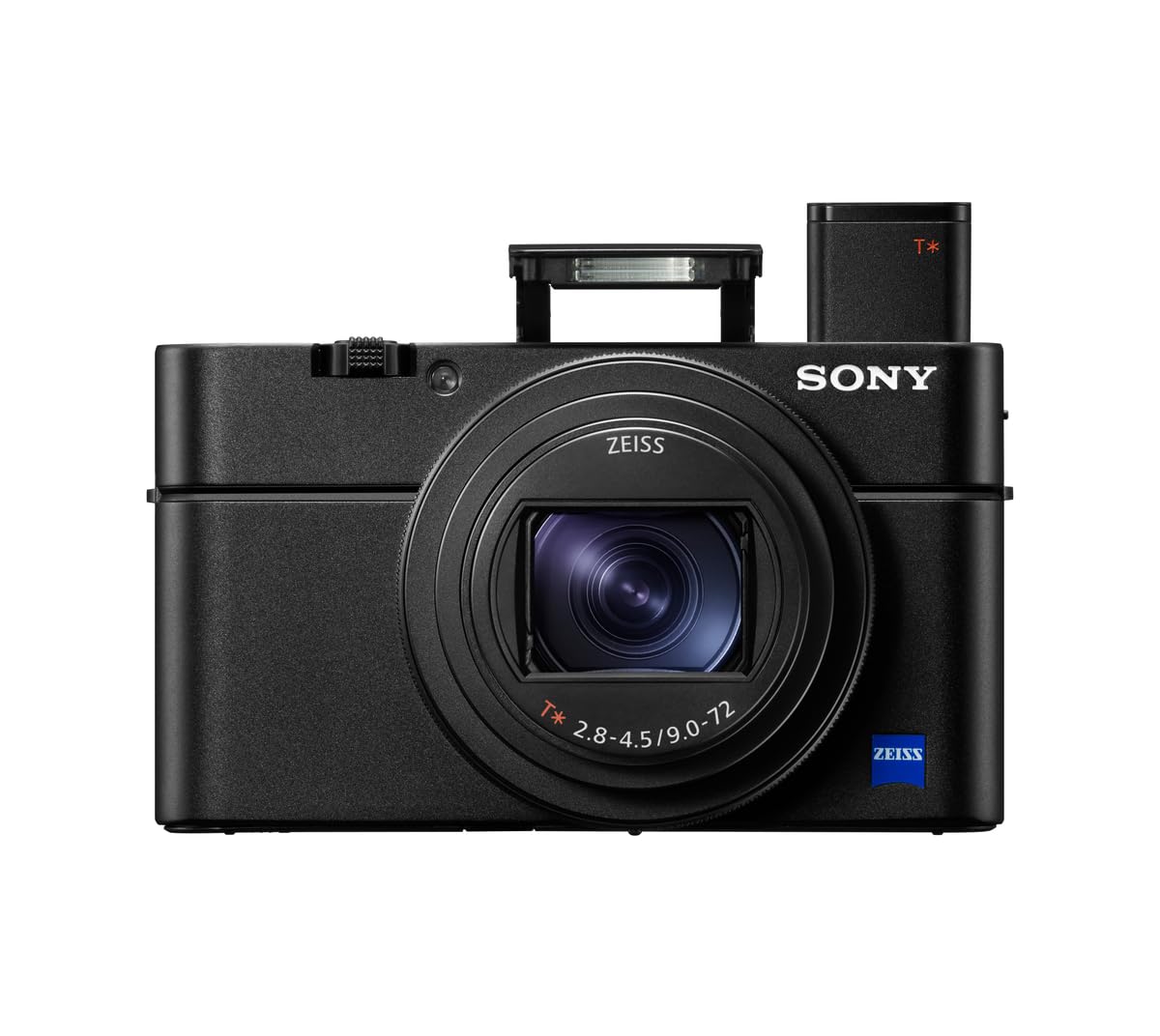
Twenty frames a second, blackout-free, with focus that grabs before your subject moves.
The RX100 VII is the speed specialist. A 20.1-megapixel 1.0-type stacked CMOS sensor (a light-catching chip built for fast readout) sits behind a Zeiss Vario-Sonnar lens covering 24-200mm at F2.8-F4.5, so you keep a genuine wide end while gaining real telephoto. Focus locks in 0.02 seconds using 357 phase-detection points plus 425 contrast-detection points (two autofocus systems working together), and it shoots up to 20 frames per second with blackout-free viewing — the screen never blanks out, so you can track the action the whole time.
Tracking is AI-based and works in real time for both stills and movies, with touch tracking on top. Eye AF follows human eyes in stills and video, and animal eyes in stills. Video specs run to 4K with S-Log3 (Sony’s flat colour profile for grading later), interval shooting, active-mode stabilization in 4K, and a microphone jack plus vertical position data recording. Aspect ratios cover 16:9, 3:2 and 4:3.
Image quality is the overwhelming favourite among buyers — stills and video both — with the compact size and portability following close behind. It travels in a purse or pocket and is well liked by travellers specifically. Autofocus earns steady praise for its speed and the visible improvement over earlier models. The wary notes are value and reliability, plus a steeper learning curve than the beginner-friendly picks; this is a camera with depth that rewards a bit of study. It is the choice for someone who shoots moving subjects and wants the same wide-to-telephoto flexibility in a body that fits a jacket pocket.
What it does better than anything here: 20fps blackout-free bursts with 0.02-second focus make it the one that catches the moment, not the aftermath.
What it costs you: more money, more menu depth, and no beginner hand-holding.
The right call for: action, kids, pets and events where focus speed is the deciding factor.
Second-guess it if: you want point-and-shoot simplicity — the interface asks you to learn it.
6. Canon PowerShot G7 X Mark III Digital Camera

An F1.8 opening at 24mm, which is the brightest wide setting on this entire list.
Aperture is the number that decides a dim-room photo, and this one opens to F1.8 at the wide end. Combined with optical image stabilization (a system inside the lens that counteracts hand shake), it lets in more light than the F2.8 compacts here, which means the difference between a grainy evening shot and a clean one. The lens runs 24-100mm equivalent with a 4.2x optical zoom, dropping to F2.8 at the telephoto end.
Autofocus uses phase detection across 99 points, versus 19 on the Panasonic ZS99. Aspect ratio is 3:2, bit depth is 10 Bit, and the battery is an NB-13L pack rated 3.6V at 1250mAh with an average life of 1 hour. That is a short session by design — this camera likes to be switched on for the shot, not left running.
The owner verdict here is short and warm: excellent quality, impressive image results, easy operation, and money well spent. There is no drama in the reviews, which is exactly what you want from a premium compact. Budget for a spare NB-13L to get past the 1-hour rating. What you are buying is a wide 24mm lens with the fastest aperture on this page and a 100mm end for portraits — a compact built for available-light shooting rather than marathon sessions.
The spec that sells it: F1.8 at 24mm is the widest, brightest opening here for evening streets and indoor shots.
The limit to plan around: one hour of average battery life means a spare pack is part of the kit.
Best match for: low-light shooters and portrait-takers who want a bright 24mm wide end plus some zoom.
Not aimed at: all-day shooters — one hour of battery sets the pace.
7. RICOH GR IV HDF Premium Compact Camera

A fixed 28mm prime that starts up in 0.6 seconds and glows highlights on purpose.
This one is for the shooter who wants a wide view and no decisions. The lens is a fixed 28mm F2.8 prime — no zoom at all — and that trade buys you a compact so small Ricoh calls it the smallest GR to date. Start-up takes 0.6 seconds, so it is ready the instant the moment appears. Image quality reaches ISO 204800 at the top end, and the lens is built for edge-to-edge sharpness rather than a soft centre with mushy corners.
The signature feature is the built-in Highlight Diffusion Filter (HDF). It softens bright areas for a dreamier, more expressive look with a sense of depth — a creative effect baked into the camera, not added later. Shake reduction is a 5-axis, 6-step stabilization system that fights hand shake for sharper frames. The battery is a high-capacity DB-120 rated for roughly 250 shots on a charge, and autofocus is a single contrast-detection point. Aspect ratio is 3:2 and bit depth is 12 Bit.
Understand what a single autofocus point means before you buy: this is a deliberate, considered camera, not a tracking machine for running children. The upside is a truly pocketable body with a sharp prime and a one-of-a-kind highlight effect. This is a specialist’s second camera or a street shooter’s only one — the sort of tool you carry because it disappears in a pocket and starts before your hand is level. It is priced as a premium niche product, and it earns that through portability and lens quality rather than zoom or autofocus breadth.
The draw, plainly
- Smallest body in this group, genuinely pocket-sized
- 28mm F2.8 prime with edge-to-edge sharpness
- 0.6-second start-up and 5-axis, 6-step shake reduction
- Built-in HDF for softer, more expressive highlights
Know before you commit
- Single autofocus point — not built to track movement
- Fixed 28mm lens, so no zoom and no wider than 28mm
- Premium pricing for a niche, single-purpose camera
Worth it to: street and travel shooters who value a pocket body, a sharp prime and instant start-up.
Wrong tool for: anyone who needs zoom or subject tracking — this is a fixed-lens, one-point-focus camera.
8. Kodak PIXPRO FZ55 Digital Camera

A 28mm wide starter kit that arrives ready to shoot, extras included.
For a first wide-angle camera, the FZ55 removes the shopping list. The box holds the camera, a rechargeable lithium-ion battery, USB cable, AC adapter, wrist strap, plus a 64GB high-speed card, a card reader, a memory wallet, a protective case, a tabletop tripod and a cleaning bundle. The lens starts at 28mm wide with 5x optical zoom, and a 16MP 1/2.3-inch CMOS sensor (a small, common compact chip) sits behind it. Video is Full HD 1080p at 30fps with digital image stabilization, and there is a built-in flash plus a panorama mode.
The 2.7-inch LCD handles framing, and the 18g battery is the lightest cell in this round-up, which keeps the whole package easy to carry. Bit depth is 12 Bit.
Sharp picture quality and simple operation are what buyers highlight, and the compact body travels easily. Reliability is the mixed note — a handful of owners mention a camera that stopped working soon after starting, which is a fit-note for careful handling rather than a reason to dismiss the line. The bundle is the real argument: everything you need to start shooting arrives in one box, so a beginner is not hunting for a memory card the night before a trip.
What makes it beginner-proof: a 64GB card, case, tripod and reader all in the box, plus 7 autofocus points for simpler aiming than the single-point FZ45.
The fair caveat: the 1/2.3-inch sensor is small, so dim-light shots will not match the 1-inch picks.
A smart start if: you want a wide-angle camera and every accessory in one purchase.
Step up instead if: indoor and evening shots are your main use — a bigger sensor will serve you better.
9. Kodak PIXPRO FZ45 Digital Camera

The lowest-cost way to get a real wide lens and a full kit in one box.
Everything about the FZ45 says entry point. A 27mm wide-angle lens starts the frame wider than most budget compacts, with 4x optical zoom behind it. The sensor is a 16MP chip (16 million pixels) recording 1080p Full HD video, shown on a 2.7-inch LCD, and the camera runs on two AA alkaline batteries included in the box — handy because you can buy replacements at any shop rather than charging. Autofocus is contrast detection with 1 point, and the aperture is a fixed F2.8. Aspect ratio is 4:3 and bit depth is 24 Bit (how finely colour is recorded), the highest figure on this list despite the lowest price.
The bundle carries the value: a 64GB high-speed card, card reader, memory card wallet, protective case, tabletop tripod, cleaning bundle, USB cable and wrist strap all arrive together. Picture quality is the standout for owners, with the compact size and ease of use following — this is a camera you hand to someone who has never used a dedicated one.
Two things to weigh honestly. The single autofocus point means moving subjects will not stay locked, and its 1 autofocus point sits against 425 on the Sony ZV-1F — a gap that shows up the moment anything moves. Functionality draws mixed notes, with some units proving trouble-free and others refusing to switch on from the start, and value splits opinion too. Buy it as a simple wide-angle point-and-shoot for still scenes, holidays and handing to a beginner, and it delivers exactly that.
Where the money goes: a 27mm wide lens plus a 64GB card, case, tripod and reader in one purchase.
The one real limit: 1 autofocus point versus 425 on the Sony ZV-1F, so moving subjects are a struggle.
Right for: a first camera, a gift, or a cheap wide shooter for holidays where AA batteries save the day.
Pass if: you film action or children — one focus point will let you down.
Know the Specs
Wide-End Focal Length (mm)
This is how much of the scene the lens pulls in, quoted in full-frame equivalent so cameras can be compared fairly. A smaller number is wider: 19mm and 20mm fit whole rooms and arm’s-length selfies, while 27mm and 28mm stay wide but leave a little out. Choose your number by what you shoot. Tight interiors and solo filming want the 19-20mm range; travel and everyday shots are comfortable from 24-28mm.
Sensor Size vs Megapixels
A sensor is the chip that captures light, and its physical size matters more than the megapixel count. A 1-inch sensor or a 1.0-type sensor collects more light than a 1/2.3-inch chip, so dim scenes stay cleaner and backgrounds blur more easily. Megapixels mostly set how large you can print. When two cameras share a similar megapixel figure, the bigger sensor is usually the better buy for real-world shots.
Autofocus Points and Technology
Autofocus points are the focus zones spread across the frame. A single point means the camera focuses on one small area and will not follow a moving subject; hundreds of points let it track a face as it moves. Phase detection tends to be faster at locking onto movement than contrast detection. If you photograph people or pets, point count and phase detection are worth more than a longer zoom.
Aperture (F-Number)
The F-number describes how wide the lens opening is. A smaller number is a bigger opening: F1.8 or F2 lets more light in than F2.8 or F3.3, which helps indoors and at dusk. It also shrinks the sharp zone so a background softens behind your subject. A camera that opens to F2.8 across its zoom range is more flexible in dim light than one that only gets there at the wide end.
Common Questions
Is a 20mm lens too wide for everyday photos?
What is the difference between optical zoom and digital zoom?
Do I need a 1-inch sensor in a wide-angle compact?
Will a wide-angle point-and-shoot work for filming myself?
Can I use AA batteries if I do not want to charge the camera?
How many autofocus points do I need for moving subjects?
Is a fixed prime lens better than a zoom for wide shots?
What does the bit-depth figure mean on these compacts?
Can I transfer photos from the camera to my phone?
How long does the battery last on these cameras?
The Bottom Line
For most people shopping for the wide-angle point-and-shoot camera, the Sony ZV-1F is the safest buy — its 20mm lens gets everything in frame, the 1-inch sensor keeps evening shots clean, and 425 autofocus points handle movement that a single-point compact simply cannot. If your priority is filming yourself, take the Canon PowerShot V10 for its 19mm lens, folding stand and front-facing screen. And if you cannot choose between a wide scene and a distant subject, the Panasonic LUMIX TZ/ZS99 stretches from 24mm to 720mm in one pocket body. One honest nudge before you decide: the ZV-1F is the crowd favourite here at 4.5+ stars across 1,700+ ratings, the strongest review signal on this page. Whichever you pick, check the wide end first — it is the one number that decides whether the shot fits.
How we choose
We do not accept paid placement. Every pick is matched to a real buyer and a real use-case; we do not hands-on test units.
Sources
Specifications: manufacturer listings and product documentation. Review insights: verified customer reviews, as of November 2026. Pricing: not shown on this page (it changes often); check the current price via the retailer link.
As an Amazon Associate, Tactical Gear Guy earns from qualifying purchases. This does not affect which products we feature.