Specs are compiled from manufacturer listings and verified buyer reviews and can change over time — please confirm the key details on the product page before buying.
Buying the wrong wide lens for your Canon costs you twice — once on glass you cannot mount, and again on framelines you keep cropping back to. Settle your mount first: EF lenses fit Canon’s DSLRs and adapt to EOS R bodies, while RF lenses only work on the mirrorless R series. Then decide how wide you truly need, if you want f/2.8 or can live at f/4, and how much weight you will carry up a trail.
This guide is built by comparing the manufacturers’ published specifications and the patterns across verified customer reviews, so you get each pick’s real strengths and trade-offs instead of marketing spin.
Below you will find eleven lenses sorted by what they do best, from a do-it-all zoom to a specialist ultra-wide prime. My picks factor in mount compatibility, aperture, stabilization, and real owner experience to bring you the best wide-angle lens for Canon.
Top Picks


How To Choose The Best Wide-Angle Lens for Canon
A wide-angle lens packs more of the scene into your frame than a standard lens. That makes it the tool for wide landscapes, cramped interiors, and foregrounds that stretch toward the edges. Before you buy, the mount is the first gate and the widest focal length you actually need is the second. Aperture speed, zoom versus prime, stabilization, and weight are trade-offs you tune to how you shoot.
Mount first: EF versus RF
Canon EF lenses are built for the older DSLR mount and will also work on EOS R mirrorless cameras with an adapter. Canon RF lenses are mirrorless-only and will not mount on a DSLR. If you own an EOS R body, RF glass is native and saves you an adapter step; if you shoot a DSLR, your shortlist is EF only. Settling the mount cuts your shortlist in half before you compare a single spec.
How wide do you need to go
Focal length in millimeters measures the lens’s angle of view — smaller numbers see more scene. An 11mm to 14mm lens captures vast skies and cramped rooms; a 16mm to 35mm zoom covers that ultra-wide punch and also the normal wide angle you will use for street and event work. If you rarely need the extreme, a zoom starting at 15mm or 16mm covers more usable framings per lens. Architecture and astro shooters want the widest view they can get and accept the distortion that comes with it.
Aperture, stabilization, and close focus
A faster aperture (f/2.8) lets in more light for night skies and dim interiors. A constant f/4 keeps size and weight down, and paired with image stabilization it lets you shoot slower shutter speeds handheld. Close-focus distance tells you how near a subject you can get to exaggerate foreground scale — smaller numbers let you fill the frame with a rock or leaf.
Side-by-Side Comparison
| Model | Best For | Mount | Focal Length | Aperture / Stabilization | Amazon |
|---|---|---|---|---|---|
| Canon EF 16-35mm f/4L IS USM | All-round performer | EF | 16-35mm | f/4, up to 4 stops IS | Amazon |
| Rokinon 14mm f/2.8 Series II | Manual-focus astro & interiors | EF | 14mm | f/2.8, no IS | Amazon |
| Brightin Star 12mm F2.8 | Ultra-wide RF landscapes | RF | 12mm | f/2.8, no IS | Amazon |
| Sigma 10-18mm F2.8 DC DN | Compact APS-C zoom | RF | 10-18mm | f/2.8, no IS | Amazon |
| Canon EF 17-40mm f/4L USM | Budget L-series walkaround | EF | 17-40mm | f/4, no IS | Amazon |
| Tamron SP 15-30mm f/2.8 Di VC USD | Fast EF astro & night | EF | 15-30mm | f/2.8, optical VC | Amazon |
Detailed Reviews
1. Canon EF 16-35mm f/4L is USM Lens
The do-it-all L-series that covers the whole wide range without a wobble.
Here is the lens most Canon full-frame shooters end up buying and keeping: a 16-35mm zoom with a constant f/4 aperture. That range starts wide enough for dramatic foregrounds and ends wide-normal enough for event and street work — one lens on the body for a whole day. The f/4 maximum aperture is the same at 16mm and 35mm, so your exposure instinct never changes as you zoom.
The stabilization is the part that earns its price on gray afternoons. Canon rates the optical image stabilizer for up to four stops of shake correction, which means slower handheld shutter speeds stay sharp in dim light without dragging a tripod along. Add ring-type USM autofocus and full-time manual focus, and you can fine-tune the plane of focus by turning the ring even while the lens is in AF mode. Close focus hits 0.28m, so you can get near a foreground rock or a leaf and let it tower into the frame.
Optically it uses 2 UD (ultra-low dispersion) elements plus 3 aspherical elements, and a rounded 9-blade circular iris that keeps out-of-focus highlights round rather than polygonal. The customer consensus is exactly what you would hope: sharp edge to edge even wide open, distortion held in check, and strong low-light behavior for an f/4 zoom.
The case for it
- Constant f/4 across the full 16-35mm range
- Up to four stops of optical stabilization for handheld low light
- Edge-to-edge sharpness wide open, per owner consensus
- 0.28m close focus pulls foregrounds forward
- Full-time manual focus works while AF is engaged
Where it gives ground
- At 615 g it is a body-and-a-half compared with the 165 g RF 16mm
- The f/4 aperture is a stop slower than the f/2.8 primes here for astro
- EF mount, so EOS R shooters need an adapter to run it
Top of the shortlist: Full-frame DSLR shooters who want one wide zoom that handles landscape, interiors, and events without swapping glass.
The honest catch: If your nights are spent chasing the Milky Way, a fast f/2.8 prime will gather more light than this f/4 zoom.
2. Canon RF 16mm f2.8 STM Lens
The pocketable ultra-wide you forget is in the bag until the scene needs it.
Weighing 165 g, this is Canon’s first ultra-wide fixed focal length RF lens, and its whole personality is compact. Toss it in a jacket pocket next to a standard zoom and it barely registers — the ideal second lens for a travel bag or a hike where every gram counts. At 16mm on full frame you get a genuinely expansive view of a canyon, a lobby, or a skyline.
The f/2.8 maximum aperture is bright for a lens this small, so dim interiors and evening streets stay usable without pushing ISO into noise. A re hiking uphill.
Fourteen elements in ten groups go into the optical design, including ED, HR, ASP, and Hybrid-ASP glass plus Ultra Multi-Coating to cut flare and distortion. A de-click switch on the aperture ring lets you change exposure silently while filming, so a video take is not punctuated by clicks. The focus is manual only, so this lens rewards a methodical shooter who likes setting focus by hand.
Where it asks patience is infinity focus. The consensus is that quality is solid, but infinity focus performance is the recurring inconsistency — so plan to test and fine-tune your technique on stars rather than trust the hard stop. If you want autofocus and point-and-shoot simplicity, this is the wrong tool; for a deliberate astro or interior shooter, the wide, bright manual prime is exactly the point.
Made for the dark: The f/2.8 aperture and 115.7° view pull in big skies; the de-click switch keeps video exposure changes silent.
The focus caveat: Manual focus only, and infinity focus needs dialing in per your own technique and body.
Best for: Astro and interior shooters happy to focus by hand and want maximum field of view on an EF body.
Skip if: You want autofocus and rely on an infinity hard stop to be dead accurate.
3. Canon EFS 10-22mm f/3.5-4.5 USM Lens Bundle

The wide zoom that finally makes an APS-C Canon body feel wide.
Designed for Canon’s EF-S mount, this 10-22mm zoom is the answer for crop-sensor DSLR shooters whose kit lens never felt wide enough. Thatneed in a single exposure. The optical build is serious for the price: fifteen elements in eleven groups, including two aspherical, two high-refractive-index, and two ED (extra-low dispersion) lenses. The result, by the maker’s design, is near-zero distortion that keeps building lines and room geometry straight.
F2.8 keeps it usable after dark and under dim ceilings, and at 1.2 lbs it carries about like a full water bottle — the kind of weight you will not resent on a walk-around. It is a manual-focus prime, so you set focus yourself and compose by moving; that is the trade for that extreme field of view at this price. On the plus side, the focal length is fixed and short, so depth of field is forgiving even when focusing by hand.
Owners are happy with the glass — the lens quality is what wins people over, with image sharpness a close second. Where opinion splits is value: some feel the ratio earns top marks, others find it on the pricier side for a manual lens. The takeaway is that you are paying for that 122.5° sweep and the optical stack, not for autofocus convenience.
The draw: A 122.5° manual prime with a 15-element optical design that holds architecture lines straight.
Set expectations: Manual focus only and no stabilization — this is a deliberate shooter’s lens.
Pick this when: You want the widest possible RF-mount prime and are comfortable focusing by hand.
Consider the RF 16mm instead if: You want autofocus and a lighter walk-around in the same bag.
4. Canon RF15-30mm F4.5-6.3 is STM Lens

A fast constant-aperture zoom that keeps APS-C mirrorless kits genuinely small.
Sigma bills this as the smallest and lightest F2.8 wide-angle zoom for APS-C mirrorless, and the constant F2.8 aperture holds across the whole 10-18mm range. That means the same light-gathering at 10mm as at 18mm, so you can zoom without rethinking your exposure. The dust and splash-resistant mount adds a measure of weather confidence for landscapes and travel.
It is built for Canon RF mount cameras, and the stepping motor keeps focus smooth and quiet for video. In the real world it earns its keep in real estate and interiors, where sharp photos and a wide view matter most. What wins people over is the lens quality, with image sharpness close behind and the lightweight design a consistent point of praise.
The mixed part is autofocus and stabilization: there is no image stabilization here, and autofocus draws a split reaction — some sing its praises while others note the absence of IS. On a body with in-body stabilization that gap closes. For an APS-C R shooter who wants a fast, compact zoom, this is a strong fit; for full-frame shooters it is not the lens.
The fast, small recipe: Constant F2.8 across 10-18mm in a body Sigma calls the smallest and lightest of its kind for APS-C mirrorless.
The honest gap: No optical stabilization, so slower handheld shots lean on in-body IBIS or good technique.
Ideal for: APS-C RF shooters doing real estate, travel, or vlogging who want a fast constant-aperture zoom.
Look past it if: You shoot full frame or demand built-in stabilization.
5. Canon EF 17-40mm f/4L USM Ultra Wide Angle Zoom

The L-series walkaround that proves an ultra-wide does not have to be exotic.
Full-frame shooters who want a weather-resistant L-series ultra-wide hear a lot about this lens, and for good reason: it balances range, build, and price in a way few wide zooms do. The 17-40mm focal range covers a diagonal angle of view from 104° down to 57° 30′, so you get the dramatic wide sweep and a tighter, more natural wide framing in one turn of the zoom ring. At 500 g it is light enough to live on the body all day.
Inside, three aspherical lens elements plus a Super UD glass element handle distortion and color, and a seven-blade rounded diaphragm keeps out-of-focus areas pleasing. Ring-type USM autofocus is fast and near-silent, and the lens accepts 77mm screw-in filters or up to three gel filters — handy for polarizers and ND on a landscape shoot. Focus gets as close as 11 inches, and the weather-resistant construction shrugs off light dust and moisture.
The nuance is at the edges: some shooters notice chromatic aberration and edge distortion at the widest settings, while others praise the wide-angle range and landscape results outright. The owner base is large and largely enthusiastic, which tells you the lens holds up in daily use. It is a strong all-rounder if you value reach, weather sealing, and a modest carry weight over an absolute edge-to-edge perfection.
Where it earns the L badge
- 17-40mm range takes you from ultra-wide to natural wide
- Weather-resistant build with dust and moisture resistance
- Fast, near-silent ring USM autofocus
- 77mm filter thread for polarizers and ND
- 500 g keeps it comfortable as a daily carry
What to weigh against it
- Chromatic aberration and edge distortion show at the widest settings
- No optical stabilization in the lens
- EF mount, so RF shooters need an adapter
Great choice: Full-frame DSLR shooters who want a weather-sealed wide zoom for landscape and everyday carry.
Think twice if: You shoot edge-critical commercial work where corner sharpness must be flawless wide open.
6. Tamron SP 15-30mm f/2.8 Di VC USD Wide-Angle Lens
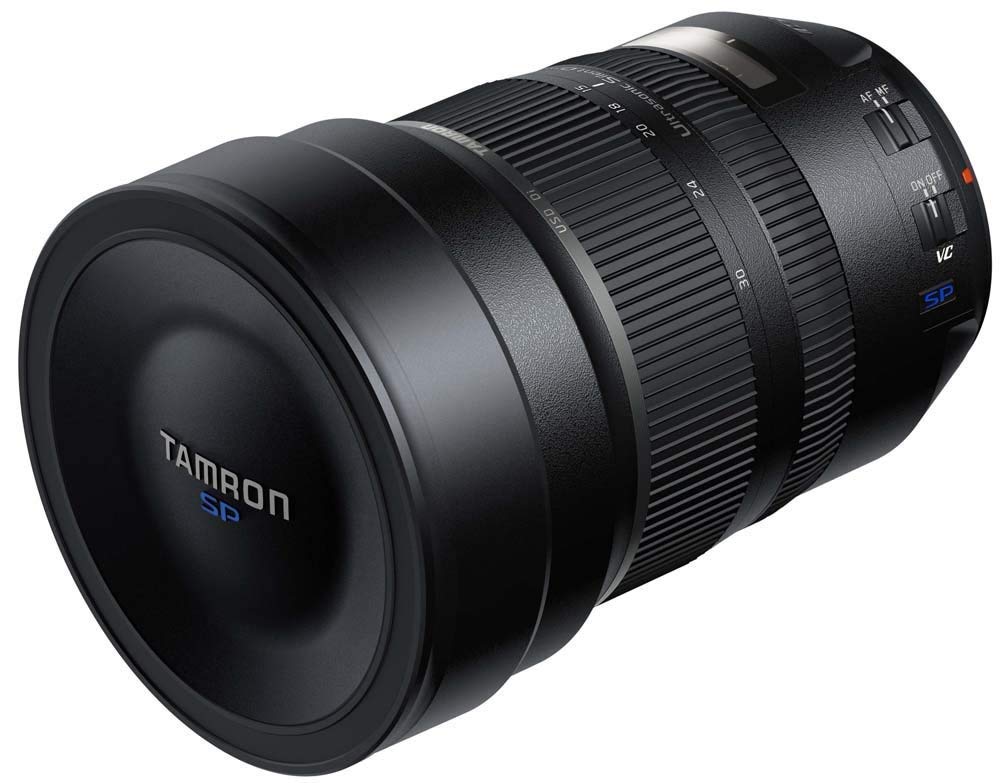
A fast f/2.8 zoom that eats the dark and pays for itself by sunrise.
A constant f/2.8 maximum aperture across 15-30mm is the headline here, and it is what makes this lens stand out for night and astro work. That wide aperture gathers light quickly, so you can shoot star fields and dim interiors with lower ISO and shorter exposures. Vibration Compensation adds shake correction for handheld shots, and the USD ultrasonic motor focuses quickly and quietly.
The optical design finishes with a fluorine coating on the front element to help shed moisture and smudges, and a 9-blade round aperture keeps bokeh smooth. Minimum focus distance is 11 inches, so foregrounds stay in reach. For full-frame Canon DSLRs, it covers demanding wide interiors and landscapes with an f/2.8 that stays constant through the zoom.
The clear catch is bulk. This lens is large and heavy at 2.5 pounds, and owners notice both the weight and the size in hand. Photographers who work from a tripod or drive between locations will not mind the heft, because the fast aperture and image quality justify it. If you backpack long distances, the weight will make itself known.
The bright, fast appeal: F/2.8 all the way through 15-30mm plus Vibration Compensation makes night work far easier.
The heft you carry: At 2.5 pounds, this is a tripod-friendly lens, not a featherweight walkaround.
Made for: Night and astro shooters on Canon full-frame DSLRs who want speed and stabilization in a zoom.
Not ideal if: You are counting ounces on a long hike — the 2.5-pound body is a commitment.
7. Canon RF14-35mm F4 L is USM Lens
Aperture and image stabilization
Aperture is the size of the hole the light passes through, written as an f-number — a smaller number (f/2.8) lets in more light than f/4. For night skies and dim rooms, f/2.8 gives you faster shutter speeds and lower ISO. Image stabilization corrects the shake of your own hands, letting you shoot slower shutter speeds without a tripod; Canon rates some lenses in “stops” of correction, where more stops means more leeway. Fast aperture helps with moving subjects, while stabilization helps with still ones.
Common Questions
Will a Canon EF lens fit my EOS R mirrorless camera?
What is the difference between EF and EF-S lenses?
Is f/2.8 better than f/4 for astrophotography?
Do I need image stabilization on a wide-angle lens?
Can I use an RF lens on a Canon DSLR?
How wide is wide enough for interior real estate photos?
What does close-focus distance mean on a wide lens?
Is a prime or a zoom better for wide-angle work?
Will a full-frame wide lens work on my APS-C Canon body?
How much does lens weight matter for handheld landscape shooting?
The Bottom Line
For most full-frame Canon shooters, the wide-angle lens for canon winner is the Canon EF 16-35mm f/4L IS USM. It covers the whole wide range with a constant f/4 aperture and up to four stops of stabilization (shake correction), so one lens handles landscape, interiors, and events. If you shoot EOS R and want to keep the bag light, grab the Canon RF 16mm f2.8 STM. And for architecture or star fields where you need the widest view or a fast aperture, reach for the Canon EF 11-24mm f/4L USM or the Tamron SP 15-30mm f/2.8.
How we choose
We do not accept paid placement. Every pick is matched to a real buyer and a real use-case; we do not hands-on test units.
Sources
Specifications: manufacturer listings and product documentation. Review insights: verified customer reviews, as of November 2026. Pricing: not shown on this page (it changes often); check the current price via the retailer link.
As an Amazon Associate, Tactical Gear Guy earns from qualifying purchases. This does not affect which products we feature.