Specs are compiled from manufacturer listings and verified buyer reviews and can change over time — please confirm the key details on the product page before buying.
You want free local TV without a monthly bill, but the antenna you tape to a window pulls in nothing or drops out every time a cloud rolls past. Two things decide whether you get channels: how far you sit from the broadcast towers, and how much cable the antenna gives you to reach a spot with better reception. Get those two right and free HD channels appear over the air; get them wrong and the antenna pulls nothing.
This guide is built by comparing the manufacturers’ published specifications and the patterns across verified customer reviews, so you get each pick’s real strengths and trade-offs instead of marketing spin.
Below you will find indoor and outdoor picks sorted by range, cable length and build, with the honest catches spelled out. The short version: match the antenna’s mile rating to your distance from the towers and buy a wi-fi tv antenna with enough coax to reach your best window before you commit.
Top Picks
How To Choose The Best TV Antenna
The fastest way to waste money here is to buy the antenna with the biggest mile number on the box. Range claims are optimistic, and what actually decides your channel count is your distance from the broadcast towers, the terrain in between, and where you can physically put the antenna. Work those three out first and the shopping gets simple.
Start with your distance to the towers, not the marketing number
Look up the transmitters near you and measure roughly how far away they sit. An antenna rated for 35 miles is designed for urban and suburban setups where obstructions and interference are part of the picture. An antenna rated to 50 miles gives you more headroom if you live further out or your signal has to push through walls. Buying more range than you need is fine; buying less is the mistake that sends people back to the store.
Cable length decides where the antenna can live
The coax cable is the leash on your antenna. A 13 ft cable keeps it close to the TV, which is fine if your best window is in the same room. A 33 ft cable lets you move the antenna to a balcony, attic or a different wall entirely to chase a cleaner signal. Measure the run before you buy, because the best antenna in the wrong corner still misses channels.
Indoor placement versus an outdoor mount
Indoor antennas are flat panels or small stands that sit on a shelf, wall or window. They are easy and neat, but a wall or a metal roof can eat your signal. Outdoor and attic mounting clears those obstructions and usually picks up more channels, at the cost of a cable run and a bracket. If your indoor attempt comes up short, the fix is often moving the antenna higher rather than buying a new one.
Amplified or passive, and why it matters
An amplified antenna runs the signal through a booster chip, which helps when you are far from the towers and the signal arrives weak. A passive antenna has no booster and works well in areas with a strong signal already. Amplification can backfire in strong-signal areas by overloading the tuner, so match the antenna to your conditions and rescan channels after every move.
Side-by-Side Comparison
| Model | Best For | Max Range | Coax Cable | Channels | Amazon |
|---|---|---|---|---|---|
| NEOSIGN TV Antenna for Smart TV Indoor★ Best Overall | Best overall for most homes | — | 13 ft | — | Amazon |
| RCA Amplified Indoor Flat HDTV AntennaBest Flat Design | Flat wall or shelf placement | 40 miles | 15 ft | 82 | Amazon |
| CXYHMG Indoor TV Antenna with Magnetic Base | Magnetic mounting on metal surfaces | — | 16.5 ft | 68 | Amazon |
| Philips Hover Amplified HD TV Antenna | Clean top-of-TV mounting | 50 miles | — | 100 | Amazon |
| A8cyc8R 33FT Cable Indoor Antenna | RVs, camping and long cable runs | — | 33 ft | — | Amazon |
| Channel Master FLATenna | Reliable flat indoor reception | 35 miles | 12 ft | 999 | Amazon |
| Channel Master Omni+ 50 | Outdoor, attic and RV mounting | 50 miles | — | — | Amazon |
Detailed Reviews
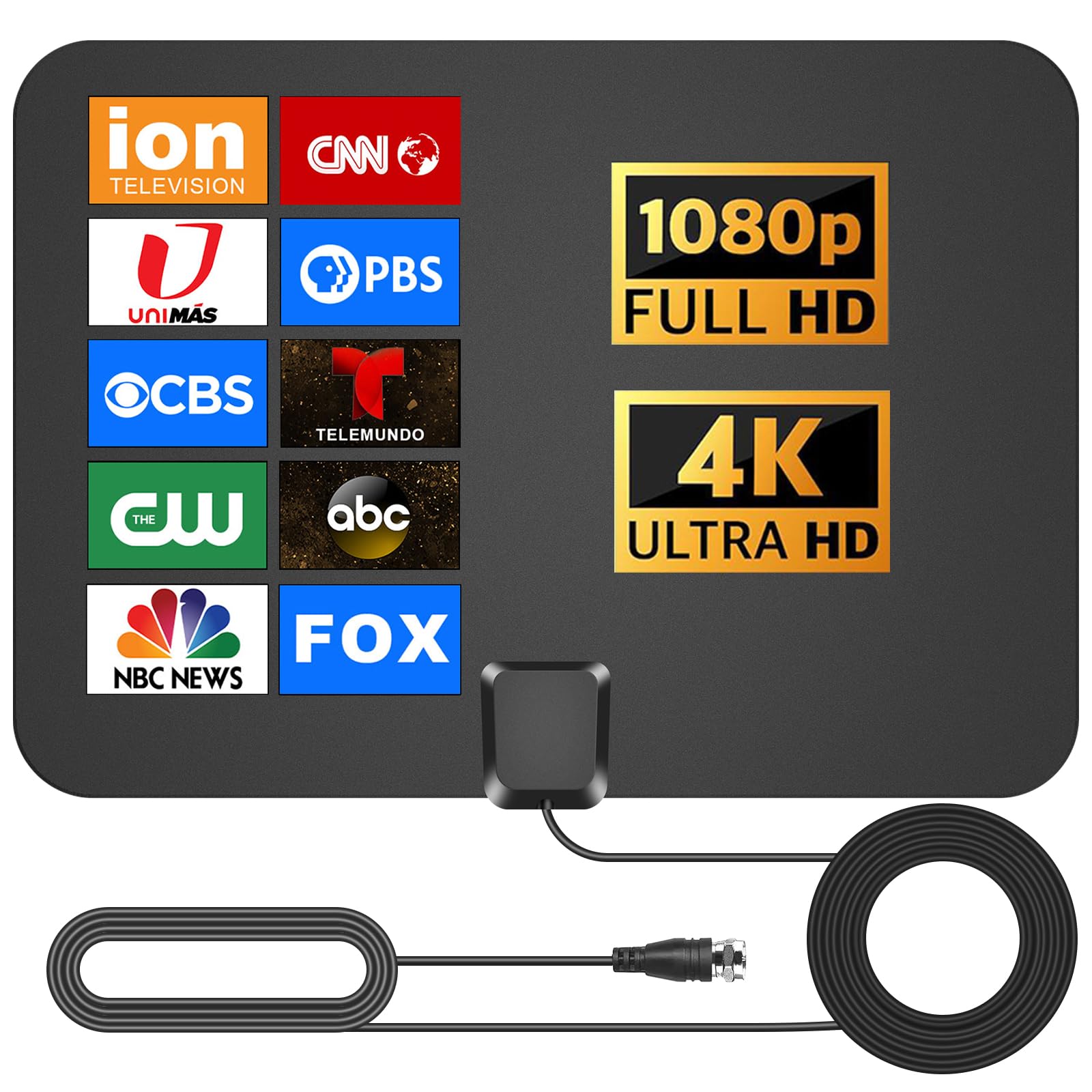
1. NEOSIGN TV Antenna for Local Channels, Indoor/Outdoor -Black
Our pick — 4.5+★ from 14,000+ verified ratings; the strongest balance of quality and price.
A passive indoor/outdoor antenna with 13 ft of thick coax and 360° pickup that needs no aiming.
This one earns the top spot because it is the easiest to trust for a first-time cord cutter. It handles both indoor and outdoor placement, so you are not locked to a window ledge if the first spot is weak. The 13 ft coaxial cable is thick and shielded, which keeps the 4K signal stable over the run rather than dropping bits in the middle.
Setup is deliberately simple: plug it into the TV’s CABLE-ANT IN port, switch the TV to AIR mode, and run the channel search. It receives from all directions, so you are not aiming it like a rooftop rig. That is why the quality of the build and the ease of installation are the two things that win people over most, followed closely by how sturdy it feels in the hand.
The honest catch is on the box itself: this is a passive receiver, meaning it pulls in whatever signal is already in the air and does no boosting of its own. If you sit far from the towers, check what is available in your area before you buy. It is the simplest all-rounder here: plug in, scan, and leave it alone.
What Makes It the Default Pick
- Works indoors or outdoors, so one antenna covers both attempts
- 13 ft thick coax gives you real placement freedom
- 360° reception means no aiming or fine-tuning
- Full HD and 4K support with ABC, CBS, NBC, PBS and Fox reception
What to Know Before You Buy
- Passive design, so it needs decent local signal to shine
- Rescanning is required every time you move it
- No amplifier to rescue a truly weak pocket
Strongest starting point: Reach for this if you want one antenna that can try indoors first and go outside if needed.
Look elsewhere if: you live in a fringe signal area and need an amplified booster built in.
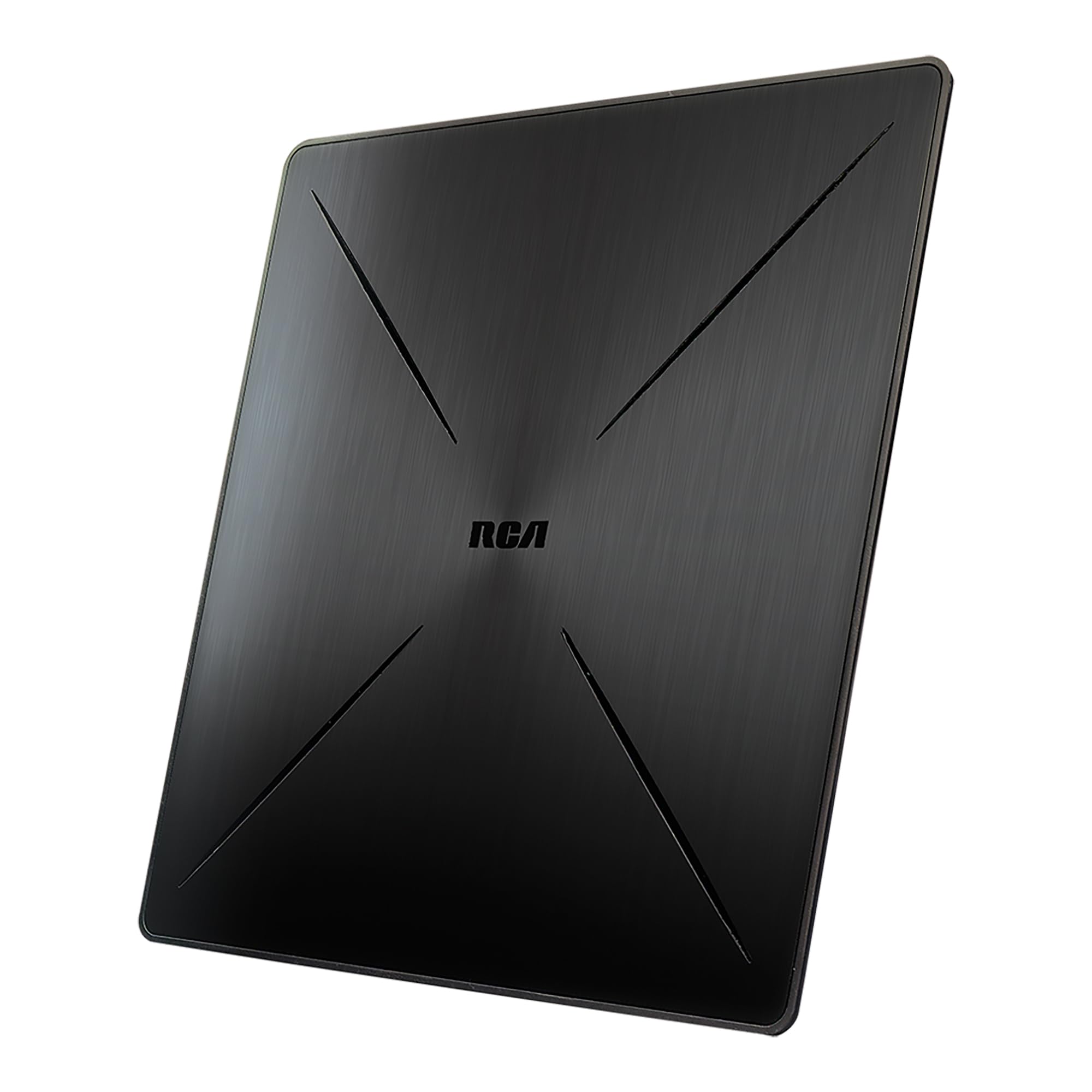
2. RCA Amplified Indoor Flat HDTV Antenna – ANT1360E
A paintable flat panel that hides on a wall and still chases channels up to 40 miles out.
If the look of an antenna matters to you, this is the one to own. The flat profile is paintable, and the package includes a built-in easel stand so it can sit on a shelf, lay flat, or hang on a wall. The reach is rated at 40 miles, which places it clearly below the Philips Hover’s 50-mile claim but is a sensible match for most suburban setups.
What sells it is the dual-stage amplification with Auto Gain Control. That chipset automatically adjusts how hard the booster works, so a weaker signal gets a lift and a stronger one does not get flooded. It handles both UHF and VHF broadcasts, which matters because some local channels live on VHF. The channel count is set at 82, and the package includes a 15 ft coax cable, the amplifier, and a 3-inch USB power cable with adapter.
The recurring gripe is that building and terrain interference can still get in the way, so like every antenna here it is a placement game. Set it near a window, run the scan, and give it a real chance before you judge it. A paintable flat panel that hides on a wall is worth a few minutes of window-hunting.
Where it shines: The flat, paintable body means the antenna disappears into your room instead of becoming the centerpiece. For people who care about a clean TV wall, that is the deciding feature.
The move to make: Pair it with a streaming player and a rescan when you move it — it is built to be a dependable backup when storms take the cable out.
Best for hidden setups: pick it if you want a flat panel that vanishes on a wall and reaches about 40 miles.
Not the choice if: you need long-range outdoor reach beyond what 40 miles covers.
3. CXYHMG Indoor TV Antenna for Local Channel, Magnetic Base
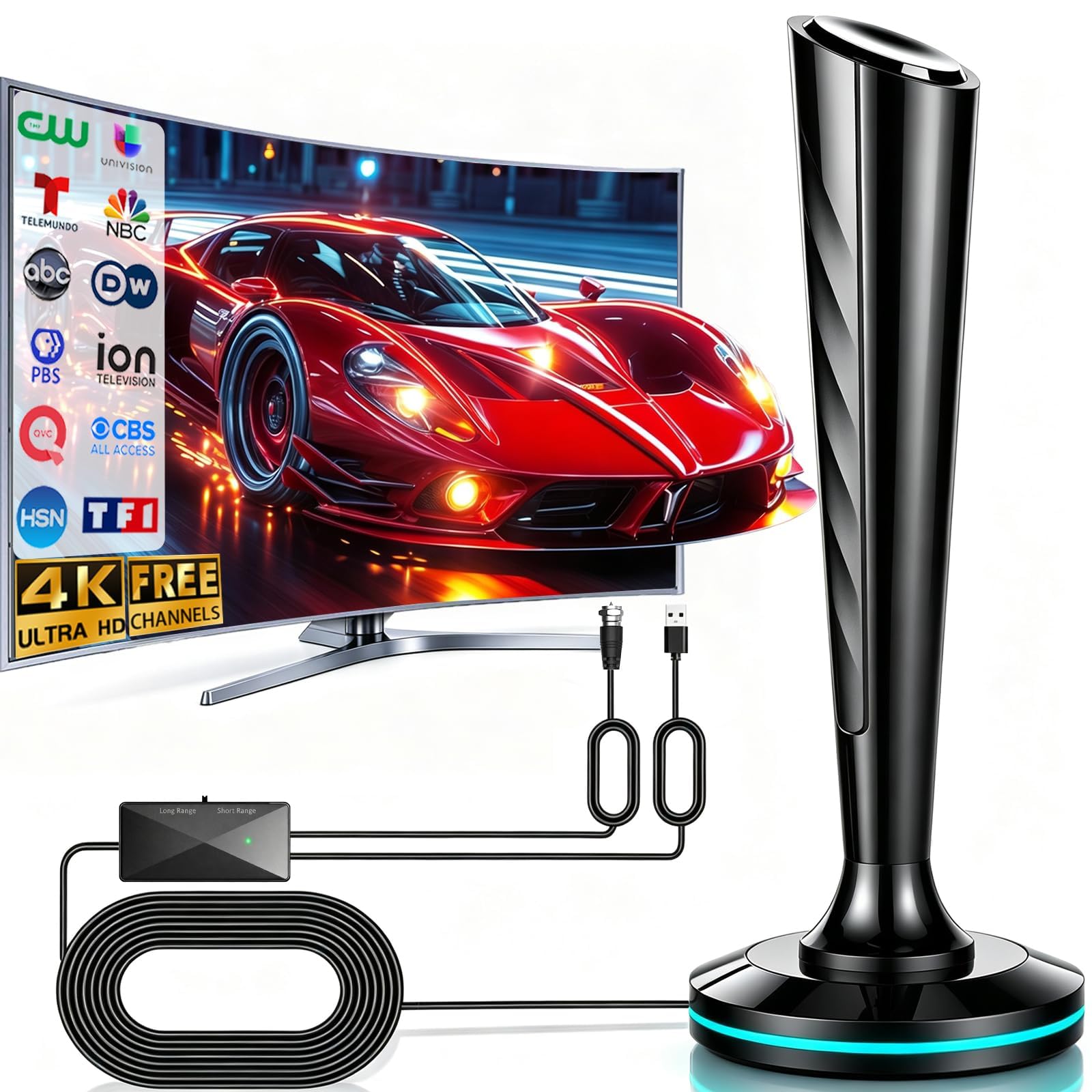
A compact antenna that clings to any metal surface and tunes out cell and FM noise.
This is the pick for anyone whose TV sits near a metal cabinet, shelf or rack. The magnetic base sticks to any iron surface, so you can get the antenna up off a table and closer to a window with almost no fuss. The full unit is compact — 2.75″L x 2.75″W x 8.27″H — so it barely takes up room, and the 16.5 ft cable gives you a decent run from the TV.
The chipset inside is designed to filter out cellular and FM interference, which is a real advantage in apartments where mobile signals crowd the airwaves. It works in 360 degrees and covers 68 channels, and the maker lists support for 2K, 4K and 1080p TVs. There is also a magnetic-base build that makes it easy to move around until the scan finds a good spot.
The candid part: reception quality is genuinely hit or miss depending on where you live, and the brand itself tells you to check your local channel map before you buy. That is how passive antennas work — placement and distance decide the channel count. Move the magnetic base between a few metal surfaces and rescan before you judge it.
The honest read: Indoor range and mounting flexibility are the selling points, not raw channel counts. The magnetic base is a genuinely useful idea for setting up near metal furniture.
Worth a look when: your reception spot is a metal surface and you want a small, moveable antenna with 16.5 ft of cable.
Think twice if: you already know your place has weak signal — this one benefits most from being close to a window.
4. Philips Hover Amplified HD TV Antenna

The antenna that perches on your TV’s top edge and reaches up to 50 miles out.
Here is the pick for people who hate the look of a flat panel on a wall. The Hover is built to sit on top of a flat-screen TV, which keeps the room tidy while raising the antenna above furniture for a cleaner path to the towers. At 18.98″L x 2.9″W x 4.7″H, it is a long, low bar that runs across the TV’s top edge rather than dangling off it.
Inside is Philips TruAmp Technology with a built-in amplifier, plus a 4G/5G LTE filter designed to cut cell-signal interference. The listed reach is up to 50 miles, which is 10 miles further than the RCA flat panel’s 40-mile claim, and it supports VHF and UHF broadcasts up to 100 channels. It is also NextGen TV compatible for ATSC 3.0 broadcasts where available, and ready for 4K and 8K resolutions.
What buyers value most is how easy it is to mount and how tidy it looks sitting on the TV. If a wall-mounted TV is your setup, the bracket can be repositioned or removed so the antenna lies flat on a surface instead. The one honest caveat is that 50 miles is a best-case figure with a clear path to the tower; obstructions will trim your results.
Why It Earns Its Spot
- Top-of-TV mount keeps the antenna out of sight
- 50-mile range with a built-in amplifier and LTE filter
- NextGen TV ready for ATSC 3.0 signals
- Bracket can be removed for flat-surface placement
Who Might Pass
- Not for you if the TV has no free top edge
- 50 miles is a claim, not a guarantee
- Range takes a hit behind heavy walls
Choose this if: you want the antenna to ride on top of the TV and stretch toward longer-range signals.
Pass if: your TV is wall-mounted so tight there is no clear flat edge to sit the bracket on.
5. A8cyc8R 2026 TV Antenna Indoor, 33FT Cable
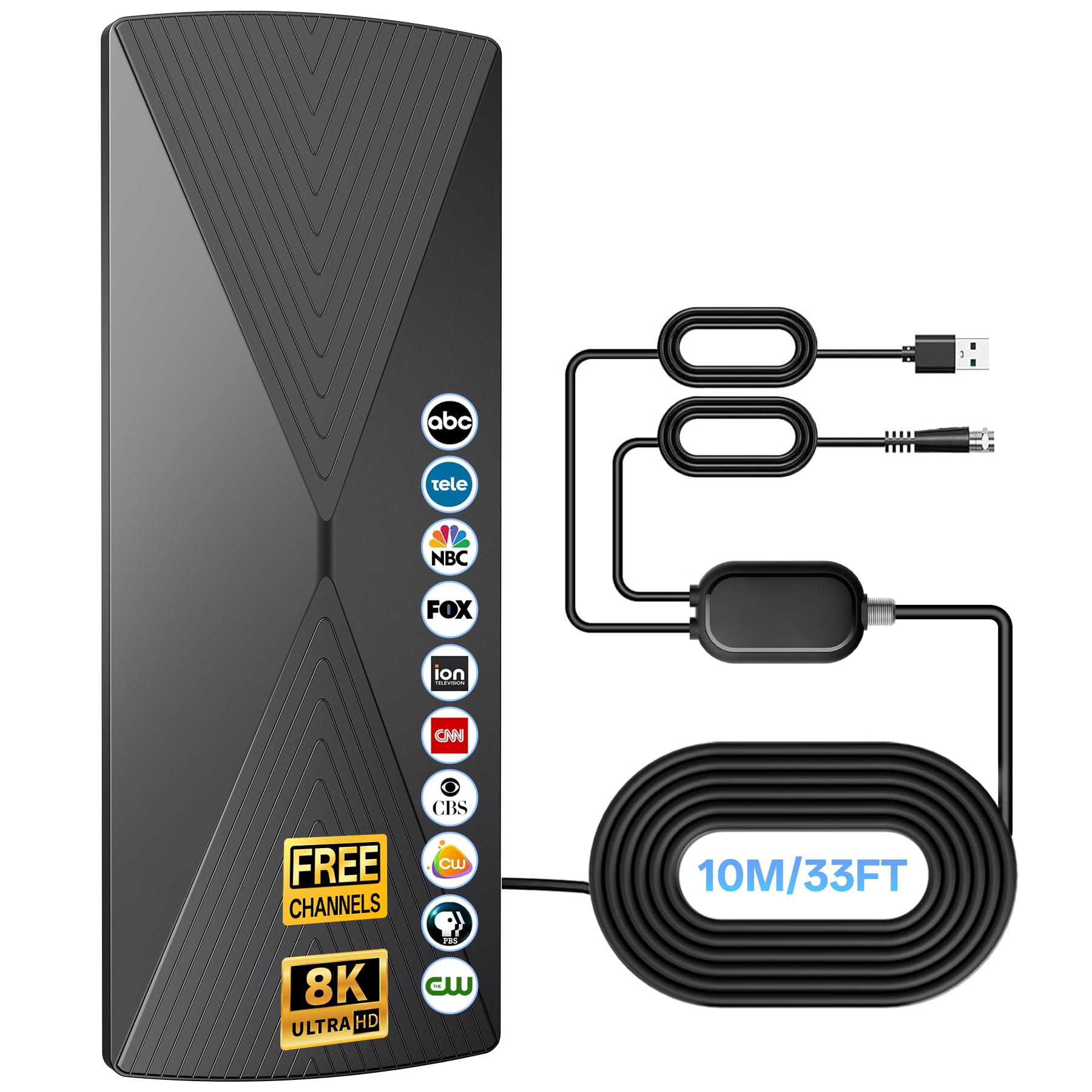
The long-cable traveler that packs light and finds signal from a balcony or campsite.
Two features here make it the obvious fit for RV owners, campers and short-term renters. The first is the 33 ft thickened coax, which is more than double the RCA’s 15 ft cable. That extra length lets you plant the antenna on a balcony, windowsill or attic while your TV stays put on the far side of the room. The second is the compact, lightweight body that stores small and packs easily for travel.
The build is weather-resistant, with a reinforced outer shell and shielding against lightning, wind and rain, so it can live outdoors by the window or mounted outside without you worrying about every storm. That is a real edge for a portable setup that sees a lot of sun and rain. The maker lists support for 8K, 4K and 1080p local channels, and there are no subscription fees after the one-time purchase.
The gentle caveat: the brand name and model are unusual, so support may be harder to find than with a legacy manufacturer. The long cable is also the kind of thing you want to coil carefully, because a thick 33 ft run has more to snag on. For an RV or campsite, that 33 ft run is the whole reason to pick it over a 15 ft panel.
Why it travels well: The weather-resistant shell and the 33 ft cable are the two specs that solve the RV and camping use case — a portable spot with distance between the antenna and the screen.
Ideal for the road: pick this if you need a long cable run and a weather-ready body for an RV, cabin or campsite.
skip it if: you want a big-name brand with easy customer support and a short cable setup at home.
6. Channel Master FLATenna Indoor Digital HDTV Antenna
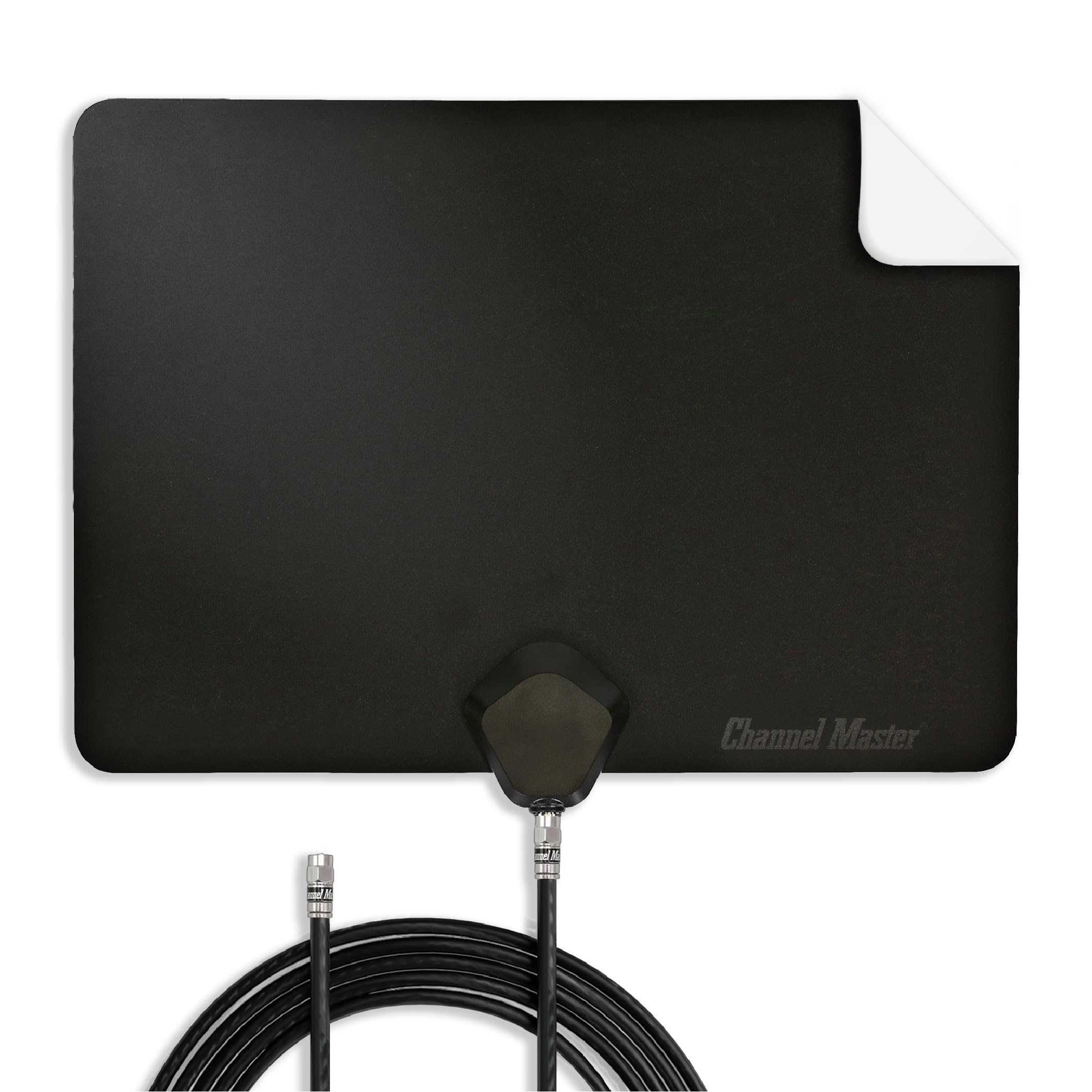
A veteran antenna maker’s flat panel, tuned for obstructions and suburban reality.
Channel Master has been building antennas since 1949, and the FLATenna reflects a more conservative engineering read. Its range is listed at 35 miles, and the maker frames that as a realistic number that already accounts for obstructions and interference. In other words, it is not a flat panel that promises 50 miles and then delivers 25 — it promises at most what it can do in a normal suburb.
The panel is ultra-thin and reversible, with a black-and-white face so it fits a room either way around. It includes a 12 ft professional-grade RG6 coaxial cable with enhanced shielding, which is a shorter run than the RCA’s 15 ft but built for cleaner signal delivery. The design supports ATSC 3.0 NextGen TV and 4K broadcasts, and the panel can be wall-mounted, window-mounted or stood on a tabletop.
Where it falls short is cable flexibility: 12 ft is the shortest coax in this group, so it is best for a same-room setup where the TV and the window are close. The upside is that the shorter, heavier-shielded cable can be a cleaner connection than a thin long run. For apartment and suburban dwellers near the towers, 35 realistic miles is plenty.
Quietly the most honest range: The 35-mile spec is designed to reflect real-world obstructions rather than open-air best case. That makes it a dependable bet in the city.
The trade-off to weigh: A 12 ft RG6 cable is generous on quality and short on reach, so plan the placement to fit it.
A solid suburban fit: choose it if you are within a realistic 35 miles and want a flat panel with well-shielded RG6 coax.
Not for far-flung homes: the 35-mile ceiling and 12 ft cable will struggle if your window is across the room.
7. Channel Master Omni+ 50 Omnidirectional HDTV Antenna

A hardier outdoor omni rig for roofs, attics and RVs, built to reach 50+ miles.
This is the one to reach for when indoor placement has failed and you are ready to mount outside. The Omni+ 50 is rated for 50+ miles with a 360-degree omnidirectional pickup, so it does not need to be aimed at a single tower. It measures 28.75″L x 9″W x 2″H, and it comes with a mounting bracket that fits a wall, a mast pole, or an existing satellite mount.
Its real advantage is that it works indoors, outdoors, in an attic or on an RV roof. That makes it one antenna you can move through several placements as you chase a clean signal. The 360-degree reception is the feature that gets it noticed — you get wide pickup instead of a narrow beam to align. The antenna quality and raw performance are the two things that impress people most about it, and it handles VHF-Low stations that flatter-pointing dishes often miss.
The main hesitation is value: at the premium end of this lineup, some people reasonably question whether the jump is worth it. The trade-off is real — you are paying for outdoor build quality and omni reception, not extra channels. If indoor panels keep missing channels, an outdoor omni mount is the fix.
What It Solves That Others Don’t
- 360-degree omni reception means no aiming at towers
- Bracket fits wall, mast pole or existing satellite mount
- Works on roofs, attics and RVs
- Handles VHF-Low stations well, per the maker
The Honest Counterweight
- Premium end of the lineup for the feature set
- Outdoor mounting needs a bracket-safe spot
- Overkill if your indoor antenna already works
The outdoor fix: reach for this when indoor antennas keep falling short and you want omni pickup without aiming.
Hold off if: you are only a few miles from the towers and already getting good channels.
Know the Specs
Mile Range
The range figure tells you roughly how far the antenna can be from the broadcast tower and still pull a signal. It is usually measured in a clear path with nothing in the way, so treat it as a ceiling, not a promise. An antenna rated 50 miles is a good buffer if you are 30–40 miles out; if you are within 10 miles of the towers, a 35-mile antenna is plenty. Terrain, walls and trees all trim the number in real life.
Coaxial Cable Length
The coax cable carries the signal from the antenna to the TV’s CABLE-ANT IN port. A longer cable gives you placement freedom — you can move the antenna toward a window or a balcony without moving the TV. A 33 ft run is the travel pick, while a 12–15 ft run suits a same-room setup. Heavier shielded cable (like the RG6 type in the Channel Master) tends to deliver a cleaner signal than a thin long run.
VHF vs UHF Reception
Broadcast TV channels live in two frequency bands: VHF (the older band that includes many local network stations) and UHF (the higher band that most modern digital channels use). An antenna that handles both picks up more local stations than one limited to UHF, which is why the amplified RCA and Philips models list both. If a network channel you care about seems missing, a dual-band antenna is the usual reason it comes back.
Amplified vs Passive
An amplified antenna runs the incoming signal through a booster chip, which helps when you are far from the towers and the signal arrives faint. A passive antenna has no booster and relies purely on the signal in the air. Amplification can overload a strong signal, so the Auto Gain Control on the RCA and the LTE filter on the Philips exist to keep the booster from drowning the picture in noise. Match the type to your local signal strength.
Common Questions
How do I know how many miles I am from the TV towers?
Will an indoor antenna work if my best window is in another room?
Do I need an amplified antenna or will passive work?
How many channels can I actually receive from one antenna?
Will an outdoor antenna beat an indoor one?
Do these antennas support 4K and NextGen TV?
Why do I lose channels after moving the antenna?
Is the Channel Master Omni+ 50 worth it over a flat indoor panel?
Can a passive antenna work without an amplifier?
What is the difference between VHF and UHF channels?
The Bottom Line
For most homes, the wi-fi tv antenna to start with is the NEOSIGN TV Antenna for Smart TV Indoor because it works indoors or outdoors, gives you 13 ft of thick coax, and does not need aiming. If you want a flat panel that hides on the wall and reaches about 40 miles, grab the RCA Amplified Indoor Flat HDTV Antenna. And when you need the longest cable run for an RV or campsite, the A8cyc8R 2026 TV Antenna Indoor is the one to reach for, with 33 ft of weather-resistant coax to find the cleanest spot.
If nearby channels already look shaky on an indoor panel, skip the guesswork and move to an outdoor-rated omni rig like the Channel Master Omni+ 50. Its 50+ mile 360-degree reach (it pulls signals from every direction) is built for the jobs indoor antennas cannot finish.
How we choose
We do not accept paid placement. Every pick is matched to a real buyer and a real use-case; we do not hands-on test units.
Sources
Specifications: manufacturer listings and product documentation. Review insights: verified customer reviews, as of November 2026. Pricing: not shown on this page (it changes often); check the current price via the retailer link.
As an Amazon Associate, Tactical Gear Guy earns from qualifying purchases. This does not affect which products we feature.