Specs are compiled from manufacturer listings and verified buyer reviews and can change over time — please confirm the key details on the product page before buying.
Most people buy a Wi-Fi thermostat because of one nagging thought: the heating is running while the house is empty. A Wi-Fi thermostat lets you check the temperature from work and dial the heat back before you head home. The catch is that this category splits into two incompatible families: 24-volt low-voltage systems for furnaces and central air, and high-voltage line systems for electric baseboard heaters. Buy the wrong family and the unit won’t power up at all.
This guide is built by comparing the manufacturers’ published specifications and the patterns across verified customer reviews, so you get each pick’s real strengths and trade-offs instead of marketing spin.
The list below walks through installation wiring, app control, and scheduling so you can match a unit to the wiring already in your wall. Check your existing wiring and system type before you buy any wi-fi thermostat, because C-wire requirements vary widely between models.
Top Picks

How To Choose The Best Wi-Fi Thermostat
Before you compare screens or app designs, confirm what kind of heating and cooling your home actually runs. Wiring, compatibility, and whether the unit powers on all follow from that answer.
First, identify your system voltage
Most homes with a furnace and central air use a 24-volt low-voltage system with a handful of thin control wires. Electric baseboard heaters, convectors, and radiant ceiling heat run on line voltage instead, and need a thermostat built for 120V or 240V wiring. A low-voltage model wired into a line-voltage heater will not work, and the reverse is just as true.
Then check whether you have a C-wire
The C-wire (common wire) supplies constant power so the thermostat’s Wi-Fi radio stays connected. Many older setups lack one. Several picks here are designed to run without a C-wire in most homes, while others require it outright or ship an adapter to create one. Pull your current thermostat off the wall and photograph the wire labels before ordering.
Decide how much smart-home control you want
A basic Wi-Fi thermostat lets you change temperature from your phone. A Matter-certified one (Matter is a shared smart-home standard that lets devices talk across brands) joins Alexa, Google Home, and Apple HomeKit through one connection. If your household is split between an iPhone and an Echo, that cross-platform support matters more than screen size.
Side-by-Side Comparison
| Model | Best For | System Type | Voice / Platform Support | Notable Spec | Amazon |
|---|---|---|---|---|---|
| Sensi ST55★ Best Overall | No-C-wire retrofits | 24V HVAC | Alexa, HomeKit, Google, SmartThings, Vera | C-wire not required in most applications | Amazon |
| Honeywell Home X2SMatter Ready | Matter-based smart homes | 24V HVAC (C-wire required) | Alexa, Google Assistant, Apple HomeKit | Matter certified | Amazon |
| Cielo Smart Thermostat EcoAdapter Included | Homes short a C-wire | 24V HVAC | Alexa, Google, Siri Shortcuts, SmartThings, IFTTT, Home Assistant | C-wire adapter included | Amazon |
| Google Nest Thermostat | Google-led households | 24V HVAC | Google Assistant, Alexa, Matter-certified assistants | Runs without C-wire in most homes | Amazon |
| Honeywell Home RTH9585WF1004 | Screen-first control | 24V HVAC (C-wire required) | Alexa, Google Home | Customizable color touchscreen | Amazon |
| Amazon Smart Thermostat | Alexa and Ring setups | 24V HVAC | Alexa, Ring | C-wire adapter bundled | Amazon |
| Mysa Smart Thermostat LITE | Electric baseboard heat | Line voltage 120V–240V | HomeKit, Alexa, Google | Up to 1,900W at 120V or 3,800W at 240V | Amazon |
| Sensi 1F87U-42WF | Fast guided installs | 24V HVAC | Alexa, Google, HomeKit, SmartThings, Wink | Most install in 30 minutes or less | Amazon |
| Nest Learning Thermostat Pro Edition | Pro-installed multi-zone homes | 24V HVAC, zoned and dual-fuel | Alexa, Google Home | Includes Nest Temperature Sensor | Amazon |
Detailed Reviews
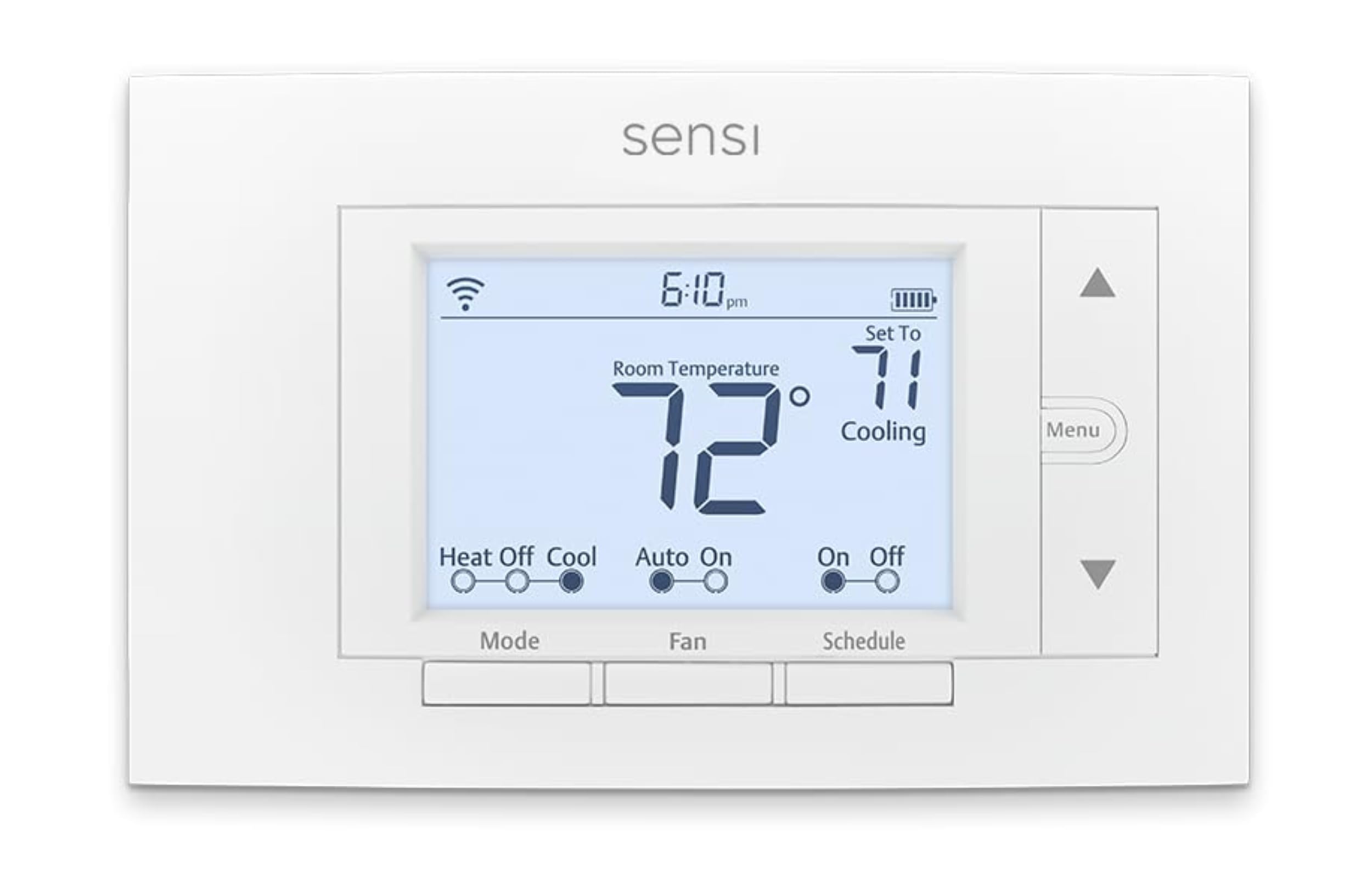
1. Sensi Smart Thermostat ST55
Our pick — 4.0+★ from 23,000+ verified ratings; the strongest balance of quality and price.
The one that fits your old wall plate without a single patch of spackle.
Here is the detail that makes this the crowd favorite — 4.0+ stars across 23,000+ owners. The unit is shaped and sized to drop into the same footprint as a traditional thermostat, so you do not have to patch and paint the wall behind it. A built-in level and step-by-step app instructions handle the alignment, which is the part most people dread.
The C-wire rule is where this one earns its place on the list. It works with the HVAC equipment found in most homes and does not require a common wire in most applications. That means an older furnace with four thin wires and no spare power lead is still a viable install target. The app is honest about it too — if your setup does need a C-wire, it tells you before you start cutting wires.
What wins people over, beyond the install, is the reporting side. Usage reports and maintenance reminders (like filter replacement) turn the app from a remote switch into something that actually monitors the equipment. The recurring gripe is that Wi-Fi setup occasionally takes a second attempt, so budget a few extra minutes on the connection step rather than the wiring.
Where It Pays Off
- Drops into the same space as a traditional thermostat — no wall repair
- C-wire not required in most applications, so older systems stay compatible
- Usage reports and filter reminders give you a maintenance nudge
- Works across Alexa, Apple HomeKit, Google Assistant, SmartThings, and Vera
What To Anticipate
- Wi-Fi pairing sometimes needs a second try
- Buttons and a plain LED display, not a touchscreen
Best for: the retrofit job — you want phone control without rewiring or repainting the hallway wall.
Think twice if: you want a glowing color touchscreen as the centerpiece of the entryway.
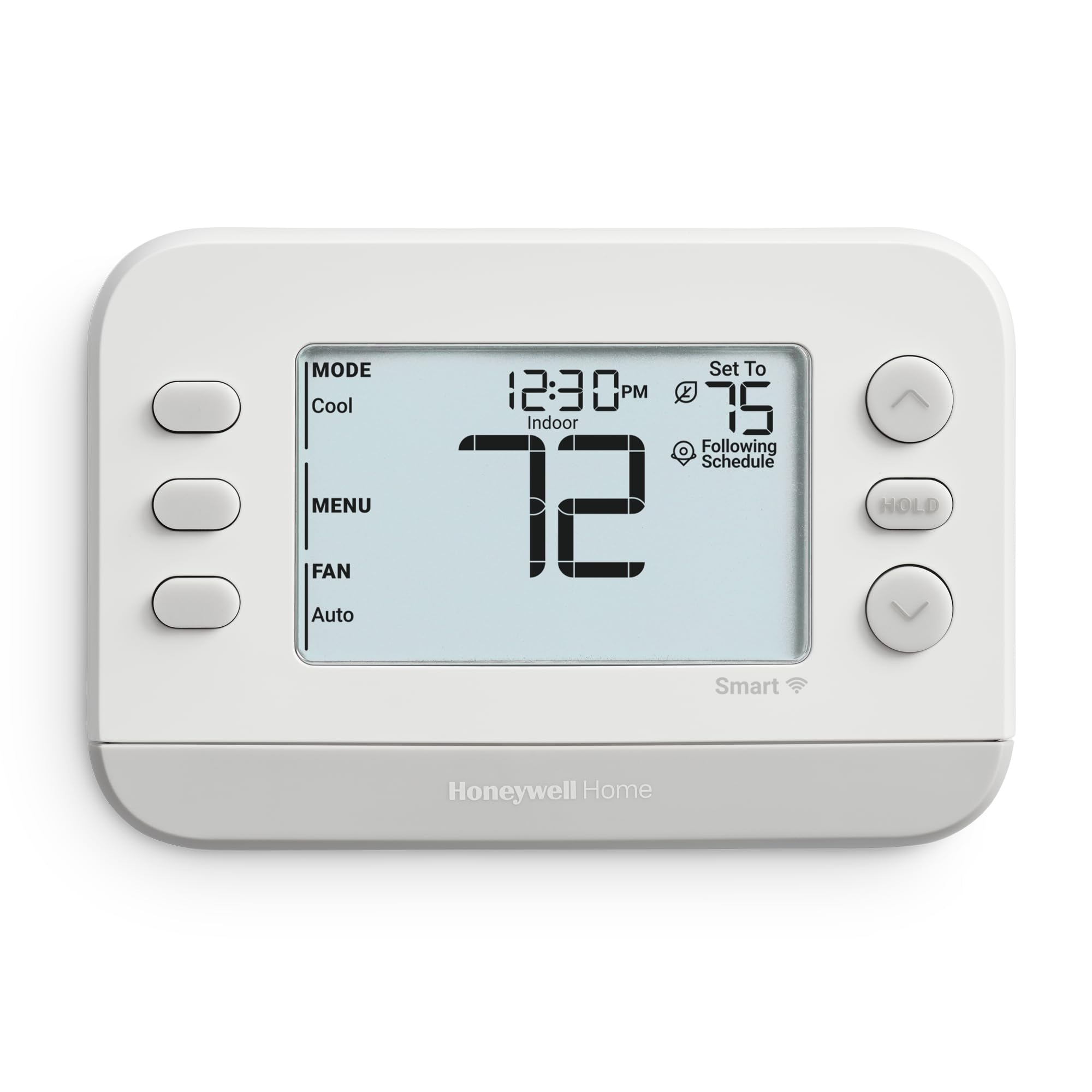
2. Honeywell Home X2S Smart Wi-Fi Thermostat, Gray
Matter certification first, so one thermostat follows every platform in the house.
Matter is a shared smart-home standard — think of it as a common language that lets one device talk to Alexa, Google Home, and Apple HomeKit without separate pairing tricks. The X2S carries that certification, which is why it suits a home where the family is split between an iPhone and an Echo. You set it up once and each platform sees it reliably.
The wiring catch is worth stating plainly: this model requires a C-wire, and Honeywell Home advises checking compatibility before you buy since an adapter may be needed. Pull the old thermostat and look for a labeled C terminal. If it is missing, factor in the adapter before you commit. The reward is a full feature set — filter change reminders, indoor humidity monitoring, and custom display settings.
Scheduling is unusually flexible for a mid-range unit. You can program in 5-1-1 day, 5-2 day, 7 day, or one-week increments, or run it non-programmable if you prefer manual control. Auto-away handles the empty-house problem on its own. The unit is also a heavier piece of hardware than the Cielo at 14.4 ounces versus 6.4 ounces, which reads as a tank-built wall unit rather than a thin panel.
What buyers single out: the no-nonsense operation.
The honest trade-off: the C-wire requirement narrows its audience. If you have four wires and no common, this is not the plug-and-play pick — the Sensi above is.
Reach for this if: you want Matter-level cross-platform control and are willing to confirm a C-wire first.
Look elsewhere if: your wiring has no common lead and you do not want to add an adapter.
3. Cielo Smart Thermostat Eco
Ships with the adapter that solves the missing-wire problem before it starts.
You get the C-wire adapter (the extra wire some smart thermostats need for power) right in the box with the Cielo Eco. That means homes without a common wire don’t have to buy a separate part. At 6.4 ounces, it’s the lightest low-voltage pick on this list — the Honeywell Home X2S weighs 14.4 ounces by comparison — so it sits as a slim panel on your wall, not a chunky block.
Compatibility runs broad. It works with most 24V systems including gas, electric, oil, hot water, heat pump, and geothermal, with two heat and two cool stages and one fan stage. That range matters if you are unsure exactly what your furnace is — the spec sheet covers the common setups. Smart-home links reach Alexa, Google Assistant, Siri Shortcuts, SmartThings, IFTTT, and Home Assistant.
Beyond scheduling, the app adds energy usage patterns and a vacation mode that guards against extreme temperatures while you are away. Buyers report it working immediately with their AC system, and quality ranks high in the feedback. The recurring gripe is that the display is a smaller LCD rather than a large touch panel, so expect to lean on the app for the detailed work.
The practical win: you get adapter, thermostat, back plate, and wall mount kit together, so an install on an older system does not stall waiting on a part.
Choose it when: your home is short a C-wire and you would rather not shop for an adapter separately.
skip it if: you want a big color touchscreen — this one favors app control over an on-wall display.
4. Google Nest Thermostat

It notices the house is empty and dials itself down before you think to.
Nest’s self-learning behavior is the hook. The thermostat turns itself down when you leave, so you are not paying to heat or cool an empty room, and you can build a schedule in the Google Home app on Android or iPhone. Savings Finder also scans for ways to trim your schedule and suggests tweaks, and HVAC monitoring sends an alert when your heating or cooling system looks off.
The compact footprint is a real advantage. At 3.31 inches wide and 3.31 inches high, it is narrower than the Sensi ST55 at 5.88 inches wide, so it suits a tight hallway wall where a broad panel would look crowded. It runs without a C-wire in most homes, though heating-only, cooling-only, zone-controlled, and heat pump systems can need one or another compatible power accessory.
The honest catch is durability. Some owners mention it working great, while others describe it quitting — reliability is mixed in the feedback, and install experiences split between easy and genuinely frustrating. If your system falls into one of the C-wire-required categories, confirm that before ordering. When it is set up cleanly, the hands-off scheduling is the reason to pick it over a manual programmable unit.
Why It Suits Google Homes
- Auto-away turns the system down when the house empties
- Savings Finder suggests schedule tweaks in the app
- HVAC monitoring alerts when something looks wrong
- Narrow 3.31-inch-wide body fits tight wall spaces
Worth Knowing
- Reliability is mixed in owner feedback — some units quit
- Certain system types still need a C-wire or power accessory
Fits best: a Google Home household that wants the thermostat to think for itself.
Second-guess it if: you run a heat pump or zone-controlled system and have no C-wire to spare.
5. Honeywell Home RTH9585WF1004 Wi-Fi Smart Color Thermostat

A bright touchscreen you can color-match to the room — and program seven days out.
The screen is the reason people buy this one. A customizable color touchscreen makes for easy operation and lets you blend the panel into your décor, and the display is bright enough to read at a glance. It also carries Smart Response Technology, which works to reach your set temperature by the time you arrive rather than starting the push after you walk in.
Scheduling is a full seven-day affair with flexible options that can follow your own routine or utility peak-rate pricing. Fan control gives you three choices — always on, automatic, or circulate, where the fan runs randomly about 35% of the time to keep air moving. The unit is slim at 0.88 inches deep, so it sits closer to the wall than a bulkier panel.
The C-wire requirement is firm here, and the compatibility list has limits. It handles forced air systems, hot water and steam, and heat pumps with electric backup, but it does not work with electric baseboard heat at 120–240V. A heat-only oil furnace also needs a C-wire present. Check your wiring and system type before ordering, because a mismatch here is a return.
What earns it a spot: owners coming from an older Honeywell often find the backplate mounting holes line up exactly, which turns a swap into a simple screw-in job instead of a fresh drywall install.
One limit to plan around: no baseboard heater support, so this is a low-voltage-only pick.
Pick it if: you want the wall device itself to look good and be readable without squinting.
Pass if: your heat is electric baseboard or you cannot confirm a C-wire.
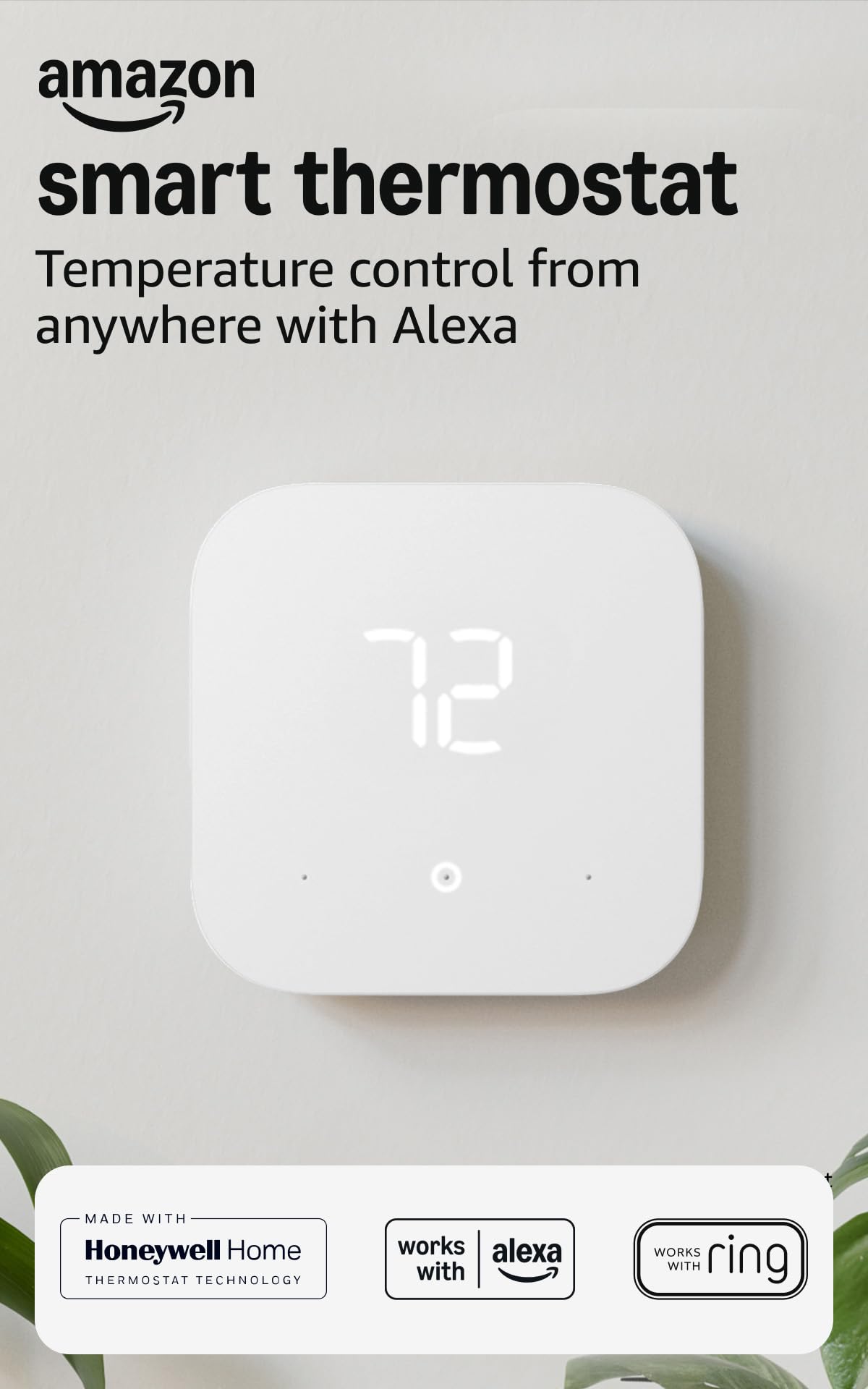
6. Amazon Smart Thermostat
The Echo-native pick, with the C-wire adapter already in the bundle.
If your home already runs on Alexa, this one connects without extra hardware. The bundle includes both the thermostat and the C-wire power adapter, so a missing common wire does not stall the install. The Alexa app walks you through the wiring step by step, and customer service is available if a wire label confuses you.
Comfort zones set the Cielo Eco apart. When linked to select Alexa devices, it adjusts heating and cooling automatically based on temperature readings or presence detection (sensing whether someone is in the room) — so the room you’re actually in gets the attention. You can also build your own home, away, and sleep schedules, or let Alexa’s automatic control handle the timing.
Amazon leans on Honeywell Home thermostat technology here, and the build feels solid as a result. The core promise is simple: less fiddling. Owners describe a setup where no manual tweaking is needed once it is running. Energy Star certification is the efficiency badge, and the package includes guidance on rebate programs available from regional energy providers.
The case for it: Alexa households get presence-based zoning and a bundled adapter in one purchase, which removes two of the usual install headaches.
Made for: an Alexa-and-Ring home that wants hands-off, voice-driven temperature control.
Weigh first: the platform support is narrow — this is an Alexa ecosystem device, not a cross-platform one.
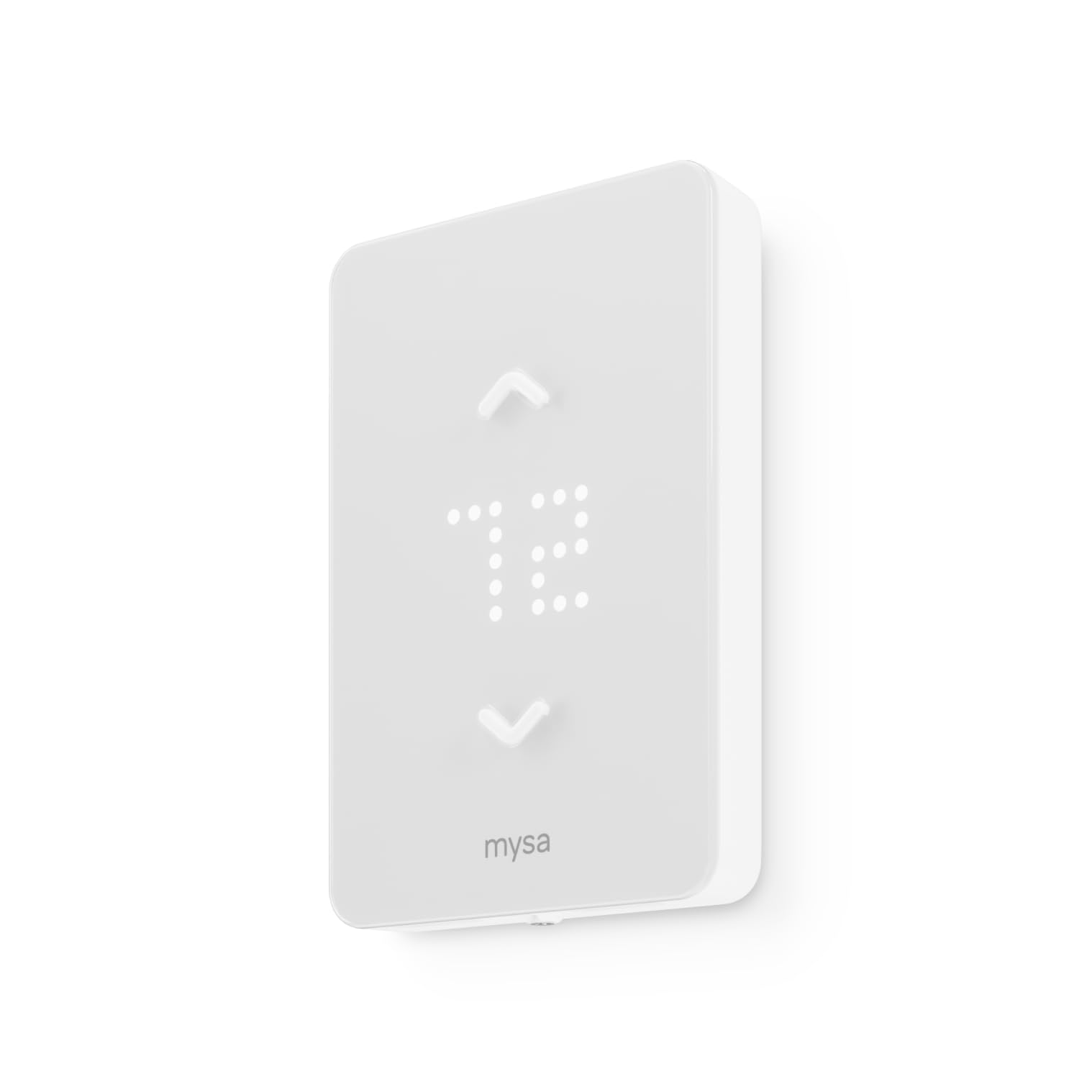
7. Mysa Smart Thermostat LITE
Built for the high-voltage heaters every other thermostat on this list refuses to touch.
Electric baseboard, fan-forced, wall, and convector heaters, plus radiant ceiling heat, run on line voltage — and that is exactly what the Mysa LITE is engineered for. It handles 120V or 240V wiring and manages up to 1,900W at 120V or 3,800W at 240V. It is a single-pole thermostat that can replace many single-pole and double-pole units, though local codes vary on what a homeowner can legally wire.
This is the one product here that will not work on a standard 24V furnace or central heat pump. It needs four wires, including a neutral or a second live wire, and it will not run on a two-wire switch loop. Mysa’s compatibility checker is the step to take before ordering — get that wrong and the unit simply cannot be installed.
What makes the install worthwhile is the running cost picture. Scheduling lets you drop the heat while you are out and warm the room before you get home, and geofencing adds a location-based assist. The app is free, scheduling and remote control carry no subscription, and a monthly runtime email shows which rooms ran longest so you can tighten the schedule. Customers note effectiveness is what they value most, and the app is easy to pick up.
Strengths That Matter
- Handles 120V and 240V line-voltage heaters the low-voltage picks cannot
- No subscription — scheduling, remote, voice, and geofencing all included
- HomeKit, Alexa, and Google support for hands-free control
- Monthly runtime email helps you find the rooms burning the most heat
Install Realities
- Needs four wires with a neutral or second live — a two-wire loop will not work
- Not compatible with 24V furnaces or central heat pumps
The right fit: a home with electric baseboard heat that has never had a smart option before.
Wrong fit: anyone with a conventional furnace or central air system.
8. Sensi Smart Thermostat 1F87U-42WF
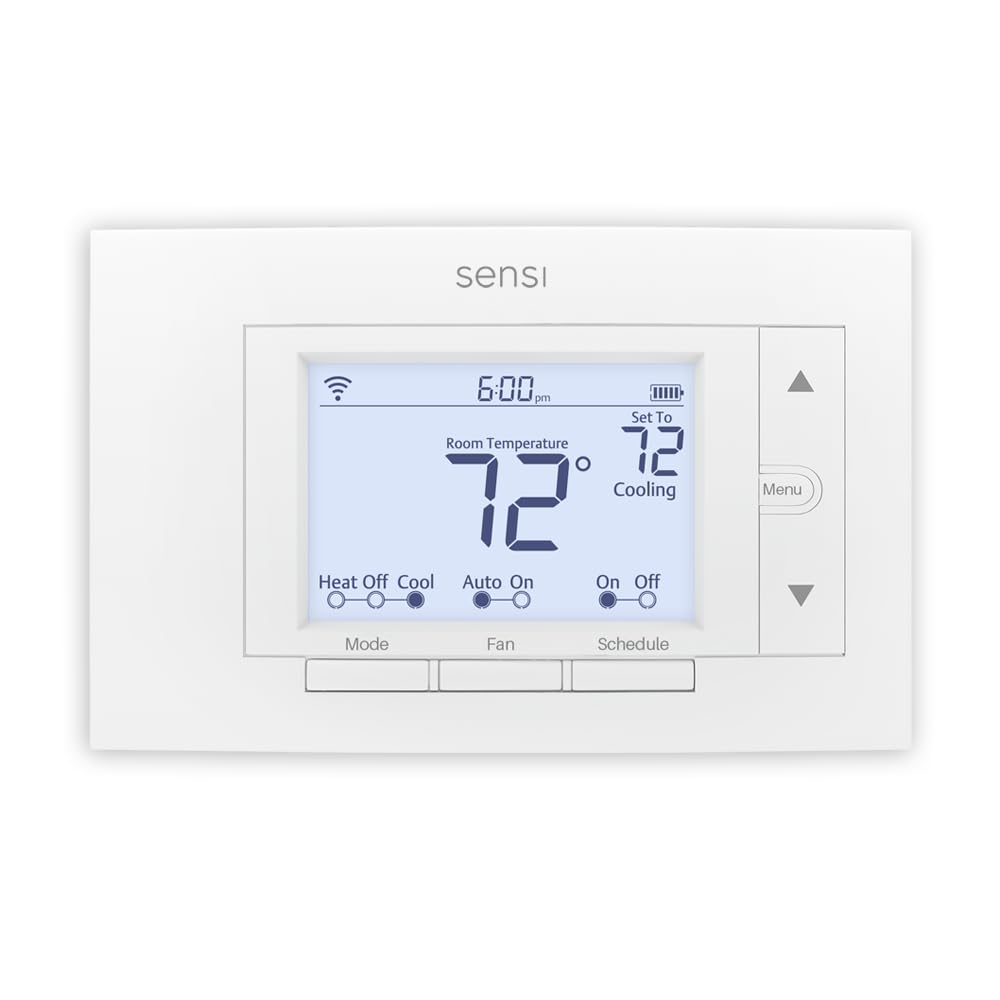
The install-first model that most people finish inside half an hour.
The headline here is time. Sensi’s step-by-step instructions and in-app video tutorials get most people installed in 30 minutes or less. That matters if you are swapping a thermostat on a Saturday morning and do not want to spend the afternoon reading wire diagrams. It carries a Reader’s Choice nod for best smart thermostat from PCMag and an Editor’s Choice best value tag from USA Today’s Reviewed.
The internal sensors feed smart alerts that flag extreme temperature and humidity levels in your home — useful if you travel and want to know something is off. Geofencing, seven-day flexible scheduling, remote access, and energy usage reports are all in. The platform list is broad: Alexa, Google Assistant, HomeKit (which requires a C-wire), Samsung SmartThings, and Wink.
Wiring compatibility follows the same pattern. It works with the HVAC equipment found in most homes, but a C-wire is required for heat-only, cool-only, and heat pump systems. Confirm that before you order. The recurring gripe is Wi-Fi connectivity, which occasionally needs a retry, so a stable 2.4 GHz signal at the wall helps.
Why owners rate the quality: it behaves like dependable equipment rather than a gadget — owners single out reliability and build quality above all. Pet owners in particular value checking and adjusting settings for animals while away from the phone.
A fair caveat: without a C-wire on a heat-only or heat pump system, this one is not an option.
Best matched to: the buyer who wants an award-recognized, fast-install thermostat with wide platform support.
Held back by: the C-wire requirement on less common system types.
9. Google Nest Learning Thermostat Pro Edition

The one built for a technician’s van, not a Saturday DIY run.
Nest’s Pro Edition is designed around professional installation, and that is the whole point. It comes with the Nest Temperature Sensor for room-based temperature control, so the system can cool or heat the room you actually occupy rather than the hallway where the unit is mounted. Advanced calibration tunes the behavior to your specific equipment.
Compatibility runs deep. It works with most 24V systems including gas, electric, oil, forced air, heat pump, radiant heating, dual-fuel, geothermal, and zoned HVAC setups. That breadth is what earns the premium positioning — multi-zone homes and dual-fuel systems are exactly where a standard thermostat gets awkward. It joins Alexa and Google Home through a single connection.
The honest catch is reliability. Some reviewers point out smooth operation while others describe random AC shutdowns, so reliability is the mixed element in the feedback. If you are comfortable having a pro calibrate it, the advanced tuning is the reward. It weighs 1.5 pounds, a substantial wall-mounted piece rather than a slim panel.
Why It Commands The Top Tier
- Includes the Nest Temperature Sensor for room-level control
- Supports radiant, dual-fuel, geothermal, and zoned systems
- Professional calibration tunes it to your actual equipment
- Adaptive Eco and advanced calibration work toward efficiency
What You Give Up
- Reliability is mixed in owner feedback — random AC shutdowns reported
- Designed for professional install, not a solo weekend project
The one to pick: if you have a zoned or dual-fuel system and are hiring an installer anyway.
The one to skip: if you want a same-day DIY swap on a standard single-zone system.
Know the Specs
C-wire (Common Wire)
A C-wire is the constant-power lead that keeps the Wi-Fi radio awake so the thermostat can listen for app commands. Without one, the unit may need batteries or an adapter to stay connected. Several picks here run without a C-wire in most applications, while others require it outright or bundle an adapter. Pull your current thermostat and note whether a labeled C terminal exists before ordering.
24V vs Line Voltage
Most furnaces and central air systems use a 24-volt low-voltage circuit with thin control wires. Electric baseboard, convector, and radiant ceiling heat run on line voltage at 120V or 240V, and need a thermostat built for those heavier wires. These are separate product families, and a thermostat from one will not work in the other. Match the unit to the voltage already in your wall.
Matter Certification
Matter is a shared smart-home standard — a common language that lets one thermostat join Alexa, Google Home, and Apple HomeKit without separate pairing tricks. A Matter-certified model is worth prioritizing if your household mixes platforms. It simplifies setup and keeps one device visible across multiple apps.
Geofencing and Auto-Away
Geofencing uses your phone’s location to decide whether anyone is home, easing the heat or cooling while you are out and bringing it back as you return. Auto-away does the same job using occupancy detection. Either one solves the empty-house problem that drives most thermostat upgrades, and both can trim running time if you commute on a regular schedule.
Common Questions
Will a Wi-Fi thermostat work if my old thermostat has no C-wire?
Can I use a standard thermostat on electric baseboard heaters?
How long does it take to install a Wi-Fi thermostat?
Does a Wi-Fi thermostat save energy or just feel convenient?
What does Matter certification actually change?
Is a Nest thermostat better than a Honeywell Home model?
Will a Wi-Fi thermostat work with Alexa and Apple HomeKit at once?
Do I need a temperature sensor with a smart thermostat?
What happens to my thermostat if the Wi-Fi drops?
Will a new Wi-Fi thermostat fit over my old wall plate?
The Bottom Line
For most homes, the winner in this wi-fi thermostat lineup is the Sensi ST55, because it installs into an existing wall plate without a C-wire in most applications — so an older system still gets phone control. If you want Matter-level cross-platform control and can confirm a common wire, reach for the Honeywell Home X2S. And if your heat is electric baseboard, the Mysa Smart Thermostat LITE is the only pick here built for that voltage. One last nudge: the ST55 carries 4.0+ stars across 23,000+ owners, which is a solid sign it holds up in real homes rather than just on the spec sheet.
How we choose
We do not accept paid placement. Every pick is matched to a real buyer and a real use-case; we do not hands-on test units.
Sources
Specifications: manufacturer listings and product documentation. Review insights: verified customer reviews, as of November 2026. Pricing: not shown on this page (it changes often); check the current price via the retailer link.
As an Amazon Associate, Tactical Gear Guy earns from qualifying purchases. This does not affect which products we feature.