Specs are compiled from manufacturer listings and verified buyer reviews and can change over time — please confirm the key details on the product page before buying.
You book a campground spot that advertises “Wi-Fi,” then find the signal dies near the office and your camper sits in a dead zone. What you need is a device that grabs that weak signal and pushes it into your rig. This list cuts straight to the models that plug in, power up, and hold a connection where your phone alone gives up.
This guide is built by comparing the manufacturers’ published specifications and the patterns across verified customer reviews, so you get each pick’s real strengths and trade-offs instead of marketing spin.
Some of these are weatherproof boxes built to bolt to a pole outside, and some are simple plug-in repeaters for inside the camper. The trick is matching the box to your setup, and the picks below are sorted to do exactly that — which is why this is the most practical wi-fi extender for camper shortlist you can work from.
Top Picks
How To Choose The Best Wi-Fi Extender for Camper Setups
Camper internet fails for one boring reason: distance and obstacles. A campground router sits at the office, your rig sits three rows back, and every aluminium panel and tree in between eats the signal. An extender fixes that by catching what’s left of it and repeating it inside your camper.
Indoor box or outdoor box — pick by where it lives
An indoor plug-in repeater plugs into a wall socket inside the camper, and that works when a usable signal already reaches your rig. A weatherproof outdoor unit mounts on a pole or wall and grabs the campground signal from a stronger spot. The catch: you must run power to it, usually over PoE (Power over Ethernet, which sends power and data down one cable), so one Ethernet cable runs from the injector to the unit.
For boondocking where the campground router is far away, the outdoor route wins. For a weekend spot with two bars of signal, the indoor plug-in is cheaper and faster to set up.
Check the weather rating before you buy
An outdoor extender has a rating like IP65 or IP67 — an industry code where the first number rates dust protection and the second rates water. If it lives outside permanently, you want one of those codes on the label. An indoor repeater rated for nothing will not survive a rainy week on a pole.
Know what the speed numbers do and don’t mean
Every extender cuts roughly a slice of your existing throughput because it must receive and re-transmit. A unit that promises 3000 Mbps of radio capacity is not promising you 3000 Mbps of campground internet — your campground connection is the ceiling. What you gain is range and stability, not a speed boost.
Side-by-Side Comparison
| Model | Best For | Speed Rating | Coverage Claim | Weather Rating | Amazon |
|---|---|---|---|---|---|
| Deco 7 Outdoor BE5000★ Best Overall | Big rigs and permanent sites | 5000 Mbps | 2,800 sq.ft | IP65 | Amazon |
| TP-Link RE515X AX1500Best Value | Simple in-camper setup | 1500 Mbps | 1800 Sq. Ft. | — | Amazon |
| NETGEAR Nighthawk EXS27Top Performer | Multi-room coverage at a site | 5 Gbps | 1,500 sq ft | — | Amazon |
| TP-Link RE815X AX5400 | Heavy device load inside the rig | 5400 Mbps | 2800 Sq Ft | — | Amazon |
| BrosTrend AX3000 Outdoor | Harsh weather and RV parks | 3000 Mbps | Varies by environment | IP65 | Amazon |
| WAVLINK AX1800 Outdoor | Starlink and rural property | 1800 Mbps | 200-300m radius line of sight | IP67 | Amazon |
| WAVLINK AX3000 Outdoor | Long-throw park and farm coverage | 3000 Mbps | — | IP67 | Amazon |
| Cyseed 10000 Sq.ft Booster | Budget in-camper backup | — | 10000 sq.f | — | Amazon |
| FLBI 15715sq.ft Extender | Budget long-range claims | — | 16K sq ft | — | Amazon |
Detailed Reviews
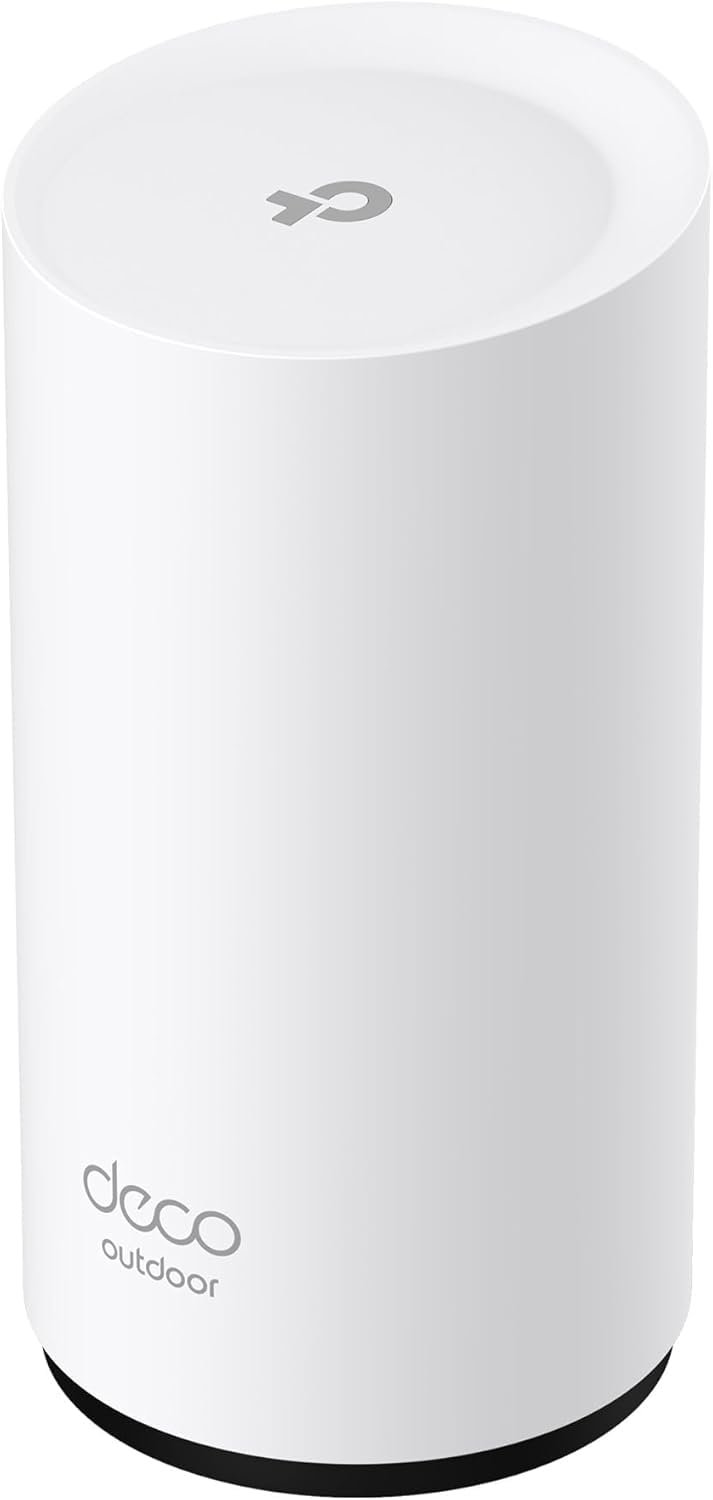
1. Deco 7 Outdoor BE5000 Dual-Band Wi-Fi 7 Mesh Add-On Extender
Our pick — 4.5+★ from 350+ verified ratings; the strongest balance of quality and price.
The weatherproof Wi-Fi 7 box that turns a whole campsite into one network.
If your camper sits in a permanent spot and you want the signal to reach the grill, the picnic table, and the trailer two spaces over, this is the pick. It is rated IP65 — a weather code meaning it is sealed against dust and protected against water jets — so it can live outside instead of getting tucked under a table when it rains. It adds up to 2,800 sq. ft. of coverage, which is roughly the footprint of a large site plus the neighbours’ rigs.
The radio capacity is the headline number here at 5000 megabits per second on the box — put plainly, it can hold up to 150 devices and still move data quickly. That matters at a busy campsite where everyone in your family is streaming on a separate phone, and it also means security cameras and a smart TV can share the same pipe without choking each other. It talks to 2.4 GHz and 5 GHz devices, and it is explicitly backward compatible with older Wi-Fi generations, so the camper’s older tablet still connects.
Two 2.5 Gbps PoEplus ports (2.5 gigabits per second, fast enough for 4K streaming) let one cable carry both power and data, so you can mount it on a pole with the included wall and pole kit and skip the extension cord. The app handles setup, and the hardware is a real TP-Link mesh node (a unit that joins one network with the router) rather than a basic repeater, so your phone hands off between the router and this unit without you reconnecting. Buyers praise effectiveness and setup most, and the recurring gripes are connectivity and value, meaning a few owners hit placement or pairing snags before they found the balance. Start it near the router for the first pairing.
Where it earns its spot
- IP65 housing means rain and hose spray are not a problem in the yard
- 2,800 sq. ft. of added coverage covers a big site plus neighbouring rigs
- Handles up to 150 devices without the stutter a cheap repeater gets at a busy park
- PoEplus power over one cable means no outdoor outlet at all
- Pole and wall mounting kit is in the box
The honest fine print
- No 6 GHz band, so it is dual-band Wi-Fi 7 rather than the full tri-band slice
- You need it to start near the router before you can mount it far away
- Costs the most on this list, which is the fair trade for the rugged housing and PoE
Reach for this: the camper who wants a genuinely weatherproof unit mounted in the yard with one cable, no outlet and no babysitting.
Hold off if: you only need a quick boost inside the rig and cannot run any cable — a plug-in repeater suits you better.
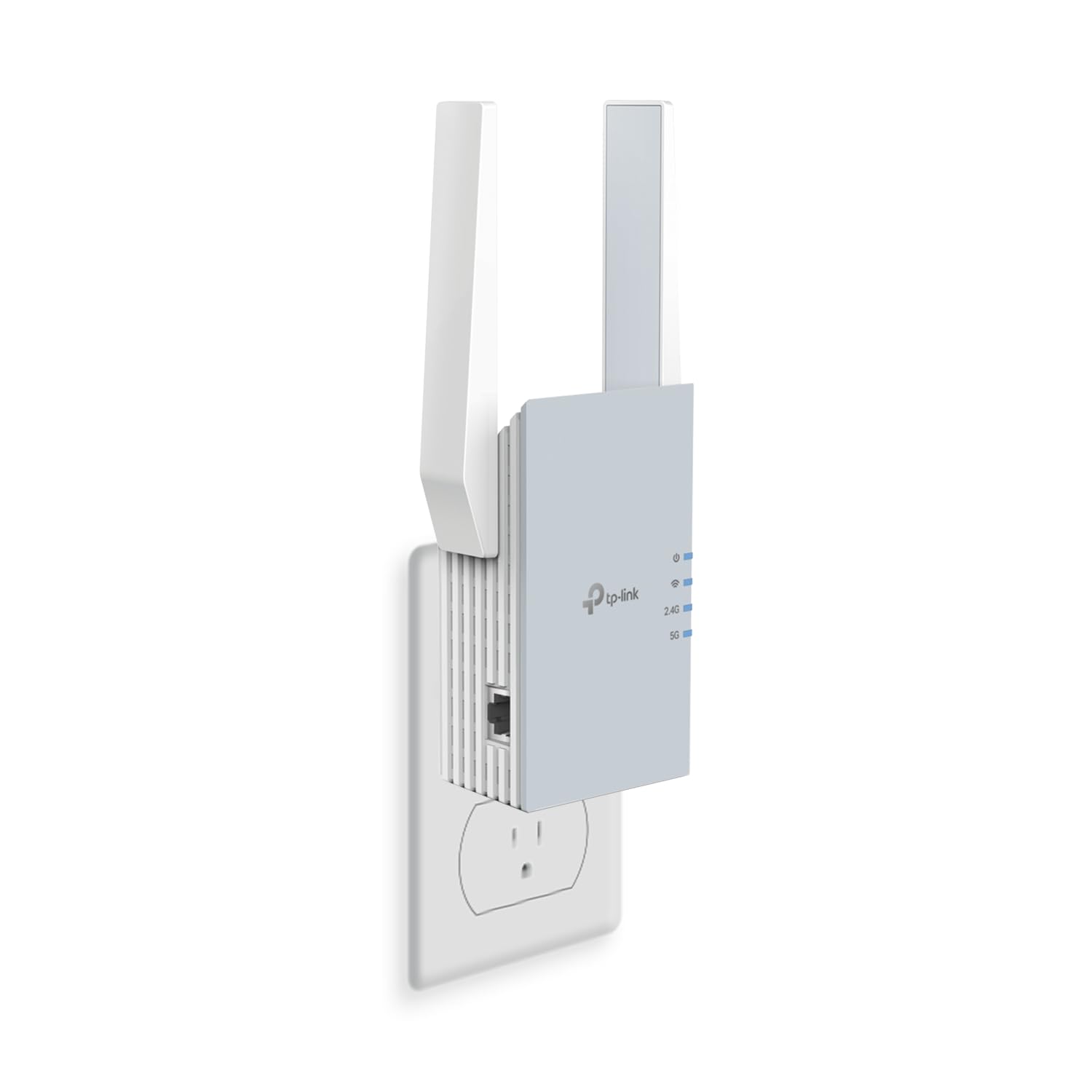
2. TP-Link RE515X AX1500 WiFi 6 Range Extender w/Ethernet Port
The straightforward plug-in that gets a campground signal into the camper without any cable runs.
Plug this into an outlet near the window facing the campground office and you are mostly done. It is a 10.24-ounce box that runs on 1201 Mbps at 5 GHz and 300 Mbps at 2.4 GHz, giving a total 1500 Mbps of radio capacity across its two bands. The 2.4 GHz band is the one that reaches through walls and trees, which is exactly what a camper needs when the park’s router is far away.
Two high-gain directional antennas with beamforming — a feature that focuses the antenna toward the signal source rather than spraying energy in all directions — push coverage up to 1800 sq. ft. for up to 64 devices. There’s a gigabit Ethernet port, so you can hard-wire a smart TV or games console instead of asking it to fight for wireless bandwidth. If the campground has a wired jack, AP mode turns it into your own hotspot.
The honest caveat is reliability: it is the most-discussed aspect of the product and Amazon’s own summary marks it mixed, with some owners reporting the unit works fine and others saying it drops or quits. The fair framing is that a plug-in repeater competes with every other network on the airwaves. Set it in a location where your phone shows two strong bars of campground signal, not one, and update it once through the Tether app after setup — those two steps handle most of the failure stories. Setup itself earns the most praise and is genuinely a few minutes’ work.
Why campers pick it: you pay a bottom-tier price and still get a grown-up feature set — EasyMesh compatibility (works with other EasyMesh gear on one network), an Ethernet port, and a signal-strength indicator on the unit so you can see how good a spot is before you commit.
The catch: it extends coverage, it does not create speed, and TP-Link says so on the box. If your campground connection is already slow at the source, this will not change that.
Best fit: weekend campers with a signal already reaching the rig who want the cheapest reliable way to spread it around.
Look elsewhere if: you need something bolted permanently to a pole outdoors.
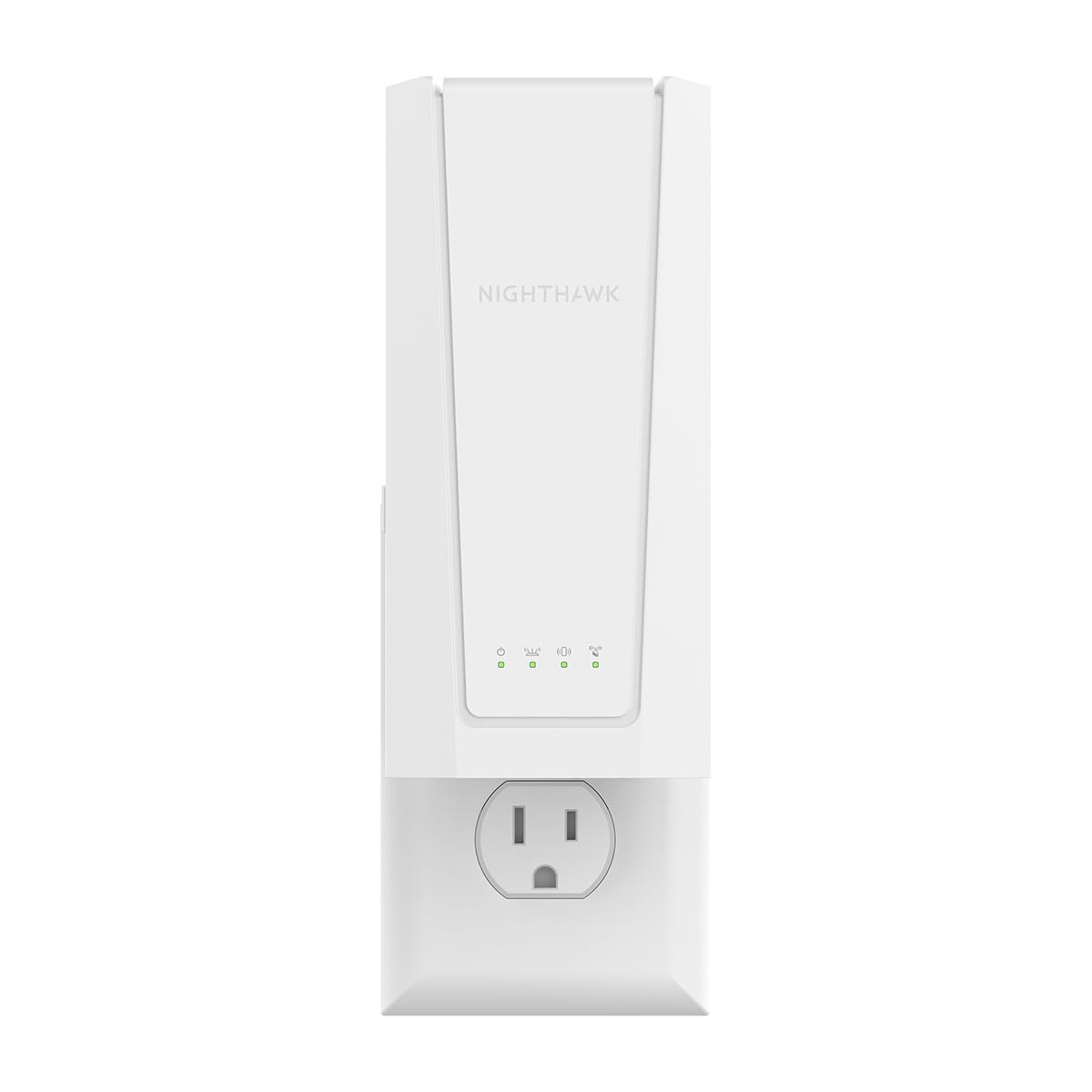
3. NETGEAR Nighthawk WiFi 7 Extender EXS27
One network name that follows you from the bunk to the back bedroom without a reconnect.
The EXS27 plugs into any wall outlet and adds up to 1,500 sq. ft. of coverage for up to 45 devices. Its real party piece in a camper is Smart Roaming, which keeps your existing network name and moves each device to the strongest signal automatically. The practical effect: your call to family does not drop every time you walk from the cab to the shower block.
The numbers behind that: up to 5 Gbps on a WiFi 7 (BE5000) radio, which NETGEAR describes as around 2.7x faster than previous WiFi, plus a 2.5 Gigabit Ethernet port so a smart TV or Starlink feed can be wired at full speed. If you want to stretch a good signal to the far end of the rig rather than blanket the whole yard, 1,500 sq. ft. covers a big travel trailer comfortably.
Where this one asks patience is whole-package consistency. Owner experience ranges from excellent to the unit dropping out in under six months, so range is the strength buyers talk about while overall functionality is mixed. Placement near the source signal matters more here than the marketing suggests. Setup is either a WPS press (a one-button pairing) or a walk through the Nighthawk app, and the app route deserves the extra time on the first install.
What you get for the money
- One network name across the whole rig via Smart Roaming
- 2.5 Gigabit Ethernet port for a full-speed wired link to a TV or console
- WiFi 7 / BE5000 radio — the most current standard in this group
- 45 devices supported, enough for a family plus cameras
Where it asks more of you
- 1,500 sq. ft. is modest compared with the yard-covering outdoor units here
- No weather rating, so it lives indoors only
- Older campground speeds are the real ceiling, and WiFi 7 cannot lift them
Pick it when: a single network that follows you around the camper is worth more to you than the widest possible range claim.
Skip the upgrade if: your campground only offers slow legacy Wi-Fi, since the radio here is faster than the feed behind it.
4. TP-Link RE815X AX5400 WiFi 6 Tri-Band Range Extender

The tri-band workhorse that holds 96 devices’ worth of campers without complaining.
For a big fifth-wheel or a family of four with a laptop each plus two TVs, this is the sensible pick. It puts up 5400 Mbps of total Wi-Fi 6 bandwidth across three bands — dual 5 GHz at 2402 Mbps each and 574 Mbps on 2.4 GHz — and it covers up to 2800 sq. ft. for up to 96 devices. Four high-gain directional antennas plus six FEM amplifiers do the reach, and tri-band genuinely matters in a park where everyone’s phones are competing on the same channel.
Functionality is the clear winner here: it is the aspect buyers praise most by a wide margin, with 119 separate mentions, and quality sits second. What that translates to in a camper is a unit that reliably picks up where an older repeater drops out. The gigabit Ethernet port lets you hard-wire a NAS, TV, or console, and AP mode turns a wired campsite jack into your own hotspot.
There is one hard limit worth repeating from the maker’s own notes: no extender increases speed, and actual speeds here run at 50% or less of your current connection. It is a coverage tool, not a speed cure. Also note it works with TP-Link OneMesh routers but not with Deco mesh systems — if you are building a Deco network, go with the Deco pick and not this one.
What it does well: 96 devices on tri-band Wi-Fi 6, gigabit Ethernet, and a signal that reaches across a long trailer or the site around it without dropping the stream.
Where it disappoints: connectivity and value are the mixed aspects — some owners expected a like-for-like speed replacement, which no repeater delivers. Expect a drop on the speed test and you will be fine.
Made for: a device-heavy rig where a dozen gadgets and two TVs need to share one decent campground connection.
Not for: an outdoor mount — the housing is made for indoor use.
5. BrosTrend AX3000 Outdoor WiFi Extender Long Range

Built to shrug off heat, rain, and a hard freeze — then beam your campground signal to the campfire.
This is the outdoor unit for the camper who parks somewhere the weather has opinions. It runs reliably from -22 °F to 140 °F, carries IP65 dust and water protection, 6 kV lightning protection, and 8 kV ESD protection. In practice that is a box you mount on a pole and forget for the season, whether the campsite is in a desert summer or a cold-weather shoulder season.
The radio side is WiFi 6 AX3000 — 2402 Mbps on 5 GHz and 574 Mbps on 2.4 GHz — with four built-in high-power amplifiers to push the signal wider across open ground. It has OFDMA and MU-MIMO (two ways of sharing airtime between devices), so gaming and video calls do not step on each other. The kit is complete enough to actually install: two detachable waterproof antennas, rubber gaskets pre-attached, a gigabit passive PoE injector (the box that sends power down the Ethernet cable), an outdoor PoE Ethernet cable, a wall-mounting bracket, and an anti-theft screw for a park where things walk.
BrosTrend states plainly that coverage varies by the signal strength at the install spot and by obstacles, which is the honest limit of any outdoor unit. If the campground router barely reaches the outside of your rig, mounting this on the boundary fence will not conjure a signal that is not there. It is a repeater, not a generator. Compatibility with Starlink and most routers makes it a strong fit for a rig that already has satellite.
The weather argument: from -22 °F to 140 °F with IP65 sealing and lightning protection is the most complete climate spec in this group, and the stainless anti-theft screw suits a seasonal site.
What to plan for: it needs a PoE cable run from the injector to the unit, and the injector itself lives indoors. Budget that one cable before you buy.
The right camper: a full-timer or seasonal site where the unit stays outside through every season.
Think twice if: you move campgrounds weekly — the install is more involved than a plug-in.
6. WAVLINK AX1800 Outdoor WiFi 6 Extender

The off-grid choice for a rig running Starlink in the middle of nowhere.
If there is no campground router to extend, this WAVLINK is the box that makes your own satellite feed reach across the property. It is Starlink Gen 2/3 compatible via the Starlink Ethernet Adapter, and it is rated IP67 (a water-and-dust rating that tolerates temporary immersion) — the stricter water rating of the two outdoor units here — with a fully sealed, heat-resistant casing rated from -20°C to 50°C. Rain and snow do not stop it.
The 1800 Mbps radio splits as 1201 Mbps on 5 GHz and 574 Mbps on 2.4 GHz, and it drives four 8dBi omni-directional fibreglass antennas to put out up to 200-300m of coverage in line-of-sight conditions. Up to 256 devices can connect, which is far more than any camper needs but useful for a farm or a long-term lot shared by several rigs. The coverage is genuinely the thing everyone brings up — signals reaching far enough to matter on a rural property.
The manual trade-offs matter here. There is no app on this one — the manufacturer says outright it does not work with any app, so all setup is through the web interface. It also ships with a 1 metre Ethernet cable, which is often too short for a real outdoor install, so plan on buying a longer CAT5E or better cable. And the PoE adapter itself is not waterproof, so it needs to sit indoors. Wire the plan right and this covers an off-grid property brilliantly.
Why the rural buyer likes it
- IP67 sealed housing rated to survive rain, dust, lightning and static
- 200-300m line-of-sight reach and support for up to 256 devices
- Works with Starlink Gen 2/3 for off-grid setups
- Both active and passive PoE supported, so no outdoor outlet needed
The setup reality
- No app at all — configuration happens in a browser interface
- The included 1m Ethernet cable is short for a real install
- The PoE adapter must stay indoors
You will love it if: your internet comes from a dish on the roof and you need it to reach the far corner of the lot.
Better not to: plan on an app-driven setup — this one is web interface all the way.
7. WAVLINK AX3000 Outdoor WiFi 6 Extender

Six antennas and 3000 Mbps of radio for the rig parked at the very back of the park.
The fastest radio in the outdoor group: six 7dBi omni-directional antennas and two built-in amplifiers push 2402 Mbps on 5 GHz and 573 Mbps on 2.4 GHz for 3000 Mbps total. Up to 256 devices can share the connection, and Starlink compatibility plus support for phones, TVs, smart speakers and security cameras makes it a genuine do-everything unit for a large site.
Where it earns its keep is the physical resilience. It carries an IP67 waterproof enclosure with 15 kV ESD and 6 kV lightning protection, rated to operate from -4 to 122 °F. It also supports both 802.3AF/AT active PoE and passive PoE, so it can be powered from your own switch or the included 54V adapter. That flexibility matters when the pole is forty feet from any outlet.
The honest notes: the PoE converter is not waterproof, so it lives inside, and the setup is web-interface or manual rather than app-driven. The signal on 5 GHz gets the praise while overall signal quality is mixed, so the common fix is to mount it high and give it a clean line to the source. The included 1 metre Ethernet cable is short — plan an upgrade with CAT5E or better for any real run.
For the far-back site: 3000 Mbps of radio capacity, IP67 sealing, and dual PoE modes make this the most capable weatherproof option if you can tolerate the wiring job.
Fair warning: at 1 kg it is a substantial mount, and the included cable is only 1 metre, so an install kit is part of the real cost.
Go for it if: you park in a park or on a farm where the source signal is far enough that a small repeater cannot bridge it.
Hold off if: a simple plug-in for a small trailer would do the job.
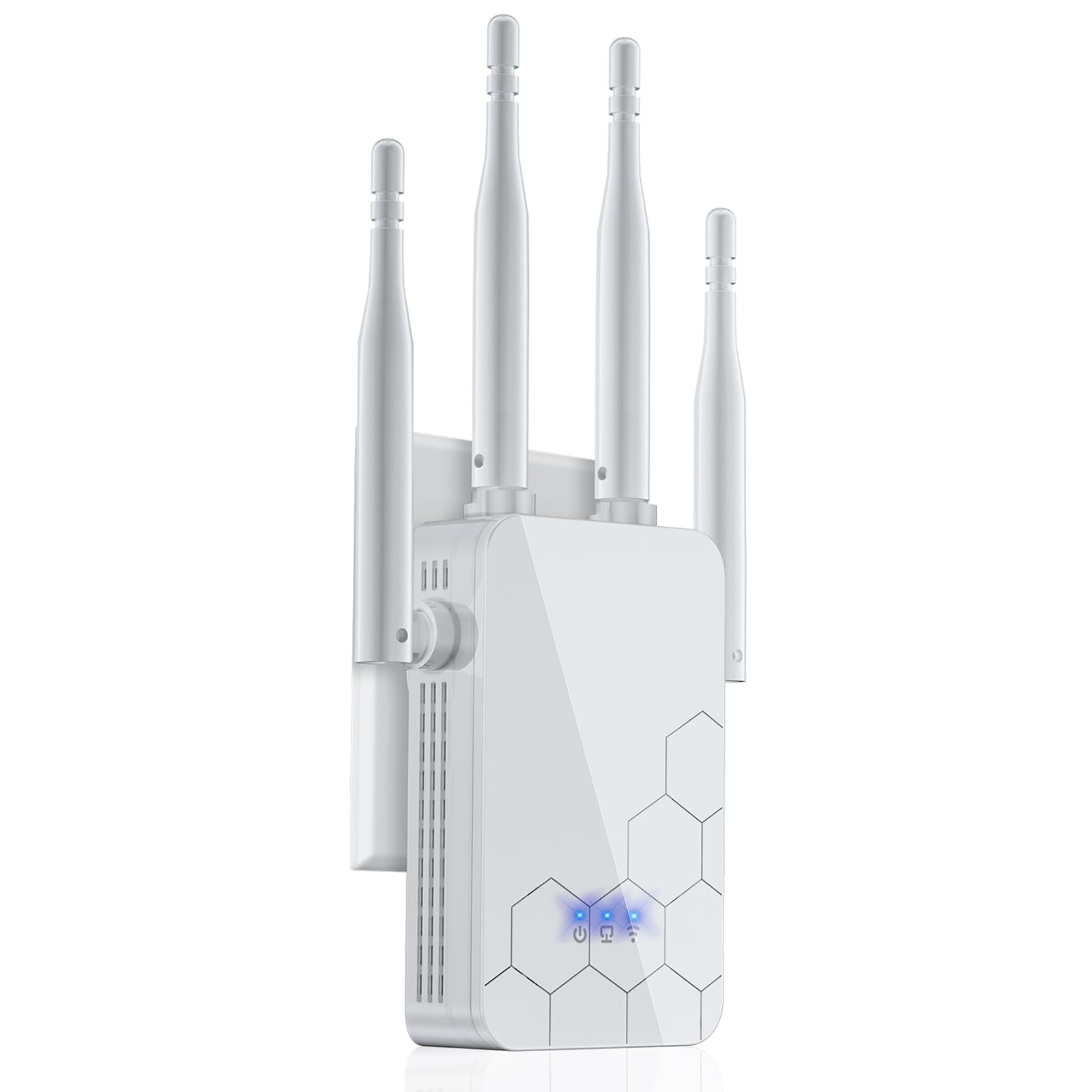
8. Cyseed WiFi Extender Internet Booster, 10000 Sq.ft
The cheap plug-in that takes minutes and asks no tech skills at all.
This is the one to throw in the camper for a weekend when you just need the signal to reach the bunk. It uses a WPS button pairing — press the button on your router, then on the extender, and the two find each other in a few seconds. Four external antennas and a claimed 10000 sq.f range are the headline, and it connects up to 65+ devices with five modes including repeater, client, AP and bridge.
What buyers praise most here is how little setup effort it takes — 48 separate mentions — with signal strength next. That first-run ease is real for a WPS-capable router. It uses WPA/WPA2 encryption, and the single Ethernet port helps when you want a wired device instead of a wireless one.
Two facts to square up before buying. It is a 2.4 GHz only unit and it supports 802.11a/b/g/n/ac, which means the older Wi-Fi generations only. That makes the 10000 sq.f claim a best-case radio reach, not a promise; a camper is a metal box, and a metal box always cuts a wireless signal. If your campground has modern 5 GHz-only Wi-Fi, this is not the tool for it. Set it near a window facing the source and it does the basic job well.
Why it makes the list
- WPS pairing takes seconds and no app or account
- Four external antennas and 65+ device support
- Five working modes including AP and bridge
- Lowest-cost way onto this list
What a camper must accept
- 2.4 GHz only — no 5 GHz band for heavier streaming
- Older 802.11a/b/g/n/ac wireless standards only
- 10000 sq.f is a best-case reach figure, not real-world through metal walls
For the cost-conscious camper: a quick weekend booster for a small rig where the signal already touches the camper.
Not the right one for: 5 GHz-only campground networks or a permanent outdoor install.
9. FLBI New WiFi Extender Signal Booster, 15715sq.ft

A very ambitious range claim, a 20-month warranty, and a camper-friendly price.
The number on the box here is a claimed 15715 sq.ft, and it is the unit that most clearly says it is for whole-house use. Four high-gain external antennas plus a smart IC chip drive that reach, and it claims support for 99+ devices and compatibility with about 99% of routers. A 220 g body keeps it easy to pack into the camper.
What stabilises the pitch is reliability, the top aspect buyers bring up with 27 mentions, and it is strongly positive. The recurring real-world report is a strong signal through the house and reasonable speed with it — the kind of “just works” that matters more at a campground than a headline speed number. Five working modes and a one-tap WPS setup cover the practical cases, and it carries WPA/WPA2 encryption with a 20-month warranty.
The fair limit has to be said: 15715 sq.ft is on paper, and your campground’s signal strength is the real constraint. It also lists 802.11bgn, meaning it is a 2.4 GHz-focused unit. For a camper whose main need is a signal through a metal box to the far end, that is exactly the band you want; for a 5 GHz-heavy setup it is not. Buy it for the reliability and the warranty, not the square-footage headline.
What earns its place: the reliability feedback is the strongest signal of the bunch for a device at this price, and a 20-month warranty is longer than most in this group.
What you should know: 802.11bgn and 2.4 GHz mean it is ideal for range through walls, not for high-bandwidth 5 GHz streaming.
Genuinely fits: a camper who wants a reliable 2.4 GHz spread through a trailer and values a longer warranty.
Rather not, if: your campground’s network lives on 5 GHz and you stream a lot of HD.
Know the Specs
Weather Rating (IP65 vs IP67)
IP stands for Ingress Protection — a two-digit code telling you how well a box keeps out solid debris and water. The first digit rates dust, the second rates water. An IP65 unit survives dust and low-pressure water jets; an IP67 unit is rated for temporary immersion. For a camper left outdoors through a rainy season, either number means the electronics are sealed. What it does not mean is that the power supply is sealed — the PoE injector that comes with these outdoor units usually lives indoors.
PoE (Power over Ethernet)
PoE means one cable carries both electricity and data. That single cable is why outdoor camping extenders can be mounted on a pole with one wire to the injector instead of needing an outlet beside them. The important nuance: the injector is the indoor end, so plan a route from inside the rig to the pole. Most outdoor kits include a passive PoE injector, and the higher-end models also accept active PoE from a switch.
Dual-Band 2.4 GHz and 5 GHz
These are two radio lanes. The 2.4 GHz lane reaches farther and passes through walls and trees better; the 5 GHz lane moves more data but loses strength faster over distance. At a campground where the router is far, the 2.4 GHz lane is your lifeline. In a camper full of streaming devices, the 5 GHz lane is where throughput comes from. A dual-band unit lets each device pick the lane that works best.
Total Bandwidth vs Real Speed
The Mbps number on the box is the sum of all radio lanes, not the internet speed you will actually feel. Every extender also spends some bandwidth repeating the signal it receives, and TP-Link and NETGEAR both state on the box that their units extend coverage rather than increase speed. Treat the Mbps rating as a capacity figure — more is better for many devices, but your campground connection is still the ceiling.
Common Questions
Will a Wi-Fi extender work on a metal camper?
Can I use a Wi-Fi extender with Starlink in a camper?
Does an extender actually increase campground internet speed?
Can I mount an outdoor extender on a pole without an electrical outlet nearby?
How many devices can these campers’ extenders handle?
Is an indoor plug-in extender enough for a small travel trailer?
What is the difference between IP65 and IP67 for a camping extender?
Does Wi-Fi 7 matter in a camper?
Can I set up an extender without an app?
Will an extender create a second network name in my camper?
The Bottom Line
For most campers, the wi-fi extender for camper to buy first is the Deco 7 Outdoor BE5000. It is the only pick here that combines a genuinely weather-resistant IP65 housing (sealed against dust and water spray) with PoE power over a single cable and a mesh node in the same box. Mount it on the pole, run one wire, and the whole site shares one network name.
Your second choice depends on the rig, not the brand. If the signal already reaches the camper and you only need it spread around, the TP-Link RE815X AX5400 handles up to 96 devices on tri-band Wi-Fi 6 and costs less than the outdoor hardware. If your internet comes from a dish in the middle of nowhere, the WAVLINK AX1800 Outdoor is the Starlink-friendly, IP67-rated pick that reaches a long way across open ground.
And if budget is the whole story, the FLBI extender sits at a lower tier with a 20-month warranty and the strongest reliability feedback of the plug-in group. Whichever you choose, work out where the signal actually lands before you buy — every extender on this list needs a real source to repeat, and that is the one thing no product can manufacture for you.
How we choose
We do not accept paid placement. Every pick is matched to a real buyer and a real use-case; we do not hands-on test units.
Sources
Specifications: manufacturer listings and product documentation. Review insights: verified customer reviews, as of November 2026. Pricing: not shown on this page (it changes often); check the current price via the retailer link.
As an Amazon Associate, Tactical Gear Guy earns from qualifying purchases. This does not affect which products we feature.