Specs are compiled from manufacturer listings and verified buyer reviews and can change over time — please confirm the key details on the product page before buying.
You want one speaker that streams over your home Wi-Fi and still comes to the beach on Bluetooth. The JBL Boombox 3 Wi-Fi is the safest bet on this list: it runs 24 hours on a charge, shrugs off water and dust, and doubles as a phone charger. The catch most people miss: Wi-Fi and Bluetooth do different jobs. Wi-Fi gives you AirPlay, Chromecast and Spotify Connect with no phone tether (no cable or pairing to your phone). Bluetooth is what keeps the music going once you leave the house. Get both, or you will be choosing one.
This guide is built by comparing the manufacturers’ published specifications and the patterns across verified customer reviews, so you get each pick’s real strengths and trade-offs instead of marketing spin.
Below you will find which of these seven dual-connection speakers actually holds its sound outdoors, which ones charge your phone, and how each one handles the handoff between your home network and your pocket. Every pick here is a wi-fi and bluetooth portable speakers option worth shortlisting.
Top Picks

How To Choose The Best Wi-Fi and Bluetooth Portable Speakers
First, decide whether you actually need both radios. A Bluetooth-only speaker is cheaper and simpler, but it always leans on your phone as the middleman — take a call and the music dips. A speaker with its own Wi-Fi radio streams straight from your network, so your phone can scroll, ring or leave the room while the music keeps playing. That independence from your phone is the entire point of a Wi-Fi radio.
Start with how you stream, not how loud it gets
Check which services the speaker supports natively. AirPlay is Apple’s streaming protocol; Chromecast built-in is Google’s; Spotify Connect lets the speaker pull the stream itself rather than pushing it from your phone. If your speaker lists these, you can start a track and walk away with your phone in your pocket. If it only lists Bluetooth, every stream is tethered to the device that started it.
Read the IP rating before you read the wattage
An IP rating is two digits: the first covers dust, the second covers water. IP67 means dust-tight and able to survive a dunking, which is what you want for a pool party or a boat. IP56 covers strong water jets but is not rated for full submersion. Neither rating says anything about how the speaker sounds — it only tells you where you can safely put it down.
Battery playtime beats battery capacity
The mAh figure is the size of the fuel tank; rated hours are the miles per gallon. A bigger tank in a speaker with hungrier drivers can still drain faster. What you actually live with is the rated playtime in hours, so compare that number across picks instead of the raw capacity.
Decide if you want a system or a single box
Multi-room audio lets one app drive several speakers around the house. If you already own gear from one brand, staying inside that brand’s ecosystem keeps setup simple. If you just want one speaker that fills a room and travels well, a standalone unit with both radios is the smarter buy.
Side-by-Side Comparison
| Model | Best For | Rated Playtime | Water and Dust Rating | Streaming Radios | Amazon |
|---|---|---|---|---|---|
| JBL Boombox 3 Wi-Fi★ Best Overall | Backyard parties and pool days | 24 hours | IP67 | Wi-Fi + Bluetooth | Amazon |
| JBL Charge 5 Wi-FiBest Everyday Carry | Everyday carry and travel | 20 hours | IP68 | Wi-Fi + Bluetooth | Amazon |
| Sonos Era 100 SL | Bookshelf sound without a microphone | — | — | Wi-Fi + Bluetooth | Amazon |
| Sonos Era 100 | Voice control and home stereo | — | — | Wi-Fi + Bluetooth | Amazon |
| Sonos Play | Camping and rough handling | 24 hours | IP67 | Wi-Fi + Bluetooth | Amazon |
Detailed Reviews
1. JBL Boombox 3 Wi-Fi
Our pick — 4.5+★ from 250+ verified ratings; the strongest balance of quality and price.
The big-box party starter that charges your phone while it shakes the patio.
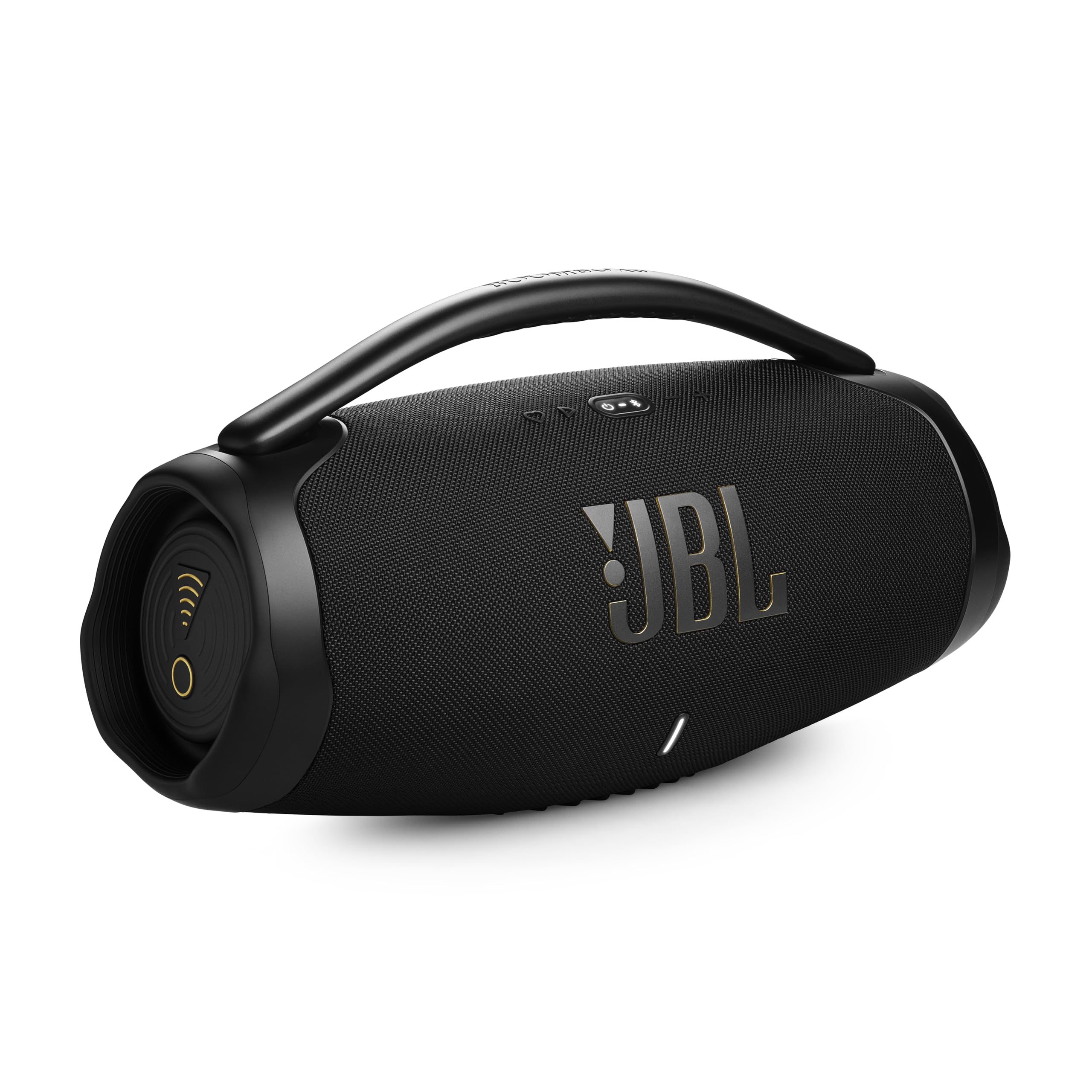
For a backyard gathering or a pool day that runs from noon into the night, this is the pick that removes the most worry. It is rated IP67 — meaning dust cannot get in and it can survive being dunked — so setting it down near splashing water is not a problem. And the 24-hour playtime means you are not hunting for an outlet mid-party.
Three driver types split the work: a built-in subwoofer for bass, two mid-range drivers for vocals, and dual tweeters for highs. In plain terms, that split lets the bass and the vocals each do their own job instead of fighting through one cone. Dolby Atmos support over Wi-Fi adds height and width to the mix, so a film soundtrack or a well-mixed album spreads out around the room rather than sitting in a flat line between the speaker and you.
Two smaller picks in this very list show why size matters. Its battery carries a 9600 mAh rating (milliamp-hours, a measure of battery capacity). The spec sheet lists that here next to the Charge 5 Wi-Fi’s 14100. The smaller sibling actually holds more capacity, but the Boombox stretches its reserve across a bigger, hungrier speaker and still claims 24 hours against the Charge’s 20. Meanwhile the Sonos Era 100 SL reaches 30 feet of Bluetooth range where this one is listed at 20 feet. So if you plan to wander far from the box with your phone, the Sonos gives you more leash.
One honest note on the sound quality that wins everyone over: the volume stays clean at high levels rather than breaking up. The recurring gripe is the handoff between Wi-Fi and Bluetooth, which a fair number of buyers find fiddly, and the box is heavy enough that “portable” means car-to-patio rather than backpack. Neither undermines a speaker this capable — it just tells you who it is for.
What earns its place up top
- Rated IP67 — dust-tight and dunk-proof for poolside and beach use
- 24 hours of playtime so an all-day event needs no recharge
- Built-in powerbank turns the speaker into a phone charger
- Subwoofer, two mid-range drivers and dual tweeters keep bass and vocals separate at volume
Where it asks something of you
- Bluetooth range is listed at 20 feet — shorter than the Sonos Era 100 SL’s 30
- Switching between Wi-Fi and Bluetooth takes some getting used to
- The size that carries the bass also makes it a car-trip speaker, not a bag speaker
Buy it for: the host who needs one box to survive a pool, outlast a party and top up a dying phone.
Think again if: you want something you can toss in a backpack — the weight goes with the bass.
2. JBL Charge 5 Wi-Fi – Portable Wi-Fi Speaker – Black
The one that lives in your bag, survives the rain and still charges your phone.
If the Boombox above is the party anchor, this is the speaker that actually leaves the house with you. It carries an IP68 rating — the higher of the two-digit water scores, meaning it can handle being submerged, not just splashed. Twenty hours of playtime covers a full weekend trip without a charger in your bag.
Here is the number worth knowing: its battery is rated 14100 mAh, and that is more raw capacity than the bigger, costlier Boombox 3 Wi-Fi, which is listed at 9600. Smaller body, larger tank — the trade is that its rated playtime is 20 hours against the Boombox’s 24, because a compact speaker pushes its drivers harder to reach the same loudness. The built-in powerbank means the phone in your pocket can borrow that reserve when it runs dry.
On the Wi-Fi side you get AirPlay, Chromecast built-in, Spotify Connect and Alexa Multi-Room Music, so you can start a stream on your home network and let your phone go ring. Switch to Bluetooth when you head outside and the music follows. The self-tuning feature uses dual built-in microphones to listen to the room and adjust the sound for where it sits — on a shelf, on a picnic table, on the grass.
Owners describe the audio as clear with real depth for a box this size, and the indoor-outdoor flexibility is the thing that keeps coming up. It is the rare speaker that does not make you choose between a home stream and a travel companion.
Why it lands here: it is the most flexible speaker in this group — a 14100 mAh reserve, an IP68 rating and a 20-hour claim in a body you can carry one-handed.
Reach for this if: you want one speaker for the kitchen counter and the tent, and a dead phone is a real risk.
Look elsewhere if: a full two-day event is the goal — the Boombox’s 24-hour claim edges it.
3. Sonos Era 100 SL Compact, Microphone-Free Speaker – White

Room-filling stereo from a shelf-sized box that never listens to you.
Two angled tweeters and a midwoofer do the work here, which is how a speaker this small produces stereo separation — the left and right channels feel like they come from different points rather than one dot. Trueplay tuning then listens to the echo of your actual room and reshapes the EQ to suit it, so a bare apartment and a carpeted den both get tuned sound without you touching a slider.
The “SL” suffix means no microphone is on board, so no wake word is ever being listened for. For a bedroom or a desk where you would rather not have an always-on mic, that is a fair reason to pick this over its Alex-enabled sibling below. It streams over Wi-Fi, pairs over Bluetooth, and takes a turntable through a line-in.
Sound is clearly what people come for — the consensus is that this little box fills a room without eating the shelf it sits on. Setup is the second thing that gets praised for being quick and painless. The places it divides opinion are the app, which some find intrusive, and the value question at its price.
One caveat worth flagging honestly: this is not a battery speaker with a rated playtime in hours, so it is a plug-in unit you move from room to room rather than a beach companion.
The sound-first read: a 19 mm driver pair tuned by Trueplay is a lot of engineering for a shelf speaker, and owners consistently describe the result as larger than the cabinet.
The honest catch: the Sonos app is the weak link for some people — it is the price of entry for tuning and streaming, and it is not to everyone’s taste.
Pick this one when: you want proper stereo in a small room and a speaker with no microphone on board.
Pass if: you need hours of untethered playtime — there is no battery rating here because it plugs in.
4. Sonos Era 100

The kitchen counter command center — ask it for music, then let it fill the room.
If hands-free control is the point, this is the version to get. It keeps the dual-tweeter stereo layout of the Era 100 SL above and adds a built-in microphone with Alexa, so you can request a track, set a timer or adjust volume without reaching for a phone. The two are otherwise built on the same acoustic idea, and both stream over Wi-Fi or pair over Bluetooth with a button press.
The processor is rated 47% faster than the previous generation and the midwoofer 25% larger, which together push deeper bass and cleaner channel separation. A 13.06 cm driver handles the mid and low end. It also supports Dolby Digital 2.0 Stereo decoding, so a film soundtrack arrives as stereo rather than collapsing into a mono stream.
This is the pick with the deepest body of owner feedback, and the through-line is the same as its sibling’s: the sound fills a room without distortion. Pair two of them for true stereo, or add them to an existing Sonos system and they slot in. The friction points are real but narrow — connection and reliability reports are mixed, and some setups go smoothly while others take a few attempts.
One contrast worth putting on the table: its Bluetooth range is listed at 10 meters, and the Era 100 SL above is listed at 30 feet. That is the same reach expressed two ways, so do not read the meter figure as shorter — both give you a comfortable room’s worth of leash.
Why the voice crowd picks it
- Built-in microphone with Alexa for hands-free requests from across the kitchen
- Dual angled tweeters plus a 25% larger midwoofer than the prior generation
- 47% faster processor for snappier app response and stereo handling
- Pairs with a second unit for real stereo, or joins an existing Sonos setup
The bits that need patience
- Getting it onto your network is smooth for some and stubborn for others
- An always-on microphone is the trade for voice control — the SL version skips it
- No battery rating, so it stays near a wall outlet
The right buy for: a household that wants to shout a song request and have the room answer.
Not for you if: you would rather no microphone ever sat in your living space.
5. JBL Authentics 300
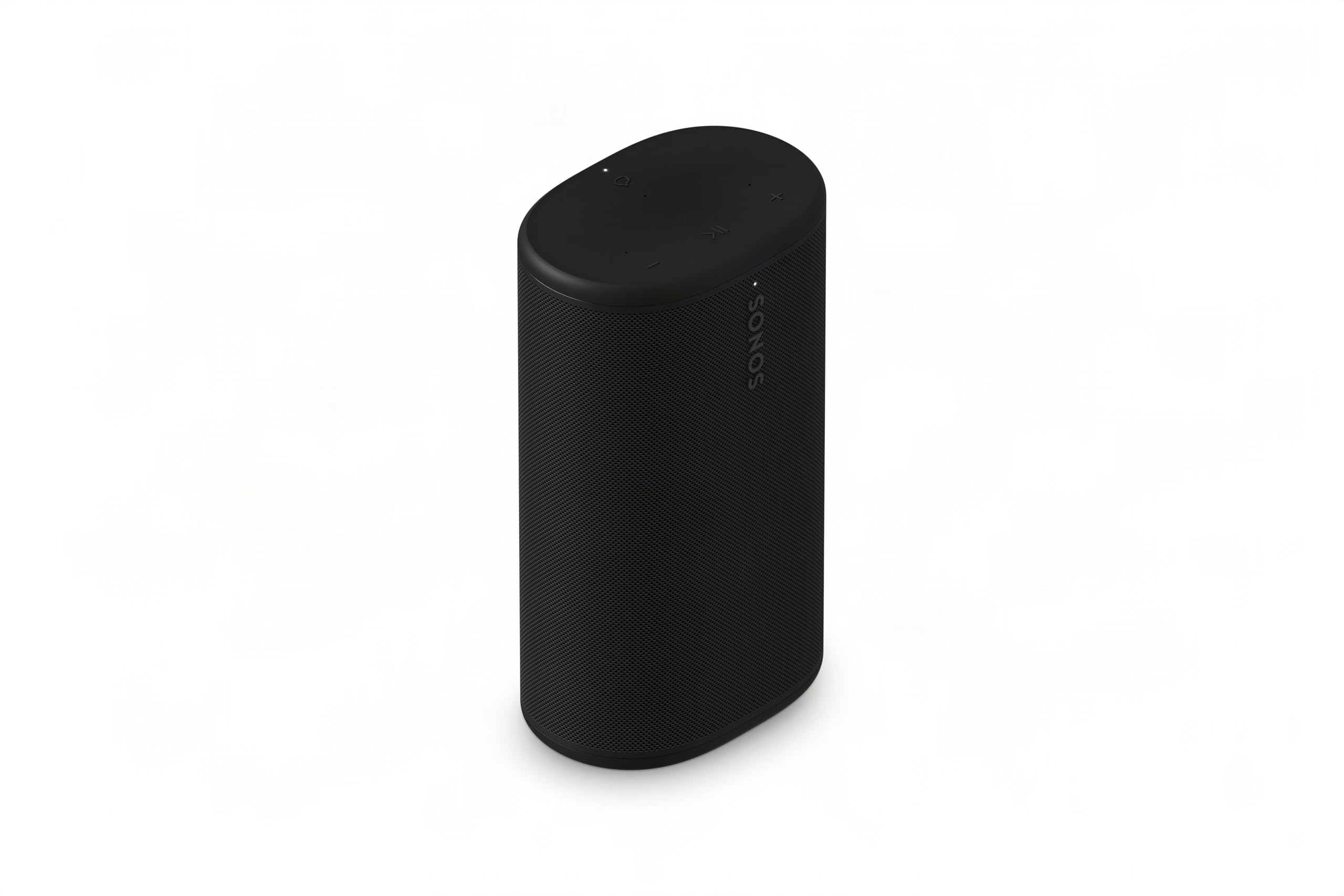
The drop-tested Sonos that charges on a pad and shrugs off a campsite.
Camping and tailgating are where this one earns its keep. It carries an IP67 rating, so dust cannot get in and water cannot ruin it, and it is built to survive drops rather than just scratches. The 24-hour playtime is the equal of the much bigger Boombox 3 Wi-Fi up top, which is a real achievement for a speaker you can pick up one-handed.
The charging story is the detail that separates it in this whole list. Instead of plugging in, it ships with a Wireless Charging Base: you set the speaker down and it tops up. There is also a replacement battery path, and the power management is tuned to stretch each charge. So heavy use does not mean an early retirement.
Sound is the reason people overlook its quirks — it is described as seriously big stereo with deep bass for a take-anywhere design, and the high-frequency performance gets singled out. Streaming splits the same way as the other Sonos models: Wi-Fi through your home system, Bluetooth anywhere else.
The honest side of the ledger: reliability and value divide opinion, and the app is a recurring friction point for a portion of owners. That is worth knowing before you commit, but it is a small slice of an otherwise well-loved speaker. Note too that it needs a USB-C/PD power adapter rated 18W or greater, sold separately, if you want to charge it away from the included base.
Where it wins: a 24-hour battery, IP67 protection and a wireless charging base add up to the most camp-friendly Sonos here.
The catch to plan around: that separate 18W-or-greater USB-C/PD adapter is an extra piece of kit for travel charging.
Made for: the camper who wants home-quality sound, a drop-proof shell and a charging pad instead of a cable.
Skip the shortlist if: you would rather not buy a separate power adapter for on-the-go top-ups.
Know the Specs
Wi-Fi versus Bluetooth, in plain terms
Bluetooth is a short direct link between your phone and the speaker; it is simple, it works anywhere, and the phone always stays in the loop. Wi-Fi puts the speaker on your home network, so it pulls the stream itself — that is why the music keeps playing while you take a call or walk to another room. Look for AirPlay, Chromecast built-in and Spotify Connect to confirm the speaker streams on its own. Bluetooth range is quoted in feet or meters depending on the listing, and a longer figure gives you more room to wander before the audio stutters.
IP ratings and what the two digits mean
The first digit covers dust, the second covers water, and higher is better on both. An IP67 rating is dust-tight and survives a dunking, which is right for a pool deck or a boat. IP56 handles strong water jets from any direction but is not rated for full submersion, so a splash is fine while a dropped-in-the-lake moment is not. Neither digit tells you anything about sound quality — a tough rating and a good driver are two separate specs.
Battery capacity versus rated playtime
Capacity in mAh is the size of the reserve; rated playtime in hours is what you actually get to use. A compact speaker with a large reserve can still quote fewer hours than a big box with a smaller one, because bigger drivers draw more power to hit the same loudness. Compare the hour figure when you shop, and treat the mAh number as a hint about how much spare juice exists for the built-in powerbank feature.
Drivers, subwoofers and passive radiators
A driver is the cone that actually makes sound. Splitting the job across tweeters for highs, mid-range drivers for vocals, and a subwoofer for bass lets each cone work in its comfort zone instead of straining across the whole range. A passive radiator is an unpowered cone that moves with the air pressure inside the cabinet — it is how smaller boxes get bass you feel. Dolby Atmos, where listed, adds height and width to the mix rather than more volume.
Common Questions
Why buy a speaker with both Wi-Fi and Bluetooth instead of Bluetooth only?
Will a Wi-Fi speaker still work if my home internet goes down?
What does IP67 mean compared with IP56 on a poolside speaker?
Does a bigger battery capacity in mAh always mean longer playtime?
Can I use a portable speaker as a phone charger?
How do I add a turntable or TV to one of these speakers?
Is Dolby Atmos worth it on a portable speaker?
Do I need a separate power adapter for these speakers?
What is multi-room audio and do I need it?
Will these speakers work with both iPhone and Android?
The Bottom Line
The crowd favorite among these wi-fi and bluetooth portable speakers is the JBL Boombox 3 Wi-Fi, backed by 4.6 stars across 200+ owners. You get 24 hours of playtime, an IP67 shell (a rating for full dust protection and water resistance) and a powerbank all in one box. That is hard to argue with for a host. If you want the speaker that actually leaves the house with you, grab the JBL Charge 5 Wi-Fi and its bigger 14100 mAh reserve in a smaller body. And if Atmos (surround-style sound) and music that follows you room to room is the draw, the JBL Cove P1 is the one to reach for. Just know its track record is still being written.
How we choose
We do not accept paid placement. Every pick is matched to a real buyer and a real use-case; we do not hands-on test units.
Sources
Specifications: manufacturer listings and product documentation. Review insights: verified customer reviews, as of November 2026. Pricing: not shown on this page (it changes often); check the current price via the retailer link.
As an Amazon Associate, Tactical Gear Guy earns from qualifying purchases. This does not affect which products we feature.