Specs are compiled from manufacturer listings and verified buyer reviews and can change over time — please confirm the key details on the product page before buying.
Hard water leaves its mark before you ever taste it — cloudy glassware, white crust on the showerhead, a water heater working harder than it should. A whole house line conditioner installs on the main line at the entry point, so every tap, appliance, and pipe downstream gets treated water. This guide covers the eleven systems worth comparing, from salt-based softeners that swap minerals for sodium to salt-free conditioners that change how minerals behave instead.
This guide is built by comparing the manufacturers’ published specifications and the patterns across verified customer reviews, so you get each pick’s real strengths and trade-offs instead of marketing spin.
The picks below are grouped by job — scale prevention, softening, or filtration — with capacity, flow rate, and footprint noted for each. Read on for the honest breakdown of every whole house line conditioner here.
Top Picks


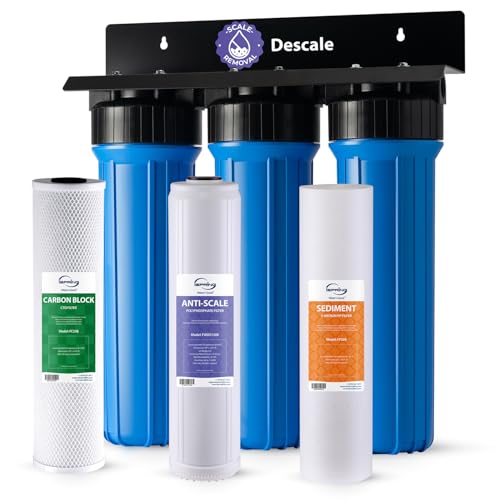
How To Choose The Best Whole House Line Conditioner
Start with the water itself. Fill a glass and let it dry on the counter — a chalky film is calcium and magnesium, the two minerals that build scale. Look up your hardness number in grains per gallon (gpg — a measure of how much dissolved calcium and magnesium your water carries), because that figure decides whether a salt-free conditioner is enough or if you need a softener that actually removes the minerals. Aquasana publishes its own ceiling of 15 gpg for its salt-free scale control, and that number is a useful sanity check for the whole salt-free category.
Salt-Free Conditioner or Salt-Based Softener
A conditioner changes how hardness minerals behave so they rinse away instead of sticking to your pipes. A softener, by contrast, traps the calcium and magnesium in resin beads (small polymer beads that grab the minerals) and flushes them down the drain during regeneration (the cleaning cycle that resets the beads). Conditioners keep the minerals in your drinking water; softeners take them out and leave you with slippery-feeling water that lathers soap easily. Neither wins outright — choose scale prevention if you want to keep the minerals, or a softener if you want them removed.
Capacity, Flow Rate, and Household Size
Two numbers describe how much a system can handle. Capacity is the total gallons or grains it treats before media needs changing — from 20,000 gallons on the NuvoH2O up to 1,000,000 gallons on the Aquasana. Flow rate in gallons per minute (GPM) is how fast water can pass through without a pressure drop, and several systems here list 12 to 15 GPM. A household of two to five people is typically served by 12 GPM, which is the flow figure both Fleck-based systems quote.
What Installing One Actually Involves
Electronic descalers and magnetic-style units clamp onto the outside of the pipe and change nothing about your plumbing. Tank systems — softeners, carbon filters, conditioner tanks — cut into the main line, so budget for a plumber or a confident DIY afternoon. Softeners with a brine tank also need a drain line and a nearby outlet. Check the inlet and outlet size before you buy; iSpring builds its systems around 1″ NPT ports and standard 20″ x 4.5″ housings, which keeps replacement cartridges easy to source.
Side-by-Side Comparison
| Model | Best For | Type | Capacity | Max Flow | Amazon |
|---|---|---|---|---|---|
| iSpring Ultimate PFAS Protection WGB32B-PFKDS★ Best Overall | Knocking out PFAS and scale together | 3-stage filter + scale inhibitor | 100,000 gallons | — | Amazon |
| NuvoH2O CitraCharge Home SystemCompact Pick | No-salt softening in a tight space | Salt-free citrus cartridge | 20,000 gallons | 15 gpm | Amazon |
| iSpring WGB32B-DS Anti-ScaleTop Performer | Big capacity on a DIY budget | 3-stage filter + anti-scale | 250,000 gallons | 15 gpm | Amazon |
| HydroFLOW Pearl Plus | Renters and no-cut installs | Electronic descaler | — | — | Amazon |
| Tier1 900,000 Gallon TAC | Set-and-leave scale prevention | Salt-free TAC tank | 900,000 gallons | 12 gpm | Amazon |
| Scalewatcher 4 Star | Pipe-clamp power without plumbing | Electronic descaler | — | — | Amazon |
| ABCwaters Space Saver 5600SXT | Real softening for a family of two to five | Salt-based softener | 48,000 grains | 12 gpm | Amazon |
| AFW Filters Fleck 5600SXT Combo | Softening plus carbon in one package | Softener + upflow carbon | 48,000 grains | 12 gpm | Amazon |
| Fleck 9100 SXT Twin Tank | Soft water around the clock | Twin-tank softener | 48,000 grains | — | Amazon |
| Kind Water E-3000 | City water with chemical load | Sediment + carbon + salt-free | — | 15 gpm | Amazon |
| Aquasana WH-1000-CS-UVS-B | Whole-home filtration with UV | Multi-stage + UV + scale control | 1,000,000 gallons | 14.6 gpm | Amazon |
Detailed Reviews
1. iSpring Ultimate PFAS Protection Water Filter System
Our pick — 4.5+★ from 200+ verified ratings; the strongest balance of quality and price.
Three filter stages that chase PFAS, heavy metals, and scale at the same time.
If your water report came back with PFAS or you simply want the broadest single-box treatment on this list, this iSpring is the one to build around. The FC25B-PF cartridge uses SGS-tested media that the maker says removes up to 99% of PFAS, including PFOA and PFOS — the two compounds most often flagged in municipal testing. That 99% figure comes from iSpring’s own published testing, so cross-check it against your water supplier’s PFAS numbers before relying on it.
Behind that sits a full three-stage stack: KDF (a copper-zinc filter media that pulls heavy metals) and granular activated carbon to pull chlorine, lead, mercury, chloramine, hydrogen sulfide, and radon, then an advanced carbon block, then the FWDS150K scale inhibitor that tackles calcium and magnesium before they coat your water heater. Capacity runs to 100,000 gallons or up to 12 months depending on water quality and usage — so a family of four can go a full year between changes. Compare that with the NuvoH2O’s 20,000 gallons and you can see how much less often you will be down in the basement swapping cartridges.
The plumbing is friendly for a DIY install. It uses 1″ NPT inlet and outlet ports and takes standard 20″ x 4.5″ filter housings, so replacement cartridges stay easy to find. One thing to understand up front: this system deliberately does not reduce TDS (total dissolved solids, the overall mineral content) and keeps healthy minerals in the water. If you want genuinely demineralized water, you would pair it with a reverse osmosis unit rather than expect it here.
Where This System Earns Its Keep
- SGS-tested media rated by iSpring for up to 99% PFAS reduction, including PFOA and PFOS
- Three stages cover PFAS, heavy metals, chlorine, chloramine, and scale in one footprint
- 100,000-gallon capacity with a 12-month filter interval
- Standard 1″ NPT ports and 20″ x 4.5″ housings keep cartridge swaps simple
What To Weigh Before Buying
- 51.4 pounds and wall-mount only, so plan for two people on install day
- Does not reduce TDS or soften water in the true sense
- A few owners have hit leak trouble at the 1″ connectors, so seal and torque carefully
Built for: households chasing PFAS or a wide contaminant list and willing to mount a real three-stage system on the wall.
Think twice if: you want softened, low-mineral water — this one keeps the minerals on purpose.
2. NuvoH2O Citrus-Based Water Filter System
A seven-pound cartridge unit that slips into a utility corner where tanks cannot go.
Space is the whole argument here. The NuvoH2O measures 5″L x 5″W x 24″H and weighs 7 pounds, against 24.5″L x 8″W x 28″H and 55 pounds for the iSpring WGB32B-DS. If your main line runs through a narrow closet or under a cramped sink cabinet, that difference decides whether the job is possible at all. CitraCharge uses a citrus-based media to condition water without salt, keeping calcium and magnesium in the supply so you avoid the slick feel of a traditional softener.
Performance is where you should set expectations carefully, because the owner feedback is genuinely split. Some report a modest improvement in how towels feel; others notice no change at all. What the unit does promise is scale prevention without salt, phosphate, wastewater, or electricity, and quick-connect cartridges rated for up to 6 months. It also lists a maximum flow rate of 15 gpm, which is respectable for a cartridge this small.
The honest split: conditioning is not softening. If your water is very hard and you want that unmistakable slippery-soft result, this will likely disappoint — it changes how minerals behave rather than removing them. Buyers with moderately hard water who mainly want to stop scale crust are the better fit.
Running cost to plan for: the 6-month cartridge cycle means two swaps a year, and value is the area owners push back on most. Budget for that rhythm rather than treating it as a one-time purchase.
Reach for this if: your install space is tiny and salt-free scale control is the goal.
Look elsewhere if: you expect visibly softer water or want a multi-year cartridge interval.
3. iSpring WGB32B-DS Anti-Scale Whole House Water Filter System
A quarter-million gallons of capacity before you touch a cartridge.
The number that sets this iSpring apart from almost everything else here is 250,000 gallons. Compare the 250,000 gallons here with the NuvoH2O’s 20,000 gallons to see the difference in how much water the media will treat before replacement. Factor in the 12-month filter life cycle on top of that capacity and you have a system that asks very little of you once it is running. Owner feedback backs that up: repeat recommendations dominate, and the recurring detail is showerheads and faucets that stop collecting calcium spots.
The filtration itself is a three-stage stack. A 5-micron sediment filter catches rust and grit first, then a coconut shell carbon block takes out chlorine, herbicides, and taste-and-odor compounds, both meeting NSF/ANSI standards per iSpring. A patented Inhibitor handles calcium and magnesium, inhibits corrosion, and forms a protective bio-film barrier inside the pipes. Flow tops out at 15 gpm, which is fine for a family-sized house.
Weigh 55 pounds and a 24.5″L x 8″W x 28″H box before you commit to a solo install — this is a two-person wall mount, and the weight is the reason. The other thing to know is water pressure. That is the one aspect where feedback lands in mixed territory, with some noticing a drop through the cartridges. Standard 1″ NPT ports and 20″ x 4.5″ housings mean replacements are easy, so the pressure question is really about your incoming supply, not the hardware.
Why it leads the value conversation: 250,000 gallons at a 12-month interval is the longest service stretch in this group short of the multi-year tanks, and it covers scale, sediment, chlorine, and odor without salt or electricity.
The catch worth naming: like the iSpring above it, this keeps minerals in the water and does not lower TDS. Expect conditioned water that resists scale, not softened water that feels slick.
Best fit for: a DIY-capable homeowner who wants maximum gallons per cartridge and scale protection without salt.
Not the pick if: a pressure-sensitive older plumbing system or a one-person install rules out a 55-pound wall unit.
4. HydroFLOW Pearl Plus Electronic Descaler

Clamps onto the cold line and starts working without a single cut.
Nothing about this install involves a plumber. The Pearl Plus attaches directly to your cold water line and fits pipes up to 1.5 inches in outer diameter, whatever they are made of — PVC, copper, galvanized, or PEX. At 1.48 pounds it hangs off the pipe with no support structure, and because there is no cartridge to change, the maintenance routine is essentially nothing. Renters and anyone who does not own their main line get the most out of this format.
The Hydropath signal is the mechanism at work. HydroFLOW says it neutralizes biofilm, that stubborn organic buildup that clogs and corrodes pipe interiors, and prevents scale from forming in the first place so faucets and shower nozzles keep flowing. It works without chemicals or salt bags, which is the environmental pitch, and the maker also claims improved appliance efficiency and longer system life as a downstream benefit.
How you judge results matters, because there is no cartridge to inspect and no TDS reading to watch. Buyers report it physically — less white calcification on fixtures and fewer water spots on glasses. That is a subtler result than a softener delivers, and it is the right trade for someone who cannot cut into the main. Cleaning performance is the third thing buyers bring up, right behind ease of install and general performance.
The two-year view: with no cartridges and no salt, there is nothing to buy again after the initial install. That changes the ownership math compared with any tank or cartridge system on this page.
What it cannot do: it does not remove minerals, does not filter sediment or chlorine, and will not make hard water feel soft. It is a scale-prevention device and nothing broader.
Worth it for: renters, PEX or copper mains you cannot cut, and anyone who wants scale prevention with zero consumables.
Wrong tool if: you also want chlorine, sediment, or PFAS pulled out of the water — that needs a filter stage.
5. Tier1 900,000 Gallon TAC Scale Prevention System

Nine hundred thousand gallons and a nine-year media life, no salt bag in sight.
TAC stands for template-assisted crystallization — a media bed that converts hardness minerals into inactive crystals so they travel through the plumbing instead of clinging to it. Fitted in a fiberglass tank measuring 10″L x 10″W x 36″H and weighing 14 pounds, this Tier1 treats up to 900,000 gallons across a stated 9-year filter life cycle. That ratio is the reason to consider it: you install once and largely forget the media for the better part of a decade.
The design is deliberately dumb, and that is a compliment. A simple in-and-out upflow head with no moving parts means no electricity, no backwashing, and no regeneration cycle — so it can sit in a basement, garage, or utility closet without a drain or outlet nearby. Salt-free operation also means no discharge, which matters if your area restricts brine lines. Maximum flow rate is 12 gpm, which covers a typical family household.
One behavior worth knowing before you buy: conditioned flow can help break down some existing scale inside the pipes over time, and that can temporarily loosen deposits as it works. If you see sediment shortly after install, that is the system doing its job rather than failing. The 10-year limited warranty applies when purchased from an authorized Tier1 distributor, so check who is selling before you order.
Why This One Sticks Around
- 900,000-gallon capacity with a 9-year stated filter life cycle
- No salt, no electricity, no backwash, and no drain line needed
- Upflow head with no moving parts to wear out
- 10-year limited warranty through authorized sellers
The Fair Caveats
- 12 gpm flow is the lowest of the tank systems here, so very large households should size carefully
- Prevents and slowly loosens scale but does not filter chlorine or sediment
Choose this when: you want one install and a decade of scale prevention with no consumables to manage.
Keep looking if: you need contaminant filtration or a higher flow ceiling.
6. Scalewatcher 4 Star Electronic Descaler

Seven hundred milliamps of descaling power that wraps around any pipe diameter.
This is Scalewatcher’s most powerful non-commercial unit, pushing 700mA into the coil. The maker’s argument is simple: more power means limescale is prevented and existing deposits break down faster, while beneficial minerals like calcium stay in the water. The design has been patented since 1991 and is sold for homes, businesses, factories, and water parks, which is a longer track record than most of the electronic units here can claim.
Installation asks nothing of your plumbing. There are no pipe changes, no electrician, and no drain line — the mounting hardware comes in the box, and it is listed as working on all diameters of both plastic and metal pipes. Salt-free and low-maintenance is the other half of the pitch: no salt to buy means improved water heater efficiency without the ongoing expense of a brine system.
Expect a subtler change than a softener gives you, because an electric descaler works on the minerals rather than removing them. Owner reviews describe the results in practical terms — a washing machine that runs better, noticeably improved water quality, and well water that tasted like bottled water. Scale prevention shows up as less crust on fixtures over time, not as slippery water on day one.
Where the money goes: into the coil and the electronics rather than media. There is no cartridge to replace, so after install the ongoing cost is essentially zero.
Honest limit: it does not filter anything — no chlorine, no sediment, no PFAS. If your complaint is taste or odor rather than scale, this is the wrong device.
Pick this for: a no-plumbing install on a large-diameter main where you want maximum descaling power.
Pass if: scale is not your problem, or you want filtration and conditioning from a single box.
7. ABCwaters Fleck 5600SXT 48,000 Grain Water Softener

Real softening — minerals actually removed — with the install kit already in the box.
Everything else on this list conditions, prevents, or filters. This one softens, which means the calcium and magnesium are genuinely taken out of the water and replaced during regeneration. The 48,000-grain resin bed with premium 8% resin is sized for a household of two to five people, and the recommended service flow is up to 12 GPM. Soft water is the result owners describe most directly — the change is immediate and unmistakable after install.
The valve is the familiar Fleck 5600SXT, a metered on-demand unit (it measures your actual water use and regenerates only when needed) rather than a timer. ABCwaters pre-programs it before shipping, which removes the setup guesswork that trips up first-time softener buyers. The mineral tank carries a 5-year warranty on the resin and a 10-year warranty on the tanks, and the package includes silicone lubricant, a hardness test, sanitizer, 4′ of 3/8″ brine line (the tube that carries salt water into the tank), a small parts kit, and a printed installation guide.
Two practical notes. The brine tank holds up to 150 lbs of salt, so factor a salt run into your routine — that is the ongoing cost of genuine softening. And with a 10-inch diameter mineral tank plus a separate brine tank, this takes floor space that a clamp-on descaler never will. Support is hand-assembled in Arizona with phone, text, and email help plus video tutorials.
The standout detail: the kit. Hardness test strips, sanitizer, and brine line in the box means one order covers the whole job, and the pre-programmed valve saves you the setup headache.
What you trade: salt, drain line, electricity, and floor space. If any of those three are impossible in your utility area, a salt-free conditioner is the fallback.
Made for: a two-to-five-person household that wants genuinely soft water and a straightforward, pre-configured setup.
Not your system if: you cannot spare the floor footprint or refuse to handle salt.
8. AFW Filters Fleck 5600SXT 48,000 Grain Softener

Two jobs in one order: minerals come out, and chlorine and chemicals go with them.
Most softeners leave you still tasting chlorine. This AFW package pairs the same 48,000-grain Fleck 5600SXT softening setup with a 1.5 cubic foot upflow carbon bed, and the carbon stage handles what softening misses — chlorine, chloramines, pesticides, herbicides, organics, MTBE, and THM. It is one purchase that covers softness and water quality together, and the carbon media is derived from coconut shells.
The upflow design is the smart part. Because the water pushes up through the carbon bed rather than down, the media does not need backwashing — which means no electricity, no drain line, and no wastewater for the filtration half. Recommended service flow is up to 12 GPM, sized for households of two to five. The Fleck valve carries a 5-year warranty and the tank carries 10 years, and the package includes a bottle with sanitizer, silicone lubricant, and hardness test strips so the install is a single afternoon.
Unlike the ABCwaters above, which is a softener alone, this is a two-vessel setup and calls for professional plumbing installation per the manufacturer. Budget for a plumber and for the extra floor space the carbon tank adds. Parts, filters, and media are NSF approved, which is worth confirming when you are choosing between similarly equipped combos.
Best argument for it: if you know you want soft water and you know you hate the taste of chlorine, buying two separate systems costs more and takes up more wall space than this combined package.
What to plan around: the carbon stage and the softener stage will not wear out on the same schedule, so track both replacement intervals separately rather than treating this as a single consumable.
Right answer for: a family that wants both soft water and chlorine-free water and is prepared to hire the install.
Overkill if: chlorine is not an issue in your supply — the ABCwaters does the softening job for less complexity.
9. Fleck 9100 SXT Twin Tank Water Softener, 48,000 Grains

Two tanks take turns regenerating, so soft water never pauses for the cycle.
A single-tank softener has one weak moment: while it regenerates, it is offline. The Fleck 9100 twin-tank design eliminates that gap by running one tank on service duty while the other regenerates, then swapping — soft water around the clock, every day. The 9100 SXT valve meters on demand, so it triggers regeneration based on actual gallons used rather than a fixed timer, and Fleck quotes 15% savings in both water and salt from that behavior.
Hardware includes 10×54″ mineral tanks, 1.5 cubic feet of high-capacity resin per tank, a 14″x36″ brine tank with a safety float, and a 1″ plastic bypass. The resin ships fully loaded, which shortens the install. At 95 pounds this is the heaviest pick on the list, so plan the delivery and the placement before it arrives.
Setup is where expectations need calibrating. Some owners find the install easy and the controls intuitive; others want a clearer step-by-step walkthrough than what ships in the box. If you are comfortable reading a programming manual or watching a video, it is manageable. Quality and reliability are what owners talk about most — one long service run of years without trouble is the pattern people describe, which is exactly what you want from a piece of equipment buried in the basement.
Why Twin Tanks Cost More
- Continuous soft water — one tank regenerates while the other serves the house
- Metered on-demand valve with Fleck’s stated 15% water and salt savings
- Resin arrives preloaded in both 10×54″ mineral tanks
- 1.5 cu ft of high-capacity resin per tank for long service between cycles
What To Prepare For
- 95 pounds plus two mineral tanks and a brine tank take up real floor space
- Programming documentation is thinner than some buyers expect
Designed for: a large or busy household where running out of soft water mid-shower or mid-laundry day is not acceptable.
Consider the single-tank units if: budget and floor space matter more than uninterrupted softness.
10. Kind Water Systems E-3000 Water Softener & Filter
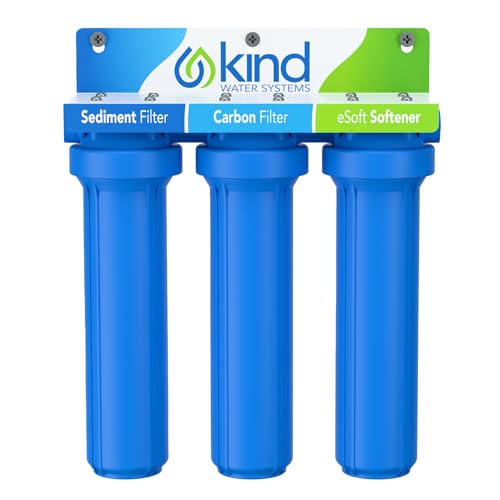
Built for treated municipal supply, where the problem is chemicals and sediment, not wells.
City water arrives already disinfected, which means your residential problem is usually chlorine, chloramine, VOCs, pesticides, and pipe sediment rather than iron or sulfur. The E-3000 targets exactly that profile: sediment filtration plus carbon block plus salt-free softening in one compact system. Kind Water publishes a target of up to 95% of sediment and over 155 chemical contaminants, and the 4.5″ x 20″ pleated 5-micron sediment filter is the first line of defense.
The conditioning half prevents and reduces scale without salt, brine discharge, electricity, or bulky tanks, so there is no wastewater and no drain line required. Maximum flow rate is 15 gpm, the highest among the tank systems here alongside the iSpring WGB32B-DS, and the footprint of 25″L x 9″W x 29″H is manageable for a utility wall. Components are NSF certified per the manufacturer.
Minerals stay in the water by design — this prevents scale rather than removing hardness, so do not expect softener-slick water. What you should expect is better-tasting water from every tap and less crust on fixtures and appliances. Kind backs the unit with a 120-day satisfaction guarantee, which gives you a real window to judge whether your specific water responds.
The city-water angle: most whole-house systems are built around well-water problems. This one is tuned for municipal supply, which makes the contaminant list far more relevant to a suburban homeowner.
Set expectations right: no salt, no brine, no electricity — but also no mineral removal. If your hardness runs very high, confirm the salt-free approach fits before you buy.
Go with this if: you are on municipal water and want chlorine, chemical, and sediment reduction plus scale control in one unit.
Different system needed if: you are on a well with iron, sulfur, or very high hardness.
11. Aquasana WH-1000-CS-UVS-B Water Filter System
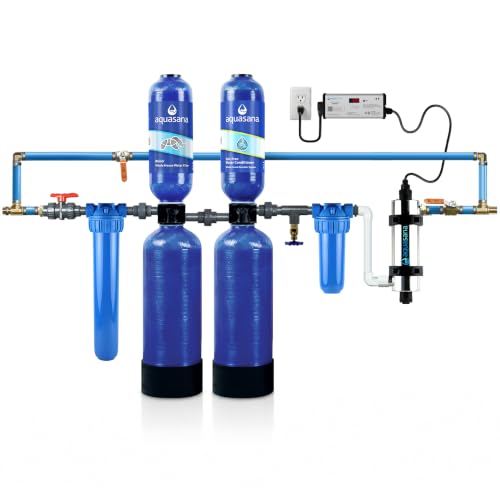
One million gallons, ten years, and a UV stage the others do not carry.
This is the most complete system on the page and the most demanding to install. Multi-stage filtration combines pre- and post-filters with carbon, KDF, UV, and salt-free Scale Control Media, and Aquasana states it reduces 97% of chlorine while tackling bacteria, viruses, and scale. The UV stage is tested and certified to NSF/ANSI Standard 55, Class B — a certification none of the other systems here list. Capacity runs to 1,000,000 gallons over a 10-year filter life cycle.
What owners notice first is taste. Chlorine and metallic notes disappear, water clarity improves, and the smell that sometimes comes off treated municipal supply goes with them. Filter replacement is straightforward enough that it comes up as a positive rather than a chore. The scale control is salt- and chemical-free and rated effective up to 15 gpg hardness, with no salt bags, backwashing, or cleaning required.
The sizing is strict and worth reading twice. Aquasana tune this system for water under 15 gpg hardness, low alkalinity, and pH below 8.3, for households of four or more. It explicitly does not soften or demineralize the water — the minerals stay. At 46″L x 9″W x 69″H it is a tall installation that wants a dedicated wall. Leak reports and pressure changes do surface in owner feedback, so a careful install with proper fittings matters, and an occasional unit arrives with a compromised post-filter.
What Sets This Apart
- 1,000,000-gallon capacity across a 10-year filter life cycle
- UV stage certified to NSF/ANSI Standard 55, Class B
- Aquasana states 97% chlorine reduction with carbon and KDF media
- Salt-free scale control rated to 15 gpg hardness with no backwashing
Things To Get Right
- 46″L x 9″W x 69″H needs a tall, dedicated wall and a careful install
- Water pressure and leakage come up in owner feedback, so check fittings and watch the post-filter on arrival
- Does not soften or demineralize, and is not intended for water above 15 gpg
The complete-package pick for: a household of four or more on moderate-hardness water who wants filtration, UV, and scale control from one system and will pay for the install.
Look elsewhere if: your hardness exceeds 15 gpg, your pH runs above 8.3, or a six-foot wall is not available.
Know the Specs
Grains per Gallon and the Salt-Free Ceiling
Hardness is measured in grains per gallon, and it decides which type of system can help you. A salt-based softener removes the hardness minerals, so it works across a wide range. Salt-free conditioners work by changing how those minerals behave, and they come with a practical ceiling. Aquasana rates its scale control for water up to 15 gpg, which is a fair guide for the category. Above that, a softener is the safer bet. Look up your number before choosing — a conditioner on very hard water will prevent some scale but will not give you soft-water feel.
Micron Ratings and Contaminant Reduction
A micron is a millionth of a meter, and the rating tells you the size of particle a filter will catch. iSpring uses a 5-micron sediment filter as a first stage, and Kind Water ships a 4.5″ x 20″ pleated 5-micron sediment filter for the same purpose. Smaller nominal numbers catch finer grit. Separately, look at what media does the chemical work — KDF and granular activated carbon pull chlorine and heavy metals, carbon block handles taste and odor, and UV is a different mechanism entirely, aimed at bacteria and viruses. A filter that catches sediment will not remove chlorine, and one that removes chlorine will not soften.
Capacity in Gallons vs. Grain Count
Two different capacity numbers show up on this page, and they measure different things. Filter and conditioner systems are rated in total gallons treated — 100,000 gallons on the iSpring PFAS unit, 250,000 on the iSpring WGB32B-DS, 900,000 on the Tier1 TAC tank, and 1,000,000 on the Aquasana. Softeners are rated in grains, which is the amount of hardness mineral the resin bed can capture before it must regenerate. A 48,000-grain bed serves a household of two to five people, which is the size both Fleck-based systems name. Do not compare the two numbers directly — one is a lifespan, the other is a working load.
What GPM Means on Your Main Line
GPM stands for gallons per minute, the flow rate the unit can pass without a noticeable pressure drop. The iSpring and Kind Water systems list 15 gpm, the Tier1, ABCwaters, and AFW filters list 12 gpm, and the Aquasana lists 14.6 gpm. If two showers, a dishwasher, and a washing machine can run at once in your house, you want headroom above your peak draw. A low-flow rating on a busy household shows up as weak shower pressure — the water pressure aspect is the one thing that lands in mixed territory in feedback on both the iSpring WGB32B-DS and the Aquasana.
Common Questions
Will a salt-free conditioner actually make my water feel soft?
How do I find out my water hardness before buying?
Can I install a whole house line conditioner myself?
Do I need a drain line and electricity for a softener?
How often will I have to change the filters?
What happens to existing scale already in my pipes?
Is a salt-free conditioner better than a traditional softener?
Will a whole house system drop my water pressure?
Does a conditioner remove chlorine and chemicals too?
What is TAC and how does it prevent scale without salt?
The Bottom Line
For most households, the whole house line conditioner that makes the most sense is the iSpring Ultimate PFAS Protection system, because it layers SGS-tested PFAS media (filter material tested by SGS, an independent testing firm, to reduce PFAS — long-lasting “forever chemicals”), KDF and carbon for heavy metals and chlorine, and a dedicated scale inhibitor into one 100,000-gallon unit with a 12-month cartridge interval. If scale prevention with zero consumables is all you need, the HydroFLOW Pearl Plus clamps onto the pipe without a plumber; if you want genuinely soft water and can handle salt, the ABCwaters Space Saver arrives pre-programmed with the install kit in the box.
One last thing worth checking before you order: confirm your hardness number in grains per gallon and your main line diameter (the width of your incoming water pipe). Those two figures rule out more bad purchases in this category than any spec sheet comparison. The Aquasana at WH-1000-CS-UVS-B is the most complete system here with its NSF/ANSI 55 UV stage (an ultraviolet lamp certified to the NSF/ANSI 55 standard for treating water) and 1,000,000-gallon capacity, but it will not help if your water runs above 15 gpg — that is the one sizing limit you cannot work around.
How we choose
We do not accept paid placement. Every pick is matched to a real buyer and a real use-case; we do not hands-on test units.
Sources
Specifications: manufacturer listings and product documentation. Review insights: verified customer reviews. Pricing: not shown on this page (it changes often); check the current price via the retailer link.
As an Amazon Associate, Tactical Gear Guy earns from qualifying purchases. This does not affect which products we feature.