Specs are compiled from manufacturer listings and verified buyer reviews and can change over time — please confirm the key details on the product page before buying.
If your house feels dry all winter, the fix is not another plug-in mist box — it is a unit mounted on your furnace that humidifies every room through the ductwork you already have. The short answer: match the unit’s daily water output and square-foot rating to your home, then decide if you want a manual dial or an automatic control that reacts to outdoor temperature. Nail output and control type and the remaining differences come down to brand.
This guide is built by comparing the manufacturers’ published specifications and the patterns across verified customer reviews, so you get each pick’s real strengths and trade-offs instead of marketing spin.
Below you’ll find eleven furnace-mounted picks sorted by real-world job, from a compact bypass unit for a tight mechanical closet to a 21-gallon-per-day fan-powered machine for a large home, all laid out so you can match one to your ductwork and your square footage before you buy any whole house furnace humidifiers for home.
Quick Picks
- AprilAire 600M Whole-House Humidifier
- GeneralAire Model 3200M Evaporative Humidifier — Budget Champion
- DIGI MISTER DM538 Evaporative Duct Mounted — Compact Pick
- Trion Duct Mounted Atomizing 24V Humidifier — Most Adjustable
- GeneralAire Humidifier Unit 1042-LH — Best Replacement
- Honeywell Home HE280A Whole House Humidifier — Best Water Saver
- AprilAire 500 Whole-House Humidifier + 5844 — Best All-In Bundle
- Honeywell HE300A1005 TrueEASE Fan Powered — Fan-Powered Value
How To Choose The Best Whole House Furnace Humidifiers for Home
A whole-house furnace humidifier is a box that taps into your heating system’s ductwork and adds moisture to the warm air as it moves through. Because it works through the ducts, one unit can raise the humidity in every room instead of just the room where a portable unit sits. The three things that decide whether you’ll be happy are output, install type, and control.
Start with gallons per day, not the square-foot claim
Gallons per day (GPD) is how much moisture the unit can push into your air in a 24-hour stretch. The square-foot rating on the box is a best-case number for a tightly built home, so treat it as a ceiling rather than a promise. A larger home in a cold climate wants more GPD headroom so the unit isn’t running flat out all season. The GeneralAire 3200M is rated at 12 gallons against a 3,200 square-foot area, while the AprilAire 720M and 720A both push 21 gallons per day.
Bypass, fan-powered, or atomizing — pick by your ductwork
A bypass unit steals a small amount of warm air from the supply duct, runs it through a water panel, and returns it to the return duct — it needs a short piece of bypass duct and, usually, a drain. A fan-powered unit has its own blower that pulls heated air through the panel, so it doesn’t rely on duct pressure and tends to deliver more output. An atomizing unit sprays a fine mist straight into the duct and evaporates it there, which can mean no drain line — but it wants adequate water pressure to work.
Manual versus automatic control
A manual humidistat is a dial or simple digital readout where you set a humidity percentage yourself. An automatic control reads outdoor temperature and adjusts the indoor setpoint for you, which matters because the right indoor humidity drops as it gets colder outside. Neither is a quality upgrade — it’s a convenience choice, and it’s the main difference between the AprilAire 720M and 720A.
Plan for the yearly water panel
Evaporative units pass water over a pad or cartridge that traps minerals and then evaporates the water into the air. That pad loads up and needs replacing, typically once a year, so check that the replacement part is easy to find and easy to swap. AprilAire’s one-piece HydroCore cartridge, for example, pops in and out as a single piece, while the GeneralAire 1042-LH calls for genuine 990-13 pads once or twice per season.
Side-by-Side Comparison
| Model | Best For | Capacity (GPD) | Coverage (sq. ft.) | Install Type | Amazon |
|---|---|---|---|---|---|
| AprilAire 600M | Large homes wanting simple manual control | 17 gallons/day | 5,000 | Bypass, evaporative | Amazon |
| GeneralAire 3200M | Tight budgets and compact installs | 12 gallons | 3,200 | Bypass, wick filter | Amazon |
| DIGI MISTER DM538 | Drain-free atomizing installs | — | 3,500 | Atomizing, duct mount | Amazon |
| Trion Mister-MINI | No-filter, adjustable-nozzle setups | — | — | Atomizing, duct mount | Amazon |
| GeneralAire 1042-LH | Replacing an existing bypass unit | 17 gallons/day | 2,800 | Bypass, media filter | Amazon |
| Honeywell HE280A | Water-conscious flow-through installs | — | 4,000 | Flow-through, duct mount | Amazon |
| AprilAire 500 + 5844 Kit | First-timers who want every part in one box | 12 gallons/day | 3,600 | Bypass, evaporative | Amazon |
| Honeywell HE300A1005 | Fan-powered output with digital control | 18 gallons/day | — | Fan-powered, wick filter | Amazon |
| AprilAire 700M | Big homes, proven fan-powered design | 18 gallons/day | 5,300 | Fan-powered, evaporative | Amazon |
| AprilAire 720M | Very large homes, manual control | 21 gallons/day | 6,250 | Fan-powered, evaporative | Amazon |
| AprilAire 720A | Very large homes, hands-off control | 21 gallons/day | 6,250 | Fan-powered, evaporative | Amazon |
Detailed Reviews
1. AprilAire 600M Whole-House Humidifier
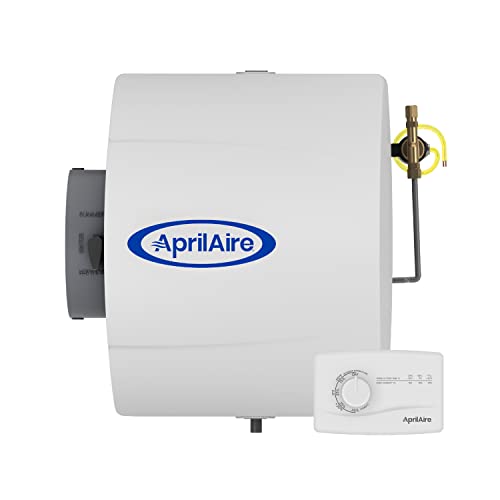
Seventeen gallons a day for a big house, without paying for a control you may never program — that’s the deal here.
The number to fix your eyes on is 17 gallons per day, the moisture this bypass unit can push into your ducts in 24 hours. That output is rated for tight homes up to 5,000 square feet, so a large house in a cold climate has headroom instead of running flat out. It’s a bypass evaporative design, meaning it borrows warm air from the supply duct through a water panel and returns it to the return side, and it weighs 8.7 pounds, which makes it one of the easier bodies to hang on a plenum.
What keeps people happy long-term is how little there is to think about: a manual humidistat with a single built-in sensor reads indoor relative humidity and you set the percentage yourself. Owners commonly report a steady mid-forties relative-humidity reading once they dial in the setpoint. The install is manageable with the included transformer, valve, sensor, and water panel all in the box, and the printed instructions are the sort you can follow without an HVAC background if you’re comfortable cutting a plenum opening. An AprilAire 10 Water Panel is the yearly replacement, and swapping it is a two-minute job.
The catch is exactly what the manual control implies — nothing compensates for the outdoor temperature dropping. On a bitter night you either walk over and turn it down or you accept condensation on the windows. If you want the unit to make that decision for you, pay up for an automatic model instead. And because it’s a bypass design, it depends on your furnace blower running to move the moisture, so it pairs best with a system that already moves a good volume of air.
Where it earns the top slot
- 17 gallons per day output gives a big house real moisture headroom.
- Light 8.7-pound body is easier to mount on a plenum.
- Every install part ships in the box — humidistat, transformer, valve, sensor, water panel.
What to weigh first
- Manual control never adjusts for outdoor temperature on its own.
- Bypass design relies on furnace airflow to distribute moisture.
Reach for this if: your home is large and you’re happy setting one humidity number and leaving it.
Look elsewhere if: you want a control that reacts to the weather so you never touch a dial.
2. GeneralAire Model 3200M Evaporative Humidifier

The low-cost entry into duct-mounted humidity, sized for a mid-size house and a tight mechanical closet.
This is a flow-through bypass unit with a 12-gallon capacity, and that figure is a striking jump from what the Honeywell HE280A block lists at 1 gallon. Coverage is rated at 3,200 square feet and the whole thing tips the scale at just 3.5 pounds, so hanging it takes far less muscle than the 15.2-pound GeneralAire 1042-LH. A wick filter handles the evaporation, and the MHX3C manual humidistat comes bundled — you set the humidity percentage, the sensor watches the room, and that’s the whole interaction.
For a homeowner who wants the duct-humidifier idea without a big outlay, that combination is genuinely appealing: evaporative bypass operation, a compact footprint, and maintenance that amounts to changing a wick pad. It suits a well-sealed 3,200-square-foot home where the winters aren’t brutally cold, or a smaller house where the 12-gallon ceiling is ample. The listing sums it up as easy to install, easy to maintain, and compact, and all three hold up if your duct setup already has room for a bypass run.
Understand the trade-off before you commit: a wick-style pad and a 3,200-square-foot ceiling mean this is not the machine for a sprawling house in a deep-freeze climate. It is a value-tier evaporative unit doing a value-tier job, and that’s a fair deal for the money — just don’t expect the output headroom of the fan-powered picks further down.
Honest read on the fit: best matched to a mid-size, reasonably sealed home where a manual dial and a wick pad suit your routine — and a real bargain on that brief.
Your move if: you have a mid-size house and want the duct-mounted fix at an entry-level outlay.
Step up instead if: your square footage pushes past the 3,200 rating in a genuinely cold climate.
3. DIGI MISTER DM538 Evaporative Duct Mounted Humidifier

A hummingbird-sized mist injector that skips the drain line — and needs real water pressure to do it.
At 1.7 pounds, this atomizing unit is not in the same weight class as the bypass boxes above — the GeneralAire 1042-LH is 15.2 pounds by comparison. Its body measures only 4.3 by 5.1 by 4.3 inches, so it slips into a tight mechanical closet where a full evaporative cabinet won’t go. It sprays a fine mist straight into the duct, which evaporates into the airflow with no wasted water running to a drain — the listing says no duct work and no drainage are required, just a small cut-out.
That atomizing trick is where it earns its place, because it’s rated for a flexible range from 1,000 up to 3,500 square feet depending on how many fine mist nozzles you run and how you set the water pressure and warm-air temperature. Digital control lets you dial in the target humidity and duct air temperature, with calibration and °F/°C switching, and eight built-in UV-C LED lamps switch on whenever the unit is powered — 260-280 nm wavelength light, which keeps working even in summer with the AC running. Maintenance is thoughtful too: an observation window lets you check the mist, mist nozzles can be tested and cleaned with the included nozzle tester, and a swing-out design makes replacing them easy with the spare nozzles in the box.
Be clear-eyed about two things. It demands a 24VAC transformer and adequate line pressure above roughly 30 psi, and the listing itself notes certain HVAC expertise is needed to install it. The bigger caution is reliability: the feedback on longevity is mixed, with accounts of units that quit after a few months. That makes it a fit for someone comfortable doing their own HVAC work and troubleshooting, not a set-and-forget buyer.
The clever bits
- Atomizing mist means no drain line and no wasted runoff water.
- Output scales from 1,000 to 3,500 square feet via nozzle count and pressure.
- Eight UV-C LED lamps run whenever the unit is powered.
- Observation window, nozzle tester, and swing-out nozzle access for upkeep.
Where it asks for patience
- Needs a 24VAC transformer and adequate water pressure to atomize properly.
- Longevity reports are mixed — some units quit after a few months.
Worth it for: the DIY-capable owner with a cramped duct space and no easy path to a drain.
Think twice if: you want a hands-off unit that runs for a decade without a service call.
4. Trion Duct Mounted Atomizing 24V Humidifier Mister-MINI

No pad to buy, no filter to change — just a nozzle you swap to set the moisture output.
Here’s the pitch in one line: this atomizing unit has no pads and no filters. Instead, capacity goes up or down by changing the nozzle, so the same body can suit a small house or a bigger one without buying a different machine. At 15.3 ounces it’s a featherweight next to the 15.2-pound GeneralAire bypass unit, and the tilt-out mounting is designed to make servicing it a quick swing rather than a disassembly job. Push-to-lock fittings mean the water connections snap in without tools.
The single nicest detail for anyone who’s been burned by a pad humidifier is the nozzle-based upkeep — no water panel soaking up scale, nothing to buy once a season. Owners of this type commonly praise the build quality and the straightforward install, and it pairs with a wide range of furnaces; the review pages describe it running alongside an 80,000 BTU gas furnace, which is the kind of big heating plant these duct injectors are often bolted to.
The honest catch is the overall verdict on how well it manages humidity, which is genuinely split — plenty of cases of it working very well, and plenty of cases of it not working all that great. Water usage and durability get mentioned as soft spots too. That doesn’t make it a bad unit; it makes it a good unit for someone who wants pad-free convenience and is willing to tune it to their duct and pressure, and a poor fit for someone who wants guaranteed results with no fiddling.
What’s genuinely appealing: a pad-free system you can re-tune with a nozzle swap, on a unit light enough to hang almost anywhere and built with tool-free push-to-lock water fittings.
One honest caveat: humidity regulation results are genuinely mixed, so it rewards a buyer who tunes rather than a buyer who sets and forgets.
Best suited to: an owner who hates buying replacement pads and is happy to swap a nozzle to tune output.
Less ideal for: someone who wants a single part number to install and never revisit.
5. GeneralAire Humidifier Unit 1042-LH
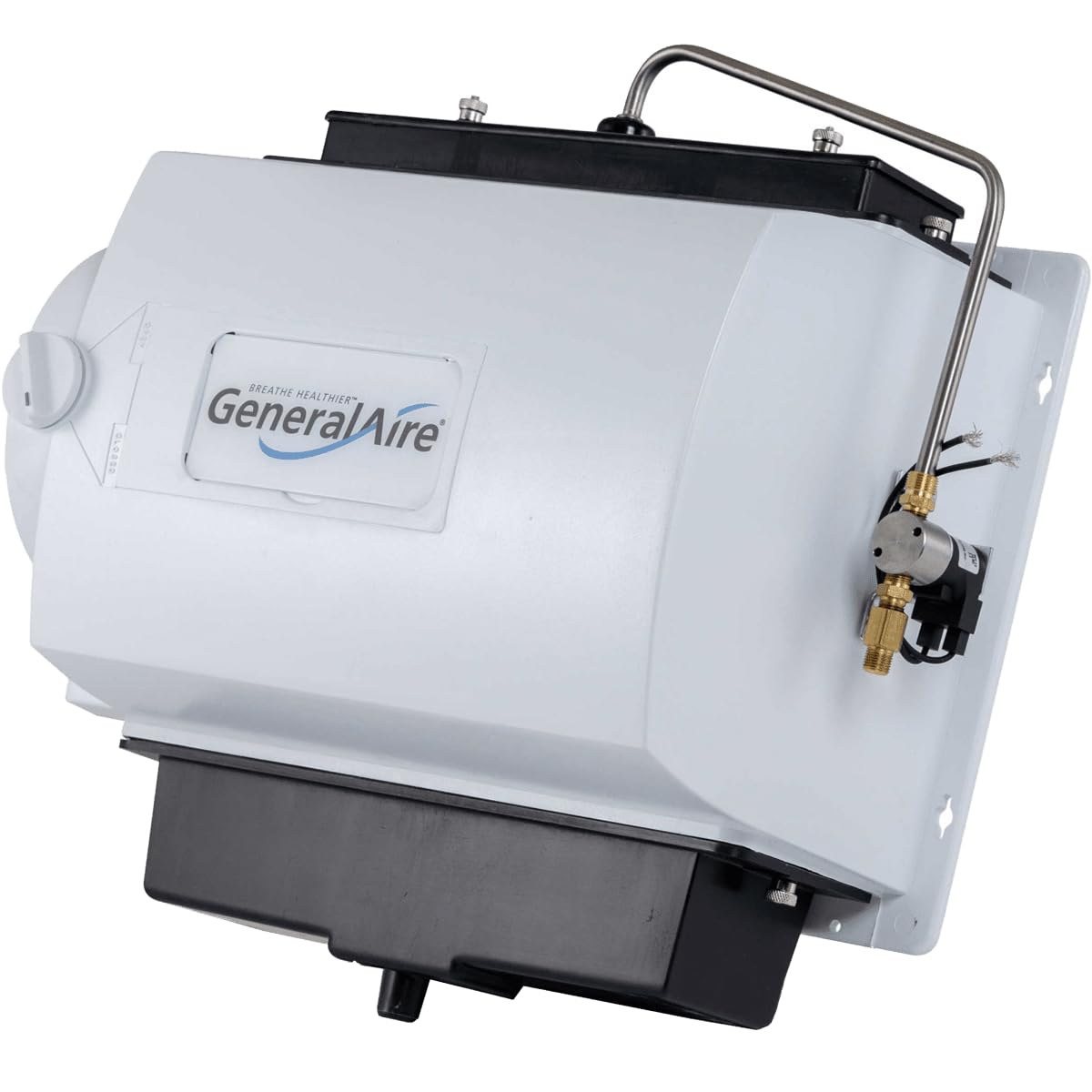
A drop-in bypass workhorse that’s already proven itself as an exact replacement in thousands of basements.
Performance is what this one is known for, and the spec sheet backs the reputation — 17 gallons per day at a 120°F plenum temperature, covering homes up to 2,800 square feet. That’s less square footage than the Honeywell HE280A’s 4,000, but the daily output tops it comfortably. It’s a furnace-mounted 24-volt bypass unit with a 120V transformer included, and the duct connection is reversible for either right-hand or left-hand routing, which is exactly what you want when you’re matching an existing cutout in a 9 1/2 by 13 5/8 inch plenum opening.
Tilt this pick toward anyone replacing a tired bypass humidifier: the 1042-LH is the kind of unit people buy specifically as an exact replacement, and it ships with the filter and manual. Owners widely describe it working effectively — including in smaller homes around 900 square feet where it brings things up quickly — and note it arrives with the screws and hardware you need rather than sending you to the hardware store mid-install. It’s a heavier body at 15.2 pounds, so plan for a second set of hands on the ladder.
The recurring gripe worth knowing: it takes genuine GeneralAire 990-13 replacement pads, and you’ll swap them once or twice per season. Go with a generic pad and the performance you bought it for can suffer. Budget for the right pads and this is a dependable, workmanlike unit.
Why it’s a smart replacement buy
- 17 gallons per day output even in a smaller 2,800-square-foot footprint.
- Reversible duct connection fits either RH or LH routing.
- Arrives with the filter, manual, screws, and hardware for the install.
- Well-regarded performance and build quality in the reviews.
The part nobody likes
- Requires genuine 990-13 pads, replaced once or twice per season.
- 15.2 pounds means a two-person hang.
It’s the one for you if: you’re swapping out an existing bypass unit and want the same footprint plus solid output.
Give it a miss if: you want a pad-free design or a unit light enough to hang solo.
6. Honeywell Home HE280A Whole House Humidifier

The water-thrifty option: a flow-through design rated for 4,000 square feet, and its makers claim 30% less water than standard models.
Coverage is the headline — this unit is rated up to 4,000 square feet, which beats the GeneralAire 1042-LH’s 2,800 by a wide margin. It mounts on either the warm-air supply or the return duct of any forced-air furnace, so you’re not locked into one side of the system. Honeywell claims its water-saving design uses 30% less water than standard models, and the flow-through path keeps water moving so the pad scales up more slowly and needs less frequent swapping.
Installation is where it shines in the reviews: clear instructions, all mounting components in the box, and a body that goes up without head-scratching. Once running, it holds indoor humidity steady through the winter, which keeps wood floors and furnishings from drying and cracking. For a homeowner who wants a big-coverage humidifier and water efficiency together, this is a genuinely strong pick.
Be honest about the split on build quality and long-term reliability. Most buyers report it holding humidity tightly, and the water savings are real if the claim holds for your setup; but alongside that are reports of units that fail to work properly.
The attractive part: 4,000 square feet of coverage with a water-saving design the maker says cuts usage by 30% versus standard models — big reach, less waste.
Where it can disappoint: reliability feedback is mixed, with some units failing to perform — so install care and pad upkeep matter more here than on a simpler bypass box.
Choose it for: a large home where water savings and a big coverage rating both count.
Pass if: you need the simplest, lowest-fuss mechanics with no mixed word on reliability.
7. AprilAire 500 Whole-House Humidifier + 5844 Installation Kit

Every hose, wire, and screw you need in one box — plus a control that does the thinking so you don’t have to.
This is a bypass evaporative humidifier cranking out 12 gallons per day for homes up to 3,600 square feet, and unlike the manual-only 600M above, it ships with the Model 60 Automatic Digital Humidistat. That control reads your home’s relative humidity and turns the humidifier on when needed, adjusting itself instead of asking you to remember. The 7.8-pound body is easy for one person to hang, and the water panel filters impurities before they ever reach your air.
The bundle is the real selling point for a first-time buyer. It comes with the 6-inch round bypass flex duct, both thermostat wires, the 25-foot water supply tube, the 10-foot drain tube, mounting screws, and the water panel — everything you’d otherwise hunt down in separate trips. Installation is listed as manageable with detailed instructions, and the 5-year warranty from AprilAire adds confidence.
Where to temper expectations: the reviews on installation and function are genuinely split, with some finding it straightforward and others reporting many hours of work and difficulty reaching the target humidity.
The bundle advantage
- 12 gallons per day for homes up to 3,600 square feet.
- Model 60 Automatic Digital Humidistat adjusts on its own.
- Complete install kit — duct, wire, tubing, screws, and panel included.
- Light body at 7.8 pounds — easy for one person to hang.
Where to set expectations
- Installation effort is genuinely mixed, from simple to many hours depending on your ducts.
- Some find it hard to hit the target humidity.
Ideal for: a first-time duct-humidifier buyer who wants one box with all the parts and automatic control.
Better left alone if: you want the fastest possible install or already have the parts on hand.
8. Honeywell HE300A1005 TrueEASE Fan Powered Humidifier

A built-in blower pushing 18 gallons a day, and a control panel that tells you when to service it.
It ships with the HumidiPRO Digital Humidity Control, and the design is aimed at straightforward installation with labor-saving touches for the installer. Honeywell also built in noise reduction so you get humidity without a rumbling complaint from the hallway.
For a mid-size to large home where a bypass unit might struggle to move the moisture, that fan more than earns its keep — it distributes moisture evenly into the airstream. Once dialed in, owners tend to land in a comfortable zone; the reviews describe holding roughly 40% humidity consistently through the house and running reliably all winter. The one-piece body is a clean rectangle, and maintenance is a wick pad you change on a schedule.
It’s also a heavier plastic body, so budget a two-person mount like the other fan-powered units.
The strong suit: a built-in blower delivering 18 gallons per day with the HumidiPRO digital control included, plus noise-reduction design for quiet running.
Fair warning: owner feedback is thinner than on the high-volume picks, so you’re buying on the fan-powered design and Honeywell’s control reputation.
Worth a look if: you want fan-powered output and a digital control bundled in one unit.
Keep shopping if: you want a deep well of verified owner experience behind the purchase.

Eighteen gallons a day, a fan that grabs heat straight from the furnace, and the biggest owner track record here.
Start with the fan, because it’s the whole point of this design: a built-in blower pulls heated air directly from the furnace through the humidifier panel, so it doesn’t depend on duct pressure and delivers a steady 18 gallons per day for tightly built homes up to 5,300 square feet. The body handles it at 11.7 pounds with a straightforward manual humidistat that reads indoor humidity and lets you set the percentage.
What makes this the proven pick in the fan-powered group is the sheer weight of owner experience — this is the model that’s been installed in a great many basements, and the consensus is that it simply works through a whole winter. Functionality and build quality earn the most praise by far; owners also note the wiring is simple to follow and the unit fits well in spaces where a previous humidifier lived, and the listing’s 24VAC transformer, control, valves, and instructions all come in the box. The digital control adjusts based on outside temperature, which pulls some of the guesswork out of seasonal shifts.
Two honest notes on control accuracy and water usage are the only quibbles worth flagging, and they’re minor against the overall pattern. If you have a large home in a cold climate and want a fan-powered unit with a long track record, this is the safe choice — it just won’t let you program it from your phone.
What wins people over
- Built-in fan pulls heated air straight from the furnace for 18 gallons per day.
- Rated for tightly built homes up to 5,300 square feet.
- Simple wiring and a fit that matches existing cutouts.
- Proven reliability across a wide base of owners.
Minor trade-offs
- Control accuracy and water usage draw some light criticism.
- No remote or app control — manual humidistat only.
The one to pick if: you have a big home and want fan-powered output with a decade’s worth of owner confidence behind it.
Skip if: you want app or remote operation rather than a wall-mounted dial.

Twenty-one gallons a day and a 6,250-square-foot rating — this one is built for the biggest houses on the street.
The capacity figure is where to start: 21 gallons per day, covering up to 6,250 square feet. That’s the highest coverage here, and it sits well above the Honeywell HE280A’s 4,000-square-foot rating. It’s a fan-powered evaporative unit with a hybrid fan pulling heated air through the panel, and the one-piece disposable HydroCore cartridge pops in and out as a single piece for annual swaps — made with recycled plastic. The distribution tray lets installation sit up to 3 degrees out of level, and a catch-all drain is designed to curb leaks.
Water efficiency is the second thing to note. A recirculation valve recycles drain water, and AprilAire claims 60% less wastewater than the 700 Humidifier while moving 3X more water across the panel. If you’ve run a bypass unit and watched water go down the drain all winter, that’s the upgrade that stops the waste. The manual control is duct- or wall-mount compatible and measures humidity changes so you can set your own percent, and the reversible fan module reconfigures for left- or right-hand installs, including horizontal furnaces.
Performance is what owners talk about most — this thing raises humidity levels and does it visibly. The HydroCore’s one-piece swap is the maintenance highlight; owners consistently note how easy it is to pull the old cartridge and drop in a new one. The clear limit is the manual control: nothing adjusts for outdoor temperature unless you turn the knob yourself. If that bothers you, look at the 720A.
Read the room: 21 gallons per day and a 6,250-square-foot rating make this the biggest-capacity pick here, with a recirculation valve AprilAire says cuts wastewater by 60% versus its own 700 model.
The manual-control note: this is set-the-dial humidity, not automatic weather-tracking — perfect if you like a fixed setting, tedious if you’d rather the system think for you.
This is your unit if: you have a very large home and want the most moisture output with minimal water waste.
Choose the automatic sibling if: you’d rather the control adjust itself as the temperature drops.

The 21-gallon powerhouse with a control that reads the outdoor temperature and adjusts for you.
This is the same 21-gallon-per-day frame and 6,250-square-foot rating as the 720M above, and the same water-saving recirculation valve — AprilAire claims 60% less wastewater than the 700 Humidifier, recycling water to push 3X more across the panel. The body weighs 13.8 pounds and uses the one-piece HydroCore cartridge for annual swaps. The distribution tray tolerates up to 3 degrees out of level, and the reversible fan module reconfigures for horizontal and tight installs.
What you’re paying extra for is the control: the Model 60 Automatic Digital Humidistat adjusts humidity levels based on outdoor temperature in Automatic Mode, and it also offers Manual Mode when you want to set things yourself. The large blue LED-backlit LCD display shows relative humidity percentage and setpoint, so a glance tells you where the house stands. AprilAire says the hybrid fan delivers 2X the evaporative efficiency of the 700 on high speed.
Owner feedback lands on performance and water efficiency as the top praise, with the recirculation design keeping running costs calmer than a flow-through unit, and installation described as straightforward. On the one thing buyers worry about most, the honest note is that noise opinions split — some find it much quieter than expected, others less so. Given it sits in a basement or closet rather than a living room, that’s usually a non-issue, but it’s worth knowing if your install lands near a bedroom.
Why the automatic control is worth it
- Automatic Mode adjusts humidity based on outdoor temperature; Manual Mode is there too.
- 21 gallons per day with a 6,250-square-foot rating for very large homes.
- Recirculation valve cuts wastewater — 60% less than the 700 model per AprilAire.
- HydroCore cartridge makes annual panel changes a one-piece swap.
- Blue LED-backlit LCD shows humidity percentage and setpoint at a glance.
Worth knowing before you buy
- Noise level draws mixed opinions — some find it quiet, others louder.
- It’s the top of the price ladder here for the same 21-gallon output as the 720M.
Pick this one if: you want the biggest capacity with a control that handles the seasonal adjustments for you.
Save the difference if: you’re happy setting a manual dial and don’t need the automatic mode.
Know the Specs
Gallons Per Day (GPD)
This is how much moisture the unit can add to your air over 24 hours. A higher number means the unit can keep up with a bigger, colder home without running flat out. The AprilAire 600M lists 17 gallons per day and the AprilAire 720M and 720A both list 21 gallons per day. Match the number to your square footage and how cold your winters run.
Coverage Area (square feet)
This is the size of home the maker rates the unit for, assuming a tightly built house. It’s a guide, not a guarantee — a drafty older home may need a unit rated above its actual square footage. The Honeywell HE280A is rated to 4,000 square feet, while the AprilAire 720M and 720A are rated to 6,250.
Bypass vs Fan-Powered
A bypass unit uses your furnace’s own airflow to push warm air through a water panel and back into the ducts. A fan-powered unit has its own blower to pull heated air through the panel, so it works independently of duct pressure and tends to deliver more output. The GeneralAire 1042-LH is a bypass unit; the AprilAire 700M and 720A are fan-powered.
Manual vs Automatic Humidistat
A manual humidistat is a dial or simple screen where you set the humidity percentage yourself. An automatic control measures outdoor temperature and adjusts the indoor setpoint for you. The AprilAire 600M and 700M come with manual controls, while the AprilAire 500 bundle and 720A ship with automatic digital controls.
Water Panel And Filter Type
Evaporative units use a pad or cartridge that water passes over; minerals collect there and the water evaporates into your air. That pad needs replacing, usually yearly. Wick and media filters work on the same principle. The AprilAire 720A uses a one-piece HydroCore cartridge for a fast annual swap, and the GeneralAire 1042-LH calls for genuine 990-13 pads once or twice a season.
Water Usage And Wastewater
Flow-through designs send unused water down the drain, while recirculating designs reuse it. Honeywell says its HE280A uses 30% less water than standard models, and AprilAire says the 720M and 720A cut wastewater by 60% versus its 700 model. If water waste bothers you, look for a recirculation valve.
Common Questions
Will a furnace humidifier work with my existing forced-air system?
How many gallons per day do I need for my square footage?
What is the difference between a bypass and a fan-powered humidifier?
How often do I need to replace the water panel?
Do I need a drain line for a whole-house humidifier?
Will a whole-house humidifier help with static shocks and dry skin?
Can I install a furnace humidifier myself?
Is a manual or automatic humidistat better?
Will a furnace humidifier work in summer with the AC running?
How much water does a whole-house humidifier waste?
The Bottom Line
For most homes, the pick is the AprilAire 600M — 17 gallons per day of moisture, a 5,000-square-foot rating, and a manual humidistat that keeps the whole setup simple and reliable. If you have a very large house and want the most output with less water waste, the AprilAire 700M and the 720A are the fan-powered step-ups worth the spend. And for a mid-size home on an entry-level outlay, the GeneralAire 3200M does the job without overcomplicating your winter.
How we choose
We do not accept paid placement. Every pick is matched to a real buyer and a real use-case; we do not hands-on test units.
Sources
Specifications: manufacturer listings and product documentation. Review insights: verified customer reviews, as of November 2026. Pricing: not shown on this page (it changes often); check the current price via the retailer link.
As an Amazon Associate, Tactical Gear Guy earns from qualifying purchases. This does not affect which products we feature.