Specs are compiled from manufacturer listings and verified buyer reviews and can change over time — please confirm the key details on the product page before buying.
You want a white helmet because white is the most visible shell color on a grey road, and that visibility is the whole point of picking white in the first place. But white shells show every scuff and bug splat, and the wrong one will fog up on a cold morning and rumble with wind roar on the highway. The picks below are all genuinely white or gloss-white shells, they all carry DOT certification, and each one solves a different problem — fog, noise, flip-up convenience, or all-day comfort on a long ride.
This guide is built by comparing the manufacturers’ published specifications and the patterns across verified customer reviews, so you get each pick’s real strengths and trade-offs instead of marketing spin.
Your pick depends on three things: how you ride, your budget, and if you want a solid full-face shell or a flip-up that lets you talk at a red light. Below, the white motorcycle helmet options are compared on shell material, venting, and real owner feedback.
Top Picks


How To Choose The Best White Motorcycle Helmet
A white shell is a safety decision as much as a style one — a bright white helmet stands out against asphalt, and it stays cooler under direct sun than a black shell. But white is unforgiving: it shows road grime, it shows swirl marks after a clumsy wipe, and a cheap glossy finish can yellow over time. So the buying question is which white shell still looks good three seasons in. It is which white shell is built well enough that you are still glad you picked white three seasons from now.
Check the certification label before anything else
DOT means the helmet meets Federal Motor Vehicle Safety Standard 218, the minimum legal bar for road use in the US. FMVSS 218 is that same standard written out in full — you will see both terms used interchangeably. Snell is a separate, voluntary standard that some manufacturers also test to; a helmet that carries Snell alongside DOT has been put through an extra round of impact testing. For everyday street riding, DOT is the line you must not cross. Never buy a helmet that cannot show you that label.
Shell material decides weight and price
ABS plastic is the budget standard — it is tough and cheap, but it is heavier than fiberglass or polycarbonate composite. Fiberglass lay-ups like the shell on the Shoei RF-SR cost more to build but come in lighter. Polycarbonate is the middle ground used on several picks here. Heavier shells are not unsafe, but a 4-pound lid starts to ache your neck on a long highway day, while a helmet closer to 3.5 pounds feels noticeably less tiring over the same distance.
Vent count and visor treatment stop the fog
Fogging happens when your breath hits a cold visor with no airflow behind it. More intake and exhaust vents push that moist air out. A Pinlock-ready visor (a shield designed to take an anti-fog insert) accepts a separate insert that clips to the inside of the shield. Those inserts are the most effective anti-fog fix for cold-weather riding, but on some helmets the insert is included and on others it is sold separately. Check which one you are getting before you buy.
Full-face or flip-up modular
A full-face helmet has a fixed chin bar and is generally lighter and quieter for the same money. A flip-up modular helmet lets the chin bar swing up so you can talk, drink, or take a call without pulling the whole helmet off. That flip-up convenience adds weight and wind noise at speed. If you ride mostly open highway, full-face is the cleaner choice; if you commute with lots of stops, flip-up earns its keep.
Side-by-Side Comparison
| Model | Best For | Shell Material | Weight | Vents | Amazon |
|---|---|---|---|---|---|
| Shoei RF-SR★ Best Overall | Long-haul riders | Fiberglass / EPS | 3.5 lb | 5 | Amazon |
| VCOROS WS-609Best Value | Budget full-face | ABS | 2.28 kg | 3 | Amazon |
| KYPARA 807Standout Looks | Standout looks | ABS | 2.18 kg | — | Amazon |
| 1Storm HB89 | Flip-up on a budget | Thermoplastic | 4 lb | — | Amazon |
| JQF Gear SJ-809 | Riders with comms | ABS | 2.48 kg | — | Amazon |
| ILM 902/902L | Night visibility | ABS / EPS | 2.36 kg | 6 | Amazon |
| BEON B-503 | Quiet-speed tuning | ABS | 1550 g | 3 | Amazon |
| HJC C91 | Glasses wearers | Polycarbonate | 3.5 lb | — | Amazon |
| AGV K1 S | Sport riding | Polycarbonate | 1580 g | — | Amazon |
Detailed Reviews
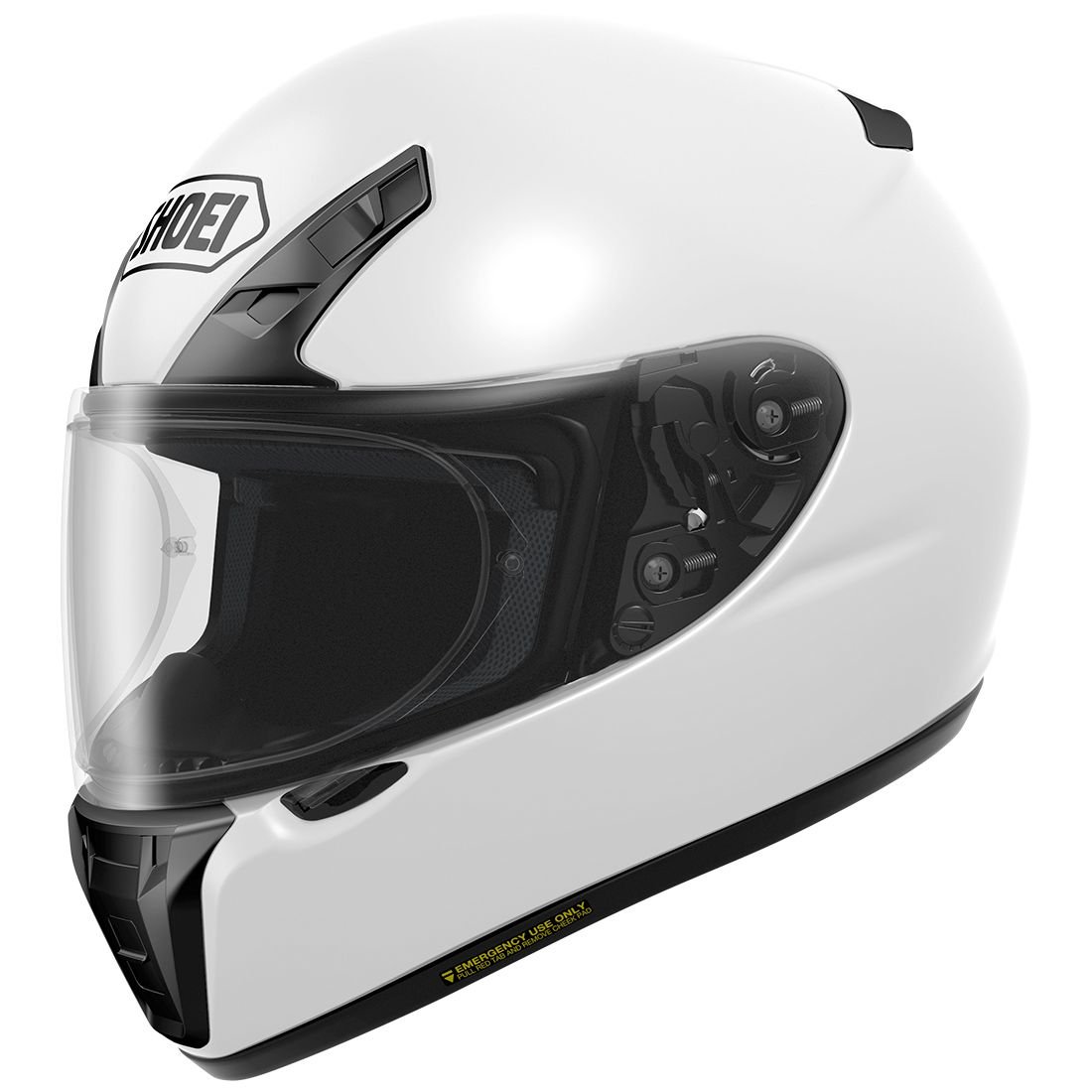
1. Shoei RF-SR Full Face Motorcycle Helmet
Our pick — 4.5+★ from 400+ verified ratings; the strongest balance of quality and price.
Three certifications and a fiberglass shell make this the one serious riders keep coming back to.
Most white helmets on this list clear the legal bar with a DOT sticker and nothing more. The Shoei RF-SR clears three: DOT, FMVSS 218, and Snell M2020D — a voluntary standard that adds a second round of independent impact testing on top of the federal minimum. Its Advanced Integrated Matrix shell layers fiberglass with organic fibers rather than mold it from plain ABS plastic, and the helmet weighs 3.5 pounds. Compare that to the 1Storm HB89’s 4 pounds, and you are carrying half a pound less on your neck over a long highway day.
Ventilation is where this shell earns its keep. The included Pinlock EVO lens clips to the inside of the shield and is the single most effective anti-fog fix you can fit to a helmet. You also get an emergency quick release system — pull the red tabs and the cheek pads slide out so a paramedic can remove the helmet without dragging it over your face.
Owners single out the shell construction and the fit as the reasons this helmet wins them over. The interior is a 3D custom system that wicks moisture (pulls sweat away from your skin), and it pulls out, washes, and goes back in without a fight. The trade-off is straightforward. Over a long highway run the wind noise is present enough that plenty of riders treat it as the one thing they would change, and the double-ring closure (a two-loop strap you thread and snap) takes an extra second at every stoplight compared to a quick-release buckle. Neither is a defect — they are the price of a Snell-rated shell (a shell that meets the Snell M2020D safety standard).
Where the RF-SR earns its spot
- Triple-certified: DOT, FMVSS 218, and Snell M2020D
- 3.5 lb fiberglass shell — half a pound under the 1Storm HB89
- 5 vents with an included Pinlock EVO anti-fog lens
- Emergency Quick Release System for safe removal after a spill
What you live with
- Wind noise at highway speed is a recurring theme in owner feedback
- Double-ring closure is slower than a quick-release buckle at stops
Built for: riders who put in real highway miles and want the extra confidence of a Snell-rated fiberglass shell.
Expect a trade: the double-ring strap and a live wind-noise note at speed come with the package.
2. VCOROS WS609 Full Face Motorcycle Helmet
The entry-price shell that still hands you a spare chrome-red visor and five size options.
Busy commuters and weekend street riders who want a real full-face lid without a premium outlay should start here. The VCOROS WS-609 is DOT approved and built to FMVSS 218, with a lightweight ABS shell wrapped around a high-density EPS liner. You get clear and chrome-red visors in the box, so you can run the mirrored look in daylight and swap to clear for night riding in moments — the visor mechanism is quick-release, so no tools.
Three vents (mouth, top, and rear exhaust) handle airflow, which is leaner than the five on the Shoei RF-SR but on par for this build tier. The chin strap uses a quick-release buckle, so getting in and out at a stop is a one-hand job. Sizes run S through XXL, and VCOROS asks you to measure your head circumference against their chart — worth doing, because size is the one split verdict in owner feedback, with some finding it spot-on and others a touch roomy. The shell quality itself draws steady praise, and the clear visor staying fog-free in ordinary conditions is a common bright spot.
The honest read: the ABS shell and 2.28 kg weight won’t match a fiberglass build for neck comfort over hundreds of miles, but for commuting and weekend jaunts it does the job without fuss.
Reach for this if: you want a DOT-certified white full-face, a spare tinted visor, and a buckle that lets you get it on fast.
Look elsewhere if: you want a shell that won’t fog at all — this one leaves fog control to the venting, not an insert.
3. Full Face Motorcycle Helmet White Samurai Spirit
The white shell that turns heads at the meet — and splits opinion once the wind picks up.
The White Samurai Spirit graphic is the reason to buy this shell, not a plain one. The White Samurai Spirit graphic on this KYPARA 807 is the point, and appearance is exactly what the owner feedback rewards most after fit. Beyond the looks it is a DOT-rated ABS shell at 2.18 kg — noticeably lighter than the JQF Gear SJ-809 at 2.48 kg, which matters when you are lifting it off after a hot ride.
The design choices are loud and functional at once. An oversized rear wing is shaping the tail to cut wind resistance, and the venting is generous for airflow and heat dissipation inside the shell. The buckle releases fast, and the microfibre liner pulls out, washes, and goes back in so a sweaty commute does not turn into a permanent smell. Fit draws the most consistent praise of anything on this helmet, with riders finding the round shape lands well.
The honest split is at speed. Some love the quiet; others find a bit of roar once you are up to highway pace. Visibility through the visor is likewise a mixed picture — clear in good weather, less so when conditions turn damp, and the colored or silver lenses are sold separately rather than bundled. Long-term durability is the one area owners watch most closely.
This one is for: riders who want their white shell to actually look like something and accept that looks and quiet are separate purchases.
Know before you buy: the tinted and silver visors are add-ons, not in the box.
4. 1Storm HB89 Modular Full Face Helmet

A chin bar that flips up, a spare spoiler in the box, and a fit riders keep raving about.
Commuter riders who are constantly stopping for lights, petrol, or a quick word with someone need a lid they can open without pulling it off. The 1Storm HB89 is a modular flip-up with a dual-lens design — an inner smoked lens behind an outer clear shield — so you get sun protection and a clear view in one unit. The thermoplastic alloy shell is aerodynamic, and there is an extra spoiler included so you can swap between a street look and a sportier one.
The fit is the standout, and it draws the heaviest praise of anything on this helmet by a wide margin. Riders with a range of head shapes land on a comfortable result, and the padding pulls out and washes. DOT and FMVSS 218 cover the safety side, the buckle is simple, and the flip-up function lets claustrophobic riders get air without a full dismount.
Weight is the honest note. At 4 pounds this is the heaviest lid on the list — that is 0.5 pounds more than the Shoei RF-SR’s 3.5 pounds — and once it is flipped up and sitting on your crown the extra mass is noticeable. Wind noise at speed is the other split point. Neither is a deal-wrecker; both are typical of a modular shell at this build tier.
Where it wins commuters
- Flip-up chin bar lets you talk or drink without removing the helmet
- Dual-lens design: smoked inner lens behind a clear outer shield
- Extra spoiler included for a street-to-sport look swap
Where it asks more
- 4 lb is the heaviest on this list — the flip mechanism adds mass
- Wind noise at highway pace is a common split point
Pick it up if: you want flip-up convenience and a comfortable fit without stretching your budget.
Leave it if: you want the lightest possible lid for long highway stretches — a fixed full-face will sit easier.
5. JQF Gear SJ-809 Modular Motorcycle Helmet
Built-in speaker and mic cutouts make this flip-up the one that already knows you ride with a headset.
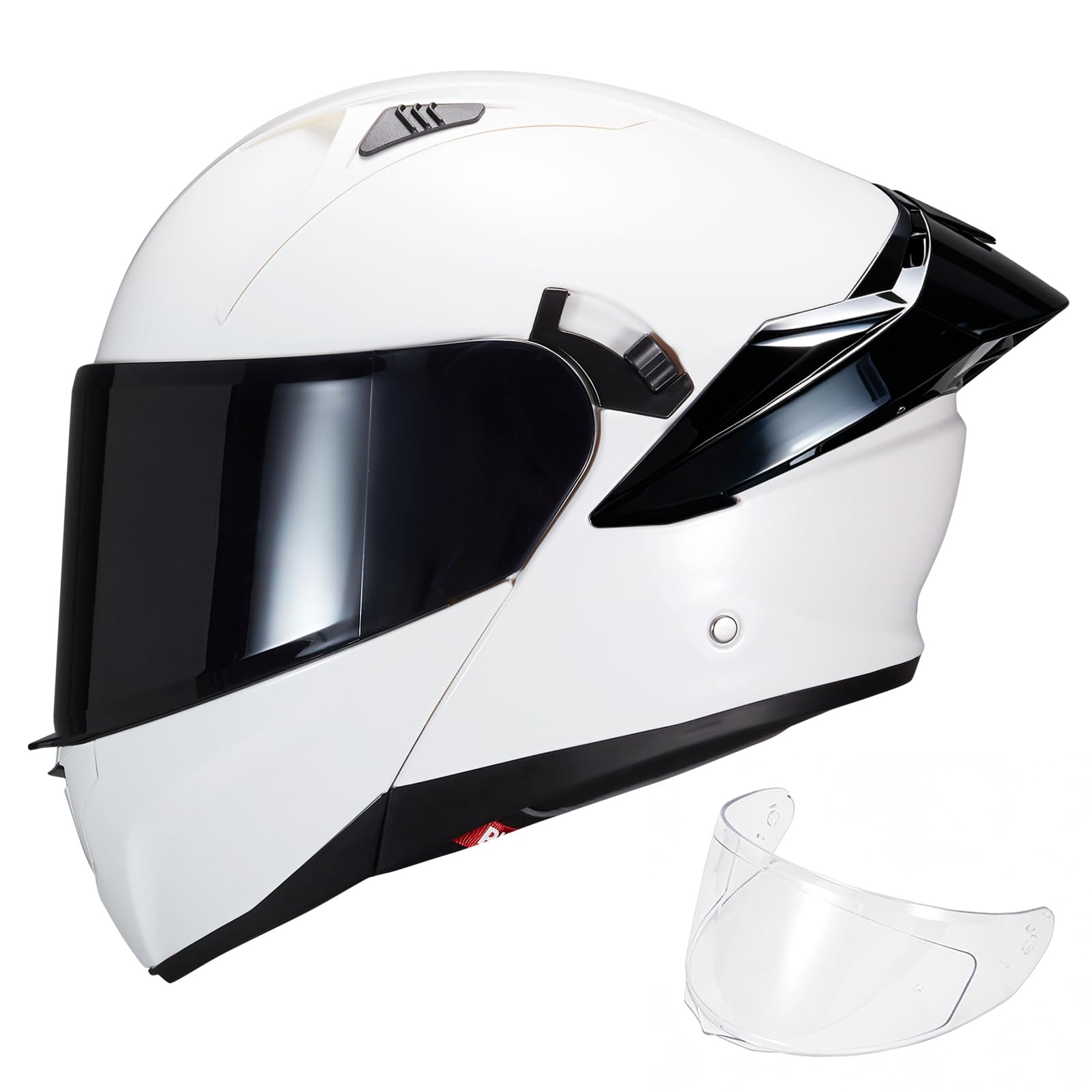
Riders who already run a Bluetooth headset — or who plan to — should look here first. The JQF Gear SJ-809 carves speaker and mic cutouts into the shell so your comms unit sits flush instead of pressing into your ears. It is modular (the chin bar flips up), so you can take a call or stretch, and it has the dual-visor layout: an outer clear shield with a black inner sun shield, plus an extra black visor included for swapping.
Safety is DOT FMVSS 218 (the US helmet safety standard), with a lightweight ABS shell (a hard plastic outer shell) and multi-density EPS (energy-absorbing foam) over the crown, and the chin strap releases fast. Ventilation runs through multiple vents aimed at summer and winter riding both, though the flip-up mechanism adds weight — at 2.48 kg this is the heaviest modular on the list, about a quarter of a kilo over the KYPARA 807’s 2.18 kg. The tail wing ships loose to prevent transport damage and clips on in a minute when you unpack it.
Quality and fit both earn warm feedback, and riders like the sense that the money went into the shell. The noise story is a split: some praise how quiet the flip-up stays, others catch a whistle at higher speeds. Sizing is a small gotcha — the maker suggests going a size up if your cheeks are on the fuller side, and you should measure against their chart before clicking.
Best match for: riders with a Bluetooth headset who want a flip-up that accommodates it cleanly.
Worth knowing: fuller cheeks may need a size up — measure first.
6. ILM 902/902L Modular Full Face Helmet

A backlight on the rear of the shell — because being seen from behind matters most at dusk.
Riders who commute in the dark or on busy roads should give the ILM 902/902L a hard look. It carries a light built into the rear of the helmet, so the driver behind you sees a glowing marker before they see a silhouette. That backlight draws its own steady praise in owner feedback — it is a visibility feature most lids at this level skip. Combine it with the white shell and you have a helmet designed to be noticed from every angle.
The rest of the build is modular flip-up with a dual visor: an outer clear anti-scratch, anti-fog shield and an inner sun lens. Six vents is the most of any helmet on the list, and the ABS shell keeps weight at 2.36 kg — lighter than the JQF Gear SJ-809’s 2.48 kg. The strap adjusts with a micrometric buckle, the liner and cheek pads pull out to wash, and a storage bag ships in the box. Riders also like that the ear space is roomy enough to run AirPods under the shell.
Fog control is the one honest split. With the visor fully down in cold, damp conditions the clear shield can cloud up, which puts this alongside the other helmets here that skip an included Pinlock insert. In good weather the visibility is clean and wide, and the value for what you get is a common bright spot.
My take: the rear light is a genuinely useful safety add most rivals leave out, and it makes this the natural pick for anyone riding after dark.
Go with it if: you ride in low light and want to be seen from behind without strapping on an extra beacon.
Check first: if you ride in the cold and hate fog, budget for an anti-fog insert since none is included.
7. BEON Full Face Motorcycle Helmets for Adult Men and Women DOT Model B-503
Every vent toggles shut — so you can dial the noise down as the speed goes up.
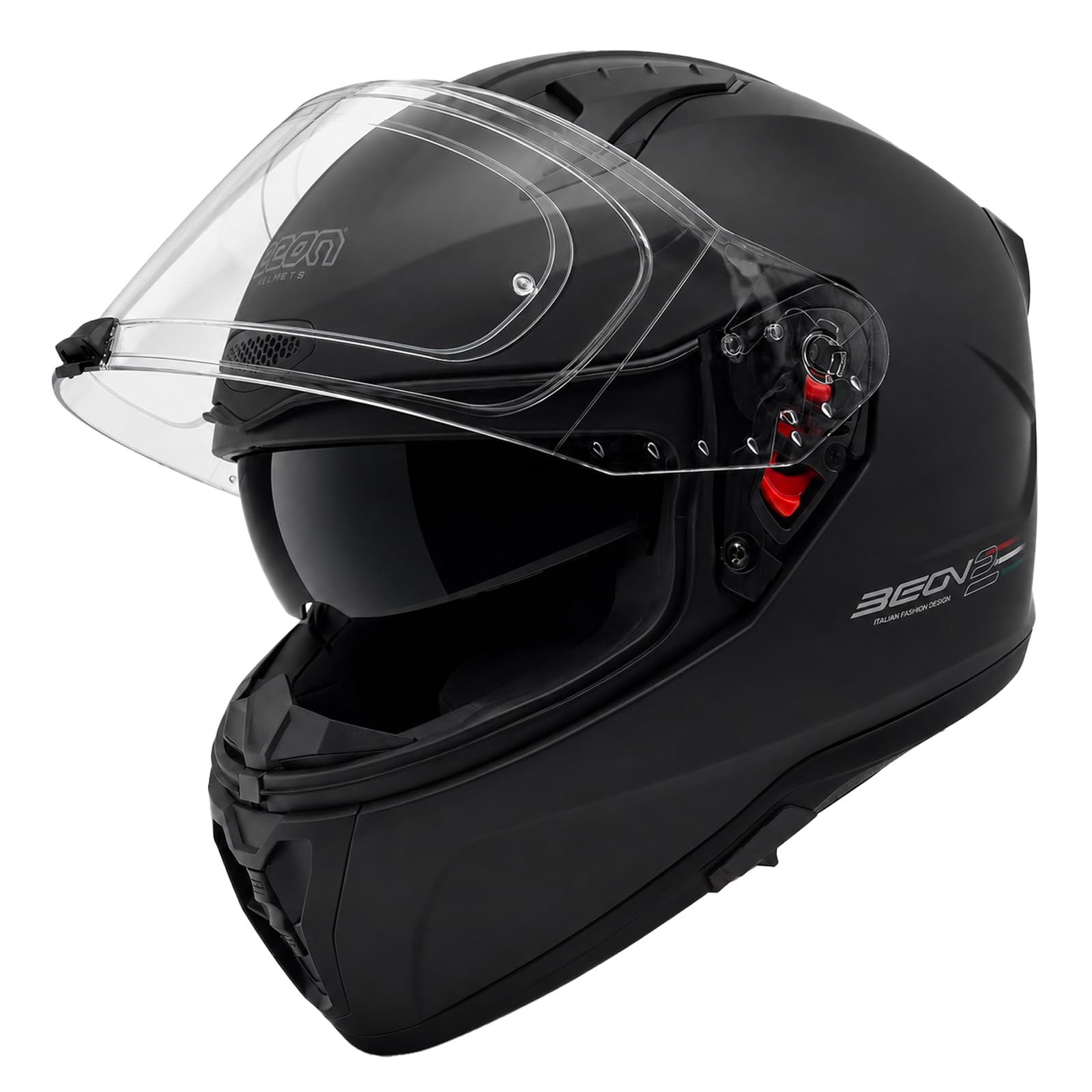
Here is a feature most helmets at this level skip: the vents on the BEON B-503 can all be toggled open or closed. That means you can run them wide in summer heat and shut them tight on a cold, fast run to cut noise and chill. Combine that with the tinted fin shaped to feel lighter on the ride, and this is a helmet that listens to how you actually ride. It carries DOT FMVSS 218 and ECE 22.05, and the shell is ABS over high-density EPS with a buffering inner lining.
The double shield system pairs an outer clear visor with an anti-fog lens, and a side toggle flips the inner sun visor up or down with one gloved hand. The cheek pads pull out so the helmet comes off easier in an emergency, and the metal quick-release buckle opens with one gloved hand. At 1550 g it is the lightest full-face on this list, under the AGV K1 S’s 1580 g. Appearance is what buyers reward most, and the finish on the white shell gets a lot of love.
The split shows up in two places. Anti-fog is claimed, but some riders report the visor still fogs in cold, damp air, and the inner sun visor slider occasionally refuses to lock. Both are worth knowing before you commit, though the comfort and finish still hold up.
Worth grabbing if: you want a light shell with vents you can close, in a finish that looks the part.
Consider the alternative: if fog-free vision is your top priority, a helmet with an included Pinlock insert will serve you better.
8. HJC C91 Modular Motorcycle Helmet

Eyeglass grooves inside the liner mean your frames finally have somewhere to sit.
Spectacle wearers know the pain of a helmet that shoves their frames into their temples. The HJC C91 cuts glasses grooves into the interior so an arm can pass through comfortably — a small detail that riders with glasses notice immediately. The shell is polycarbonate composite built with CAD adjustment on the chin bar, and it is a modular flip-up, so you can open the front without removing the helmet. It carries DOT FMVSS 218.
The HJ-17 shield is Pinlock-prepped and offers 99% UV protection, with a RapidFire system that swaps the shield without tools. An integrated black dark smoke sun visor drops with a sliding trigger. Airflow runs through an Advanced Channeling Ventilation System front-to-back to move heat and humidity out. The interior is moisture-wicking and quick-drying, and cheek pads are interchangeable across sizes for a custom fit. At 3.5 pounds it matches the Shoei RF-SR on the scale, but the flip-up mechanism makes it a heavier-feeling lid under the sun visor.
HJC positions this as the bargain of the modular class, and owner feedback echoes that — protection is the thing the review pages keep coming back to. The catch is in the details. The Pinlock-ready shield prepares you for an insert, but the insert is an optional purchase, so fog control is not in the box. Speaker pockets are cut for the Smart HJC 10B or 20B Bluetooth systems, which are also sold separately.
What makes it different
- Glasses grooves inside the liner for spectacle wearers
- Pinlock-prepared HJ-17 shield with 99% UV protection
- RapidFire tool-free shield replacement
- Interchangeable cheek pads across all sizes
What adds up on top
- Pinlock insert and Bluetooth units are optional extras, not included
- 3.5 lb pairs with a flip-up bar, so it feels heavier than a fixed full-face
Reach for it when: you wear glasses daily and want a modular lid that leaves your frames room.
Budget beyond it if: you want fog-free vision from the start — factor in the Pinlock insert.
9. AGV K1 S Solid Gloss Full Face Motorcycle Racing Helmet
Two shell sizes, not one — so the fit is closer to your head shape from the start.
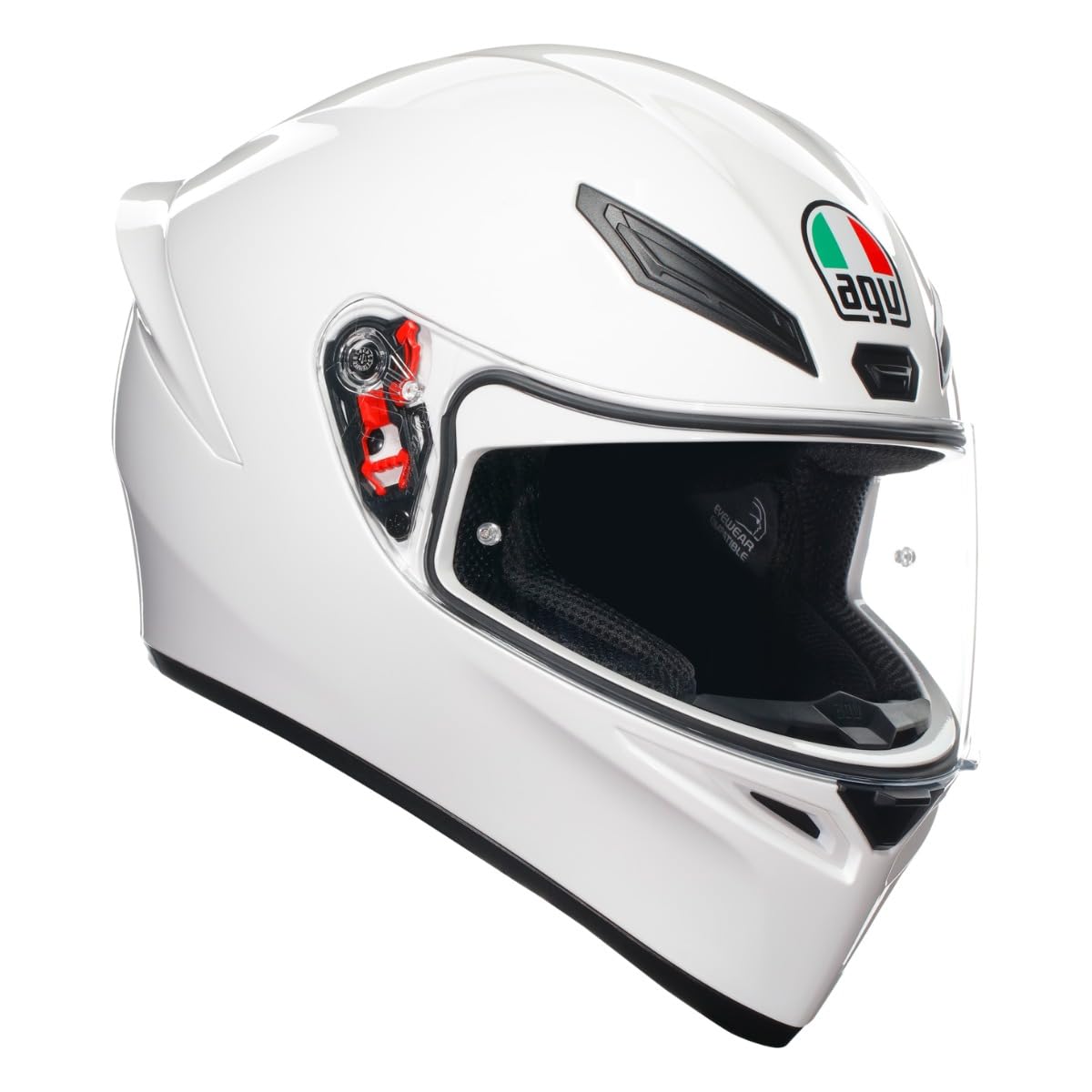
Sport riders and track-day riders want a fixed full-face shell with race-derived closure, and the AGV K1 S delivers both. It is built in two shell sizes rather than one, so the outer shell scales with the head circumference instead of padding a single big shell down to fit a small head. The closure is a double-D ring — the race-standard fastening that will not slip once set — and the shell is a high-resistance thermoplastic at 1580 g.
Airflow is the sport-rider priority here. Large front and crown vents feed air in, and rear extractors pull it out, keeping the flow moving even when you are tucked. The GT4 visor is Pinlock MaxVision-prepared with a wide field of view, and a clear visor is included. It meets DOT FMVSS 218, and the liner is removable and washable. Quality and fit are what the owner feedback rewards most, with appearance and sturdiness close behind.
The honest note on the K1 S is that the sport fit runs snug, and size feedback splits between riders who find it spot-on and a few who want more room. The double-D ring takes a couple of seconds to thread at every stop compared to a quick-release buckle, which a commuter might find fiddly. Neither is a flaw in a race-focused shell — just a trade for the sport fit.
The verdict: a race-shaped full-face with two shell sizes, a Pinlock-ready visor, and the double-D closure serious riders prefer.
For the tucked-in rider: sport and track-day riding where a snug shell, big vents, and a race closure are the whole point.
Not for the errand-runner: the double-D ring and snug fit will feel fussy in heavy stop-and-go traffic.
Know the Specs
DOT versus Snell versus ECE
DOT is the US federal minimum for road-legal helmets, enforced through Federal Motor Vehicle Safety Standard 218. Snell M2020D is a voluntary standard that adds its own independent impact testing on top — a helmet that carries both has been checked twice. ECE 22.05 is the European equivalent, and a helmet that meets it alongside DOT is covered on both sides of the Atlantic. For everyday street use, DOT is the bar you cannot skip.
Shell material and weight
ABS plastic is the budget route — tough and moldable, but heavier per unit of strength than fiberglass or polycarbonate composite. Fiberglass lay-ups like the one on the Shoei RF-SR bring weight down without giving up impact resistance, at a higher cost. Polycarbonate sits in between and shows up on the HJC C91 and AGV K1 S. On a long ride, half a pound of shell weight makes a real difference to how tired your neck feels.
Pinlock and anti-fog inserts
A Pinlock insert is a thin lens that clips to the inside of your shield and traps a pocket of air against the plastic, so your breath never touches the cold surface that would fog it. Pinlock-prepared means the shield has the mounting pins for an insert — but the insert itself is often sold separately. If you ride cold or damp mornings, confirm the insert is included or budget for one.
Vent count and channeling
More vents mean more airflow, but what matters is where they are and whether the air has somewhere to go. An intake at the mouth and crown paired with a rear exhaust pushes hot, moist air out of the shell. Toggleable vents — as on the BEON B-503 — let you shut them for quiet and chill. The Shoei RF-SR runs five; the ILM 902 runs six.
Common Questions
Is a white motorcycle helmet harder to keep clean than a black one?
Does a DOT sticker alone mean a helmet is safe enough to ride in?
Should I choose a full-face or a flip-up modular helmet for daily commuting?
How do I stop my visor fogging up on cold mornings?
What is the difference between ABS and fiberglass helmet shells?
Will a modular helmet fit a Bluetooth headset?
Why does helmet weight matter if I only ride short distances?
Do I need to size up for a flip-up modular helmet?
What does Pinlock-prepared actually mean on a helmet shield?
Is a double-D ring better than a quick-release buckle?
The Bottom Line
For most riders, the white motorcycle helmet winner is the Shoei RF-SR because its fiberglass shell carries DOT, FMVSS 218, and Snell M2020D at the same time, with a 3.5-pound weight and five vents including a Pinlock EVO insert. If you want flip-up convenience at a friendlier price, grab the 1Storm HB89 — its modular chin bar and comfortable fit are the ones commuters rave about. And for night riding where being seen from behind is the whole game, the ILM 902/902L brings a rear backlight most rivals leave out.
White is a safety choice, so pick the shell that keeps you visible and your neck fresh on the ride you actually do.
How we choose
We do not accept paid placement. Every pick is matched to a real buyer and a real use-case; we do not hands-on test units.
Sources
Specifications: manufacturer listings and product documentation. Review insights: verified customer reviews, as of November 2026. Pricing: not shown on this page (it changes often); check the current price via the retailer link.
As an Amazon Associate, Tactical Gear Guy earns from qualifying purchases. This does not affect which products we feature.