Specs are compiled from manufacturer listings and verified buyer reviews and can change over time — please confirm the key details on the product page before buying.
If you are caring for someone who cannot stand unaided, a normal bathroom scale is useless — you need a platform a wheelchair can roll onto, and one that subtracts the chair’s weight from the total. That subtraction (called tare) is the whole point. Get it right and you can track a seated person’s weight from week to week without lifting them. Get it wrong and you are guessing. The picks below all do that job, and each one is set apart by how much weight it holds, how fine its readings go, and whether it stays put while a chair rolls up the ramp.
This guide is built by comparing the manufacturers’ published specifications and the patterns across verified customer reviews, so you get each pick’s real strengths and trade-offs instead of marketing spin.
One honest note before you scroll: these picks use flexible, human-like matching for a wheelchair scale designed to weigh a person seated in a wheelchair, so not every model is the exact number you searched. A near-match in the same type serves the same purpose, and each entry below tells you exactly what it holds and how it reads. Use this breakdown of the best wheelchair scales for home use to match capacity and ramp style to your own hallway and chair.
Top Picks


How To Choose The Best Wheelchair Scales for Home Use
The first thing to decide is not the brand — it is the number on the box. Capacity tells you the heaviest total load the platform holds, and that total includes the chair itself, not just the person in it. A 660 lb platform and a 1000 lb platform are two different tools once a heavy power chair rolls on.
Match capacity to the chair plus the rider
A power wheelchair can weigh far more than a manual one, so add the chair’s published weight to the person’s weight before you pick. A 1000 lb capacity gives you room to spare; a 700 lb capacity suits lighter manual chairs and lighter riders. Buying tighter than you need is the mistake most first-time buyers make.
Look hard at the readout increment
Readout accuracy is the smallest step the scale will display — the scale measures in steps of that size, so a 0.1 lb step shows you a finer change than a 0.2 lb step. For tracking a slow change in weight over weeks, the finer step is the one that shows a real trend instead of jumping over it.
Ramp style changes how easy the roll-on is
Dual ramps let a chair roll on from either direction without a lift, and the low ones are easier for a chair with small front casters. A detachable ramp is simpler to store in a hallway; a fixed ramp is one less piece to misplace. If the carer is doing the pushing alone, this detail matters more than the display size.
Side-by-Side Comparison
| Model | Best For | Capacity | Readout Accuracy | Platform / Build | Amazon |
|---|---|---|---|---|---|
| Heavy Duty Digital Portable Floor Wheelchair Scale (ANGEL USA)★ Best Overall | Daily weighing with a wall display | 660 lb / 300 kg | 0.2 lb / 100 g | All-metal, 33″ x 30.5″ with ramp | Amazon |
| MS-WCS1000 1000lb Wheelchair ScaleMost Capacity | High capacity in a storable frame | 1000 lb | 3.2 ounces | Foldable alloy aluminum and steel | Amazon |
| PEC Wheelchair Scale 700×0.1lb | Simple roll-on weighing for one location | 700 lb | 0.1 lb | Alloy steel with two low-profile ramps | Amazon |
| MINRASTOS Wheelchair Scale (WS003) | Home use with a large easy-read display | 1000 lb | 1.6 ounces | Alloy steel, foldable | Amazon |
| BizAutom Improved Pro Version (BA-1000WCS) | Ramps that resist flipping on entry | 1000 lb | 0.1 lb | 47 lb, 35 x 32.5 x 3.25 in | Amazon |
| PEC Portable Wheelchair Scale 31″x31″ | Large platform, movable between rooms | 1000 lb | 0.1 lb | 35 x 35 x 4 in, alloy load cells on steel plate | Amazon |
Detailed Reviews
1. Heavy Duty Digital Portable Wheelchair Scale
Our pick — 4.0+★ from 90+ verified ratings; the strongest balance of quality and price.
A metal deck and a display that goes on the wall — the setup that survives daily use.
What makes this one the pick is the combination of a sturdy all-metal platform and a display you can wall-mount. The deck measures 33″ x 30.5″ with the ramp fitted, and it drops to 25″ x 30.5″ without the ramp. That shorter footprint without the ramp helps when the hallway is tight and you only fit the ramps for weigh-in day.
The headline limit here is 660 lb / 300 kg, and it reads in 0.2 lb / 100 g steps, so it shows change in fine increments. It also weighs in Kg or lb if you switch units. There is a tare function that subtracts the wheelchair, so the number on the display is the person’s weight, not the chair plus the person.
What wins people over is reliability — that is the trait that comes up most often about this deck. The protection edge along the wheel path is a small detail that saves the frame from scuffs when the chair is lined up slightly crooked. It runs on batteries or a power adapter, so a socket in short supply is not a blocker. The trade-off is the tightest capacity on this list at 660 lb — if a heavy power chair is in the picture, the 1000 lb picks below give you more headroom. It holds 4.0+ stars across 90+ owners, the most-reviewed pick here.
Why this deck earns the top spot
- Tare function removes the chair’s weight from the reading, so you track the person.
- Wall-mountable display keeps the number in view while you steady the chair.
- Runs on batteries or the included adapter.
Where it stops short
- 660 lb / 300 kg capacity is the lowest here.
- 0.2 lb / 100 g steps are coarser than the 0.1 lb picks.
Made for: the carer who weighs the same person every week and wants the number visible on the wall.
Think twice: if a power chair plus rider pushes past 660 lb, the 1000 lb models below fit better.
2. MS-WCS1000 Wheelchair Scale
The stow-it-against-the-wall option when a heavy chair is in the house.
If the chair is a heavy one, the capacity here is the reason to look: 1000 lb of load rating, with a readout accuracy of 3.2 ounces. That is a coarse step compared with the 1.6 ounces on the MINRASTOS below, so a small change in weight may not show. The foldable alloy aluminum and steel frame stows against the wall when it is not in use.
It has a backlit display so you can read the number in a dim hallway, and a carry handle plus side wheels for moving it. The build folds, which is rare among these platforms, so it is the easiest one to put away between weigh-ins. The maker also notes that 10% of profit goes to local senior care houses.
The main thing buyers find is that it works as intended — functionality is the trait that comes up most. The honest catch is the assembly. Several find the instructions unclear, and some find it heavy once it is unpacked. It holds 3.5+ stars across 200+ owners, the largest review pool here. Compare that honesty with the BizAutom below, which holds 1000 lb at a 0.1 lb step.
What you gain: a foldable frame, a backlit display and a 1000 lb limit — enough headroom for a heavier manual chair.
The real friction: setup can take patience if you follow the manual, and the 3.2 ounce step is the coarsest readout in this group.
Reach for this if: you need high capacity but only have a corner to store the scale in.
Look elsewhere if: you want fine 0.1 lb readings, which the PEC and BizAutom models below give.
3. PEC Wheelchair Scale 700×0.1lb
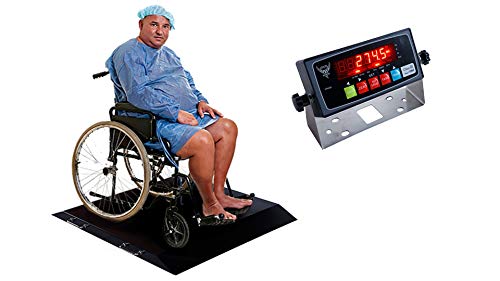
A 0.1 lb step on a 700 lb deck — fine detail without a tall ramp.
For weekly weight tracking, the increment matters, and this one holds 700 lb at a 0.1 lb step. That fine step is what shows a slow change instead of jumping over it. It weighs in pounds only, with an LED display you can read across a small room.
Two low-profile ramps are included, so the chair rolls on without a lift. The deck surface is smooth, which helps a chair glide as it lines up. The maker says the reading adjusts almost instantly when the load changes, so you are not waiting on the number. A loadcell — the metal sensor the deck rests on — does the measuring, and the maker describes it as high quality for stable readings.
Built-in handles and wheels let you move it between rooms, and at less than 60 pounds it is one of the heavier builds here — lighter than the MINRASTOS only if you check the numbers directly. There is a 12-month warranty and a charger plus cable bundled. This one carries 3.5+ stars across dozens of owners, a thinner review base than the top two.
Value read: a 0.1 lb step and dual ramps on a 700 lb deck is a rare combination at this tier.
Worth knowing: it is pounds only, so check that your care notes use the same unit.
The right call for: fine-grained home weight tracking on a lighter manual chair.
Pair it with something else if: you need a 1000 lb envelope or a kg readout.
4. MINRASTOS Wheelchair Scale WS003

A big clear display and a ramp that comes off for storing in a closet.
The number that defines this one is 1.6 ounces — the finest readout step in the whole group, on a deck rated to 1000 lb. That is a tighter step than the MS-WCS1000’s 3.2 ounces, so small shifts show up sooner in the reading.
The ramp is detachable and extended, which means you can take it off and stand it against a wall when the scale is not in use. The display is a large LCD intended to be read from a distance and in low light, so you do not have to bend over to check. The alloy steel frame folds for storage.
Designed specifically for home use, the operation is kept simple for all family members — the kind of scale a visiting carer can figure out without a manual. The one thing to keep in mind is that the finer 1.6 ounce step is a small display increment, so a big weight change will still roll the number quickly. It has 4.0+ stars across a small pool of owners, so the rating rests on fewer opinions than the older picks above.
What stands out: 1000 lb capacity combined with the finest readout step here — two things that rarely arrive together.
Worth noting: the detachable ramp is an extra piece to keep track of in a busy hallway.
Fits best: a home where the scale lives in a closet and comes out on weigh-in day.
Skip past it if: you want a permanently set-up platform with no loose parts.
5. BizAutom Wheelchair Scale 1000 lb
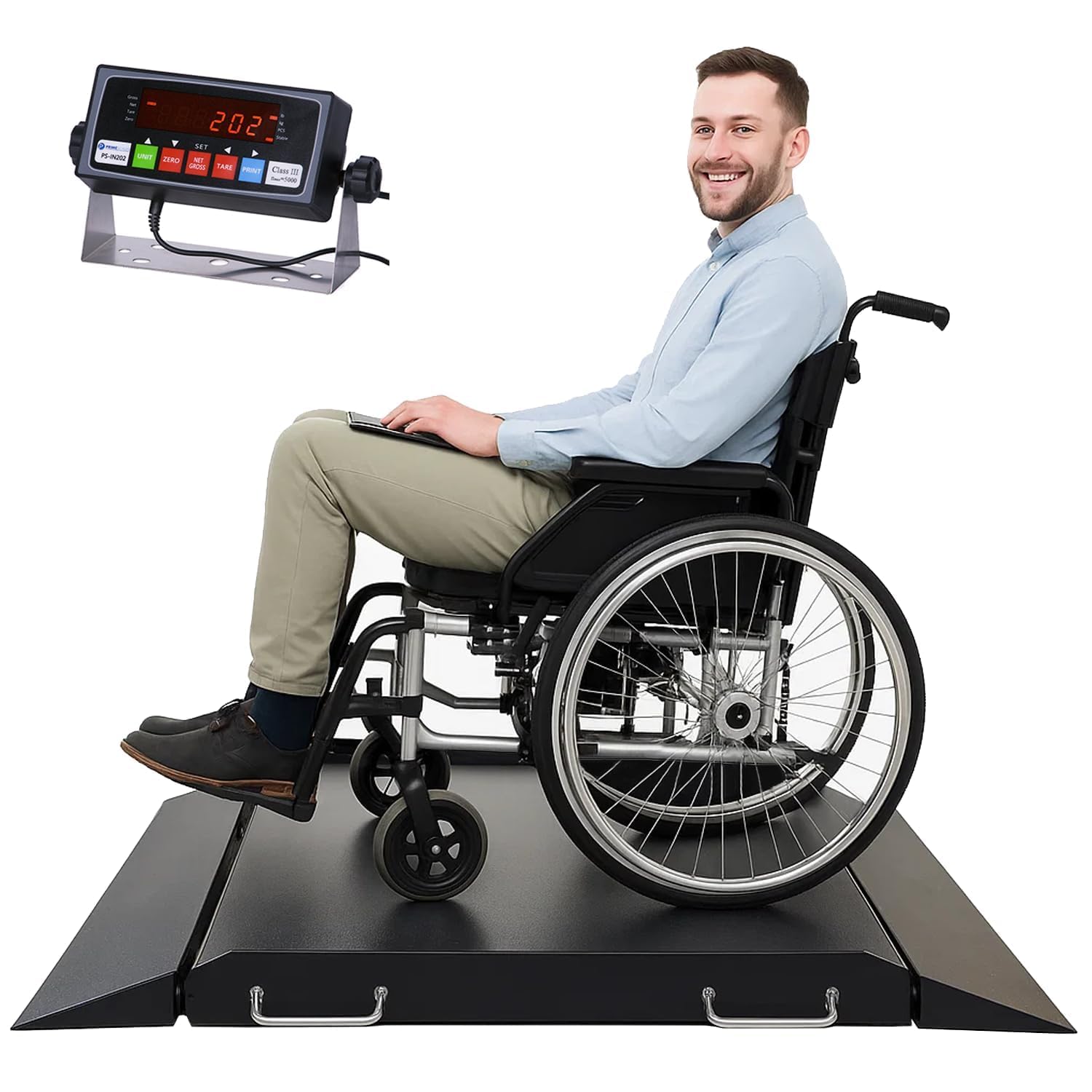
Separate ramps that resist flipping, so the chair rolls on without a wobble.
The honest problem with a fixed ramp is that it can tip up as the front wheels go over. This version uses separate ramps specifically to prevent that flip, and the deck is rated to 1000 lb at a 0.1 lb step. That is a finer step than the MS-WCS1000’s 3.2 ounces and matches the PEC for granularity.
The platform is rated for a full body weighing, with a 1000 x 0.1 lb resolution. The foldable ramp system lets a chair roll on and off without assistance, so a carer pushing alone has one less thing to manage. Setup and storage are kept simple, and it moves between rooms without much hassle.
At 47 pounds it comes in lighter than the PEC’s 60 pounds, so moving it between a bedroom and a bathroom does not require breaking it down. Compare the 35 x 32.5 x 3.25 inch footprint with the PEC floor model’s 33 x 1.5 x 30.5 inches — the BizAutom runs slightly deeper, so measure the hallway before you commit. It holds 4.5+ stars across a small pool of owners, the highest rating here, though on fewer reviews than the older picks.
What it does better than the rest
- Separate ramps are designed to stop the flip that fixed ramps can cause.
- 1000 lb at a 0.1 lb step — the finest granularity on a full-capacity deck here.
- 47 pounds, lighter than the PEC’s 60 pounds, so it moves room to room.
What to plan for
- The deepest footprint here at 35 x 32.5 x 3.25 inches — check the doorway.
- Fewer owners to go on than the older 1000 lb pick.
The pick that earns trust: a carer pushing a chair alone up a ramp that will not tip.
One caveat to size: the deeper deck needs a little more floor room than the MS-WCS1000.
6. PEC Portable Wheelchair Scale 31″ x 31″

The widest deck here, built to take a chair without a shimmy on entry.
This one is about the platform: it measures 35″W x 35″L x 4″H overall with a 31″ x 31″ deck, and it holds up to 1000 lbs at 0.1 lb accuracy. The alloy steel deck rests on four alloy aluminum loadcells — the sensors that do the weighing — mounted on 1/2″ thick steel plates welded to the top deck. The loadcell cables run through tubes, so no wires are exposed to a chair’s wheels.
Two wheels sit on one side and two handles on the other, so one person can move it between a bathroom and a bedroom without lifting. Dual ramps let a chair roll on and stay seated through the weighing. At less than 60 pounds it is a heavier unit, closer to the PEC floor model than the BizAutom.
The honest picture is a mixed one. Reliability feedback splits — some find it works great, others find it useless — and accuracy feedback splits the same way. That is a wider spread than you see on the highest-rated pick above, so treat the 12-month warranty and lifetime technical support as the safety net here. It carries 3.5+ stars across 40+ owners, and it is the top choice if the widest flattest entry is what you need.
What it gives you: the largest rolling surface here and the strongest sensor build — four loadcells on half-inch steel plate with no exposed wiring.
What you accept: a split reliability record and a heavier 60-ish pound shell.
Best matched to: a wide chair and a wide hallway where the extra deck is the deciding factor.
Consider the BizAutom instead if: you want a lighter shell and a cleaner accuracy record.
Know the Specs
Capacity — what the platform can hold
Capacity is the heaviest total load the deck will weigh, and that total includes the chair, so a chair’s own weight eats into the number. A 1000 lb deck leaves room for a heavy power chair and rider, while a 700 lb deck fits a lighter manual chair. Adding the chair weight to the rider weight is the first number to check before you buy.
Readout accuracy — the step size you see
Readout accuracy is the smallest step the display will show, and the scale measures in steps of that size. A 0.1 lb step shows a finer change than a 0.2 lb step, or than a 3.2 ounce step. For tracking a slow change in a seated person’s weight, the finer step is the one that shows the trend instead of stepping over it.
Tare — subtracting the wheelchair
Tare is the feature that lets you zero out the chair before you load the person. You weigh the empty chair, press tare, and the display resets to zero — every reading after that is the person alone. Without tare, you have to do the subtraction by hand, which means trusting your own arithmetic on a weigh-in day.
Ramp design — how the chair gets on
Dual ramps let a chair roll on from either side without a lift, and low profiles are easier for a chair with small front casters. A fixed ramp is one less piece to misplace, while a detachable ramp stores against a wall. Separate ramps that resist flipping are a real upgrade if the carer is pushing alone, because a ramp that tips up is the main snag on entry.
Common Questions
How do I weigh a person in a wheelchair without lifting them?
What capacity do I need for a power wheelchair?
Is a 0.1 lb readout better than 0.2 lb for home use?
Will a wheelchair scale fit through a normal hallway and doorway?
How much does a home wheelchair scale weigh to move?
Can a wheelchair scale be moved between rooms or between homes?
What does a tare function actually do on these scales?
Do these wheelchair scales need battery power or a wall outlet?
What warranty should I expect on a home wheelchair scale?
Are separate ramps better than a fixed ramp for a solo carer?
The Bottom Line
Across the six, the ANGEL USA Heavy Duty Digital Portable Floor Wheelchair Scale is the well-rounded pick — a metal deck, a wall-mountable display and a tare function that does the subtraction for you. If a heavier chair is in the house, the BizAutom Improved Pro Version gives you a 1000 lb deck at a 0.1 lb step and separate ramps that resist flipping. And for a wide flat entry with the strongest sensor build, the PEC 31″ x 31″ model is the one to reach for, warranty and all.
How we choose
We do not accept paid placement. Every pick is matched to a real buyer and a real use-case; we do not hands-on test units.
Sources
Specifications: manufacturer listings and product documentation. Review insights: verified customer reviews, as of November 2026. Pricing: not shown on this page (it changes often); check the current price via the retailer link.
As an Amazon Associate, Tactical Gear Guy earns from qualifying purchases. This does not affect which products we feature.