Specs are compiled from manufacturer listings and verified buyer reviews and can change over time — please confirm the key details on the product page before buying.
Pulling a steering wheel, hub, or harmonic balancer goes one of two ways: the part slides off clean, or you spend an afternoon fighting a seized metal-on-metal bond. The puller in your hand decides which of those two days you have. Too thin a yoke bends under load. The wrong thread pitch chews up bolts. A puller that walks off-center can scar the shaft you’re trying to save. This guide covers what actually matters in a puller kit — yoke thickness, bolt variety, screw hardness — and which kits handle which job, so you buy the right puller once instead of returning three.
This guide is built by comparing the manufacturers’ published specifications and the patterns across verified customer reviews, so you get each pick’s real strengths and trade-offs instead of marketing spin.
Working on a steering column, a stuck hub, or an LS balancer each demands a different kit — and the wrong one costs you a stripped bolt or a bent yoke. Below are the nine kits worth your bench space, sorted by the job each handles best, so you can match the puller to the work before you spend a cent on the wheel puller tool.
Top Picks


How To Choose The Best Wheel Puller Tool
Every puller does the same basic thing: it threads bolts into a hub, braces a yoke across them, and drives a center screw down to push the shaft out of its seat. The variables are how much force the yoke survives, whether the bolts match your hub’s thread, and whether the center screw pushes straight or wanders. Get those three right and a seized wheel or balancer comes off in minutes. Get them wrong and you’re drilling out a snapped cap screw at midnight.
Match the kit to the job first
A steering wheel puller, a harmonic balancer set, and a hub removal tool are three different animals. Steering wheel kits use short cap screws and a slotted yoke that spans the small bolt circle on a wheel hub. Balancer kits run longer bolts and often include stepped bolts for specific engine families. Hub removal tools use a thick drive plate and a heavy forcing screw to drag a seized bearing assembly off the axle. Buying a balancer set for a hub job wastes money and often won’t fit. Read the application list on the kit before anything else.
Check the yoke — thickness and heat treatment
The yoke is the bar that bridges your bolts and takes the pulling load. Too thin and it flexes or bends. Look for a yoke that is integrally forged rather than welded, and check the stated thickness where the maker lists it. Heat-treated alloy steel resists deformation under high pull force; plain mild steel does not. A 4-way slotted yoke gives you more bolt patterns to work with, which matters on vehicles where the hub bolt spacing is unusual.
Count the bolts, but check the thread pitches
A kit with 46 or 49 pieces wins on paper, but the number only helps if the pitches cover your vehicle. Look for a mix of SAE (1/4″-28, 5/16″-18, 5/16″-24, 3/8″-16, 3/8″-24) and metric (M8×1.25, M10×1.5) sizes. If your vehicle is a specific engine family — an LS V8, a Chrysler V6 — check whether the kit lists stepped bolts or adapters for that family. Universal-fit claims are true but they still mean “fits most,” so verify the pitch you need appears in the included hardware list.
The center screw and swivel tip
The forcing screw is where the real load lands. A hardened, quenched screw with interchangeable tips handles more pressure without mushrooming. A floating swivel at the tip keeps the screw from walking off the shaft and protects the shaft end from damage. If the kit lists a thrust bearing or a live-center screw, that is the feature that keeps the pull straight instead of crooked.
Side-by-Side Comparison
| Model | Best For | Piece Count / Type | Item Weight | Vehicle Fit | Amazon |
|---|---|---|---|---|---|
| Powerbuilt Master Steering Wheel and Lock Plate Puller Kit★ Best Overall | Full steering column service | 16-piece kit | 7.5 lb | Foreign and domestic | Amazon |
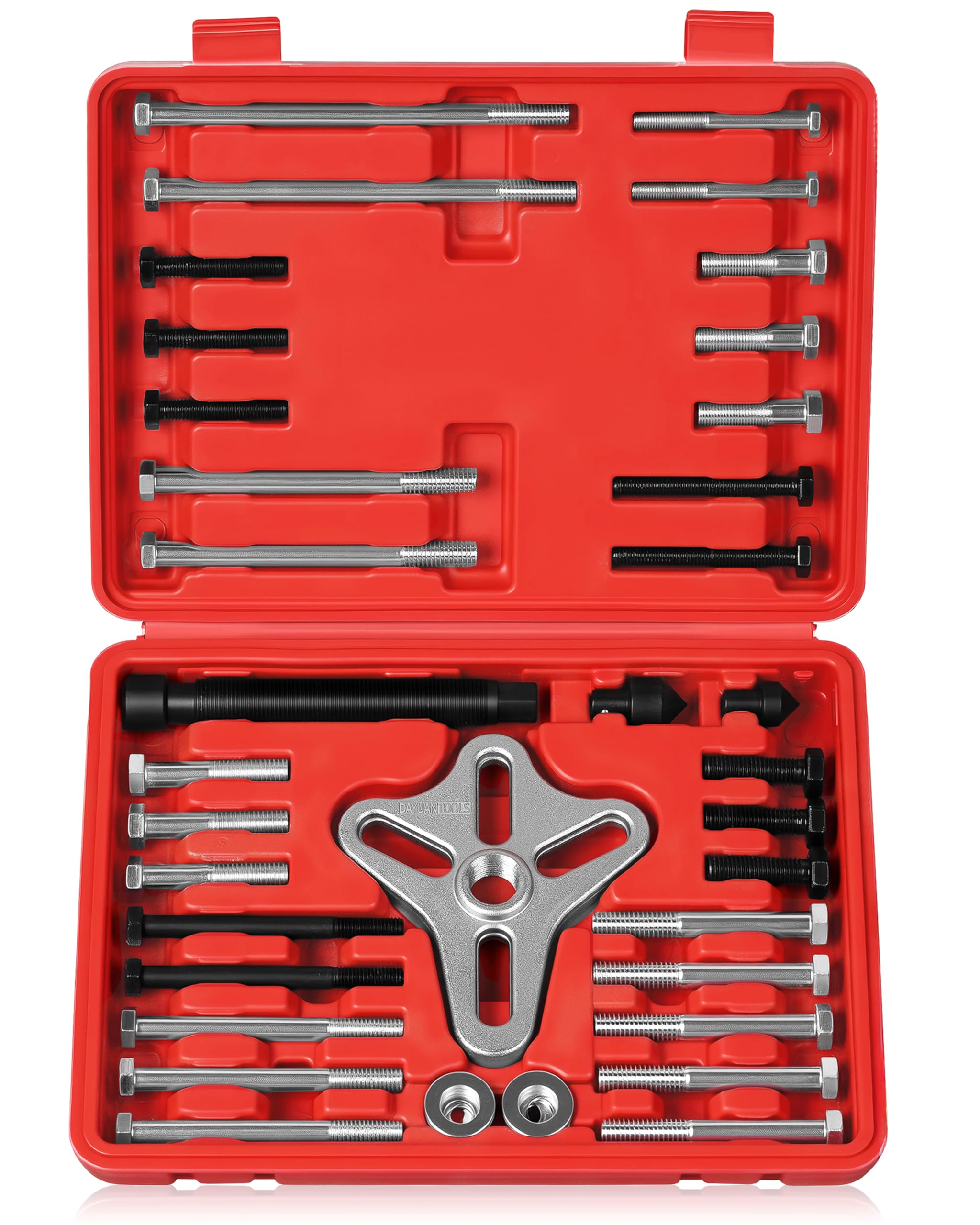
| DAYUAN 46Pcs Harmonic Balancer Puller SetBest Value | Balancer and flywheel work | 46-piece set, 30 bolts | 2.11 kg | Universal fit | Amazon |
| WYNNsky 46 Pieces Steering Wheel Puller KitMost Versatile | General steering wheel removal | 46-piece kit | 4.75 lb | Most cars, pickups, SUVs | Amazon |
| OMT Harmonic Balancer Puller Kit | Balancer, pulley, and steering wheel | 49-piece set | 4 lb | Most cars, pickups, SUVs | Amazon |
| Lisle 45000 Steering Wheel Puller | Quick steering wheel jobs | Single puller | 1.3 lb | Passenger car | Amazon |
| Sunluway GM LS Harmonic Balancer Puller and Installer | LS and LT engine balancers | Puller + installer set | 4.22 lb | GM LS/LT, Chrysler V6/V8 | Amazon |
| SGT Wheel Hub Removal Tool Kit | Seized wheel hubs | Complete hub removal set | 7.28 lb | 5, 6, or 8 lug hubs | Amazon |
| DearChan Universal Hub Puller for OTC 7394 | Tapered axle and drum removal | Puller + striking wrench | 10.17 lb | Most car models | Amazon |
| Astro Pneumatic Tool 7846 Harmonic Balancer Puller Set | Balancer and flywheel variety | 4-way yoke + 3 screws | 7 lb | Tapped flywheels, many pulleys | Amazon |
Detailed Reviews
1. Powerbuilt Steering Wheel and Lock Plate Puller Kit
Our pick — 4.5+★ from 500+ verified ratings; the strongest balance of quality and price.
The one kit that pulls the wheel and the lock plate without a second trip to the store.
Most steering wheel pullers stop at the wheel. This one keeps going into the column. The 16-piece set includes a dedicated lock plate removal tool plus five different pairs of cap screws, so on a job that needs the wheel off and the lock plate compressed, you don’t switch kits mid-disassembly. That completeness is why it holds a 4.5+ star score and sits at the top of this list.
The build is the headline. It is precision-built to meet or exceed ANSI standards, and the 7.5-pound overall weight tells you the metal is substantial rather than stamped-thin. Compare that to the Lisle 45000 at 1.3 pounds against the Powerbuilt’s 7.5 pounds — that mass is the yoke and hardware that resists flexing when a corroded wheel fights back. Quality is what wins people over most on this kit, and functionality runs a close second. Owners put it to work on real vehicles, and one of those jobs was a 2000 Ford F150 that came apart without drama.
The catch is size and cost. At 15.7 x 12.6 x 3.1 inches it takes real drawer or shelf space, and it is the priciest tool in this lineup. If you only ever pull one steering wheel a year, a smaller single-purpose puller does the job for less. But if you service columns regularly — wheels, lock plates, the works — the storage case with photo instructions and the lifetime-grade construction make it the kit you keep. Note that value for money and durability drew mixed reactions, so a few owners wanted more for the outlay; most found the completeness justified it.
What earns it the top slot
- Lock plate removal tool included, so column jobs need one kit, not two
- 5 pairs of cap screws cover more bolt patterns than a single-pair set
- Built to meet or exceed ANSI standards, with a case and photo instructions
Where it asks more of you
- At 7.5 pounds and 15.7 x 12.6 x 3.1 inches, it needs dedicated storage space
- Premium-tier spend for a kit you may only use occasionally
Reach for this if: you pull steering wheels and lock plates regularly and want one complete kit that handles the full column service.
Think twice if: you need a puller for a single, one-time wheel swap — a lighter single-purpose tool will do it for less.
2. DAYUAN 46Pcs Harmonic Balancer Puller Set
Thirty bolts in one molded case — the widest hardware spread for the least money.
If your problem is “I don’t have the right bolt,” this is the fix. Thirty bolts cover the small, medium, and large thread sizes that trip up a universal puller, and the four-slot yoke lets you run two- or three-hole applications without hunting for a second tool. The yoke is heat-treated alloy steel, so it holds shape under load rather than flexing. Owners describe it as working easily on balancer jobs — functionality is the top praise, with quality close behind.
The 46-piece count comes with a real caveat, and it is the one that matters most here. Durability drew negative feedback in the review data, with thread stripping the recurring theme, and several owners found the included bolts to be on the cheap side. The floating swivel tip that protects the shaft end is a genuine plus, but the threads beneath the load are where this kit asks you to be gentle. Torque in stages, don’t gorilla a seized balancer, and it does the job.
What makes it the value pick: it does the same core work as the pricier balancer sets for significantly less money. The 1.5-inch diameter yoke and heat-treated construction are the right recipe. Treat the bolts as consumables rather than the last set you’ll own, and this earns its place in the drawer.
The thread reality: heat-treated yoke and a floating swivel are the right design, but the bolts are the soft spot — ease into the pull and check thread engagement before you lean on the screw.
Who it fits: the home mechanic who pulls a balancer now and then and wants broad bolt coverage without paying for a full shop-grade set.
Best fit for: budget-minded DIYers who need bolt variety for occasional balancer and flywheel work.
Look elsewhere if: you do frequent high-load pulls where thread durability is non-negotiable.
3. WYNNsky 46 Pieces Steering Wheel Puller Kit
A forged 9mm yoke with three interchangeable screw tips that keep the pressure centered.
Where thin yokes bend, this one is a solid forged piece — the whole forging is integrally formed for toughness, with a 9mm thickness that resists bending and deformation under pull. The dead-center forcing screw is quenched and forged for higher hardness, and three interchangeable screw tips let you tune pressure so the screw doesn’t walk or wobble while you tighten. The 4-way slotted yoke spans up to 93mm, so it reaches across a range of steering wheel hub bolt patterns.
At 4.75 pounds in a 10.75 x 8.25 x 1.75-inch package, it sits well within a standard toolbox drawer. That footprint is also where the verified comparison lands: the Powerbuilt kit above is 15.7 x 12.6 x 3.1 inches, so this WYNNsky set takes up considerably less bench and shelf space — easier to stash for occasional jobs. Functionality is the positive consensus; owners find it works well and is easy to set up.
The honest trade-off sits in quality and value. Reviews call it serviceable but not professional-grade — several buyers frame it as “you get what you pay for.” That is a fair read of an entry-priced kit. For a home mechanic pulling a wheel on a weekend project it is plenty; for a pro shop swinging on it daily, the threads won’t feel shop-grade. The instruction flow — find the hub’s threaded holes, bolt the puller on, ease the center screw down — is spelled out clearly and makes it a friendly first puller.
Worth picking up if: you want a forged yoke and swivel-tip screw for home steering wheel jobs at entry-level money.
Pass it by if: your work demands professional-grade hardware and daily repeat use.
4. OMT Harmonic Balancer Puller, Steering Wheel Puller Tool Kit

Forty-nine pieces of hardened carbon steel — the broadest, most color-coded hardware set here.
The 49-piece count leads, and it delivers on the detail. A steel yoke, pressure screw, 3 adaptors, and 30 bolts in the most-needed SAE and metric sizes — 1/4″-28, 5/16″-18, 5/16″-24, 3/8″-16, 3/8″-24, M8x1.25, and M10x1.5 — cover two- and three-slot operation from a single 4-slot yoke. The color coding is a small thing that saves real time: metric bolts are blackened, SAE bolts chrome-plated, so you grab the right one without reading the shaft.
Construction is where this kit pulls ahead of the budget sets. Every tool is hardened AISI 1045 medium carbon steel, and the centering adaptors are further heat-treated and anodized for strength. When the yoke and washers distribute pressure evenly, pulleys come off without scuffs on the surfaces — the scratch-free operation the design is built around. It reaches wide too, with stepped bolts for 1990-and-newer GM 3300-3800 V6 crankshaft pulleys, and works on most cars, pickups, and SUVs. Owners find it easy to use and versatile, and its 30-something bolts are why one job that actually worked on a Ford blow-mold steering wheel went through.
There isn’t a dramatic weakness in this kit — the volume of reviews speaks to broad satisfaction, and the 4-pound weight is manageable. The main thing to plan for is that 30 bolts and a dozen washers need real case space; keep the molded tray intact and rebuilds go faster. For a shop or a serious home mechanic who wants one balancer set that also handles steering wheels and crank pulleys, this is the knocks-around-every-engine answer.
Hardware density: 30 bolts plus 3 adaptors in one AISI 1045 set give you the widest size spread here, and the metric-black/SAE-chrome coding keeps you from fumbling.
The trade to weigh: more pieces mean more to keep sorted — the molded case is doing real work, so don’t scatter it across the bench.
Grab it if: you want one hardened-steel kit that covers balancers, pulleys, and steering wheels with hardware to spare.
skip it if: you prefer a compact single-purpose puller over a 49-piece kit to store and organize.
5. Lisle 45000 Steering Wheel Puller

One pound, one screw pad, and zero drama on a straightforward wheel pull.
This is the anti-kit. Where the Powerbuilt set weighs 7.5 pounds, the Lisle 45000 lands at 1.3 pounds — light enough to toss in a glovebox. It is a single heavy-duty puller built for long wear, with a screw pad that protects the end of the steering shaft as the center screw drives down. On passenger cars, particularly Chrysler T&C models, it makes quick work of removing the wheel — functionality is the clear strong point.
What owners prize here is speed and value. It handles the wheel and, as one reviewer noted, can be pressed into service on various flywheels too, so the little clam-shell tool earns a bit of versatility beyond its label. The limited lifetime warranty backs a metal build that is meant to be a keeper rather than a throwaway. For a quick wheel swap where you already know your bolt size, this is the tool you own for two decades and never think about.
The limitation is scope. It is vehicle-specific rather than universal, and the bolt quality drew some mixed comment — if your hub needs an unusual thread or an oversized bolt, a full kit is the safer bet. Think of this as the glovebox companion to a bigger set, the puller you reach for when the job is simple and you don’t want to haul the case. For a compact single-purpose puller, it does exactly what it says.
The lightweight argument
- At 1.3 pounds it stows anywhere — a true glovebox puller
- Screw pad protects the steering shaft end as you drive the screw
- Limited lifetime warranty on a metal build
Where it stops short
- Vehicle-specific fit — not a one-size universal puller
- Single-puller scope means no bolt variety for unusual hubs
Made for: quick, simple steering wheel pulls on a known vehicle, and a puller you want to keep light and handy.
Not for: hubs with odd thread sizes or jobs needing a full bolt assortment.
6. Sunluway GM LS Harmonic Balancer Puller and Installer

The only kit here that pulls the balancer off and threads the new one back on.
Most sets stop at removal. This one does both sides of the job. The 25264-style puller uses a 3-jaw, clip-in design that grabs the balancer without tapped holes or pulling the radiator, and the matched installer — with a thrust bearing, threaded rod, flange nut, and washers — presses the new balancer onto the crank so it seats completely without risking the crank threads. It is mapped to GM LS and LT V8 engines from 1997 to present, plus Chrysler, Dodge, and Jeep 3.5L/3.6L V6 and 4.7L/5.7L/6.1L V8 models.
That mapping is the whole point, and it is also where the kit draws a firm line. It explicitly will not fit 1997-or-earlier LT 5.7L (threaded-hole) engines, 1991-1997 LT1 Gen 2 5.7L, or 2018-and-newer Coyote balancers. The clip-in design is fast when it is right and useless when the application is wrong — so read your engine code before buying. Steel, black-painted for corrosion resistance, with galvanized nuts and aluminum washers, it carries a 12-month warranty.
Here is the honest downside, and it is not small. Sentiment on this kit is split: the durability feedback runs negative, with instances of breakage on first use and the tool slipping off the balancer mid-pull. That doesn’t make it a bad tool — it makes it a specialty tool that rewards proper seating and patient loading. If you keep the jaws square and ease the screw, it works; if you horse it, the steel can let go. Buy it for the specific LS/LT job and it earns its place; expect a universal puller to survive endless abuse and it won’t.
The two-way win: a puller and a bearing-equipped installer in one kit means you remove and reseat a balancer without a second purchase — genuinely useful for LS swaps.
Read the fit list first: it will not work on early LT1 or 2018-plus Coyote balancers, and the durability reports say it needs careful, square loading rather than brute force.
Buy it if: you are servicing a GM LS or LT V8 (or listed Chrysler/Dodge/Jeep) balancer and want removal plus installation in one set.
Don’t buy it if: your engine is an early LT1, a threaded-hole LT, or a 2018+ Coyote — or you want a puller to survive rough, high-force abuse.
7. SGT Wheel Hub Removal Tool Kit
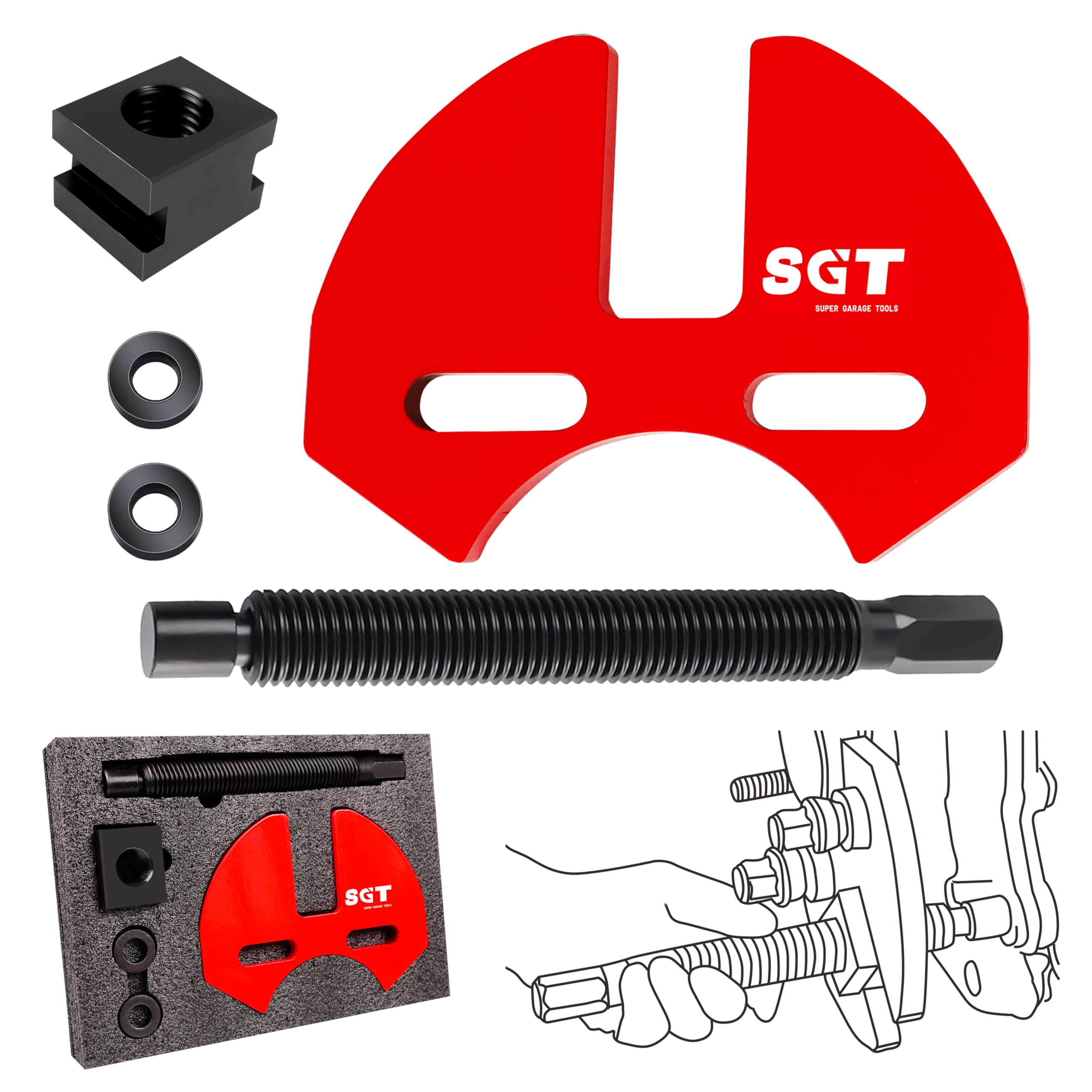
A half-inch steel drive plate built to drag a seized hub off the axle in minutes.
When a wheel bearing hub fuses to the knuckle, heat and hammers fail and a real puller wins. This kit is built for that fight. The 0.5-inch thick steel drive plate carries the load, and the threaded rod and screw assembly are heat-treated to a 30–35 HRC hardness so they resist deformation under high pull force. The removal plate is red powder-coated, the rest of the components black-oxide coated for rust and wear resistance. A foam-lined box keeps it all organized between jobs.
It fits a broad slice of the driveway: 5, 6, or 8 lug wheel hubs, which covers a wide range of cars and trucks. The positioning design aligns with the hub bolts and connecting parts so the pull stays square and doesn’t scar the axle or surrounding components. Buyers report the payoff clearly — one hub that was fully seized came free in minutes, and speedy removal is the recurring theme. Functionality is the top positive, quality close behind.
The lone watch-item is durability feedback, which comes back mixed — some find it tough, others feel it won’t last through repeated heavy use. Sized against 7.28 pounds of steel and a hardened screw, that reads less as a flaw and more as a “know its limits” note: it is a specialty hub puller, not an industrial press. Apply a little lubricant to the threads before you start and the operation smooths out, which the maker also recommends. For a DIYer staring at a hub that won’t budge, this is the tool that ends the standoff.
Call for it when: a wheel hub is seized on a 5-, 6-, or 8-lug vehicle and you want to pull it without damaging the axle.
Keep shopping if: you need to pull hubs weekly under industrial loads where only shop-grade endurance will do.
8. DearChan Universal Hub Puller
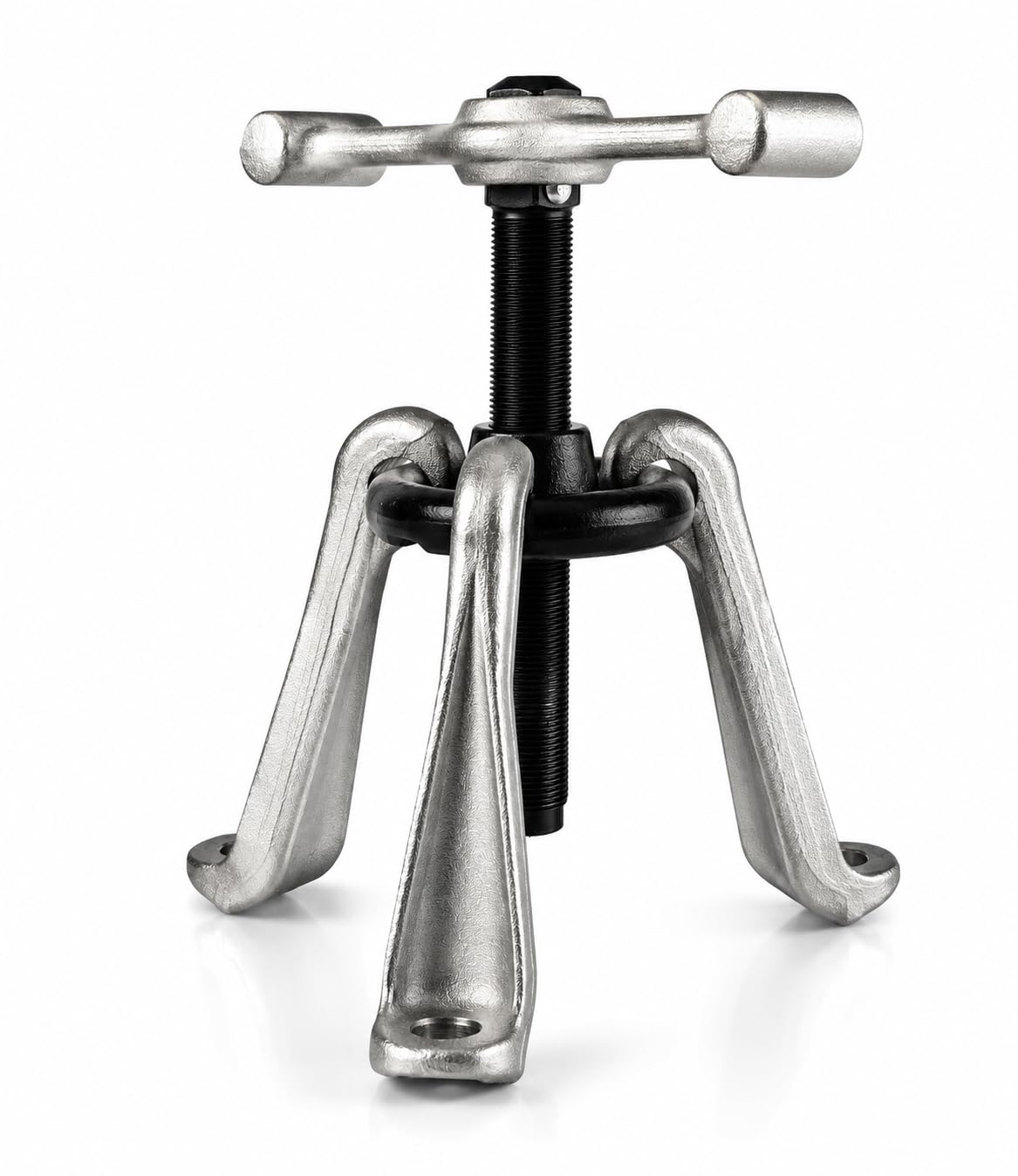
The heavy forged puller for tapered axles and press-fit rear drums, built like a shop tool.
This is a different breed of puller — a forged, heat-treated steel body with a fine-threaded 1-1/8-inch hex drive center bolt, made to yank hubs off tapered axles and press-fit rear drum brakes. At 10.17 pounds it is the heaviest tool here, and that mass is the point: it provides a straight pull without distorting the wheel lugs. Three adjustable sliding arms extend out to a 7-1/2-inch diameter bolt circle, so the same tool adapts across a range of hub patterns. A striking wrench and puller screw come in the box.
The straight-pull geometry is what separates it from a generic puller. When the arms are set to the right diameter and the center bolt is turned, the load pulls true instead of twisting the lugs off-line. It handles four drums or hubs in a session without complaint when seated correctly — the kind of removal job where patience and a properly set bolt circle pay off in about the time a coffee takes.
The honesty note: durability comes back mixed, and a few find it isn’t as strong as the heavy-duty label suggests. That is a sizing question as much as anything — this is a tapered-axle and drum-brake tool, not a universal answer to every stuck hub. Set the arms properly, use the striking wrench as intended, and it earns its keep, especially given that value for money is a clear positive. For classic-car rear drums and tapered axles, this is the right shape of tool.
Why the arms matter: three sliding arms reaching a 7-1/2-inch bolt circle let this puller adapt where a fixed-width tool cannot, and the straight pull protects the lugs.
The honest limit: durability feedback is mixed, and it is purpose-built for tapered axles and press-fit drums — not the tool for a modern hub or a steering wheel.
The right tool if: you work on tapered axles or press-fit rear drum brakes and need a solid straight pull with adjustable arms.
Wrong tool if: your job is a modern sealed hub or a steering wheel — different geometry entirely.
9. Astro Pneumatic Tool 7846 Harmonic Balancer Puller Set

A shop-class balancer set with three hardened screws and a yoke that covers four bolt patterns.
The Astro 7846 is the veteran of this group — a heavy-duty 4-way slotted yoke paired with three hardened forcing screws measuring 3-3/4 inches and 6-1/2 inches long. That spread lets you reach deep-set pulleys and shallow ones from the same kit. It is designed for harmonic balancers, crankshaft pulleys, steering wheels, and gear pulleys, and it can also be used on tapped flywheels of electric or two-cycle motors, which expands its usefulness well past the car bay.
Where the pricey Powerbuilt leans on completeness for a steering column, this Astro leans on yoke range for the engine bay. The 4-way slot gives you two-, three-, and four-bolt patterns from one bar, and the hardened screws take load without mushrooming. Owners consistently rate the quality and value highly and like the storage case that keeps the screws grouped. With a 1-year warranty on material and workmanship, it is built to be a permanent fixture on the bench.
The only thing to keep in mind is that at 7 pounds in a 9.2 x 12.8 x 4.4-inch frame it isn’t pocket-sized — it is a shop tool, not a glovebox one. And it doesn’t ship as a 46-piece bolt warehouse, so if you specifically need a huge bolt assortment for oddball hubs, the OMT or WYNNsky sets cover more thread sizes. For balanced, hardened performance on the jobs this kit names, it is a steady, dependable buy.
Shop-grade strengths
- 4-way slotted yoke covers multiple bolt patterns from one bar
- 3 hardened screws at 3-3/4″ and 6-1/2″ reach shallow and deep pulleys
- Works on balancers, pulleys, steering wheels, and tapped flywheels
What to keep in mind
- 7 pounds and a wide footprint — it’s a fixed bench tool, not portable
- No large bolt assortment, so odd hubs may need a kit with more thread sizes
Choose this for: a hardened, multi-pattern balancer and pulley set that lives on the bench and handles tapped flywheels too.
Choose a kit instead if: your biggest need is a wide bolt assortment rather than a heavy-duty yoke and long screws.
Know the Specs
Yoke thickness and heat treatment
The yoke is the bridging bar that carries the pull load across your bolts. A forged yoke resists bending where a welded or stamped one flexes. Heat treatment (and hardness ratings such as 30–35 HRC) tells you how well that steel holds its shape under pressure. Thicker, forged, heat-treated yokes pull harder without deforming — which is exactly what a seized part demands.
Thread pitch and bolt count
The bolt count on the box only matters if the pitches inside match your vehicle. SAE sizes (like 1/4″-28, 5/16″-18, 3/8″-16) and metric sizes (like M8x1.25, M10x1.5) are not interchangeable. A kit with 30-plus bolts in mixed SAE and metric covers more vehicles, while a single-puller tool assumes you know your pitch in advance. Check the size list against your hub before you buy.
The forcing screw and swivel tip
The center forcing screw takes the highest load in the whole tool. A hardened, quenched screw resists mushrooming, and interchangeable tips let you match the screw to the shaft end. A floating swivel or thrust bearing keeps the push centered so the pull stays straight and the shaft end isn’t scarred. Stainless-where-it-counts and live-center designs are the features that separate a controlled pull from a crooked one.
Application fit vs universal
A universal puller fits “most” vehicles — useful but not guaranteed. A vehicle-specific tool (an LS/LT kit, for example) fits its engine family exactly and often won’t touch anything else. Match the application list to your job: universal for broad light use, specific when you know the engine code and want a precise fit. Reading the “not applicable to” line is as important as the “compatible with” line.
Common Questions
Will a steering wheel puller work on a harmonic balancer?
How do I know which thread pitch my hub uses?
Why does my puller keep slipping off the balancer?
What’s the difference between a hub puller and a steering wheel puller?
Can I use a puller on an LS engine balancer and will it fit my LT1?
How much force can these pullers take before something breaks?
Do I need a bolt assortment or is a single puller enough?
Will a hub puller damage my axle or wheel lugs?
Should I put lubricant on the puller threads?
Can a balancer puller also remove a flywheel?
The Bottom Line
For most buyers, the wheel puller tool that earns its place first is the Powerbuilt Master Steering Wheel and Lock Plate Puller Kit — it pulls the wheel and the lock plate in one go, and that completeness is why it holds the top spot. If you want one hardened-steel kit that also covers balancers and crank pulleys, the OMT 49-Piece Harmonic Balancer Puller gives you 30 bolts in mixed SAE and metric sizes from a single 4-slot yoke. And for a seized wheel hub that won’t budge, the SGT Wheel Hub Removal Tool Kit with its 0.5-inch steel drive plate is the one built for that fight.
The puller you keep reaching for is the one whose yoke, thread pitch, and screw match your job — steering column, balancer, or hub — not the one with the most pieces on the box. Buy for the job in front of you and the puller pays back the first time a rusted part finally lets go.
How we choose
We do not accept paid placement. Every pick is matched to a real buyer and a real use-case; we do not hands-on test units.
Sources
Specifications: manufacturer listings and product documentation. Review insights: verified customer reviews, as of November 2026. Pricing: not shown on this page (it changes often); check the current price via the retailer link.
As an Amazon Associate, Tactical Gear Guy earns from qualifying purchases. This does not affect which products we feature.