Specs are compiled from manufacturer listings and verified buyer reviews and can change over time — please confirm the key details on the product page before buying.
If your sinks, toilets, and white laundry keep turning orange-brown, you already know the problem: dissolved iron in your well water. The fix is a whole-house iron filtration system that treats the water before it reaches any tap, and for most homes the best starting point is a two-stage sediment-and-carbon unit: no control valve to program, standard cartridges, and low running cost. Below you get ten real systems sorted by what they actually do, from basic sediment-plus-carbon boxes you can install yourself to automatic air-injection tanks that handle heavy iron loads without you touching a thing.
This guide is built by comparing the manufacturers’ published specifications and the patterns across verified customer reviews, so you get each pick’s real strengths and trade-offs instead of marketing spin.
You will see what each system truly removes, how much water it moves per minute, and how much babysitting it demands. The right pick depends on your iron level in PPM and how much maintenance you will tolerate.
Top Picks
How To Choose The Best Well Water Iron Filtration System
Start with your iron number, not the product photo. A lab test that reports iron in PPM tells you more about which system you need than any listing page. Low iron with sediment and rotten-egg odor points one direction; heavy dissolved iron points another.
Cartridge systems versus air-injection tanks
Cartridge units pass water through replaceable filters inside housings, and you swap those cartridges on a schedule. They suit homes with modest contaminant loads and a homeowner happy to change filters. Air-injection tanks create a pocket of air that oxidizes the iron so it drops out of the water and gets trapped by the media bed. The control valve then backwashes the tank to flush the captured junk down the drain, which is why they cost more and need a drain line.
Match flow rate to your household
Flow rate, measured in GPM (gallons per minute), is how fast treated water reaches your shower or washing machine. Look at the figures here and compare: a 15 GPM unit keeps multiple fixtures running, while a 12 GPM tank is still generous for most single-family homes. Check the flow rating before you buy, because an undersized system turns every shower into a slow drizzle.
Know what these systems will not do
Whole-house iron filters are not water softeners and they do not lower TDS (total dissolved solids — the overall mineral content of the water). If hard-water scale is your other headache, plan for a separate softener. Several of these systems are built to sit upstream of a softener to protect it, which is a smarter order of installation than the reverse.
Side-by-Side Comparison
| Model | Best For | Capacity | Max Flow Rate | Filter Life | Amazon |
|---|---|---|---|---|---|
| iSpring WGB22B★ Best Overall | Best overall for most well homes | 100,000 gallons | 15 gpm | 1 year | Amazon |
| iFilters 4.5 x 20 Sediment CTOSediment Specialist | Sediment-heavy wells | — | — | 12 months | Amazon |
| Waterdrop WHF3T-FGCertified Iron Reducer | Certified iron and manganese reduction | 100,000 gallons | 15 gpm | 6 months | Amazon |
| Express Water 3-Stage Iron & Manganese | Proven crowd favorite with gauges | 100,000 gallons | 0.25 gallons per second | 6 months | Amazon |
| Home Master HMF3SdgFeC | Fine 1-micron filtration | 100,000 gallons | 15 gpm | — | Amazon |
| iSpring WCFM400K | Hands-off automatic regeneration | 400,000 gallons | 12 gpm | — | Amazon |
| DuraWater Air Injection Iron Eater 1.0 | Air injection on a budget | 1.0 cu ft media | — | — | Amazon |
| Air Injection Iron Eater Almond Series | Iron up to 10-15 ppm | 1 cu ft media | — | — | Amazon |
| Fleck 5600 SXT 1.5 cu ft | Catalytic carbon media | 1.5 cu ft media | — | — | Amazon |
| AFWFilters Air Injection Titanium | High iron levels, chemical free | — | — | — | Amazon |
Detailed Reviews
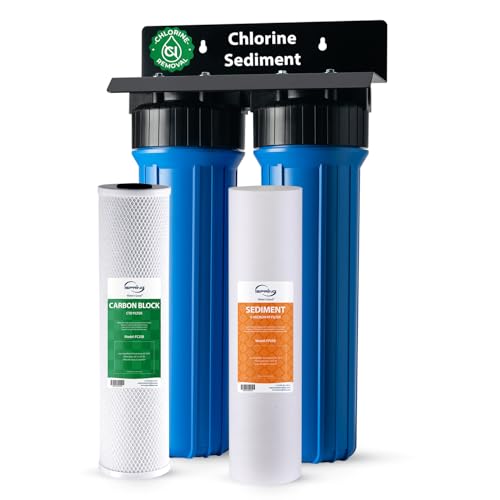
1. iSpring WGB22B 2-Stage Whole House Water Filtration System
Our pick — 4.5+★ from 800+ verified ratings; the strongest balance of quality and price.
The sensible first buy for a well-fed house: two stages, standard filters, no valve to program.
The number that decides this one for most people is the 15 GPM maximum flow rate — fifteen gallons per minute means you can run the shower and the washing machine without watching the pressure sag. Stage one is a sediment filter that grabs particles down to 5 microns (five thousandths of a millimeter, fine enough to stop the grit and rust flaking that clouds well water). Stage two is a coconut-shell carbon block that the maker says is independently tested to reduce up to 99% of chlorine along with odors and bad taste.
Capacity is quoted at 100,000 gallons, which the brand frames as roughly a year of service. The cartridges are the ordinary 20-inch by 4.5-inch size, so replacements are cheap and sold everywhere instead of locked to one brand. That is a genuine long-haul advantage over proprietary cartridge systems, and it matters more each time you reorder.
Owners praise the build quality first and the easy installation second — the included 9-inch wrench, double O-ring seals, and standard 1-inch FNPT (female threaded) connections keep a first-time DIY job manageable, and iSpring publishes video walkthroughs. The recurring gripe is leakage around the housings, so seat the O-rings carefully and do not overtighten. It is a sediment-and-carbon system, not an iron-specific media bed, so very heavy dissolved iron will outrun it.
Where it earns its keep
- 15 GPM flow keeps whole-house pressure steady
- Uses standard 20″ x 4.5″ cartridges, so refills stay cheap
- 5-micron sediment stage catches fine rust and grit
- Handles both well and city water sources
The honest caveats
- Housing leaks show up if the O-rings are not seated cleanly
- Not a dedicated iron media bed, so extreme iron loads need more
- Cartridge swaps become your yearly chore
Reach for this if: you want a dependable whole-house filter you can install in an afternoon and refill with ordinary cartridges.
Think twice if: your iron test comes back very high — that calls for air injection instead.
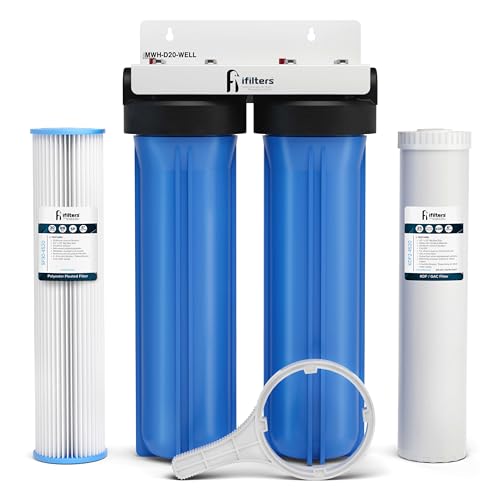
2. iFilters 4.5 x 20 Sediment CTO
Built around a rinse-and-reuse pleated filter for wells that deliver a lot of grit.
Here the standout is the first stage: a washable, anti-bacterial pleated sediment filter with a large surface area built to hold dirt and resist harboring bacterial growth between rinses. On a well that coughs up sand, silt, and rust flakes, that reusable pleat saves you from burning through cartridges. Behind it sits a combined GAC and KDF cartridge — granular activated carbon for taste, odor, and organic compounds, plus KDF media that works by redox (a chemical exchange that pulls metals out of the water) to help reduce iron, sulfur odor, and heavy metals.
Where it wins is sediment duty: the heavy-duty Big Blue-style housings are meant for wells where smaller filters clog fast. Owners mostly report that it simply works, with the rinse-and-reuse pleated stage doing the heavy lifting on sediment. Water quality results split between homes that stop seeing orange stains and homes that still fight them, and leakage reports split the same way, so a careful install with the included wrench and pressure relief valves is worth the extra ten minutes.
Pick it for gritty wells: if your water arrives cloudy with sand and rust flakes, the rinse-and-reuse pleated stage earns its place.
Check your flow needs first: confirm the manufacturer’s current flow rating before sizing it for a whole house.
Right answer when: sediment is your headline problem and you like a filter you can rinse rather than replace.
Wrong turn if: you need whole-house volume and a confirmed higher flow rating before you commit.
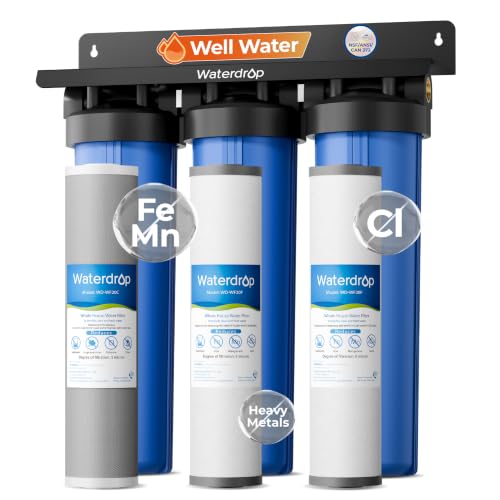
3. Waterdrop WHF3T-FG 3-Stage
A three-stage system that publishes its own iron and manganese test results.
The figures worth reading here are the reduction percentages: Waterdrop says SGS testing shows it removes 95.9% of iron and 99.7% of manganese. Those are the two minerals behind orange staining and black speckling on fixtures, so this one is aimed squarely at the dissolved-metal problem. A double iron and manganese cartridge sits under a carbon fiber filter, giving the 7-stage filtration the brand advertises across iron, manganese, odor, chlorine, and sediment down to 5 microns.
Materials carry their own paper trail — NSF/ANSI 372 for lead-free components, NSF/ANSI 42 for the filter media, and the iron media also listed against NSF/ANSI 61/44/53/58, FDA, and REACH requirements. Capacity runs 100,000 gallons at a 15 GPM maximum flow rate, matching the iSpring WGB22B on flow while adding a dedicated iron stage it lacks.
The maintenance rhythm is the trade-off: the iron and manganese cartridge is expected to change every 6-12 months, while the GAC carbon filter goes about once a year. That is more frequent than a single annual cartridge swap, and the unit weighs 49 pounds, so plan a solid mounting spot. It handles both well and municipal water, which makes it an easy pick if you may switch sources later.
The real draw: published reduction numbers for iron and manganese plus a stack of material certifications — rare transparency in this category.
Budget your time for: the iron cartridge refresh lands every 6-12 months, more often than a plain two-stage filter.
Suits you best: if you want documented iron and manganese reduction in a cartridge system that keeps 15 GPM flowing.
Look elsewhere if: you would rather never think about a filter change — go automatic instead.
4. Express Water Iron & Manganese 3-Stage

The heavy steel frame and gauges that turn filter changes from guesswork into a glance.
This one was purpose-built for the household with reddish-brown staining on porcelain, fixtures, and laundry, plus water that smells off. The 3-stage layout targets iron and manganese specifically, and the Deluxe Series hardware is the difference-maker up close: a heavy-duty stainless steel bracket and free-standing frame, pressure release buttons on each filter, and a pressure gauge so you can watch system health instead of guessing. The maker lists NSF-certified filters and a schedule of 6-12 months or 100,000 gallons, with 1-inch connections rated for 0.25 gallons per second at 45-80 PSI.
By volume of owner satisfaction this is the most battle-tested system on the page, and the pattern is consistent: straightforward installs, visibly clearer water, and iron and sulfur taste and smell gone from well water. Plenty of owners frame it as money well spent over the years. Leakage is the mixed note — real but not dominant, and usually traceable to a fitting rather than the housing.
One practical tip from the listing that pays off: if you run a water softener, mount this at the water inlet ahead of the softener, so it catches dirt and silt before they reach the resin. Compared with the cartridge-only iSpring above, you get iron-specific media plus gauges and a stand in exchange for more bulk and 57 pounds of shipping weight.
Why it turns heads
- Pressure gauges and release buttons make maintenance a visual check
- Iron and manganese media aimed at staining and odor
- Stainless steel stand and bracket handle the 57-pound load
- Built to sit upstream of a water softener to protect it
What to keep in mind
- Bulkier footprint than a wall-mounted cartridge pair
- Occasional leaks traced to fittings on install
- Still no TDS reduction, so hard-water scale needs its own fix
Best match if: stained fixtures and smelly well water are your daily reality and you want gauges to prove the system is working.
Pass on it if: you are tight on floor space — the free-standing frame wants room.
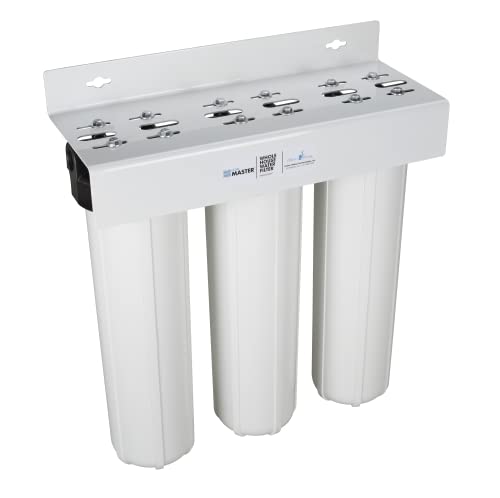
5. Home Master Three Stage
Cuts contaminants down to 1 micron, so the water arrives genuinely clear.
The 4-layer sediment filter here runs a 25-10-5-1 micron progression — the last stage catching particles down to 1 micron, finer than the 5-micron stage in the iSpring and Waterdrop units above. That depth gives it a greater dirt-holding capacity too, which means fewer changes. Behind the sediment filter, the iron and carbon stages tackle up to 95% of iron, manganese, and sediment, plus the chemicals behind off tastes and odors, in water up to a 3 PPM combined load. The brand is candid that this figure describes the combined load the media handles.
Flow is the reason this one fits whole homes: 1-inch ports and massive housings support up to 15 gallons per minute, so pressure stays strong at every fixture. Capacity sits at 100,000 gallons. It is engineered for well water specifically, and Home Master points city-water households toward a different model in its line.
Buyers report water clearing up fast, less sediment, better taste, fishy odors gone, and iron stains lifting from sinks and toilets. Installation goes smoothly with the supplied instructions, and the heavy steel bracket holds 48 pounds of system securely. If you want the finest sediment capture on this list, the 1-micron stage is the reason to pick it.
The fine-mesh argument: a 25-10-5-1 micron sediment ladder is the tightest staged filtration here, and the oversize housings keep maintenance intervals long.
Worth knowing: it is built around a 3 PPM combined contaminant load, so a very heavy iron well may want air injection instead.
Go here when: you want the cleanest-looking water and strong pressure across the whole house.
Skip if: your iron test is off the charts — this is a filter, not an iron oxidation plant.
6. iSpring WCFM400K

Regenerates its own media with nothing but air, then backwashes itself on a schedule.
The figure that changes your routine is 400,000 gallons of capacity — at 400,000 gallons versus the 100,000-gallon rating shared by most cartridge systems above. A digital control valve runs automatic regeneration using air only, no oxidizers or chemical feed, and the media is certified to NSF/ANSI Standard 61. You set the auto-flush intervals to match your incoming water and usage, then leave it alone. It is a point-of-entry system with 12 GPM maximum flow, a fiberglass and manganese dioxide media tank, and a 66.8-inch height that wants a proper utility-room footprint.
Two honest limits are printed right on the listing: it does not remove hydrogen sulfide (H2S — the gas behind rotten-egg smell), and its maker warns H2S can damage the system, directing those households to a different model. It also does not reduce TDS, same as every cartridge unit here.
Owners mention water that tastes better than bottled, with iron, manganese, and odors handled. Setup is called easy and the value fair. The one durability thread note is the head unit — a few report cracking, so mount it where it will not take a knock. Compared with changing cartridges every 6-12 months, this is the system that stops asking you for anything.
Why it is worth the step up: air-only regeneration plus 400,000 gallons of capacity means years of service between real interventions.
The catch: it explicitly will not handle H2S, and the tall 66.8-inch tank needs a dedicated spot.
Made for you if: you want iron and manganese gone and never want to think about a filter again.
Not the one if: rotten-egg sulfur odor is in your water report — that needs a different tank.
7. Air Injection Iron Eater Filter 1.0
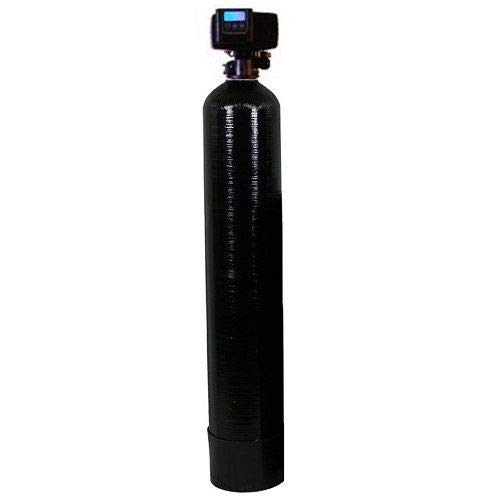
A complete air-injection package — tank, media, bypass, and valve — in one box.
Air injection works by trapping a pocket of air inside the tank that oxidizes dissolved iron and sulfur so they drop out of the water and get caught in the media bed. This DuraWater Black Series unit ships with 1.0 cubic foot of filter media, a 10×54 inch mineral tank, a 1 inch plastic bypass, and a digital control valve. Everything for the install arrives together, and the brand says it is a DIY job for someone with basic plumbing skills and the instructions in hand.
What owners talk about most is the outcome: iron, sulfur, and manganese gone, odors and stains lifted, water clarity and color transformed. Some describe the change as going from a smelly, stain-inducing supply to normal clear water. The bugbear is longevity — reports range from over three years of service to less than one, so factor a media refresh into your long-term math.
Set against the automatic iSpring WCFM400K above, this one trades a printed capacity figure and a self-regenerating routine for a simpler manual-tank design. If your iron is moderate and your sulfur is present, this is the entry into air injection without the biggest spend.
What it gets right
- Air injection oxidizes iron and sulfur without chemicals
- Complete kit with tank, media, bypass, and digital valve
- Odors, rust, and stains handled across the whole house
What to weigh
- Service life reports vary from under a year to three-plus
- Install needs basic plumbing confidence
- No published GPM or gallon capacity in the listing
Pick it for: a moderate-iron well where you want chemical-free air injection without the premium tag.
Weigh it against: a self-regenerating tank if you would rather not manage backwash timing yourself.
8. Air Injection Iron Eater Filter Almond Series

Rated for iron up to 10-15 ppm — a range most cartridge systems never claim.
If your lab report reads high, this is the one that names its ceiling: it removes iron up to 10-15 ppm, and the brand directs anything higher to its Black series. The heart of it is a Fleck 5600 SXT control valve, pre-programmed and shipped loaded to make installation easier. Air injection handles iron and sulfur without chemicals, everything runs automatically, and the 10-inch diameter fiberglass tank treats the whole house from a 1 cubic foot media bed.
At 86 pounds it is a serious piece of equipment, so plan a solid floor or wall anchor before delivery day. Fiberglass construction keeps the tank itself protected from corrosion while the media does the work inside.
Sulfur is the enemy this one takes personally. Customers note water going from smelly and stain-inducing to clear, with staining stopping entirely. Installation is straightforward and water quality improves right away. The main trade-off is the manual setup work: pre-programming helps, but you still set the valve and manage the air pocket.
The iron ceiling is the headline: 10-15 ppm is a range you can match to a real water test instead of hoping.
One thing to plan for: 86 pounds of loaded fiberglass tank needs a proper spot and a second set of hands.
Look here if: your iron test sits in that 10-15 ppm band and chemical-free treatment is the goal.
Move up if: your iron is higher — this model’s range tops out there.
9. Fleck 5600 SXT 1.5 cu ft
More media, catalytic carbon, and a backwash that cleans itself every day.
The upgrade here over the 1.0 cubic foot units is volume: 1.5 cubic feet of upgraded Centaur catalytic carbon inside the 10×54 inch mineral tank. More media generally means more contaminant contact time and longer life between refresh cycles. The Fleck 5600 SXT digital air injection system automatically runs a daily backwash, which means the media gets cleaned and the trapped junk flushes down the drain on its own.
The package includes the tank, the 1.5 cubic feet of carbon, and a 1 inch plastic bypass. Air injection creates that oxidizing air pocket for organic iron and sulfur, and the whole system runs automatic once programmed. The brand notes it is a DIY install with instructions and some plumbing skill.
Reviewers point out clear water right away, detailed setup instructions, and both iron and manganese reduced. The change is real enough that the listing cites a drop from 1.4 ppm to less than 0.1 ppm, a concrete before-and-after worth matching against your own test.
What the extra media buys you: 1.5 cubic feet of catalytic carbon gives more contact time and fewer refresh cycles than the 1.0 cubic foot tanks.
The honest catch: the daily backwash needs a drain line nearby, so check your utility room before you buy.
Best for: the buyer who wants more media and fewer changes, and has a drain ready for a daily backwash.
Consider the smaller tank if: floor space and drain access are tight.
10. AFWFilters Air Injection Iron & Sulfur

Built for high iron and sulfur with a K series media that works at low flow.
The distinguishing claim here is the media: the new K series is designed to need only a fraction of the flow rate of normal systems, which makes it appealing for a home where supply is not generous. It super-oxidizes the water before it even reaches the filter media, giving the best possible shot at dropping iron and sulfur out of suspension. Titanium construction is listed on the spec sheet, and the system works with no chemicals and no salt — fully automatic whole-house treatment.
The AFW instructions arrive on a USB drive, and a free water bottle ships with the system.
Owners appreciate the quality of the result — one notes the water is comparable to bottled — and installation reads as straightforward. No odor after setup is a repeated point. This sits at the premium end of the page, and the honest note is that the documentation and support expectations are higher at this size; the media swap is a project, not a cartridge click.
Why the low-flow media matters: a K series bed that needs only a fraction of normal flow can suit weaker well systems without starving pressure.
Set your expectations: a tall 10×54 tank plus media handling makes servicing a bigger job than any cartridge unit here.
Fits your situation when: high iron and sulfur are both present and your well flow is modest.
Think twice if: you want the simplest possible install — this one rewards a buyer who reads the manual.
Know the Specs
Flow Rate (GPM)
Gallons per minute is the speed at which treated water travels into your home. A higher rating keeps pressure steady when several taps run at once. Lower ratings suit single fixtures or a small household. Always match the number to your peak demand, not your average use, or your showers will suffer.
Micron Rating
A micron is one thousandth of a millimeter. The lower the number, the finer the particles the filter catches. A 1-micron stage catches finer silt than a 5-micron stage. For fine rust flake and cloudy well water, look for a sediment stage in the 1-5 micron range.
Iron Level (PPM)
Parts per million measures iron concentration. Cartridge systems handle lighter loads, while air-injection tanks are designed for higher levels, with some models rated for iron up to 10-15 ppm. Match the system’s stated range to your own water test before you buy.
Capacity and Backwash
Capacity, in gallons, is how much water the media or cartridge treats before service. Air-injection tanks add a daily backwash that cleans the media automatically. Cartridge systems simply get a new filter. Capacity tells you how often you will be back at the work.
Common Questions
Does an iron filtration system also remove the rotten-egg sulfur smell?
Will these systems make my well water softer?
How often do I have to change the filters?
Can I install one of these myself, or do I need a plumber?
Will an iron filter fix the orange stains on my sinks and laundry?
What if my iron is really high, like above 10 ppm?
Do I need a drain line nearby for a tank system?
Will any of these lower my TDS reading?
Do these systems filter city water too, or only well water?
What flow rate do I need for a family home?
The Bottom Line
For most well-water homes dealing with iron, sediment, and odor, the well water iron filtration system to start with is the iSpring WGB22B, because 15 GPM flow, a 5-micron sediment stage, and cheap standard cartridges cover the everyday problem without a valve to program. If you want documented iron and manganese reduction in a cartridge design, the Waterdrop WHF3T-FG brings published SGS test figures to the table. And when you would rather never touch a filter again, the iSpring WCFM400K regenerates itself with air and asks nothing of you — just verify your sulfur level first.
How we choose
We do not accept paid placement. Every pick is matched to a real buyer and a real use-case; we do not hands-on test units.
Sources
Specifications: manufacturer listings and product documentation. Review insights: verified customer reviews, as of November 2026. Pricing: not shown on this page (it changes often); check the current price via the retailer link.
As an Amazon Associate, Tactical Gear Guy earns from qualifying purchases. This does not affect which products we feature.