Specs are compiled from manufacturer listings and verified buyer reviews and can change over time — please confirm the key details on the product page before buying.
Damp electrodes are the quiet reason a weld cracks three days after you finish it. A rod oven keeps your stick electrodes at a steady warm temperature so they stop soaking up moisture from the air. The one spec that decides whether an oven works for you is its temperature range, not its brand name. Below are six ovens that hit different spots on that range, from a budget-friendly 20 lb box with a dial to a premium Lincoln with a fixed 300°F preset.
This guide is built by comparing the manufacturers’ published specifications and the patterns across verified customer reviews, so you get each pick’s real strengths and trade-offs instead of marketing spin.
Capacity, voltage, and how finely you can set the heat are what separate a shop oven from a field oven, and those three numbers do most of the work in the picks below. Every oven here is compared on the same three specs so you can scan the trade-offs fast and find the right welding rod oven for your bench.
Top Picks

How To Choose The Best Welding Rod Oven
The job of a rod oven is narrow: keep stick electrodes warm and dry so the coating doesn’t pull moisture out of the air. Everything else — steel gauge, handle shape, lid style — is convenience built around that one job. So start with what you weld, then work outward.
Match the temperature range to your electrode class
Low-hydrogen rods such as E7018 and stainless types like 316L want steady heat, and the top of an oven’s range tells you how far it will push. Units here top out at 300°F or 302°F, while the low end varies a lot — one oven starts at 80°F, another at 85°F, another at 150°F. If you only need to hold rods warm on the job, a lower floor is fine. If you want the box to double as a drying oven for rods that got damp, the higher settings do that work.
Size the capacity to your rod length, not just the weight
Weight in pounds is the headline number, but rod length is what actually trips people up. A box rated for 10 lb may only swallow shorter rods, while one rated for 20 lb may take 19-inch stock. Check both before you buy, because a 36-inch rod does not fit a compact cylinder no matter what the label says.
Think about where the power comes from
Most portable ovens want 110 V, 115 V, or 120 V from a standard wall outlet. If your plan is to run it off a welder or a generator in the field, confirm the oven can take that supply. A simple analog dial is easier to read with gloves on than a digital panel, and it has fewer parts to fail in a shop.
Side-by-Side Comparison
| Model | Best For | Capacity | Temperature Range | Voltage | Amazon |
|---|---|---|---|---|---|
| Arc Union 20 lb Temperature Controlled★ Best Overall | Everyday shop use on a budget | 20 lb | 80°F to 300°F | 115 V | Amazon |
| YESWELDER 15lb Rod OvenBest for Travel | Carrying to the job site | 15 lb (14 in rods) | 85°F to 300°F | 110 V | Amazon |
| Vouyar 20 Lb Dial Temperature Container | Reading the temp at a glance | 20 lb (19 in rods) | 150°F to 300°F | AC 120V 60Hz | Amazon |
| SÜA TRC-10 Portable Drying Oven | Long 18-inch rod runs | 22 lb (18 in rods) | Ambient to 302°F | 115 V | Amazon |
| BEST WELDS 900-BW Electrode Oven | Simple analog set-and-go | 10 lb | Analog thermostat | 110 V | Amazon |
| Lincoln Electric K2939-1 Hydroguard | Jobsite durability with fixed heat | 10 lb | Preset 300°F | 115 V | Amazon |
Detailed Reviews
1. Arc Union 20 lb Electrode Oven
Our pick — 4.5+★ from 200+ verified ratings; the strongest balance of quality and price.
A 20 lb steel box that holds more than a day of rods at a dialed-in 80°F to 300°F.
For shop duty plus the occasional field trip, this is the oven buyers keep pointing at. It’s the highest-rated and most-reviewed of the six, and it earns that by doing the one job a rod oven has without fuss. You dial a temperature between 80°F and 300°F on an analog knob, plug it into 115 V, and it keeps a full 20 lb box of electrodes dry.
The steel shell earns its share of the credit. The shell is steel with a tough powder-coat finish, and it weighs 19.56 pounds, so it sits solid on a bench and doesn’t wander. Owners praise the value first — it’s consistently called a lot of oven for the money — with build quality and moisture resistance close behind. The thermostat floor of 80°F is lower than most of the field here, which is handy if you just want to keep rods warm overnight without cooking them.
There’s one honest caveat, and it shows up as mixed feedback on heat. Some owners find it heats exactly as asked, while others feel it throws off more warmth than it should. That’s the trade-off of a simple analog design: it’s easy to repair and cheap to own, but it isn’t a precision lab instrument. For general fabrication, farm work, and maintenance welding, most people will not notice.
Why It Wins The Top Slot
- Handles a full 20 lb of electrodes — the biggest standard box here outside the SÜA.
- Adjustable from 80°F to 300°F at 115 V, so it doubles as a warm-hold box and a dryer.
- Steel body with a powder-coat finish and 19.56 pounds of heft to keep it planted.
- The strongest value in the group — buyers consistently call it a lot of oven for the money.
Where It Falls Short
- Heat output gets mixed reads — some say it heats perfectly, others say it wastes heat.
- At 19.56 pounds it is heavy enough that you won’t want to tote it far from the truck.
Reach for this if: you want the best-reviewed oven in the bunch and need room for a 20 lb box of rods.
Think twice if: you need to carry it up a ladder — the YESWELDER weighs far less.
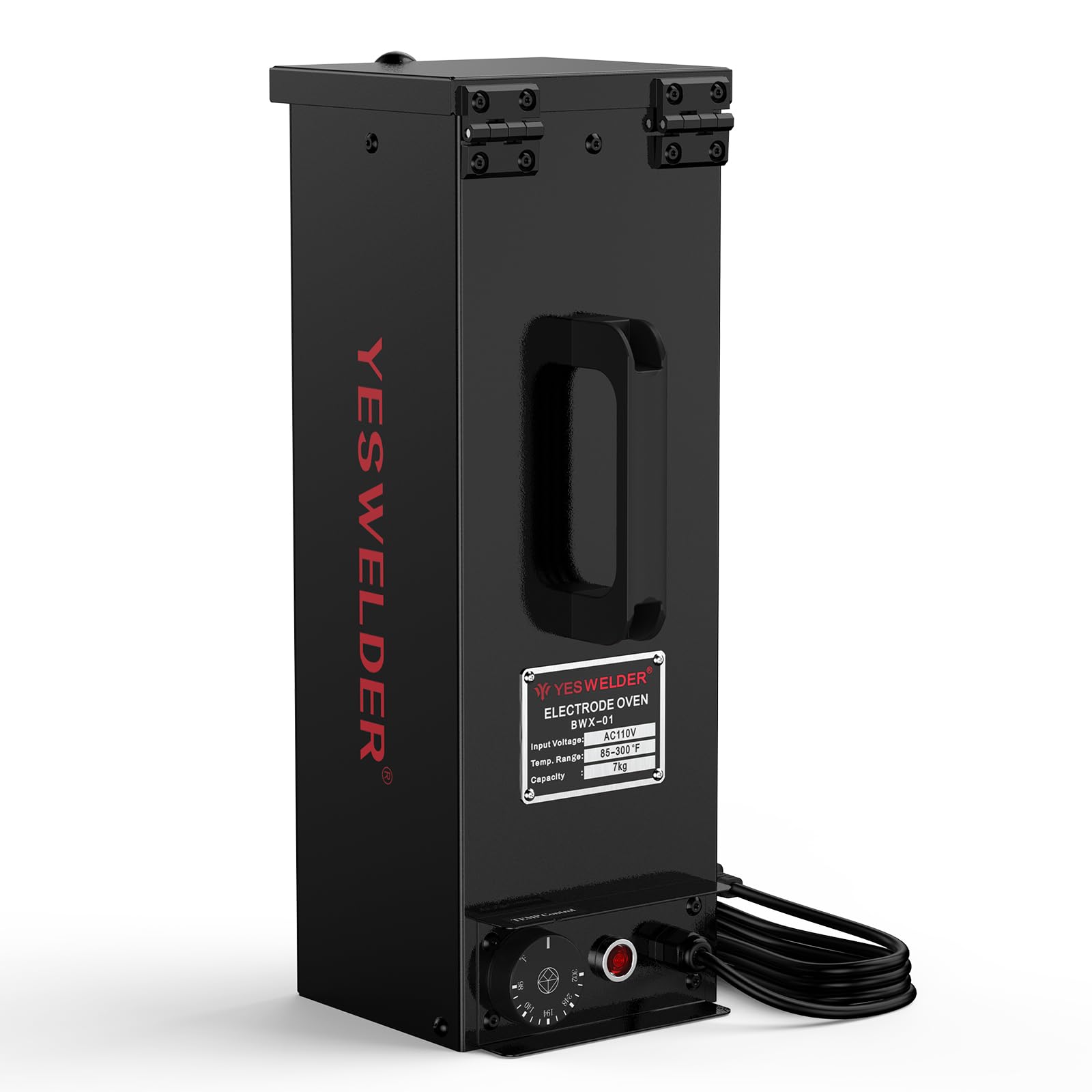
2. YESWELDER 15lb Welding Rod Oven 110V Temperature Controlled
Under nine pounds, with a wide lid you can open one-handed in welding gloves.
Weight is this oven’s whole argument. It tips the scale at 8.91 pounds, against 19.56 pounds for the Arc Union above. That difference is the whole point if your work moves: the YESWELDER is the one you sling into a truck, carry onto a site, and set on a bench without thinking about it.
The capacity is 15 lb of rods cut at 14 inches or shorter, and the temperature knob runs from 85°F to 300°F. Those numbers mean you can hold enough electrodes for a full day of stick work and cover the standard rod families — E6010, E6011, E6013, E7018 among them — at a setting the maker lists for each.
Here’s the catch worth reading twice. The manufacturer specifically warns against extended unattended use, meaning no leaving it running overnight or over eight hours straight. It’s a warm-hold and short-drying oven, not a set-and-forget cabinet. If you want something that can stay plugged in indefinitely, look at a different pick.
The portability payoff: at 8.91 pounds it is the lightest full-size oven on this list, and the 14-inch rod ceiling covers the common low-hydrogen sizes you’d actually tote to a job.
The limits to know: 15 lb and a 14-inch rod maximum rules out longer stock, and the maker asks you not to leave it running beyond eight hours or overnight.
Pick this one when: the oven lives in your truck and travels to jobs — its weight and gloved-hand lid make the most sense off the bench.
Look elsewhere if: you want a box that stays plugged in all night in the shop.
3. Vouyar 20 Lb Welding Rod Container
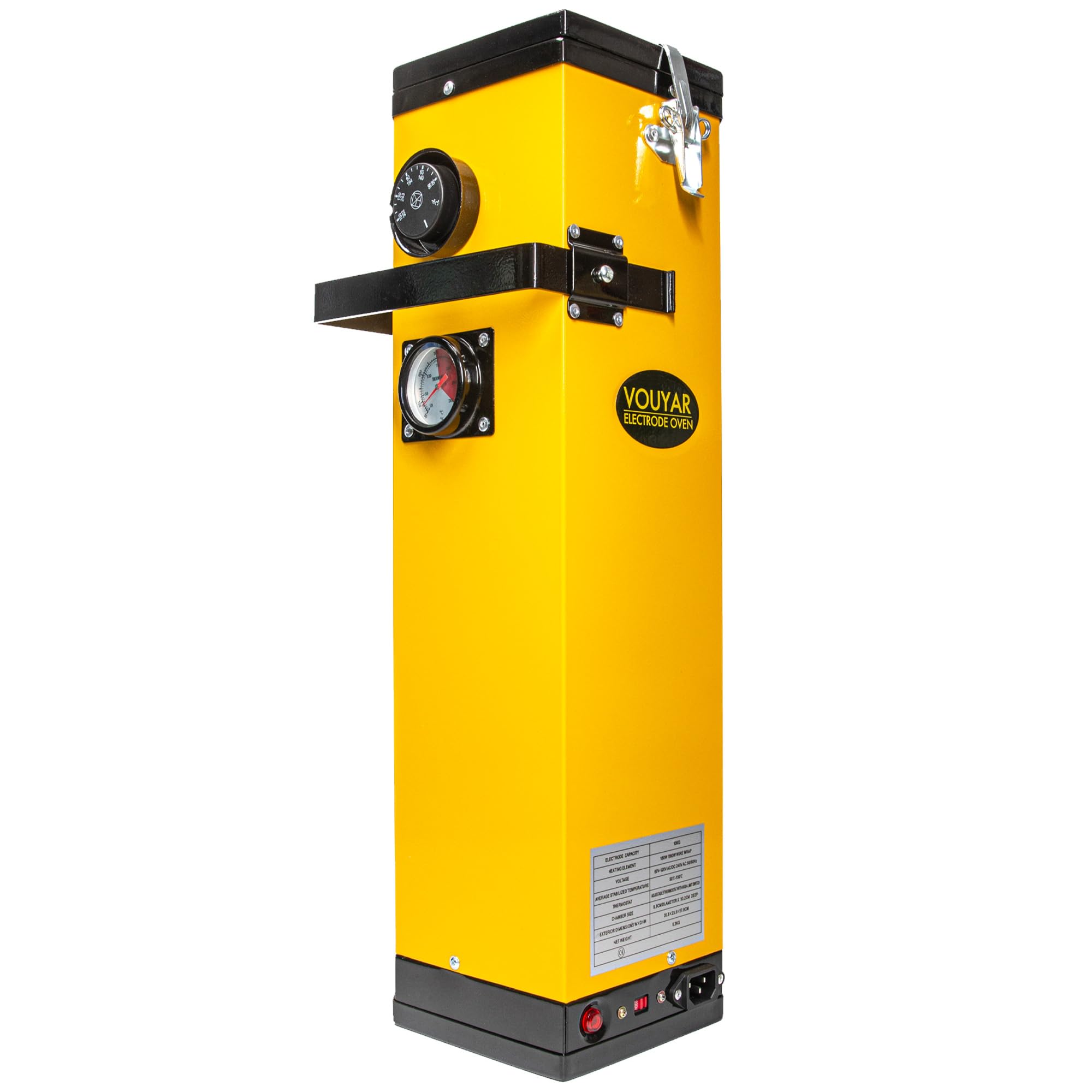
The only oven here that shows you the internal temperature while you work.
Most rod ovens make you trust the dial. This one puts a thermometer display on the body so you can watch the heat move in real time. For anyone who has ever set a knob to 250°F and wondered whether the box actually got there, that feedback is the feature that sells it.
It holds 20 lb of rods up to 19 inches, which is a step up in rod length over the YESWELDER’s 14-inch ceiling. The range runs from 150°F to 300°F, versus the YESWELDER’s 85°F floor, so it’s built for drying rather than gentle warm-holding. The maker lists 7018, 6018, and 316L rods as the target, and the wide lid and handle let you pull rods out with gloves on.
Two practical notes before you buy. Input is AC 120V 60Hz, and the maker asks you to toggle the voltage switch to match your supply to avoid a malfunction — do that first, every time. Second, the 150°F floor means you can’t park it in the low-warm range like the Arc Union; it’s a hotter-running box by design.
What the display buys you: a live temperature read instead of a guess, plus 19-inch rod capacity and a 150°F to 300°F window aimed straight at low-hydrogen and stainless work.
Before you plug in: set the voltage switch to your supply, and accept that this oven’s floor is 150°F — it is not a low-temp warm-hold box.
This is your oven if: you want to see the actual temperature and need to fit 19-inch rods.
Choose another if: you mostly want to keep rods barely warm — that 150°F floor is too high for it.
4. SÜA Portable Electrode Drying Oven TRC-10, 22 Lbs
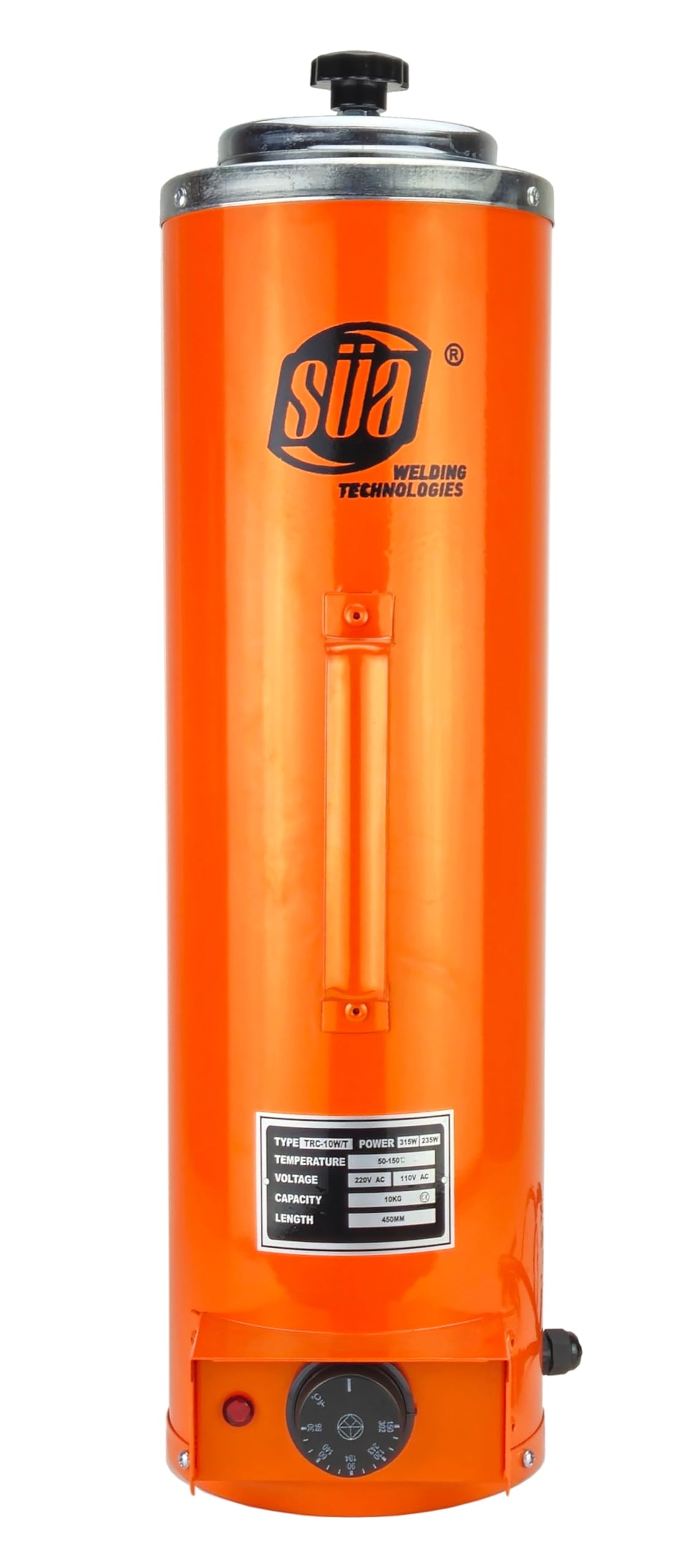
A 22 lb cylinder with a lock-open basket so you can lift rods out with one hand.
When the job is a long run of 18-inch low-hydrogen rod, capacity stops being a nice-to-have. The TRC-10 takes 22 lb of electrodes at 18 inches or shorter — more rod than the BEST WELDS or Lincoln boxes hold, and the largest load on this list. It’s a cylinder standing 24 inches tall with a 6-½ inch diameter barrel, and it weighs 9.5 pounds empty.
The basket is the detail that makes it feel built for real work. It lifts out and locks open, so you can grab electrodes with one gloved hand while the other holds your stinger. The analog dial goes from ambient up to 302°F at 115 V, and the maker says the same unit runs on 220 V as well, which opens up more field setups. It’s aimed at E7018, E7024, and other low-hydrogen electrodes, and it’s rated to plug into generators or welders with 115 V three-plug outlets.
Owners talk most about functionality and build quality, and most agree it holds heat efficiently. The one mixed note is temperature: some find it keeps rods hot exactly as needed, while others feel it doesn’t reach the heat they expected. Size the job to the oven — it’s very good for occasional use and steady holding, less so if you expect it to bake a soaking-wet box of rods back to dry.
The capacity argument: 22 lb of 18-inch rods versus the 10 lb BEST WELDS, and the lock-open basket is the most practical loading design in the group.
The mixed signal: temperature feedback is split — some find it plenty hot, others say it falls short — so don’t buy it planning to dry soaked rods in a hurry.
Your fit if: you burn through a lot of 18-inch low-hydrogen rod and want to load 22 lb at once.
Not your fit if: you need maximum drying heat from a portable cylinder.
5. BEST WELDS 900-BW Electrode Oven, 10 lb, 110 V

A plain 10 lb oven with an analog thermostat and nothing to distract you.
Not every shop needs 20 pounds of rod at temperature. If your work is smaller or you keep a separate box for each electrode type, a 10 lb oven keeps things organized and takes up less bench space. This one is a 110 V unit with a simple analog thermostat, and it’s been on the market since 2015 — long enough that the design has settled.
The trade-off against the bigger boxes is clear: the BEST WELDS holds 10 lb, versus the Arc Union’s 20 lb. If you go through rod slowly or want a dedicated box for a specific class like stainless, that smaller size is a benefit, not a compromise. It also runs on 110 V, matching the YESWELDER’s supply, so it plugs into the same standard outlet.
What you give up is precision. The analog thermostat keeps rods warm without a digital readout or a live temperature display, so you’re trusting the dial. For a dedicated warm-hold box that’s fine. For anyone who wants to see the number, the Vouyar above is the pick.
The case for a small box: 10 lb of dedicated space, an analog thermostat, and 110 V power that matches the most common outlet in the shop.
Suits you when: you want a compact dedicated box for one rod class and prefer a dial over a display.
skip it if: you regularly load more than 10 lb at once.
6. Lincoln Electric K2939-1 Hydroguard Portable Electrode Oven
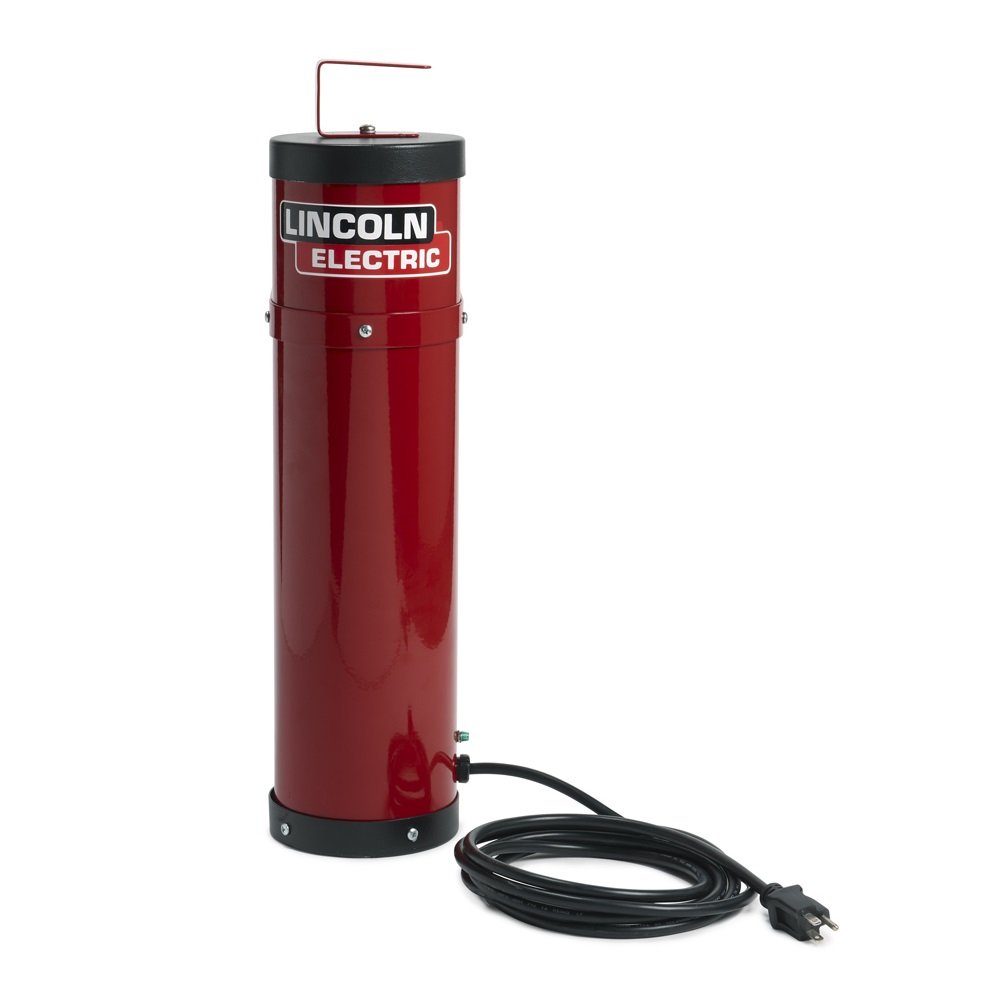
A fixed 300°F Lincoln with fiberglass insulation and a rod elevator built for jobsites.
This is the only oven in the group that takes the guesswork out of temperature entirely. It’s preset to 300°F (149°C) — no dial, no dial to bump, no knob to lose. You plug it in at 115 V, the power-on indicator light tells you it’s live, and the oven does the rest. For crews that want every welder running the same heat, that presetting is a feature, not a limitation.
The build is the other half of the story. It has premium fiberglass insulation to hold heat in, a rod elevator so you can pull electrodes without digging, a removable one-piece carrying handle, and a compact 10 lb body meant to travel to a job site. It’s the most purpose-built package here — the pick for anyone who wants one dependable 300°F setting instead of a dial to tune.
Two things to weigh against the cheaper boxes. Capacity is 10 lb — the same as the BEST WELDS, versus the Arc Union’s 20 lb. And with a fixed 300°F setting, you can’t dial down for a gentle overnight warm-hold the way you can on the 80°F to 300°F Arc Union. This oven assumes you want rods hot, all the time.
What The Premium Buyers Get
- Preset 300°F heat with no adjustment to drift or knock out of place.
- Fiberglass insulation holds temperature for job-site reliability.
- Rod elevator and removable one-piece handle make loading and carrying simple.
- Power-on indicator light confirms it is actually running.
The Honest Cost Of Preset
- 10 lb capacity is on the small side for a full shop run.
- No dial means no low-temperature warm-hold option.
Best for the welder who wants: a fixed-heat, insulated, insulated jobsite oven with no adjustments to manage.
Not for the tinkerer: anyone who wants to choose their own temperature should look at a dial-controlled box instead.
Know the Specs
Temperature range in °F
The range tells you how hot the box can get and how low it can idle. A wide window, like the Arc Union’s 80°F to 300°F, lets you warm-hold rods gently or dry them at higher heat. A narrow window, like the Vouyar’s 150°F to 300°F, is built for drying and won’t do a low idle. Match the floor to how you want to use the oven — gentle holding or active drying.
Capacity in pounds and rod length
Pounds are the usual headline, but the rod-length ceiling decides whether your stock fits. A 10 lb box may only take shorter rods, while a 20 lb or 22 lb box can take 18-inch or 19-inch stock. Check both numbers against the electrodes you actually burn before you buy.
Voltage and power source
Most portable ovens run on 110 V, 115 V, or 120 V from a standard outlet, and that near-match lets them plug into a wall receptacle, a welder’s auxiliary outlet, or a generator. If the maker asks you to set a voltage switch, do it before you power on — a mismatch is the surest way to damage a heater.
Insulation and hold time
Insulation is what keeps the heat where it belongs once the oven is on. Fiberglass insulation, like the Lincoln’s, holds temperature better than a bare metal shell, so the box recovers faster when you open the lid and pull rods out. For jobsite use, that insulation is what keeps the numbers steady between passes.
Common Questions
What temperature should a welding rod oven be set to for E7018 rods?
Can I use a rod oven to dry electrodes that got wet?
Will a welding rod oven run off a generator or a welder outlet?
How many pounds of rods do I need to keep warm at once?
Do longer rods fit in a portable rod oven?
Is a preset-temperature oven better than an adjustable one?
How do I know the oven is actually heating?
Can I leave the rod oven plugged in all day in the shop?
What is the difference between a rod oven and a rod quiver?
The Bottom Line
For most shops, the welding rod oven to buy is the Arc Union 20 lb. It holds the biggest standard box of rods, gives you an 80°F to 300°F dial, and buyers keep calling it a lot of oven for the money. If your work travels, the YESWELDER 15lb at 8.91 pounds is the one to sling in the truck. And for a fixed-heat jobsite box with fiberglass insulation and no knobs to fiddle with, the Lincoln Electric K2939-1 is the premium answer.
How we choose
We do not accept paid placement. Every pick is matched to a real buyer and a real use-case; we do not hands-on test units.
Sources
Specifications: manufacturer listings and product documentation. Review insights: verified customer reviews, as of November 2026. Pricing: not shown on this page (it changes often); check the current price via the retailer link.
As an Amazon Associate, Tactical Gear Guy earns from qualifying purchases. This does not affect which products we feature.