Specs are compiled from manufacturer listings and verified buyer reviews and can change over time — please confirm the key details on the product page before buying.
Buy the wrong mat and a single stray spark can scar a garage floor or torch a workbench finish. What you actually need is a blanket whose heat rating matches your work: a 1,022°F fiberglass mat covers most stick and MIG jobs, while carbon felt rated to 1,800°F is the safer call for heavy slag and molten steel. Size and grommet count decide whether it hangs as a curtain or lies flat, so both matter as much as the fire rating.
This guide is built by comparing the manufacturers’ published specifications and the patterns across verified customer reviews, so you get each pick’s real strengths and trade-offs instead of marketing spin.
Below you’ll find the honest differences between four-by-six fiberglass mats, silicone-coated shields and cuttable carbon felt, laid out so you can match one to your bench and your torch. Here is how to pick a welding fire blanket that actually survives the spatter your work throws at it.
Top Picks


How To Choose The Best Welding Fire Blanket
A welding fire blanket is a heat shield first and a blanket second. The number printed next to its temperature rating tells you what kind of molten spatter it will shrug off, and the fabric weight tells you how long that shield lasts before it frays. Get those two right and the rest — grommets, size, coating — is fine-tuning.
Match the temperature rating to your process
Light welding, grinding and cutting throw sparks that a 1,000°F to 1,022°F blanket handles without complaint. Those figures are what most fiberglass mats in this class advertise as their working temperature. Think of working temperature as the ceiling you can sit under all day, not a one-time survival limit. Heavy slag, plasma cutting and molten metal splash sit in a harsher bracket, which is where a carbon felt mat rated to 1,800°F starts to make sense.
Read the fabric weight, not just the size
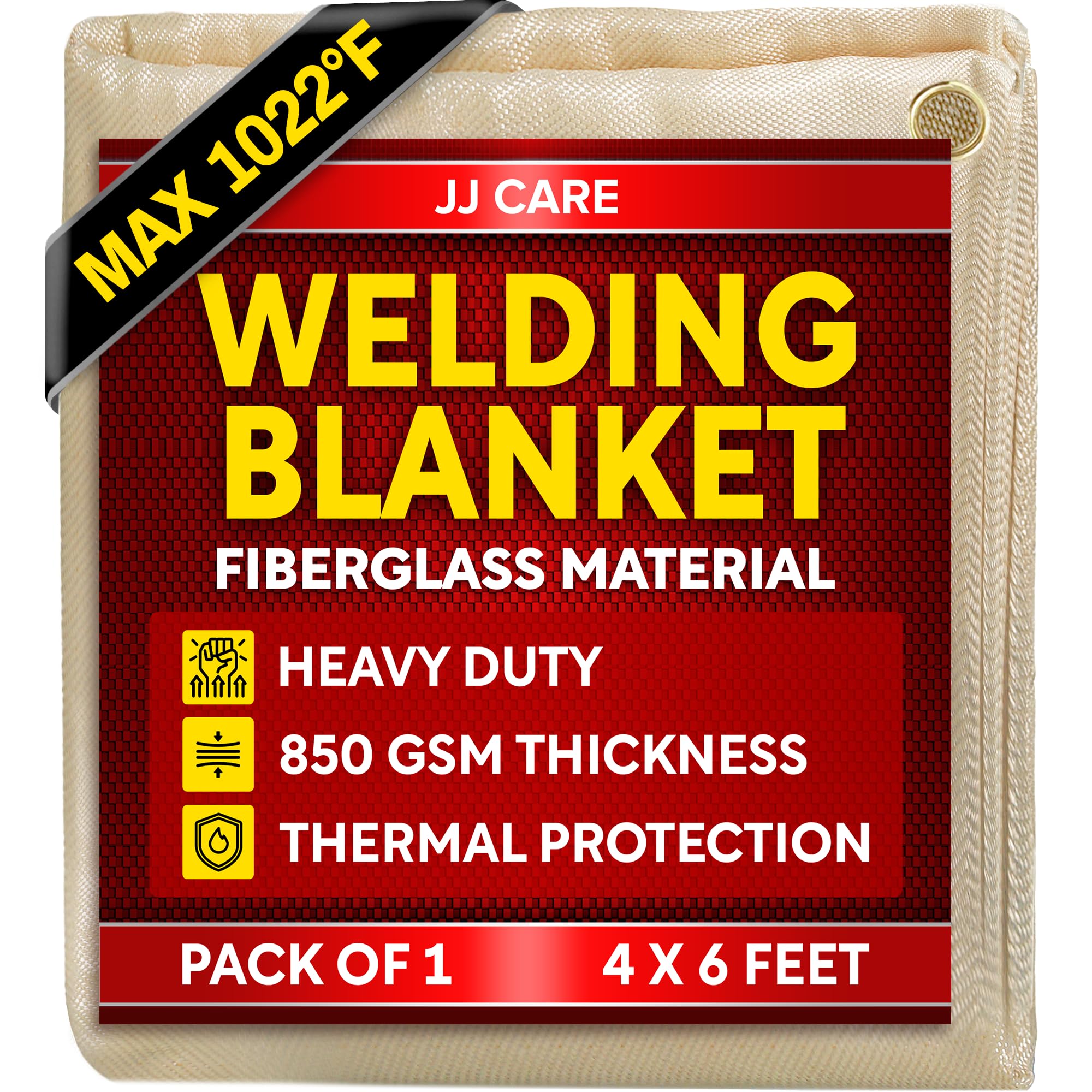
Two blankets can both measure four by six feet and behave completely differently. Fiberglass is often sold by weight per square yard — 19.8 oz/yd² on a VCT or NEIKO mat, 24.7 oz/yd² on a YESWELDER blanket, and 850GSM on the JJ CARE. Heavier fabric generally means a denser weave that resists spatter longer, but it also means more bulk to fold and store. The weave count matters too: a 30 x 30 per square inch pattern is denser than a loose generic weave and holds up better to repeated use.
Decide whether you hang it or lay it flat
A floor mat just needs to stay put. A vertical spark curtain needs brass grommets strong enough to hold it up, and the spacing tells you how evenly it will hang. Closer grommet spacing spreads the load better; wider spacing means fewer anchor points. If you plan to drape a blanket over equipment or a smoker, a lighter fabric folds down quicker and drapes more tightly than a heavy industrial sheet.
Side-by-Side Comparison
| Model | Best For | Size | Working Temp | Fabric Weight | Amazon |
|---|---|---|---|---|---|
| 4x6ft Silicone Coated Fiberglass Blanket★ Best Overall | All-round shop protection | 4 x 6 ft | 1,022°F (550°C) | Silicone-coated fiberglass | Amazon |
| VCT Heavy Duty Fiberglass BlanketBudget Champion | Budget hanging curtain | 4 x 6 ft | 1,000°F (537°C) | 19.8 oz/yd² | Amazon |
| JJ CARE 850GSM Fiberglass BlanketGrill and Smoker Pick | Smoker and grill draping | 4 x 6 ft | 1,022°F (550°C) | 850GSM | Amazon |
| NEIKO 10908A Welding Blanket | Heavy repeated welding use | 4 x 6 ft | 1,000°F (537°C) | 19.8 oz/yd² | Amazon |
| NEZUIBAN 6 x 8 ft Fiberglass Blanket | Large-area industrial cover | 6 x 8 ft | 1,000°F | Fiberglass | Amazon |
| YESWELDER Fiberglass Blanket | Thick insulation layer | 4 x 6 ft | 1,022°F (550°C) | 24.7 oz/yd² | Amazon |
| FLASLD Silicone-Coated Heat Shield | Low-lint coated shield | 4 x 6 ft | 800°C | 1 mm coating | Amazon |
| Waylander Carbon Felt Blanket | Extreme heat, no fiberglass | 36 x 36 in | 1,800°F (1000°C) | Carbon felt, 0.18 in | Amazon |
Detailed Reviews
1. 4x6ft Silicone Coated Fiberglass Welding Fire Blanket
Our pick — 4.5+★ from 550+ verified ratings; the strongest balance of quality and price.
The coated shield that covers floor, bench and doorway without wetting the bench with stray fibers.
The silicone coating is what earns this one the top spot. That coating is a rubbery layer bonded over the woven fiberglass, and its job is to lock loose glass fiber in place so fewer itchy strands end up on your garage floor. The mat still takes a 1,022°F (550°C) working temperature, which is a real ceiling for stick, MIG and general cutting. Owners who drape it over concrete or slide it under a weld table describe the protection working exactly as promised — the concrete stays clean and the spatter dies on the mat.
Eight stainless-steel grommets line the edge, so you can hang it as a vertical spark screen or tie it off around equipment. Folding it down is genuinely practical: at 3.12 pounds it behaves like a stiff blanket rather than a sheet of sheet metal. Compare that to the NEZUIBAN six-by-eight in this list at 8.1 pounds, and this one is far easier to ball up and shove into a tool bag for a job off-site. The four-by-six footprint is the size most home garages actually need.
The honest catch sits with the flame resistance. Most buyers find it holds up, but a handful report the material can catch rather than snuff out a persistent flame, so it works best as a spark and spatter shield rather than a mat you hold under a torch. Keep it away from direct contact welding flame and it does its job for years. If you need the highest possible burn-through margin, the carbon felt further down is built differently on purpose.
What the coated fiberglass brings
- 1,022°F (550°C) working temp — real headroom for stick and MIG sparks and general cutting
- Silicone coating holds loose fiber in check so the mat is easier on your hands and shop floor
- 8 stainless-steel grommets let you hang it as a vertical spark shield or stake it flat
- 3.12 pounds folds into a compact bundle you can carry to the truck
Where it draws the line
- Sustained direct flame is not its job — treat it as a spatter and spark barrier
- Dry fiberglass mats of this size are lighter for pure floor work, though they come without the coating
Pick it for: home garages and mobile welding work where you want coated protection that doesn’t shed fiber everywhere.
Think twice if: your work involves holding a torch flame directly against the mat for long stretches.
2. VCT Fiberglass Welding Blanket
Twenty-two inches of hem spacing and a tight 30 x 30 weave make this the cheapest real curtain here.
What wins people over on the VCT is the value: a 19.8 oz/yd² fiberglass sheet at 4 x 6 feet that covers a smoker, a bench or a weld bay without asking much. The weave is the detail that keeps it alive — 30 x 30 fibers per square inch is a dense, tight pattern that takes repeated sparks far better than a loose mat. Its working temperature tops out at 1,000°F (537°C), which is a hair under the 1,022°F ceiling of the top pick but still fine for everyday welding tasks.
The brass grommets sit every 11 inches along a 3/8-inch inner-diameter hem, so hanging it as a spark screen is simple with a bungee or a length of wire. Beyond the shop, this blanket has a second life: owners use it over pellet grills and smokers, and one report notes it holding cooking temperatures within 1 degree of target in cold weather. That is the thermal insulation value of tight fiberglass doing quiet work.
Be clear on the durability expectation. The mat resists melting, but sustained welding spatter will eventually wear at the weave, so you would not want to point a hot slag stream at the same spot for an entire project. For occasional hobby welding or keeping a grill warm through winter, it earns its keep.
Cheap way to hang a shield: 11-inch grommet spacing and a reinforced hem mean you can string it up in about a minute, and the tight 30 x 30 weave means the fabric holds its shape rather than sagging.
Pair it with a heavier mat: keep this for grill draping and light welding, and break out a thicker blanket when you are running a hot bead all afternoon.
The smart budget call: hobby welders and anyone who wants a grill or smoker cover that doubles as spark protection.
Look elsewhere if: you weld daily at high heat and need a mat that won’t thin out over the years.
3. JJ CARE 850GSM Fiberglass Welding Blanket
An 850GSM sheet that spends as much time wrapped around a smoker as it does hanging over a weld bay.
It started as a welding mat and gets kept for the grill. The 850GSM rating refers to grams per square meter — a measure of how much fabric weight is packed into the sheet — and that density is what makes it such a good thermal wrap. It handles a 1,022°F (550°C) working temperature, which puts it in the same safety class as the top pick, but the heavier 4.09-pound body makes it drape and hug a smoker barrel instead of flapping loose.
It has a genuine double life. Buyers report it working well as a thermal cover for grills and a smoker drape, keeping heat where it belongs in cold weather. In the shop, it shields machinery from sparks, embers and slag on cutting and grinding jobs, and the reinforced hem with 1-inch brass grommets spaced for stability lets you hang it as a permanent screen. The dense fiberglass weave resists the wear and tear that thins cheaper mats.
The trade-off is weight and bulk. At 4.09 pounds it takes more effort to fold and takes up more room in a toolbox, so it is better suited to a fixed bench or a permanent grill cover than a bag you carry site to site. Those who want a folding blanket for the truck should look at the lighter coated pick above.
What sells it: the 850GSM density and 1-inch grommets make it sturdy enough for a permanent hang and heavy enough to insulate a grill through a cold evening.
Worth knowing: this is a fixed-position blanket, not a portable one — plan its spot before you buy.
Best served: the shop owner who wants one mat that guards the bench and keeps the smoker hot in winter.
skip it if: you need something you can fold small and toss in a tool bag.
4. NEIKO 10908A 4×6 Welding Blanket

A fireproof mat built for a lifetime of sparks, with the tightest weave the fiberglass class offers.
Quality is what owners rave about here — a fiberglass sheet that still reads as one of the tougher mats in this bracket. The build is textbook: 19.8 oz/yd² fiberglass, a 30 x 30 fibers-per-square-inch weave for extreme durability, and a 1,000°F (537°C) working temperature that covers general-purpose welding against sparks and flame.
The fire resistance holds up in real welding environments, and its heat retention is strong enough that owners use it for cold-weather smoking and grilling as much as shop work. A reinforced hem with 3/8-inch inner-diameter brass grommets every 11 inches gives you clean hanging points. The four-by-six size is easy to lay over a bench or drape over a smoker, and 3.5 pounds keeps it manageable to move and fold.
The one thing to plan around is fiber shedding. Dry fiberglass of this weight will shed loose strands, so wear gloves and long sleeves when you first unfold it and give it a shake outside. That’s the nature of an uncoated fiberglass mat, not a fault unique to this one — and it’s the reason the silicone-coated options above suit bare-handed handling better.
Why it earns its place
- 30 x 30 weave and 19.8 oz/yd² fiberglass stand up to long-term repeated use
- 1,000°F (537°C) working temperature covers general welding, sparks and flame protection
- 3/8-inch brass grommets every 11 inches make it easy to hang as a screen
- Bonus duty as a cold-weather smoker and grill wrap
The trade you accept
- Dry fiberglass sheds loose strands, so gloves are a good idea when you unfold it
- The weave wears over years of blast-direct spatter, as fiberglass mats do
Go here for: a shop mat you plan to keep in place for years and use across welding and grilling without a second thought.
Bear in mind: if itchy fiber is a dealbreaker, the coated picks handle bare hands better.
5. NEZUIBAN 6FT x 8FT Heavy Duty Welding Blanket

Forty-eight square feet of fiberglass with ten buckles, built to wall off a whole weld bay.
When your work spills past the edge of a four-by-six, size is the spec that decides everything. This sheet covers 6 x 8 feet, a full 50% more area than the 4 x 6 mats above, and it carries ten metal buckles along the hem so you can tie off a wider curtain. The 0.08-inch thick fiberglass handles temperatures up to 1,000°F, and the reinforced hem holds the edge shape so it doesn’t curl as you hang it.
Quality of the build shows up in the stitching around the edges, which owners notice holds its line even when the blanket is pulled taut. It handles industrial and domestic protection duties, from shielding property against sparks to working as a general fire blanket. Fold it down and it stores compactly, though you will feel the heft getting there.
Weight is the honest cost of that coverage. At 8.1 pounds it is 2.6 times heavier than the silicone-coated four-by-six pick, so one person wrestling it into place overhead is a chore. A few buyers also report that regular-sized spatter can eventually burn through the fabric, so it is best used as a wide-area barrier rather than a spot shield against heavy slag.
The case for the big sheet: 6 x 8 feet, ten buckles and 48 square feet of coverage turn an open bay into a shielded one.
The catch: 8.1 pounds and a size that needs two hands to hang — this is a permanent fixture, not a portable one.
Made for: the welder who needs to wall off a large work zone and can leave the blanket hung in place.
Better elsewhere: small garages, or work where you need to haul the blanket with you.
6. YESWELDER Fiberglass Welding Blanket 4 x 6ft

The heavyweight of the fiberglass class: 24.7 oz/yd² woven tight enough to feel like a proper heat barrier.
Fabric weight is the whole story. At 24.7 oz/yd² this is the heaviest fiberglass sheet in this list, denser than the 19.8 oz/yd² VCT and NEIKO mats, and that density translates into a shield that holds heat and stops spatter dead. It handles a 1,022°F (550°C) working temperature and is rated for MIG, TIG and stick work, with the ember, heat, spark and splatter protection a welder wants around metal.
It is thick, too — 0.31 inches (8mm) — so it doubles as an insulation wrap. Owners drape it over Weber grills to hold heat in during colder months and use it for brazing in tight spots where a thin mat would let heat leak through. Grommets sit every 11 inches with a 0.59-inch bore, giving you room for hooks and tie-wire, and the fabric folds down for storage despite its weight. For a comparison of sheer heat-holding ability, this takes the density crown over the lighter 19.8 oz/yd² picks.
The thing a buyer should expect is bulk. A 24.7 oz/yd² blanket is not something you stuff into a small toolbox, and folding requires a little more care to avoid creasing the weave. Treat it as a bench or grill fixture rather than a portable accessory.
The heavyweight argument
- 24.7 oz/yd² fiberglass — the densest sheet here, built for MIG, TIG and stick welding
- 1,022°F (550°C) rating and 0.31-inch thickness for serious heat holding
- Grommets every 11 inches with a 0.59-inch bore for easy hanging
What bulk costs you
- Heavy fabric takes more effort to fold and store than the lighter mats
- Its size makes it a bench fixture rather than a carry-along blanket
Reach for it if: you want the most heat-holding fiberglass sheet here for MIG and TIG work and grill insulation.
Pass if: you need something light enough to stash in a compact toolbox.
7. FLASLD 4×6 FT Silicone-Coated Fiberglass Heat Shield
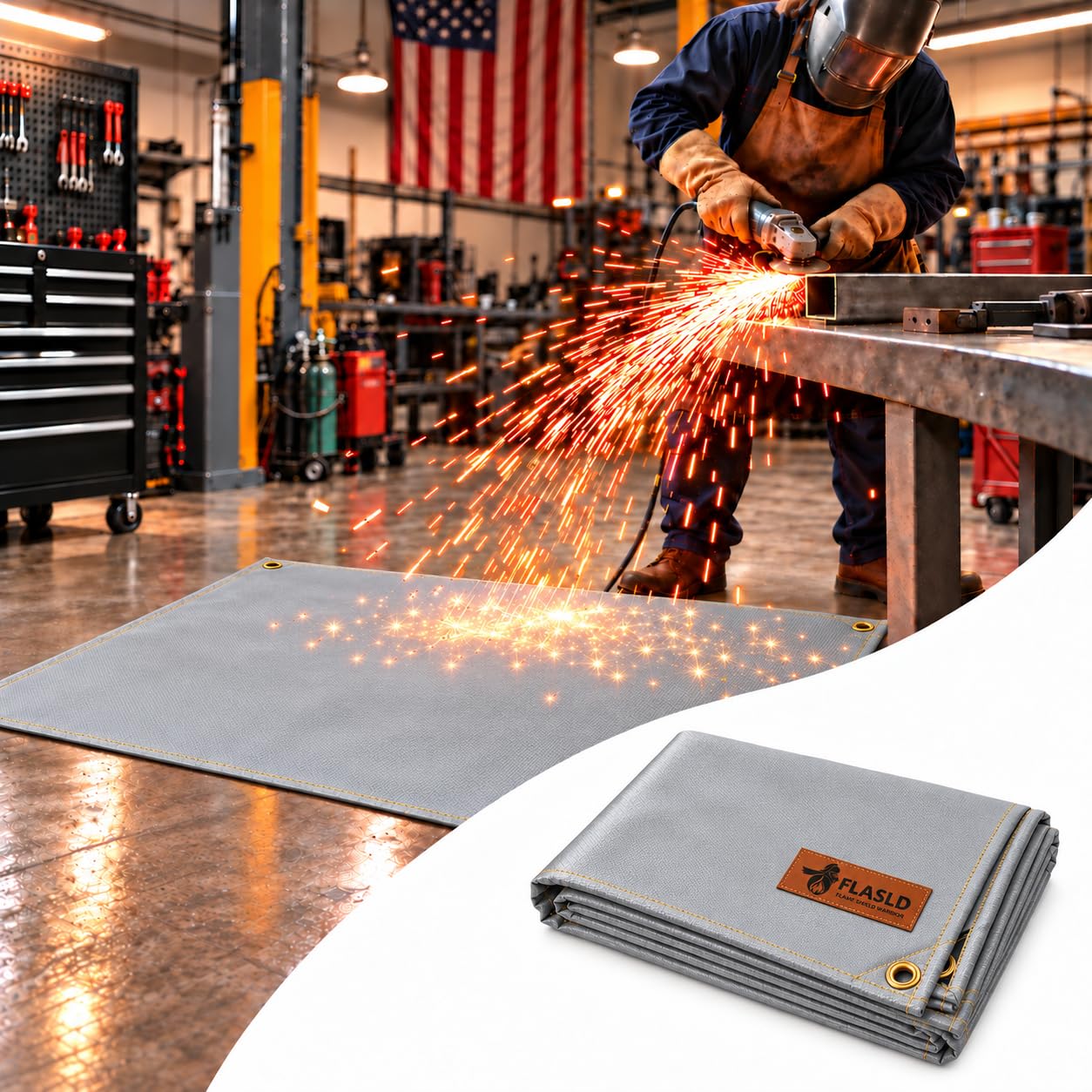
A thin, wipe-clean silicone skin that keeps fiberglass fibers off your hands and shop floor.
The coating is the reason to buy this one. It’s a silicone layer bonded over the woven fiberglass, and its job is to keep loose strands out of the air and off your skin — a real advantage for anyone who has ever spent a morning itching after unrolling a dry mat. It measures 4 x 6 feet (48 x 72 inches), so it covers a bench, serves as a floor mat, or hangs as a spark curtain. Four reinforced brass grommets sit one at each corner, so hanging is simple and secure.
The stitched and folded hems reduce edge fraying, which matters if you plan to use it repeatedly. Its coating wipes clean after a job, and the whole blanket folds compactly at 5.17 pounds. Owners find it works well, with reports of it doing its job as a cover on a pellet grill during cold weather. The UL listing backs up the fire-retardant claim, which not every mat in this class carries.
The thickness is the thing to know before you buy. At a nominal 1 mm it is a thin shield compared to the heavy 24.7 oz/yd² YESWELDER and the 8mm-thick blanket above, so it is built for incidental sparks and spatter rather than a steady stream of molten slag. Think of it as a protective skin for surfaces and equipment, not a heavy-duty heat barrier for the harshest work.
Why the coating wins: the silicone skin reduces exposed fiberglass, and the 4 x 6 feet of coverage with four corner grommets hangs or lays flat in seconds.
Where it’s thin: at 1 mm, this is a surface-protection shield, not a barrier for heavy slag streams.
Ideal for: the workshop that wants low-lint, wipe-clean protection over benches and floors.
Not the best fit for: daily heavy slag work that needs thick, dense fabric.
8. Waylander Carbon Felt Welding Blanket
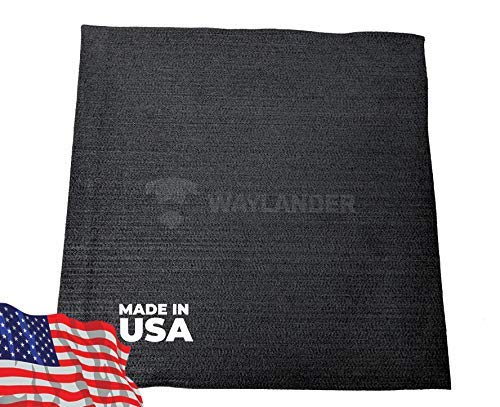
Carbon felt, not fiberglass, rated to 1,800°F — and soft enough to cut with scissors.
The headline is the heat ceiling. This is carbon felt, a dense soft fabric made of carbon fibers rather than glass, and it takes temperatures up to 1,800°F (1000°C). That is well above the 1,000°F to 1,022°F ceiling of the fiberglass mats here, which is why it suits heavier processes — molten steel, glass blowing, stove and fireplace insulation, and automotive body work. The 36 x 36 inch pad is thick at 0.18 inches and has a smooth, non-irritating surface that won’t leave you scratching.
Owners value the cutability. You can trim it to fit with scissors or a utility knife, which makes it useful for wrapping grills, insulating a smoker or lining an odd-shaped cavity that a rigid blanket would never fit. It shields valuables from sparks and heat at temperatures the fiberglass mats here can’t match. At 0.48 kg it’s light enough to reposition on your own. Compared to the fiberglass blankets above, this one holds up against far hotter material.
The trade-offs are real and worth stating. It’s a 36 x 36 pad, not a four-by-six, so the coverage is smaller than the large fiberglass mats. It is also not meant to be worn or used directly on the body — keep it for protecting surfaces and equipment. And like most carbon felt, repeated flexing will eventually break it down, so handle it with some care rather than balling it up roughly.
The extreme-heat ace: a 1,800°F (1000°C) rating and 0.18-inch carbon felt thickness handle processes that burn straight through ordinary fiberglass.
Size and handling trade: it’s a compact 36 x 36 pad, and it prefers light handling to rough folding.
Choose it for: glass blowing, auto body, stoves and any work where sparks run hotter than fiberglass can comfortably handle.
Know before you buy: it’s smaller than a four-by-six sheet, so plan around the smaller footprint.
Know the Specs
Working Temperature (the ceiling figure)
The number in °F or °C beside “working temperature” is the heat a blanket can sit under continuously without breaking down. A 1,000°F to 1,022°F mat handles ordinary welding sparks, spatter and grinding. A carbon felt mat rated to 1,800°F is built for heavier processes like molten metal and glass work. Always match that ceiling to the hottest thing your job will throw at the fabric.
Fabric Weight (oz/yd² or GSM)
This tells you how much material is packed into the sheet. Heavier fiberglass — 19.8 oz/yd², 24.7 oz/yd² or 850GSM — generally means a denser, tougher blanket that resists spatter longer and holds heat better for grill duty. Lighter fabric is easier to fold and carry. Neither is “better” on its own; the trade is durability against portability.
Grommets and Hem Spacing
Brass grommets are the metal ringed holes along the edge that let you hang the blanket. Their spacing decides how evenly it hangs: every 11 inches spreads the load, while four corner grommets keep it simple for flat coverage. A reinforced hem around those holes is what stops the fabric tearing when the blanket is pulled taut.
Coating and Fiber Shedding
Plain fiberglass sheds loose strands, which is why silicone-coated blankets exist: the rubbery layer locks the glass fibers in place. Coated mats suit bare-handed handling and wipe clean more easily. Uncoated and carbon felt options have their own advantages — carbon felt in particular is soft and non-irritating without any glass fiber at all.
Common Questions
Is 1,000°F enough for stick welding?
What is the difference between carbon felt and fiberglass welding blankets?
Can a welding blanket be used on a grill or smoker?
Will a 4 x 6 welding blanket cover my whole workbench?
Do I need brass grommets to hang a welding blanket?
Why does my fiberglass welding blanket shed fibers?
Can I cut a welding blanket to fit a tight space?
How thick should a welding blanket be?
Is a silicone-coated welding blanket worth choosing over plain fiberglass?
Can I hang a welding blanket vertically as a spark curtain?
The Bottom Line
For most home welders, the welding fire blanket that makes the best all-round case is the 4x6ft Silicone Coated Fiberglass Blanket, because the coating stops the fiber shedding that plain fiberglass brings and the 1,022°F working temperature covers everyday stick and MIG jobs. If you want a large curtain that walls off a whole bay, reach for the NEZUIBAN 6 x 8 ft with its ten metal buckles and 50% more area than the four-by-six picks. And when your work runs hotter than fiberglass can take, the Waylander Carbon Felt Blanket at 1,800°F is the one built for it. The silicone-coated mat is the crowd favorite at 4.5+ stars across 500+ ratings, and the fit notes above make the coated, large-area or carbon felt choice a quick one.
How we choose
We do not accept paid placement. Every pick is matched to a real buyer and a real use-case; we do not hands-on test units.
Sources
Specifications: manufacturer listings and product documentation. Review insights: verified customer reviews, as of November 2026. Pricing: not shown on this page (it changes often); check the current price via the retailer link.
As an Amazon Associate, Tactical Gear Guy earns from qualifying purchases. This does not affect which products we feature.