Specs are compiled from manufacturer listings and verified buyer reviews and can change over time — please confirm the key details on the product page before buying.
You want a ram that pushes hard, holds its seal, and bolts straight onto your loader without a fight. The short answer: buy by bore, stroke, and rated pressure first, and pick a welded body over a tie-rod design if you want fewer leak points. Match those three numbers to your machine and most of the guesswork disappears.
This guide is built by comparing the manufacturers’ published specifications and the patterns across verified customer reviews, so you get each pick’s real strengths and trade-offs instead of marketing spin.
Below you get three welded-body cylinders sorted by real job, from a heavy front-end-loader replacement down to a compact bucket ram. Every pick below is a genuinely welded hydraulic cylinder worth bolting on, and this guide to welded hydraulic cylinders explains which one fits your machine.
Top Picks

How To Choose The Best Welded Hydraulic Cylinders
Most cylinder returns happen for one reason: the ram didn’t fit the machine. Force and pressure get all the attention, but length and pin size decide whether the thing bolts on at all. Get the retracted length, extended length, and pin size right and the ram will bolt on.
Start with bore and stroke, not pressure
Bore is the inside diameter of the barrel — the wider it is, the more push you get from the same pump pressure. Stroke is how far the rod travels, so a 10-inch stroke moves the load ten inches. Measure your old ram’s stroke before you shop, because a stroke that runs short leaves your bucket hanging mid-tilt.
Match retracted and extended length to your mounts
These two numbers tell you where the pin holes sit when the ram is fully in and fully out. A cylinder that is too long won’t pin up at all, and one that is too short won’t reach full travel. Check both figures against your bracket spacing, plus the pin hole diameter, before you commit.
Check the port thread before you buy hoses
Ports come in different thread standards, such as SAE O-ring boss or JIC fittings. A mismatch here means a trip back to the parts store for adapters. Note the port type on your machine’s hoses and confirm the ram matches it.
Side-by-Side Comparison
Detailed Reviews
1. Magister Hydraulic Cylinder 4″ Bore x 10″ Stroke Welded Ram
Our pick — 4.5+★ from 550+ verified ratings; the strongest balance of quality and price.
A 4-inch bore, 10-inch stroke welded ram rated to 3500 PSI for front-end-loader replacement.
If you are replacing a tired loader ram and want the same push without rebuilding the mounts, this is the one to look at first. The 4-inch bore is double the 2-inch bore on the compact AMRAP below — that is the difference between nudging a bucket and lifting a full scoop. It carries a 37,700-pound column load rating and a 3500 PSI working-pressure rating, so it holds up under continuous loader duty.
The fit side is where serious buyers should focus. Retracted length is 20 inches and extended is 30 inches, with 1.5-inch pin holes and cross tube ends — check those three against your bracket spacing before ordering. It uses SAE 8 O-ring boss ports, so match your hose fittings to that standard. At 47 pounds it is far heavier than the 11-pound AMRAP, which is exactly what you expect from a loader-grade barrel.
What wins people over most is the barrel quality and the value it delivers as a weld-in replacement. The honest catch is that the welding and rod finish deserve a look on arrival, because a rare unit has arrived cracked and the fit varies a little by machine. Magister sells direct as the manufacturer and backs it with a 2-year warranty, made in Europe.
Why loader owners gravitate here
- 4-inch bore and 3500 PSI give real pushing muscle for full buckets
- 37,700-pound column load rating for full-bucket lifting
- Cross tube ends with 1.5-inch pins drop into common loader brackets
- Manufacturer-direct sale with a 2-year warranty
What to weigh first
- At 47 pounds it is heavy to wrestle into place alone
- Fit varies — confirm retracted and extended length against your machine
- A rare unit has arrived with weld or rod damage, so inspect on delivery
Reach for this if: you run a front end loader and want a drop-in 4-inch ram that pushes hard and bolts to existing cross tube mounts.
Look elsewhere if: your brackets are sized for a 2-inch bore compact ram or you need a longer 16-inch stroke.
2. AMRAP 2×4 Hydraulic Cylinder

A compact 11-pound bucket ram that slots in where the big cylinders cannot reach.
Small machines need short strokes, and this is a purpose-built short one. The 2-inch bore and 4-inch stroke keep the barrel stubby — 12 inches retracted, 16 inches extended — so it tucks into tight bucket brackets. It still carries a 3500 PSI rating, matching the big Magister above on pressure, while the 4-inch stroke is a quarter of the RHKING’s 16-inch travel below.
What wins people over most here is that it drops in and works like the original ram. Buyers describe it as a drop-in for loader buckets, with easy installation and no drip at the seals. The 2-inch bore is the same as the RHKING below, so the difference between them is stroke and pressure, not push. For a small tractor or skid-steer bucket, that compactness is the whole point.
At 11 pounds it is easy to install single-handed, and the cross tube design lets it pin straight into worn brackets. One caveat worth knowing: this is a short-stroke ram, so if your implement needs long reach it will run out of travel. Confirm your 4-inch stroke requirement before you commit, since the length is fixed at that 16-inch extended dimension.
The short-stroke advantage: a compact 2-inch bore at 3500 PSI that fits brackets a long ram cannot, installs cleanly, and seals tight.
Where it stops: the 4-inch stroke caps its travel — a long-throw implement will outrun it, so match it to short bucket work.
The right call for: small tractors, skid-steers, and bucket jobs where space is tight and a short 4-inch stroke is all you need.
Not the ram for: implements needing the 16-inch travel the RHKING provides.
3. RHKING 2×16 Hydraulic Cylinder
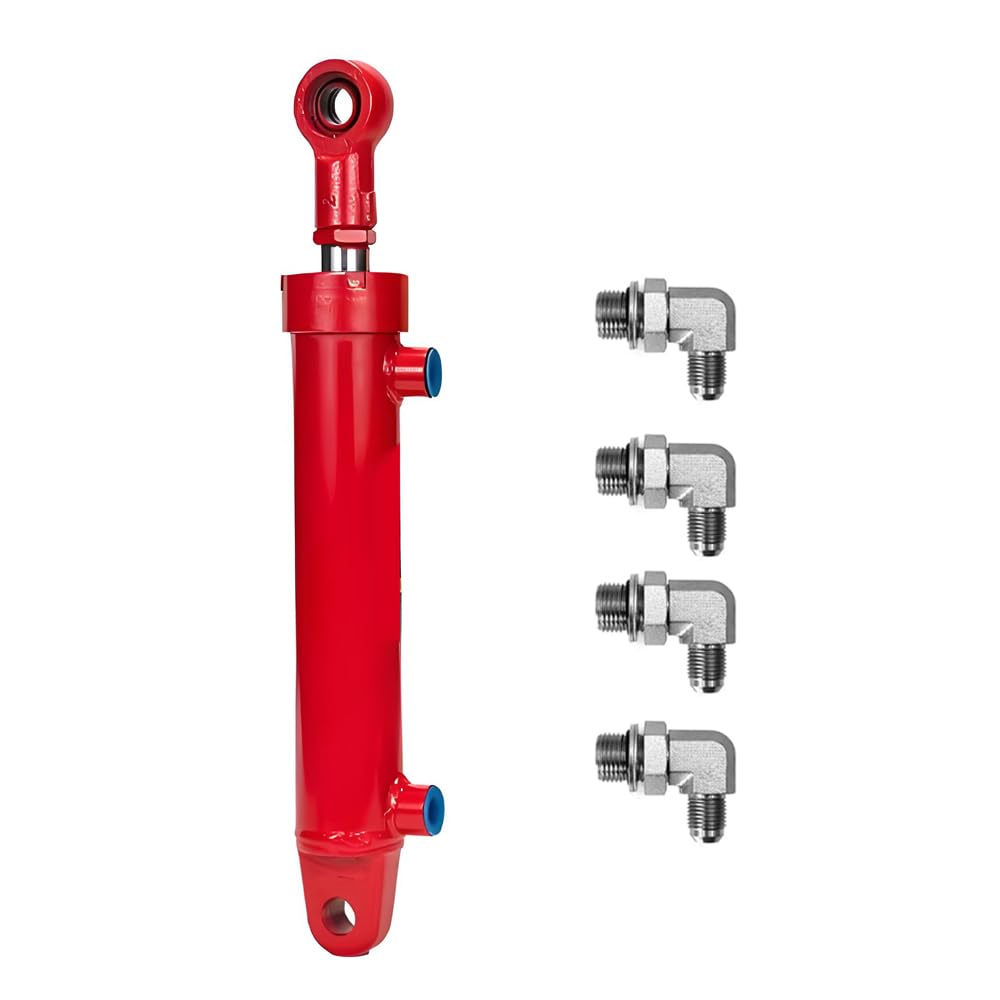
Sixteen inches of travel for implements that need to reach, not just nudge.
Long-reach jobs need long travel, and this ram delivers 16 inches of stroke where the AMRAP above offers just 4. That is the number that decides the job. It runs a 2-inch bore like the AMRAP, but travels four times as far, extending to 40.9 inches and retracting to 25.2 inches — check both against your bracket span before you order.
It is rated to 2320 PSI with a maximum thrust force of 6613 lbs and a pulling force of 4410 lbs, which suits lighter agricultural and material-handling implements. It uses 3/8-inch JIC 37-degree fittings on 9/16″-18 threads, so your hoses need that standard. The fully welded steel barrel and chrome-plated rod are built to shrug off outdoor grit. At 18 pounds it is lighter than the 47-pound Magister but heavier than the compact AMRAP.
Owners trust the build quality most, but the 2320 PSI ceiling is lower than the other two, so run it inside its rating rather than at loader-grade pressure. Note the shipping list is the cylinder only; fittings are not included in the box. For a long-stroke implement, that 16-inch reach is the reason to pick it.
The reach argument: 16 inches of stroke and a 6613-lb thrust ceiling make it the pick for implements that need distance over brute pressure.
The trade-off to size up: a 2320 PSI rating sits below the 3500 PSI pair, so run it within spec and add your own fittings.
Pick it when: your implement needs a long 16-inch throw and a 6613-lb push for agricultural or material-handling work.
Think twice if: your system runs at loader-grade pressure, since 2320 PSI is the ceiling here.
Know the Specs
Bore and stroke
Bore is the inside diameter of the barrel — the wider it is, the more force the ram produces at a given pressure. Stroke is how far the rod travels; the Magister runs a 10-inch stroke, the AMRAP a 4-inch, and the RHKING a 16-inch. Match stroke to the throw your implement needs, and match bore to the load you are lifting.
Rated pressure (PSI)
PSI, or pounds per square inch, is the fluid pressure the cylinder is built to handle. The Magister and AMRAP are rated to 3500 PSI; the RHKING is rated to 2320 PSI. Run the ram inside its rating — exceeding it strains seals and welds, which is where leaks start.
Retracted and extended length
These two figures place the pin holes when the ram is fully in and fully out. The RHKING runs 25.2 inches retracted to 40.9 inches extended, the Magister 20 to 30 inches, and the AMRAP 12 to 16 inches. Confirm both against your bracket spacing so the ram pins up and reaches full travel.
Port threads and fittings
The port is the threaded opening where the hose connects. Standards differ: the Magister uses SAE 8 O-ring boss ports, the RHKING uses 3/8-inch JIC 37-degree fittings on 9/16″-18 threads. Match the ram’s port standard to your hoses, or plan on adapters.
Common Questions
Will a 4-inch bore cylinder fit where my old 2-inch bore ram sat?
What does 3500 PSI mean for pushing power?
Do these welded cylinders need a hose adapter?
Is a welded cylinder better than a tie-rod cylinder?
How long a stroke do I need for my implement?
What is the difference between retracted and extended length?
Can I use these cylinders in cold weather?
What is a JIC 37-degree fitting and will my hoses connect?
Are the pin holes sized for standard loader pins?
The Bottom Line
For most working machines, the welded hydraulic cylinders pick to beat is the Magister 4×10 — a 3500 PSI loader-grade ram with a 37,700-pound column load rating and cross tube ends that drop into common front-end-loader brackets, sold direct by the manufacturer. If your brackets are tight and a short 4-inch stroke is enough, the AMRAP 2×4 installs easily and seals tight at the same 3500 PSI. And when your implement needs a long 16-inch throw, the RHKING 2×16 reaches it with a 6613-lb thrust ceiling. Buy on bore, stroke, and length, and the ram that fits your machine is the right one.
How we choose
We do not accept paid placement. Every pick is matched to a real buyer and a real use-case; we do not hands-on test units.
Sources
Specifications: manufacturer listings and product documentation. Review insights: verified customer reviews, as of November 2026. Pricing: not shown on this page (it changes often); check the current price via the retailer link.
As an Amazon Associate, Tactical Gear Guy earns from qualifying purchases. This does not affect which products we feature.