Specs are compiled from manufacturer listings and verified buyer reviews and can change over time — please confirm the key details on the product page before buying.
Most weighted vests fail in the same boring way: the load slides, the shoulders ache, and you spend the whole walk hitching it back into place. The fix is a vest that takes solid plates — real steel or iron blocks that sit in their own pockets — instead of loose sand or shot that migrates to one corner. Below you get nine vests that load with plates, sorted by what each one is genuinely good at: progressive training, running, rucking, and everyday walks.
This guide is built by comparing the manufacturers’ published specifications and the patterns across verified customer reviews, so you get each pick’s real strengths and trade-offs instead of marketing spin.
You’ll see which weight ranges actually scale with you, which closure systems hold a loaded vest still, and where each one gives ground. Read on for the vests that make a weight vest with plates feel like training gear instead of a sack of hardware.
Top Picks

How To Choose The Best Weight Vest with Plates
A plate-loaded vest is only as good as two things: how the plates sit, and how the vest holds them against your body. Everything else is detail. Start with the load you need and work backwards.
Match the maximum load to your training stage
Vests in this group run from a 10 lb base up to a 35 lb load, with removable plates so you can drop weight on recovery days. A vest that tops out early will stall you once you get stronger. A vest that starts heavy is hard to wear on an easy walk. Pick the range you expect to grow into over the next year, not the one you can lift today.
Check the plate increment, not just the total
Plate sizes here come in 2 lb, 2.1 lb, 2.25 oz, and 2.5 lb blocks. Smaller plates mean finer jumps. If you want to nudge your load up slowly, a vest with 2 lb or 2.1 lb bricks gives you more steps than one loaded with big blocks. This matters most for progressive overload — the small increases that keep a training block moving.
Look at how the vest closes and pads
A buckle plus hook-and-loop waist belt holds a loaded vest tighter than a zipper alone. Padded shoulders and a wide waistband spread the load so it stops digging in. Reflective strips are worth having if any part of your session happens near traffic in low light.
Iron plates versus steel plates
Both are solid, corrosion-resistant metals used for plate loading, and both avoid the sand-shift problem entirely. The practical difference is the finish and the pocket fit — electroplated steel resists sweat corrosion, while cast iron blocks are dense and compact. Neither is inherently better; match the plate type to how much you sweat and how often you wash.
Side-by-Side Comparison
| Model | Best For | Plate Material | Max Load | Adjustment Increment | Amazon |
|---|---|---|---|---|---|
| HANZO Weighted Vest★ Best Overall | Calisthenics and all-round training | Iron weights | 25 lbs | 2 lbs | Amazon |
| LEKÄRO 44LB 5-Piece SetBest Value | Vest plus wrist and ankle weights | Electroplated steel | 44 lbs set | — | Amazon |
| APEXUP Adjustable VestTop Performer | Running and rucking | Cast iron | 40 lbs | 2.5 lbs | Amazon |
| ZELUS Weighted Vest | HIIT and strength training | Corrosion-proof iron | 45 lbs | 2.1 lbs | Amazon |
| BAGAIL Weighted Vest | Men and women across training styles | Rust-resistant iron | 40 lbs | 2.5 lbs | Amazon |
| EVERLIT Adjustable Vest | Tactical-style workouts | Iron plates | 20 lbs | — | Amazon |
| AmStaff Tactical Weighted Vest | Building load over time | Weight plates | 10 lb base, up to 80 lb | Plate pairs | Amazon |
| MVRK Weighted Vest | Heavy rucking and strength work | Iron blocks | 35 lbs | — | Amazon |
| Hyperwear Hyper Vest ELITE | Low-profile daily walks | USA steel weights | 10 lb base, up to 25 lb | 2.25 oz | Amazon |
Detailed Reviews
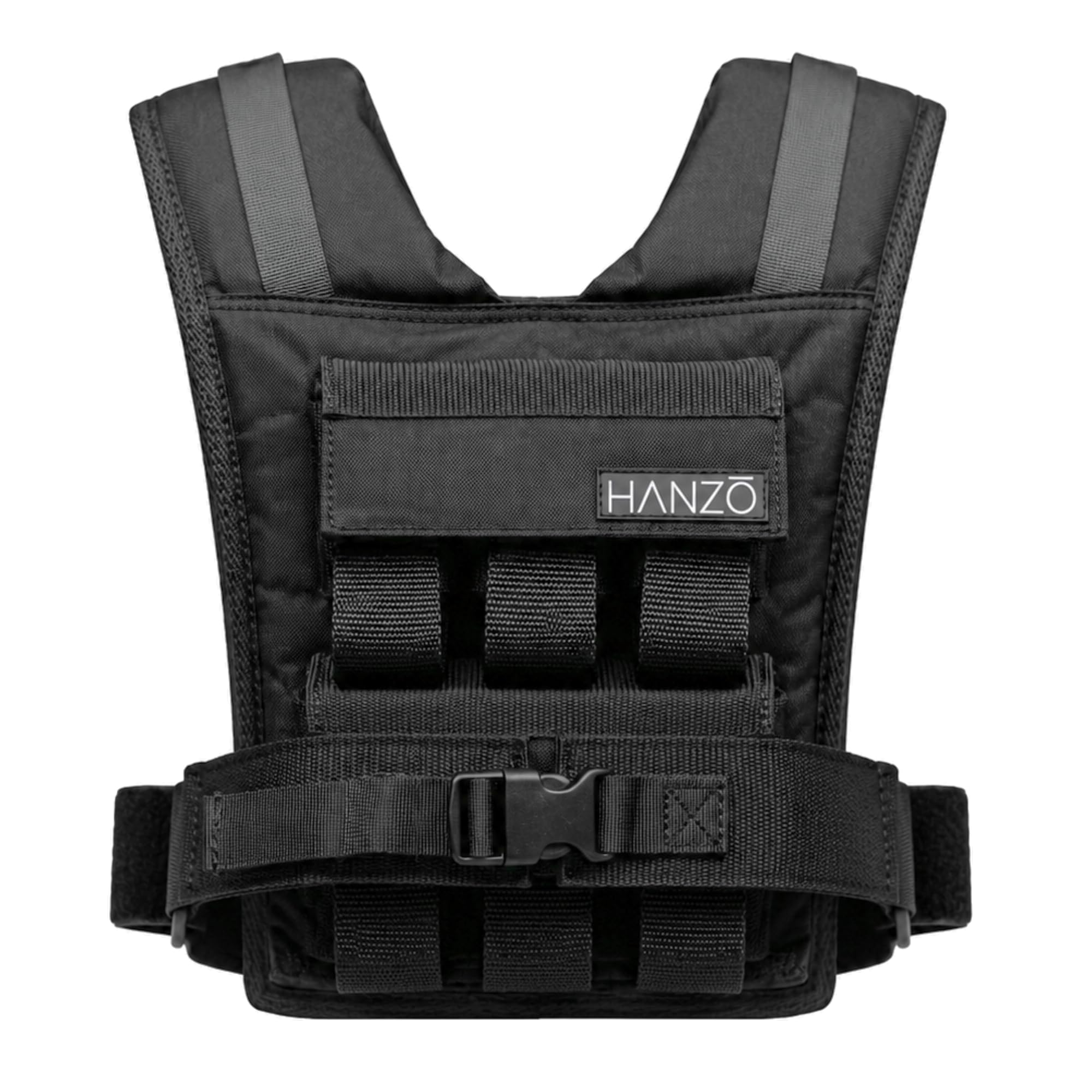
1. HANZO Weighted Vest for Men & Women 25lbs
Our pick — 4.5+★ from 450+ verified ratings; the strongest balance of quality and price.
The vest that treats 2 lb bricks as the smallest step you’ll ever need to take.
What sells the HANZO first is the loading system — you add or remove iron bricks 2 lbs at a time, which turns a single vest into a progression tool. Train light on a recovery day, stack it up when a strength block gets easy. The full set of bricks ships with the vest, so there is no separate plate purchase to plan around.
The build is 1000D Oxford nylon (a heavy weave used in tactical bags) with reinforced stitching, and the shoulders are double-padded. That padding earns the second-strongest reaction in the vest’s feedback after build quality itself — comfort lands right behind it, which for a loaded vest is the whole game. Owners doing push-ups, chin-ups and sit-ups report the vest stays put against the body instead of chafing. Hook-and-loop closure keeps the fit easy to set and re-set.
Where the HANZO pulls ahead
- 2 lb plate steps give you the finest progression in the mid-range group
- 1000D Oxford nylon with reinforced stitching handles daily abuse
- Double-padded shoulders and hook-and-loop closure set up fast
- Full brick set included — nothing extra to buy to start training
What you’re trading off
- 25 lbs is the ceiling, so heavy ruckers will outgrow it
- Hook-and-loop straps need re-tensioning over a long session
Reach for this if: you train calisthenics, dips and bodyweight work and want to climb in small, honest 2 lb steps.
Look past it if: your goal is a loaded ruck above 25 lbs.
2. LEKÄRO 44LB 5-Piece Weighted Vest Wrist Ankle Weights Set
Five pieces of training kit in one box — the vest, plus wrist and ankle weights for the rest of you.
This is the only set here that outfits more than your torso. The five-piece bundle pairs a plate-loaded vest with separate wrist and ankle weights, which makes it a starting point for a full weighted session rather than just a torso load. For a beginner putting together a home kit, that coverage is the point.
Plate handling is where LEKÄRO spent its design effort. An extra-wide pocket opening — built from a 2/3 stitching pattern — lets you slide the heavy, rust-resistant steel plates in and out without fighting a tight slot. Four sponge pads cushion the plate pressure against your hips, and the waistband wraps 35 cm around the ribcage for a fit that doesn’t bounce. The 45-degree-cut Velcro is shaped to stop the edges tearing, and a central tab lets you release the whole thing one-handed.
The plates are electroplated steel — 48 of them — so daily sweat-heavy sessions won’t corrode them. Where this vest earns its keep is workout efficiency: the even 1:1 weight distribution lets you train hard without the load dragging to one side. The catch is scale. The set is rated 44 lbs, so if you’re planning to progress toward a loaded ruck, you’ll run out of headroom sooner than you would with the higher-capacity picks above.
The honest read: the widest starting kit here, priced as the entry point of the group, and the plate-pocket design is genuinely easier to load than a tight sleeve.
Best for: a first weighted-training setup where you want the vest, wrists and ankles covered in one order.
Third thought: the fixed 44 lb load caps your long-term progression.
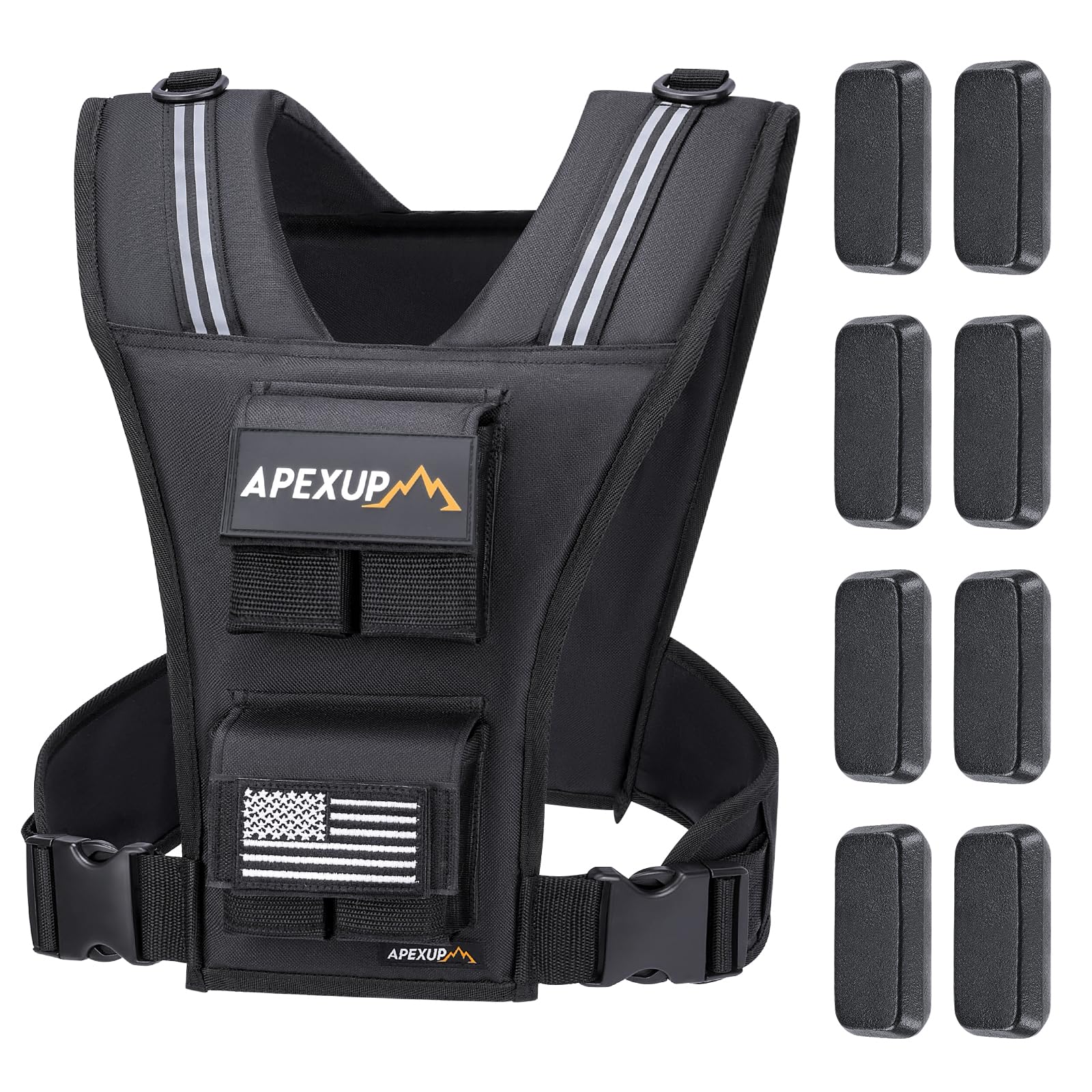
3. APEXUP Weighted Vest Men, Adjustable Weight Vest for Running
Built for the runner who wants a vest that disappears into the stride.
APEXUP comes in 20 lb, 30 lb and 40 lb versions, each loaded with removable 2.5 lb cast iron blocks. That block size gives you a working range above the plate-mounted picks — a 40 lb vest that grows with you rather than capping out — and cast iron keeps each block compact in its pocket instead of bulky like a filled bag.
Running-specific details are what lift this one above the pack. Padded shoulder straps and an adjustable waist belt lock the load tight to the torso so nothing shifts mid-stride, and the breathable build keeps air moving through long cardio sessions. Reflective strips catch headlights on early or late runs, and the detachable logo lets you strip the branding off for a cleaner look.
The trade-off worth knowing is the loading routine itself: getting the blocks in and out is a fiddlier job than sliding plates into wide pockets, and some owners find the process takes a bit more patience than they expected. Once it’s on, though, the vest stays put. If you want a rig for road work and rucking, this sits high on the list.
Why runners gravitate here: the 2.5 lb cast iron blocks hold firm in their pockets and the waist belt stops the load from drifting, which is exactly what a 5-mile weighted walk demands.
Pick this when: running, jogging and rucking are the bulk of your training and you want load up to 40 lbs.
One step back: the incremental loading dance takes practice.
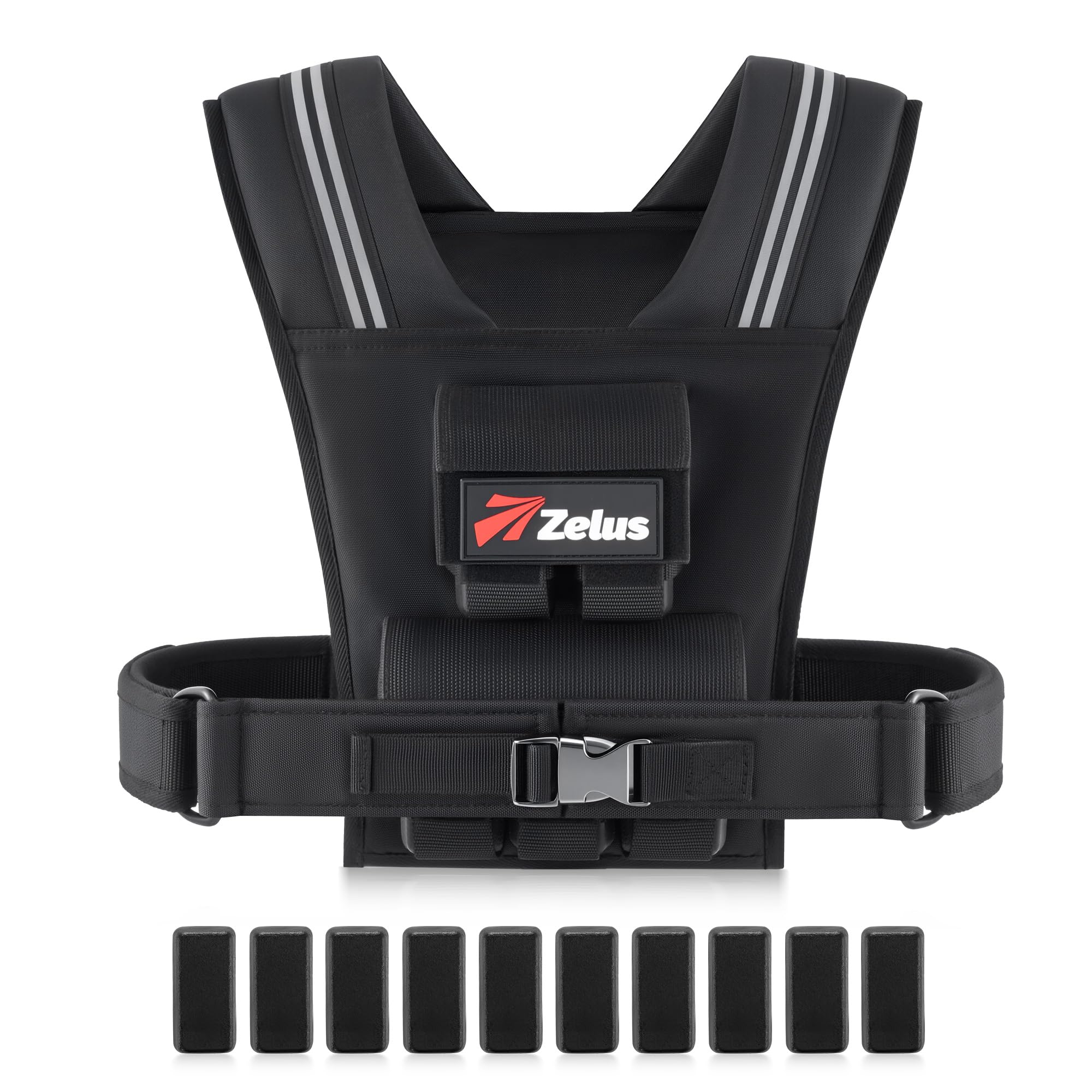
4. ZELUS Weighted Vest
Forty-five pounds of load built from small iron bricks you can dial up one at a time.
ZELUS tops this group’s capacity in its largest version, and it gets there in small steps: 10, 16 or 20 removable 2.1 lb corrosion-proof iron bricks, depending on whether you take the 23, 36 or 45 lb vest. Those bricks divide between the front and back pockets, so you can shift the balance as well as the total. Sand-filled vests can’t do that.
Comfort here comes from two places — 1.2 in. foam padding and extra-wide shoulders that spread the load rather than digging in. The fabric is 900D, built to take sweat and strain, and the whole vest hand-washes with the weights pulled out. Reflective strips add visibility for early or evening runs, and D-rings plus patch-friendly panels let you add your own gear.
Strength training is where this vest gets used hardest — owners repeatedly credit it with productive sessions that build up the lower back and core. One honest limit: a few owners note the fit isn’t always locked tight during the most explosive movements, so treat the vest as a training tool for steady, controlled work rather than max-effort sprints.
The case for the ZELUS
- 45 lb max load with 2.1 lb increments gives you fine progression at high weight
- Iron bricks split front and back so you can tune how the load sits
- 1.2 in. foam padding and wide shoulders handle the heavier versions
- 900D fabric hand-washes clean with plates removed
The honest caveat
- Fit isn’t always fully rigid during the most explosive moves
- Hand-wash only, and only with the bricks pulled out
Your match if: you’re training for strength endurance and want a vest that goes past 40 lbs with fine, incremental steps.
Worth a second look if: your sessions involve hard sprints and you need a genuinely locked-down fit.
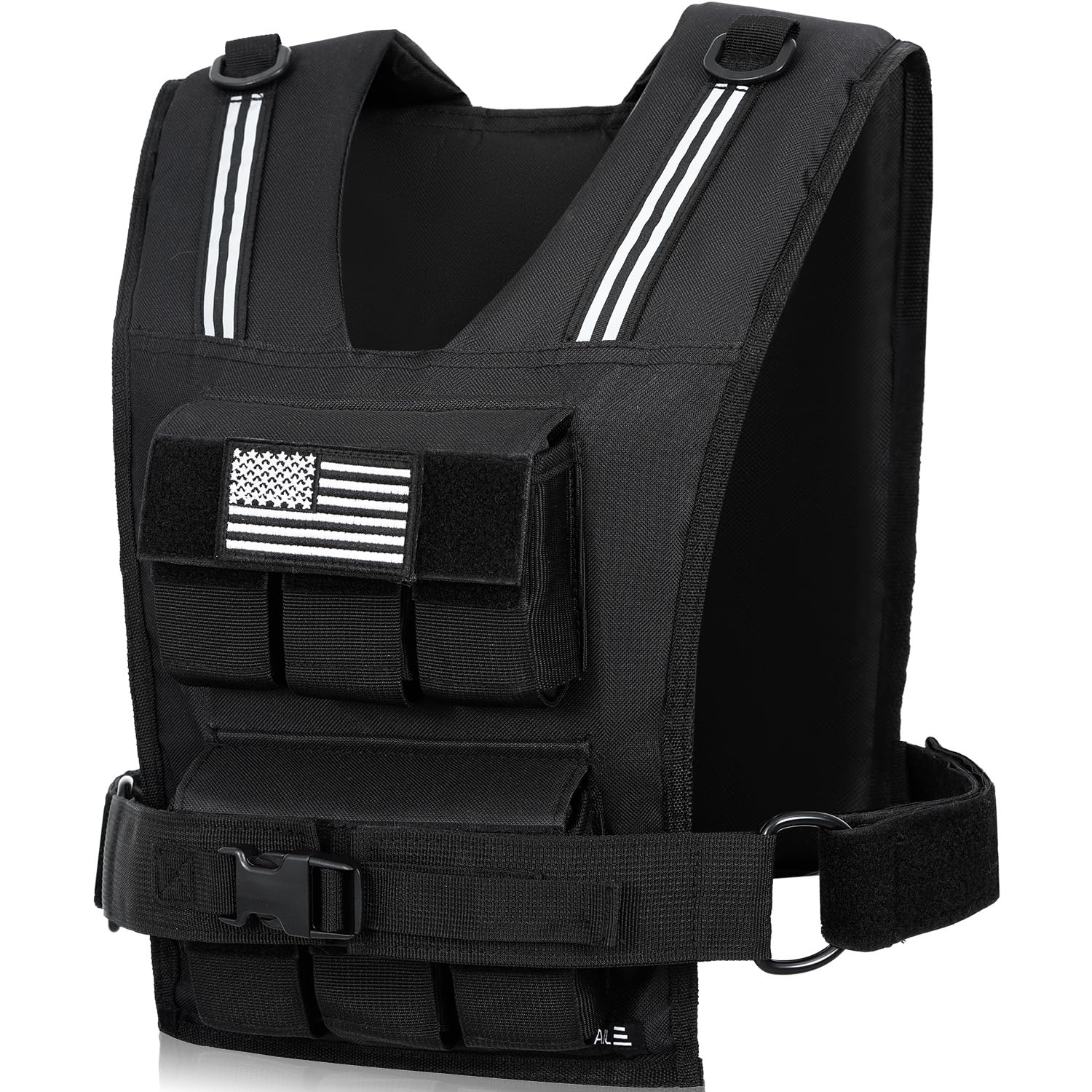
5. BAGAIL Weighted Vest
The one vest in this lineup genuinely built to fit a shared household.
BAGAIL’s real differentiator is sizing flexibility. The chest adjusts, the waist belt adjusts, and the included logo comes off — so the same vest works across body types and across both men and women in a home. Choose the 20, 30 or 40 lb version and you get rust-resistant 2.5 lb iron blocks in the load system: 8 bricks on the 20 lb, 12 on the 30 lb, 16 on the 40 lb.
The fabric is 1200D Oxford nylon with reinforced stitching — a denser weave than the 900D and 1000D vests around it — and it’s washable so sweat doesn’t settle in over time. Extra-thick shoulder pads, wide Velcro straps and safety buckles work together to keep the load firm without pinching. Reflective strips run front and back for low-light training.
The fit is the part that gets talked about most after the load itself. Owners describe a vest that reaches just past the ribcage, and the 2.5 lb bricks let you shift the weight distribution rather than just the total. The honest limit is the adjustment dance: 2.5 lb blocks are bigger than the 2 lb bricks on the Hanzo, so the steps are coarser. The 18-month warranty covers defects, though it won’t help if the fabric tears from wear.
What wins people over: the 1200D shell outlasts the lighter fabrics in this group, and the adjustable chest means a shared vest actually fits the second person who wears it.
It clicks with: households where more than one person trains, and anyone who wants a washable vest with serious fabric.
Not the sharpest fit if: you’re chasing the smallest possible plate increments.
6. EVERLIT Adjustable Weighted Vest 14 Lbs/ 20 Lbs
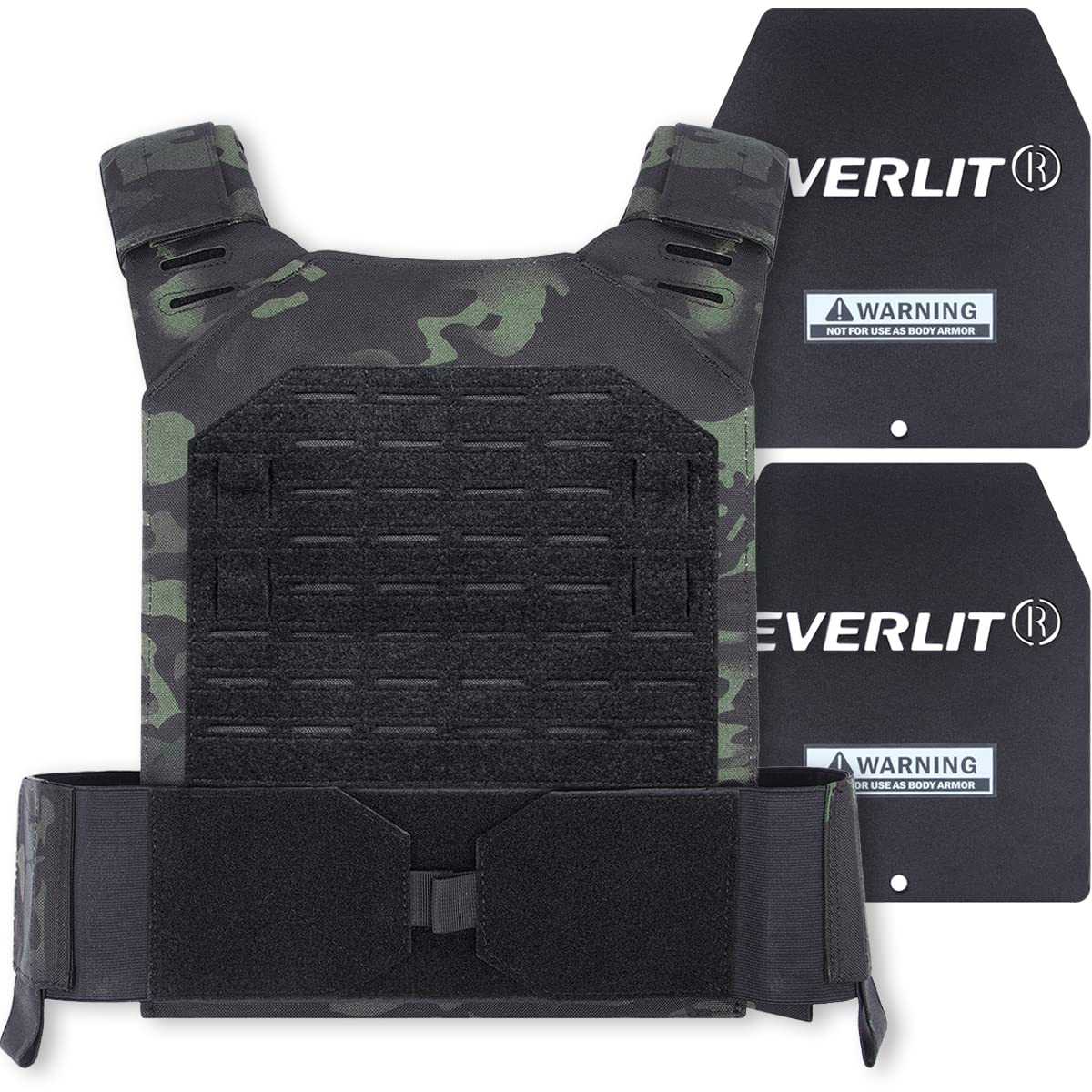
The vest that treats training gear like a loadout rig — Molle webbing and all.
If you’ve come to weighted training from a tactical background, the EVERLIT will feel familiar. Laser-cut Molle webbing on the front and back holds patches, lights, pouches and accessory pockets, and elastic side pockets take keys and a phone. The shell is reinforced high-density 1000D nylon, the build quality is the aspect owners bring up most, and the shoulder and waist adjust so it sits tight through most movements.
The load ranges across the 14 lb and 20 lb versions, and the vest accommodates plates from different brands if you already own some. Distributing that load evenly across the body is the design’s stated goal — it’s built to pull weight off the shoulders and spread it across the torso instead.
Where this one asks for care is plate security. The plate retention isn’t as tight as it should be across the board — an occasional plate works loose, and the fit can shift around in more active sessions. Two active workarounds are worth knowing before you buy: check the pocket closure every few sessions and, if you’re heavy on running, consider one of the more no-bounce picks above. For walking and bodyweight work where the vest doesn’t take a lot of impact, the tactical layout still earns its keep.
Built for: the tactical trainee who wants Molle-compatible storage and a tight 1000D shell for steady sessions.
Hold off if: you’re planning on running hard with plates in.
7. AmStaff Tactical Weighted Vest
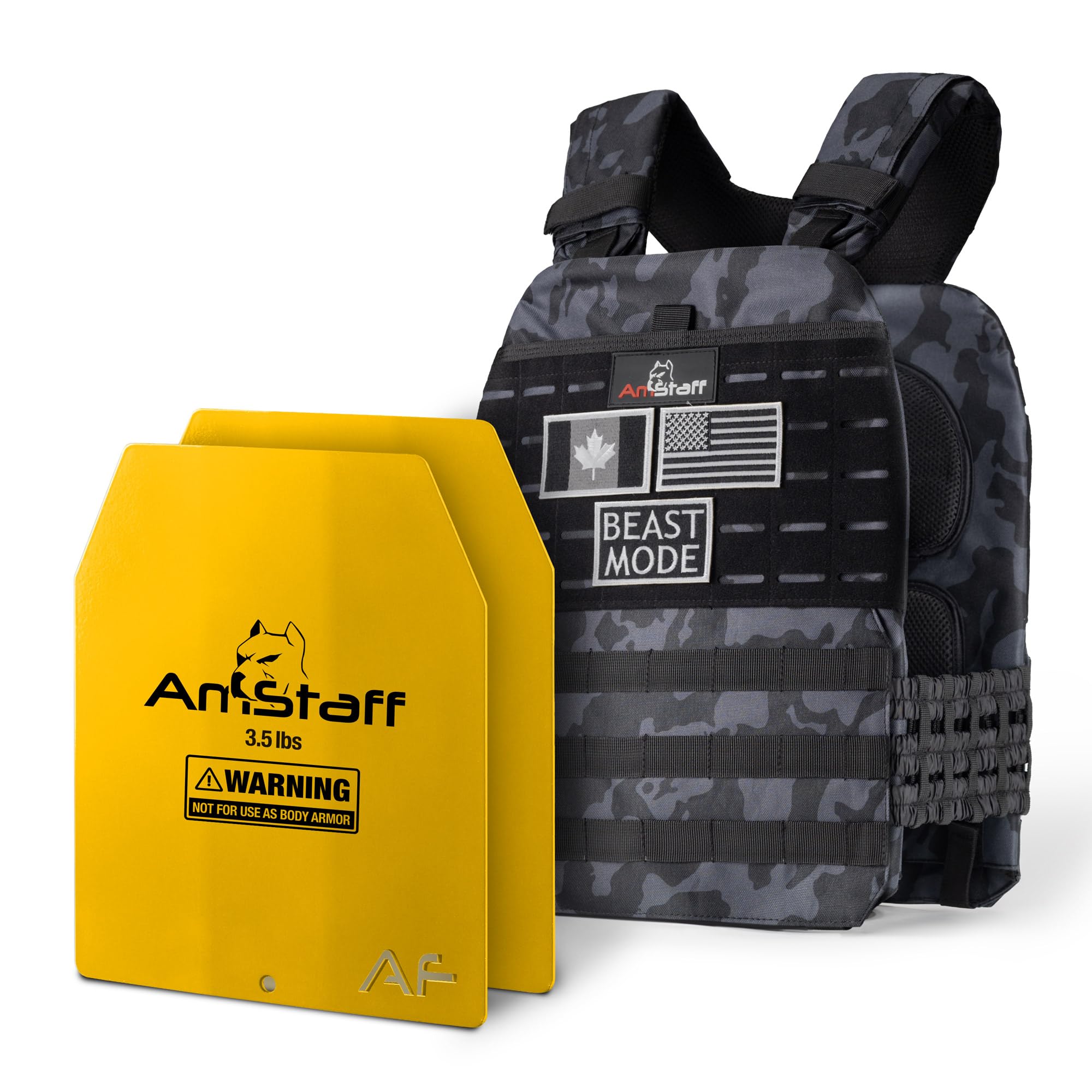
Start at a 10 lb base and keep buying plates as long as you keep getting stronger.
AmStaff sells capacity as a subscription to your own progress. The vest arrives around a 10 lb base — two 3.5 lb plates plus a 3 lb vest — and takes additional 3.5 lb, 5.5 lb, 8.5 lb and 13.5 lb plate pairs as you need them. The fabric is rated to bear a load up to 80 lb, so the ceiling sits far higher than anything else here.
The plates are curved to hug your torso, with airflow channels and breathable mesh padding between plate and body. Two sets of waist straps let you dial in a snug fit around different body shapes, and the 600D Oxford fabric is water-resistant so sweat and drizzle don’t soak in. The curved plates are what win people over — owners credit the shape with taking the sting out of a heavy load, and the 80 lb capacity keeps coming up in feedback.
The one thing to check before you commit: durability is mixed. Most owners train on it for years, but a handful report the fabric beginning to rip inside the first six months. Treat it as a vest for steady, controlled training and check the seams when it arrives. If you start small and build slowly, the cost grows with you instead of all at once.
What it does well
- Starts at a 10 lb base and grows to an 80 lb load
- Curved plates hug the torso for comfort on heavier days
- Two sets of waist straps fit a wider range of body shapes
- 600D water-resistant shell handles sweat and light rain
What to know before you buy
- Durability is mixed — some report fabric ripping within six months
- You’ll buy extra plate pairs separately as you progress
The pick for: someone who wants to build a vest load one plate purchase at a time, up to 80 lb.
Better to know now: the 10 lb base is a starting point, not a finished training weight.
8. MVRK Weighted Vest Men 35lbs
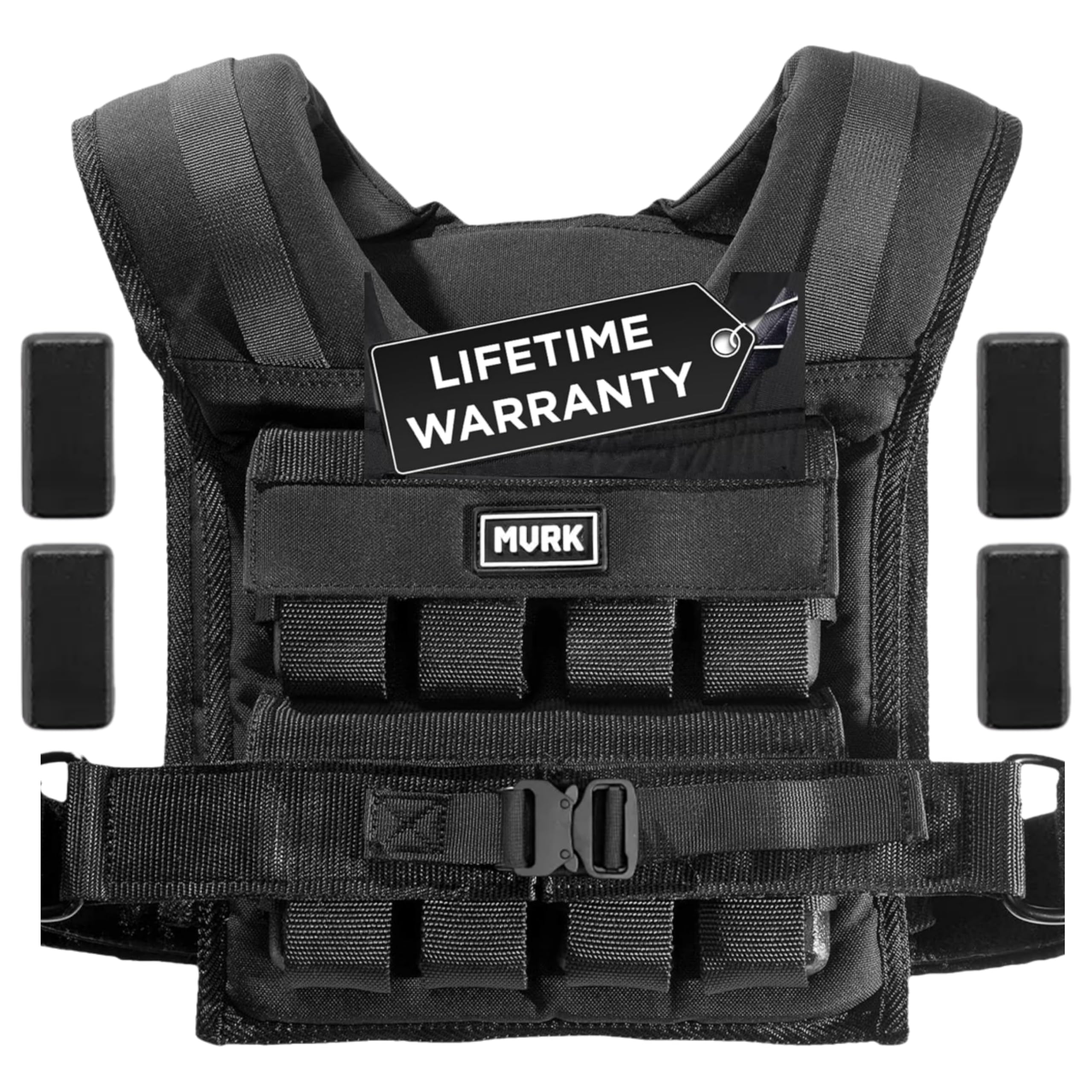
The rucking vest that starts empty and loads all the way to 35 lbs.
MVRK’s selling point is range: you can scale the vest from 0 lbs to 35 lbs using removable iron blocks, so it covers everything from a recovery walk to a max-effort ruck. The compact design packs that load tight to the body with less bulk, which keeps your range of motion open even at the heavier end.
Build quality is deliberate. Reinforced stitching at every stress point, heavy-duty buckles rated for the full load, and sweat-resistant materials address the three places a loaded vest tends to fail. Feedback reflects that — the fit is by far the most-mentioned positive, with comfort right behind it, and owners describe it as a vest that’s easy to pull over the head and take off after. Washing is straightforward: pull the weights, hand wash with soap, hang dry.
The honest trade-off is value. Some owners feel the MVRK is very much worth it when it holds up through relentless training, while others feel the price is steep next to the vest’s feature set. If you’re training for rucking and heavy strength work, it’s built to take the abuse. If you’re doing lighter work, one of the mid-range picks does the same job for less.
Built to take punishment: reinforced stitching and load-rated buckles are the exact details that give a 35 lb vest a long working life, and the fit lands as the overwhelming owner strength.
For the rucker who means it: heavy strength and loaded walks, scaled from zero to 35 lbs.
Keep looking if: you want a budget vest for light sessions and don’t need the load range.
9. Hyperwear Hyper Vest ELITE Thin Adjustable Weighted Vest

The vest you can wear under a hoodie and nobody will know it’s there.
Hyperwear took the opposite approach to everyone else: instead of thick plates in bulky pockets, it uses ultra-thin USA steel weights that hold just 10 lbs across the torso. The stretch CORDURA fabric holds them evenly with zero bounce and nothing pulling at the neck. That slim profile is why this vest can go under a jacket, on a dog walk, or through the yard — it doesn’t announce itself.
The weights are 2.25 oz apiece, so this is the finest adjustment increment of any vest in the lineup. Start at the pre-loaded 10 lbs, then add 5 lb booster packs: Small reaches 15 lbs, Medium and Large reach 20 lbs, and X-Large reaches 25 lbs. Reflective stripes, a YKK zipper and orange reflective side cords cover low-light visibility, and the whole vest machine-washes cold once the weights come out. Fabric quality and fit are what owners bring up more than anything else.
What it gives up is top-end load. If you’re chasing a heavy ruck, 25 lbs on the largest size won’t get you there and the premium price is the toughest part of the deal. For daily walks, stairs and home workouts where comfort and discretion matter more than maximum weight, nothing here does the job more quietly.
The slim-wear case: 2.25 oz steel weights in a stretch CORDURA shell let you add resistance to the walking you already do without feeling strapped into hardware.
Ideal for: daily walks, hikes and home training where you want the load hidden and the jumps tiny.
A different tool entirely if: you need to train past 25 lbs.
Know the Specs
Plate Material: Iron vs Steel
Cast iron and steel plates are the two solid options here. Both hold their shape and won’t leak or shift like sand. Cast iron is dense and compact — good when pocket space is tight. Electroplated steel resists sweat corrosion so plates last through daily sessions. Neither is automatically better; match the finish to how hard you sweat and how often you wash.
Adjustment Increment
The size of one plate decides how finely you can progress. A 2 lb brick gives you more training steps than a 2.5 lb block. If you’re climbing slowly from a beginner load, smaller increments matter. If you just need to go heavy fast, a larger block is more efficient. The Hyperwear’s 2.25 oz weights are the finest step in this group; the 2.5 lb blocks are the coarsest.
Closure System
Buckle plus hook-and-loop straps generally hold a loaded vest tighter than a zipper alone. Hook-and-loop alone is quick to set up but can loosen across a long session. A waist belt or cummerbund is what actually stops the load from bouncing. This matters most for running and rucking — for walking and calisthenics, an easier closure is usually fine.
Maximum Load
Every vest here has a ceiling. A 10 lb base grows via plate purchases; a 35 lb load is a fixed top package. The highest ceiling in this group is a shell rated for 80 lb. Pick the ceiling you expect to train at over the next year, not just the weight you can handle right now.
Common Questions
Are plate-loaded vests better than sand-filled vests?
How much weight should I start with?
Can I run in a weighted vest?
Will a plate vest damage my shoulders?
How do I clean a weighted vest with plates?
Can I add more plates to a vest that I already own?
How do I know a vest will fit my body type?
Will plates stay put during a workout?
Is a weighted vest safe for beginners?
Should I choose steel or cast iron plates?
The Bottom Line
For most people, the weight vest with plates winner is the HANZO 25 lbs vest because its 2 lb iron bricks give you the finest, most honest progression in the mid-range group and the 1000D Oxford shell is built to take daily training. If running and rucking are your focus, the APEXUP brings a waist belt and cast iron blocks up to 40 lbs. For a shared household, the BAGAIL adjusts to fit different body types in 1200D nylon. Pick one, load it light, and add plates as you get stronger.
How we choose
We do not accept paid placement. Every pick is matched to a real buyer and a real use-case; we do not hands-on test units.
Sources
Specifications: manufacturer listings and product documentation. Review insights: verified customer reviews, as of November 2026. Pricing: not shown on this page (it changes often); check the current price via the retailer link.
As an Amazon Associate, Tactical Gear Guy earns from qualifying purchases. This does not affect which products we feature.