Specs are compiled from manufacturer listings and verified buyer reviews and can change over time — please confirm the key details on the product page before buying.
Buying a training chain set is really one question: does the weight on the label match the weight on your bar, and does it survive being dropped on concrete every week? Get those two things right and the rest is details. This shortlist covers the sets that hold up.
This guide is built by comparing the manufacturers’ published specifications and the patterns across verified customer reviews, so you get each pick’s real strengths and trade-offs instead of marketing spin.
You will see what each set actually weighs, how it attaches to an Olympic bar, and where the honest trade-offs sit. The practical way to judge a weight training chain is simple: check the real drop weight and the attachment hardware before anything else.
Top Picks
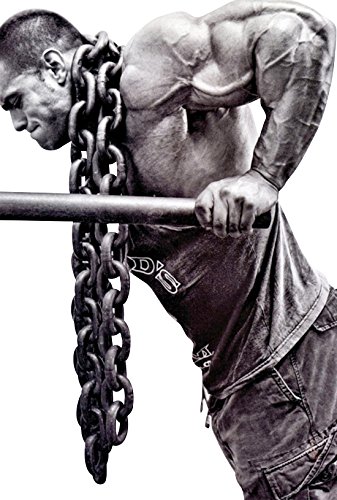

How To Choose A Weight Training Chain Set
Chains are not a generic accessory — the diameter of the link decides how the weight loads up on the bar. A thinner chain stays in contact with the floor longer, so you get more of the resistance toward the top of the lift. A thicker chain leaves the ground sooner, which changes the feel of the whole rep. Decide what you are training for first, then pick the diameter.
Match the diameter to the lift
For deadlifts and squats, a 5/8″ or 3/4″ chain gives you a longer ramp of resistance. For bench press and speed work, a 1/2″ chain is often easier to control and to drape. The set’s job is to make the bar heavier as you stand up — that only works if the chain length and the bar height are roughly aligned.
Check the hardware, not the marketing
Collars and leader chains are what actually connect the load to your bar. A set with spring links or twist-lock pins means you are not hunting for carabiners mid-session. Look for a collar that fits a standard 2-inch Olympic sleeve, and check whether the set ships with or without a connector chain.
Finish and floor contact
Chains get dragged, dropped and stacked. A rust-resistant finish holds up better in a garage where humidity swings. Some chrome coatings can flake where the links meet the floor — worth knowing before you commit a set to a concrete slab.
Side-by-Side Comparison
| Model | Best For | Chain Diameter | Set Weight | Chain Length | Amazon |
|---|---|---|---|---|---|
| Weight Lifting Steel Chains 28 to 60lbs★ Best Overall | All-round home gym use | 1/2″ | 28 lb | 60 inches | Amazon |
| Logest Weight Lifting Chains with CollarsBuilt For Quick Swaps | Quick on/off bar changes | — | 25 lb pair | 46″L | Amazon |
| Titan Fitness 6 FT 5/8″ Chains | Powerlifting and speed work | 5/8″ | 44 lb pair | 6 feet | Amazon |
| Valor Fitness Barbell Chains 53 lb Pair | Heavier lockout training | — | 53 lb pair | 5.5 feet | Amazon |
| Titan Fitness 6 FT 3/4″ Chains | Experienced lifters wanting max diameter | 3/4″ | 54 lb pair | 72″L | Amazon |
Detailed Reviews
1. Weight Lifting Steel Chains 28 to 60lbs
Our pick — 4.5+★ from 400+ verified ratings; the strongest balance of quality and price.
The 1/2″ all-rounder that lets you add load to any bar lift without overthinking the setup.
For most garage gyms, half-inch chain hits the balance, and this set delivers exactly that. You get a 28 lb pair of 1/2″ chain, a 60-inch item length, and forged steel stock finished to resist rust. The best part is what’s in the bag: two 5-foot 1/2″ chain sections, two 4-foot 3/16″ leader chains, and two spring links. That means you can hang the load from an Olympic sleeve without hunting for extra hardware.
What wins people over here is the build. Reviewers mention build quality 51 times, more than any other set here, and the value-for-money notes back that up — a set that feels like a one-time buy for a home gym. It handles deadlifts, bench presses and squats equally well: the 1/2″ links drape across a bar without fighting you, and the 5-foot sections leave the floor gradually.
The honest catch is weight. A few buyers find the 28 lb pair lighter than expected once the chain is loaded onto a heavier bar, and you will top out sooner than a 3/4″ set. If you are chasing big numbers on a squat, you will want to step up. For everything short of a max squat, it is a balanced, reliable set.
Why It Earns Top Spot
- Complete kit: 5-foot chain sections, 4-foot leader chains, and spring links included
- 1/2″ forged steel with a rust-resistant finish
- Rated 4.5+ stars across 400+ ratings — the highest-rated, most-reviewed set here
- Works for deadlifts, bench presses, and squats with the same pair
Where It Tops Out
- 28 lb pair is lighter than some buyers expect for heavy squats
- Thinner than a 5/8″ or 3/4″ set, so less top-end load
Reach for this if: you want one set that handles every barbell lift and comes with the leader chains and links already in the bag.
Look elsewhere if: your training has moved past 28 lbs of added chain and you need more load in a single pair.
2. Logest Weight Lifting Chains with Collars – 1 Pair
The set that turns chain changes into a ten-second job with a single L-screw collar.
Most chain sets make you thread a carabiner through a link and hope the bar sleeve is at the right height. This one ships with steel black bar collars, each with an L screw to secure the lock. The collar grips a 2-inch Olympic barbell with a knurled surface, so you clamp the chain on and off without the fiddle. At 25 lb per pair and 46″L, it is the shorter set of the two Titan-style pairs here, which makes it easier to control on bench press.
Versatility is the second thing buyers keep coming back to. The chains target back, legs, core, arms, hips and shoulders depending on whether you attach to a bar or drape them over your shoulders, and the range covers deadlifts, squats, bench presses, curls, lunges, pull-ups and dips. The set is sold in four capacities — 15, 25, 35 and 45 pounds — so you can size the load to your current level and not buy beyond it.
The trade-off is weight truthfulness. Some buyers report the delivered chain does not quite match the advertised number, and a handful arrive with a missing part. The collars themselves work, but check the contents on arrival before you commit a session to them. The rest of the feedback backs up the alloy steel build and the value for money.
The Collar Advantage: an L-screw collar on a 2-inch Olympic sleeve is the practical difference between this set and a set of bare chains — you are buying convenience as much as steel.
Best Fit: a lifter who swaps chain weight between sets and wants four capacity options rather than one fixed pair.
Pick this one when: quick on/off collar changes matter more to you than a heavier single load.
Think twice if: you need the delivered weight to exactly match the advertised capacity — verify on arrival.
3. Titan Fitness 6 FT 5/8″ Weightlifting Chains
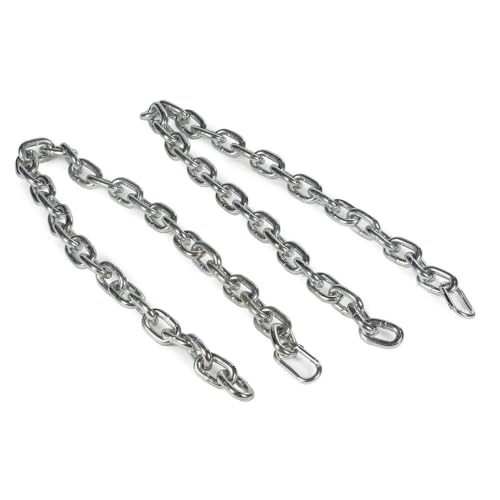
Six feet of 5/8″ chain per side — the powerlifter’s diameter at a sensible pair weight.
This is the set that splits the difference between the thin 1/2″ chains and the heavy 3/4″ pair. Each chain runs 6 feet long at a 0.625-inch diameter and weighs approximately 20 lb, so the pair lands at 44 pounds. That diameter leaves the floor at a different point in the rep than the 1/2″ set above, giving you more of the resistance toward lockout. Two carabiners come in the box for attaching to connector chains, and Titan notes a connector chain is recommended for a low-hanging barbell setup — worth flagging before your first session.
Owners keep two themes going. First, quality: 16 review mentions land there, the most for this set. The length is the third thing that comes up — a 6-foot chain gives you room to drape across a bar or run through a belt without running short.
Where it falls short of the 3/4″ pair is raw load. If you want a truly heavy top-end pull on a squat, 44 pounds across the pair leaves less headroom. For powerlifting, dips, pull-ups and bench presses it is effective, and the alloy steel stock should shrug off regular use. The carabiner need for a connector is a small extra-step cost, not a dealbreaker.
The Diameter Story: 5/8″ is the practical middle — heavier than a 1/2″ chain for lockout, lighter than a 3/4″ pair for setup and storage.
The match: a powerlifter who wants a long, mid-diameter chain pair for squats, bench and dips.
The hurdle: you will need a connector chain for a low-hanging bar, which is not included.
4. Valor Fitness Barbell Chains 53 lb Pair

A 53 lb pair for the lifter who already has the base strength and wants chain as the main event.
Least resistance at the bottom, most at the top — that is the entire pitch of variable resistance, and this pair is built to lean into it. The 53 lb pair is the heaviest load in this shortlist, and it comes with twist-lock connections and removable steel pins so the chains secure to the bar without extra clips. The 5.5-foot chains are designed for Olympic barbells with 2″ sleeves, so they belong on a powerlifting bar rather than a standard home-gym bar.
Quality carries the reputation here, and value sits right behind it. Owners say it does its job breaking through plateaus, and the solid steel build is meant to take repeated floor contact. For lockout training and speed work, the 53 lb pair gives you a load you can feel from the first inch off the floor.
One recurring issue worth knowing: the chrome coating can shed metal flakes onto the ground during use. It does not affect the training, but it is a mess on a concrete slab and a little extra cleanup. If you train on a finished floor or hate sweeping up after a session, that is the trade-off to weigh against the 53 lb capacity.
What It Delivers
- 53 lb pair — the heaviest single set in this comparison
- Twist-lock connections with removable steel pins for fast setup
- Solid steel construction for lockout and speed work
- 5.5-foot chains sized for 2″ Olympic sleeves
What To Keep In Mind
- Chrome coating can leave metal flakes on the floor during use
- Heavy enough that a beginner may not need this much load
For the lifter who: wants the most added chain weight in a single pair and trains lockout and speed work hard.
Skip the upgrade if: a 28–44 lb pair already covers your training — this one is the next step, not a starting point.
5. Titan Fitness 6 FT 3/4″ Weightlifting Chains
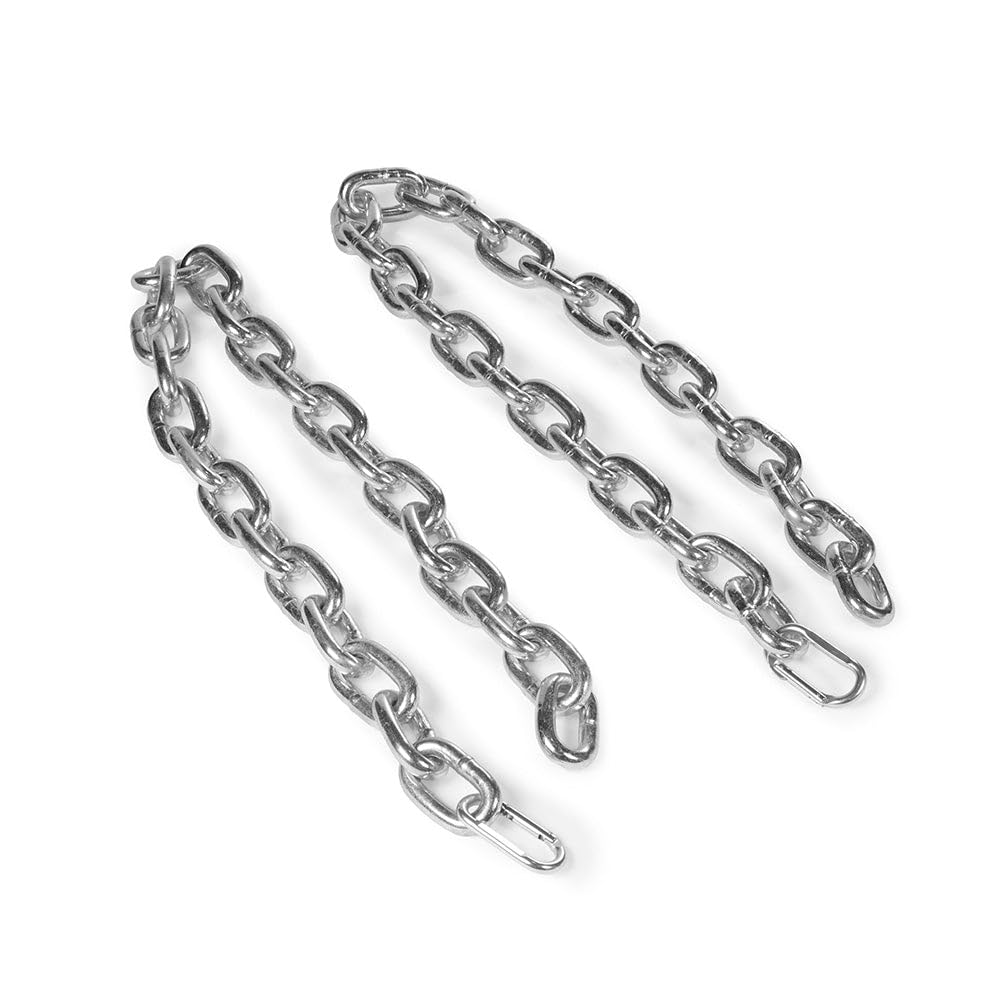
The thickest link and the longest chain in the lineup — 54 pounds that leaves the floor fast.
At 54 pounds the pair here weighs 2.2 times as much as the 25 lb Logest pair. The chains also run longer — 72″L against the Logest’s 46″L. In practice, that longer, thicker chain ramps resistance harder toward the top of the lift and gives you more chain to work with across a bar. Two 6-foot, 3/4-inch chains come with carabiners for attaching to connector chains, and the stainless steel stock is finished in silver.
Progressive resistance is the headline: the load is lighter at the bottom and heavier at the top, which is exactly what this diameter is for. If you are working toward a new one-rep max and want the bar to fight back through the later stages of the lift, this is the set built for that. The carabiners make attaching to a connector chain quick.
This one wants an experienced lifter. The thicker 3/4″ link is unforgiving on technique, and 54 pounds is a lot of added chain if your base lifts are still developing. It is also the least-reviewed set here, so the owner pool is smaller. If squat and deadlift chain is already a core tool in your training, the 3/4″ diameter and 72″ length are the draw.
Why The 3/4″ Link: thicker links leave the floor earlier in the rep, so the resistance stacks up toward lockout where the diameter matters most.
Honest Read: the bigger chain is the right call only if the base lift is already strong — heavier is not automatically better.
Built for: the lifter chasing a max single who wants a thick, long chain pair as the main resistance tool.
Not for you if: you are new to chain training — start with a lighter, thinner pair and build up.
Know the Specs
Chain Diameter
The diameter is the thickness of each link — 1/2″, 5/8″ or 3/4″. A thinner chain stays on the floor longer, so the resistance comes in more gradually. A thicker chain leaves the floor earlier, pushing more of the load toward lockout. Pick the diameter that matches the lift you are programming, not just the weight on the bag.
Set Weight
Most sets are sold as a pair, and the number on the listing is the combined weight of both chains. A 44 lb pair means 22 lbs per chain, roughly. That total is what gets added to the bar at the top of the rep, so it is the figure that tells you whether the set is a starter load or a main tool.
Collars And Leader Chains
Collars are the bits that clamp the chain to the bar, and leader chains are the short sections that hang from the bar down to the main chain. A set that includes both means less hunting for hardware and a more secure setup. Check whether the collar fits a 2-inch Olympic sleeve — that is the standard most barbells use.
Progressive Resistance
This is the reason chains exist. The chain is lighter at the bottom of the lift, when most of it rests on the floor, and heavier at the top, when all of it hangs free. That means your bar gets harder to move as you stand up, which trains acceleration and lockout strength in a way plates alone do not.
Common Questions
What diameter chain is best for deadlifts?
Do training chains come as a pair or a single chain?
Will chain collars fit my Olympic barbell?
Do I need a connector chain with my chain set?
How much chain weight should a beginner add to the bar?
Do training chains rust if I keep them in a garage gym?
Can I use training chains for squats and bench press as well as deadlifts?
Do chains damage a concrete floor?
Is a heavier chain pair always better?
The Bottom Line
The set that earns its place for most home-gym lifters is the Weight Lifting Steel Chains 28 to 60lbs. It ships complete with leader chains and spring links, runs 1/2″ forged steel with a rust-resistant finish, and covers deadlifts, squats and bench press with the same pair. If you want quick collar swaps and four weight options, the Logest pair is the pick. And if you are chasing a heavier lockout load, the Valor Fitness 53 lb pair is the honest step up — just expect a little chrome flake on the floor.
How we choose
We do not accept paid placement. Every pick is matched to a real buyer and a real use-case; we do not hands-on test units.
Sources
Specifications: manufacturer listings and product documentation. Review insights: verified customer reviews, as of November 2026. Pricing: not shown on this page (it changes often); check the current price via the retailer link.
As an Amazon Associate, Tactical Gear Guy earns from qualifying purchases. This does not affect which products we feature.